


Lychee Wine: Choosing Fermentation for Acid and Floral Aroma
Oct 09, 2026
Leave a message

Consider an illustrative GreenLand discussion: a fruit-wine developer asks us whether two lychee trials with comparable completion will retain the same floral character. We would answer that completion alone cannot establish that. We would first clarify the wine the developer wants to sell and the actual frozen lychee input it plans to use. The fermentation decision then belongs to its own trials with that material and system. GreenLand supplies the frozen fruit ingredient; the vessels, tasting glasses and bottles shown here are application illustrations, not evidence that we manufacture wine or have validated the customer's process.
State the intended wine profile
A fermentation comparison becomes easier to interpret when the desired wine is described before the results arrive. "More lychee aroma" can mean recognizable fruit character, a floral note, an attractive overall bouquet or simply a higher reading for one volatile compound. These are not interchangeable objectives. The developer should describe what it expects the drinker to experience and identify any acid or texture characteristics that would make an otherwise aromatic sample unsuitable for the product.
For the illustrative buyer, we would ask whether floral character is the central feature or one part of a broader wine style. A light aromatic product may place a different emphasis on acidity than a fuller fruit-wine style. Sweetness, alcohol perception and serving conditions can also affect the sensory brief. The purpose is not to define a preferred commercial wine for the buyer. It is to ensure that a fermentation choice is evaluated against a stated product rather than against the largest analytical number.
The team should identify the stage at which that profile needs to be present. A fermentation sample, a clarified trial and a packaged wine may answer different questions. A floral note observed early does not automatically establish the character of the product at sale. If the buyer is choosing a regime for a bottled wine, the comparison needs an appropriate finished-product stage. Earlier samples remain useful for understanding changes, but they should not substitute for the stage the customer intends to approve.

Actual peeled lychee product appearance from the corresponding product page.
Material identity belongs in that brief as well. Peeled or pitted frozen lychee provides a different practical starting point from whole fruit requiring shell and seed removal. The actual input form affects preparation and usable yield, while the customer's route determines how that input becomes fermentation juice or must. We would clarify the frozen ingredient requirement and available identifying information. A published juice experiment is not proof that every form of supplied frozen lychee will respond identically.
The photographs of actual GreenLand lychee show the ingredient's appearance and form. They cannot prove a floral profile in wine. A clean-looking aril, an attractive seed cavity or a uniform pack is useful sourcing information, but the eventual aroma depends on the customer's complete system. We would keep appearance evidence and application evidence separate. This avoids promising finished-wine characteristics from a product image or from the aroma of a fruit sample before fermentation.
The buyer should also state what would count as a meaningful improvement. A small analytical increase may be interesting without being detectable or desirable in the intended wine. A prominent new note may improve one style and distract from another. The customer's sensory and quality teams should decide how to assess that distinction. Setting the brief first helps prevent the selection criterion from shifting toward whichever result looks most favorable after the trials have been completed.
We would therefore frame the sample conversation around a defined frozen lychee form, a customer preparation route and a finished-wine target. That does not require the customer to disclose a proprietary recipe to begin discussing supply. It does require enough application context to avoid a misleading ingredient recommendation. A request for "lychee for wine" can open the conversation; a useful qualification brief explains which material and finished-product characteristics the development team actually needs to compare.
Similar completion did not mean the same chemistry
In Chen and Liu's lychee-wine comparison, alcoholic fermentation was compared with simultaneous alcoholic and malolactic fermentation using defined cultures. The reported sugar and ethanol differences were not statistically significant, while the acid and selected volatile profiles differed. In the combined regime, malic and citric acids decreased and lactic acid, pH and ethyl lactate increased. Some aroma-relevant compounds also differed. The study therefore supports a limited but useful conclusion: comparable completion outcomes did not imply matching product chemistry.
Statistical non-significance should not be translated into exact equality. It means the experiment did not establish a significant difference for the reported comparison under its analytical and statistical approach. It does not mean the two measured wines were identical, nor does it establish that every future fermentation will consume sugar or produce ethanol at the same level. That distinction matters when a development report uses "same completion" as shorthand for a much broader equivalence claim.
The process comparison must also retain its identity. The work used a particular yeast and a particular malolactic culture in a defined lychee system. It was not a survey of every available strain or a general instruction that simultaneous fermentation always preserves more floral aroma. Culture identity, fruit preparation and the rest of the customer's process are part of the question. If those change, the published result remains a reason for a trial rather than a prediction that has already been verified.

Matching conceptual fermentation vessels illustrate a paired customer trial without an operating recipe.
For the illustrative buyer, completion can still serve a useful screening function. A route that does not meet the customer's fermentation requirements may be unsuitable regardless of its attractive aroma. But after the candidates meet that requirement, selection should move to the remaining product criteria. Treating completion as the entire decision discards precisely the differences the buyer is asking about: acid balance, floral character and suitability of the resulting wine.
A useful comparison preserves separate records for separate endpoints. The developer can state that both trials reached its accepted fermentation endpoint while showing that their acid profiles or sensory assessments differed. That is clearer than merging the results into an overall "better fermentation" score. A combined score can be useful if the team has a justified method, but the underlying observations should remain visible so procurement and development can understand what drove the choice.
It is also important to distinguish a selected regime from a manufacturing recipe. The original paper's culture choices and experimental conditions are not an industrial operating procedure supplied by GreenLand. This article does not propose dosages, inoculation timing, temperatures or stabilization parameters. The developer's technical team must evaluate a feasible process under its own production and quality requirements. Research provides a comparison to examine; it does not remove the need for process competence and validation.
The paired-vessel image is a conceptual illustration of a controlled comparison. Matching glass geometry and fill make the comparison legible, but the image contains no measured outcome and cannot identify which fermentation regime produced which chemical response. We would not use generated imagery as laboratory evidence. The actual customer's records should carry the sample identities and observations. Keeping that distinction clear allows the image to explain the idea without pretending to document a completed experiment.
The resulting decision is more specific than "add malolactic fermentation because it finishes well." The developer needs to know whether a feasible regime meets its completion requirements and produces a wine consistent with the intended profile. If the two regimes differ mainly in characteristics the buyer does not want, similar completion is not a reason to choose the more complex route. If the differences serve the brief, the route deserves evaluation with the actual material and finished-product requirements.
Read acid and aroma changes together
Acid composition and aroma composition should be read beside each other rather than treated as competing explanations. A trial can change both, and the customer drinks the complete wine. A floral note that appears attractive in one acid balance may be less attractive in another. Conversely, a pleasant balance does not establish preservation of a particular fruit note. The team should assess the dimensions separately and then consider how they combine in the intended product.
The qualitative diagram summarizes the direction reported in the anchor study without numerical bars or a reconstructed data set. It separates changes in acid-related measurements from selected aroma-related measurements. The table makes the same scope explicit: the comparison belongs to that study, not to all lychee wine. A directional arrow is not a target value, an operating limit or a sensory recommendation. It tells the reader which reported measurements changed and which further questions remain.
| Reported comparison | Study observation | Transfer limit |
|---|---|---|
| Sugar and ethanol | Differences not statistically significant | Not exact equality or identical finished wine |
| Acid-related profile | Malic / citric acids decreased; lactic acid and pH increased | No universal acidity target |
| Selected aroma compounds | Different compound-level response | No automatic consumer preference or GreenLand wine capability |
The paper discussed increases in selected aroma-relevant compounds, including linalool, geraniol and cis-rose oxide, with their concentrations considered in relation to odor thresholds. That evidence is more specific than a claim that the wine contained "more volatiles." It still does not establish consumer preference or guarantee the same perceived floral character in another formulation. Concentration and sensory contribution need to be interpreted in the actual product context, not ranked by a compound count.

Study-limited arrows show reported acid-related and selected aroma-compound directions, without magnitudes.
A developer should therefore avoid selecting a regime because it has the longest list of detected compounds. A method can detect components that contribute little to the intended aroma, and the combination of components matters to the complete profile. The customer's analytical team should identify measurements relevant to the brief and interpret them with appropriate sensory work. An attractive chromatogram is useful evidence, but it is not the product that will be sold.
Fruit recognition deserves its own wording in the assessment. A panel might find a wine more floral while finding it less recognizably lychee, or might prefer a balanced combination without describing the floral note as stronger. Those are possible customer outcomes to investigate, not findings attributed to the anchor experiment. Recording the question asked of the assessors helps distinguish them. A broad aroma-intensity score should not be rewritten as proof of retained lychee identity when that identity was never assessed.
Likewise, a pH result should not be used as a complete description of acid taste or a finished-product release decision. It is a defined measurement that belongs beside other acid information and the customer's appropriate quality controls. If the buyer's commercial concern is a harsh or flat drinking impression, its sensory assessment should address that concern directly. The article does not prescribe an acid adjustment or imply that the study's pH change is desirable for every style.

Coded wine samples illustrate sensory assessment separately from analytical completion.
The blind-assessment image shows the reason for controlling serving conditions. Glass shape, fill, sample presentation and serving stage should be appropriate and consistent within the customer's comparison. A developer who knows which route is expected to be more floral can unintentionally interpret the samples through that expectation. The team should use a sensory method suitable for its question and decision importance. A casual tasting can guide exploration without being misrepresented as conclusive preference evidence.
Disagreement between analytical and sensory observations is informative. If a selected volatile rises but the desired note is not apparent, the team should not simply discard the tasting. It should investigate the sample context, analytical interpretation and the complete sensory profile. If the wine smells attractive but has an unsuitable acid balance, the aroma result remains real while the route may still fail the brief. This separation makes the next development action more precise.
For the illustrative GreenLand buyer, we would ask for the conclusion at the product level: which tested regime produces the acceptable combination of completion, acidity and floral character in the intended wine? We would not ask it to select the treatment with the most favorable isolated measurement. That approach lets the customer preserve promising aroma evidence while acknowledging tradeoffs. It also prevents a research result about selected compounds from becoming a blanket statement about flavor superiority.
Evaluate the actual fruit and fermentation system
The actual frozen input needs to enter the trial before the developer makes a supply-linked approval. A juice prepared from fresh fruit or a different cultivar can be useful for exploratory work, but it is not the same as a trial with the planned frozen material. The customer should identify the lot, form and preparation route it evaluates. If the initial development material differs, the transition to the purchasing candidate should be explicit and assessed.
For GreenLand, the ingredient discussion starts with the frozen lychee product range. The buyer may need peeled, pitted fruit for its preparation route and a packing format suited to its consumption pattern. Those requests concern supply of the fruit input. They do not establish a wine-making capability or a final aroma guarantee. We can discuss the available product information and samples while the customer determines how to qualify the ingredient in its own fermentation system.
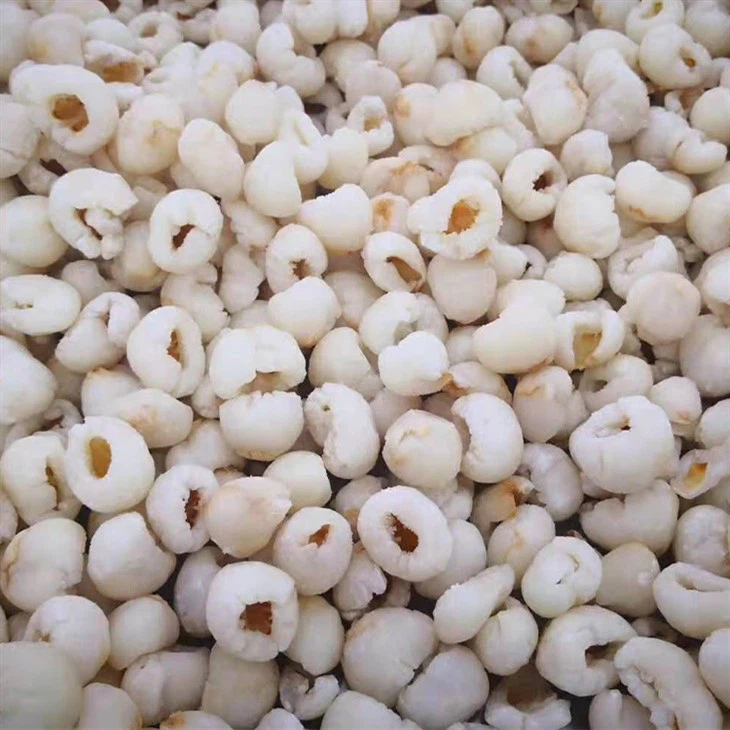
A distinct actual peeled lychee product view supports ingredient identity and preparation discussion.
Preparation should keep the fruit-to-juice transition interpretable. Shell and seed removal, thawing approach, released liquid and the use of pulp can change what material reaches fermentation. The developer should record those choices and apply the comparison it intends. If one trial discards liquid while another retains it, a difference may begin before culture selection. The purpose is not to mandate a preparation route but to avoid crediting fermentation for an uncontrolled difference in starting material.
Fermentation culture identity should be documented rather than reduced to "yeast" or "MLF." A separate lychee-wine study comparing four commercial yeast strains reported differences in chemical and volatile composition. It supplies another reason to retain the identity of the system tested. It does not validate the simultaneous regime in the anchor paper or establish which strain the illustrative buyer should use. Different comparisons answer different questions.
The stage flow shows where the customer can retain sample identity: frozen ingredient, prepared fermentation input, fermentation sample and finished packaged trial. It is a sampling map, not a production instruction. The customer should choose the checkpoints needed to investigate its product question. If an aroma difference appears only after fermentation, the earlier sample helps locate when the difference emerged. It does not, on its own, prove the biochemical mechanism that caused it.
The team should avoid combining results from incompatible trial bases. One wine report may assess a dry sample while another assesses a later sweetened formulation, or the serving conditions may differ. Those records can each be useful, but their difference is broader than fermentation regime. The developer should identify the product state and reporting basis with each observation before interpreting them as a paired comparison. A request for the two reports helps us understand the sourcing question without pretending that their numbers can be compared uncritically.

A traceable customer route connects frozen input, prepared must, fermentation and finished wine checkpoints.
Downstream handling matters because the selected wine must remain suitable for sale. A favorable aroma observation immediately after fermentation does not settle microbial stability, clarity or the customer's other release requirements. The Australian Wine Research Institute's resource on microbiological hazes and deposits explains why wine microorganisms and downstream stability require attention. Its grape-wine treatment guidance should not be transplanted into a lychee recipe. The customer needs controls appropriate to its actual product.
The developer should also distinguish a nonfermented lychee application from this wine comparison. Our article on lychee syrup extraction and drink dilution discusses another preparation route. A syrup result does not predict fermentation aroma, and the acid or volatile response in wine does not approve a soft drink. The shared ingredient identity can support sourcing discussion while the application evidence remains specific to the product being developed.
For the illustrative buyer, a feasible qualification plan therefore connects its real frozen lychee material to a defined preparation and fermentation system, then follows the product to the stage at which the brief must be met. The supplier and developer have complementary responsibilities. We clarify the ingredient requirement and the information available for supply; the customer's technical team demonstrates its wine outcome. The approval becomes stronger when neither side uses an adjacent product or published system as a substitute for that connection.
Choose the supported regime for the brief
The final regime choice should be explained by the product requirements it meets. If both trials satisfy the customer's completion criteria but only one achieves the intended acid and floral balance, that is a reasoned selection within the tested scope. If neither meets the brief, similar completion does not rescue either route. If the differences are too uncertain to interpret, the appropriate conclusion is a need for further evidence rather than an unsupported preference.
The customer should record the input and process identity alongside the decision. A conclusion about a particular lychee material, culture combination and finished-product stage should not become an unrestricted statement about all fruit wine. A future change in fruit form, lot characteristics, culture or preparation may require the team to reconsider applicability. Clear records make that discussion practical because they show what changed relative to the evidence on which the original choice rested.
It is useful to distinguish application approval from routine release. Development establishes a supported route under the assessed conditions; the customer's quality system determines how ongoing production remains within its requirements. This article does not supply those release limits. A laboratory success is valuable, but it should not be described as proof that every production batch or every storage stage has already been qualified. The team should decide what further work is required for its commercial product.

Generic trial bottles and wine samples illustrate finished-package qualification.
The approval should also preserve any relevant tradeoff. A route might strengthen a floral impression while creating an acid balance the team needs to evaluate further. Another might fit the wine style while providing no improvement in the specific compound of interest. These outcomes are more informative than a single winner label. The developer can decide which combination serves its brief and whether any additional formulation or process work is feasible within its commercial constraints.
A supply inquiry can then focus on the ingredient needed for that route. We would ask for frozen lychee form, any required identifying information, pack size, estimated volume, destination and sampling needs. If a particular raw-material characteristic is important to the customer's validated process, it should be raised explicitly. The buyer should not assume that a research cultivar or a wine-related analytical specification is included in an ordinary frozen-fruit quotation unless it has been discussed and confirmed.
The packaged-bottle illustration marks the stage that matters to a bottled-wine brief. It does not demonstrate stability, preference or an established GreenLand wine product. Those claims require the customer's own evidence. Using the image at the end of the article makes the practical point visible: the regime is selected for the finished product, not merely for the appearance of a fermenter or a convenient completion measurement.
For the illustrative developer, the answer to its original question remains clear. Comparable completion provides one piece of information, while acidity and floral character require their own assessment. The anchor experiment makes that distinction credible, but the buyer's actual material and process determine the application decision. A supported selection names the route and the conditions under which it met the brief, rather than declaring simultaneous fermentation universally better for lychee.
We would help the buyer clarify the frozen ingredient needed for that selection and keep the claim within its evidence. The developer then has a useful basis for procurement: a defined fruit input connected to a tested wine outcome. That is more actionable than asking for the "most aromatic lychee" without an application trial, and it avoids confusing a fruit supplier's product information with a finished-wine performance guarantee.
Source Frozen Lychee with GreenLand-food
GreenLand-food is a professional frozen lychee supplier and manufacturer in China, providing factory-direct wholesale supply for ingredient buyers and food manufacturers.
Send the product form, specification, packing, quantity, application, destination, private-label needs, and requested documents. Send the intended product use, the two reports or trial conditions being compared, and the reporting basis for each result. Include material identity, preparation, sampling stage and the application endpoint.