


More Nitrogen Does Not Always Mean Less Cider Hydrogen Sulfide
Oct 09, 2026
Leave a message

Imagine an illustrative question from a cider developer: a nitrogen adjustment in an apple-juice trial failed to reduce a sulfur note, and the team asks GreenLand whether the frozen apple ingredient caused the problem. We would first clarify what apple form we supplied, how the customer made or blended the juice, the native juice nitrogen result, the yeast strain and the fermentation records. This is a reconstructed purchasing scenario, not a documented GreenLand customer case. GreenLand supplies frozen apple ingredients; the customer's qualified beverage team is responsible for its fermentation design, permitted ingredients, final cider and regulatory compliance.
Separate added DAP from total available nitrogen
Diammonium phosphate, or DAP, is one way a cider producer may supply inorganic nitrogen to yeast. Yeast assimilable nitrogen, or YAN, describes the nitrogen available to yeast in the juice system. YAN includes a native contribution from the apple juice and a contribution from supplementation. The mass of DAP added per liter is a mass of the compound, whereas a total YAN value is reported as nitrogen on its measurement basis. Treating the two numbers as interchangeable can make a sound experiment look inconsistent before anyone has even measured hydrogen sulfide.
The original cider study used one pressed apple-juice base for every fermentation. That base measured 63.7 mg/L YAN before supplementation and had been stored frozen before the controlled trials. The investigators varied DAP at three levels, creating total YAN treatments of 86, 208 and 433 mg/L. The published values have distinct meanings. The 63.7 mg/L is the native juice result; the three treatment labels describe total YAN under the study conditions; the DAP additions are separate quantities of added material. A commercial formulation should retain all three columns rather than copying a treatment label into a dosing field.
Apple juice composition is not fixed across orchards, harvests, fruit mixes or pressing methods. A new ingredient lot can change the material entering the press, but the frozen status alone does not define the juice's YAN. A developer who receives frozen apple dice or chunks should record the actual mass and form used, any blending with fresh fruit or concentrate, extraction yield, dilution and pressing route. The laboratory sample for native YAN should represent the juice that the yeast receives. Otherwise, a calculated total based on an older juice analysis is only an estimate of a different starting material.

Native juice YAN and added DAP must be recorded on their own bases.
YAN also says less than the complete nutrient story. The original paper explains that free amino nitrogen and inorganic forms contribute to yeast-available nitrogen, while other composition and strain factors may affect sulfur metabolism. Its experiment used DAP to test a defined question; it did not compare every organic nutrient source or every commercial juice. Other cider work on methionine and nutrient strategies illustrates why nitrogen source and composition deserve attention. None of those studies makes a supplier's frozen apple photograph a yeast-nutrition certificate.
For GreenLand, the appropriate supply discussion starts with what we can verify: offered frozen apple form, cut size, packing, lot, quantity, shipping destination and any agreed product documents. If a customer needs fruit for a press or beverage base, we should discuss whether the supplied form suits its validated extraction process. We should not claim that a frozen apple lot has a particular YAN value without a test on that lot and process. A product specification can capture fruit quality and format; fermentation nitrogen belongs to the customer's measured juice system.
The first line of a useful trial sheet is therefore "native YAN in this prepared juice," followed by "nutrient addition as actually weighed," "resulting YAN as measured or calculated on the correct basis," and "yeast strain." These fields keep the treatment comparison intelligible. They do not establish that the selected dose is safe, legal or effective in a target market. That commercial decision needs a qualified beverage process and its applicable requirements.
If the developer changes the apple supply during the program, retain a reference aliquot or at least a complete record of the original juice. A shift in sugar, acidity or free amino nitrogen can change how a yeast behaves even when the nominal DAP addition stays the same. The team should distinguish a recipe expressed per liter of juice from an actual resulting nitrogen analysis. A stable numerical addition is not necessarily a stable nutritional environment. This is especially relevant when a fruit ingredient moves from a screening sample to a regular production lot, where extraction yield and blend composition can change.
The original response was not monotonic
In the study, the yeast strain UCD522 produced measurable hydrogen sulfide at all three DAP treatments. Its total evolved H2S was 123.750 μg per 100 mL in the low treatment, 288.250 μg per 100 mL at the intermediate treatment and 44.125 μg per 100 mL at the high treatment. The middle treatment produced the most, even though it had more total YAN than the low one. The second strain, UCD932, had no H2S detected at any of the three levels by the study's method. This pair of outcomes is the central reason an automatic "add more nitrogen and sulfur will fall" rule is too simple.
The figure visualizes the reported UCD522 values; it is a compact reconstruction from the published table, not a GreenLand test. The amounts are evolved gas detected during those fermentations, not a direct specification for the finished cider's perceived sulfur note. The investigators controlled many conditions and used the same base juice, which made the strain-by-treatment comparison more interpretable than a comparison across unrelated commercial batches. Their study also examined gene expression at selected time points. These observations can suggest pathways for further work, but a transcript correlation is not proof that changing any one gene will correct a commercial beverage.
One might expect the smallest nutrient addition to create the most stress and the largest to create the least H2S. That expectation is a useful risk hypothesis, especially for severely deficient juice, but the UCD522 data show a curving response in this particular system. The high treatment gave the least evolved H2S; the intermediate exceeded both ends. The result should prompt measurement across a suitable range for the actual chosen yeast and juice. It should not prompt direct replication of the paper's concentrations, because those levels were chosen for research in a specified base juice and under defined legal and process conditions.

Reported evolved H2S for UCD522 peaks in the intermediate treatment.
The UCD932 observation is equally important. If a report discusses only the UCD522 bars, a reader may conclude that every yeast must show a middle peak. The no-detection result in the second strain shows that yeast identity can dominate the practical interpretation. "None detected" means none by the measurement approach in those treatments. It does not promise that any cider fermented with that strain will always be sulfur-free, nor that all other yeast strains divide neatly into a high and a zero producer category. The two strains are examples inside one experiment.
The research result also does not say that nitrogen is unimportant. Apple juices can be low in yeast-available nitrogen, and deficiency can impede fermentation. The finding is narrower and more useful: an intervention that improves one nutrient measure may not reduce evolved H2S in every strain system. A cider team should retain both the nutrient and sulfur results. If the same juice and strain produce a repeatable middle maximum, the team's next question concerns that system's composition and process, not an argument with the simple rule.
For an ingredient buyer, the procurement implication is to specify a reliable fruit supply and then measure the juice actually prepared from it. The GreenLand frozen apple page shows available commercial forms. Those forms can differ in suitability for a press, maceration or blending route. The scientific comparison, however, starts after the juice is made. No product photo can tell the developer whether a specific yeast will release H2S at a specific nutrient level.
The original experiment's triplicate design also matters. A single fermenter can be affected by setup, sampling and measurement variation. Replication lets the investigator judge whether the middle peak is a consistent treatment response in that defined system. A purchasing team need not turn every ingredient screening into a research publication, but a consequential change in nutrient strategy deserves more than one unblinded pilot. Document replicate identity and keep the same analytical basis across treatments so a plausible effect can be separated from an outlying vessel.
Completion and sulfur aroma are different outcomes
A cider fermentation can move steadily toward completion while still releasing hydrogen sulfide. Conversely, a low H2S reading does not by itself show that sugars were consumed as intended. The original study measured fermentation progress through mass loss and analyzed residual sugars, while it tracked evolved H2S during fermentation with gas detector tubes. These are distinct endpoints with distinct units. A development report should keep them in separate columns instead of using "fermentation worked" as shorthand for "the cider will have no sulfur defect."
The paper found treatment effects on fermentation kinetics and H2S production. It also reported no difference in residual sugar concentration among treatments at completion. That observation matters because it prevents a simple substitution of endpoint: equal residual sugar does not erase the different H2S profiles. Likewise, a faster rate, if observed, would not prove that the finished beverage meets its sensory specification. Gas can be produced and released at different times, and the customer's packaging and serving conditions can affect what a taster ultimately perceives. The study measured evolved H2S during its defined trial, not every finished-product aroma outcome.
To keep the stages clear, use a time axis. Record when yeast was pitched, when nutrient additions were made, when fermentation visibly began, how mass loss or sugar changed, and when a sulfur note or detector response appeared. The original paper found that UCD522's H2S release began at different times across treatments. Timing can shape a troubleshooting hypothesis, but a qualified process team must decide how to sample and interpret its own system. One isolated end-of-fermentation smell check may miss a transient release pattern; one early detector reading may not predict the final cider.

Completion and sulfur release require separate observations.
A buyer sometimes receives a single numeric "sulfur" value without a method statement. Ask whether it refers to evolved gas collected during fermentation, dissolved sulfide in the liquid, a specific volatile sulfur compound, or a panel description. These do not share one conversion factor or one acceptability threshold. The word "rotten egg" can guide an investigation but should not replace chemical identification when a formulation decision is expensive. Other sulfur compounds may also affect the beverage. A diagnosis that silently treats them as identical can lead to an ineffective correction.
The H2S-producing strain in the original work generated the most evolved gas at the intermediate nitrogen treatment despite that juice fermenting under the study's conditions. A commercial developer should therefore pair a completion measure with a sulfur measure and a sensory measure. Each answers a different question: did the yeast metabolize the intended sugar, what sulfur gas was released, and does the final beverage meet the consumer-facing flavor target? The last answer belongs to a blinded or otherwise controlled assessment in the intended product, not to the GreenLand fruit specification.
When the customer shares a concern with us, we can help check fruit form, lot consistency, thaw and handling records relevant to the ingredient. We cannot infer the organism's sulfur metabolism from a purchase order. The customer and its beverage specialists should interpret analytical and sensory results together, preserving strain and juice identity throughout the report.
Sensory evaluation should be designed for the finished product's real service conditions. Carbonation, serving temperature and other cider aroma compounds can change how a sulfur note is perceived. Use a defined panel method or qualified internal tasting procedure, compare coded samples and record which attribute triggered rejection. A value for evolved H2S during fermentation may help explain a process difference, but the sales decision concerns the beverage delivered to customers. The two observations become useful together when the team retains their timing and method.
Test the intended strain and juice combination
The controlled study achieved a clear comparison by using the same previously frozen apple juice as the base across treatments. That detail is easy to overlook because the article is often summarized as a nitrogen-dose result. Holding the juice base constant reduced one major source of variation. It did not establish that frozen apple chunks supplied by any producer behave like that laboratory juice. The paper's base had a particular fruit mix, harvest origin, pressed chemistry and freezer history. Commercial juice prepared from frozen apple dice needs its own measured starting point.

Keep juice and strain identity aligned across controlled comparisons.
For an R&D screening plan, begin with the question the buyer needs answered. Is the team choosing between two apple forms for a press route, investigating sulfur after a lot change, or selecting a yeast for a new cider base? If the ingredient changes, hold the chosen yeast and other process variables as constant as practical. If the strain changes, hold the juice base and treatment plan constant. Document the variables that cannot be held constant, such as differences in extraction yield, and measure the resulting juice rather than assuming a mass-equivalent fruit change is chemically neutral.
The supply route matters physically. Frozen diced apple may be suited to a fruit preparation or blend, while larger chunks may be assessed differently by a press or milling operation. GreenLand's site shows distinct frozen apple dice and chunks. These photographs establish that forms exist; they do not promise a particular cider yield or aroma. The buyer's own pilot should check fruit-to-juice yield, solids, acidity, processing losses and any texture or browning issue that affects the route. The precise tests depend on the intended product and buyer specification.
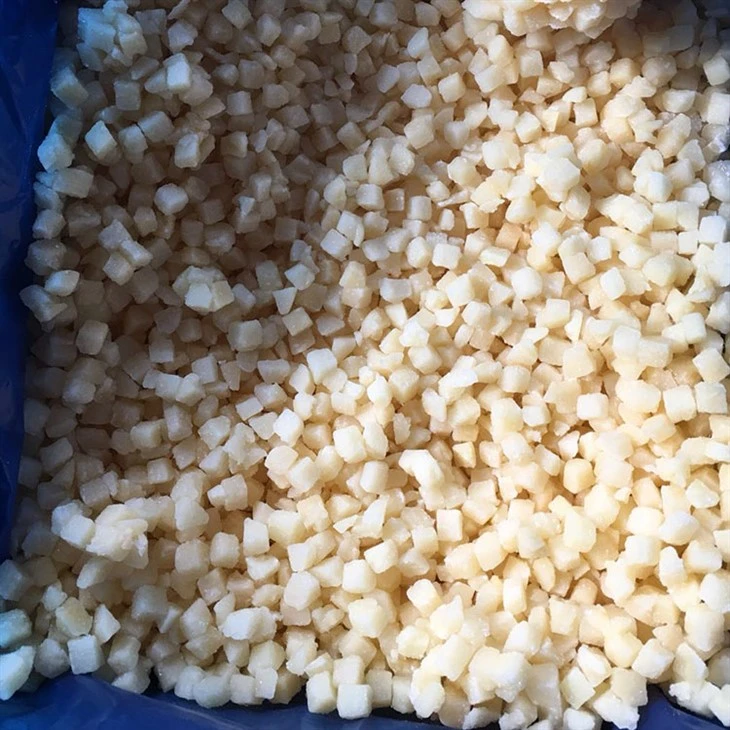
Frozen apple pieces for a processing trial. Actual GreenLand product-page photograph.
A controlled comparison should also identify the sample's frozen history. Record when fruit or juice was frozen, storage conditions available in the actual chain, how it was thawed or processed, and whether the comparison base was fresh, previously frozen juice, or juice pressed from frozen fruit. The original paper's juice was stored frozen before fermentation, yet that fact does not isolate freezing as a causal factor because every treatment used the same juice. It helps describe the system; it does not explain the nonmonotonic response by itself.
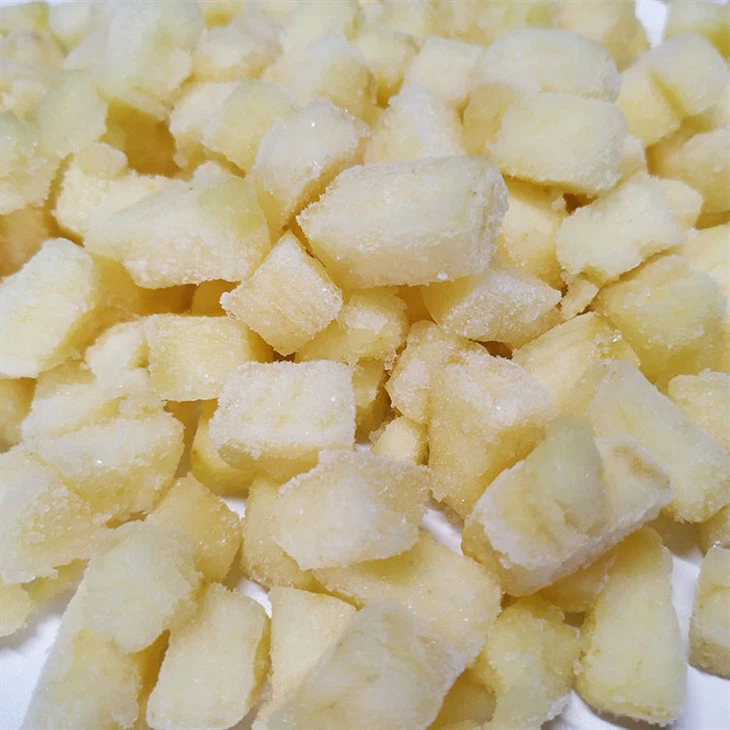
Frozen apple pieces in a distinct commercial cut. Actual GreenLand product-page photograph.
Qualification of nutrients and fermentation conditions belongs to the customer's licensed and technically competent team. They should apply ingredients permitted in the destination market and use their own validated controls for yeast, sanitation, temperature, oxygen exposure and process monitoring. The paper reports its methods so readers can interpret the experiment. It is not a commercial DAP or sulfite recipe, and this article does not reproduce its operating concentrations as an instruction. A buyer can use the study to design a question, then establish a lawful, safe and fit-for-purpose test through the appropriate specialists.
The trial should finish with a decision matrix rooted in the actual application. Compare completion, evolved H2S or other appropriate sulfur metrics, and finished sensory acceptance under a consistent evaluation procedure. Repeat promising conditions sufficiently to judge reproducibility. If the response changes when the apple base or strain changes, treat that as a finding about the interaction rather than a failure of the original paper. Its purpose here is to prevent a false universal rule.
Reject an automatic nutrient repair rule
When a sulfur concern appears, the quick answer "increase DAP" can be attractive because it is an easy operational lever. The evidence calls for a more disciplined response. Measure native juice YAN, confirm what nutrient was added and on what basis, identify the strain, record fermentation stage, and determine what sulfur endpoint was observed. In the original cider study, the intermediate addition worsened evolved H2S for one strain, while the other strain showed none detected at all three additions. That pattern makes blind escalation a poor diagnostic method.

Ingredient and beverage decisions need linked but distinct evidence.
The available evidence does not establish that a higher nitrogen level is always harmful either. UCD522 produced the least H2S at the high treatment in the experiment. The decision is conditional on the system and the full fermentation outcome. A commercial team might test a different strain, revise its nutrient strategy or examine juice composition; whichever route it chooses needs evidence from its own controlled trials and compliance review. The transcript results in the study offer biological insight but should not be translated into a gene-specific troubleshooting promise for an industrial lot.
For GreenLand, the useful conversation is upstream and concrete. Tell us the intended product use, the frozen apple form needed, cut preference, packing, expected order quantity, destination and requested documents. If a current trial is under review, share the two conditions being compared and the basis for each fruit or juice result. We can align the ingredient sample and specification with the customer's process. We should not describe ourselves as a cider maker or claim that supply of frozen apple includes validated alcohol production, nutrient management or sulfur control.
The buyer's final approval should rest on the finished cider it intends to sell, with the relevant process and regulatory experts signing off the treatment. A purchasing team may also set a repeatable ingredient acceptance plan that supports consistent juice preparation, but it should not make an unmeasured YAN or H2S promise part of a frozen apple specification. Keeping the ingredient and beverage responsibilities distinct makes both sides more accountable.
If a nutrient change did not reduce a sulfur note, send the strain identity, native juice analysis, treatment record, fermentation time course and sensory comparison to the qualified beverage team. Send GreenLand the supplied fruit form, lot and application details so we can help make the next ingredient trial comparable. That combination turns an unexpected result into a testable question and a sound purchasing decision.
Source frozen apple with GreenLand-food
GreenLand-food is a professional frozen apple supplier and manufacturer in China, providing factory-direct wholesale supply for importers, food manufacturers, and foodservice distributors.
Send the product form, specification, packing, quantity, application, destination, private-label needs, and requested documents so we can match the actual ingredient requirement.