


Porcini Caps and Stipes: A Preferred Cooking Method Can Depend on the Part
Oct 09, 2026
Leave a message

Research This Article & Topic with AI
Verify key claims, compare reliable sources, and explore GreenLand-food's practical frozen food knowledge.
Article details and research questions are prepared in the links. Sign-in or sending may be required.

Imagine a developer asking GreenLand whether a cap-heavy sample and a stipe-heavy sample can share one cooking approval. This is an illustrative buyer scenario, not a past customer case. We would ask how much of each part enters the finished dish, how they are cut, and whether the customer's process is a dry sear, a moist sauce cook or a staged cook-and-hold. A single overall liking score for a mixed bag can conceal a chewy stipe or a collapsed cap. Approval should cover the actual frozen mixture in its intended route, with the two parts assessed separately before their scores are combined.
Frozen porcini purchasing often starts with species, cut and grade. Those fields are necessary, but they do not tell a product team how a particular cap-to-stipe balance will behave in a risotto, sauce or premium ready meal. The part ratio is a functional ingredient variable. A trial that records it allows R&D and purchasing to understand why a recipe accepted with one sample might disappoint after a sourcing or cutting change.
Name the cap-to-stipe mix in the trial
The cap and stipe are visually connected on a whole mushroom but are distinct materials in a cut ingredient. A porcini cap includes a surface and a pore-bearing underside; the stipe is a thicker supportive structure. Their dimensions and tissue geometry affect how heat reaches a piece and how water leaves it. Slice thickness, cube size and any retained pore layer can magnify or soften those differences. A bag labeled simply "porcini pieces" may contain different proportions of caps and stipes across samples even when total net weight and cut size look similar.
Start by identifying the form that the buyer actually wants. Whole mushrooms allow the processor to separate parts. Slices may include cap-only, stipe-only and connected cap-stipe pieces. Cubes can obscure origin unless the sample is sorted before cooking. A cap-heavy mix intended for visible pizza topping has different appearance needs from a stipe-heavy dice dispersed through a creamy sauce. The correct trial takes its sampling units from the commercial cut, rather than choosing the most attractive pieces for a tasting table.
On receipt, spread a representative frozen sample and record the visible portion of each part by weight or count using a consistent sorting rule. A weight ratio is especially useful when large cap slices coexist with many small stipe cubes. Record ambiguous connected pieces separately or use a declared allocation rule. Photograph the sample on a neutral surface with a scale. That gives the buyer a repeatable record without pretending the research study supplied a commercial ratio. The GreenLand frozen porcini page establishes the offered product context; the quoted cut and ratio, if relevant, still need confirmation for the actual purchase.
The distribution matters as much as the average. Two boxes might both be approximately half cap by weight while one contains large cap slices plus fine stipe fragments and the other contains more uniform connected pieces. The first may give an uneven mouthful and lose fragile parts in a sauce; the second may portion more predictably. A useful sampling record describes the fraction of broken pieces, largest dimensions and visible cap surface as well as the cap-to-stipe balance. These are proposed approval fields, not current GreenLand lot claims.

Qualitative schematic. The brown cap, pore-bearing underside and pale stipe are distinct parts of a porcini mushroom. Open full-size diagram.
Do not infer part ratio from a hero image or a product name. A commercial frozen cap-and-stem product page shows that mixed parts are sold as a format, but its marketing description does not resolve a particular buyer's specification. Other suppliers sell cubed frozen porcini where the visible cut is the headline. The missing field for this decision is how much of each part the customer's cook will experience and whether that mix is stable enough for the application.
The ratio should be recorded before the first cook because cooking can make later sorting difficult. A cap may shrink or darken, and a stipe may absorb sauce or break. Once pieces are plated, judging the original blend from appearance alone becomes unreliable. A raw-sample record links every sensory result back to a documented input. If a new trial later uses a changed mix, the developer can distinguish an ingredient-form change from a cooking-process change.
The original study compared parts as well as methods
The Boletus edulis cooking study examined wild mushrooms with cap and stipe separated under four culinary treatments: vacuum confit, grill, roast and marinate. Its abstract reports measures of composition, phenolic compounds, antioxidant assays, color, instrumental texture and sensory attributes. It says grilled stipe and confitted cap samples generally received the highest scores, while marinated samples were least favored for smell, flavor and texture. Those observations are about the fresh material and the conditions used in that study. They make part-specific tasting a reasonable test design for frozen porcini; they cannot be pasted into a frozen product specification as guaranteed results.
The study's strength for this buyer question is that the anatomical part remained visible in the comparison. A whole-mushroom treatment average can miss a useful pattern: a cooking method may create desirable surface texture on a stipe while a cap performs better in another treatment. The research also measured several endpoints that can move in different directions. For a ready meal, the highest antioxidant assay result is not a substitute for acceptable bite, aroma and appearance after reheating. The buyer should select endpoints in the order the finished dish actually needs.
The accessible abstract has an important statistical limit. It describes high-scoring combinations, but that alone is not proof that a formal factorial interaction term between part and method was significant. An interaction claim would require the model, comparisons, sample size and error structure in the full paper. The practical recommendation is more modest and sturdier: treat caps and stipes as separately observable trial components, then test whether one commercial cooking route gives acceptable results for each. The buyer does not need a universal interaction p-value to see that an unmeasured part is a risk in its own dish.
Related 2026 Boletus cooking research found different volatile profiles across cooking methods and used sensory evaluation for its whole-mushroom comparisons. It reinforces that cooking route changes the experience, while answering a different question from the cap/stipe study. It should not be used to rank GreenLand frozen caps against frozen stipes without a matching material trial. Fresh wild mushrooms, another origin and a whole-mushroom sensory result are each different from a commercial frozen mix.

Qualitative schematic. The cited study reported highly rated confitted caps and grilled stipes; the pairings do not establish a universal method ranking. Open full-size diagram.
An editorial comparison table can keep the evidence honest:
On smaller screens, scroll across the table to read every column.
| Question | Original fresh-mushroom study | Commercial frozen-mix approval |
|---|---|---|
| Material | Wild B. edulis cap and stipe portions | Actual quoted frozen cut, grade and part ratio |
| Treatments | Confit, grill, roast and marinate as studied | Customer's equipment, cook and hold sequence |
| Reported observation | Grilled stipes and confitted caps generally high-scoring | No outcome until the buyer's trial is run |
| What can be transferred | Reason to inspect parts separately | A method and acceptance criteria tailored to the dish |
This comparison protects both sides of a sale. It lets GreenLand explain why part balance deserves attention while avoiding a promise that the published ranking will be reproduced in a frozen ready meal. It also keeps the research valuable: the paper suggests an easily missed variable that can be added to routine sample approval.
Do not average away the less suitable part
Suppose a mixed sample earns an acceptable overall score. That score can arise because the cap is excellent and dominates perception while the stipe is only marginal. A slight shift toward more stipe in the next lot could move the finished dish below the buyer's threshold. The reverse can also occur if a stipe-heavy trial hides a fragile cap that becomes prominent when larger pieces are packed. Averages are useful for forecasting portion-level experience, but part-specific observations show whether the average is robust.
Separate tasting does not require a complicated laboratory panel. Cook representative cap and stipe portions through the same production route and let trained assessors describe each part's firmness, chewiness, moisture, aroma and visible integrity using clear terms. Then taste the recombined mixture in the finished dish. The separate plates locate a problem; the mixed dish determines whether it matters commercially. A disliked standalone stipe might be perfectly suitable as small dice in a seasoned sauce, while the same bite could be unacceptable as a visible premium slice.
The sensory scale needs anchors. "Tender" can mean soft enough to bite yet still distinct in a sauce. "Chewy" can be pleasant in one application and a rejection in another. Set examples or written definitions with the buyer before scoring. Record whether a complaint concerns a tough center, rubbery surface, watery finish, weak mushroom aroma or dark appearance. Those attributes can call for different changes in cut, cook or part balance. A single "texture failed" box gives little guidance to supply or production.
Water management deserves a separate observation because freezing and reheating introduce a route the original fresh study did not test. Frozen pieces may release liquid as they heat. A crowded pan may steam a cap that was intended to brown; a deep sauce kettle can fully hydrate a stipe while a short sear may not. Observe free liquid before and after cooking, the mass yield of the portion and the texture after the planned hold. These measurements are useful even without a claim that one anatomical part always releases more water. The result must be established for the cut and process at hand.
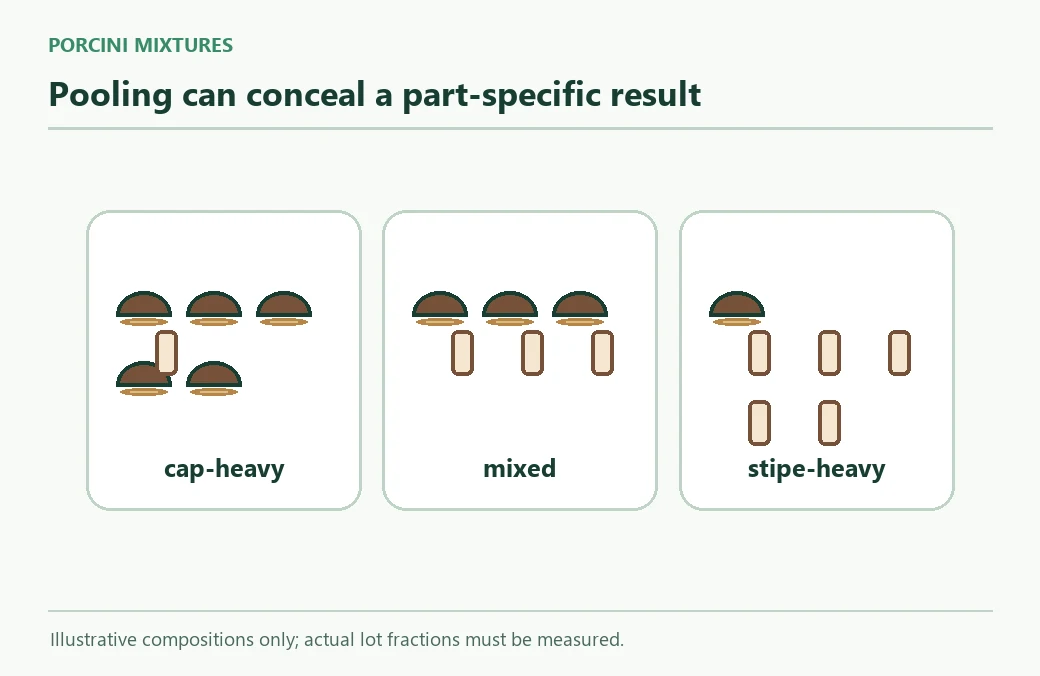
Qualitative schematic. Illustrative cap-heavy and stipe-heavy mixes can give different pooled impressions even before a cooking method changes. Open full-size diagram.
The size distribution can interact with part ratio. A thick stipe cube needs more time for its center to heat than a thin cap slice, so a single timed pan trial may expose both to different effective treatments. Conversely, smaller stipe dice may overcook while a large cap piece is still cold. Document the piece dimensions that reach the line, not only the supplier's nominal size band. When the dish contains sauce, evaluate both the mushrooms and sauce consistency because released liquid can change the whole application.
A useful trial repeats at least the most important observations across more than one preparation. One pan can have a hot spot, an uneven layer or a different operator's stirring pattern. A second batch under the same documented method shows whether the apparent cap or stipe problem recurs. If the decision has substantial purchasing consequences, include more than one ingredient lot after the first route is selected. The goal is to learn whether the proposed specification and recipe work together under normal variation. It is not to turn a small kitchen tasting into a statistically powered claim about all porcini from all origins. Record any deviations while they are still fresh in the operator's mind; they can explain a surprising score later.
Serving conditions also need consistency. Aroma appears different in a hot pan, a closed tray and a reheated plated meal. Texture changes while the sample cools, and a sauce can mask a defect when the mushroom dose is low. Decide when the product is scored, how many pieces each assessor receives and whether caps and stipes are clearly identified during diagnosis. A blinded finished-dish tasting can follow the diagnostic tasting to check whether the issue remains noticeable in context. This separates a useful development observation from a purchasing rejection.
One overall "best method" ranking also hides what the buyer values. The published study assessed multiple sensory attributes. A premium visible topping may prioritize cap integrity and browning. A soup can prioritize characteristic porcini flavor and even distribution. A stuffed pasta filling may tolerate smaller stipe pieces and require moisture control. The approval criteria should follow the application. If the recipe changes, a different part ratio or cooking route may be rational without contradicting the research.
Validate the actual frozen mix in the finished dish
The illustrative ready-meal developer should send a target recipe, portion size and cooking sequence. We would supply a sample of the quoted frozen porcini form and confirm what the sample represents. The developer would first record the cap-to-stipe mix and cut distribution, then cook it under the line's intended conditions. A pan test can screen obvious problems, but final approval should include the actual ready-meal assembly, freezing or chilling step, storage interval, reheating route and service hold that customers will experience.
Use a comparison that changes one useful variable at a time. If the buyer is choosing between cap-heavy and stipe-heavy grades, keep sauce, mushroom dose, cut-size range, heating surface and holding time as similar as practical. If choosing a cooking route, begin with one ingredient lot divided between routes. Randomize serving order or blind the samples where possible so the first aroma or a visible garnish does not determine every score. Keep photographs of the plated result at the same distance and light. These are ordinary product-development controls that let a small trial answer a defined question.

Illustrative cap-rich and stipe-rich ready-meal portions. Evaluate the actual mixture and dish; no preference score is implied.
Record separate part scores and the finished-mixture score. A minimal sheet might have part identity, cooked mass, size band, heating step, hold duration, aroma description, firmness, chew, visible integrity, free liquid and accept/reject decision. Add an application-specific measure: slice retention on pizza, distribution in a risotto or fill uniformity in a ready-meal compartment. The proposed sheet is a trial framework, not a claimed GreenLand testing certificate. Its value is that another operator can reproduce the result and see which change affected it.
If one route yields a desirable cap but an overly firm stipe, several adjustments deserve testing: a different cut size, a staged addition or a different part balance. Do not promise that a warmer pan or longer cook will solve the problem; these changes can also shrink or darken the cap and alter liquid release. Choose a small set of alternatives based on the observed defect. A stipe-only precook can be evaluated where the recipe permits, while a single-step process may call for a more homogeneous cut. The trial decides which is workable at commercial throughput.
Freeze state must be consistent at trial entry. A sample partly thawed during transport can shed water before the cook and produce a misleading result. Document package integrity, storage and the state when opened. Compare samples after equivalent handling, using the same cooking start point. Commercial frozen porcini guidance discusses sliced, diced and whole formats, including the option to separate caps from stems for some preparations. It is helpful application context but cannot replace the buyer's equipment-specific trial.

Frozen porcini caps in a bulk product view. GreenLand product photograph; finished-formulation performance requires the customer's defined application trial.
Keep the test within food safety controls established for the finished meal. The original study's vacuum confit treatment is a research culinary method, not a validated safe time, temperature or storage plan for a commercial product. A ready-meal manufacturer owns its heating, cooling, packing and shelf-life validation. GreenLand's role is to supply the agreed frozen ingredient form and traceable lot information for the trial and subsequent orders.
Write a mixture-specific approval
An approval that says "porcini accepted" leaves too much room for a later mismatch. Specify the scientific or commercial species description used in the purchase, the form, cut dimensions, cap-to-stipe ratio or agreed visual range, tolerance for broken fragments and the intended application. Add package format, net weight, expected shipment quantity, destination and documentation required by the buyer. These fields help the supplier quote the right program and help the factory know which sample it approved. They should be confirmed for the real offer rather than inferred from this article.
The sensory part of the approval should name the cooking route and the reference dish. "Acceptable after cooking" is too vague. State whether the assessment is made after a direct pan cook, after cooking in sauce, after reheating a frozen ready meal, or after a service hold. Record the mushroom dose and representative portion. If the finished product is a risotto, a steamed sample alone cannot establish that it will hold bite and flavor after the rice process. A comparison to a retained approved sample can make later lots easier to evaluate, provided both samples are prepared the same way.

Mixed frozen porcini pieces with caps and cut stipes. GreenLand product photograph; finished-formulation performance requires the customer's defined application trial.
Write a change trigger into the specification. A shift in part balance, cut program, species mix, process route or intended dish should prompt a focused review. The trigger need not force a complete redevelopment for every minor variation. It should direct the team to the observation likely affected. For instance, a larger stipe fraction calls for reassessing bite and distribution; a thinner cap slice calls for checking integrity and liquid loss. When a complaint arises, these records show whether it followed a known change or occurred within the approved range.
Inspection at receipt should establish identity and frozen condition before anyone attributes a cooked-texture problem to anatomy. Check that cartons correspond to the lot and form, note obvious breakage or free ice, and preserve the agreed sample for a controlled cook. If a lot fails, document the actual cooked attribute and the part where it occurred. The buyer and GreenLand can then compare like material under the agreed method. A complaint based on a different recipe or thawing route remains useful feedback, but it does not automatically establish failure against the signed acceptance method.
The final purchasing request should therefore ask for a sample tied to a proposed cap-to-stipe and cut specification, then include the developer's finished-dish trial result. GreenLand-food can help match a frozen porcini supply form to the order as a professional supplier and manufacturer in China with factory-direct wholesale supply. The developer retains responsibility for the recipe and process validation. With part and method both visible in the record, a preferred cook becomes a tested decision for that meal rather than a slogan applied to every porcini piece.

Qualitative schematic. Keep part-resolved observations and the final dish score as separate results in a cooking trial. Open full-size diagram.
Related reading
Review moisture control when cooking frozen porcini for sauces, risotto and other dishes.
Check grading, cleaning and incoming-quality issues before comparing cooking methods.
Separate porcini from shiitake by species, structure and buying specification before considering substitutions.
Discuss frozen porcini mushrooms for your application
GreenLand-food is a frozen porcini mushrooms supplier and manufacturer in China, offering factory-direct wholesale supply for food manufacturers, importers and private-label programs.
Send the required product form and specification, packing, quantity, application, destination, private-label needs and requested documents. Include the sample or process question discussed above so we can identify the appropriate frozen ingredient and supply details.