


Frozen Pack Seal Strength and Leak Integrity: Cold Storage and Transport Trials
Sep 29, 2026
Leave a message
Research This Article & Topic with AI
Verify key claims, compare reliable sources, and explore GreenLand-food's practical frozen food knowledge.
Article details and research questions are prepared in the links. Sign-in or sending may be required.

Reviewed 22 October 2026. Shipment requirements are checked for the actual product, route and filing date.
Map failures in the actual filled frozen pack
A packaging complaint should start with the location and shape of the opening. A weak bond separates along part of the heat seal when the two layers are pulled apart. A channel leak may look like a narrow passage through a seam that otherwise holds strongly. A sharp frozen piece can puncture the film away from the seam. A trapped piece of product, moisture, oil or ice can obstruct sealing at one point. These failures call for different corrective actions, so a single label such as "seal failure" is too broad for investigation.
Inspect the filled pouch before cutting it for a strength test. Photograph all four sides under consistent light, including corners, end seals and any gusset. Record whether the pouch is still frozen, partially thawed or conditioned to room temperature. Note the fill mass, headspace, product form and any unusually hard or sharp pieces near the damage. For example, a bulk pack of frozen sweet corn cob segments presents different contact geometry from a small pouch of free-flowing kernels. The product photographs here show the forms that a packaging trial must account for; they do not show a tested or approved seal.
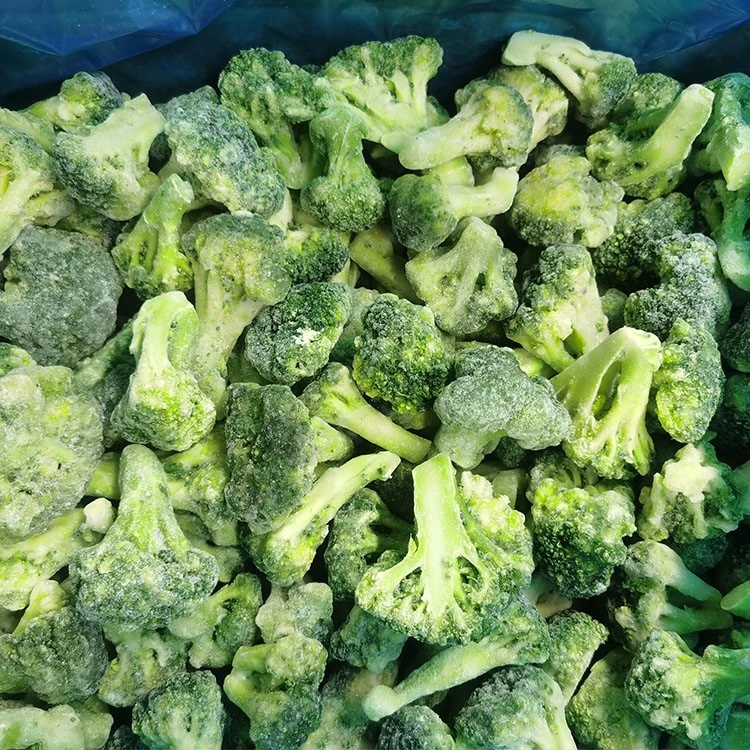
Original GreenLand product photograph. Frozen broccoli florets in a second original close view; product form only. It is not evidence from the DEMO calculation, test or shipment.
A useful defect map separates the seal perimeter from the package body. Mark the exact location of each observed leak on a simple pouch sketch, then trace it back to the sealing jaw, film web direction, filling point and case-packing position. Repeated defects at the same jaw location suggest a different cause from isolated punctures at random product contact points. If a frozen pack has been squeezed, dropped or pulled from a case, preserve the original damage pattern before any destructive laboratory method changes it.
The filled bag is the commercial unit the buyer receives. A film supplier's barrier certificate can support a material choice, but it cannot show how the film formed around a particular product on a particular line. Similarly, a seal-strength report on selected strips cannot show whether every part of the perimeter remained closed after freezing and transport. In our frozen corn packaging guide , package size and product form are linked to handling needs. Here the release question is narrower: which failure was challenged, and what observation would have found it?
Read seal-strength data within its sampling limits
Seal strength is normally reported as force for a defined strip width and a defined peel configuration. ASTM F88/F88M is a public cataloged method for the seal strength of flexible barrier materials; the current applicable version and full procedure should be confirmed with the testing laboratory. The report should identify specimen width, direction, grip arrangement, peel support, speed, conditioning and how the result was calculated. A number without those details is difficult to compare with another supplier's number or with a later production lot.
The shape of the force trace matters. A specimen can show an initial peak followed by a lower sustained peel force, stretching of the film, delamination or film tear before the heat seal itself separates. Those behaviors do not mean the same thing. Ask the lab to show failure mode and, where useful, the curve or representative photographs, not only the largest value copied into a COA. A high peak caused by film stretching may obscure a weaker portion of the bonded seam. The buyer and lab should agree whether the key statistic is an average, minimum, distribution or another criterion appropriate to the pack.

Diagram for read seal-strength data within its sampling limits. Conceptual structure or explicitly labelled DEMO values; no shipment evidence.
Sampling determines how far the result can be interpreted. A peel strip taken from a clean straight edge says little about a corner, a seal transition, the top of a gusset or a place where food entered the jaw. Production start-up, shift changes, film-roll changes and adjustments to temperature, pressure or dwell time can create different conditions. A sensible sampling plan therefore identifies where strips come from, when production packs are pulled and how exceptions are retained for investigation. It does not imply that every bag has been destructively tested.
For a frozen program, the team also needs to agree whether the strength test is performed on a freshly sealed pack, after freezing, after a defined handling simulation, or at more than one stage. Peel values may change with film construction and conditioning; they are not a universal "good seal" threshold. We would ask for the film and line run to be named on the report so the result can be connected to the approved pack. If the film or sealing equipment changes, the original number should not be carried forward as if nothing about the process changed.
A passing strength criterion is evidence of mechanical performance for the tested specimens. It cannot prove leak freedom because the measurement pulls on a selected portion of seam rather than surveying every possible path through the finished pack. That distinction is the central reason to request a separate integrity test when loss of containment or environmental exposure matters to the product.
Choose an integrity test for the package and defect
Leak integrity asks whether a path connects the package interior to the outside under the conditions of the chosen method. A bubble-emission test, dye penetration, vacuum decay and pressure methods observe different physical signals and do not share one detection limit. The lab should choose a method after seeing the material structure, headspace, filled product and expected defects. Some methods are destructive; some need a package with gas space; some examine the entire package while others focus on the seal. Those distinctions belong in the method selection record.
ASTM's public catalog lists F3039 for dye penetration in nonporous packaging or flexible barrier materials, D3078 for gross leaks in flexible packaging by bubble emission, and F2338 for vacuum decay. The catalog alone is not a protocol. In particular, a method developed for porous medical packaging should not be copied into a nonporous frozen food specification merely because its name includes "dye penetration." A qualified laboratory must verify the current version, scope, sample preparation and compatibility with the actual filled pack.

Diagram for choose an integrity test for the package and defect. Conceptual structure or explicitly labelled DEMO values; no shipment evidence.
Sensitivity should be stated as a capability for the configured pack and method. Small leaks can be plugged by food or obscured by the film's behavior during a test; an aggressive pressure may itself damage a previously intact seam. A gross-leak method may answer whether a bag has a large opening after rough handling, while a different method may be needed to challenge a small seal channel. The report should state what kind of defect was intentionally introduced during method suitability work, where it was placed and whether the system detected it. That is stronger evidence than a broad claim that the bags were "leak-free."
The test also needs a failure-location record. Bubbles from a cut test port, a damaged corner, and a channel in a heat seal are not equivalent findings. Likewise, dye visible on the outer film surface is not automatically proof of passage through the seal. Preserve photographs of the test setup and failed areas before discarding the package. When a lab result seems surprising, inspect the original sample and the test-induced puncture or clamp mark to avoid attributing damage to distribution without evidence.
No method provides a universal assurance for every pouch format and every leak size. The purchase specification should therefore name the protection goal, the chosen test, its scope, the sample condition, the acceptance rule agreed for that pack and the escalation path when an unexplained indication appears. A statement such as "passed integrity test" without the method and conditions is too narrow a record for a repeat purchase.
Retest after the agreed frozen handling route
Frozen distribution changes the stresses on a package. Product pieces become rigid, cases may be stacked, and pouches can rub against neighbors or the carton. Temperature changes can alter film flexibility and headspace pressure. The right conditioning sequence depends on the product and route: a retail bag moved through several handling points, a bulk foodservice pack, and a large industrial liner do not experience identical hazards. The buyer, packing team and laboratory should define a representative sequence rather than borrow one from an unrelated pack.
Record the starting state before conditioning. This includes the filled product form, bag dimensions, fill weight, seal layout, film construction, closure date and storage temperature. Agree on any freeze period, case pack, movement, compression or drop assessment and the condition at which strength and leak tests will be run. If a pack is tested after warming, note the time and temperature path so a later comparison is genuinely like for like. A single test on a warm empty pouch cannot stand in for a frozen filled-bag challenge.

Original GreenLand product photograph. Frozen peas and carrots inside a food-grade liner; product and pack form only. It is not evidence from the DEMO calculation, test or shipment.
Keep the chain of custody clear. Identify which packs were unconditioned controls, which were exposed to the frozen route and which were deliberately damaged as method checks. Do not accidentally use the same pouch for a destructive leak procedure and then attribute its puncture to transport. When a failure is found, retain nearby packs from the same line interval and the same case location if possible. This can distinguish an isolated impact from a sealing setup problem.
The two real sweet corn images illustrate why the product geometry needs to be documented. Cob segments have comparatively hard cut surfaces and a large contact area, while loose kernels present a different packing surface. Neither image alone proves puncture resistance or seal quality. The quality decision comes from a representative packed sample tested under the agreed route, with defect location and method limitations recorded. Our quality control system page gives broader context for linking checks to batch records.
If the intended shipment includes a new carton arrangement, heavier fill, changed primary film or different pallet pattern, revisit the conditioning plan. The packaging system has changed even if the heat-seal set point has not. Buyers who specify only one seal-strength number can miss this practical shift in damage risk.
Resolve strength and leak results that disagree
A strong peel result and a failed leak test are compatible observations. The peel strip may have come from a clean part of the seam while a short channel sits elsewhere; the bag body may have a puncture; or the integrity test may have introduced an artifact. First confirm both reports refer to the same film, run, product form and condition. Then map the leak location and inspect retained packages. Do not respond by simply increasing sealing temperature: excess heat can distort a film, narrow the effective seal area or create another failure mode.
The reverse pattern also needs attention. A pack may pass a particular leak test while a seal strip falls below the agreed mechanical criterion. The pack could be closed at the moment of testing but lack strength for the intended handling route or opening behavior. Alternatively, the strip may have been cut or gripped incorrectly. The team should review failure mode, replicate under the qualified procedure and decide whether the issue affects release, future process settings or the specification itself. A short-term pass cannot erase a credible mechanical weakness.

Diagram for resolve strength and leak results that disagree. Conceptual structure or explicitly labelled DEMO values; no shipment evidence.
An illustrative comparison helps organize the investigation. If both strength and integrity meet the agreed criteria, confirm that sampling and conditioning were representative before release. If strength fails and integrity passes, investigate mechanical margin and handling sensitivity. If strength passes and integrity fails, find the channel, pinhole or test artifact. If both fail, hold affected material and inspect the sealing process and film. These are decision branches, not GreenLand test results or universal acceptance limits.
Corrective action should follow the physical cause. Product contamination at the seal may call for changes to filling alignment, product control and jaw cleanliness. Weak bonding may call for a process-window review across film structure, jaw pressure, dwell and temperature. Repeated body punctures may need a different product/film/secondary-pack combination. An apparent leak caused by a test fixture requires method correction and repeat testing, with the original finding still documented. Buyers should ask what evidence closed the investigation, not only whether the next lot received a passing number.
The release file should preserve any disagreement even if later samples pass. A traceable deviation record explains what changed, which packs were held or reworked, how the affected time window was defined and what was checked before supply resumed. That history is valuable when a later claim points to a similar location.
Build a packaging release file buyers can audit
For repeat frozen-food supply, the packaging evidence should connect four things: the approved film and bag drawing, the actual filling and sealing run, the representative filled-pack samples, and the agreed strength and integrity tests. A COA can summarize results, but the underlying reports should remain retrievable. Record film batch, pouch size, seal width, fill mass, product form, machine identifier, run time and the points where samples were removed. Link those to the sample condition, method version and acceptance criteria established for that pack.
The buyer's request can be specific without dictating a laboratory method outside its scope. Ask for seal-strength data with specimen configuration and failure mode; an integrity result for the completed pack with defect sensitivity and method limits; cold-route conditioning details; and photographs or retained examples of any failure. A supplier may need to work with a qualified packaging lab to design or execute a method. We can coordinate the product and packing information so the evidence relates to the frozen food actually ordered.

Diagram for build a packaging release file buyers can audit. Conceptual structure or explicitly labelled DEMO values; no shipment evidence.
For a private-label or export program, the approved artwork and legal declarations are another record stream, but they do not substitute for physical package performance. Confirm how the primary bag sits inside the carton, whether a liner is used, and how the lot code remains readable after freezing. Specify who approves a material change, revised fill weight or new case configuration. The sample approved at the start of a program should remain a reference when line conditions or supply partners change.
Ask that exceptions be recorded in the same file. This includes an interrupted run, a film splice, a sealing-jaw adjustment, a failed leak indication and the decision on associated finished packs. A release decision is stronger when it shows the boundary of the affected product and the check used to clear it. Repeating a good average seal number across shipments is less useful than a traceable record of what was actually sampled and how a deviation was resolved.
We supply frozen food in formats that need different primary packs and shipment plans. For a quotation or packaging review, send the product form, fill weight, bag style, target packing, order quantity, destination and any specific handling or documentation requirement. The result should be an agreed test plan that covers both the seam's mechanical behavior and the finished pack's ability to contain the product through its frozen route.

A second view of build a packaging release file buyers can audit for the later section explanation. Conceptual, not an actual test or shipment.
For an incoming packaging qualification, keep the filled sample design realistic. A bag tested nearly empty may behave differently from one filled to the intended weight; angular frozen pieces can load the film and corners differently from small round pieces. Record headspace, orientation and how the pack was closed before conditioning. If the customer intends to stack cartons or use a particular case count, include that secondary-pack arrangement in the handling route. The seal should be judged as part of the actual package system, while the strip test still has its separate job of characterizing the bond.
Agree how many packages and seal locations will be tested before looking at results. A convenient strip from the top center cannot represent the side folds and corners of every pouch. Sample across machine positions, start-up and steady operation when these are material to the process. For each leak indication, mark its location and preserve the pack until the cause is understood. A photograph of a wet or dyed region can help, but the physical pack and test notes remain more useful than a single image taken after handling.
Method sensitivity needs a practical discussion. A test that easily finds a large open seam may miss a small channel that matters after rough frozen transport; a very sensitive test can flag defects that require investigation even when routine packs seem sound. The test report should state the method and its validated detection capability for the chosen package, without promising that a passing result means zero possible leaks. If an integrity method uses vacuum or pressure, check that the package material and headspace are suitable and that the fixture has not become the failure source.
Change control closes the loop. If a supplier changes film gauge, sealant layer, bag dimensions or sealing equipment, the earlier qualification may not carry across automatically. A change in the food itself can matter too: different cut size, loose surface moisture or fill behavior can put more product in the seal area. Decide which changes trigger a new strength study, a new filled-pack integrity study and a handling-route check. The buyer should receive the revised evidence before a changed pack is released under an old specification.
Design the cold route as a paired pack trial
Define the commercial pack before choosing a test. Record film construction, pouch dimensions, seal layout, headspace, fill mass, product geometry and carton arrangement. Pull filled production packs from start-up, steady running and any relevant line change, with positions around the pouch recorded. Divide samples into an unconditioned control group and a group that will experience a defined freezing, case-handling and distribution sequence. Keep both groups traceable to the same film and run.
ASTM D4169 gives a framework for laboratory evaluation of shipping units through selected distribution hazards. It does not supply a universal frozen-food route. The buyer and packaging team should choose the actual carton and pallet configuration and identify which handling hazards matter. Record temperature and time for each stage, plus when the pack returns to the condition required by the test method. The same package may have to be reserved for nondestructive observation before any destructive peel or puncture test.

Diagram for design the cold route as a paired pack trial. Conceptual structure or explicitly labelled DEMO values; no shipment evidence.
After conditioning, inspect the still-closed pouch and map each opening to a seal segment, corner, body panel or closure. Then apply a leak method shown suitable for this pack, followed by seal-strength specimens where the sequence permits. The comparison asks whether the route created new defects or changed mechanical margin. If the pack is cut first and subsequently leaks, the cause is ambiguous. Preserve photos, failed specimens and the exact order of operations.
DEMO: calculate seal force and locate defects
DEMO ONLY - Consider a fictional trial with 40 filled frozen-vegetable pouches. Before route conditioning, five 15 mm seal strips show peel forces of 8.1, 7.8, 8.4, 8.0 and 7.7 N. Their arithmetic mean is 8.0 N per 15 mm; the minimum is 7.7 N per 15 mm. After the agreed handling route, another five strips from matched seal positions give 7.4, 7.2, 7.6, 7.1 and 7.3 N per 15 mm. The mean is 7.32 N per 15 mm, a decrease of 0.68 N per 15 mm, or 8.5% of the initial mean. These small sample groups do not establish a population trend or compliance by themselves.
Suppose an integrity check finds two leak indications among the 40 handled packs: one channel at a gusset and one puncture in a body panel. The observed rate is 2 ÷ 40 = 5% in this deliberately limited trial. It is not an estimated future failure rate or a universal acceptance threshold. The gusset points to seal geometry, contamination or pressure distribution; the body puncture points to product shape, film or secondary-pack handling. Increasing sealing temperature would not address both causes.

Diagram for demo: calculate seal force and locate defects. Conceptual structure or explicitly labelled DEMO values; no shipment evidence.
A data sheet should retain each strip's location, width, peel orientation, force trace and failure mode, and each leak's pack ID, location, method and test stage. The buyer's signed criterion may require no detected leaks in a defined sample and a separate strength range, but that criterion must be specified for the actual pack and route. A strong average strip value cannot cancel a confirmed leak in a filled commercial pack.
Escalate a mismatch to a cause-specific trial
When peel specimens meet their agreed strength range but a pack leaks, first locate the opening. A channel crossing a seal calls for examination of product in the jaw, folds, jaw alignment and pressure at that geometry. A puncture in the body calls for a different trial involving piece shape, fill level, film thickness and carton movement. Check for fixture damage or intentionally introduced test ports before assigning the defect to production. Save the original finding and the evidence for any test artifact.
When the filled packs pass the selected leak method but strips fall below the mechanical criterion, review the peel setup and failure mode, then test another defined set under the same method. The package may be closed at the test moment while lacking margin for the planned route. Do not change a contractual limit retrospectively to fit one lot. Any process adjustment should be documented as a controlled trial, with the film batch and machine position held visible.

Diagram for escalate a mismatch to a cause-specific trial. Conceptual structure or explicitly labelled DEMO values; no shipment evidence.
An escalation file connects the defect map, trial variable, revised setup, paired samples and release decision. It states which production window and cartons were affected and what disposition QA approved. A later passing sample is evidence about its own pack and conditions; it does not make the earlier leaking pack disappear.
Build your frozen vegetables order with GreenLand-food
GreenLand-food manufactures frozen vegetables in China. We fill factory-direct wholesale orders for importers, food manufacturers and foodservice programmes.
Tell us how you'll use frozen vegetables and where you need delivery. We'll review the product form and specification with you, then confirm packing, quantity, private-label details and requested documents.