


Testing Frozen Hami Melon for Rind Residue, Soft Pieces and Drip Loss
Oct 19, 2026
Leave a message

The method below is a proposal for agreeing a purchasing specification and an application trial. It gives no universal defect tolerance or automatic lot-release rule. The supplier and buyer should select limits, sampling and decision procedures for the actual cut and intended use. We help purchasing teams connect those requirements to an approved frozen sample so that receiving results can be compared fairly with the material used for approval.
Define the cut and the sample before testing
Begin with the ingredient identity. Record that the material is Hami melon and state the actual form: wedges, dice or another approved cut. Include whether the fruit is intended to be fully peeled, how the seed cavity is cleaned and which additions or processing aids are declared. A product name alone leaves these details open. Two cartons bearing "frozen melon" can contain different geometries and trimming boundaries, making their defect results difficult to compare.
Describe what constitutes one unit. A wedge with a detached tapered end might be counted as one broken original piece or as two observed fragments, depending on the method. Counting every visible fragment as a separate unit can change the apparent defective-unit percentage substantially. Agree the rule before examining the sample, and use mass where the application needs mass yield. Keep the unit-count result and the mass result separately named in the report.

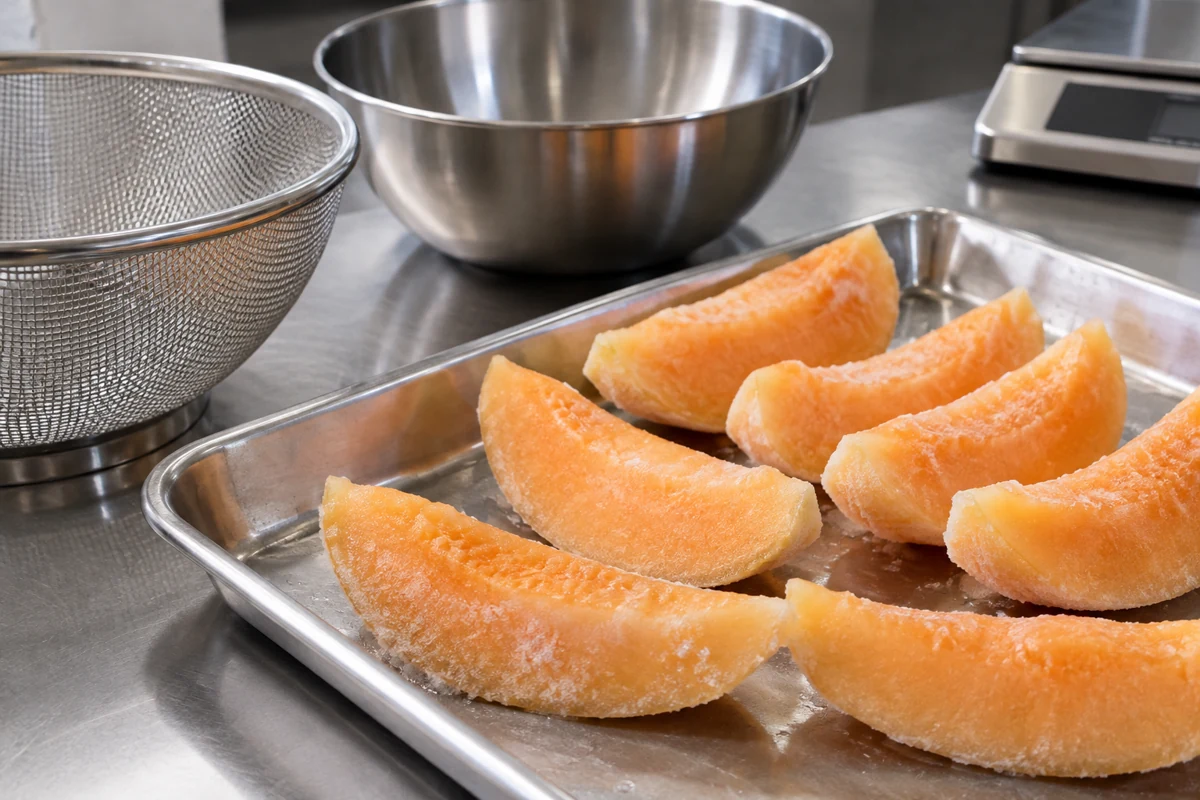
Frozen wedges with visible pale outer bands; agree the rind-removal boundary on the approved sample.
Decide whether the initial mass includes loose ice or material separated inside the pack. Visible frost, free liquid in a partly thawed bag and the fruit itself should not disappear between opening and weighing. Record their treatment explicitly. A test intended to represent the purchased net ingredient needs a stated starting basis, whereas a measurement on selected drained pieces answers a narrower question. Preserve the original observations if a second calculation is needed later.
State the sample condition at opening. Note whether pieces separate with the agreed gentle handling, whether a clump is present and whether the pack or liner is damaged. Record the product-temperature measurement method and relevant transport or staging information. A single surface reading does not reveal the entire pack's history. These observations help interpret a result; they do not establish that a particular temperature excursion occurred or that a shipment is safe.
The current GreenLand Hami melon photograph shows wedges with visible pale outer bands. It is a useful reference for the importance of a trim definition, but an image cannot settle whether the actual buyer accepts those bands. Approve a representative physical sample and a written description together. When an order specifies a different outer boundary or cut, the previous photograph remains a form reference rather than evidence that the new requirement has already been achieved.
Keep enough information to compare the trial with later receiving work. A record should identify lot, pack, cut description, sample selection, opening condition and method version. If any of these changes, decide whether the results remain comparable. This is especially useful when procurement receives one small approval pouch but the commercial shipment arrives in a different inner format, which can affect handling, sample access and the degree of separation observed at opening.
Inspect rind and seed-cavity material separately
Agree what the word "rind" means in the specification. Tough external skin, a pale green layer of edible outer flesh and a fibrous boundary near the skin can look different after freezing. A green color description alone may classify acceptable flesh as a defect or overlook a thin skin strip. Use photographs and physical references that show the agreed boundary, and ask operators to explain borderline classifications before the method is adopted.
Inspect all relevant surfaces under consistent lighting. A residue on the curved outer side can be missed when every wedge lies with its inner cut face upward. Turn pieces using clean handling appropriate to the frozen or thawed state specified for the test. Avoid force that creates new fragments. Record whether a suspected strip is attached or loose and whether it can be identified reliably without an additional controlled observation.
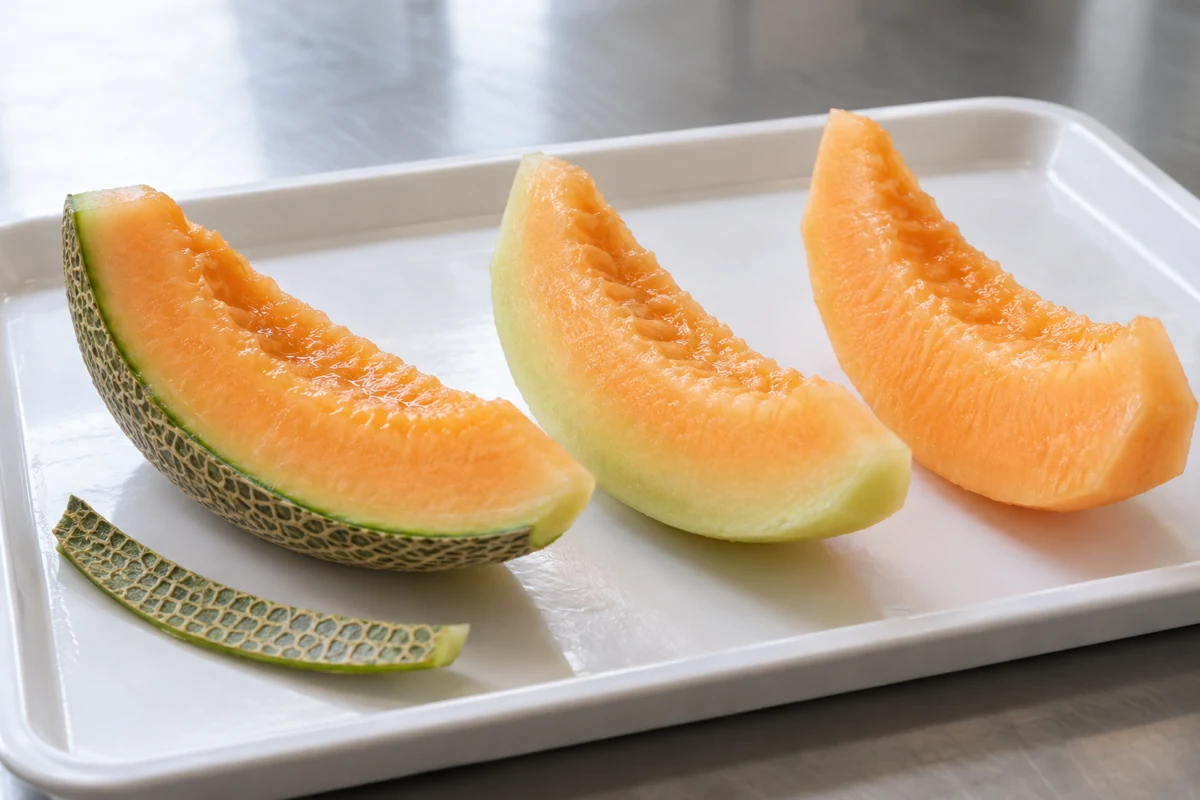
Agree which outer tissue counts as rind residue before sorting a sample.
Seed-cavity material needs its own description. A loose seed, a strip of cavity tissue and softened orange flesh are different findings. The buyer may object to one or more of them for appearance, texture or the finished process, but that does not make them interchangeable in the report. Sort them into the agreed classes and retain a reference where identification is uncertain. Do not call normal fruit tissue foreign material simply because it is unwanted in a particular recipe.
Choose the measurement that matches the defect limit. "Wedges carrying external rind" is a count of affected units divided by inspected units. "Removed rind mass" uses the isolated residue mass and a stated sample denominator. One tiny strip on each of several wedges can give a high affected-unit share but a low residue mass. Conversely, one large residual strip may matter to a serving despite appearing in only one counted unit. Report the measure the contract actually uses.
If trimming is used to quantify residue mass, define the removal boundary and weighing practice. Cutting away generous amounts of good flesh along with the skin will inflate the result. Very small residues also require a balance appropriate to the quantity being measured. Where the method cannot distinguish an amount reliably, report that measurement limitation. A zero displayed by an unsuitable balance is not proof that no residue was present in the inspected material.
The National Center for Home Food Preservation's melon guidance includes removing rind and seeds before freezing. That supports the preparation distinction; it does not supply a commercial frozen-Hami tolerance. The USDA standard for frozen melon balls has a different defined product scope. A wedge specification should therefore name its own agreed preparation and test basis rather than borrowing a grade score or defect allowance from a form that was never being inspected.
Take samples that represent the packed lot
Plan selection across the lot before opening convenient cartons. Different positions or packs may have different breakage and clumping, and a neat surface handful can hide the smaller pieces below it. Agree how cartons or inner packs are selected and how portions are taken within them. The proposed plan should reflect the commercial question and the lot structure. This article does not prescribe a universal sample number, statistical confidence or acceptance quality level.
Keep individual pack observations where variation matters. Combining every portion into one composite can provide an overall estimate, but it can also hide one pack with concentrated residue or severe softness. A buyer concerned about occasional unacceptable servings may need both the combined result and the spread between sample units. Decide that in advance. A sample plan designed for an average ingredient property does not automatically control the worst pack in the shipment.

Melon dice are a separate cut, with their own size and handling requirements.
Sample the actual cut being purchased. The genuine carton photograph of melon dice shows a different geometry from the wedge photograph. Dice may require different access and handling to obtain a balanced portion, and their unit count is on a very different scale. If both forms are being compared, maintain separate identities and form-specific definitions. Combining them under one average can conceal a practical difference that the receiving team needs to see.
Avoid selectively removing attractive pieces for the thaw trial. If the test is intended to describe the delivered grade, include the agreed share of fragments and observed defects. If a development experiment intentionally uses selected intact wedges, label that selection and interpret the result accordingly. The experiment can answer how those wedges behave, but it cannot establish the yield of an unsorted commercial pack that contains other material.
Where different observations are destructive, use either linked portions or a clearly documented sequence. Trimming off rind before a drip test changes the fruit surface and starting mass. Crushing a wedge in a firmness test before drainage also changes what can be collected. Separate sub-samples can avoid that interaction, provided their relationship to the original selected material is recorded. Do not claim that the identical pieces received every test when they did not.
Preserve the conditions that make the comparison meaningful. Keep unopened retained material under its approved frozen storage, record any separation or subdivision and prevent uncontrolled thawing during sample preparation. A replacement sample from another carton is a new observation, not a correction to the first. If a sample was mishandled, retain that fact and the reason for exclusion. A repeat test becomes useful when its difference from the original is visible.
Judge soft pieces at a defined thaw endpoint
Softness must be observed in a stated condition. A wedge with a frozen core can resist a spoon while its outer flesh is already soft. Another portion assessed after complete thawing can behave differently even though it came from the same bag. Choose the endpoint appropriate to the buyer's use and write it into the method. Record actual sample and environmental conditions rather than relying only on a clock time that may behave differently in another refrigerator.
Use controlled chilled handling appropriate to the ingredient and intended route. The NCHFP thawing guidance explains the need to keep food at safe temperatures while it defrosts. An inspection should not extend uncontrolled exposure to obtain a more convenient result. If the buyer's application uses fruit directly from frozen storage, keep that application trial distinct from a fully thawed softness assessment. Both can be informative, but they answer different questions.
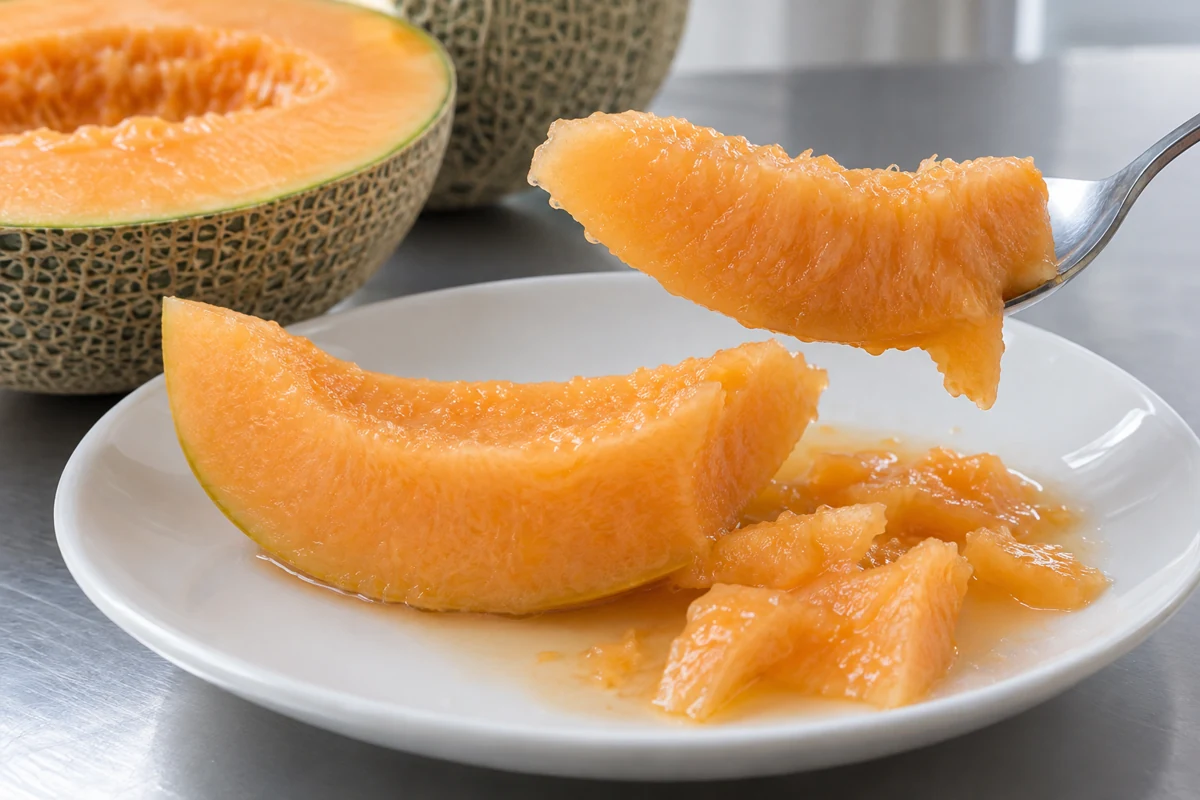
A handling observation needs a defined utensil, motion and thaw condition.
Define the action that reveals softness. A proposed handling test might lift a wedge once with a stated spoon and transfer it to a plate, then classify whether the piece remains coherent under that action. Another buyer may need an instrumental compression method. Select the observation that supports the decision, fix the motion or equipment conditions and train operators against examples. Repeatedly pressing a piece until it fails creates a different test from a single normal transfer.
State what counts as a soft piece. Bending, flattening, tearing at the taper and dispersing into pulp are different responses. A tender wedge that remains coherent may be acceptable in a dessert but unsuitable for a prominent fruit presentation. The limit must come from the application and approved reference. Avoid using fresh crisp melon as the unspoken standard for a completely thawed frozen product, and avoid treating every tender piece as commercially unusable.
Instrument readings require the same care. Probe geometry, contact location, speed, penetration or compression endpoint and sample temperature influence the result. A tapered wedge does not present a uniform cross-section, so position needs definition. Keep readings in their original units and report the number and selection of tested pieces. Do not convert a convenient force reading into a universal sensory label without an established relationship for the actual product and method.
Wen and colleagues' 2015 frozen-Hami study reported different quality outcomes under different thawing treatments. The available abstract supports the need to control the method; it does not establish a universal commercial setting or justify copying a microwave wattage into receiving instructions. For buyer approval, reproduce the chosen relevant endpoint and compare the fruit under it. A method that is convenient in one laboratory still needs agreement before it becomes a contractual test.
Measure drip with an explicit mass balance
Define drip as the liquid collected under the specified procedure, then state the denominator. One useful proposal expresses collected liquid mass as a percentage of the initial frozen sample mass, with the treatment of loose ice declared. Another calculation may use thawed fruit plus liquid recovered from a closed container. Those bases can differ. Print the formula with the result so the number cannot be separated from the method that produced it.
For a simple proposed gravity-drain test, use a clean basket or sieve above a separate receiving vessel, with enough clearance to keep the fruit out of the collected liquid. Record the basket geometry, openings, loading depth and drainage endpoint. Fix whether the container is covered during thawing and how condensate is handled. Do not press, shake or squeeze the fruit unless that action is explicitly part of the method being compared.
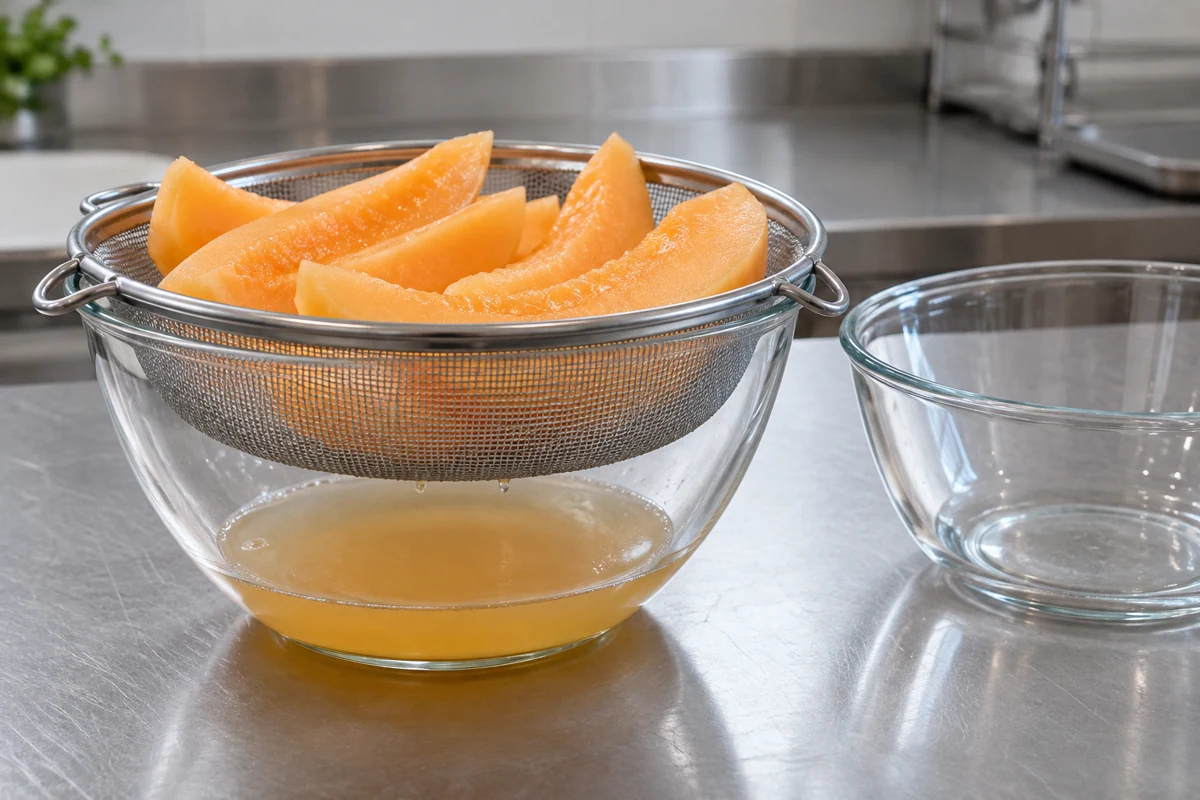
Use the same drainage geometry and endpoint when comparing samples.
Weigh the dry receiving vessel and any other required containers before use. Record the initial fruit sample and the collected liquid at the stated endpoint, then check the retained fruit mass where useful. Container tare errors can have a large effect on a small sample. Transfer losses and liquid left on surfaces should be acknowledged if they explain a mass discrepancy. A balance that does not close should prompt a method review before a strong conclusion about the ingredient.
As a hypothetical arithmetic example, collecting 55 g of liquid from a 500 g starting sample gives 11% collected drip on that starting basis. If retained fruit weighs 440 g, the accounted total is 495 g, leaving a 5 g difference to investigate or report. Dividing 55 by 440 instead produces 12.5% liquid relative to retained fruit. That is a different ratio, and it should not be labelled as the original 11% starting-sample result.
Record how loose ice, pre-existing free liquid and condensation are treated. A partly thawed pack can already contain liquid before the laboratory thaw starts. Discarding it and weighing only the remaining pieces changes the starting material. Similarly, external water entering a leaking container can inflate collected liquid. Inspect the setup and record deviations. The method measures what reaches the receiving vessel; interpreting that quantity as tissue drip requires confidence in the material and handling boundaries.
Do not force drainage beyond the agreed endpoint simply to obtain a stable-looking number. Prolonged handling can change fruit condition and move the result away from the intended use. Where a method-development trial compares several endpoints, retain each observation separately and choose the relevant one with the buyer. The selected method should be practical enough for consistent routine use, with its sample condition and limitations available alongside the reported percentage.
Read the three results together
Rind residue, soft pieces and drip describe different properties. A sample may have clean outer trimming but soften extensively, or it may retain its shape while carrying unacceptable skin. A low collected-liquid result can occur alongside poor piece integrity under the chosen handling test. Keep the three measurements visible together. Combining them into an unexplained overall score can conceal the specific problem that the buyer and supplier need to resolve.
Decide how overlapping defects are handled. A wedge with both rind and soft flesh may count in each separate defect measure, while its mass should be counted only once when calculating a total rejected fraction. Without a rule, adding the separate percentages can exaggerate total unusable fruit. Retain the individual classifications and define any combined rejection calculation. This allows the same record to support both quality investigation and application-yield discussion.
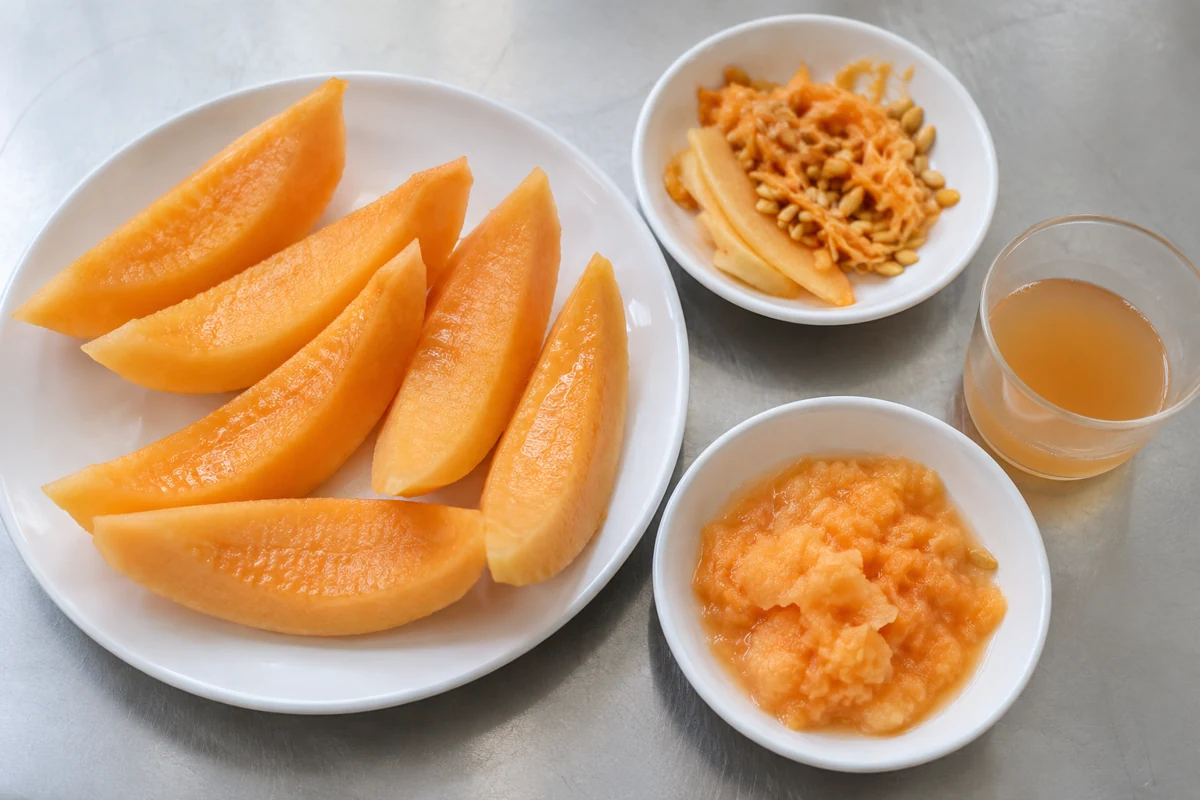
Keep each measured fraction distinct and record how overlapping defects were classified.
Consider the application before interpreting a failure. A soft piece may still be useful in a preparation that disperses the fruit, whereas a retained skin strip can remain objectionable after blending. Recovered liquid may be a useful formulation input even though it reduces drained-piece yield. Any alternative use must meet the buyer's process, safety and contractual requirements. The inspection result should explain the fractions available; it cannot authorize an unapproved disposition.
The GreenLand article on raspberry drip plateaus explains why one stable liquid-loss response cannot prove unchanged internal structure. That reasoning is relevant here, while the raspberry findings themselves should not be transferred to melon. For Hami receiving work, measure the property that matters directly. A firmness observation, a drainage result and a finished preparation trial each contribute evidence within their own boundaries.
Review variation before declaring one lot superior. If two samples differ by a small amount, check repeatability, operator classification and sample selection. A wider spread between packs may matter more to the customer than a slightly improved average. Report the individual observations or a useful range with the summary. If repeat tests use a revised method, separate the method change from any claim that the product itself improved.
Keep quality interpretation separate from safety release. Rind appearance, firmness and collected liquid cannot establish microbial suitability or validate a thawed holding period. Intended use, ingredient declarations, relevant testing and process controls require their own review. The purpose of this physical inspection is to make cut quality and application performance clearer, while preserving the evidence the wider release decision needs.
| Observation | Method needs | What it cannot establish alone |
|---|---|---|
| Rind residue | Tissue boundary; unit or mass basis | Firmness and thaw-liquid behaviour |
| Soft pieces | Thaw endpoint and handling or instrument method | Rind cleanliness or microbiological suitability |
| Collected drip | Initial mass; setup; drainage endpoint | Unchanged tissue structure or shelf life |
Turn the trial into an agreed acceptance record
An acceptance specification needs a method and a decision rule as well as limits. Identify the cut, lot definition, sampling plan, inspected quantities, specimen state, defect classes, denominator and calculation. State who performs the test and which version applies. If the buyer and supplier use different methods, compare them during approval before a delivery disagreement. Two precise results can conflict simply because they describe different sample conditions.
Attach references that operators can use. A photograph of acceptable pale outer flesh, an example of external rind and a defined softness observation can reduce classification drift. Keep the references connected to the approved product and method. An illustrative scene can explain a distinction; contractual acceptance requires photographs and observations linked to the actual sample. Use those linked records when making a lot decision.
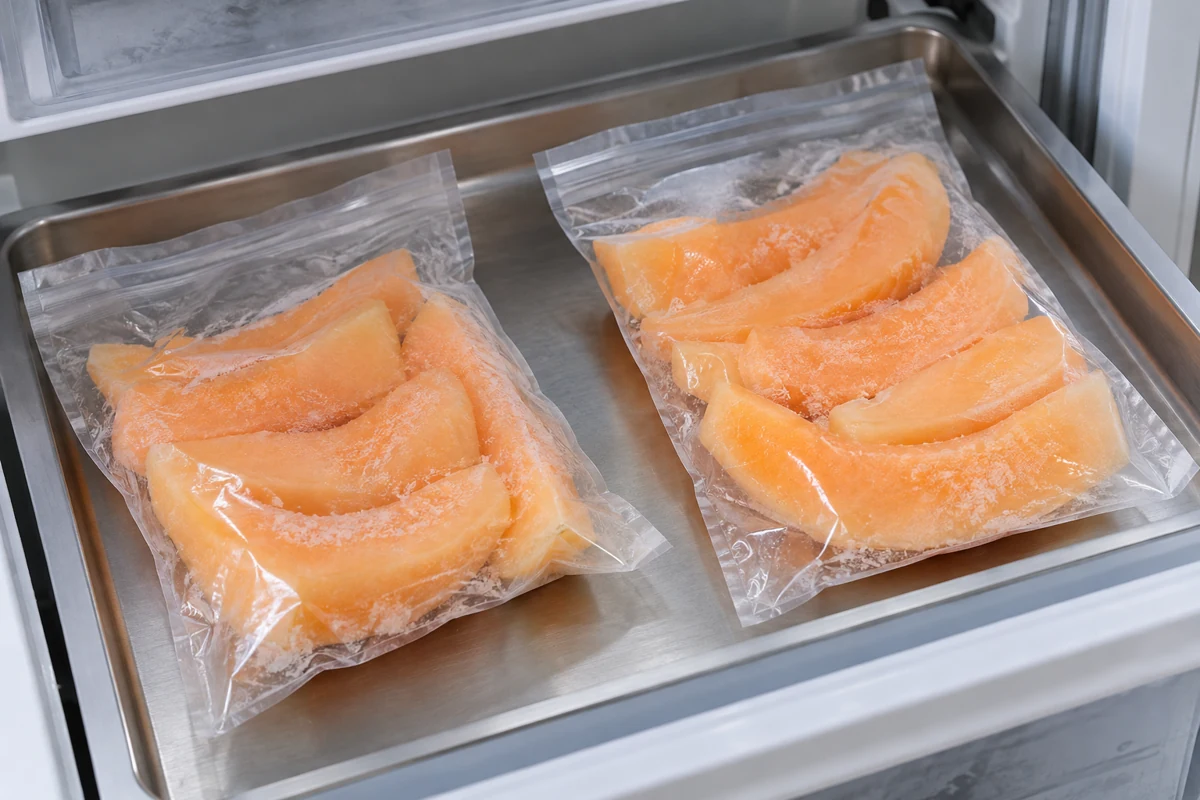
Retained samples support a repeat comparison only when their identity and handling are recorded.
Specify the review route for borderline or failed results. A retained sample, a witnessed repeat, an agreed referee method or additional investigation may be appropriate, depending on the order. Record the original result and every subsequent observation. A later passing sample does not erase a valid earlier failure. The decision should explain which evidence was used and how the agreed rule was applied to the actual lot.
For repeated supply, monitor whether the approved method remains practical. Operators need suitable equipment, training and enough controlled space to keep samples identified. If a routine test takes so long that the sample condition drifts, revise and reapprove the method instead of accepting inconsistent work. Retain the link between old and new versions so historical trends are interpreted with the correct test basis.
GreenLand-food can work with your team on the cut specification, packing, quantity, application, destination and requested documents. Confirm any processing aid, private-label declaration and shipment evidence for the actual SKU. Those inputs help connect the quotation to the approval sample and receiving requirements. They do not imply that a proposed inspection has already been performed or that an unverified numerical limit applies to every order.
The final record should let another competent person understand what was inspected, how it was handled and why the lot decision followed. That is the practical value of separating rind, softness and drip: a supplier can address the actual preparation or handling issue, and the buyer can assess delivered fruit against a reproducible requirement rather than a changing impression of what frozen melon ought to look like.
Continue reading about fruit handling and testing
Separate an agreed physical inspection from a stress trial and any commercial shelf-life conclusion.
Examine why a flat drip response cannot establish stable internal fruit structure.
Follow the effect of starting state and liquid handling when the inspected fruit enters a kettle trial.
Source frozen Hami melon with GreenLand-food
GreenLand-food is a professional frozen Hami melon supplier and manufacturer in China, providing factory-direct wholesale supply for importers, food manufacturers, foodservice distributors, and private-label programs.
Send the product form, specification, packing, quantity, application, destination, private-label needs, and requested documents.