


UK ENS, CDS, GVMS and IPAFFS for Frozen Produce
Oct 20, 2026
Leave a message

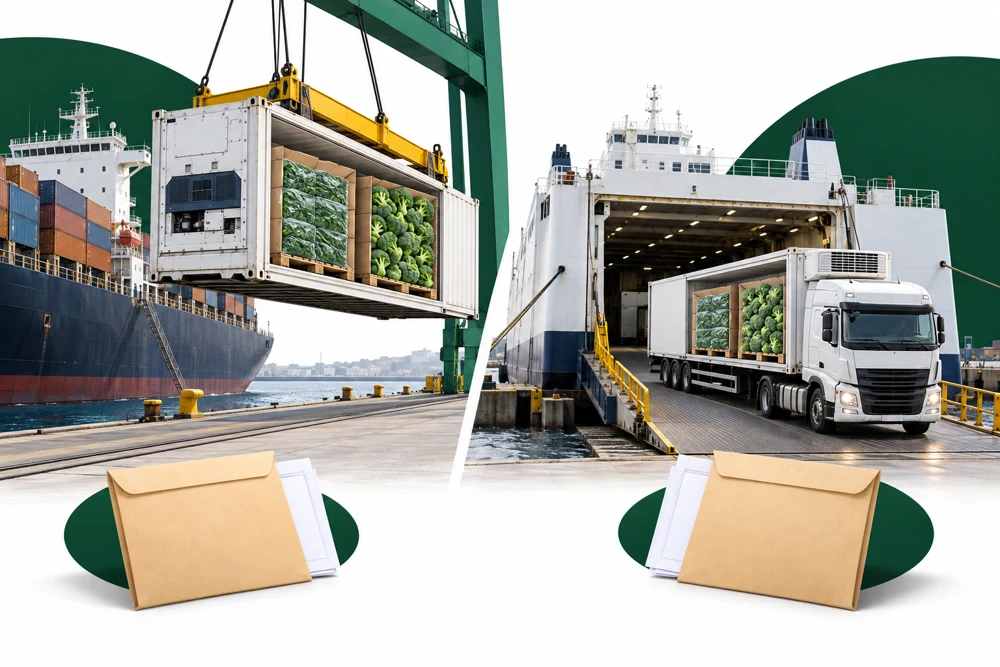
Request separate results for safety/security, customs and any applicable movement or food process. The ENS response, CDS result, GMR where needed and IPAFFS outcome have different owners and cannot be replaced by a single email saying "cleared".
Reviewed 20 October 2026. Shipment requirements are checked for the actual product, route and filing date.
Select the Great Britain or Northern Ireland route
Great Britain means England, Scotland and Wales for this procedure. Northern Ireland has a different safety and security interface. UK guidance directs ENS for imports into GB to S&S GB, while movements from Great Britain or outside the EU into Northern Ireland use ICS2. The current HMRC ENS guide, updated 19 October 2026, states that distinction and the relevant EORI direction for NI. A purchase order saying only "UK warehouse" does not tell the filer which system, customs office or movement rules apply.
Write the physical route in full: China origin site, load port, vessel, first UK or EU stop, discharge port, inland vehicle, final buyer warehouse and any NI leg. An ocean reefer unloaded at Felixstowe for a GB buyer is different from a container landing in Northern Ireland. A reefer reaching a continental EU port and then crossing to GB by road brings a short-sea or RoRo leg and potentially GVMS. The carrier and broker should identify each external border crossing, its ENS, customs and transit responsibilities, rather than treating the original China booking as one uninterrupted UK entry.
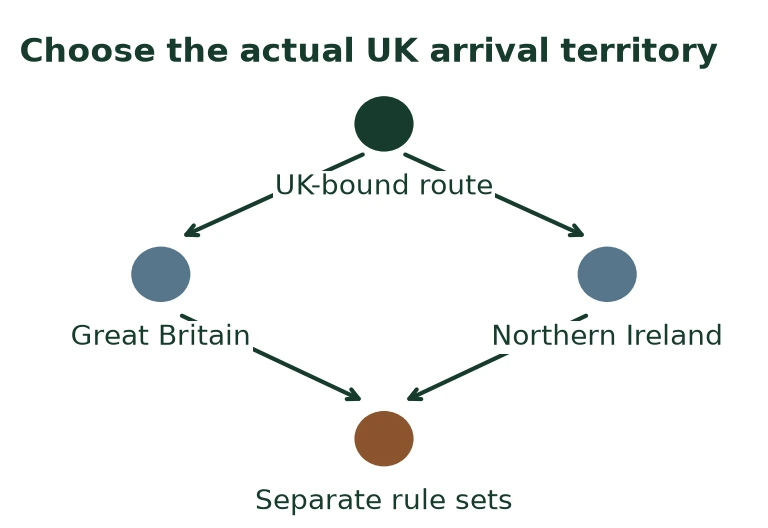
Great Britain uses S&S GB for the applicable ENS route; Northern Ireland follows the relevant ICS2 arrangements.
The rules for qualifying Northern Ireland goods moving to GB have particular easements, while non-qualifying goods can have declaration duties. Those are not automatic benefits for China-origin IQF products simply because a route passes through NI. The UK safety and security guidance provides the qualifying-goods distinction. If a buyer proposes a NI route, its customs adviser should classify the actual movement and goods. GreenLand can provide origin-side details but cannot assign qualifying status through a sales invoice.
The destination also affects the food-control question. IPAFFS is a GB pre-notification system for defined goods, including high-risk food and feed not of animal origin and some regulated plants and plant products. NI competent authorities and EU-aligned routes require separate review. A 2026 frozen-fruit guide for England and Wales says imports from third countries meet GB hygiene requirements and do not normally require a health certificate, but certain higher-risk foods have additional border controls. FSA's fruit and vegetable guidance is a starting point, not a blanket exemption for every IQF product.
Before booking, the buyer should record one route decision with the actual destination, transport modes and parties. The receipt is an agreed route sheet from importer, carrier and customs agent. It identifies the ENS system, first arrival, customs declaration plan, whether a GVMS location is used, and the product-specific control lookup to be completed. If the vessel later diverts or the customer changes its warehouse from GB to NI, reopen the route decision. A filed S&S GB ENS cannot be assumed to satisfy an ICS2 requirement for NI.
Assign the ENS filer and choose S&S GB or ICS2
The carrier or person responsible for bringing the goods into the territory normally carries the ENS obligation and may arrange an intermediary to submit on its behalf. Ask for the actual named filer and its service scope. The HMRC intermediary guidance explains that a carrier or haulier remains legally responsible while an appointed intermediary may transmit. An exporter supplying product data is not automatically the filer. The buyer should know who monitors acceptance and amendments outside ordinary office hours.
For GB, S&S GB is an electronic service using compatible software, a community system provider or an agent's service. HMRC's developer guide documents API-based submissions, validation and MRN returns. A public consumer-style web form is not the ordinary filing route described for traders. The importer need not build software itself if a carrier or agent handles it, but it should require the accepted reference and a contact for errors. For NI, HMRC says to use ICS2, with the applicable XI or EU EORI and technical access arranged by the responsible party.
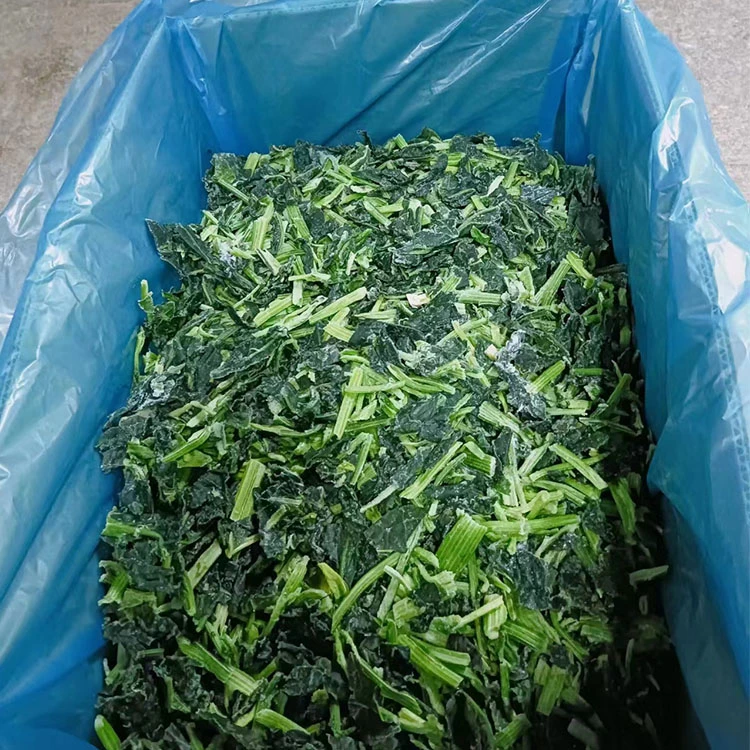
IQF chopped spinach: identify the actual form, packing and intended use in the shipment file. Product photograph; not evidence of a filing result.
IQF chopped spinach for your import programme
Tell us your destination, intended use, cut or grade, packing, quantity and preferred shipment window. We can coordinate the proposed source, sample specification and origin documents with your importer and appointed filing team. The actual lot, factory and required documents are agreed before dispatch.
View product and supply details
Request Specifications & QuoteThe data worksheet should identify actual consignor, consignee, goods description, transport and arrival facts, location code, country, package details and the other fields required by the current S&S GB or ICS2 data set. An IQF cut-green-bean line should say what the food is and how it is packed, not merely "frozen vegetables." A whole-strawberry line should remain separate if the products have different commodity identities. The carrier and filer decide which data elements are legally required for the actual mode; we provide verified origin product and loading facts. HMRC updated its S&S GB data-element file in October 2026, so the filer should use the current version, not a spreadsheet circulated the previous season.
Before submission, reconcile the ENS with the commercial invoice, packing list, transport document and true shipment. If a freight forwarder is the consignee on a master bill but the actual buyer appears on a house bill, send the filer the detail it requires for risk assessment. The buyer should confirm the EORI of the party whose identity is being declared. A supplier should not copy a customer's EORI into a field it has not checked. When the system accepts the ENS, the filer receives an MRN. HMRC's making-an-ENS guide describes that receipt and possible control outcomes.
Keep the MRN in a movement log with the goods, bill, vehicle or vessel and arrival. The ENS MRN is not the CDS customs declaration MRN, and neither is the GVMS goods movement reference. Confusing those identifiers creates a practical border failure: a haulier may have a valid security declaration but no pre-lodged customs reference in its GMR. Ask each filer to return its own acceptance and identify what the carrier or haulier must carry. GreenLand can keep the commercial shipment reference consistent across documents, but it cannot manufacture a government-issued MRN.
Set the correct ocean, road, rail or air clock
The UK timing table differentiates modes. Maritime containerised cargo normally needs ENS at least 24 hours before loading at the departure port; maritime bulk and breakbulk normally use at least four hours before arrival. Short sea journeys use at least two hours before arrival, including containerised imports. RoRo accompanied and unaccompanied freight each use at least two hours before arrival. The relevant route and mode must be checked before a deadline is put on a purchase order.
Road traffic through the Channel Tunnel needs ENS at least one hour before arrival at the Eurotunnel terminal in Coquelles, France. Short rail journeys under two hours use at least one hour before arrival, and longer rail journeys use two hours. For short-haul flights of under four hours, filing is required at actual take-off; long-haul flights of four hours or more require at least four hours before arrival. These are statutory minimums; carriers can set earlier working cut-offs. A China-origin sample sent by air does not take the ocean reefer's 24-hour loading rule.
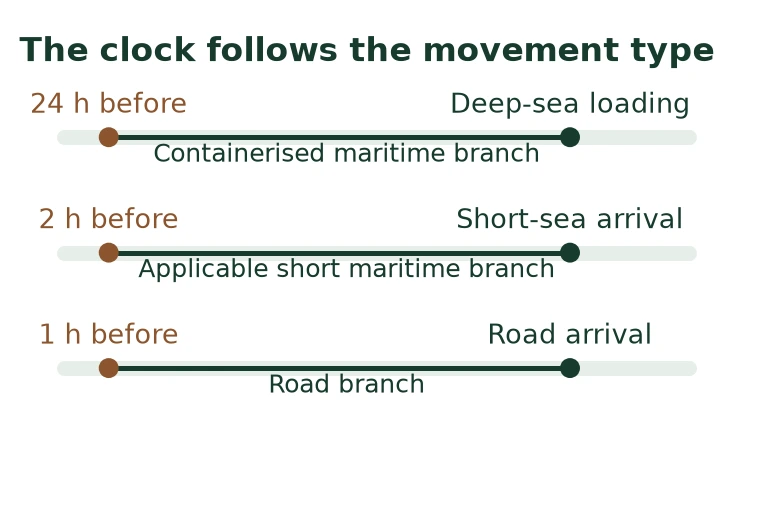
Use the precise route definitions and exceptions in the official guidance; commercial cut-offs can be earlier.
The deep-sea container rule does not apply to "bulk frozen produce" merely because cartons are sold in wholesale quantities. A reefer container with pallets of 10 kg cartons is maritime containerised cargo. A short-sea exemption depends on the defined origin route, not on the buyer's assertion that the final UK road leg is short. The guidance's short-sea section lists the relevant waters and ports. Ask the carrier to identify which leg and first arrival trigger the ENS calculation, especially if cargo transships on the continent.
Calculate the time in the filer's and carrier's calendars, including time zone, daylight-saving change and the latest confirmed ETA. If the vessel rolls, recheck the departure loading time; if a RoRo crossing is moved, recheck the arrival time. Set an internal document cut-off before the legal minimum to allow validation and repair, but mark it as a commercial working deadline. HMRC says a new maritime container booking made less than 24 hours before loading must be moved to a later vessel to meet the minimum. A late supplier document does not create an exception to the law.
The receipt for the clock is a time-stamped accepted ENS MRN matched to the operative movement. A "submission queued" status before rejection testing is insufficient. Where the system returns an error, the filer must correct it and get acceptance in time. The buyer should require a communication chain for urgent changes: exporter to buyer and forwarder, forwarder to carrier and electronic filer, then accepted response back to the buyer. Frozen cargo can incur storage and reefer-power costs while a missed clock is repaired, so the document timetable is part of commercial planning.
| Mode or route | Minimum UK ENS timing | Source event |
|---|---|---|
| Maritime container, general | 24 hours before loading | Foreign port load |
| Maritime bulk or breakbulk | 4 hours before arrival | First UK arrival |
| Short sea / RoRo | 2 hours before arrival | First UK arrival |
| Channel Tunnel road | 1 hour before Coquelles terminal arrival | Terminal arrival |
| Rail under 2 hours / 2 hours or more | 1 hour / 2 hours before arrival | UK arrival |
| Air under 4 hours / 4 hours or more | Actual take-off / 4 hours before arrival | Departure / UK arrival |
Coordinate CDS customs entry and GVMS where used
CDS is the UK's customs declaration service. The importer's broker or authorized declarant uses it to lodge the appropriate import declaration, with commodity code, valuation, origin, procedure, duties and supporting documents under current guidance. HMRC's CDS import instructions are updated as procedures change. An accepted ENS does not provide the tariff calculation or customs release. The buyer should agree the customs declarant and the entity whose EORI appears on the declaration, then supply product facts and invoices in time for that separate submission.
GVMS applies at ports and locations using that service, especially road and RoRo. The haulier assembles the goods movement reference (GMR) with the applicable pre-lodged CDS declaration or transit references and confirms it is valid for check-in. The ENS MRN is a separate security reference. HMRC says adding ENS MRNs to a GB GMR is optional, while for NI they should be included; including them triggers arrival and presentation notifications. If included, the ENS must be accepted before whichever comes first: the modal minimum deadline or check-in close. The route sheet identifies the haulier and every reference it put in the GMR.
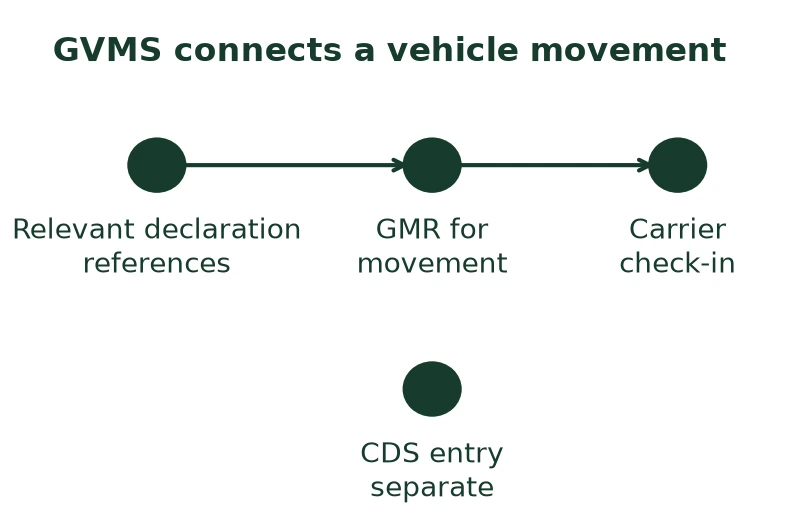
GVMS applies to the relevant movement and location; every ocean container does not automatically need a GMR.
The haulier and broker reconcile each declaration or transit reference to the right trailer and consignment. Keep separate columns for order/lot, ENS MRN and filer, CDS or transit reference and declarant, GMR and haulier, plus conditional IPAFFS/CHED identifier and status. The ENS MRN does not substitute for the CDS/transit reference used to assemble the vehicle movement. Where the haulier includes ENS MRNs, confirm their accepted status before the earlier legal or check-in deadline. Preserve the GMR response and any arrival/presentation notification separately.
For China frozen produce discharged at a GB container port and trucked inland, the customs broker still manages CDS even if no GMR is needed at the discharge location. If the same goods enter GB on a RoRo truck after transit through the EU, the haulier's GVMS work may be central. Distinguish those examples in the buyer's instructions. A forwarding firm may offer customs and haulage as one package, but the buyer should still receive separate status messages and know which party can correct each error. GreenLand can provide the packed goods, value and origin-side evidence; classification and customs procedural choice remain with the UK declarant.
The customs receipt should identify whether the declaration was accepted, whether a hold or examination applies, whether duty and VAT arrangements are settled and when release was granted. Do not treat a pre-lodged declaration as released goods. The haulier also needs the GMR to be valid for boarding and checked for any required inspection. A frozen-food buyer should reserve reefer power and delivery options if the border outcome remains open rather than making a customer production promise based on an ENS acknowledgment alone.
Check conditional IPAFFS and plant or food controls
IPAFFS is not a universal extra filing for every frozen fruit and vegetable carton. It is required for particular regulated categories, including specified high-risk food and feed not of animal origin and relevant plant or plant-product movements. The exact commodity, origin, processing form and current restrictions decide the branch. The GB IPAFFS guidance lists the notified categories; FSA guidance for frozen fruits and vegetables explains that higher-risk foods can require designated border control posts and additional controls.
Start with the actual product and a current official measure lookup. "IQF strawberries from China" and "blanched cut green beans from China" need separate checks, even if they share the same reefer and supplier. The importer asks whether the food falls under a current high-risk non-animal-origin list, whether a plant-health measure still applies to its processed/frozen state, and whether a certificate, laboratory result or CHED-D is required. Some frozen goods may fall outside routine plant-health pre-notification, but that conclusion needs a product-specific basis. Do not make a blanket claim that freezing removes all plant or food-control measures.
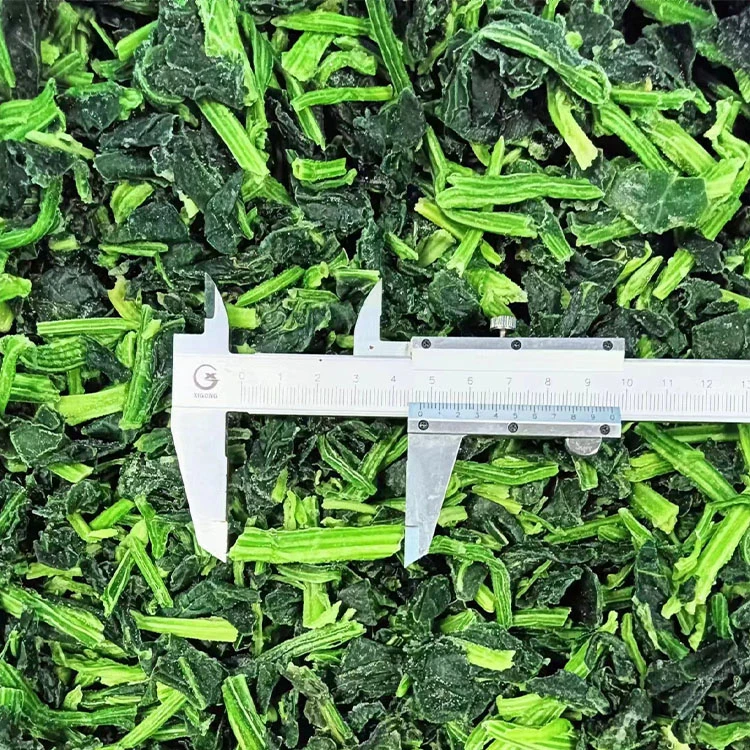
IQF chopped spinach: identify the actual form, packing and intended use in the shipment file. Product photograph; not evidence of a filing result.
Where a high-risk food control applies, the importer or its agent pre-notifies in IPAFFS and follows the applicable documentary, identity or physical check route. GOV.UK high-risk notification guidance states the pre-notification requirement and system. A port-health authority's CHED-D guide helps locate goods currently requiring the common health entry document, but the government regulation and current commodity listing control the actual obligation. Importers should confirm the permitted port and any certificate or test evidence before fixing the reefer routing.
If IPAFFS applies, retain its notification and reference, CHED or other official result, supporting certificates where required and their correspondence to the exact lot and container. If it does not, record the commodity-and-origin lookup, date and reviewer rather than leaving a blank checklist. A buyer may be asked later why a notification was omitted; a dated applicability decision is more useful than a generic statement that frozen vegetables are low risk. We can supply product processing, origin and batch details to support the importer's classification, but the importer and competent authority decide the border measure.
IPAFFS and CDS can interact through document references when a CHED is required. The customs declarant needs the correct supporting identifier and release status, not merely a PDF emailed from the supplier. An ENS acceptance does not settle the food control. The importer should track whether the consignment has been routed for documentary, identity or physical checks and plan cold storage and sampling access. Avoid moving goods from a controlled area before the competent authority releases them.
Reconcile border references and amendment decisions
HMRC permits some ENS amendments before goods arrive, including ordinary quantity or arrival changes, but the original submission still had to meet its legal clock. The person lodging the declaration and representative fields cannot be amended. The first-entry customs office can be amended only within the same destination: a GB office to another GB office, for example. A GB S&S GB ENS cannot be turned into a NI ICS2 ENS by amendment. On a GB-to-NI diversion or a changed immutable filer, the carrier and appointed filer must arrange a correctly routed new declaration under current HMRC procedure and clock, while retaining the original receipt and diversion log. An ENS cannot be cancelled; if goods never move, HMRC requires no cancellation action. HMRC amendment and cancellation rules.
Maintain a change log with old and new vessel, port, carrier, bill, truck, ETA, goods description, quantity and consignee as applicable. The party that learns of a change alerts the ENS filer, customs broker and haulier where their records are affected. A changed discharge port may alter the customs location and vehicle plan. A different buyer may alter the CDS declaration and food-control owner. A smaller packed quantity may require document corrections. Each system has its own amendment or new-filing rules; one updated invoice cannot repair them automatically.
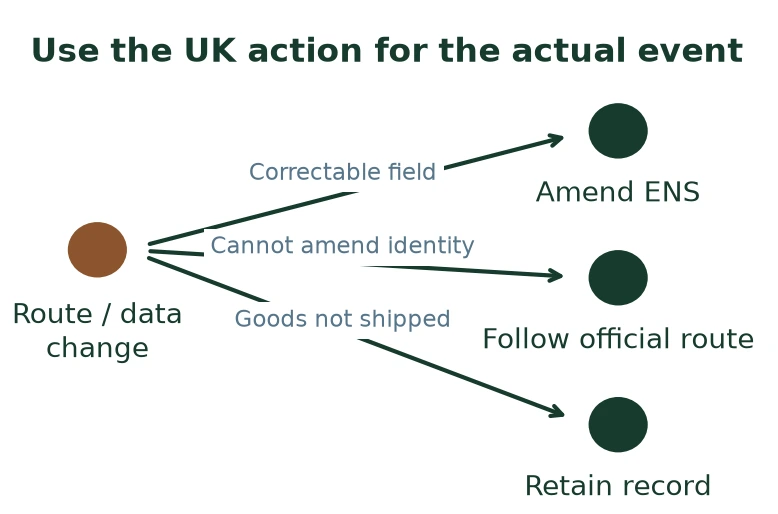
UK guidance does not provide an ENS cancellation action. Do not import the US ISF withdrawal workflow.
When a submission is rejected, the filer saves the exact error, identifies the owning field and retransmits after correction. If a declaration receives no response, HMRC's 19 October 2026 helpdesk guidance calls for the LRN, lodging party's EORI, timestamps and a brief account of the attempted action. For a rejection or obscure data error, send the XML declaration message and error code. The ENS filer, or its XML software provider or agent, owns that helpdesk packet; GreenLand supplies corrected origin facts only once the rejected field is identified. Keep the original message, escalation and fresh response together. A CDS tariff error stays with the customs declarant; an IPAFFS/CHED gap stays with the importer and food-control agent; a GMR assembly error stays with the haulier.
At the border, ask which authority has placed any hold. An ENS risk referral, CDS customs query, IPAFFS food-control decision and GVMS routing instruction have different owners. Record the official reference, timestamp, requested action and next decision point. Keep the reefer operating and preserve temperature evidence while awaiting instructions. Do not publicly describe a customer shipment as released because one dashboard is green; wait for the relevant customs and food outcomes plus carrier delivery authorization.
The final reference ladder contains the operative order and lot, transport document, accepted ENS MRN and filer, CDS or transit reference and declarant, GMR and assembling haulier if GVMS applies, IPAFFS/CHED identifier and status if required, and separate release results. If the goods divert from GB to NI, stop relying on the GB ENS: the first-entry office cannot be amended across territories, so the carrier confirms the NI ICS2 route and new filing before movement. Keep the original GB receipt, diversion decision, new NI acceptance, revised GMR and customs/food results in one versioned log.
| Reference | Who obtains it | What it shows |
|---|---|---|
| ENS MRN | Carrier or authorized security filer | Accepted advance safety and security declaration |
| CDS / transit reference | Customs or transit declarant | Import or transit declaration identity and status; separate from ENS |
| GVMS GMR | Haulier assembling the GMR | Vehicle movement with required declaration references |
| IPAFFS / CHED | Importer or food-control agent if measure applies | Conditional pre-notification and official control status |
Close the frozen-produce shipment handover
For a new UK order, we would confirm the offered frozen product, form, pack, intended use, quantity, destination and requested quality documents with the buyer. The proposed source file identifies the actual seller and production site, lot structure, origin support, invoice, packing list, cold-chain instruction, container and seal. The buyer's carrier then confirms the route and ENS responsibility; the customs broker confirms CDS identity and tariff procedure; the haulier checks GVMS where applicable; and the importer checks IPAFFS and any plant or high-risk food conditions for the exact goods. This sequence gives each party a real input before its deadline.
Use two review points. The pre-load review checks the correct ENS system, mode clock, article descriptions, filing party and acceptance. The pre-arrival review checks final transport, CDS status, haulier's GMR with applicable CDS/transit references if relevant, IPAFFS result if relevant and any revised ETA or lot quantity. The supplier should receive a clear request when origin documents need amendment, including the exact field and authority that raised the issue. We retain the earlier version and reason for correction rather than overwriting it.
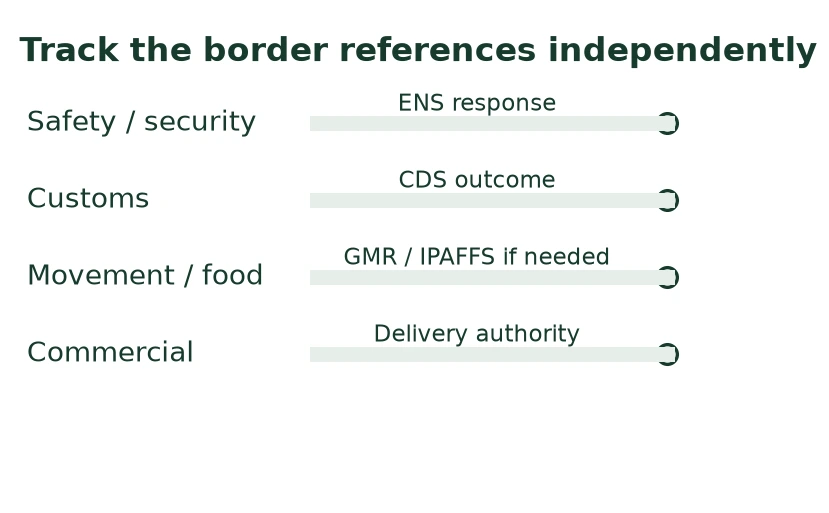
Only include the movement and food procedures that the real product and route trigger.
The UK frozen-produce import guide covers the wider commercial import path. This page addresses the advance security, customs movement and conditional notification sequence in enough detail to assign work. A buyer should still check current commodity measures and its particular port before shipping; guidance updated in October 2026 may differ from an older saved checklist. The responsible filer should keep the current official source and the time of the lookup in the order record.
If an exception arises, prioritize the question that controls the next physical event. Before the foreign vessel loads, resolve a missing deep-sea ENS acceptance. Before a RoRo truck boards, resolve its valid GMR and required declarations. Before the goods leave a border control post, resolve any food or plant-health hold. Before final customer delivery, reconcile customs release and carrier authorization. A chronological list makes it clear when an issue can still be repaired within the window and when the shipment needs a new plan.
Tell us the frozen vegetable or fruit, processing form, application, pack, quantity, UK destination, transport route and documents your importer requests. We can coordinate proposed GreenLand supply information and origin-side corrections. Your appointed UK carrier, customs and food-control parties verify the current requirements and file through their respective services. The useful outcome is a shipment whose electronic references and physical frozen goods still describe the same order at the moment each authority makes its decision.
- Identify GB or NI and the actual mode, carrier, ports and road legs.
- Assign the ENS and customs owners; add GVMS and food notifications only where required.
- Transmit through the appropriate systems, checking the separate references and responses.
- Resolve changes and holds with the responsible filer or authority, then obtain the relevant delivery results.
Use the existing order worksheets
Use T10 to assign each field or document to its provider, reviewer, due time and returned reference. T12 records changed source, product or transport facts; T11 preserves arrival evidence. Keep the legal deadline separate from the agreed earlier handover.
Build your frozen food order with GreenLand-food
GreenLand-food is a professional frozen food supplier and manufacturer in China, providing factory-direct wholesale supply for importers, food manufacturers and foodservice programmes.
Send your product form, specification, packing, quantity, application, destination, private-label needs and requested documents. We will organise the product and order requirements with your purchasing and quality teams.