



Freezing Diced Potatoes
Description
Technical Parameters
Freezing Diced Potatoes: IQF Potato Dice for Food Manufacturing and Foodservice
We supply IQF frozen diced potatoes as a plain, blanched and individually quick-frozen ingredient for importers, distributors, ready-meal manufacturers, soup and stew processors, foodservice kitchens, frozen vegetable brands and private-label programs. Our standard commercial cut is 10 × 10 × 10 mm. We can also prepare 5 × 5 × 5 mm, 8 × 8 × 8 mm, 12 × 12 × 12 mm, 15 × 15 × 15 mm and 20 × 20 × 20 mm dice when the order volume and production plan support the requested size.
We supply plain IQF potato dice separately from pre-fried home fries, coated potato bites and seasoned roast potatoes. The standard ingredient is potato, with no added oil and no added salt. If your project requires sodium acid pyrophosphate, dextrose, an anti-browning treatment, seasoning, oil or coating, we treat it as a separate formula and declare it in the ingredient list and specification. This distinction matters for label review, customs classification, nutrition calculation and cooking performance.
We match the potato profile, dice size, blanching condition and defect limits to the final application. A potato dice for soup needs controlled softening and shape retention. A roast or breakfast application needs lower reducing sugar, suitable dry matter and an application color test. A retail vegetable mix needs accurate size distribution, free-flowing pieces and stable visual appearance. Send us your application, target size, cooking process, packing format, destination and annual quantity for a specification-based quotation.

Actual frozen diced potato appearance: pale yellow, separate pieces with visible natural size variation and no fried coating.
Product Identity: Plain IQF Dice, Not a Pre-Fried Product
| Product name | IQF Frozen Diced Potatoes / IQF Frozen Potato Dice |
|---|---|
| Botanical name | Solanum tuberosum L. |
| Standard cut | 10 × 10 × 10 mm |
| Processing | Selected potatoes, washing, peeling, trimming, dicing, rinsing, blanching, cooling, dewatering, IQF freezing, sorting and packing |
| Standard ingredient | 100% potato; no added oil, no added salt and no added seasoning |
| Product condition | Free-flowing frozen pieces with no large compacted block |
| Intended use | For further cooking in industrial processing, foodservice and retail packed-food applications; not represented as ready-to-eat |
| Storage | Keep continuously frozen at −18°C or below; do not refreeze after thawing |
| Shelf life | 24 months from production when stored at −18°C or below in unopened original packing |
| Country of origin | China |
We quote two frozen potato categories separately. Plain blanched IQF dice are used as a flexible ingredient and normally contain no oil. Pre-fried or roasted cubes are prepared products designed for browning and may contain oil, dextrose, stabilizers, coating or seasoning. We state the process and ingredient list clearly on the offer, specification and label artwork so the purchased item matches the intended use.

Frozen potato dice on a stainless-steel sorting line. We use this visual only as potato-dice process evidence.
Available Dice Sizes and Application Matching
Cut size affects heating time, surface area, breakage and the way a potato piece appears in the finished meal. We therefore define the nominal dimension, tolerance, size-conformity method and application before production. The following options are commercial starting points; the signed order specification controls the delivered lot.
| Nominal cut | Recommended dimensional tolerance | Typical application | Important purchasing point |
|---|---|---|---|
| 5 × 5 × 5 mm | ±1 mm | Fine vegetable mixes, fillings, small ready-meal inclusions | Higher surface area makes fines and softening more visible; a stricter breakage review is useful. |
| 8 × 8 × 8 mm | ±2 mm | Soups, sauces, compact meal components | Balance short cooking time with sufficient piece identity. |
| 10 × 10 × 10 mm | ±2 mm | General foodservice, frozen mixes, soups, curries and ready meals | Our main commercial size and the best starting point for most inquiries. |
| 12 × 12 × 12 mm | ±2 mm | Premium visible inclusions, stews and tray meals | Cooking validation should check the center texture after the buyer's full heat cycle. |
| 15 × 15 × 15 mm | ±2 mm | Hearty soups, curries, catering and roast-style applications | Larger pieces need longer heating and stronger raw-material texture. |
| 20 × 20 × 20 mm | ±2 mm | Large stew pieces, catering sides and visible meal components | Use a blanching profile and final heat cycle that cook the center without excessive edge breakdown. |
| 10 × 10 × 30–50 mm | Cross-section ±2 mm; length 30–50 mm | Potato chunks and elongated inclusions | This is a separate chunk format, not a cube; it requires its own specification and packing sample. |
For 10–20 mm cubes, our Grade A commercial starting point is at least 90% of units by count within the agreed nominal tolerance. For a 5 mm fine dice, we recommend a ±1 mm tolerance and an order-specific sampling plan. Sieving can support size control, but visual counting remains useful because irregular corners and broken pieces may pass through a screen while still affecting appearance.
Custom sizes are practical only when the cutting equipment, usable potato diameter and order volume support a stable run. We do not promise every theoretical dimension for every shipment. For a custom cut, we prepare the drawing or dimensional definition, tolerance, sample size, conformity percentage and defect limits before the production order is released.
Raw Material Profiles for Cooking, Roasting and Frying Applications
Potato variety and crop condition influence dry matter, reducing sugar, color development and texture. One specification cannot optimize every use. We divide inquiries into a general cooking profile and a roast or fry-oriented profile, then connect the raw-material targets to an application test.
| Control item | General cooking profile | Roast or fry-oriented profile | Why it matters |
|---|---|---|---|
| Dry matter | 18–22% | 20–24% | Higher dry matter generally supports a mealier interior and lower oil uptake, while excessively high solids may increase breakage. |
| Reducing sugars | ≤0.50% on fresh-weight basis | ≤0.30% on fresh-weight basis | Lower reducing sugar helps control excessive darkening during high-temperature cooking. |
| Specific gravity | Recorded when requested | 1.080–1.120 target range | Specific gravity is a practical raw-material indicator associated with solids and processing behavior. |
| Post-cook texture | Tender but identifiable; no excessive disintegration | Cooked center with controlled surface breakage | The acceptance result must reflect the buyer's actual process rather than a generic tasting statement. |
| Cooked color | Typical cream to light yellow for the selected potato | Application color standard agreed from a sample | High-temperature color can change even when the frozen raw dice look acceptable. |
These values are not presented as the result of every shipment. They are specification targets used to build the commercial offer. The lot COA records the Actual Result measured for the represented production batch when the item is included in the agreed test plan. For roast or breakfast-potato programs, we recommend that the buyer provide oven, fryer or griddle conditions, product load, oil level, time and target color. We then define a repeatable application test instead of relying on an imprecise statement such as "good frying quality."
Detailed Commercial Specification
| Item | Grade A commercial starting specification | Inspection basis |
|---|---|---|
| Appearance | Sound, clean, reasonably uniform potato dice; free-flowing in the frozen condition | Visual examination of the defined sample |
| Color | Typical cream to light yellow; no abnormal overall darkening | Frozen and cooked comparison against the approved sample or written standard |
| Flavor and odor | Typical potato after cooking; no sour, rancid, fermented or other foreign odor | Organoleptic assessment after the agreed cooking method |
| Nominal size | 10 × 10 × 10 mm standard | Caliper or template measurement and count |
| Size conformity | ≥90% by count within ±2 mm for standard 10–20 mm dice | Defined random sample and unit count |
| Total defects | ≤5.0% by weight | Separation and weighing of all defined defect categories |
| Irregular or misshapen pieces | ≤10.0% by count | Unit count; at least 90% regular dice |
| Undersize pieces and fines | ≤5.0% by weight | Sieve plus manual review using the agreed lower dimension |
| Peel and visible eyes | ≤1.0% by weight | Manual separation and weighing |
| Black or brown discoloration | ≤1.0% by weight | Visual separation before and, when specified, after cooking |
| Mechanical damage and breakage | ≤3.0% by weight | Pieces with materially damaged faces or loss of cube identity |
| Clumps not easily separated by gentle hand pressure | ≤5.0% by weight | Frozen sample assessment without thawing |
| Decay or mould | Absent in the examined sample | Visual and odor examination |
| Foreign material | Absent in the examined sample | Visual inspection and process controls |
| Added oil and salt | None in the standard plain SKU | Formula and ingredient declaration |
| Net weight | Meets declared net content and the applicable destination requirement | Pack-weight records and finished-pack checks |
The total-defect limit is not added on top of every individual limit. It is an overall cap: individual defect categories must comply and their combined measured weight must also remain at or below 5.0%. The signed specification defines whether a piece may be counted in more than one category or assigned to the most serious category only. This prevents double-counting disputes during receiving inspection.
For contract acceptance, we recommend a representative composite sample from multiple cartons across the lot. The sample weight, number of cartons, conditioning method and counting rules should be stated in the specification or inspection plan. A retained production sample and clear photographs of the approved appearance make repeat-order comparisons more objective.
Processing Flow and Control Points
We control the product from raw-potato intake to frozen storage through a defined process route:
- Raw material intake: potatoes are reviewed for soundness, maturity, sprouting, green color, decay, mechanical damage and suitability for the requested application profile.
- Washing and peeling: soil is removed and potatoes are peeled to the agreed level.
- Trimming and inspection: eyes, green tissue, scab, bruised tissue and other visible defects are removed.
- Dicing and size control: potatoes are cut to the nominal dimension; irregular pieces and excessive fines are separated.
- Rinsing: surface starch and loose fragments are reduced before blanching.
- Blanching: time and temperature are controlled to manage enzyme activity, color and the required partial-cook condition.
- Cooling and dewatering: the dice are cooled and surface water is reduced. This supports loose-piece freezing and helps limit surface ice.
- IQF freezing: product passes through the freezing system to reach a frozen core condition and maintain piece separation.
- Frozen sorting: visible defects, clumps and out-of-size pieces are checked against the production standard.
- Packing and frozen storage: finished product is packed, coded and held at −18°C or below pending shipment.

General IQF tunnel equipment. This is process-equipment evidence and is not described as a potato-only production line.
Blanching is not treated as a universal fixed number because cube dimension, potato solids and the buyer's final cooking process change the required condition. The contract should define the output-enzyme control, appearance, cooked texture and application performance-rather than copying a time and temperature that may not fit the lot. If a buyer needs a specific residual enzyme test or firmness method, it can be added to the inspection plan.
Microbiological, Chemical and Food-Safety Criteria
The following microbiological limits are our commercial starting specification for a plain frozen vegetable ingredient. Destination regulations, buyer standards and intended use take priority when they are stricter. Because the standard product is intended for further cooking, the label and handling instructions must not imply ready-to-eat status.
| Test item | Starting limit | Reporting unit |
|---|---|---|
| Total plate count | ≤100,000 | CFU/g |
| Coliforms | ≤100 | CFU/g |
| Escherichia coli | <10 | CFU/g |
| Yeasts | ≤1,000 | CFU/g |
| Moulds | ≤1,000 | CFU/g |
| Salmonella | Absent | in 25 g |
| Listeria monocytogenes | Absent | in 25 g |
For EU-oriented peeled potato supply, our starting limits are lead ≤0.10 mg/kg and cadmium ≤0.10 mg/kg on a wet-weight basis. Pesticide residues must comply with the destination-market maximum residue limits. For the EU, where no specific maximum residue level is established for a pesticide/product combination, the general default is 0.01 mg/kg. Compliance is expressed against the applicable legal limits and test scope. The agreed scope may include a targeted screen or a multi-residue panel according to market and risk.
Physical-hazard controls include raw-material inspection, line hygiene, equipment condition checks, visual sorting and the finished-pack foreign-material control plan. Metal-detection sensitivity depends on the product, bag size, product temperature, aperture and validated machine condition. The actual Fe, non-Fe and stainless-steel test-piece sizes must therefore be stated in the approved production record rather than copied as an unsupported universal claim.
COA, Lot Release and Actual Results
We can provide a product specification and a lot-linked Certificate of Analysis according to the agreed order program. The specification shows the acceptance limit. The COA's Actual Result column shows the value measured for the represented production batch; it is not a repeated copy of the limit. A complete COA layout can include:
- Product name, cut size, ingredient statement and country of origin
- Production lot or batch number, production date and best-before date
- Color, odor, frozen condition, size conformity and measured defect results
- Dry matter, reducing sugar or specific gravity when included in the order plan
- Total plate count, coliforms, E. coli, yeasts, moulds, Salmonella and L. monocytogenes as agreed
- Lead, cadmium and pesticide-residue report references when required
- Test method or method reference, result unit, acceptance limit, Actual Result and release conclusion
- Authorized review, issue date and link to the represented lot
Not every line item needs to be tested by an external laboratory on every shipment. The contract should distinguish routine in-house checks, periodic verification, crop or supplier verification, and batch-specific external testing. This keeps the release plan commercially workable while making the promised evidence unambiguous.

General certification display. Certificate scope, facility name, product coverage and validity should be reviewed for the specific supply program.
Application Testing and Buyer Approval
A frozen cube can pass its dimensional check and still perform poorly in the finished recipe. We therefore recommend an application approval for projects where texture, color or shape retention is commercially important.
| Application | Suggested validation | Acceptance focus |
|---|---|---|
| Soup or stew | Add frozen dice at the buyer's normal process stage; record simmer time and agitation | Cooked center, shape retention, edge breakdown, starch release and color |
| Ready meal | Run the full production, chilling or freezing, storage and reheating cycle | Texture after reheating, sauce interaction, piece identity and package appearance |
| Roast or breakfast potato | Use the real oven, griddle or fryer time, temperature, load and oil level | Surface color, center texture, breakage, sticking and flavor |
| Frozen vegetable mix | Blend at the intended ratio and test the customer's final cooking instruction | Visual size balance, separation, migration of moisture and synchronized cooking |
| Retail private label | Evaluate product, bag, seal, print, frozen display and consumer cooking directions | Pack integrity, label compliance, finished appearance and repeatable preparation |
Approval samples should be identified with the sample date, source lot, nominal cut, formula, blanching status and packing. When the sample is approved, the relevant appearance and cooking result can become part of the contract standard. If the buyer later changes equipment, recipe, cooking time or desired texture, the product specification may also need adjustment.
Packaging, Private Label, MOQ and Container Planning
We offer bulk, foodservice and retail packing according to the channel. All packing must be suitable for frozen storage, sealing, transport and destination labeling. Common starting formats are:
| Channel | Common packing | Notes |
|---|---|---|
| Bulk processing | 1 × 10 kg polybag/carton | Main economical format for processors and repackers |
| Foodservice | 4 × 2.5 kg or 10 × 1 kg/carton | Inner bag count and opening convenience can be matched to kitchen use |
| Retail | 300 g, 400 g, 500 g, 750 g, 900 g or 1 kg | Plain or printed bags; artwork, coding area and language depend on the market |
| Private label | Customer-designed retail or foodservice bag | Artwork approval, film structure, print lead time and minimum film quantity apply |
Our planning MOQ is 10–12 metric tons for a standard bulk SKU and 15 metric tons for a custom dice or private-label program. For mixed-container projects, a practical starting point is 3–5 metric tons per SKU when the products share compatible production timing and packing. A 20-foot reefer commonly carries about 10–12 metric tons, while a 40-foot high-cube reefer commonly carries about 22–24 metric tons. Final payload depends on carton dimensions, pallet use, shipping line limits, route and legal weight restrictions.
Normal production planning is about 15–20 days after the specification, packing, artwork where applicable, deposit and production slot are settled. Printed film, laboratory schedules, crop timing or a custom cut may extend the lead time. The final sales contract and production plan replace these starting figures.

General frozen-food carton staging and reefer-loading area. The cartons are not represented as a potato-cube shipment.
Cold Storage and Export Loading
Finished cartons are held at −18°C or below and prepared for frozen-container shipment. Cold-chain review includes carton condition, product temperature, storage status, container cleanliness, reefer set point, loading sequence, container number and seal number. A single temperature reading cannot describe the complete shipment, so loading evidence should connect the product lot, cartons, container and shipping documents.

General frozen-food cold storage used before export. It is not described as a dedicated potato warehouse.

General container-loading and temperature-check evidence for frozen-food exports.
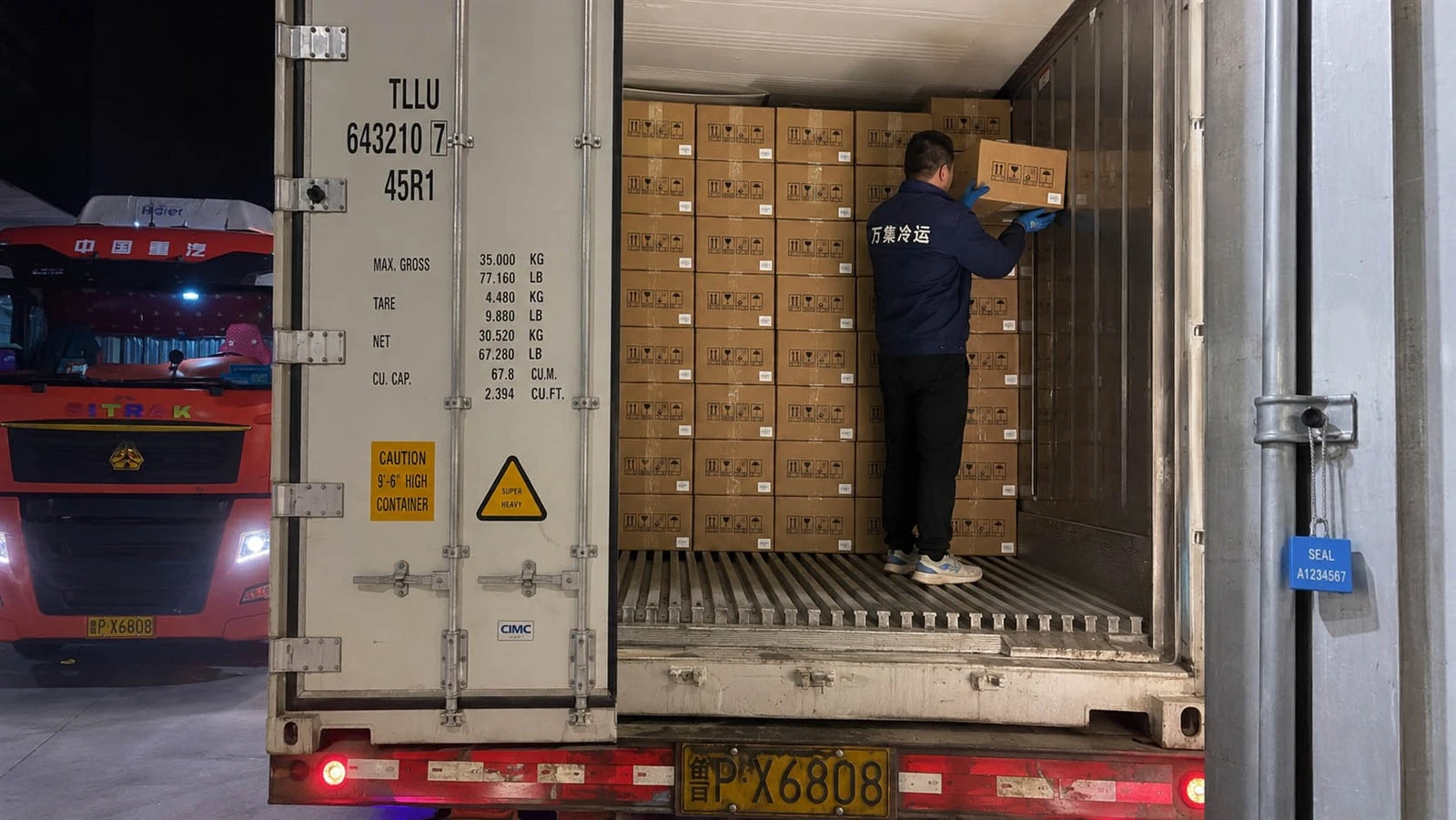
Reefer loading of export cartons. Product identity is established by the order and batch documents, not inferred from this loading photograph.
Traceability, Documents and Change Control
We connect the commercial product description to production and shipment records through the product code, raw-material or intake reference, production batch, packing date, carton code, cold-storage record, COA and container information. The buyer's carton mark can include product name, cut size, lot number, production date, best-before date, net weight, origin and storage statement.
Order documents may include the signed product specification, commercial invoice, packing list, bill of lading support, certificate of origin and destination-required health or phytosanitary documentation where applicable. COA, microbiological reports, residue or heavy-metal reports, packing declarations and certificate copies are included according to the agreed document list. We do not use a certificate logo alone as proof that every certificate covers every facility, product and shipment.
Repeat-order consistency also requires change control. We communicate material changes that can affect the approved product, including nominal cut, tolerance, raw-material profile, ingredient or processing-aid declaration, blanching condition, factory, packing material, printed artwork, analytical scope or shelf life. A change that may affect cooking performance or label compliance requires buyer review before the revised order is released.
Receiving Inspection and Claim Evidence
On arrival, buyers should record the container number, seal condition, reefer information, visible carton condition and receiving temperature before unloading is complete. Random cartons should be selected across loading positions, not only from the container door. Samples should remain frozen until the agreed inspection method begins.
If a concern arises, useful evidence includes the affected lot and carton codes, number of cartons examined, sampling positions, calibrated temperature readings, unopened-pack photographs, frozen-condition photographs, separated defect weights, unit counts, cooking method and the time between receipt and inspection. For clumping, the report should distinguish a large compacted block from pieces that separate under gentle hand pressure. For size disputes, photographs should include a ruler or caliper and the complete measured sample, not a single selected piece.
This evidence allows us to compare the receiving result with the production sample, COA, packing record and loading information. It also helps separate manufacturing variation from cold-chain interruption, handling damage or a mismatch between the product profile and the buyer's cooking process.
Freezing Diced Potatoes FAQ
Are these frozen potato dice pre-fried?
No. Our standard SKU is a plain, blanched and IQF-frozen potato ingredient with no added oil and no added salt. Pre-fried, coated, seasoned or roast-style cubes are separate products with separate formulas and specifications.
What is the standard size for IQF diced potatoes?
Our standard size is 10 × 10 × 10 mm with a recommended tolerance of ±2 mm and at least 90% size conformity by count. Other commercial options include 5, 8, 12, 15 and 20 mm cubes.
Can you supply 5 × 5 mm or 20 × 20 mm potato dice?
Yes. Commercial 5 mm production normally uses a tighter ±1 mm tolerance, while 10–20 mm cuts commonly use ±2 mm. The quoted run states the usable potato profile, minimum volume and dimensional acceptance rule.
What dry matter should we specify for frozen potato dice?
For general cooking, 18–22% is a practical starting range. For roast or fry-oriented applications, 20–24% is a stronger starting profile. The correct target depends on desired texture, oil uptake, breakage and the complete cooking process.
What reducing sugar level is suitable for roasting or frying?
We use ≤0.30% on a fresh-weight basis as a roast or fry-oriented starting target. For general soups, stews and ready meals, ≤0.50% is a practical starting limit. High-temperature application color should also be tested.
Do the potato dice contain SAPP or dextrose?
The standard plain SKU does not include SAPP, dextrose, oil, salt or seasoning. If an anti-browning or color-control formula is requested, it is developed as a separate declared SKU and must appear in the ingredient statement.
How do you control peel, eyes, discoloration and broken pieces?
Our Grade A starting limits are total defects ≤5.0% by weight, peel and visible eyes ≤1.0%, black or brown discoloration ≤1.0%, mechanical damage and breakage ≤3.0%, and irregular pieces ≤10.0% by count. The signed specification defines the sampling and counting rules.
Are IQF potato dice ready to eat?
No. Unless a separately validated ready-to-eat program is agreed, the product is intended for further cooking. Cooking instructions and label statements should reflect the buyer's product and destination requirements.
What microbiological limits are available?
Our starting specification is total plate count ≤100,000 CFU/g, coliforms ≤100 CFU/g, E. coli <10 CFU/g, yeasts and moulds each ≤1,000 CFU/g, and absence of Salmonella and Listeria monocytogenes in 25 g. Stricter buyer or destination requirements can replace these limits.
Can you provide a batch COA?
Yes. The agreed COA can show the acceptance limit and a separate Actual Result for the represented production batch. The test scope may include sensory, dimensions, defects, microbiology, raw-material indicators, heavy metals or residue-report references.
What bulk and retail packing do you offer?
Common options are 1 × 10 kg, 4 × 2.5 kg, 10 × 1 kg and retail bags of 300 g, 400 g, 500 g, 750 g, 900 g or 1 kg. Private-label film, carton marks and artwork are available for runs meeting the printed-film and packing MOQ stated in the quotation.
What is the MOQ for frozen diced potatoes?
A practical starting MOQ is 10–12 metric tons for a standard bulk SKU and 15 metric tons for custom dice or private-label production. Mixed-container planning can start from 3–5 metric tons per compatible SKU.
How much fits in a reefer container?
A 20-foot reefer commonly carries about 10–12 metric tons, and a 40-foot high-cube reefer about 22–24 metric tons. The final payload depends on carton size, pallet configuration, route and legal weight limits.
How should we approve potato dice for soups or ready meals?
Run the cube through the real recipe and complete heating cycle. Record addition stage, time, temperature, agitation and reheating. Approve center texture, shape retention, edge breakdown, starch release, color and finished-meal appearance.
Send Your Frozen Diced Potato Requirement
For an accurate quotation, send us the nominal cube size and tolerance, application, plain or formulated ingredient requirement, dry-matter or reducing-sugar target, defect limits, microbiological standard, packing, private-label need, destination market, order quantity, annual forecast and required shipment date. We will prepare the commercial specification around those purchasing conditions.
Hot Tags: freezing diced potatoes, China freezing diced potatoes manufacturers, suppliers, factory, potato sticks frozen, fried potatoes frozen, frozen french fries, frozen fries, frozen potato, frozen potato chunk
Previous
Frozen Fried PotatoesNext
Crinkle Cut Potatoes


