


Can Brussels Sprouts Be Frozen? Trimming, Quality and Intended Use
Oct 19, 2026
Leave a message

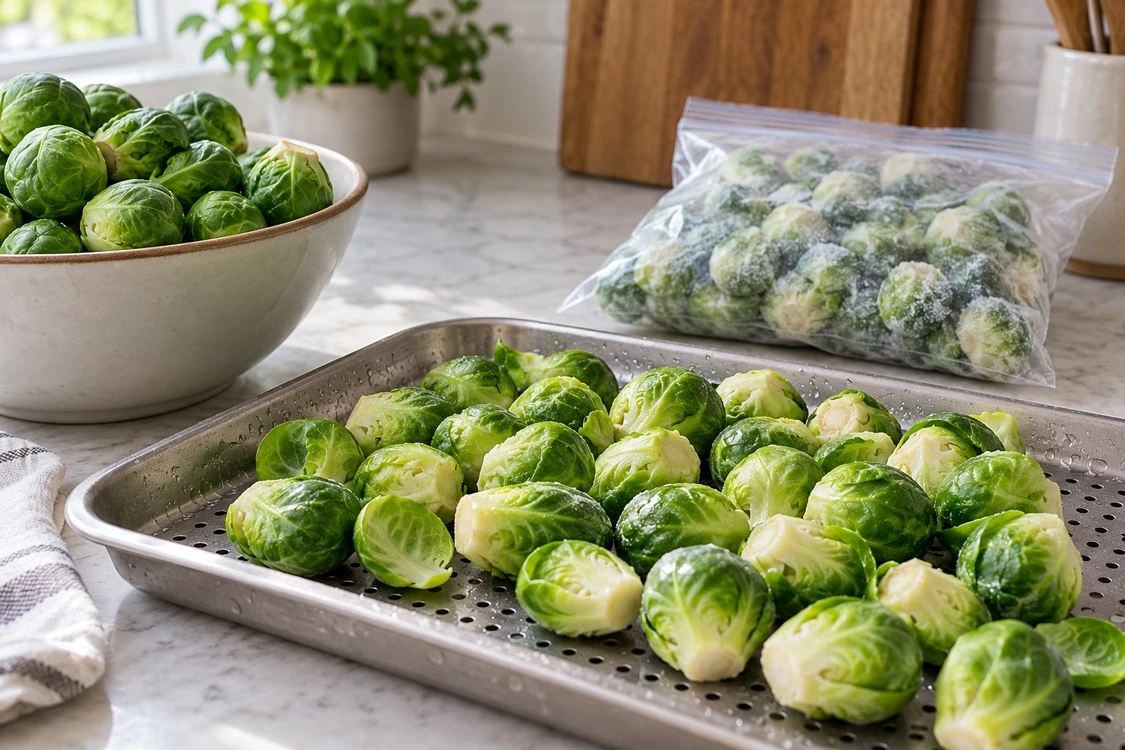
The useful question is not simply whether the vegetable survives a freezer. It is whether the trimmed whole head remains suitable for the dish you plan to make. Size, preparation, packaging and later cooking all affect that result. Commercial frozen supply requires its own product specification and process information; a household blanching schedule is not a factory process validation. This guide separates those contexts and explains the decisions that influence quality before freezing, during storage and at the final point of use.
Yes, when the intended use suits a cooked sprout
Brussels sprouts are layered leafy buds rather than solid, uniform pieces. Their outer leaves, inner layers and denser base respond differently during preparation and cooking. Freezing preserves the vegetable in a useful storage form, but it does not hold every aspect of fresh texture unchanged. The most practical expectation is a head that performs well after the intended cooking method, with an acceptable centre bite and enough structural integrity for the finished dish.
That makes intended use the first decision. A whole sprout for a cooked vegetable side has a different texture target from a raw shaved salad. A frozen head may be entirely suitable for the former while being a poor substitute for the fresh ingredient in the latter. The distinction does not imply that frozen sprouts are inferior in every application. It means that preservation method and culinary purpose need to match before the result can be judged fairly.
For home freezing, the National Center for Home Food Preservation's Brussels sprout directions provide a specific starting point. They call for green, firm, compact heads and a sequence of preparation, blanching, cooling, draining and packaging. Those steps describe how to prepare the vegetable for freezer storage. They are not a promise that every head will have the same cooked texture regardless of maturity, size, storage conditions or the later recipe.
Some online advice focuses on whether unblanched sprouts can physically be placed in a freezer. That is a narrower question than whether the method is recommended for maintaining quality. The NCHFP method includes blanching. Its general blanching guidance explains the role of the treatment in controlling enzyme activity associated with quality changes. Follow the established method rather than treating the absence of immediate visible damage as proof that an alternative is equally suitable for storage.

Whole heads in a wet raw-material reference photograph. Confirm the frozen form and size distribution from the offered sample.
For a commercial buyer, the starting point is different. You may be selecting an already frozen ingredient, rather than deciding how to freeze fresh heads yourself. Ask what form and size are offered, what preparation is applied, how the product should be stored and how it is intended to be cooked. The specification and supporting documents should answer those questions. A general article about freezing cannot establish the process or shelf life of a particular supplier's product.
At GreenLand, we would connect the freezing question to the meal: will the heads be served whole, browned after heating, incorporated into sauce or reheated in a prepared dish? That information helps define the sample evaluation. A head that looks good while frozen may become too soft for one application and remain perfectly useful in another. Approving the ingredient through the intended cooked use gives the purchasing decision a practical basis instead of relying on the freezer appearance alone.
It is also worth deciding what "whole" means in the finished meal. Some uses require recognisable intact heads, while others tolerate a few separated leaves or subsequent cutting. These differences affect how much value to place on compactness and trim. Set that expectation before the trial. Otherwise, a technically successful freezing method can be judged against an appearance target that was never stated and may not be realistic for the chosen application.
Trim and sort before freezing
Start with the condition of the fresh heads. The NCHFP directions specify firm, compact, green sprouts and include inspection for insects. Freezing is a preservation step, not a way to restore deteriorated raw material. Select heads appropriate for food use, remove unsuitable material and wash as directed. Keep the preparation area, utensils and handling practices suitable for food. The quality of the starting material remains relevant after the product is frozen and cooked.
Trimming removes coarse outer leaves and prepares the attachment end. The aim is a sound usable head, not the smallest possible pale core. Excessive trimming can remove valuable leaf material or weaken the structure that keeps the head intact. Too little trimming can leave an inconvenient stem end or coarse leaves in the finished dish. Observe the actual head rather than applying a deep cut of the same length to every size.
Separate raw-material rejection from normal preparation loss when assessing yield. A damaged head discarded entirely is different from the small amount removed while trimming a sound head. If these are combined in one figure, it becomes difficult to understand whether a poor recovery came from incoming condition or the preparation method. For a commercial trial, weigh and describe these stages consistently. Do not compare an untrimmed purchase weight with a finished cooked portion without accounting for the steps in between.
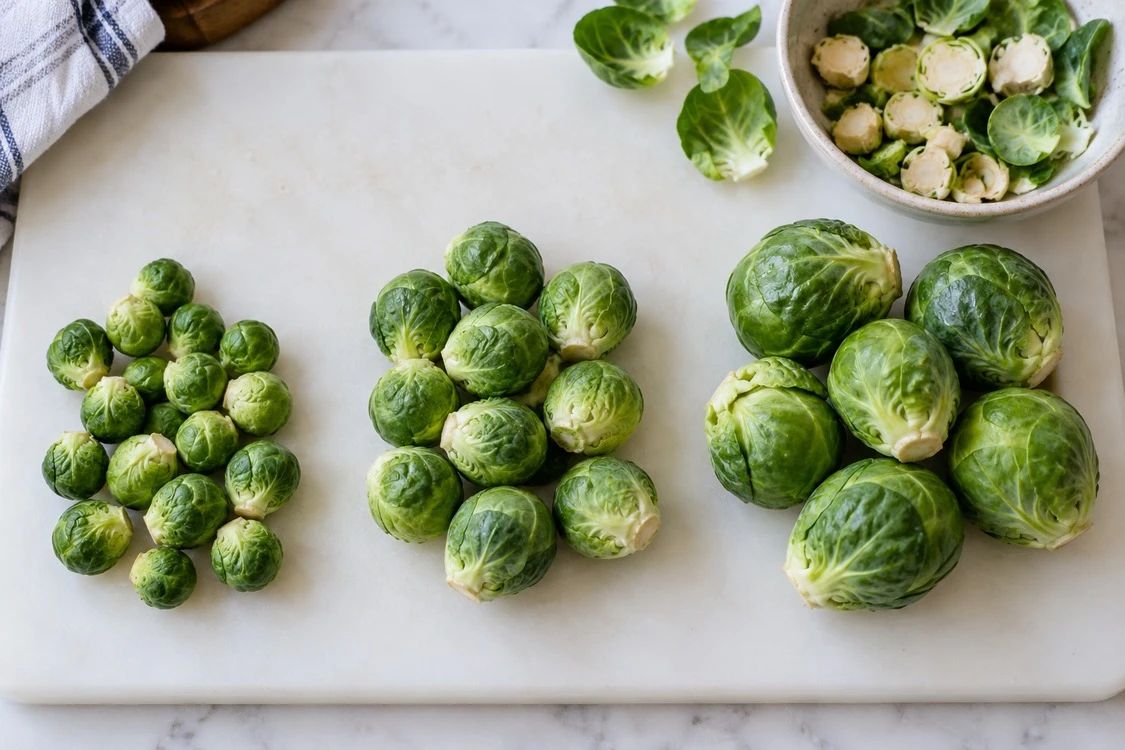
Illustration: Sorting helps keep small and large heads on appropriate preparation schedules.
Sorting by size matters because whole heads differ in the distance from their surface to their centre. The NCHFP home method gives different water-blanching times for small, medium and large heads. It does not publish diameter cutoffs on that instruction page, so a guide should not invent them and present them as official definitions. Use the source's directions in their proper context and seek a clear size description when evaluating commercially sorted product.
Compactness should be observed separately from diameter. A loose head and a tight head of similar outside size may not retain their structure in the same way during handling. Sorting only by a ruler does not capture every relevant quality attribute. For a whole-head dish, include integrity and trim in the later cooked assessment. A naturally varied crop can still be suitable, but the delivered range and condition need to support the intended preparation.
Do not assume that instructions for whole heads apply unchanged to halves or shredded sprouts. Cutting changes the exposed surface and geometry. If a different form is required, use appropriate guidance or a process developed for that form. The convenience of cutting before freezing does not justify borrowing a whole-head schedule without considering the difference. Commercial specifications should declare the cut clearly so that the buyer does not have to infer it from a product name.
A representative preparation trial can help identify the right raw-material requirements. Note how much coarse leaf material is removed, whether the base can be trimmed neatly and how many heads remain intact. Photograph typical examples rather than only the best one. These records make a supplier discussion more specific: the issue may be excessive outer-leaf removal, an inconsistent size range or heads that open during handling. Each has a different implication for the final usable portion.
Blanch and cool with the head size in mind
For household freezing of whole Brussels sprouts, the NCHFP specifies water blanching for three minutes for small heads, four minutes for medium heads and five minutes for large heads. These are the source's size categories and times for this particular home-preservation method. They are not a universal cooking schedule, a ready-to-eat claim or an industrial validation. Keep the distinction explicit when using the numbers in a recipe-development or procurement conversation.
Blanching is a brief treatment before freezing, with quality preservation as a central purpose. The general NCHFP guidance explains that underblanching and overblanching can both be undesirable. More time is therefore not automatically better. For water blanching, start the timer when the water returns to a boil. NCHFP says it should return within one minute; a slower recovery means the vegetable load is too large for the water quantity. Keep the heat high for the specified time, then cool promptly as directed. The size, load and heat recovery need to remain compatible with the method being followed.
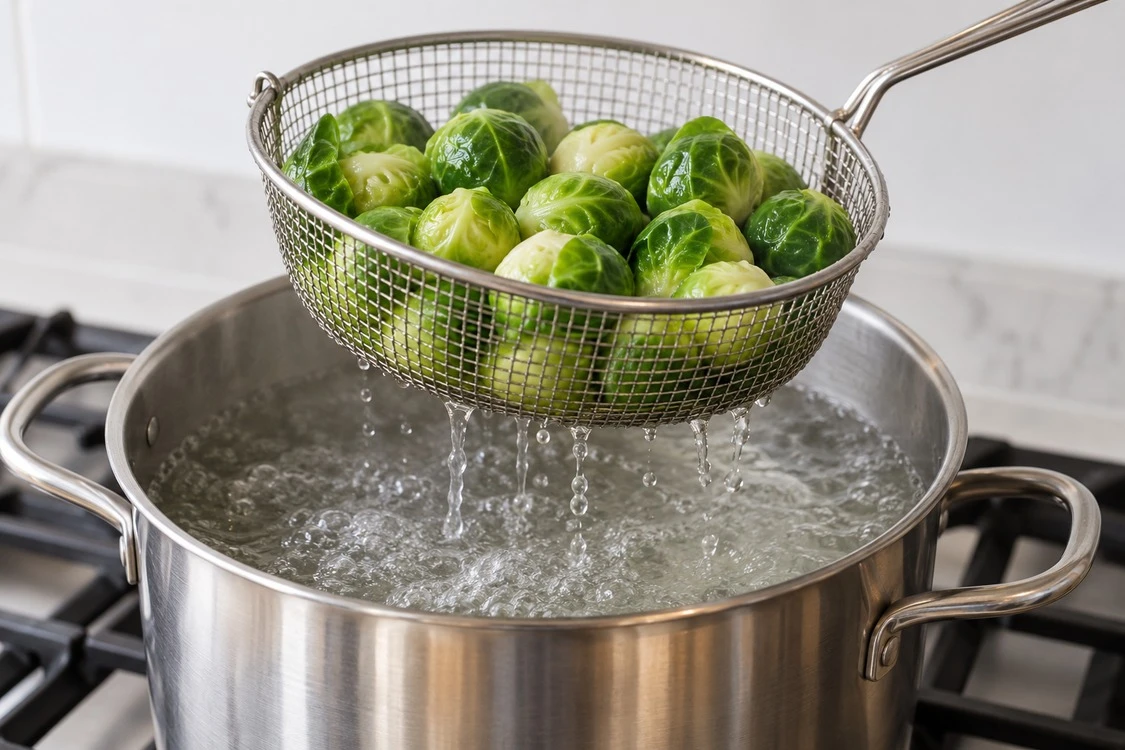
Illustration: A basket of whole sprouts is lifted from the blanching water before prompt cooling.
The published Brussels sprout directions use water blanching. Do not convert the stated durations to steam, a microwave or another treatment by assumption. Different methods expose the food to heat differently. If another method is needed, it requires suitable guidance or validation for that product and use. A similar-looking cooked surface does not establish that two treatments have achieved the same quality-preservation effect throughout the head.
Cooling follows promptly in the NCHFP sequence. Its purpose in the preparation process is to end the heating stage rather than allowing hot heads to continue changing while they wait for packaging. Handle the product according to the source method and normal food-hygiene practices. An overloaded cooling step can become inconsistent just as an overloaded blanching step can. Observe the whole sequence, including what happens to the largest heads and to the final portion of a batch.
After cooling, drain before packaging. Water remaining on and between leaves can affect the condition of the frozen pack and the amount of liquid later introduced into a dish. Drainage should be sufficient and consistent with the chosen method, without crushing the heads in an attempt to remove every trace of moisture. Pressing and squeezing can create a different product from an intact whole head and make a yield comparison difficult to interpret.
For a commercial product, ask for the offered treatment information at the level relevant to the purchase. A buyer may need confirmation of whether the heads are blanched, their intended cooking status and the agreed quality specification. Detailed process controls belong to the supplier's validated production system and the customer's requirements. Do not replace them with household times, and do not assume a particular machine or blanching technology from a general description of frozen Brussels sprouts.
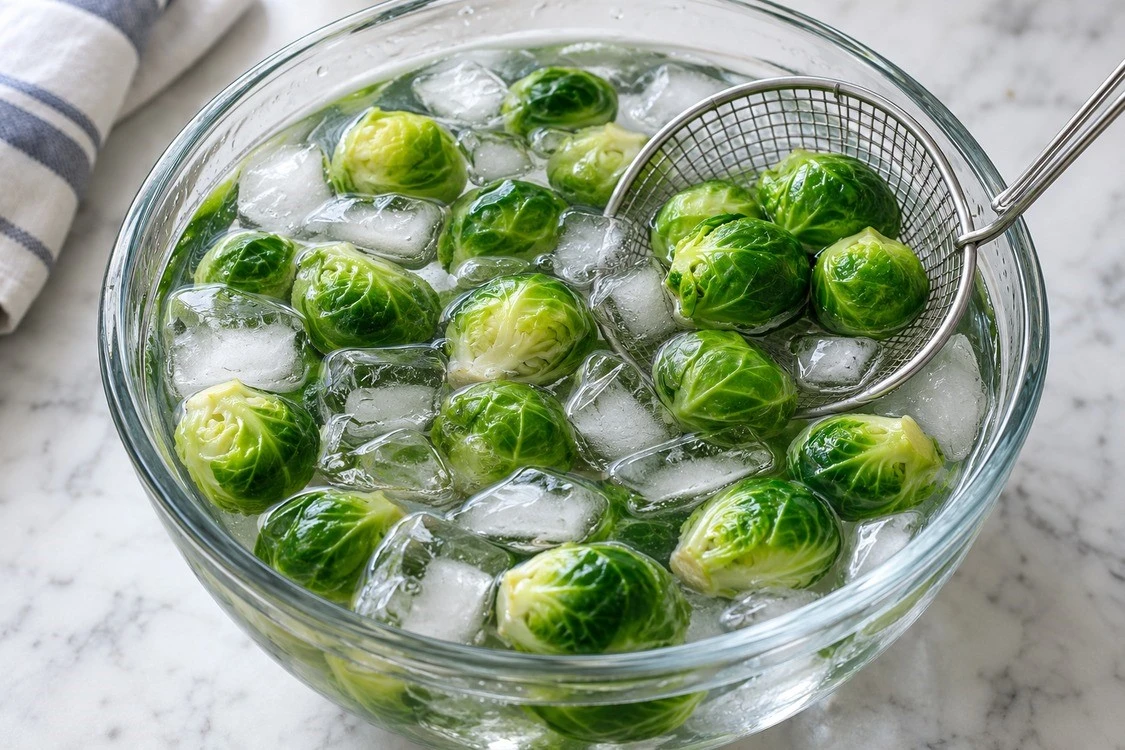
Illustration: Prompt cooling limits continued softening after blanching.
The USDA frozen Brussels sprout standard provides useful context by defining the product in terms of trimmed, washed, blanched and drained heads before freezing. It also uses attributes such as character and defects to describe quality. This helps explain the established category, but it does not certify an individual pack or prove its actual process. Any claimed grade or treatment should be supported by the product's own documentation.
When evaluating a sample, keep observations within what the trial can show. A tender centre, attractive colour and intact head are useful application results. They do not reveal the complete earlier blanching history or establish that a process has been validated. If a cooked result is poor, use the observation to ask focused questions rather than diagnosing a specific factory setting from the plate. Several stages can contribute to the same visible outcome.
Drain, pack and protect the frozen condition
The NCHFP home directions call for draining, packing without headspace, sealing and freezing. Use packaging suitable for the intended frozen storage and follow the complete preservation guidance. A bag or container that is convenient for immediate kitchen use may not provide the same protection in a freezer. The objective is to preserve the prepared food's condition and make later handling practical, rather than simply to fit the largest possible quantity into one package.
Portion size deserves thought before packing. A large frozen mass can be inconvenient if only a small amount is needed at a time. Packaging according to likely use reduces unnecessary handling of the remaining food. Where a method includes a separate tray-freezing step to improve portion separation, it should be performed as part of appropriate guidance and packaging practice. A household tray of separated heads is not evidence of the industrial IQF process or a guarantee of equivalent product performance.
Label the package with enough information to identify the contents and preparation date. For a commercial ingredient, retain the lot and product information supplied with it. These details connect a later observation to the correct material and make stock use more orderly. An attractive frozen appearance does not tell the operator when a pack was prepared, which process it received or whether a partially used package has been handled consistently.
Maintain the storage conditions specified for the product and operation. Repeated warming during portioning can alter the condition of a frozen pack even when the product is returned to the freezer afterwards. Plan removal and handling so that the amount not being used remains under the required controls. This is especially relevant to bulk bags opened repeatedly in a busy kitchen. Package size can therefore be a quality decision as well as a purchasing decision.
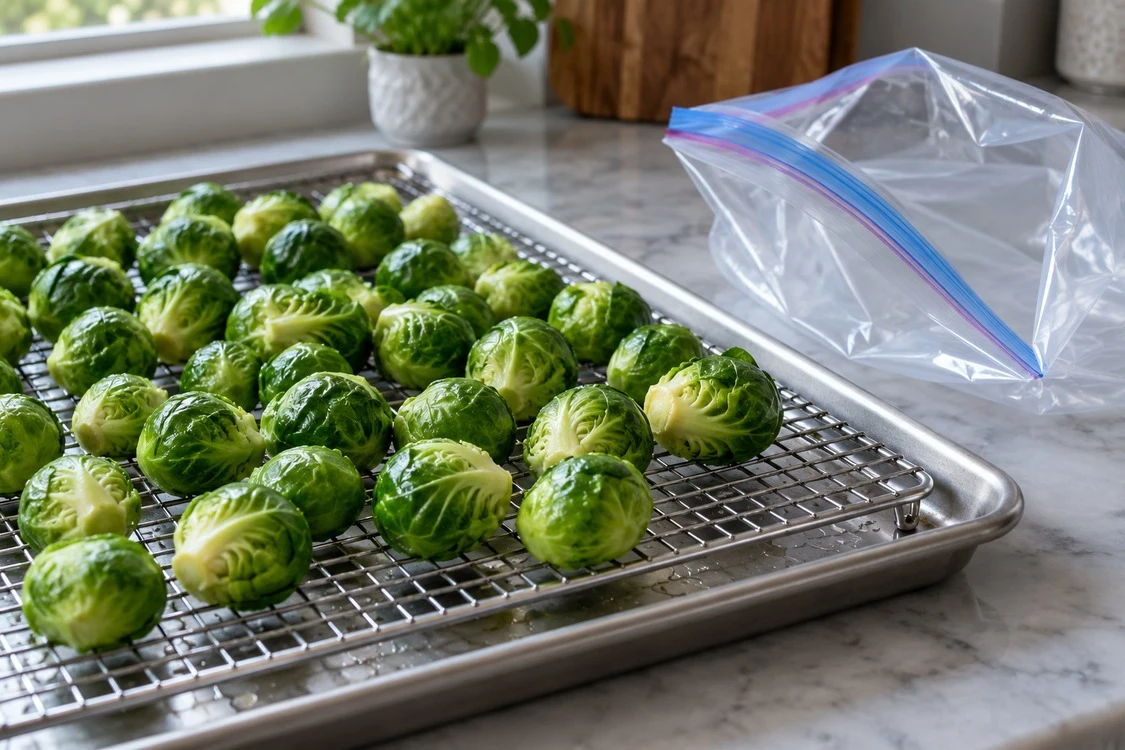
Illustration: Remove excess surface water before the heads enter the freezer pack.
Ice, surface dehydration and clumping should be described carefully when they are observed. They can affect appearance and handling, but a photograph alone cannot reconstruct the full storage history or assign responsibility. Record the package condition, the point at which it was opened and how the sample was transported. If comparing suppliers or lots, apply the same handling conditions. Otherwise, differences introduced after receipt may be mistaken for differences in the original product.
Avoid attaching a universal shelf-life claim to the general statement that sprouts can be frozen. A commercial shelf life belongs to a defined product, package and storage condition with an appropriate basis. Household guidance may discuss storage quality in its own context, but that does not establish a supplier's commercial date coding. Request the applicable information for the actual product and use it with the stated conditions rather than transferring a number from an unrelated frozen vegetable.
At receiving, a commercial operation should follow its established frozen-food checks and record any nonconformity. The article cannot replace those procedures or define an acceptance temperature for every jurisdiction and business. For quality development, retain the information that affects interpretation: lot, packaging, storage instructions, observed condition and subsequent handling. This allows a cooking trial to be understood as a trial of a known sample, rather than a general verdict on all frozen Brussels sprouts.
Good packaging and storage cannot rescue a poorly chosen application, but they help preserve the condition created by sound preparation. The final test still happens when the head is cooked and served. Treat frozen-pack appearance as one stage of the assessment, with the later meal providing the evidence for tenderness, integrity and portion usefulness. Keeping those stages separate makes both household expectations and commercial approval more realistic.
Choose how the frozen heads will be used
Choose a cooking method that suits the dish and follow the actual product directions. For many frozen products, preparation begins from frozen, but that should be confirmed from the label rather than assumed for every pack. Do not add an uncontrolled thawing period simply because a recipe written for fresh sprouts begins with room-temperature ingredients. The starting condition changes the method and should be part of the development record.
An oven or air fryer can suit a browned side dish, while moist heating can suit a tender vegetable component or an ingredient that receives a later finish. A pan may be useful for seasoning and surface colour after a suitable earlier stage. The right choice depends on the whole preparation sequence. A frozen head is not a promise that every cooking method will reproduce the appearance and bite of the same fresh head prepared immediately after harvest.
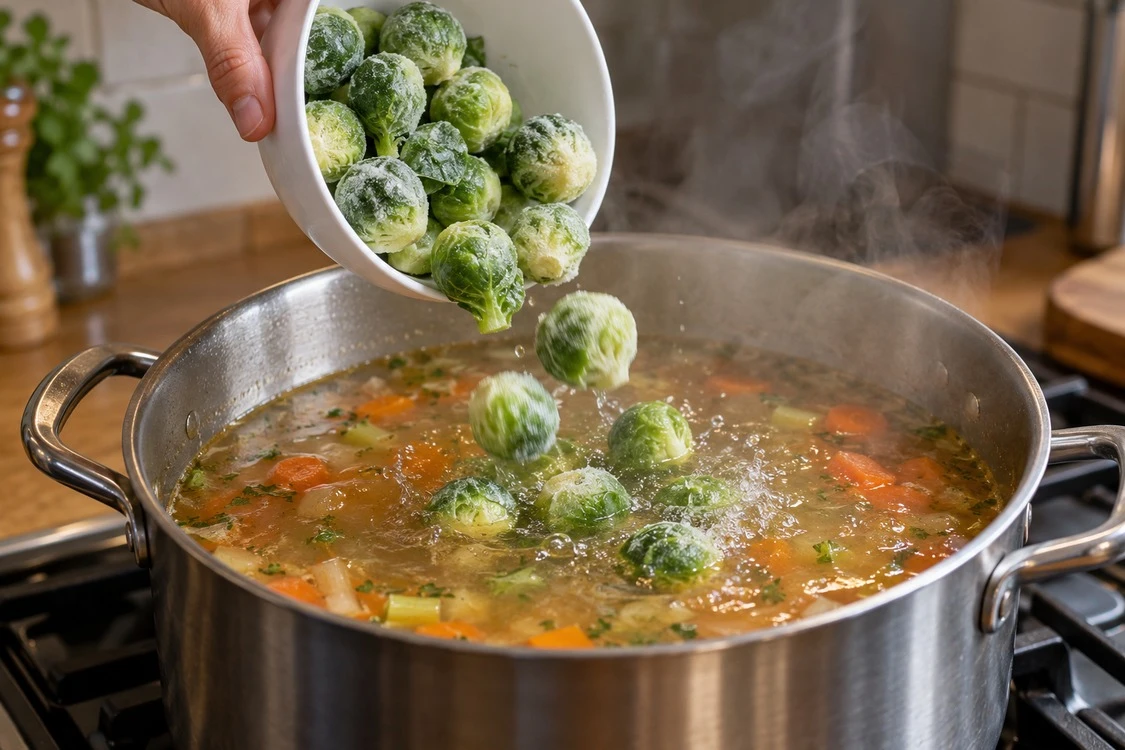
Illustration: Use the frozen heads in a cooking route that brings the centres to the intended condition.
Check the centre of representative large heads as well as the outside. A browned leaf can appear ready before the middle has the desired texture, and a pale steamed head can be tender throughout. For quality assessment, examine fork resistance, head integrity and the eating result. These checks are separate from any required safe preparation process. Follow the label and the operation's validated controls rather than using appearance or a fork test as a substitute.
If the sprouts enter a sauce, observe the assembled dish. Water carried over from cooking and liquid released during subsequent handling can change the sauce's consistency. Use a defined drainage step and compare the result at service. Do not automatically attribute every watery sauce to the frozen ingredient. The recipe, preparation water, proportion of vegetables and holding conditions can all be relevant, and a controlled trial is needed to distinguish them.
For a ready meal, test through the complete intended cycle. The intermediate cooked head may look good but soften further during later heating. Alternatively, a large head may remain too firm under the final consumer instructions. Record the actual portion, compartment arrangement and surrounding ingredients. Approving a component before assembly is useful, but it does not establish that the finished meal delivers the same texture or heating performance.
Whole-head appearance can be an advantage when the vegetable is intended to remain recognisable. It can also add work if the final product needs smaller pieces. Decide whether the supplied form suits the recipe before freezing or purchasing a large volume. If cutting is required, consider an appropriate offered cut or a safe, controlled preparation stage. Forcing a knife through a hard frozen head is not a sensible way to solve a form mismatch at the last moment.
The most informative comparison uses the same recipe and serving point for each candidate. Compare cooked texture, usable portion and appearance under a defined method, then adjust one important variable at a time. A fresh-versus-frozen comparison can be useful if that is the purchasing decision, but each ingredient should be prepared appropriately. Applying an unsuitable method to one sample and then attributing the difference entirely to freezing gives a misleading result.
Approve commercial supply through the final dish
For a commercial purchase, translate the intended use into a concise specification. State whole heads or the required cut, the relevant size range and measurement method, trim expectations, packaging and storage requirements. Add the application that the sample must support. If the acceptable range is still being developed, say so. A supplier can respond more usefully to a defined meal and trial plan than to a request for an undefined "best quality" sprout.
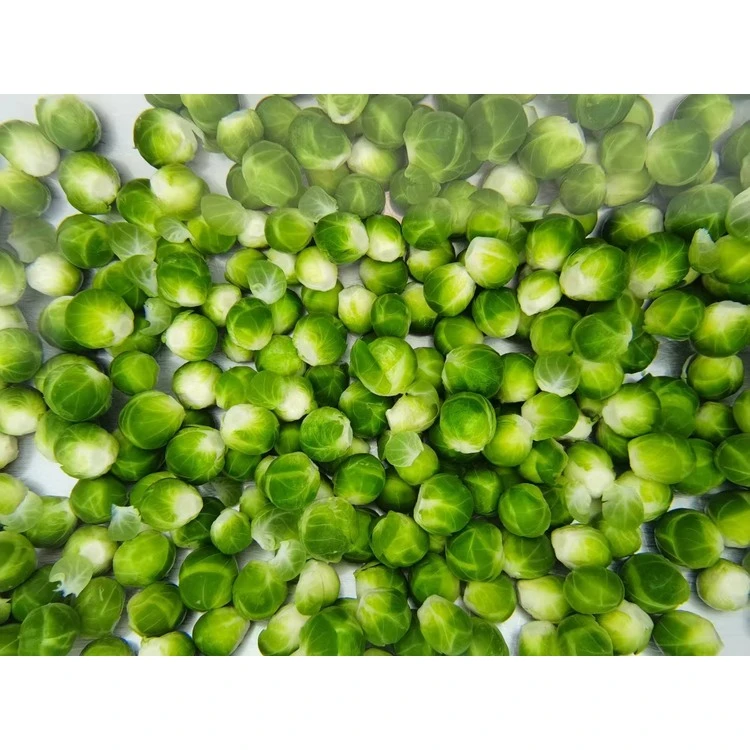
Whole heads in a wet raw-material reference photograph. Confirm the frozen form and size distribution from the offered sample.
Request a representative sample and record what it represents. A small sample can help establish suitability, but it does not by itself demonstrate the distribution of every attribute in all future deliveries. Agree the product specification and the method used to assess important limits. Where a formal grade is requested, identify the standard and supporting evidence. Do not infer a grade from a marketing adjective or from the absence of obvious defects in a single photograph.
Measure recovery at the point that matters to the operation. Incoming frozen weight, drained cooked weight and plated usable weight are different quantities. If a portion depends on intact heads, record broken pieces and loose leaves separately. If it is served by count, note the relationship between count and mass. The resulting figures describe that trial under its method; they should not be presented as a universal yield percentage for all frozen Brussels sprouts.
Document the reason for acceptance. It might be consistent centre tenderness after the final heating stage, enough intact heads for the plated portion or a size range that works with the other vegetables. Include any conditions needed to achieve the result, such as the load or preparation sequence. This turns sample approval into a useful production reference. It also makes later discussions more precise if a delivered lot performs differently under the same method.
At GreenLand, the practical next step would be to compare the offered frozen Brussels sprout specification with that application record and confirm the details still outstanding. Product photographs can support the conversation about form, but the sample and documents must carry the questions of size distribution, process status and cooked performance. No general description of our category should be treated as a substitute for those confirmations.
Brussels sprouts can be frozen successfully when sound preparation is matched with suitable storage and a cooked use. For home preparation, follow the established whole-head blanching and packing guidance. For commercial supply, approve the actual ingredient through the complete dish and its serving conditions. The useful outcome is a head that remains fit for the intended meal, with its size, trim and handling requirements understood before a larger quantity is committed.
Continue reading
Understand how sorting, preparation, blanching, dewatering and frozen handling fit into the IQF processing chain.
Understand what a controlled handling-stress trial can reveal, and why it cannot establish shelf life or authorize temperature abuse.
Separate drip loss, cooked recovery and piece integrity when evaluating an ingredient in its actual recipe.
Source Frozen Brussels Sprouts with GreenLand-food
GreenLand-food is a professional frozen Brussels sprouts supplier and manufacturer in China, providing factory-direct wholesale supply for importers, food manufacturers and foodservice distributors.
Tell us your application and destination. We can discuss product form, specification, packing, quantity, private-label needs and requested documents with your purchasing team.