


Can You Eat Bamboo?
Aug 31, 2026
Leave a message
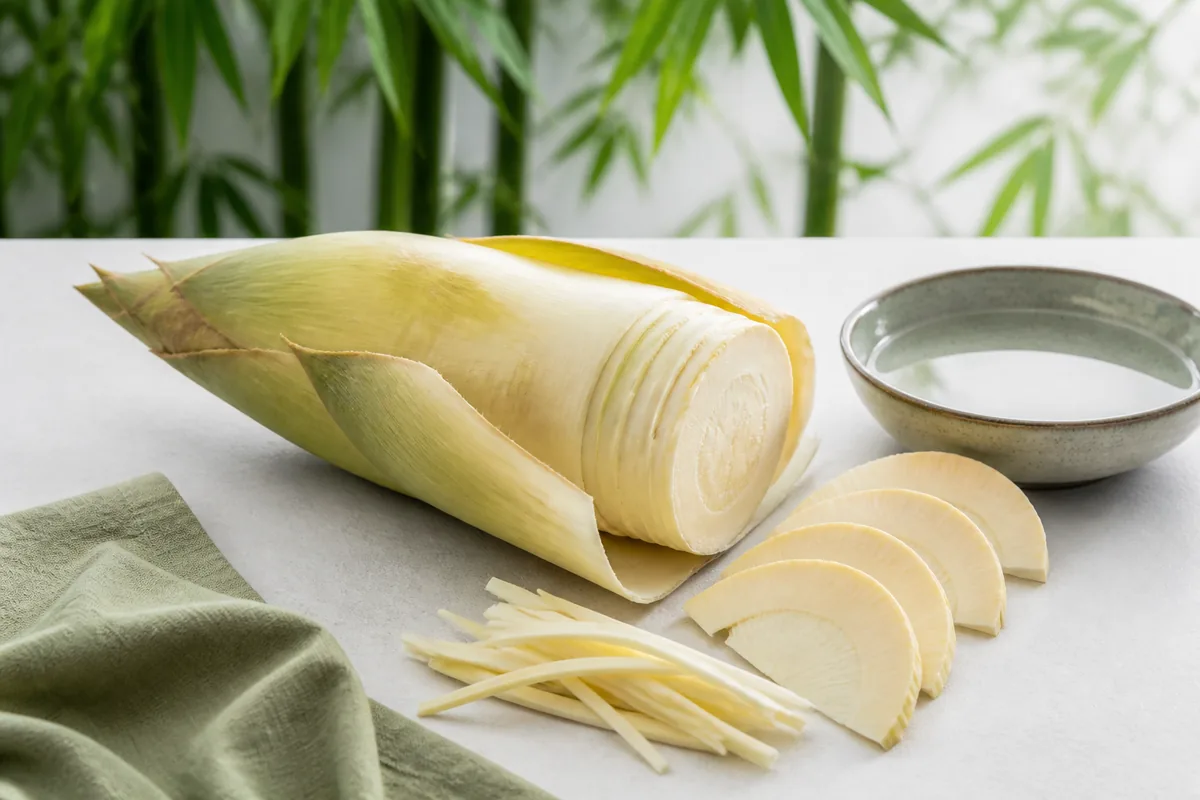
You can eat bamboo shoots-after identification and proper processing
The edible vegetable is the tender shoot that emerges from the plant. The tall, mature culm becomes hard, hollow, and woody; it is useful as a material, not as an ordinary human food. Even a young shoot is not automatically ready to bite. Food Standards Australia New Zealand states that only a small number of bamboo species are used as food and that unprocessed fresh shoots contain cyanogenic glycosides. Its consumer guidance calls for peeling, trimming, thin slicing, boiling in water, and discarding the cooking water.
Do not turn that into a backyard rule that "all bamboo is safe if boiled." If the plant is unidentified, treated with unsuitable chemicals, contaminated, or not intended for food, leave it out of the kitchen. The safer choice is a correctly identified food-use shoot or a packaged product from a responsible food supplier, followed by the applicable preparation instructions.
What part of bamboo can humans eat?
When people say they eat bamboo, they usually mean young bamboo shoots: new growth harvested before it develops into a tall, hard culm. Remove the overlapping outer sheaths and the food portion is a pale, dense inner core. Depending on the species, harvest age, and cut, it can be sliced into half-moons, cut into strips, diced, shredded, or kept as small tips.
Age matters as much as the plant name. Tender shoots have a short harvest window. As growth continues, lignification and fiber development make the base and inner tissues harder. Cooking can soften a suitable young shoot, but it cannot turn an old woody cane into a desirable vegetable. For foodservice and industrial use, "bamboo shoot" is therefore incomplete. A usable specification needs the food-use source, age or tenderness standard, removed hard-base tolerance, cut geometry, and sensory result after the buyer's actual cooking process.
| Bamboo part or form | Normal human-food status | Decision to make |
|---|---|---|
| Tender young shoot | Common food portion after correct identification and preparation | Confirm food-use source, freshness, tenderness, and required cooking. |
| Older shoot or hard base | May be excessively fibrous even after processing | Set a hard-base, fiber, and piece-tenderness tolerance. |
| Mature woody culm | Not an ordinary human vegetable | Do not confuse construction or garden bamboo with food. |
| Leaves, seeds, sap, or specialty products | Use varies by species, product, and culinary tradition | Treat each as a separate ingredient; a shoot guide does not establish its safety. |

A product name should be followed by a visible cut reference: slices, strips, dice, tips, or another buyer-approved form.
Is all bamboo edible?
"Is all bamboo edible?" sounds like a yes-or-no botanical question, but it is a poor food-safety rule. A plant part can be technically edible after extensive processing and still be bitter, fibrous, impractical, or inappropriate to harvest. Food Standards Australia New Zealand says only a small number of the many bamboo species are used as food. Commercial supply chains therefore start with known food-use material, not with a claim that every bamboo in a garden is interchangeable.
Species identity is only one control. The shoot must also be young enough, harvested and handled hygienically, free from unsuitable chemical treatment, and processed by a method appropriate to that food. Ornamental bamboo may have been treated for landscape pests or exposed to contamination that a food producer would not accept. A plant app, social-media photo, bitter-taste test, or a panda's diet is not a food approval system.
Safe boundary: do not taste an unidentified shoot to find out what it is. If you want fresh shoots, obtain them from a food grower or retailer that can identify the product and give preparation instructions. For a commercial order, request the common name, botanical or source-program identification when relevant, origin, crop and harvest information, and the supplier's approved raw-material standard.
Why fresh raw bamboo shoots require correct processing
Fresh bamboo shoots can contain cyanogenic glycosides, including taxiphyllin. When plant cells are cut or chewed, these compounds can break down and release hydrogen cyanide. The Hong Kong Centre for Food Safety explains that cutting the plant into smaller pieces helps release hydrogen cyanide and that cooking in water helps remove it because the compound is volatile. In its testing, cutting cyanogenic plants into smaller pieces and cooking them thoroughly in boiling water reduced cyanide content by more than 90% under the studied conditions.
That evidence explains why three casual shortcuts are unsafe. First, washing alone is not the control. Second, a quick dry sauté is not equivalent to a validated wet-heat preparation. Third, freezing preserves the ingredient but does not replace the preparation needed for fresh raw shoots. Bitterness can alert you to a poor eating result, but the absence of bitterness is not an analytical certificate and should not be used as proof that an unknown shoot is safe.
Cooking guidance varies because shoots differ by species, age, size, and preparation status. FSANZ currently tells consumers to halve fresh shoots lengthwise, remove outer leaves, trim fibrous tissue, slice thinly, boil in lightly salted water for eight to ten minutes, and discard the water. Other culinary authorities describe longer boiling or water changes for particular shoots. Follow the applicable food authority, seller, or package instructions for the actual product in front of you; do not average several internet times into a universal rule.
For commercial production, the control cannot be "boil until it seems fine." Define the cut thickness, product-to-water ratio or validated process, time and temperature, water disposal or renewal, cooling, dewatering, and hold limits. Then connect that process to a finished-product acceptance plan. A heat-treatment record shows what the line did; a finished-product result shows what the lot achieved. They answer different questions.
How to prepare fresh food-use bamboo shoots safely
Use this as a decision sequence, not as permission to forage unidentified bamboo. Begin only with a food-use shoot and follow any more specific local or supplier instructions.
- Confirm the ingredient. Verify that the shoot comes from a food source and is suitable for eating. Reject unidentified, spoiled, slimy, moldy, chemically treated, or abnormally fibrous material.
- Remove the outer sheaths and hard base. Peel back the tough layers and trim fibrous tissue until the tender inner portion remains. Keep the work surface and knife clean.
- Cut before cooking. Thin, consistent pieces expose more surface area and produce a more repeatable result than a whole, thick shoot. Match the cut to the applicable guidance.
- Cook in sufficient water. Use the time and method specified by the relevant food authority, food seller, or validated process. Do not substitute dry heat or freezing for the required wet-heat step.
- Discard the cooking water. Do not use it as soup stock or sauce liquid. The preparation is designed to move released compounds out of the food and into the water.
- Continue with hygienic handling. Drain, cool, store, or cook the shoots according to the intended recipe. Refrigerate or freeze promptly when they are not used immediately, and avoid uncontrolled cooling at room temperature.
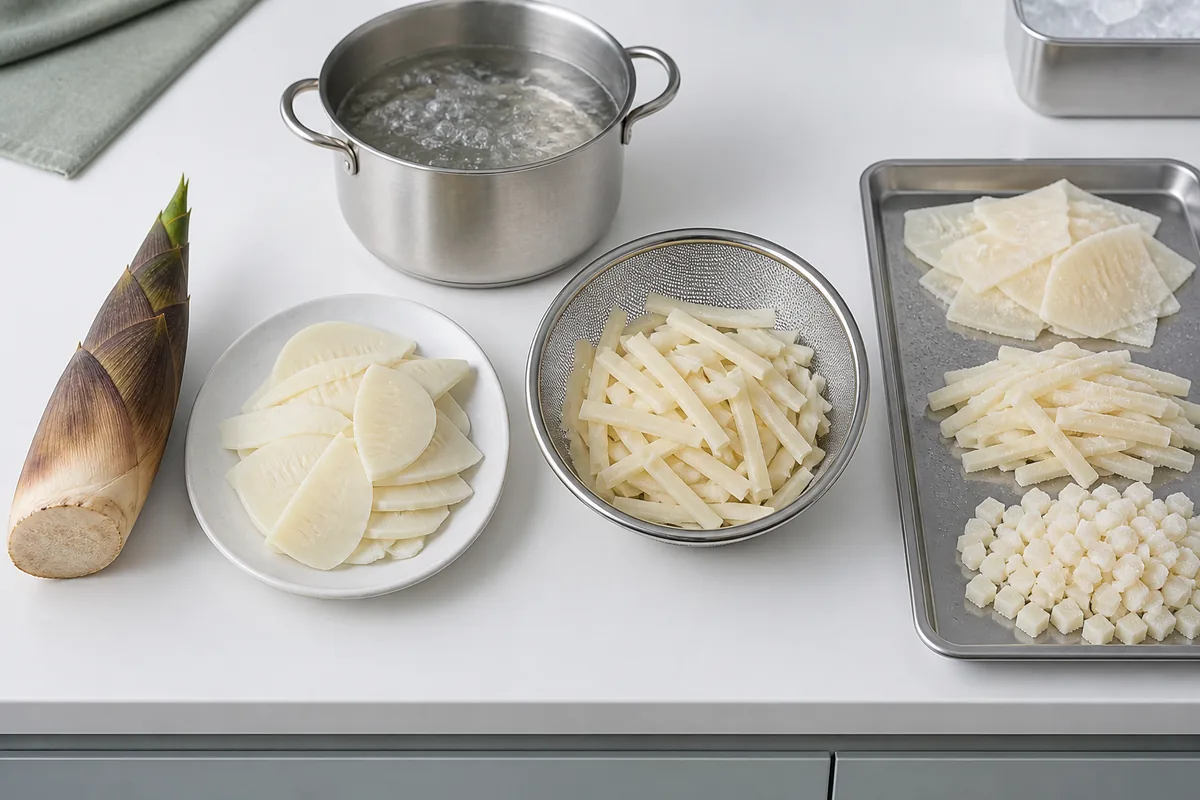
Identification, wet-heat preparation, draining, and freezing are separate stages. Freezing belongs after the required food-safety preparation.
"Cooked," "blanched," "frozen," and "ready to eat" are not synonyms
A frozen bamboo shoot can be peeled, cut, heat-treated, cooled, and individually quick frozen, yet still be designated not ready to eat (NRTE). The manufacturer may require a final cooking step to address the complete safety and use profile. Conversely, a commercially canned product generally receives a canning heat process and may be ready to use after draining, subject to the package label.
Procurement and label teams should never infer status from appearance. Put the designation, storage temperature, cooking instruction, intended user, and use limitations on the specification and artwork. If the supplier changes the cut thickness or pretreatment, recheck whether the validated instruction still fits.
How fresh, canned, fermented, and frozen bamboo shoots differ
The best format depends on who will cook it, how the product is distributed, and which texture the recipe needs. These forms should not share one unqualified product name in a quotation.
| Format | Processing and use | Quality trade-off | Buyer verification |
|---|---|---|---|
| Fresh raw food-use shoot | Requires peeling, cutting, and correct cooking before eating | Fresh texture potential, short handling window, highest preparation responsibility | Identity, harvest age, condition, preparation instruction, storage life |
| Canned | Commercially heat processed; usually drained and used according to label | Shelf stable but softer, with canning-liquid or acid effects on flavor | Ingredient, drained weight, can size, pH or formulation, RTE status, defects |
| Fermented or pickled | Acid, salt, microorganisms, and process time create a distinct product | Strong flavor and regional appeal; formula drives use and labeling | Process validation, salt or acidity, ingredients, shelf-life basis, package condition |
| Vacuum-packed or refrigerated cooked | May be prepared but has a defined chilled shelf life and status | Convenient with less freezing impact; tighter temperature and shelf-life control | RTE or NRTE statement, seal integrity, temperature, use-by date, microbiology |
| IQF frozen | Usually peeled, cut, heat-treated, cooled, dewatered, and frozen as separate pieces | Portionable, stable frozen logistics, cut-specific texture after reheating | Pretreatment, RTE or NRTE status, cut, free-flow condition, cooking instruction, cold chain |
If your question is specifically about preservation, see GreenLand-food's separate guide on whether bamboo shoots can be frozen. That page covers household preparation and freezing steps; this article keeps ownership of the broader edibility, identification, and product-status question.
Cut form changes eating quality and commercial performance
A buyer cannot evaluate bamboo-shoot price without knowing what the usable piece looks like. Thin slices heat quickly and show their curved profile in hot pot. Strips mix evenly into ramen toppings, spring rolls, dumpling fillings, and vegetable blends. Dice support dosing in soups and ready meals. Tips or larger chunks keep a more recognizable shape but make hard-base control and tenderness variation more visible.
Measure more than a nominal size. For strips, specify cross-section, target length, short-piece tolerance, split or broken pieces, and allowable fiber. For slices, define direction, thickness, diameter range when relevant, and broken-slice tolerance. For dice, set dimensions, oversize, undersize, fines, and whether natural tapered pieces are allowed. Approve the product after the actual boil, stir-fry, hot-pot hold, or retort/reheat cycle rather than only while it is frozen.

Meal-kit and hot-pot programs need repeatable strip length, portion weight, cooking texture, and separation from other components.
| Cut | Typical application | Acceptance focus |
|---|---|---|
| Slices | Hot pot, soups, stir-fries, visible toppings | Thickness, profile, low breakage, even tenderness |
| Strips or julienne | Ramen, spring rolls, dumplings, vegetable mixes | Cross-section, length, short pieces, fiber, mixing performance |
| Dice | Ready meals, soups, fillings, fried rice | Dimensions, fines, dosing, reheat integrity |
| Tips or chunks | Premium visible dishes and foodservice | Hard-base removal, piece integrity, tenderness range |

A close product view helps procurement and QA align on pale color, strip geometry, broken pieces, and visible fiber before sample approval.
What to verify in a frozen bamboo shoot specification
A supplier declaration that the product is "edible bamboo" or "blanched bamboo" is not enough for an importer, food manufacturer, or private-label program. Build the purchase file around product identity, process evidence, finished-lot acceptance, and final-use instructions.
- Identity: common name, food-use species or source program where required, origin, crop/season, ingredient statement, and any acid, salt, or preservative.
- Process: peeling and trimming standard, cut before heat treatment, moist-heat method, time/temperature or validated equivalent, cooling, rinsing, dewatering, and IQF step.
- Finished product: RTE or NRTE designation, residual-HCN limit or testing program where applicable, microbiology, sensory acceptance, tenderness, bitterness, color, fiber, defects, and foreign material.
- Commercial form: slice, strip, dice, tip, or chunk dimensions; oversize, undersize, broken pieces, fines, free-flow condition, net weight, and glaze status if any.
- Order and market: pack size, label language, cooking instruction, lot code, MOQ, mixed-container plan, destination, certificates, COA or test report, traceability, shelf life, and cold-chain terms.
Process evidence and finished-product evidence serve different jobs
A heat-treatment log may show that a lot passed through a defined water temperature for a defined time. It does not, by itself, prove the identity of the raw material, uniformity of thick and thin pieces, accuracy of the probe, or result of the finished product. Conversely, one laboratory result cannot show that every production run follows the same process. Strong approval uses both.
At GreenLand-food, we separate the heat-treatment record from the finished-product test and release decision. Before quotation, we ask which cut, destination-market rule, residual-HCN evidence, cooking status, and application trial the buyer requires, then match those items to the selected production program instead of promising one universal document pack.
Ask the supplier how the raw shoot is released, how hard bases and sheath residues are removed, how cut thickness is controlled before heating, how time and temperature are recorded, and how cooling prevents texture loss or uncontrolled microbial growth. Where the market or buyer program requires residual-HCN verification, define the method, sample identity, laboratory scope, reporting unit, acceptance limit, and action for an out-of-specification result. Do not copy a limit from a different product or jurisdiction without regulatory review.
The same discipline applies to microbiology. Blanching or boiling is not automatically commercial sterilization, and IQF freezing does not kill every microorganism. Product status, hygienic zoning, water control, environmental monitoring, foreign-material prevention, metal detection or X-ray where applicable, and the buyer's final cook remain part of the safety design. GreenLand-food's broader article on blanching in frozen vegetables explains why a heat step must be evaluated with texture, cooling, dewatering, and storage performance-not by time alone.
Finally, make the approval sample representative. Compare several bags or cartons from the same lot, measure the actual cut distribution, cook them under the intended use, and record the decision. A purchasing team that keeps the approved specification, photos, cook test, COA, retained sample, and lot code can resolve deviations far more effectively than one relying on "good quality" language.
Packing, labeling, and cold chain complete the decision
Bulk cartons suit industrial dosing and foodservice when the line can manage open-bag handling. Smaller inner bags support portion control, reduce exposure after opening, and can simplify central-kitchen use. Retail private-label packs need approved artwork, cooking directions, storage statements, ingredient and allergen review, net weight, lot coding, date coding, country-of-origin treatment, and destination-market language before production.
Frozen bamboo shoots should remain under stable frozen storage and transport, commonly anchored at or below −18°C unless a stricter specification applies. The reefer setpoint is only one signal. At receiving, inspect carton condition, pallet stability, product temperature under the agreed method, ice build-up, clumping, seal integrity, lot codes, and evidence of thaw/refreeze abuse. GreenLand-food's cold-chain logistics guide provides the wider receiving logic.
A private-label project should also test the consumer instruction. "Cook thoroughly" is clearer when the method, time, portion, equipment assumptions, and frozen-or-thawed starting state have been validated. If the product is NRTE, the front and back panels, online listing, and foodservice case should not imply that it can be eaten straight from the bag.
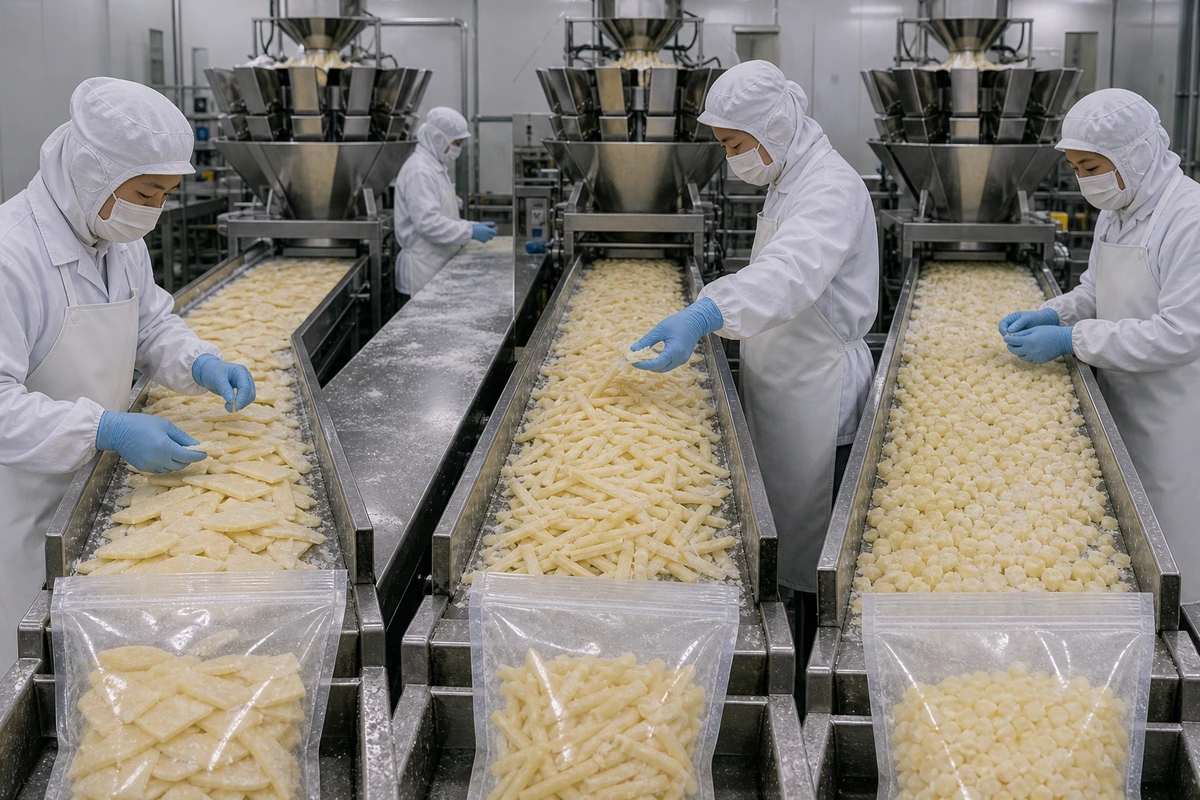
Retail and foodservice packs need the same cut identity, lot controls, storage statement, and cooking-status decision as the bulk product.
What should you do if you ate raw or unidentified bamboo?
Stop eating it. Keep the remaining plant or package, note approximately how much was eaten and when, and contact your local poison-information service or medical provider for product-specific advice. If symptoms develop or the person is seriously unwell, use the local emergency service. Do not wait for bitterness to appear, do not induce vomiting unless a medical professional directs it, and do not rely on an online species guess.
The Hong Kong Centre for Food Safety lists nausea, vomiting, headache, throat constriction, and severe outcomes among possible signs of hydrogen-cyanide poisoning from raw or undercooked cyanogenic foods. This article is general food information, not individual medical diagnosis. The correct response depends on the plant, preparation, amount, time, symptoms, and the person exposed.
Frequently asked questions
Can you eat bamboo shoots?
Yes. People eat tender young bamboo shoots after the food-use material has been correctly identified and properly prepared. Fresh raw shoots should not be eaten casually because they can contain cyanogenic glycosides.
Is all bamboo edible?
Do not use that phrase as a food-safety rule. Only a small number of bamboo species are commonly used as food, and suitability also depends on shoot age, source, contamination, and processing. Never taste an unidentified garden plant to identify it.
Can you eat bamboo shoots raw?
Fresh raw bamboo shoots should be correctly peeled, cut, and cooked in water according to authoritative or product-specific instructions. Cutting and wet-heat processing help release and remove hydrogen cyanide formed from natural cyanogenic compounds.
Does freezing make raw bamboo shoots safe?
No. Freezing is a preservation step, not the preparation that makes an unprocessed raw shoot suitable to eat. Complete the required identification, peeling, cutting, and wet-heat step before freezing fresh shoots.
Are canned bamboo shoots ready to eat?
Commercially canned bamboo shoots are heat processed and are commonly ready to use after draining, but the package label is the controlling instruction. Check ingredients, storage after opening, and any cooking direction for the actual product.
Are frozen bamboo shoots already cooked?
Many frozen bamboo-shoot products receive peeling, cutting, and heat treatment before IQF freezing, but they may still be designated not ready to eat. Confirm the specification and follow the package or foodservice cooking instruction.
What should a bamboo-shoot buyer include in an RFQ?
Send the food-use source or required product identity, cut and dimensions, tenderness and defect limits, heat-treatment and RTE or NRTE requirements, finished-product tests, packing, quantity, application, destination, private-label needs, and requested documents.
Source Frozen Bamboo Shoots with GreenLand-food
GreenLand-food is a professional frozen bamboo shoot supplier and manufacturer in China, providing factory-direct wholesale supply for importers, food manufacturers, foodservice distributors, and private-label programs.
Send the product form, specification, packing, quantity, application, destination, private-label needs, and requested documents. We will confirm the food-use source, cut, heat-treatment and product-status requirements, order plan, and available evidence for the selected program.