


Can You Freeze Napa Cabbage? Rib Texture and Cooked-Use Fit
Oct 19, 2026
Leave a message

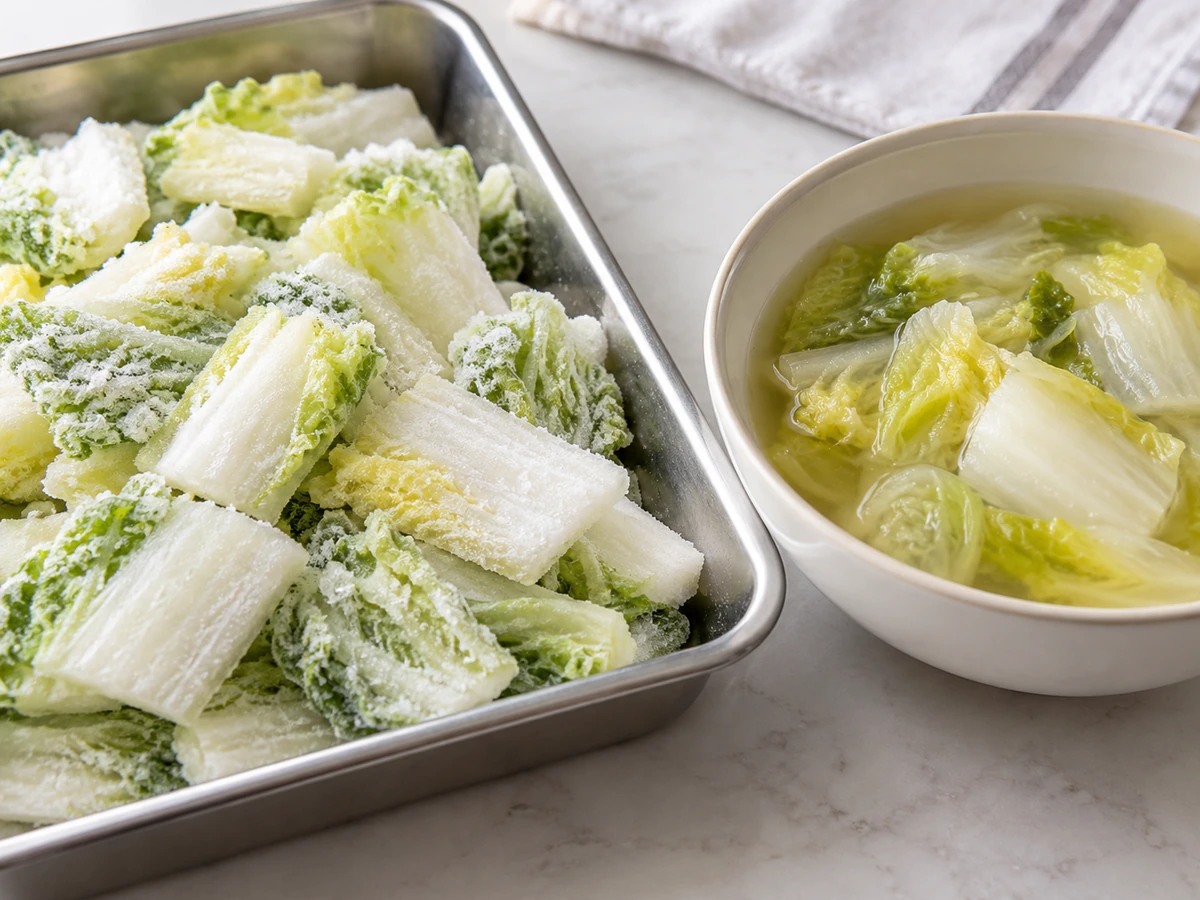
For a food manufacturer or foodservice buyer, the practical question goes beyond whether cabbage survives the freezer. The cut, preparation, portioning and final cooking sequence determine whether the frozen ingredient is useful. A home-preservation method can explain the basic process, but it does not establish a commercial blanching schedule, shelf life or the specification of a purchased frozen product. This guide separates those decisions and shows how to evaluate the cabbage in the food you actually intend to serve.
Freezing works when the next use is a cooked dish
The National Center for Home Food Preservation guidance for cabbage or Chinese cabbage explicitly places the frozen product in cooked uses. That is a helpful starting boundary for napa. Freezing can preserve an ingredient for later preparation, but the result should be judged as frozen cabbage used in cooking. An expectation that thawed leaves will behave exactly like a fresh head creates an avoidable mismatch before the trial begins.
Napa is valued in cooked foods for the contrast between tender leaf and more substantial pale rib. In a soup, that structure can still provide recognizable pieces and a gentle cabbage character even after softening. In a finely chopped filling, individual leaves need not remain visually intact for the ingredient to work. A crisp salad or a raw garnish asks much more of the original cell structure, so it is a different and less suitable goal for cabbage prepared by ordinary freezing.
Define the destination before deciding how much work to put into preparation. A broad leaf-and-rib cut intended for a bowl of broth will be inconvenient if the next task is to mince it for a small dumpling. A fine chop designed to distribute through filling will disappear more easily into a soup. Both may be acceptable frozen napa, but they are not interchangeable without changing either the process or the appearance of the dish.
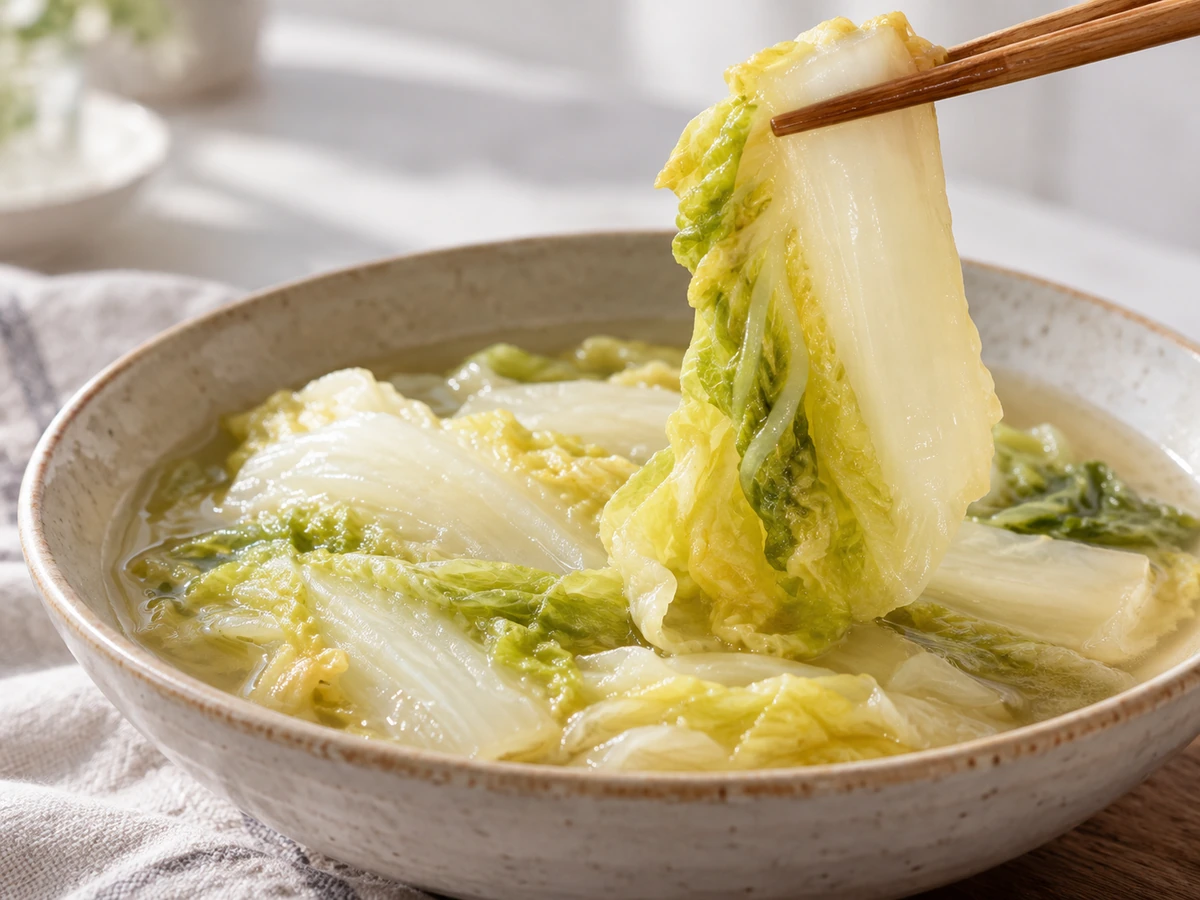
A cooked napa rib and attached leaf bend as they are lifted from the bowl.
The same principle applies to purchasing. Start with the application and preparation instruction rather than a broad claim that frozen napa is "as good as fresh." The useful comparison is whether the offered product performs adequately in the intended meal at the required portion and cost. A frozen ingredient may simplify a particular preparation step, but that benefit should be checked against its handling needs and usable yield in the actual kitchen or factory.
At GreenLand, we suggest bringing a concrete use to the sample discussion: a clear soup with visible napa pieces, a cooked dumpling filling, or a mixed meal component that will be reheated. These descriptions help identify which cut and quality observations matter. The frozen Chinese cabbage product page is a starting point for the inquiry; the treatment and preparation requirements of the offered product should still be confirmed directly.
Expect the white rib and green leaf to soften differently
Freezing changes the physical condition of vegetables. The University of Minnesota guidance on freezing food explains that freezing can damage plant cell walls and produce softer texture after thawing. For napa, this general mechanism matters because a single piece contains tissues with very different thicknesses. A thin leaf blade and a broad fleshy rib will not give the same sensation in the cooked mouthful, even when they come from the same head.
The visible result depends on more than the presence of a freezer. The size of the piece, its preparation before freezing, the way it is packed and its later heating all contribute to the final texture. A broad rib can remain conspicuous after the attached blade has become very soft. A thinly sliced rib may blend into a filling more readily. This is why "frozen napa" is too broad a description to predict a cooking time or a finished texture.
Thawing may also make liquid easier to separate from the vegetable. A pool beneath thawed cabbage is relevant to recipe development, but its appearance alone cannot diagnose the history or quality of a commercial lot. It could reflect the preparation method, the sample condition or the product itself. Compare samples under a defined method before turning an observation into a claim about one supplier's freezing performance.
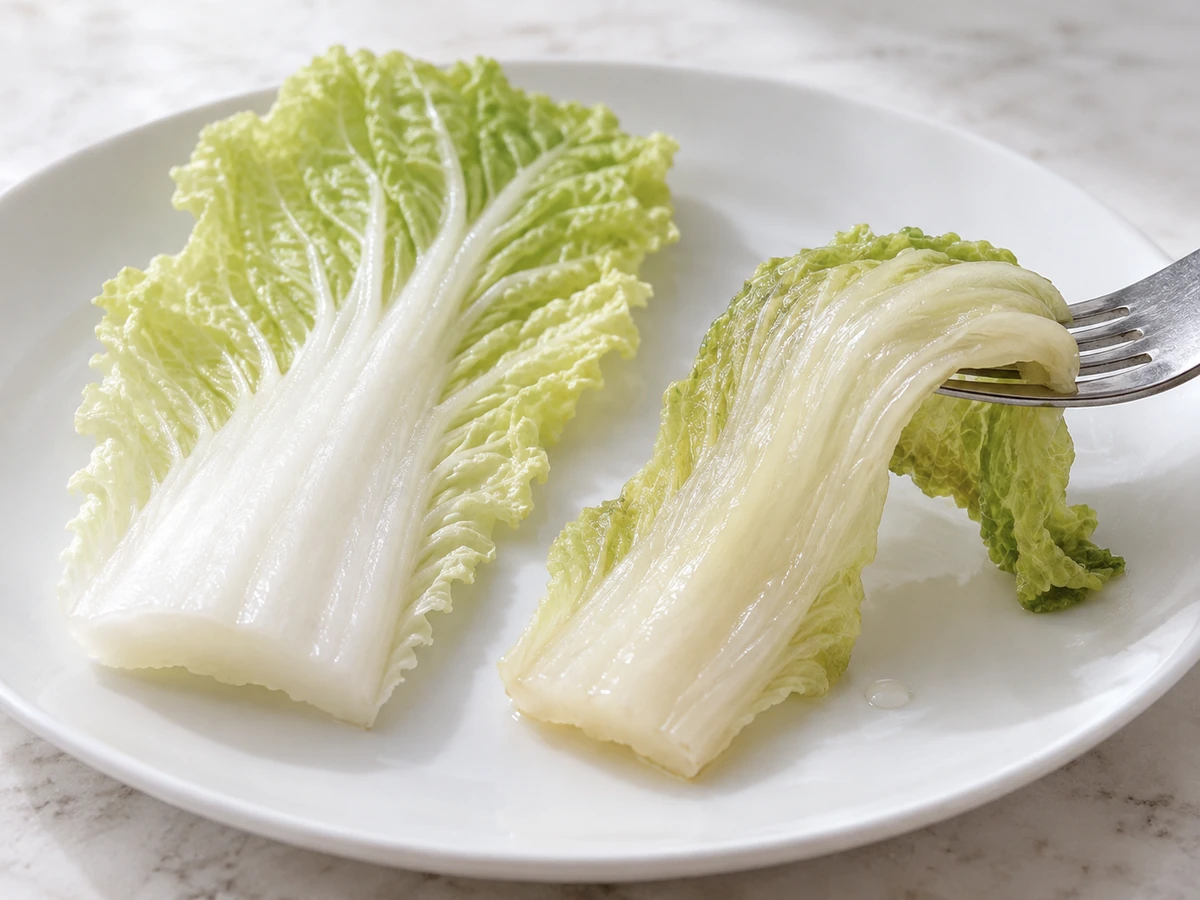
A firm pale rib beside a more translucent, flexible rib supported by a fork.
Avoid the opposite mistake of treating all softening as failure. A soup designed for tender cabbage may need very little fresh-like resistance. A filling may benefit from small pieces that combine smoothly with other ingredients. The meaningful defect is a change that makes the final food unacceptable: ribs that remain awkwardly large, leaves that break down beyond the intended appearance, or liquid that makes a filling difficult to handle. Those outcomes can be observed and discussed without promising to eliminate normal effects of freezing.
When tasting a trial, examine the rib and leaf separately and then together in a normal bite. A spoonful composed mainly of leaf may suggest that the cabbage is ready, while a larger rib piece tells a different story. Record which tissue causes any complaint and at what point in preparation it appears. That information gives the next trial a clear purpose, such as changing the cut or adjusting the cooking sequence, instead of simply asking for "better texture."
Choose the cut before preparing the cabbage for freezing
Choose the cut before freezing because that decision determines much of the later handling. For a soup, a piece large enough to recognize may be useful, provided it fits the serving utensil and softens within the recipe's cooking sequence. For a small filling, shorter and more evenly distributed fragments are usually easier to incorporate. Think about the bite, the portion and the equipment that will handle the material, rather than selecting a dimension in isolation.
The NCHFP home method allows several forms, including shreds, thin wedges and separated leaves. Those options are not a promise that every form will suit every napa application. A separated leaf still contains a thick base and a delicate upper blade. A wedge can hold several layers together and behave differently from loose chopped pieces. The preparation should fit the intended cooked use, and any published method should be followed within the scope for which it was written.
With napa, the distribution of leaf and rib is part of the cut decision. Chopping an entire head finely can produce a mixture of thin green fragments and pale rib particles. Selecting mainly upper leaves creates a different ingredient from retaining a greater share of the basal ribs. Neither description should be reduced to a colour preference alone. The mixture affects the way pieces distribute through the recipe and the amount of noticeable rib in the bite.

The chopped product combines small pale ribs and green leaf pieces.
For commercial samples, ask how the cut is described and what variation is included. "Small pieces" may be enough for an exploratory conversation, but it is weak as an acceptance description. A nominal dimension should indicate what is being measured, especially when leaves are folded or irregular. If large rib fragments cause problems, request information about that characteristic rather than assuming that an average cut length will control it.
A small development batch can answer a useful question before a larger quantity is prepared. Compare two plausible cuts in the same cooked dish, keeping the portion and other ingredients consistent. Retain photographs of the uncooked cut and the served result. The purpose is to find a practical starting form, rather than to prove that one dimension is best for every recipe. When the preferred cut is selected, describe it clearly enough that the next batch can be prepared similarly.
Keep the cutting decision separate from the freezing format. Individually separable pieces and a compact frozen block create different portioning and cooking tasks, even if the pieces began with a similar cut. GreenLand's frozen vegetable product forms guide explains the broader distinction. Confirm what the offered product actually does when handled at the intended temperature. A product name containing a freezing term is not a substitute for observing whether the required portion can be taken and prepared consistently.
Use blanching for its stated quality purpose
Blanching before home freezing slows or stops enzyme activity that would otherwise continue to reduce vegetable quality. It helps protect flavor, color and texture during frozen storage; it is not a promise that thawed napa will regain fresh crispness. The University of Minnesota's freezing guidance describes this quality role and the need for rapid cooling after the brief heating step.
For cabbage or Chinese cabbage, the National Center for Home Food Preservation specifies a one-and-a-half-minute water blanch within its complete home-preservation method, followed by prompt cooling, draining, packaging and freezing. Follow the linked procedure as a whole, including its preparation and blanching directions. That home timing does not establish a commercial line schedule, a purchased product's processing history or ready-to-eat status.
For a home-scale batch, read the complete preservation instructions before starting and organize the cooling and packing stages in advance. The cabbage should not be left waiting while the next container is found or the packaging is prepared. The published method is a sequence, and selectively taking its blanching time while improvising the rest can produce a different result. Use a manageable batch size that allows the stated procedure to be followed consistently.
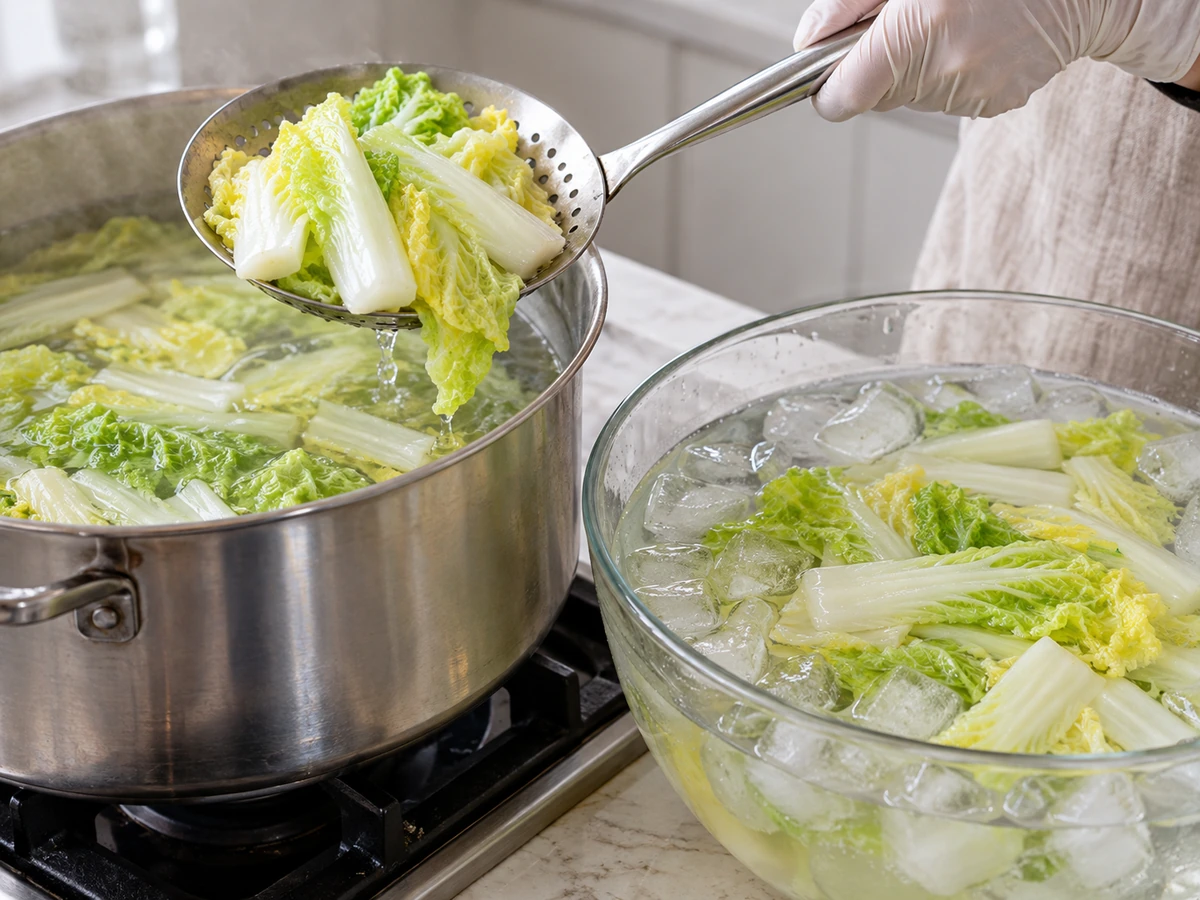
A ladle carries napa pieces between separate hot-water and cooling vessels.
For a purchased frozen ingredient, ask whether it is supplied raw, blanched or otherwise prepared, and request the relevant preparation instructions. Do not infer those details from a bright colour, a pale rib or a soft thawed texture. Product photographs are useful for appearance and cut discussion, but they cannot confirm a thermal process. Likewise, the word "frozen" alone says nothing about whether the product is ready to eat.
GreenLand's article on blanching in frozen vegetables provides wider context for this step. When evaluating napa, keep the treatment question connected to the intended food. A kitchen using the cabbage in a fully cooked soup and a manufacturer incorporating it into a filling may have different preparation sequences, but each still needs clear product instructions. Confirming those instructions is more useful than applying a generic blanching rule to every frozen vegetable in the recipe.
Drain and package for the portion you will actually cook
After preparation, the amount of loose water carried into the package affects later handling. Drain according to the chosen method and avoid treating water clinging to the surface as if it were useful cabbage solids. The objective is not to squeeze every trace of moisture from the vegetable. Excessive manipulation can change the texture and the form the next recipe needs. Use a preparation appropriate to the intended cooked use and keep it consistent between comparison batches.
Portion size should match the next cooking task. A large frozen mass may be inconvenient when only a small quantity is needed, while many tiny packs may add handling without a practical benefit. Consider the cooking vessel, normal batch size and whether the cabbage can be portioned while frozen. For a commercial product, confirm the packing format and the actual ability to remove the required amount instead of assuming that a pack weight describes how the contents will separate.
Packaging and temperature management belong to the whole process. Follow the storage and handling instructions that apply to the product and maintain the intended frozen condition. A freezer should not become a place where an unidentified package waits indefinitely without a planned use. Record the identity and preparation date of a home-prepared batch, and retain the relevant product and lot information for purchased material. Those records help connect a later cooking result to the correct sample.
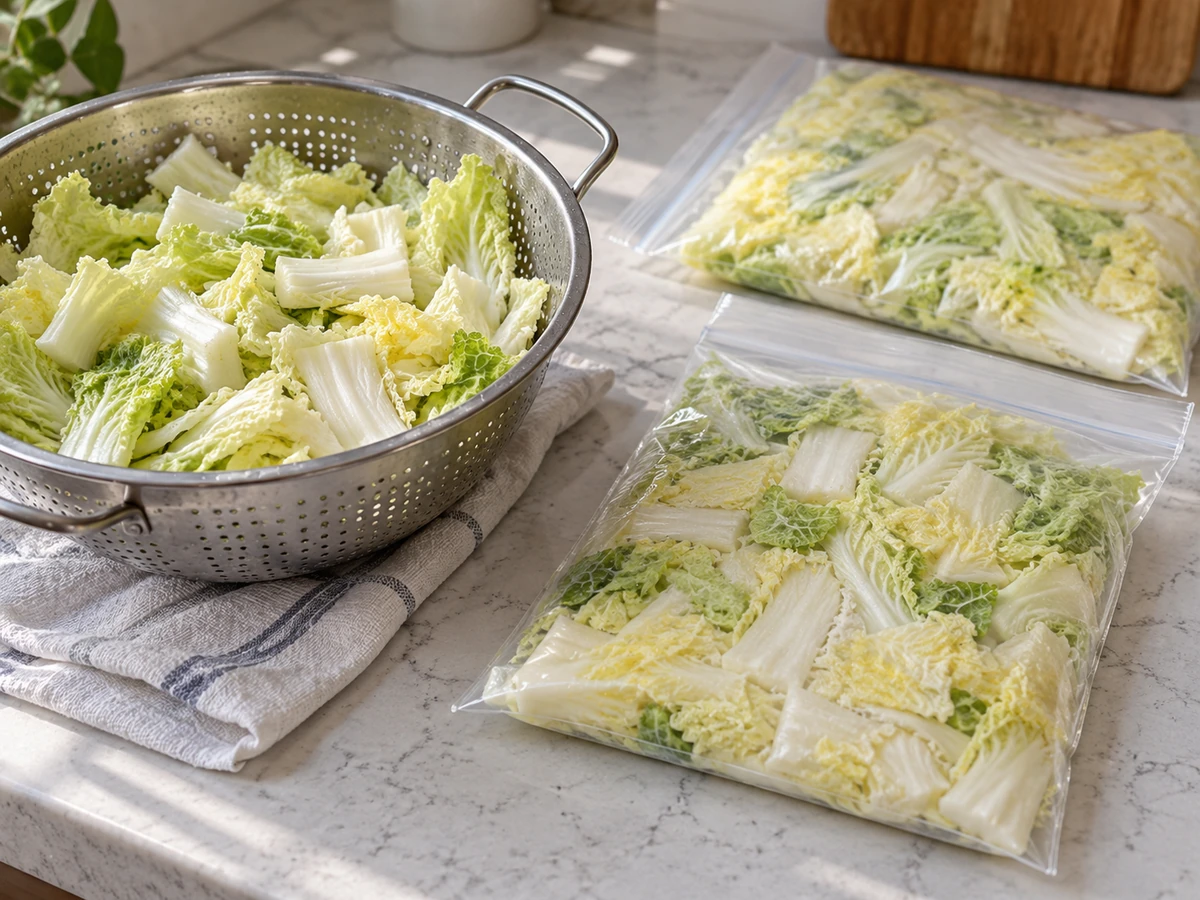
Drained cabbage is spread in a thin layer inside plain freezer pouches.
Before scaling a portioning plan, rehearse it with the people who will use the cabbage. A development cook may manage a small pack easily while a busy service team finds the same format difficult to open, separate or dose. Conversely, a large complete pack may fit a manufacturing batch very well. This practical trial helps distinguish the convenience of frozen supply from the suitability of a particular pack for a particular operation.
For purchased frozen napa, use the offered product's stated shelf life and storage conditions, and request the supporting documentation. Home-storage guidance has a different scope. In development, assess the actual sample under the conditions relevant to the intended food. Keep the pack identity, preparation condition and assessment point with each observation, so an initial cooking result can be distinguished from performance later in storage. An opened development pouch and a sealed commercial pack may have different handling histories; record which one was tested.
When checking a frozen sample, note whether the material is loose, clustered or compacted and whether that condition interferes with the intended portioning step. An observation should lead to a specific question. For example, a pack that cannot be divided conveniently may require a different packing or preparation approach. It does not, on its own, establish why the condition occurred. Keep the distinction between what was observed and what is known about the product's history in the trial record.
Match frozen napa to soup, fillings and other cooked uses
Soup is often a practical destination for frozen napa because the released vegetable liquid can remain part of the dish. The main questions are then piece size, broth appearance and the relationship between rib tenderness and leaf integrity. Add the cabbage at a point that allows it to cook properly without making the other ingredients wait unnecessarily. A cooking time copied from a fresh-cabbage recipe is only a starting observation; the frozen cut, quantity and heating system determine the actual sequence.
For hot pot, portioning and broth recovery matter. A large addition of frozen material changes the immediate cooking conditions, so the operator needs a manageable addition size and a clear endpoint. Broad pieces should be easy to separate and retrieve with the normal utensils. If the leaves detach and disperse while thick ribs remain conspicuous, consider whether the cut or the addition sequence suits that service. The desired result may be very tender cabbage, but it should be intentional and repeatable.
Dumpling filling brings a different moisture problem. Liquid that would be welcome in broth may accumulate in a mixing bowl or affect how filling is deposited and enclosed. Establish whether the cabbage enters frozen, thawed, drained or otherwise prepared, and measure it on that same basis during recipe development. A fresh-cabbage salting and squeezing instruction cannot be assumed to produce the same outcome with every commercial frozen product.
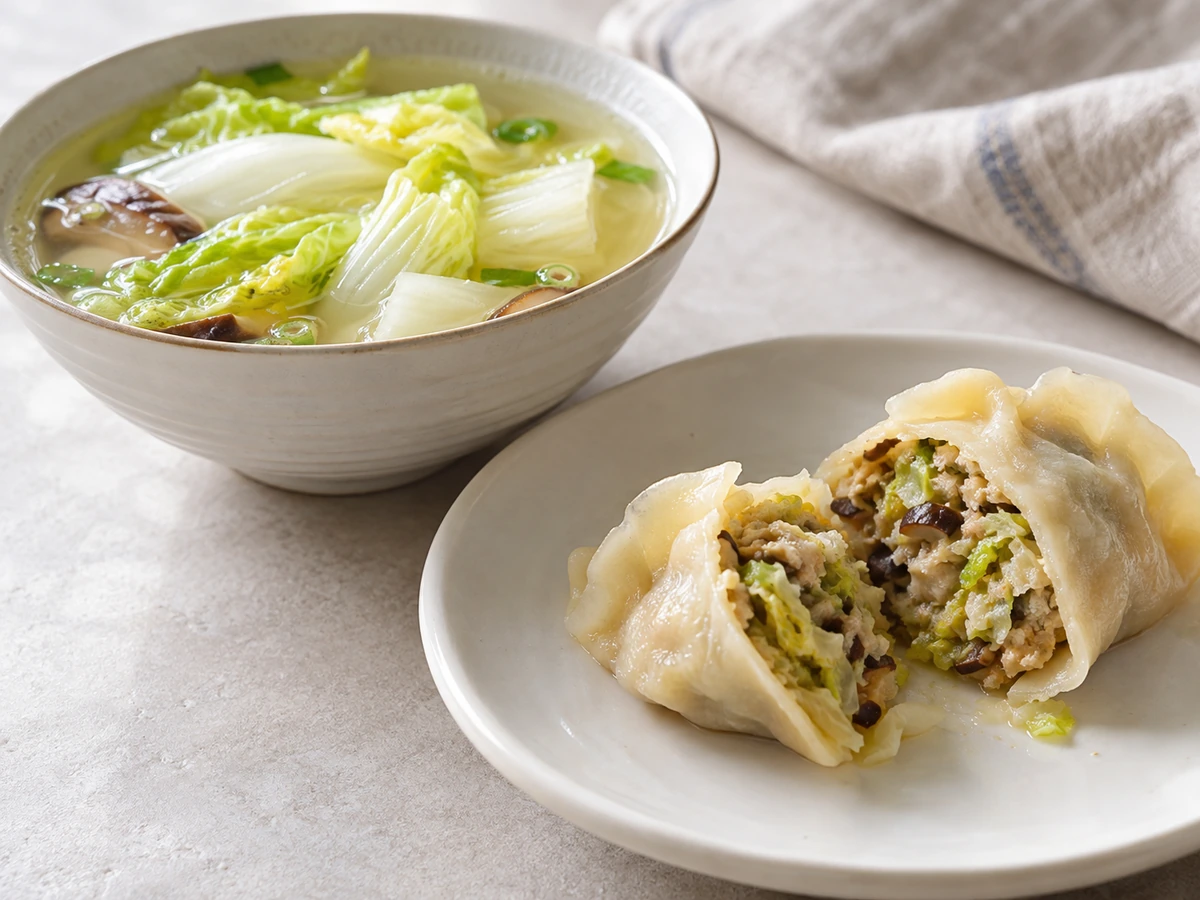
Broad Napa cuts in broth beside chopped cabbage and mushroom filling inside a cooked dumpling.
Stir fry can also use frozen napa, but the pan must manage the water that enters and is released. A crowded pan may produce a wetter result than the recipe expects. The useful trial keeps the cabbage quantity, pan capacity and other liquid additions visible, then checks the final texture and sauce consistency. If the intended dish depends on a crisp fresh leaf, changing only the cooking time may not recover that quality. Reconsider the ingredient form or the dish's texture expectation.
A mixed vegetable dish adds another variable: the cabbage and the other ingredients may need different heating sequences. Adding everything together can leave delicate napa leaves waiting for a dense vegetable to become tender. Consider whether staged addition is compatible with the intended workflow, then verify it in a complete batch. If the process requires a single addition, evaluate the supplied cut under that constraint instead of approving it under a more forgiving development procedure.
Evaluate holding and reheating when they are part of service. A sample tasted directly from the pan can seem satisfactory and then become too soft after the real waiting period. A chilled or frozen finished meal may expose the cabbage to another heating cycle. Follow the intended process through to the point of eating, and judge it in a normal serving. This connects the freezing decision to a complete application instead of declaring success as soon as the cabbage is hot.
Evaluate a commercial frozen sample before committing to supply
A commercial sample trial should begin with the product description, preparation instruction and intended application. Record the cut, visible leaf-and-rib mixture, freezing or packing format and the condition in which the sample is received and prepared. These observations create a basis for comparison. They do not replace the supplier's specification or establish compliance with requirements that have not yet been agreed.
Use the same recipe and starting basis for comparison samples. Equal frozen weights are useful when the production recipe uses a frozen addition. Equal drained weights answer a different question when the recipe uses prepared cabbage solids. If the trial changes from one basis to another, record the change and its effect on yield. Otherwise, a favourable texture result may simply reflect a different amount of cabbage or water in the finished dish.
The chopped Chinese cabbage photograph shows one visible product form. It cannot tell the buyer how the material will behave in a particular recipe, how much liquid it will release under a chosen preparation, or which treatment has been applied to a current offer. Those questions require the actual product information and a sample trial. Keep appearance approval and performance approval connected, while recognizing the evidence each one provides.

Cut cabbage on the sorting surface contains visible pale and green fragments.
A trial record should also state what was deliberately held constant. The same frozen mass, cooking vessel, recipe liquid and final serving condition make differences easier to interpret. Where a variable cannot be controlled, record it and avoid assigning all of the result to the cabbage. This modest discipline is especially helpful when comparing samples on different days or across two kitchens, where ordinary process variation can otherwise be mistaken for a product difference.
For a useful review, note what happens at preparation, mixing or cooking, and final service. Identify any issue precisely: large rib pieces, poor distribution through filling, excessive dispersed fragments in broth, inconvenient portioning, or texture loss after holding. A specific observation gives the supplier and development team something to investigate. A broad complaint that frozen cabbage is "too watery" may conceal several different problems requiring different changes.
When approaching GreenLand about frozen napa, share the finished dish, desired cut, preparation route, pack requirement and the quality result you want to protect. Confirm the available product details and sample conditions before fixing the recipe or purchase specification. Freezing is a useful option when the cabbage is selected and prepared for a suitable cooked use. The final decision should rest on the offered product's documented instructions and its performance through the buyer's actual cooking process.
Source Frozen Chinese Cabbage with GreenLand-food
GreenLand-food is a professional frozen Chinese cabbage supplier and manufacturer in China, providing factory-direct wholesale supply for importers, food manufacturers, foodservice distributors and private-label programs.
Send your product form, specification, packing, quantity, application and destination. Include private-label needs and requested documents so we can confirm the supply details with your purchasing team.