


Frozen Napa Cabbage Leaf-to-Rib Ratio and Cut Size: How to Specify It
Oct 19, 2026
Leave a message

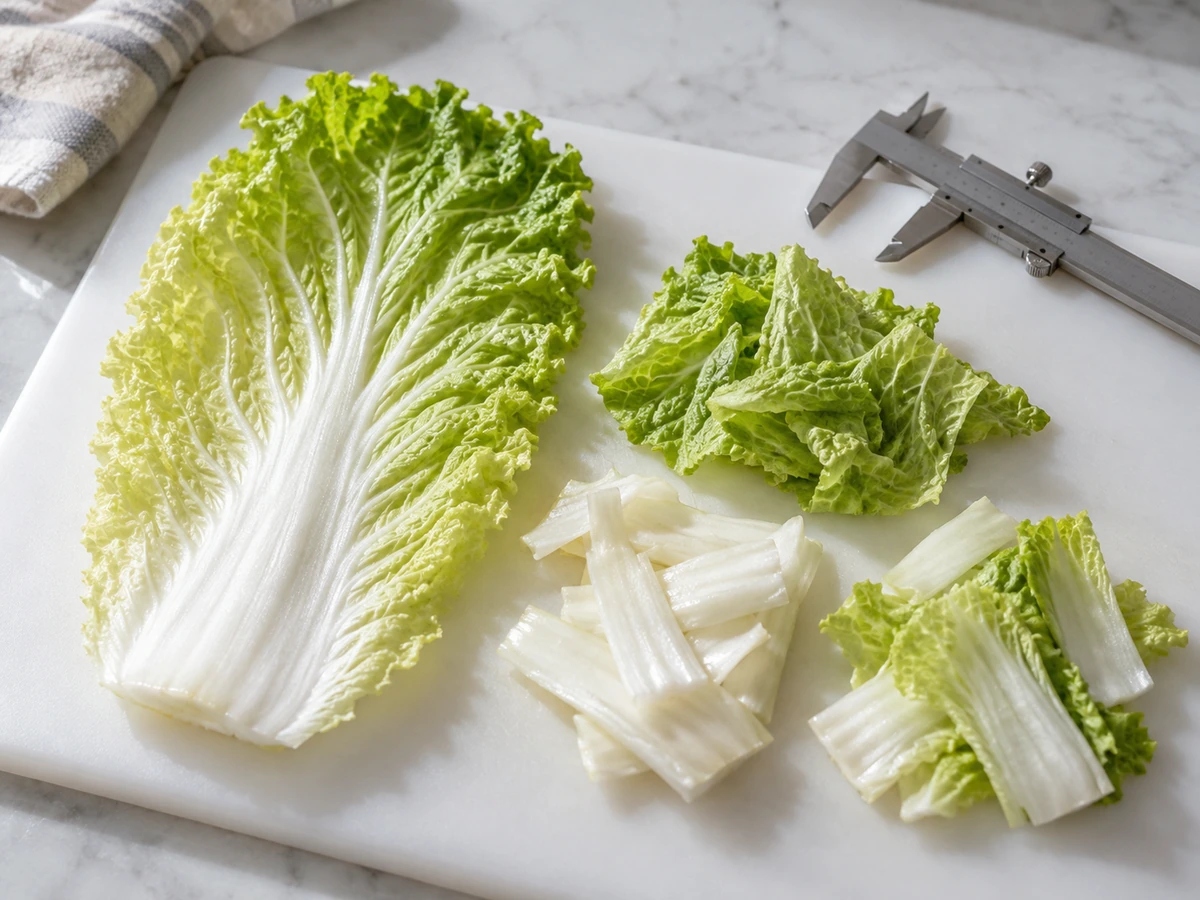
Leaf-to-rib balance affects the appearance and bite of cooked cabbage, while cut geometry affects distribution through a filling, soup portion or meal component. Neither measurement alone predicts the finished result. At GreenLand, we recommend approving the physical description alongside a sample prepared in the intended recipe. The following approach helps buyers write that description without presenting a proposed target as a universal industry limit or an already confirmed production capability.
Define leaf, rib and mixed pieces before choosing a ratio
Napa has crinkled leaf blades attached to broad, pale ribs. The UC Davis napa cabbage fact sheet describes the fresh vegetable and its quality characteristics; it is useful for identifying the tissue, although its fresh-market criteria cannot be copied directly into a frozen ingredient contract. Once a head has been chopped, a single piece may contain both blade and rib. That mixed piece is the first problem a ratio definition must solve.
One workable inspection approach uses three categories: predominantly blade, predominantly rib, and mixed pieces. The parties must then define the boundary for "predominantly," ideally with clear sample photographs and a written handling rule. The resulting report describes the mass of three piece classes. Assigning mixed pieces to a class can make that classification reproducible, but it does not turn blade-dominant and rib-dominant pieces into pure tissues. Report it as a piece-class composition. A claim about the actual mass of blade versus rib needs a separate, agreed tissue-separation or validated estimation method.
Another approach separates blade from rib along a defined anatomical boundary before weighing. This is more laborious, especially with fine chopped cabbage, and the manipulation can change the sample through lost fragments or liquid. It may be useful for development or occasional verification, but its practicality should be checked before it becomes a routine release test. A method that cannot be completed consistently during receiving offers little protection, however detailed the contract sounds.
An inspection sheet also needs room for observations that the selected categories cannot explain. If an operator finds a piece that sits between two definitions, retain it temporarily as an example and resolve the classification rule. Do not force it into whichever category makes the result look closer to the target. A small set of agreed borderline examples often improves consistency more than adding another sentence of abstract description to the method.
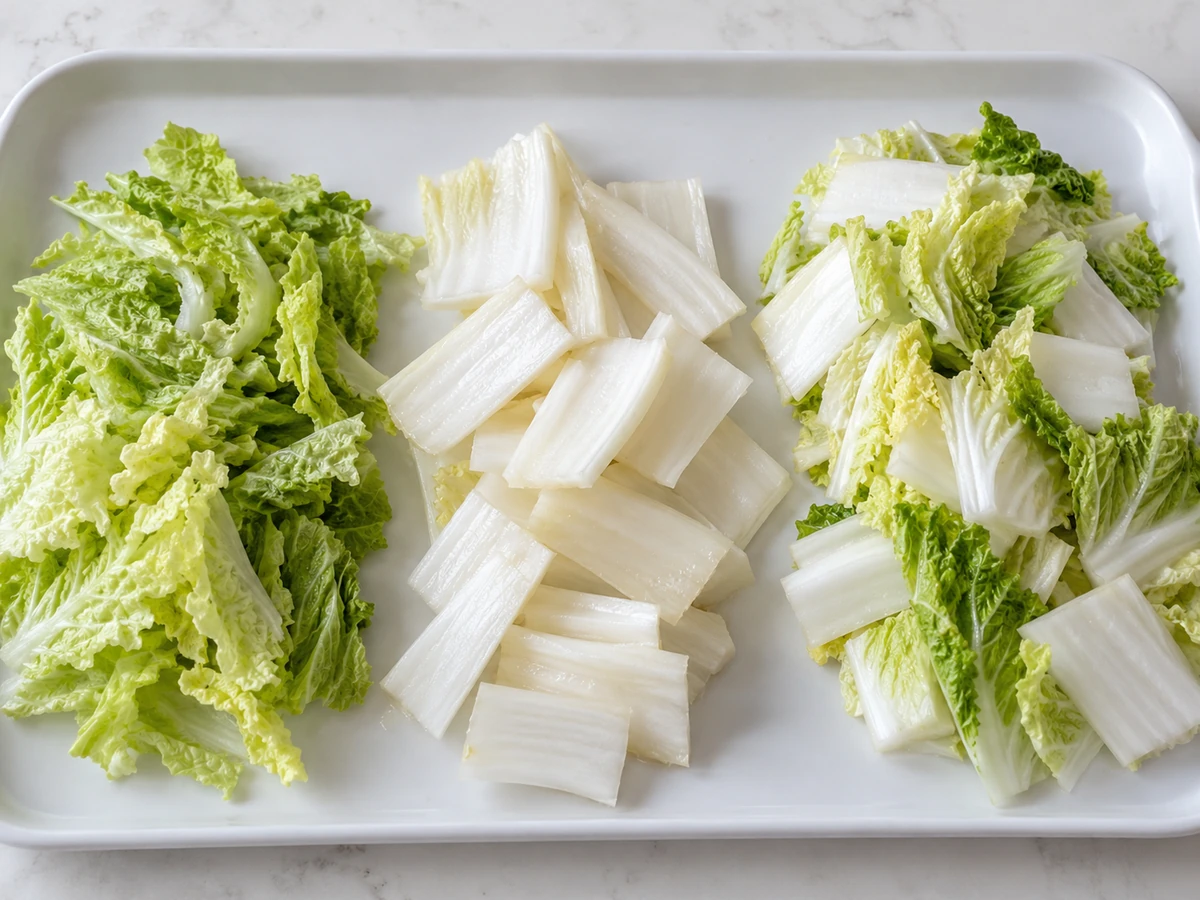
Leaf-rich pieces, pale ribs and attached leaf-and-rib cuts arranged separately.
A useful boundary check is to ask whether the same piece would be classified the same way after it is turned over. One face may show mostly leaf while the reverse exposes a broad rib. If classification depends on the first visible surface, the method may be measuring presentation rather than tissue composition. State whether both faces are inspected and how attached blade is handled. That detail matters especially when inspection is quick and the material is visually heterogeneous.
Choose the method around the actual question. If the problem is large pale chunks in a dark-green filling, a category for oversized rib pieces may identify the defect more directly than a total rib percentage. If the problem is an inconsistent cooked bite, a mass composition measure together with rib thickness may be more informative. If visual coverage in a meal tray matters, a photograph under fixed lighting can support the inspection, but a picture-based area estimate should not silently replace a mass measurement.
The product name also belongs at the beginning of this definition. "Chinese cabbage" can create confusion between heading napa and other Asian brassicas. Include the intended vegetable identity and an approved reference photograph. Ask for confirmation of the product offered under the GreenLand frozen Chinese cabbage page, then connect the specification to that agreed material. A description of napa should never be used to approve a different crop simply because both products carry a similar common name.
Choose a mass basis and a consistent sample condition
State whether a composition percentage is calculated by mass, piece count or visible area. These measures answer different questions. A small number of thick rib pieces can contribute substantial mass, while many thin leaf fragments can dominate the piece count. A photograph emphasizes the surfaces facing the camera. Calling all three results "leaf percentage" hides those differences and makes comparison between suppliers unreliable.
For a mass method, identify the condition in which the sample is weighed. Frozen, partially thawed and fully thawed-and-drained samples do not necessarily share the same denominator. Loose ice, water adhering to leaf folds and liquid released during thawing can alter the measurement. A receiving method should specify how these materials are handled and how long the sample remains in that condition before sorting and weighing. Record the measured condition rather than describing it vaguely as "prepared as usual."
Consider a deliberately hypothetical 1,000 g inspection sample sorted into 420 g blade-dominant pieces, 330 g rib-dominant pieces, 200 g mixed pieces and 50 g fines. The honest report under this method is 42%, 33%, 20% and 5% of the original sample. It is not automatically 56% leaf and 44% rib. That two-part result would exclude both mixed pieces and fines, change the denominator to 750 g, and answer a different question. No numbers in this example are proposed acceptance limits.
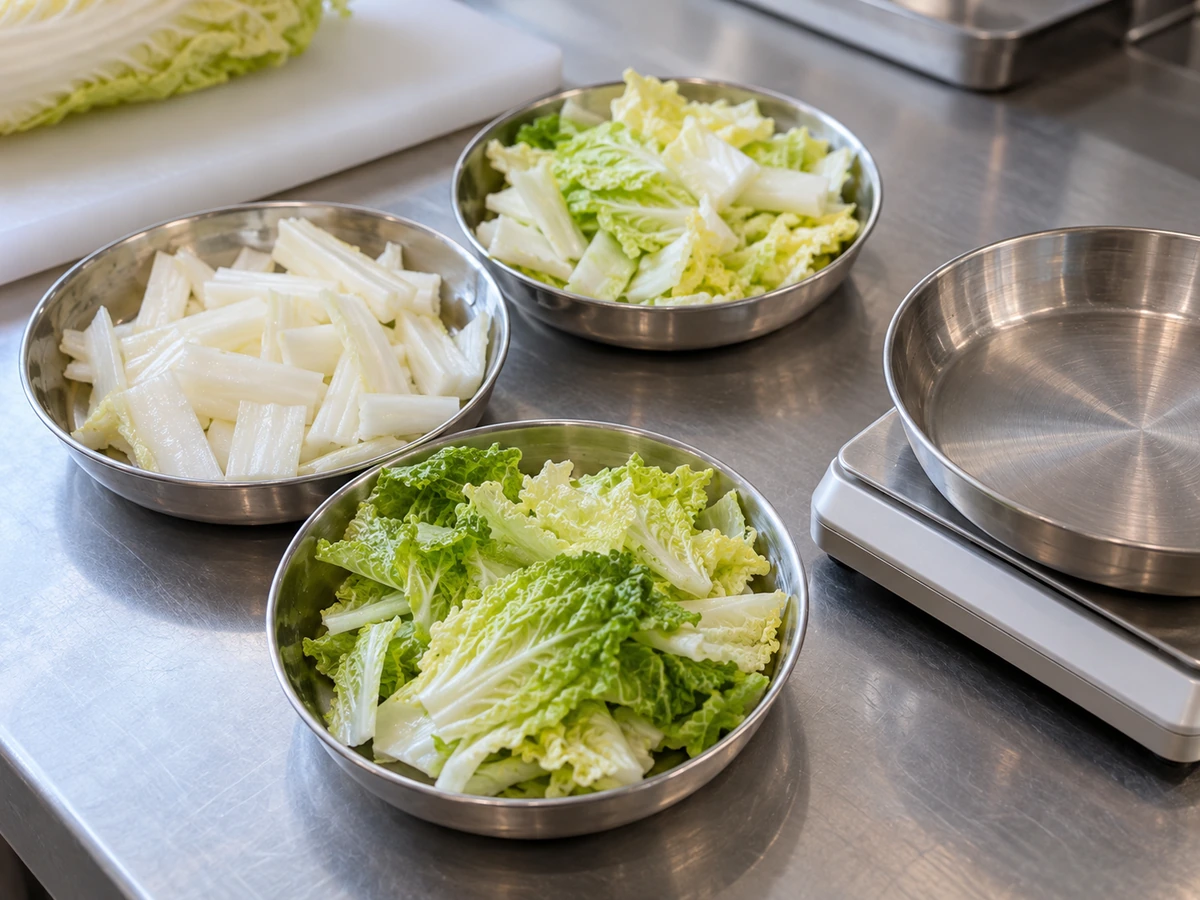
Rib-rich, leaf-rich and mixed pieces held in separate dishes beside a scale.
If the buyer also wants a comparison between the two dominant-piece classes, report 56% blade-dominant pieces and 44% rib-dominant pieces within the 750 g classified subset. Keep the excluded 200 g of mixed pieces and 50 g of fines visible. These percentages describe classified pieces, not pure blade and rib tissue. Retain all four category masses so another reviewer can reconstruct the result. Otherwise, an apparent improvement may come from excluding more material rather than changing the delivered cabbage.
Agree how to handle water lost while sorting. A long inspection on an open bench can become an uncontrolled thawing test. Conversely, brittle frozen pieces may break when separated forcefully. Establish a workable sample size, preparation sequence and handling time during method development, then check whether different operators reach comparable results. Scales and containers should suit the quantity being measured. The objective is a repeatable measurement of the agreed material; extra decimal places cannot repair an unstable preparation method.
Describe cut width, length and rib thickness separately
A nominal cut size needs a geometric definition. A label such as "20 mm cut" might refer to a blade piece's length, the distance between cutting strokes or an approximate square appearance. Napa pieces fold, curl and retain attached ribs, so they will not behave like rigid cubes. State which dimension matters to the application and how an irregular piece is placed for measurement. Avoid requiring an exact square if the intended product naturally consists of irregular leaf-and-rib fragments.
Length and width can control different problems. Long strips may bridge across a small filling outlet or become visible strings when a dumpling is bitten. Broad leaf pieces can fold into a soup spoon and still be acceptable even when their unfolded width is comparatively large. A short but thick rib piece may remain noticeable in a filling where a longer, thinner strip would blend in. This is why rib thickness deserves its own consideration instead of being buried inside one general cut number.
Commercial catalogues show that sellers describe cabbage in a variety of cut formats. Those examples demonstrate the need for an explicit purchase description; they do not establish an industry-wide size system or confirm that any particular dimension is available for the proposed order. GreenLand's guide to frozen vegetable product forms provides the broader distinction between the physical cut and the freezing format. Both should appear separately when they affect handling.

The close view shows irregular green leaf fragments and pale rib pieces.
For a fine filling ingredient, a useful development observation may be the longest conspicuous rib fragments after preparation. For a soup ingredient, it may be the proportion of pieces that retain enough blade and rib to look like napa in the bowl. Measure the failure the buyer actually sees. A strict upper length limit for every flexible leaf strand may create sorting work without improving the dish, whereas a limit focused on troublesome rib pieces could address the same complaint more effectively.
The measurement sheet should identify whether pieces are flattened gently, measured in their natural shape or assessed after a defined preparation. Include an agreed illustration of the dimension being measured. Record a distribution or the relevant out-of-size fraction when appropriate, rather than relying on an average that can conceal both very large and very small material. The agreed sample and calculation basis still matter: a percentage outside a size range by mass is different from a percentage by piece count.
Separate fines and defects from the leaf-to-rib calculation
Fines, damaged material and foreign matter should not disappear inside the leaf-to-rib calculation. They require their own definitions and decisions. Fine leaf fragments may be acceptable in a minced filling but undesirable in a clear soup, where they can disperse through the broth. Small pale particles may be normal rib fragments, while a compact clump may contain many individually acceptable pieces. The inspection needs to distinguish particle size, piece condition and aggregation rather than grouping them under an undefined "defect" heading.
Decide whether fines are included in the composition denominator and whether they are also measured separately. If both reports use the same sample, make the relationship explicit. The same material can be described under more than one characteristic, but the category masses used to reconstruct the total sample cannot be counted twice. A blade fragment classified as fine should not be added once to the leaf category and again to a separate fraction when those values are expected to total 100%.
For colour, use an agreed reference under consistent lighting. Napa naturally combines pale ribs with lighter and darker green leaf tissue. The presence of pale material alone does not prove poor quality. A buyer seeking a specific visual mix should describe that mix separately from genuine discolouration. Photographs are useful for resolving this distinction, provided they show representative product and are not edited in ways that conceal the variation being discussed.
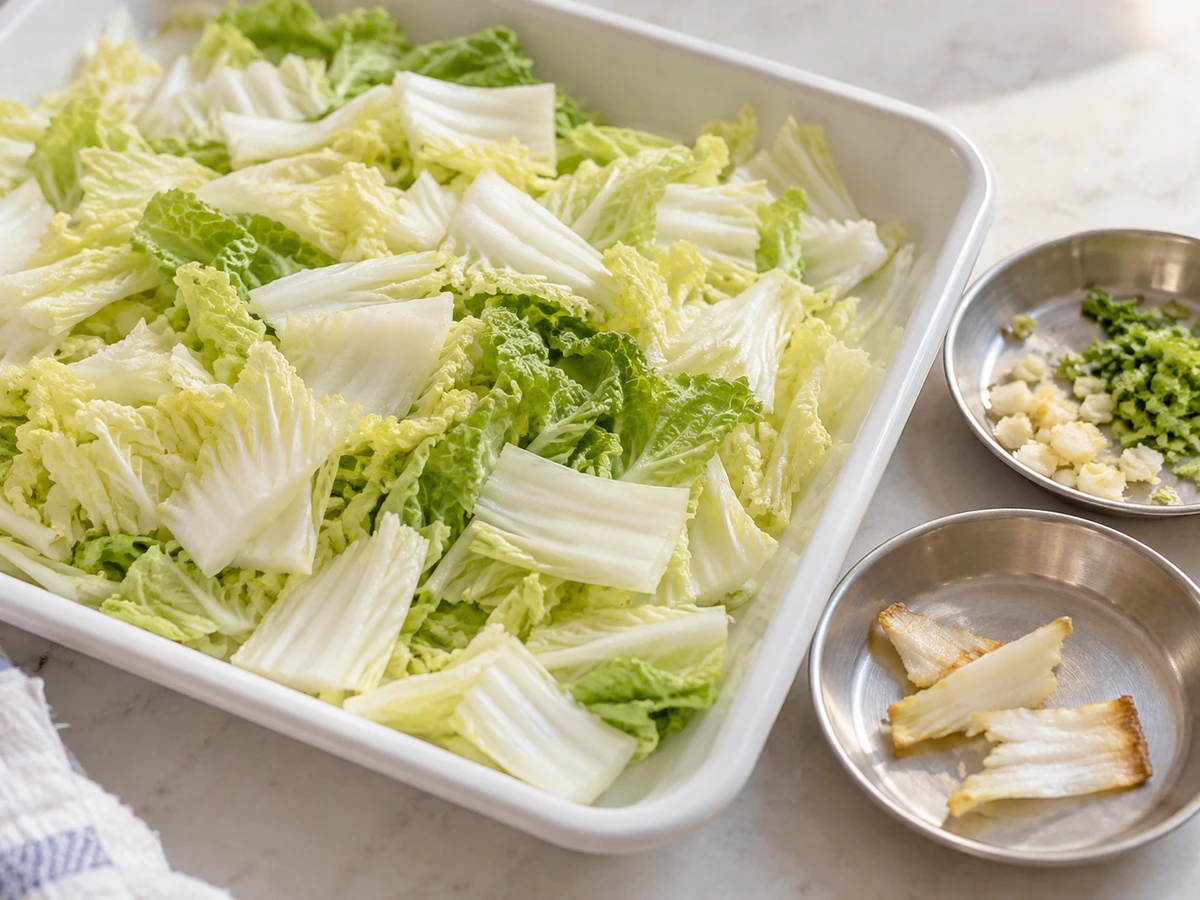
Fine fragments and brown-edged pieces separated from the larger Napa cuts.
An acceptance document should also separate food safety requirements from commercial appearance criteria. A leaf-to-rib ratio cannot establish freedom from foreign material, appropriate processing or suitability for eating without further preparation. Those matters require their own product information and controls. Likewise, an attractive sample photograph does not confirm the treatment applied to the delivered product. Ask for the relevant preparation instructions and specifications rather than interpreting colour or softness as evidence of a particular process.
GreenLand's discussion of frozen vegetable defect specifications explains why defect names and measurement bases need agreement. For napa, keep the schedule focused on defects that matter to the intended food. A long list copied from another vegetable can be difficult to inspect and may miss the characteristic causing the actual problem. During sample review, retain examples of acceptable natural variation as well as rejected material, so inspectors do not gradually tighten the standard through memory alone.
Build a sample that represents the delivered lot
A carefully defined ratio still produces a weak conclusion if the sample does not represent the delivered product. Chopped napa can contain pieces with very different shapes and masses. Pulling only the most accessible loose leaves from the top of one bag may exclude heavier rib pieces or compacted material. Sampling should follow an agreed plan that considers the delivery unit, the number and location of packages selected, and the way increments are taken within those packages.
There is no single sample count that can be prescribed for every order in this article. The appropriate plan depends on the lot structure, the risks being evaluated, the contract and the inspection system. The useful purchasing step is to agree that plan before a disputed delivery arrives. Identify what constitutes a lot, which packages are eligible for selection, how samples are combined if they are combined, and what information remains linked to each package.
Combining increments can describe the average composition while hiding package-to-package variation. Keeping every increment separate can reveal variation but requires more inspection work. Decide which result is needed. A meal producer whose small batch uses one bag at a time may care strongly about individual-bag consistency, whereas a process that blends many bags may also need a representative combined result. These are operational questions that should shape the test design.
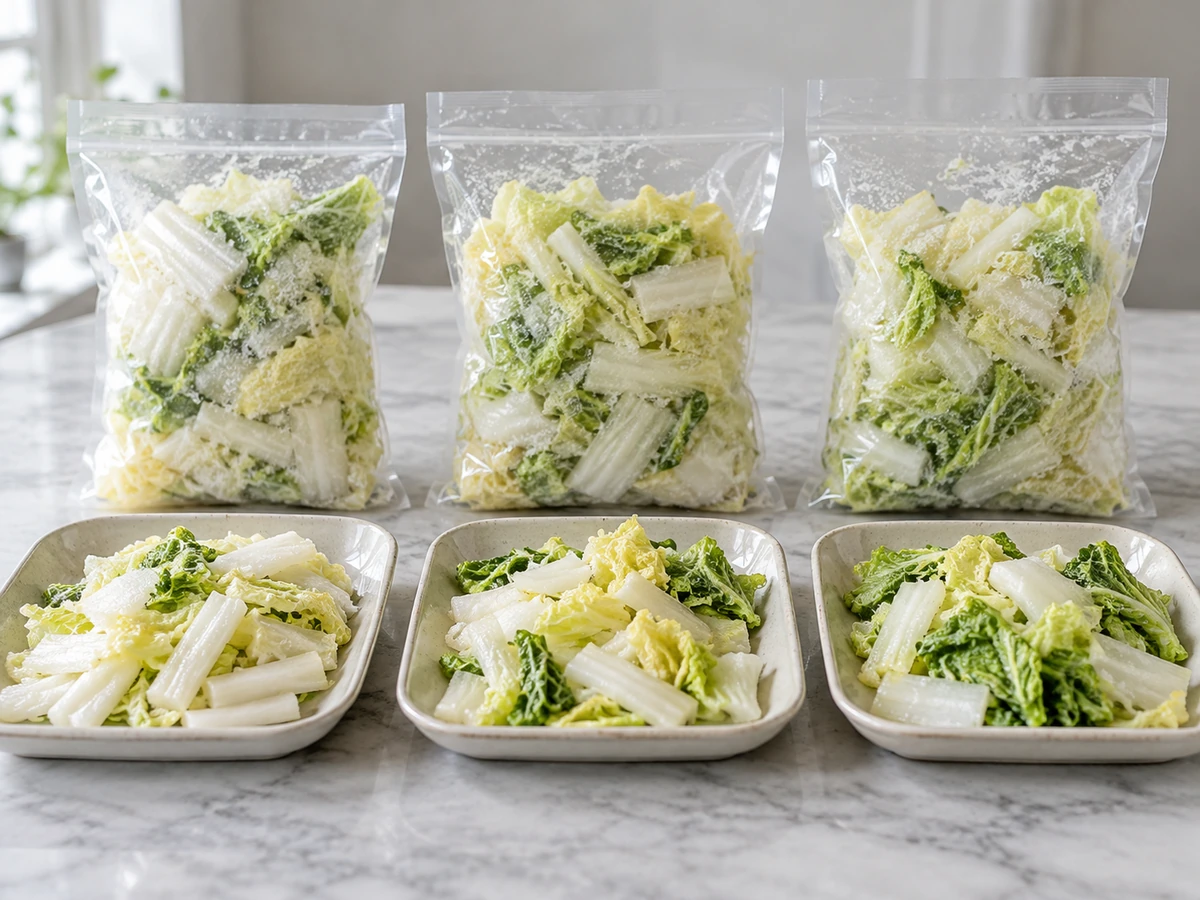
Individual pouches and trays keep several cabbage portions separate.
During development, comparing separately prepared increments can reveal whether the proposed method is sensitive to where the sample was taken. If results differ, investigate both product distribution and handling. Pieces may have been sorted unintentionally during sampling, or a sample may have thawed longer while waiting for inspection. Repeating the same flawed procedure more often will not resolve that uncertainty. A short record of selection and preparation conditions can be more valuable than an unexplained final percentage.
Keep identification practical and traceable. The inspection record should connect the result to the supplier product description, delivery or sample reference, preparation condition and method version. Photographs should carry the same reference outside the image itself. An approved development sample is a useful comparison point, but it does not prove every future lot will match it. The purchase agreement needs a way to handle out-of-range results, including who reviews the evidence and whether an application check is appropriate before disposition.
Connect the physical specification to cooked performance
Physical compliance and cooking suitability should be reviewed together. Two samples can meet the same broad cut range yet behave differently in a filling because their rib thickness, preparation condition or leaf distribution differs. Conversely, small variation in the measured composition may have little effect in a long-cooked soup. The purpose of an application trial is to identify which physical measurements protect a meaningful result and which merely add paperwork.
Prepare comparison samples with the same starting basis and recipe. If the production instruction uses drained cabbage, compare equal amounts at the agreed drained condition. If it uses frozen cabbage directly, keep the frozen addition and other liquid inputs consistent. Changing the weighing basis during the test can make a product appear better or worse through a recipe adjustment that was never recorded. Measure retained solids or released liquid where that information explains the cooking outcome.
For dumpling filling, examine distribution during mixing and depositing, conspicuous rib pieces in the bite, liquid accumulation during the actual waiting period, and the result after the formed dumpling is cooked. For soup, observe spoonable piece shape, leaf integrity, rib tenderness and dispersed fines. These are examples of application observations, not a universal scoring scheme. Select the observations relevant to the customer's process and write their meaning in ordinary language before assigning scores.
The endpoint matters as much as the initial cook. A sample that looks good immediately after heating may become too soft during a normal hold or reheat. If the finished meal is frozen again, the evaluation should follow that real sequence as well. This does not mean adding extreme treatment simply to make one sample fail. It means reproducing the conditions the ingredient will actually encounter and identifying where quality changes become commercially important.
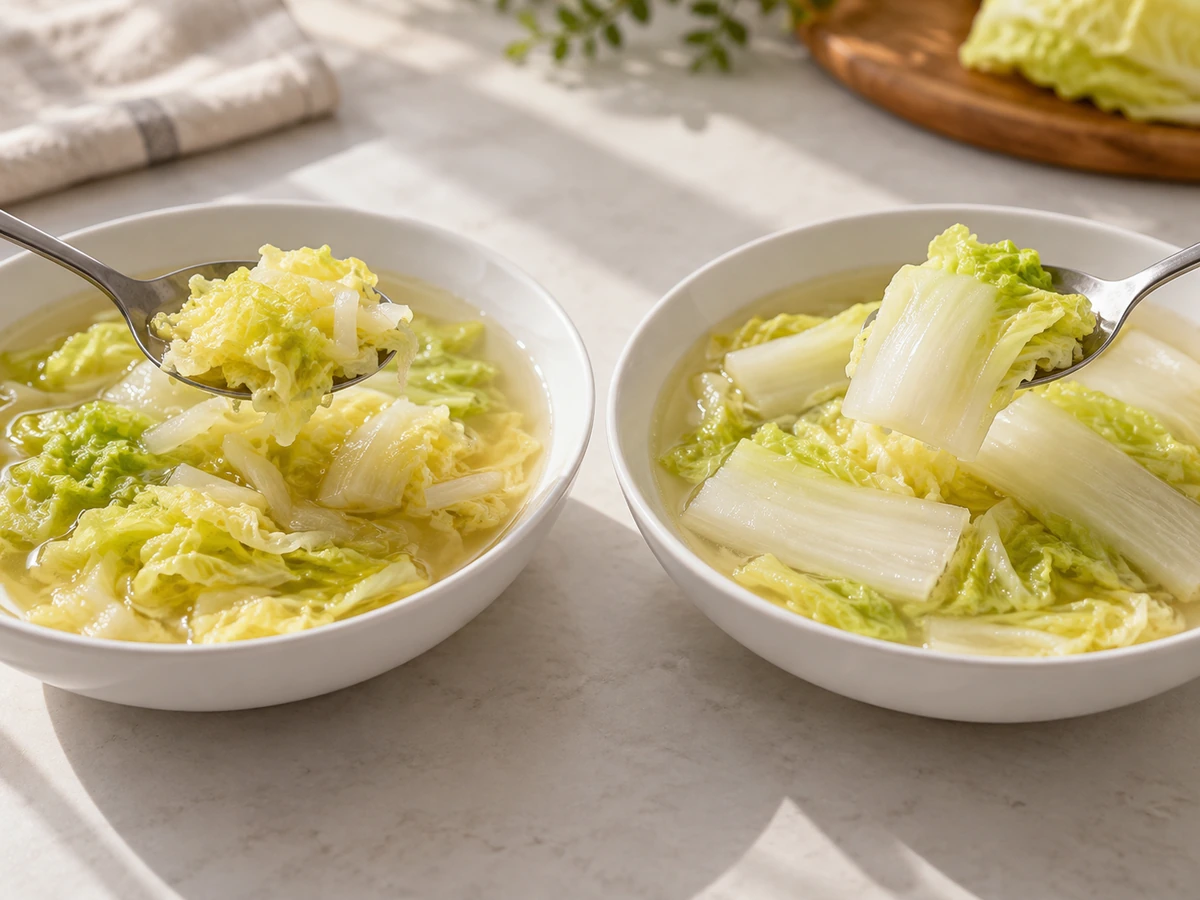
Spoons reveal different leaf-and-rib piece shapes in two bowls of broth.
Use the trial findings to refine the physical clause. If thick rib pieces consistently cause rejection, define the relevant rib dimension and inspection method. If leaf fragments cloud the broth, establish a useful fines criterion. If the difference is mainly the quantity of liquid released during preparation, a composition ratio may not be the best control on its own. Keeping the physical and application records connected helps the buyer explain why a requirement exists and helps the supplier assess whether it can be met consistently.
A recipe adjustment should be documented separately from a product approval. If one sample needs less added broth, a different mixing sequence or a longer cook to perform well, that may be an acceptable development choice. It is still a change to the process. Recording it allows the buyer to compare the total handling and yield implications instead of declaring two ingredients equivalent because both can eventually produce an acceptable dish.
Revisit the specification when the application changes. The cut approved for a small dumpling may not be appropriate for a larger filled bun, and a soup intended for immediate service may tolerate a different leaf condition from a reheated meal. The original inspection method can remain useful, but its acceptance limits should retain a clear connection to the new result. Version the approval so that an old photograph or sample report does not silently govern a different product.
Write a short clause that two inspection teams can reproduce
A reproducible clause begins with the product identity and intended form, then states the sample preparation, classification method and calculation basis. It includes the agreed targets or ranges only after those definitions are settled. The same document should refer to the cut measurement method, relevant defect schedule and approved application result. These references can be concise if the supporting methods are controlled and available to both parties.
For example, a development brief might request heading napa cabbage in a fine chopped form for cooked dumpling filling, with leaf, rib, mixed pieces and fines reported by mass using the agreed sample preparation. It might request separate observations of long rib fragments and liquid released during preparation. This describes the information needed to evaluate a sample without inventing numerical tolerances. The buyer and supplier can then agree achievable limits from evidence instead of assuming that a percentage found in another quotation has the same meaning.
The chopped Chinese cabbage photograph shows pale rib pieces and green leaf fragments in one cut form. It does not establish the leaf-to-rib percentage, a measurement method or the current specification of an offered lot. Use photographs to support the written description, then request the actual sample and product information needed for the decision. A reference image works best when both parties understand exactly which characteristics it is intended to show.

Chopped cabbage pieces are spread across the sorting surface.
Before issuing the purchase specification, ask two people to apply the proposed method independently to comparable samples. Their results need not be identical to every decimal place, but unexplained disagreement should be resolved before the method becomes contractual. Check whether mixed pieces are classified consistently, whether the denominator is clear, and whether the cut dimensions can be measured without distorting the material. This simple method check can expose ambiguity that is difficult to see while reading the document.
When discussing a frozen napa cabbage requirement with GreenLand, provide the finished-food application, the desired cut appearance, the preparation route and the performance issue the specification must prevent. We can use that brief to discuss the relevant product and sample information for the inquiry. Confirm the offered cut, composition method, treatment, packing and acceptance terms in the actual quotation and approval record. A useful specification gives both inspection teams the same task and connects the result to the food the buyer intends to make.
Source Frozen Chinese Cabbage with GreenLand-food
GreenLand-food is a professional frozen Chinese cabbage supplier and manufacturer in China, providing factory-direct wholesale supply for importers, food manufacturers, foodservice distributors and private-label programs.
Send your product form, specification, packing, quantity, application and destination. Include private-label needs and requested documents so we can confirm the supply details with your purchasing team.