


Cooked Cauliflower Rejection: Sulfur Odor and Bitterness Need Different Chemical Investigations
Oct 09, 2026
Leave a message

Research This Article & Topic with AI
Verify key claims, compare reliable sources, and explore GreenLand-food's practical frozen food knowledge.
Article details and research questions are prepared in the links. Sign-in or sending may be required.
Imagine a ready-meal team asking GreenLand to investigate a cauliflower sample described as both bitter and sulfurous. This is an illustrative buyer scenario rather than a past customer case. We would ask the team to record what panelists smelled before tasting, what they tasted in the mouth, and whether the attributes appeared in the cauliflower alone or after it was cooked and held in the full meal. A volatile screen aimed at odor cannot automatically explain bitterness. A bitter-compound assay cannot by itself resolve a cooking-related sulfur smell. The complaint must be separated before choosing tests or changing supply.
This approach does not dismiss the sensory problem. A ready-meal rejection is commercially important even if the chemistry is not yet known. The aim is to identify whether the next useful action concerns raw-material selection, frozen-form consistency, cooking and holding, another ingredient, or a combination. Keeping odor and taste distinct gives the buyer and supplier a route to evidence rather than a general instruction to cook for less time.
Ask whether the rejection was smelled or tasted
Start with a disciplined sensory description. "Sulfur" can be used casually for a cabbage-like aroma noticed when a tray is opened, a lingering taste after chewing or an unpleasant smell generated during a long hold. Those are not the same observation. Have assessors note whether the odor is present in the frozen pack, after thawing if the process uses a thaw, during heating, on opening a sealed meal and at the moment of eating. Record bitterness only after tasting an appropriately prepared sample. Ask whether a reference lot and the complaint lot differ under the same treatment.
The distinction matters analytically. Odor-active volatiles can be collected from the air above a cooked sample and characterized with gas chromatography and smell or mass-spectrometric methods in a specialized investigation. Bitterness is perceived in the mouth and may be associated with compounds extracted from the food matrix. A laboratory can measure both, but a report for one route should not be presented as if it answers the other. The original cauliflower study used trained sensory assessment and separate chemical approaches to connect these attributes. A routine supplier complaint may begin with a smaller matched sensory test before advanced analysis is justified.
Use a neutral vocabulary and avoid leading the panel. One taster's "rotten" may be another's normal cooked-cauliflower note. Define the unacceptable intensity and the reference food. For a ready meal, compare the cauliflower alone, the base sauce alone and the assembled dish if safe and appropriate under the manufacturer's controls. Salt, acidity, fat and other vegetables can alter perception. If the odor appears only after the meal is held warm in a sealed compartment, a raw floret sniff test has limited diagnostic value. If bitterness is clear in the cauliflower before it meets the sauce, the lot or cultivar may deserve focused investigation.
Record the physical context: floret size, stem proportion, cut surfaces, color, package condition and visible defects. A GreenLand frozen cauliflower sample should be compared with its actual quoted form and grade. Size and stem allowance can affect cooking uniformity, while temperature history and packing can influence condition. These facts help construct a fair comparison. They do not prove a particular glucosinolate or volatile level; chemical attribution requires the appropriate method.

Qualitative schematic. Odor is evaluated through headspace and the nose, while bitterness is evaluated in the tasted material. Open full-size diagram.
Severity also determines the next step. A mild characteristic Brassica note that exceeds a brand's flavor target calls for recipe and variety comparison. A strong, unexpected off-odor, discoloration or decay concern may require the manufacturer's food-safety and quality investigation before any tasting panel. UC Davis postharvest guidance describes fresh cauliflower disorders that may become evident after cooking under certain storage atmospheres. That is a distinct hypothesis, not an explanation to impose on a properly frozen lot. The team should document actual condition and route before assigning cause.
The cultivar experiment separated two compound groups
The published cauliflower study cooked eleven varieties and had a trained panel assess flavor attributes. It found varieties differed especially in a cauliflower odor note and bitterness. The researchers used HPLC to assess glucosinolates in relation to bitterness, and headspace gas chromatography with olfactometry and mass spectrometry to investigate odor-active compounds. Their abstract identifies sinigrin and neoglucobrassicin in the bitterness discussion, while allyl isothiocyanate (AITC), dimethyl trisulfide (DMTS), dimethyl sulfide (DMS) and methanethiol (MT) were key to the sulfur-odor findings. These are different chemical questions even though sulfur appears in some names on both sides.
It would be misleading to turn the abstract into a universal concentration threshold. The accessible study description does not supply an acceptance level for frozen cauliflower or a particular ready meal. The eleven varieties were compared under the researchers' procedure. Cultivar composition, cooking and food matrix can all influence what a panel perceives. An association observed across varieties suggests analytes worth investigating, but a single bitter commercial batch could have additional causes. The buyer needs a complaint description and matched samples before claiming one molecule caused its rejection.
The compound groups also have different behavior in an analytical workflow. A volatile can leave the hot food and enter the headspace, so container shape, time after cooking and sampling temperature influence what is measured. A glucosinolate assay concerns compounds extracted from the food itself and requires a defined sample basis. If one laboratory tests the headspace of a freshly steamed reference and another tests a chilled puree, the results cannot be compared simply because both reports mention cauliflower. The sample and preparation must be aligned with the actual eating experience.
The study's value for a buyer is not a list of chemical acronyms to place in every specification. It shows that two sensory dimensions that are often lumped together can be investigated separately. If the ready-meal team describes a sulfur odor without bitterness, begin with a controlled cook and odor evaluation; a targeted volatile analysis may follow if the commercial decision requires it. If bitterness is the problem, use a taste comparison and consider the appropriate nonvolatile analytes. If both are present, record them separately so that an improvement in one does not mask a failure in the other.

Qualitative schematic. Volatile gas-phase targets and dissolved nonvolatile taste targets need different sampling approaches. Open full-size diagram.
A concise evidence table clarifies the relationship:
On smaller screens, scroll across the table to read every column.
| Rejected attribute | Study-associated group | Relevant sample observation | What remains to establish for this lot |
|---|---|---|---|
| Sulfurous cooked odor | AITC, DMTS, DMS and methanethiol among key odorants | Smell at a defined cook and hold point | Whether the same volatiles are elevated and perceived in the customer's meal |
| Bitterness | Sinigrin and neoglucobrassicin associated with bitterness | Taste intensity in cooked cauliflower | Whether these or other factors explain the complaint sample |
| Both together | Two sensory dimensions | Separate odor and taste scores | Whether ingredient, cooking or formulation changes can improve both |
The table records study directions and investigation needs, not guaranteed diagnostic markers. Broader Brassica explanations help explain why these vegetables can carry pungent and bitter notes, but the general class story cannot replace the paired cooked-cauliflower evidence. Nor should a health or nutrition discussion determine how a ready-meal defect is diagnosed. The commercial endpoint is acceptable flavor under the product's own process.
A volatile screen cannot substitute for the bitter-compound question
A headspace report can be highly informative when the complaint is a smell. It may show which volatile compounds are present after a defined cook and whether their pattern differs from an approved reference. Its scope is narrower when the buyer asks about bitterness. A bitter molecule may remain in the food, and the sensory experience depends on what is tasted in the mouth. A chromatogram of headspace volatiles cannot establish that the bitter fraction is acceptable. Similarly, detecting a glucosinolate in the food does not tell the buyer the intensity of a sulfur smell released during reheating.
Before commissioning a chemical screen, ask what decision the result will change. If the customer needs to choose between two cauliflower lots for a fixed recipe, a blinded matched-cook sensory comparison may be enough for preliminary selection. If a repeated rejection requires root-cause work, targeted chemical analyses can be chosen after the sensory pattern is clear. If a regulatory or labeling question is involved, use the relevant validated method and specialist advice. Testing every available compound without a defined decision can produce impressive data and little actionable interpretation.
The laboratory brief should specify material and basis. Was the sample frozen florets, cooked florets, cooking liquid, sauce or a complete ready meal? Was it homogenized before analysis? Was the report on wet weight, dry weight or serving basis? For headspace work, note the vessel, headspace time and temperature. For an extracted food assay, note extraction and calibration. Without these fields, even a correct chemical result may be attributed to the wrong stage of production. The causal question is especially difficult when the sample has already been blended into a meal.
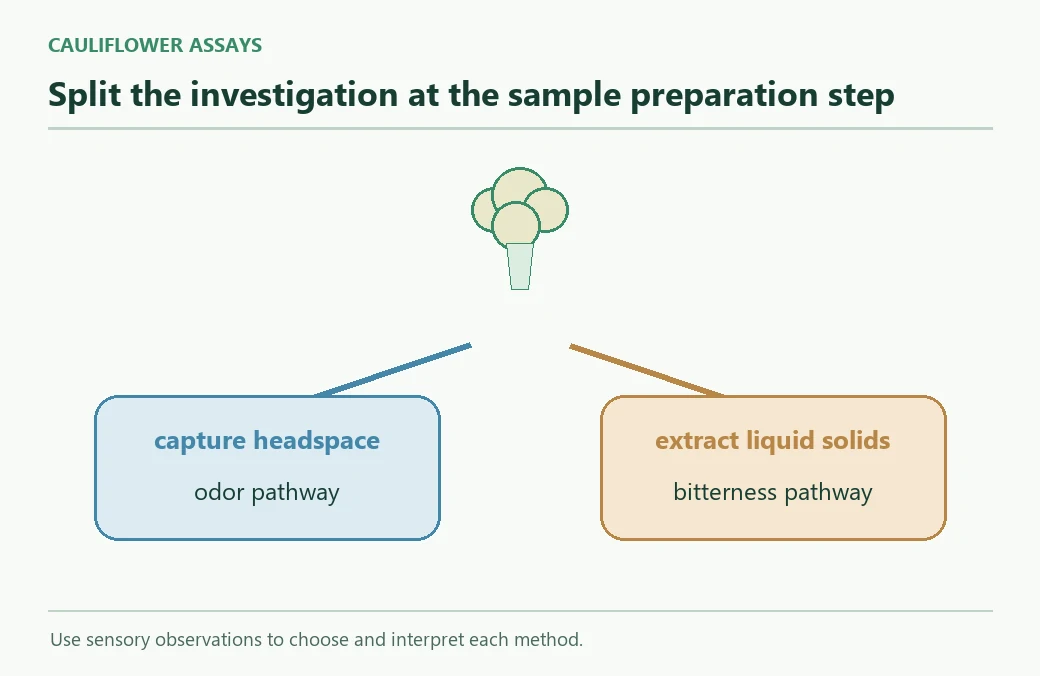
Qualitative schematic. A headspace screen and a liquid/solid extract answer separate chemical questions after a sensory complaint. Open full-size diagram.
An absence or small amount on a report is not automatic proof that a compound played no sensory role. Detection limits, sample loss, timing and the panel's sensitivity matter. Odor-active molecules can be perceptible at low amounts, while a measured compound may not dominate a complex meal's perception. A trained panel and analytical method complement each other: the panel describes what the food does; the method characterizes a candidate chemical signal. The study joined those approaches. A customer complaint investigation should preserve that sequence rather than replacing sensory evidence with a broad instrument list.
Different processing histories can confound a supplier comparison. A sample may have been cooked longer because it came from a larger floret grade; another may have been held in a sealed tray. A new sauce ingredient can add its own odor or change bitterness perception. When possible, retain the incoming cauliflower and reproduce the process with an approved reference lot. If the fault appears only after the meal is assembled, investigate the interaction in the finished recipe. This may be a formulation issue even when the cauliflower is within its agreed frozen specification.
The primary research gives a useful hypothesis list but no reason to claim a specific commercial frozen lot contains a particular amount of AITC, DMTS, DMS, MT, sinigrin or neoglucobrassicin. A spec should list these only when there is a validated method, a business reason and an agreed limit. Otherwise the buyer can describe sensory acceptance and process conditions more honestly. Chemical detail belongs where it resolves a real dispute or controls a meaningful attribute.
Control cooking and holding in the lot comparison
To compare a complaint lot with a reference, use equal portion mass, similar floret size, the same equipment, water or sauce amount, heating endpoint and holding interval. Randomize preparation or serving order where feasible. Make separate observations at the end of cooking and after the actual ready-meal hold. Odor can build in a closed container and escape when opened; bitterness may be perceived after chewing the cauliflower with sauce. A sample cooked in open water and served immediately is not the same exposure as a sealed meal reheated for service.
Floret geometry matters. A small crown and a thick stem may heat differently, and a mixed-size sample can produce tender and firm pieces in one tray. If the customer cooks to make the thickest piece acceptable, smaller pieces may receive more heat than intended. Record the size distribution and stem allowance in both lots. This does not predetermine which compound forms; it gives the sensory comparison a fair physical basis. If the lots differ in cut, the developer can either select matched pieces for a chemistry comparison or test each lot as actually supplied for a practical production decision.

Illustrative open and covered cauliflower holding states. Record the actual cooking and serving history in a lot comparison.
Control the meal context as well. Cauliflower in a plain broth may release and display different aromas from cauliflower in a fatty sauce. Salt and acid can change how bitterness is perceived. The factory may blanch or precook, then freeze, reheat and hold. Capture the complete sequence and record which stage first shows the rejected note. If the complaint appears only after a long hold, changing raw-material selection alone may not solve it. If it appears in a matched short cook before other ingredients are added, the incoming lot deserves closer examination.
Use replication proportionate to the decision. A first controlled cook identifies a pattern; repeated cooks by more than one operator test whether the pattern is stable. If a change in lot or cook method has major financial consequences, a structured panel and several production runs are warranted. Keep the threshold specific to the brand's meal: for example, an agreed maximum intensity relative to an approved reference rather than an unsupported universal numeric compound limit. The actual panel scale and pass criterion should be written before results are seen.
Cold-chain and package observations belong in the record, but they should not be treated as shortcuts to chemical causation. Check that the frozen sample was stored and transported as specified, that cartons and inner packs are intact, and that lot identity is clear. A thawed and refrozen sample or one with heavy clumping may need a separate condition investigation. That finding does not automatically explain the exact odor or bitterness, but it prevents an invalid sensory comparison and may point to a quality-control problem.

Bulk cauliflower florets with visible stem portions. GreenLand product photograph; finished-formulation performance requires the customer's defined application trial.
When the complaint is resolved by a cook adjustment, document whether the new method is compatible with production throughput and final food safety requirements. A shorter heat exposure may change texture or core heating; a longer exposure may worsen odor and softness. The manufacturer must validate its own process and finished product. This article provides no universal cooking time or temperature to eliminate sulfur notes. It offers a way to observe the problem and test a change under controlled conditions.
Resolve the application complaint before changing supply
The illustrative ready-meal team can send GreenLand the lot reference, quoted frozen cauliflower form, photographs of the received material, and separate descriptions of odor and bitterness. Include the recipe and the precise point where the rejected attribute arose. We would compare that information with the agreed product specification and arrange an appropriate retained-sample or new-sample comparison where possible. If the product is within its frozen form and grade specification but the assembled meal fails a flavor target after a changed process, the investigation must include the customer's cooking and holding route.
For a new sourcing decision, specify floret size, stem allowance, color, defect limits, packing, order quantity, destination and documentation. Confirm the actual offered parameters rather than borrowing numbers from another supplier's page. Add an application trial if the product will be a visible ready-meal component. Sensory acceptance should name the cooking route, meal matrix, serving point and reference sample. A change in cut or recipe should trigger review of the affected attributes. This is more useful than a statement that all cauliflower must have "low sulfur."

Cauliflower florets on a white plate. GreenLand product photograph; finished-formulation performance requires the customer's defined application trial.
If bitterness alone drives rejection, a new variety or material lot could be worth comparing under the same cook. If odor appears only after prolonged holding, process and packaging may offer a more direct experiment. If both remain in matched tests, the buyer may evaluate another frozen grade alongside recipe adjustments. These are trial options, not conclusions about a GreenLand shipment. The original eleven-variety study supports separating the questions; it cannot select the commercial remedy without the buyer's data.
Record the outcome in two linked documents. The supplier acceptance record states whether the delivered frozen florets met the purchase agreement. The finished-meal validation record states whether the cooked dish met flavor, texture and safety requirements under the brand's process. A result can differ between them. Making the distinction explicit allows the parties to investigate a real complaint without forcing a volatile laboratory result to stand for bitterness or a cooking defect to stand for a raw-material failure.
The first investigation can be deliberately modest. Retain a sealed sample of the questioned lot and an approved reference under equivalent storage. Cook equal masses with the same floret size selection, vessel, liquid amount and heating endpoint. Have assessors record sulfur odor when the container is opened, then bitterness after tasting, using separate scales. If the two attributes do not recur, review the original meal assembly and hold before sending expensive samples for a broad chemical screen. If one attribute consistently differs, a targeted laboratory brief can name the material, preparation, comparison sample and compounds of interest. This sequence makes an analytical result interpretable.

Qualitative schematic. Matched raw, cooked and held samples can locate when an off-note appears without assuming its chemical cause. Open full-size diagram.
The original paper's associations should not be converted into a one-compound verdict. A correlation across eleven cultivars can point to a useful analyte, but it cannot identify the sole cause of a later bitter batch. The food matrix may alter perception, and sensory panels vary in sensitivity. A volatile can escape before sampling, while a nonvolatile analyte can remain in the food. These possibilities explain why a panel description and a laboratory result may diverge without either being careless. Preserve the timing and basis of both observations, then refine the test if the commercial decision remains unresolved.
Retention practices matter to the comparison. Label each sealed sample with lot, packing date, withdrawal point and storage history. A reference kept much longer than the questioned lot can introduce an age difference that looks like a sourcing difference. An opened or partly thawed retained sample should not silently become an acceptance standard. If suitable reference material is unavailable, record that limitation and compare several current lots under one cook while seeking a future approved reference. Good sample history will often save more time than a longer chemical list.
GreenLand-food can supply frozen cauliflower as a professional supplier and manufacturer in China with factory-direct wholesale supply. A buyer can use the frozen cauliflower page to start a quote and send its application, form, packing, quantity, destination and required documents. For a disputed ready-meal result, include the separate odor and taste observations as well. Those details tell us which sample and specification to discuss while the manufacturer investigates the cooked meal under its own validated route.
Related reading
Use tray heat and spacing to manage released water and develop a roasted profile.
Compare frozen-cauliflower cooking methods and texture endpoints without excess water.
Understand blanching and rapid cooling as distinct preparation steps before freezing.
Discuss frozen cauliflower for your application
GreenLand-food is a frozen cauliflower supplier and manufacturer in China, offering factory-direct wholesale supply for food manufacturers, importers and private-label programs.
Send the required product form and specification, packing, quantity, application, destination, private-label needs and requested documents. Include the sample or process question discussed above so we can identify the appropriate frozen ingredient and supply details.