


Frozen Sweetcorn Starch Results: An Apparent Decline Does Not Prove Conversion to Sugar
Oct 09, 2026
Leave a message

Research This Article & Topic with AI
Verify key claims, compare reliable sources, and explore GreenLand-food's practical frozen food knowledge.
Article details and research questions are prepared in the links. Sign-in or sending may be required.

Imagine a customer asking GreenLand whether a lower post-freezing starch number means a sweeter corn ingredient. This is an illustrative buyer scenario, not a recorded customer case. We would first request the two sample reports, the analytical basis and the individual sugar results. We would then assess sweetness in the actual intended product using a relevant sensory trial and, if needed, a Brix specification on the agreed frozen corn form. Starch recovery, individual sugars, soluble solids and perceived sweetness are related questions with different methods. One number cannot settle all four.
The distinction matters to frozen sweetcorn sourcing because a simple conversion story sounds persuasive. Sweet corn can undergo sugar-to-starch changes during maturation and postharvest handling, and buyers know that rapid processing helps retain its eating quality. That background does not allow the reverse inference that an apparent starch decline during a particular analytical comparison must have created more sugar. A paired measurement is the starting point; the method and material history determine what its pattern means.
Name the carbohydrate result that decreased
Begin with the report label. Did the laboratory measure total starch by an enzyme-based method, resistant starch by a separate protocol, available carbohydrate by calculation, total sugars, individual sugars, or Brix? These are not alternate names for one pool. In the original sweetcorn paper, starch and sugars were measured using distinct analytical methods after sample preparation. The samples were analyzed on a dry-weight basis following lyophilization for analytical work. Lyophilization in the laboratory should not be mistaken for a commercial freeze-dried sweetcorn SKU. The frozen food product being discussed is still a frozen kernel ingredient.
An enzymatic starch assay reports the material that is recovered under its prescribed preparation and enzyme treatment. Its value can depend on how the sample is milled, cooked or dispersed before digestion, as well as the chemistry and accessibility of starch after processing. If two samples were prepared differently or expressed on different bases, a numerical difference may partly reflect method or moisture rather than a biochemical transfer. The buyer should request the analytical protocol, sample preparation, recovery controls, replicate results and units before translating a smaller report number into a process claim.
Individual sugars are a separate endpoint. High-performance anion-exchange chromatography with pulsed amperometric detection, as used in the study, can distinguish sugar species rather than reporting one undifferentiated "sweetness" value. Sucrose is especially relevant to sweetcorn flavor, but its concentration on a report is still an analytical concentration, not a complete sensory score. A starch decrease that is hypothesized to become sugar should have a corresponding increase in one or more measured sugar pools under a compatible mass basis, unless another measured pathway or loss accounts for the difference. The study did not show that simple-sugar increase in the frozen samples.
Brix is different again. It measures refractive behavior of a liquid extract as soluble solids, commonly used as a practical grade indicator. Sweetcorn extract contains more than sugar, and the method of extracting and measuring it affects the result. A Brix grade can support a commercial sweetness discussion, but it does not measure total starch in the kernel. GreenLand's frozen sweetcorn kernel page uses Brix bands in its product specification. Those bands are sourcing tools for a defined offered form. They are not evidence that any measured starch change converted into sucrose.
The report basis should be written alongside each result. A percentage of wet fresh kernels, a percentage of dry matter and a concentration in the expressed juice can move differently as water changes. Blanching can add or remove water; freezing and thawing can change drip; canning involves liquid exchange. A buyer who places a wet-basis starch value beside a dry-basis sugar value may create an apparent missing mass. Convert to a common basis only when moisture and recovery data permit it, and retain the original values so the calculation can be checked.
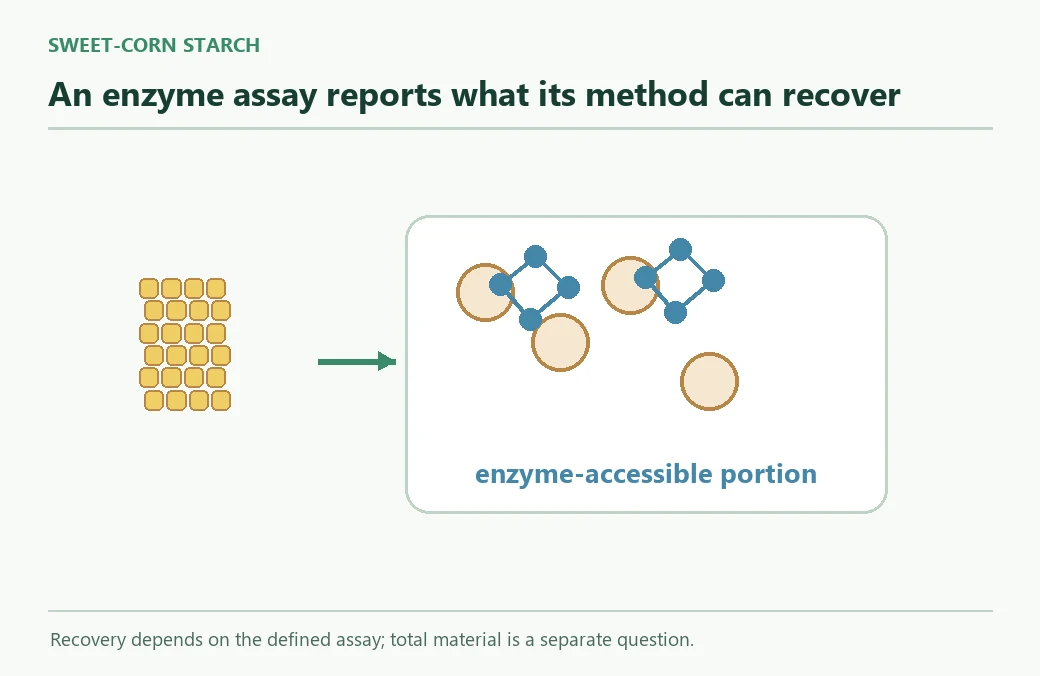
Qualitative schematic. An enzyme assay reports recovered starch under its method rather than directly showing the fate of every kernel carbohydrate. Open full-size diagram.
These definitions belong in the article because they prevent an attractive but unsupported causal statement. If the question is "did measured starch decline?" answer with the study's assay and sample basis. If the question is "did the corn become sweeter?" ask for relevant sugar and sensory evidence. If the question is "where did the carbohydrate go?" design a mass-accounting study. Each can be addressed without claiming that the earlier result settles the later one.
Read starch and sugar measurements together
The 2023 sweetcorn processing study examined fresh bi-color supersweet corn and samples after blanching, freezing and canning. The authors measured simple sugars, starch and dietary-fiber fractions and also performed glycomic analyses. Its freezing result is distinctive: starch measured by the chosen method declined in the frozen samples, while sucrose and total simple sugars did not rise in the way a simple starch-to-sugar explanation would predict. The USDA's interpretive and technical summaries report the same paired observation. They do not establish that no chemical change occurred; they show that the claimed simple-sugar destination was not observed in those measurements.
The paper's canning data should not be blended into the freezing conclusion. Canned samples underwent a different process and liquid environment, and their carbohydrate pattern differed. A sweetcorn processor might want to compare all three routes for a broader development project, but a buyer assessing IQF kernels should focus on the matched fresh/blanched/frozen path. An unrelated canning increase in measured starch cannot close the frozen-sample balance. Each path needs its own inputs, outputs and method checks.
The result also should not be generalized to every cultivar or every commercial lot. This was a specific bi-color supersweet material and processing experiment. Genetics, maturity, field conditions, delay after harvest, blanching and freezing conditions can all affect starting composition and subsequent measurements. The study is strong evidence against the shortcut "lower measured starch proves sugar formation" in its sample set. It is not a universal estimate for how many percentage points of starch any GreenLand corn lot will lose after freezing.
A paired evidence table helps the reader keep claims within scope:
On smaller screens, scroll across the table to read every column.
| Sample comparison | Measured endpoint | Reported pattern in the study | Interpretation permitted |
|---|---|---|---|
| Fresh versus frozen path | Enzymatic starch recovery | Lower in frozen samples | The method recovered less starch under its conditions |
| Same processing path | Sucrose and total simple sugars | No corresponding rise after blanching or freezing | Simple-sugar formation was not demonstrated by these measures |
| Same study | Other carbohydrate fractions and glycomic patterns | Processing-associated changes reported | Further analysis is needed to locate and explain every difference |

Qualitative schematic. In the cited sweetcorn study, assay-recovered starch fell in frozen samples without a rise in measured simple sugars. Open full-size diagram.
This table describes directions, not a closed carbon balance. There may be analytical uncertainty, a change in accessibility, compositional shifts in other fractions or material lost during handling. The published data and discussion should be read on their own terms. A buyer should resist filling an unmeasured gap with whichever mechanism is commercially attractive.
Some search results on postharvest sweetcorn describe changes in sugar and soluble solids during storage. A precooling study, for example, addresses a different period and intervention from an enzymatic comparison after freezing. Those sources can guide crop and processing decisions, but they cannot overturn the paired starch-and-sugar observation in the study at issue. The exact question here is what a lower laboratory starch result establishes about a frozen sample, not how every sweetcorn carbohydrate changes over a season.
Retrogradation is a proposed accessibility explanation here
Starch is a collection of glucose polymers organized within the kernel. Heating in water can disrupt its native granule organization, while cooling and storage can allow chains to reassociate into more ordered structures. Researchers often call that reassociation retrogradation. It can influence texture and the accessibility of starch to enzymes under some assay conditions. The sweetcorn paper discusses this as a possible explanation for the lower recovered starch after freezing. The study did not independently quantify a resistant-starch fraction that would prove this pathway accounted for the observed difference.
The words "possible" and "measured" need to stay separated. An enzyme assay recovery can fall because a fraction is harder for the prescribed enzymes to access, but the raw polymer carbon has not necessarily disappeared. Conversely, a lower assay result does not by itself demonstrate retrogradation; other method or processing effects could contribute. The relevant next test would use a protocol specifically designed to distinguish digestible and resistant or inaccessible fractions, with appropriate controls and sample preparation. If a buyer does not need a nutrition claim, the practical decision may be resolved without that extra mechanistic study.
The proposal also cannot support a glycemic or health message. To claim resistant starch, the fraction must be measured with a suitable independent method on the actual product. To make a glycemic claim, an even broader evidentiary and regulatory basis is needed. Neither follows from a single lower enzymatic starch value. A marketing phrase such as "freezing converts starch into healthy fiber" would add a pathway the paper did not establish and assign a benefit it did not test. The scientifically honest statement is narrower: the assay recovered less starch, simple sugars did not rise, and altered starch accessibility is one explanation worth testing.
A method comparison can make the hypothesis more useful without pretending it is already proven. Split the same processed sample between the reported enzymatic procedure and a second validated procedure that prepares starch more aggressively or separately measures resistant material. Include an appropriate recovery reference in each matrix. If the methods diverge on frozen material, the result would support further work on accessibility, though it would still need interpretation. If both decline similarly, investigate sampling, processing losses or other fractions. Either outcome is more informative than assigning the missing value to retrogradation because it is a familiar starch term.

Qualitative schematic. Reassociation could reduce enzyme access, but the study did not independently quantify resistant starch to prove that explanation. Open full-size diagram.
An unresolved accessibility explanation should remain an open item in the laboratory brief. Ask the analyst to state which preparation makes starch accessible to the enzymes and which fractions the reported value includes. If that information is missing, record it before interpreting the difference. A result may justify an alternative recovery test, but it supplies no numerical increase in resistant starch and no prediction of blood-glucose response. The report can retain a useful hypothesis without using it as a product claim.
The texture of the kernel may be relevant to product development, but it is another endpoint. Sweetcorn firmness and bite change with variety, maturity and processing, and retrogradation can be discussed in broader food-starch science. The present data do not establish that the frozen sweetcorn lot is firmer, sweeter or slower to digest because its measured starch is lower. Those properties should be evaluated directly in the intended meal. The difference between an analytical hypothesis and product performance is essential when an ingredient team prepares specifications for customers.
If a buyer asks whether freezing "uses up" starch, ask what mass is being tracked. A meaningful fate claim accounts for the starting kernel, water, soluble losses, recovered starch, measured sugars, other carbohydrate fractions and analytical recovery. The study investigated several fractions and found processing-related changes, yet it was not a complete customer-lot mass balance that identified every destination of the apparent starch decline. It gives a precise challenge to an oversimplified conversion claim and a rationale for further testing where the claim matters.
Design a carbohydrate-fate comparison for the actual lot
For a commercial IQF program, begin with one well-identified sweetcorn lot. Collect representative incoming kernels before processing and matched portions after blanching and freezing. Document whether samples came from the same harvest, variety and maturity window, and record the time between harvest and each step. Keep the sample handling and laboratory method consistent. If moisture changes, measure it and report the carbohydrate results on a common dry-matter basis as well as the units required for the commercial specification.
Track material that leaves the kernels. Blanching water and drained liquid can carry soluble compounds; trimming and kernel damage can alter recovery. If a claim is that starch carbon became sugar, include the relevant sugar species in both the kernel and any collected process liquid where feasible. If a claim is that assay accessibility changed, include a suitable alternative preparation or resistant-starch method. A full carbon balance is demanding, so the study plan should identify the question it must answer and the fractions it can realistically recover. Uncollected losses should be described as unresolved rather than assigned to a favored pathway.

Illustrative frozen and thawed kernel sampling. Match lot identity and preparation before comparing starch, sugars and moisture.
Use laboratory controls and replication. An enzyme assay needs performance checks on both fresh and frozen matrices, and the sample may require consistent grinding, cooking or dispersion. Analyze more than one portion from each processing point to see whether the difference exceeds sampling and method variation. A few damaged kernels can bias a small sample, especially when juice is lost during thawing. Mix and sample in a way that represents the commercial lot while preserving the processing-point identity. Retain chain-of-custody notes and the original laboratory sheets.
The sampling point should be physically documented. "After freezing" might mean immediately after the freezer, after months of storage, after thawing in a laboratory or after reheating. These conditions can produce different moisture and drip histories. Label collection time, storage duration, temperature record and any thaw or drain step. Collect enough material that the same composite sample can support moisture, sugar and starch analyses, while retaining separate replicates for variability. A buyer who sees a small difference between two reports can then determine whether it reflects the process of interest or simply unlike samples. Keep the original units on the record even after converting to a common dry basis, so another reviewer can audit the calculation.
The trial should also match the buyer's business decision. If the question is procurement sweetness, include a defined Brix method and sensory assessment of the cooked kernels. If the question is ingredient labeling or nutrition, use the appropriate accredited methods and review the destination-market requirements. If the question is a manufacturing yield discrepancy, weigh the product and process streams. Starch and individual-sugar data may be collected in every version, but the decision rules should differ. One omnibus test report can contain many correct numbers and still fail to answer what the buyer needs.
Write the acceptance plan before seeing the results. Define the expected frozen form, Brix band if used, maturity and tenderness attributes, broken-kernel tolerance, package and frozen condition, and any requested chemical assay. Specify the sample preparation for each test. If the supplier and buyer have agreed on a starch figure, the contract should say whether it is measured on a frozen kernel, a thawed and drained kernel or a dry sample under a particular method. A threshold without this basis invites dispute and may encourage a false conversion explanation when two labs disagree.

Bi-color sweetcorn kernels with yellow and cream kernels. GreenLand product photograph; finished-formulation performance requires the customer's defined application trial.
GreenLand can provide a sample of the actual quoted frozen corn form and discuss its product specification. The buyer's process or laboratory must establish any proposed carbohydrate-fate claim for that lot. The GreenLand frozen corn supply page and kernel specification can anchor the sourcing discussion, while the paper guides which paired measurements prevent an overclaim. This division keeps the trial practical and gives both sides a record that can be repeated after a variety or processing change.
Keep sweetness and nutrition claims outside the shortcut
The customer in the illustrative scenario wants to know whether lower post-freezing starch means sweeter corn. The answer is no on that evidence alone. Sweetness is a sensory property affected by sugar profile, concentration, aroma, maturity and the finished recipe. A Brix grade can be useful for a defined frozen kernel sample, but it is a soluble-solids proxy. The most relevant approval combines the agreed Brix method with a cooked-kernel taste and texture comparison in the intended application. A measured starch decline does not replace that work.
Likewise, no "lower carbohydrate," "more resistant starch," "lower glycemic impact" or digestive-health claim should be drawn from the shortcut. The study did not independently establish resistant-starch content or human glycemic response for GreenLand corn. A nutrition claim would require appropriate validated measurements on the actual product, a defined serving and review under the destination market's rules. An assay difference in a research batch is a reason to formulate a question, not a permission slip for a label.

Yellow sweetcorn kernels in a loose product view. GreenLand product photograph; finished-formulation performance requires the customer's defined application trial.
In a supply agreement, separate sensory and analytical acceptance. The supplier can confirm the quoted frozen corn form, kernel size, color, integrity, Brix program if applicable, packing, quantity, destination and documents. The buyer can define the cooking test and brand flavor target. If a special starch assay is required, both parties should agree on the method, laboratory and basis. A discrepancy can then be investigated through retained samples and method records instead of explained automatically as sugar conversion.
If a new lot tastes sweeter, test why through the relevant measurements and recipe conditions. Variety and maturity can alter the starting sugar and starch pattern. A changed Brix result can reflect soluble solids more broadly. A different cook or sauce can change sensory perception. The fact that one laboratory reports lower starch in a frozen sample may coexist with any of these observations, but it is not their demonstrated cause. Keep the inference matched to the evidence collected for the actual lot.
GreenLand-food supplies frozen sweetcorn as a professional supplier and manufacturer in China with factory-direct wholesale supply. Buyers can send the required kernel or cob form, Brix grade, application, pack size, projected quantity, destination and requested documents when asking for a quote. If the question concerns a before-and-after starch report, send both reports and their sample preparation methods as well. We can help define the supplied ingredient and sample chain. A paired carbohydrate test and an application-specific taste trial then determine what can responsibly be said about that corn.
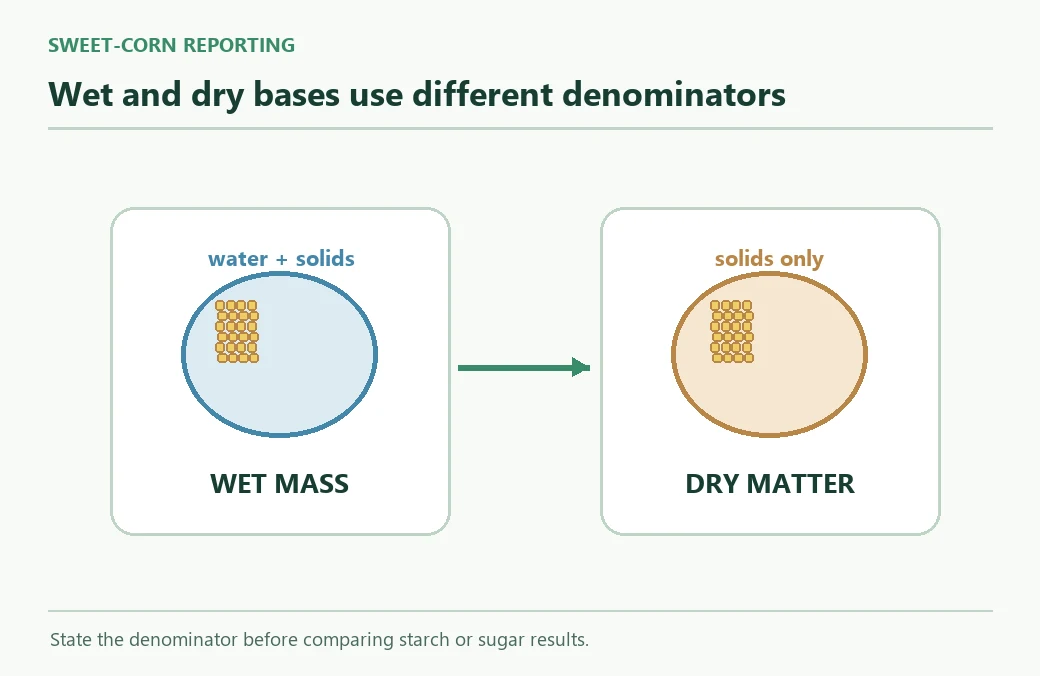
Qualitative schematic. Wet-mass and dry-matter results use different denominators; report the basis before comparing carbohydrate figures. Open full-size diagram.
Related reading
Interpret a soluble-solids reading without treating Brix as a direct measure of all sugars or eating quality.
Assess kernels frozen, partly thawed and cooked using a repeatable inspection sequence.
Trace harvest, blanching, cooling and freezing steps that set the material reaching the trial.
Discuss frozen corn for your application
GreenLand-food is a frozen corn supplier and manufacturer in China, offering factory-direct wholesale supply for food manufacturers, importers and private-label programs.
Send the required product form and specification, packing, quantity, application, destination, private-label needs and requested documents. Include the sample or process question discussed above so we can identify the appropriate frozen ingredient and supply details.