


Citric Acid vs Malic Acid in Fruit Formulas: Compare Flavor, Not Just pH
Sep 28, 2026
Leave a message

For a beverage or fruit-preparation developer, the first commercial question is often whether the adjustment should make a weak fruit note clearer, control a pH target, balance sweetness or satisfy a processing requirement. Those aims may overlap, but they need separate measures. GreenLand-food supplies frozen fruit inputs such as berries and stone fruit under agreed form, Brix, color and packing specifications. We can help make the fruit component repeatable while the finished-product manufacturer selects and validates acidulants for its complete recipe. We do not assume that an acid choice proven in one strawberry drink will work in a peach yogurt preparation.
Start with the fruit and the intended sensory result
Document the unadjusted fruit base before comparing acids. Record the fruit species, variety or source, frozen form, concentration, Brix, measured pH and titratable acidity, and whether the input contains added sugar or other ingredients. A puree prepared from thawed whole fruit can differ from a commercially supplied puree in particle size, soluble solids and released liquid. If fruit comes in syrup, the syrup is part of the formula. An acid trial becomes difficult to interpret when one cup contains more fruit solids or more water than another. Mix a single uniform base, then divide it into equal coded portions.
The intended product decides what "better" means. A ready-to-drink strawberry beverage may need a lively first sip and a clean finish when served cold. A peach fruit preparation for yogurt may need the peach note to remain distinct against dairy acidity. A frozen fruit filling may be judged after heating, cooling and application in pastry. Write one sensory target for the real application rather than asking tasters which isolated acid they prefer in water. A preference in water can guide screening, but fruit aroma, sugar, viscosity and processing change the experience. The decision must be made in the finished matrix.

GreenLand frozen strawberries for fruit formulas
Use the GreenLand frozen fruit category to identify a fruit form that fits the trial. Whole, diced and puree-style inputs should not be treated as interchangeable simply because the fruit name is the same. Diced fruit adds uneven local acidity and visible pieces; a smooth puree distributes acids differently and may need a different mixing plan. Ask for ingredient declaration, fruit percentage or concentration basis, Brix range, acidity data where available, and packing medium. The supplier's values define a starting material, while the developer remains responsible for the complete formula.
Keep sweetness controlled. Added sucrose, fruit sugar and high-intensity sweeteners can change how sourness is perceived, even when the measured pH is unchanged. A blind test in which citric samples receive one sweetness level and malic samples another cannot isolate acid character. The same principle applies to serving dilution. A concentrate tasted neat may seem forceful and balanced when diluted, or the reverse. Set the water addition and serving concentration before screening acid options. If the product has several use dilutions, test those deliberately as separate conditions rather than averaging them into one impression.
Temperature is another part of the target. A chilled drink, room-temperature fruit sauce and warm bakery filling expose different flavor notes. Use the actual serving temperature or a defined range and ask the panel to record the full experience: first sourness, fruit character in the middle and finish after swallowing. The terms need not be elaborate. "Sharp at first sip but clean finish" or "fruit note lost after heating" is more actionable than "acid A wins." If the commercial brief includes dairy, carbonation or another ingredient system, include it in the later round even when the first screen uses a simpler fruit base.

Matched strawberry fruit bases before acid adjustment
Choose a reference formula, ideally one already accepted for the application, and retain an unadjusted control. The control shows how much of the final character comes from the fruit itself. Without it, a panel can attribute the fruit's own malic or citric profile to the added ingredient. A white peach example is useful because fruit identity and maturity influence natural sweetness and acidity; our white peach guide explains that background. The trial still needs measured properties of the actual lot. A fruit name is not a substitute for a current ingredient certificate or analytical result.
Separate pH, acidity and perceived sourness
pH describes hydrogen ion activity in the measured system. Titratable acidity describes how much base is required to reach a defined titration endpoint, reported on a stated acid-equivalent basis. Perceived sourness is a human response to the whole formula. They are related but answer different questions. Two beverages can have similar pH and different amounts of acid, because fruit buffering and other ingredients influence the measurement. They can also taste different at the same pH because acid identity and concentration affect sensation. A published sensory study on organic acids examined concentration, pH and anion species rather than treating any one of them as a complete predictor of sourness.
Record the pH method with the result. A reading depends on the sample condition and an appropriately calibrated instrument. In fruit preparations, pulp distribution and temperature can matter; define whether the sample is blended, strained or measured after a specific hold. For a commercial specification, agree the method and tolerance with the responsible laboratory. A pH number without sampling basis invites false comparison between a concentrate and a diluted drink. It can be important for processing or stability, but the number alone cannot approve the process or tell a buyer how the product tastes.
Titratable acidity requires equal care in reporting. If one report expresses acidity as citric acid equivalent and another as malic acid equivalent, the figures are not directly comparable without the basis and conversion method. This article focuses on formula choice, while an analytical report should name its titration endpoint and acid equivalent. Use the same laboratory method across the pilot if possible. The value can help a formulator understand acid load and fruit lot differences; it does not rank the pleasantness of citric versus malic acid on its own. Preserve both the measured value and the sensory note instead of replacing one with the other.

Fruit beverage assessed by pH, titration and tasting
Citric acid is commonly associated with a bright, relatively quick acid impression in supplier descriptions, while malic acid is often described as a more persistent tartness. Those are useful screening hypotheses, not universal rankings. The Bartek malic acid information describes food applications, and current beverage comparisons discuss perceived timing. Actual perception depends on the fruit matrix, sweetness, concentration, serving conditions and individual panel. Avoid generic claims that malic is always "stronger," that citric always hides fruit, or that a fixed ratio suits every beverage. A sensory decision needs the actual finished formula.
Buffering explains part of the gap between a measured pH and the acid addition. Fruit components and other recipe ingredients can resist pH change. A small amount of acid may move pH more in one base than in another; two fruit lots may require different additions to reach the same target. This is one reason to measure the starting fruit and dose by mass, rather than copying a recipe percentage from a supplier blog. It is also why the formulator should record both how much acid was added and what the final sample measured. Dose without final state, or final state without dose, leaves a poor audit trail.
Sourness also interacts with aroma and sweetness. If an acid makes a strawberry sample seem brighter, the effect may be a changed balance among sourness, sweetness and fruit aroma rather than a change in fruit content. A panel can record perceived fruit intensity and sourness separately. A fruit note that seems attractive in one sip may become tiring over a full serving. Sample order and carryover affect judgments; offer water and a consistent break between coded cups. Sensory screening is a structured comparison, not proof of product safety or shelf life. That boundary matters when a low pH target is being discussed at the same time.
Compare citric, malic and a blend in a controlled pilot
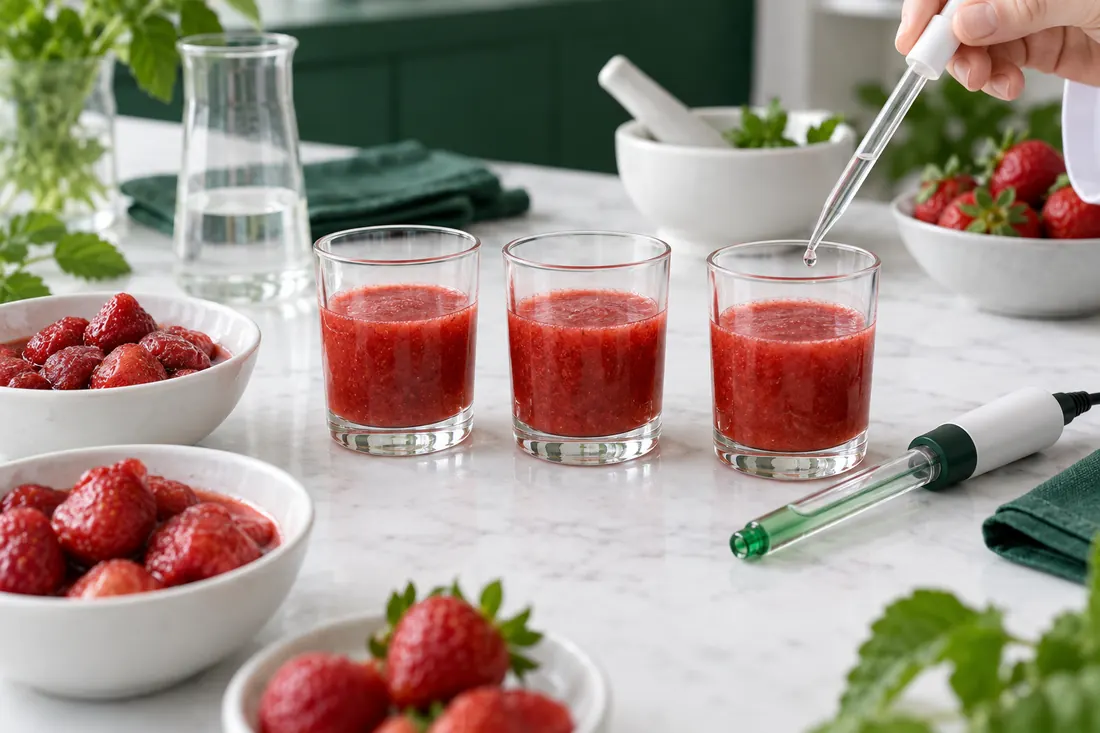
Design the first pilot around three acid systems: citric, malic and a planned blend. Keep fruit lot, fruit mass, water, sweetener, processing state, portion size and serving temperature constant. Record the exact food-grade ingredient identity, supplier, batch and form for each acid. If the purpose is to compare sensory character at a common pH, adjust each sample toward the chosen pH under a documented method and then measure the resulting acid dose and titratable acidity. If the purpose is to compare equal acid mass, state that as a different trial. Those designs answer different questions and their results should never be merged in one table without a clear basis.

Identical fruit beverage cups prepared for a controlled acid comparison
Start with a small bench range that the responsible development team judges appropriate for its recipe. No universal citric-to-malic swap percentage is supplied here. A fixed "75/25" blend from a commercial article may be an idea to investigate, but it is not evidence that the same proportion will work in a strawberry puree, peach beverage or low-sugar preparation. Make several coded candidates around the target, then remove options that miss analytical or sensory requirements. The final concentration should come from the actual formula and process validation, with the acid supplier's technical data used for handling and ingredient compliance.
Use a blind code so that tasters do not score the samples by expectation. Serve them in identical cups at the same temperature and volume, with the same mixing time and hold after acid addition. Ask panelists to note onset, perceived intensity, fruit character, persistence and any undesirable metallic, chemical or flat finish. For a dairy application, add a separate observation of protein behavior and appearance, because a promising fruit-only trial can fail when mixed with yogurt. For a juice or drink, test the final dilution and packaging conditions. These observations determine what to refine next rather than producing a single magic answer.
The records should make a result reproducible. A useful pilot sheet names base lot, fruit solids, sweetener, water, acid lot, dose, preparation order, pH, titratable acidity method, sample temperature and tasting time. Note whether the cups were processed or unprocessed. If one sample was made on a different day, hold it out of a direct ranking unless the base and conditions can be matched. A modest, well-controlled pilot often teaches more than a larger set of inconsistent cups. Its value lies in separating the acid effect from ordinary fruit-lot and recipe variability.

Fruit beverage tasting with neutral sample cups
Interpret a blend as its own formula. It may offer a preferred balance of first impression and finish, or it may blur a fruit note that one acid alone expressed more clearly. A blend can also change measured pH, acid load and ingredient cost. The decision is not simply whether two acids taste better together. The purchasing and regulatory teams may need to confirm both ingredient specifications and declarations. In a private-label program, the customer's requested ingredient statement and market restrictions can rule out an otherwise attractive candidate. Keep the intended label and destination in the pilot brief.
Repeat the leading option with another fruit lot before approval. One batch of strawberries may be sweeter or more acidic than the next, and a formula tuned to a single lot can drift. Define acceptable starting-fruit range and the adjustment procedure, including who may authorize a correction. GreenLand can discuss frozen fruit form, Brix, packing and lot documentation; we would not promise that the fruit arrives at an identical natural acidity every season. A robust recipe can tolerate the agreed fruit variation without chasing every shipment with an undocumented acid change.
Check the full recipe after processing
A bench cup is only the beginning. Heating, homogenizing, blending with dairy, freezing, thawing or carbonation can change how the final product is experienced. Acid addition order may matter for mixing and local concentration. A small trial that tastes balanced before heat treatment can taste flat or too sharp after processing, so retain samples at the stages that correspond to the real line. Measure pH again under the specified method and taste at the planned service condition. Record a difference rather than assuming the acid itself caused it; fruit aroma and sweetener performance can change in the same process.
For a peach beverage, for example, compare the same fruit input in all candidates. A frozen peach product may be supplied as pieces or puree-style input under a confirmed specification. If pieces are blended for a drink, document their drain and dilution behavior before acid addition. If the product will be served cold, taste it cold after the actual heat and cooling route. A peach's natural aroma can be delicate, and the successful acid profile is the one that supports the final fruit identity while meeting technical requirements. Do not infer that a peach formula should automatically use malic acid merely because malic occurs in many fruits.

GreenLand frozen peach pieces for beverage trials
In dairy, evaluate appearance and texture alongside flavor. Adding acid to a fruit preparation that will be swirled into yogurt can affect the immediate local environment when the streams meet. Observe whether the preparation distributes cleanly, whether fruit pieces remain distinct, and whether the final spoonful has the intended tartness. The responsible dairy processor validates stability and shelf life in its complete system. An ingredient supplier can provide fruit data and samples, but cannot approve the finished dairy product from fruit and acid identities alone. Keep the dairy trial as a separate phase from a water-based fruit tasting.
Packaging and storage add another test. Taste and measure the leading formula soon after production and again at planned checkpoints under the actual storage program. Observe color, aroma, sediment or separation and container compatibility. These checks identify formulation risks; they do not establish a shelf life without a validated study. If the product is intended for export, consider the distribution temperature and the time to consumption. The chosen acid can support a target flavor and pH, while the complete preservation and food-safety design requires a separate qualified process review.
Do not use a pH reading as a substitute for microbiological control. Acidification can be one element of a product's safety strategy, but the finished product's ingredients, thermal or other treatments, packaging and distribution decide the validation route. This is particularly important for fruit beverages with added dairy, low acid components or changing dilution. A claim that "citric preserves better" or "malic makes it safe" is too broad to be responsible. State the target condition, the processing authority and the validated method for the specific product. Keep sensory preference and safety clearance in different sign-off lines.

Peach beverage samples observed across processing and service
A practical scale-up trial should reproduce the best bench candidate in the real mixing and heating equipment. Check dissolution, ingredient addition sequence and any local acid concentration before full blending. Confirm that the analytical and sensory results match the bench within the agreed tolerance. If they diverge, investigate mixing, sample preparation, fruit-lot properties and process exposure before changing the acid level. A reformulation made too quickly can mask the true cause and create a new labeling or quality issue. The best formulation record includes the failed trial and what was learned from it.
Approve ingredient identity and the final label
The acid supplier should provide a current food-grade specification, identity, lot traceability and technical information appropriate to the destination market. Review the form and grade actually purchased against its batch documents. Confirm the ingredient declaration for the completed recipe with the party responsible for its label. An acid's natural presence in fruit does not by itself settle how an added acid must be declared. The exact requirements vary by market and product category, so the regulatory review belongs to qualified personnel working from the current destination rules and finished formulation.
GreenLand-food's role in this decision is the frozen fruit input. We can supply or coordinate confirmed fruit species, cut or puree form, Brix and appearance range, packing, quantity and order documents. We do not assume we supply the acidulant or certify an acid supplier's statements. A buyer that wants a repeatable acid trial should send the fruit brief early: intended beverage or preparation, fruit form, target fruit content, sweetener system and whether it will be heated, chilled or blended with dairy. We can then help the purchasing team obtain a fruit sample and specification that make the test meaningful.
Keep ingredient claims modest. "Malic acid comes from apples" is an incomplete description of an industrial ingredient, and "citric acid is natural" can mean different things under different rules. If a finished label will make natural, organic, allergen, halal, kosher or other claims, obtain the actual ingredient and facility records. Do not infer certification from the chemical name or from a supplier's marketing page. The same care applies to fruit: syrup-packed strawberry and unsweetened IQF strawberry have different ingredient statements and soluble-solids contributions. Confirm the exact ordered form rather than relying on a category label.

Food technologist reviewing acid ingredient and formula records
Commercial approval should join the laboratory, sensory, processing and purchasing records. The final brief can state the accepted fruit specification, acid grade and lot controls, target analytical values with methods, sensory reference, mixing sequence, process, package and destination-market label review. Include who owns each decision. The laboratory may approve pH, a sensory panel may prefer one finish, and the process authority may require another review. Making these decisions visible avoids the common error of treating one good pH reading as blanket formula approval.
For repeat orders, monitor the fruit input and the adjusted product separately. The fruit specification helps control the starting material, while finished pH and taste show the effect of the whole recipe. If an incoming frozen fruit lot sits at one end of the agreed Brix or acidity range, the formula team can apply its documented adjustment process. We help buyers compare the lot's declared fruit form and records against the order, but the manufacturer's formulation team owns the acid change. This division makes supplier accountability clear and protects the intended flavor across seasonal fruit variation.
Citric, malic or a blend can each be appropriate. Choose the one that meets the actual fruit product's sensory goal and technical constraints after controlled testing. The next useful action is to specify a representative frozen fruit base and run coded trials with both analytical and tasting records, then verify the leading option through the real process and label review. That produces a formula decision a buyer and plant can repeat.
Source Frozen Fruit with GreenLand-food
GreenLand-food is a professional frozen fruit supplier and manufacturer in China, providing factory-direct wholesale supply for importers, food manufacturers, foodservice distributors, and private-label programs.
Send the product form, specification, packing, quantity, application, destination, private-label needs, and requested documents.