


Cooking Frozen Mallow Leaves: Mucilage, Heating and Dish Texture
Oct 19, 2026
Leave a message

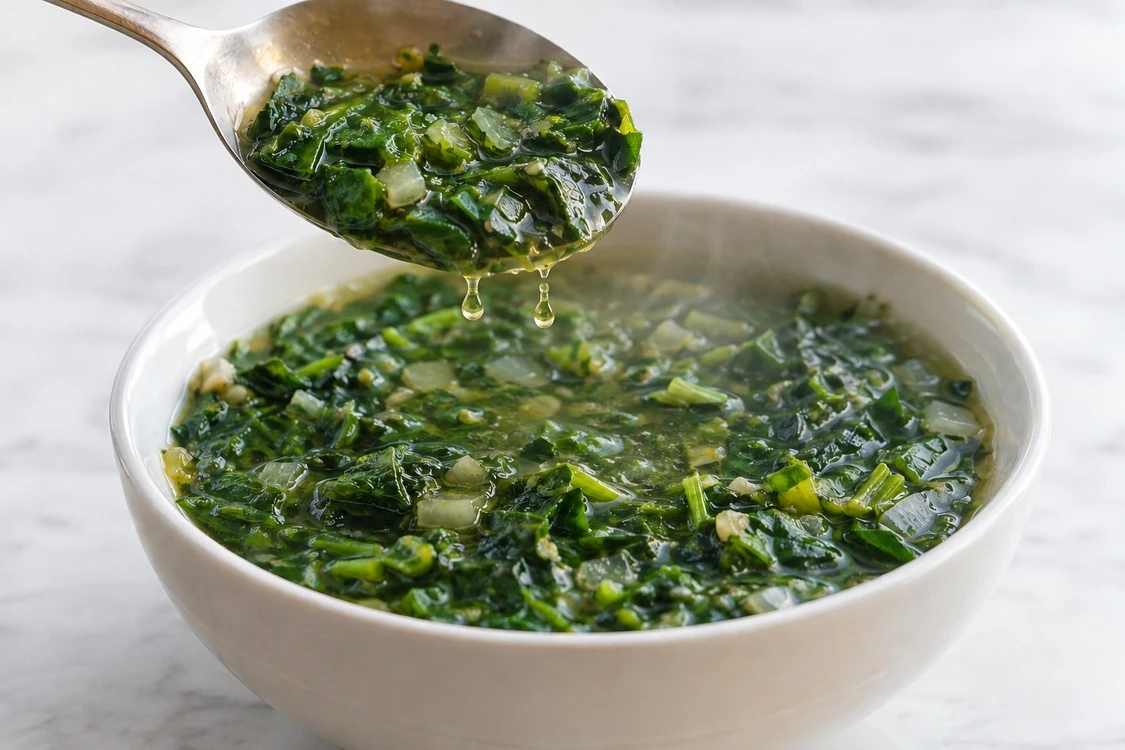
There is no single cooking time for everything sold as mallow. Malva leaves and Corchorus leaves used for molokhia are botanically different, and a whole-leaf frozen pack behaves differently from a finely chopped block. Confirm the identity, treatment and form before borrowing a recipe. The guidance below explains the variables to control and the observations to make. At GreenLand-food, we would resolve those product details before discussing an application trial, because a familiar common name cannot establish how an unidentified leaf should be prepared.
Start with the labelled leaf and the intended dish
Check the common name, botanical identity and ingredient declaration together. Malva sylvestris and Corchorus olitorius belong to different genera, as shown by the respective Kew Malva and Corchorus records. Corchorus is the leaf associated with molokhia. An English label that says mallow may require further clarification, especially when it is translated from a regional food name. The required identity should follow through to the sample and final commercial specification.
Next look at the physical form. Whole leaves may be compressed into a frozen block, so a rectangular pack does not necessarily contain minced material. Cut leaves can include broad strips, coarse pieces or a fine mince. The leaf-to-stem balance matters too: a tender blade can soften while a thick petiole remains noticeably resistant. A cooking instruction developed for a fine leaf mince may be a poor starting point for large whole leaves with substantial stem material.
The treatment before freezing affects the remaining cooking task. A product may have been blanched, partly cooked or prepared by another declared route. Blanching is not, by itself, proof of ready-to-eat status. Read the actual use instruction and ask for clarification when the wording is unclear. The colour of the frozen leaves, their softness after thawing or their appearance in a catalogue does not establish the microbiological condition of the product.
Describe the intended dish in concrete terms. A leafy stew needs recognisable pieces and a manageable amount of sauce. A finely chopped soup needs an even distribution of particles and a suitable pouring consistency. A filling may need less free liquid because moisture can migrate into pastry or another surrounding ingredient. These are different texture targets. Trying to make every product as thick as possible can move it away from the dish the customer expects.

Leaf-and-stem material pictured on our mallow product page. Confirm the botanical name and agreed stem allowance for the ordered product.
Culinary recipes illustrate those differences when their identity is clear. Lebanese whole-leaf molokhia and Egyptian finely chopped molokhia are examples of Corchorus preparations with different visual and sensory expectations. They show why leaf form and liquid balance deserve attention. Their cooking preferences cannot be transferred automatically to a Malva product, and their household timings do not validate a foodservice kettle or a retail heating instruction.
For an unfamiliar frozen product, begin with the supplier's instructions and a small representative trial. Keep the pack information beside the recipe so the source material and method remain connected. Record whether the sample entered the pan loose, clustered or as a block, and whether it contained only leaves or declared additional ingredients. These observations often explain a disappointing first attempt more clearly than a general statement that frozen mallow is difficult to cook.
Understand the texture that mucilage contributes
Mucilage is a group of water-interacting plant materials, largely polysaccharides, that can contribute a slippery feel and body to the surrounding liquid. It is part of the ingredient's behaviour rather than a defect that must always be removed. Whether the resulting texture is desirable depends on the dish. A smooth green soup may rely on it, while a lightly sauced leaf portion may need a more restrained effect.
Laboratory work on mucilage extracted from Corchorus olitorius found water interaction and concentration-dependent viscosity in the material studied. That provides a useful reason to control concentration in a cooking trial. It does not supply a conversion from grams of frozen leaves to a guaranteed soup viscosity. Extraction separates and concentrates material; a whole food also contains insoluble tissue, salts, fat and other components that influence the result.
Think of the cooked dish as two connected parts: leaf pieces and the liquid around them. The leaves can be tender while the liquid is too thin, or the liquid can feel thick while coarse stems remain unpleasant. A single instruction to "cook until thick" fails to distinguish these outcomes. Check leaf tenderness separately from spoon coating and flow. The preparation can then be adjusted for the part that actually needs attention.
The amount of leaf relative to broth is a major practical variable. A heavily diluted mixture may show green particles in a loose liquid even when the leaf itself has cooked properly. A concentrated mixture may feel dense or difficult to pour. Record the starting leaf mass and the added liquid, including liquid supplied with other ingredients. A stock reduction, a wet frozen ingredient and a drained canned ingredient each change that balance differently.
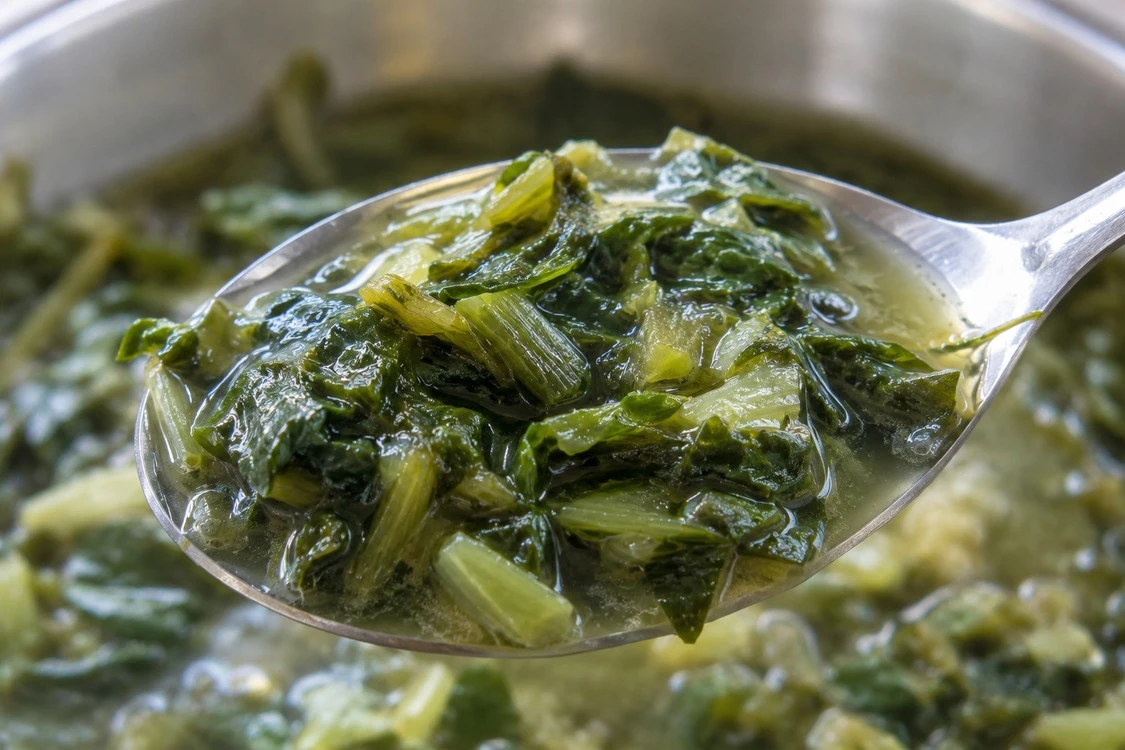
Illustrative Malva scene. Leaf particles and the surrounding liquid contribute different parts of the texture.
Cutting and stirring also alter what is visible and how the mouthful feels. Fine particles can distribute through the liquid, while large leaves remain distinct. Vigorous mixing may break tender leaves during cooking, so the finished texture may be finer than the purchased cut suggests. These effects are reasons to standardise the method; they are not a promise that more chopping or more stirring always increases useful thickness. The response depends on the confirmed material and formulation.
Texture should be compared at a common serving condition. A sample straight from the pan and one left in a bowl can give different impressions because their temperatures and moisture histories differ. Use the same spoon, similar sample amounts and a defined observation point for a simple kitchen comparison. Describe what you see: a thin coating, a steady pour, separate leaf clumps or a dense mass. Those descriptions are easier to reproduce than "perfectly silky."
Natural mucilage cannot be used to decide whether a food is safe. An unfamiliar odour, damaged packaging or an uncertain storage history needs assessment under the appropriate food-safety procedure. Equally, normal mucilage should not be mistaken for spoilage solely because the cook expected spinach-like texture. Product identity, handling records and the required cooking instruction provide the context; appearance alone cannot settle either question.
Heat the frozen leaves evenly before judging the soup
Prepare the cooking vessel and liquid as directed for the product and recipe. A large cold block absorbs heat and can lower the temperature of the surrounding broth. The outside may loosen while the centre remains frozen. Until the block has separated and the required cooking condition has been reached throughout the food, its apparent thickness is an incomplete picture. Avoid adding large amounts of extra liquid simply because the early mixture looks uneven.
Choose a batch size the vessel can handle. A small saucepan crowded with a large mass of frozen leaves can heat slowly and unevenly, even when the burner is set high. In a foodservice trial, record the load and the starting condition of both product and liquid. Scaling a household recipe by weight does not automatically preserve heat transfer, mixing or the time needed for the centre of a cluster to warm.

Illustrative Malva scene. A frozen cluster must loosen and heat through before its texture can be judged.
Follow the label on cooking from frozen or any permitted thawing preparation. Some leaf products and applications are designed for direct addition to hot liquid. Others may require a controlled preparation step to separate, drain or portion the material. Do not leave a pack at room temperature merely to make it easier to handle. If thawing is part of the approved method, use the specified food-safe conditions and include the retained or removed liquid in the recipe record.
As the material loosens, use the mixing action appropriate to the desired leaf form. A broad spoon can gently move leaves away from the vessel base and distribute them through the liquid. Aggressive whisking may be useful for a particular fine soup, but it can tear whole leaves and change a stew's appearance. Choose the action deliberately. The texture should result from the recipe, rather than from whichever utensil happens to be available.
Pay attention to the base of the pot. A concentrated leafy mixture can collect in local areas, especially before a frozen cluster has fully separated. Local sticking or scorching can affect flavour before the rest of the batch looks cooked. A wider vessel, an appropriate liquid level and a consistent mixing pattern may help, but each needs to fit the actual cooking instructions. Raising the heat alone can intensify the problem at the contact surface.
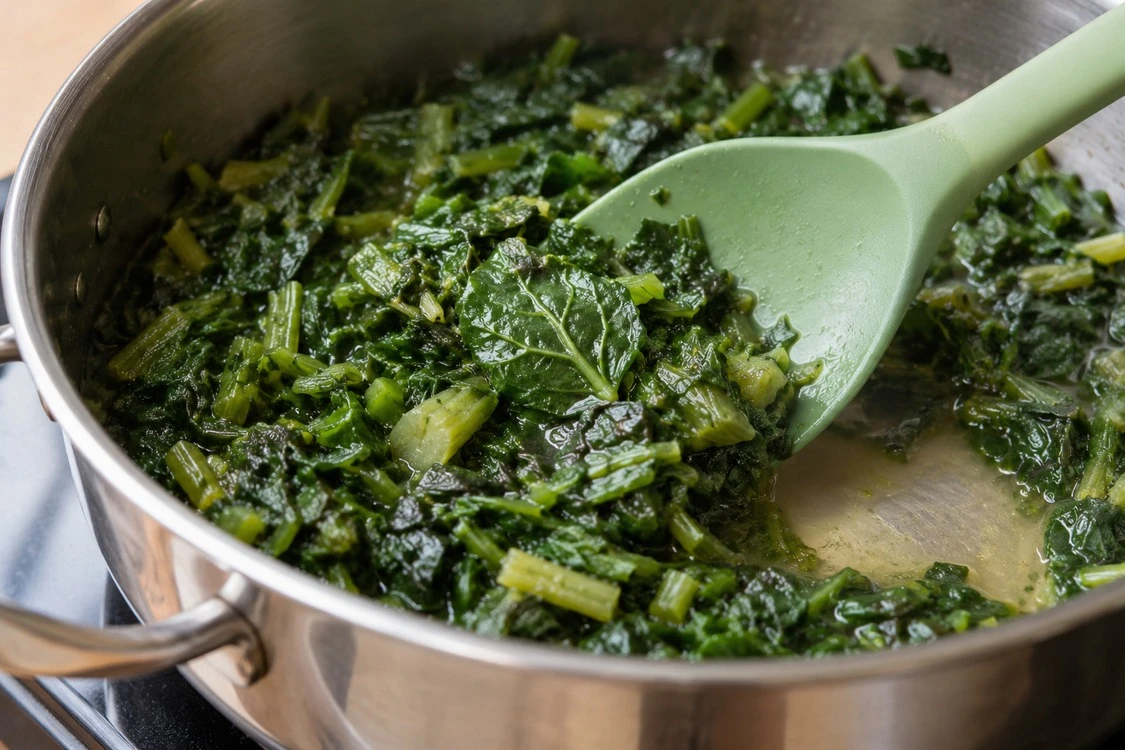
Illustrative Malva scene. Gentle movement helps distribute leaves and reduce local sticking.
Gentle simmering is a common culinary preference for molokhia recipes because it allows the cook to manage the texture and finish. It is not an exemption from the required heating procedure. A visual instruction such as "avoid a hard boil" describes a recipe style; a food business still needs an adequate, validated process for its product and intended use. Do not replace that process with a colour change or a spoon test.
Once the material is evenly heated, assess tenderness across the sample. Check a representative leaf piece, any thicker stem and material from a larger cluster. Then evaluate the surrounding liquid. Keeping those observations in that order reduces the temptation to correct a partly frozen mixture as though it were a finished dish. It also makes a later change in pack size or cluster condition easier to investigate.
Adjust liquid and mixing with the finished texture in view
Hold some of the recipe's optional adjustment liquid in reserve when the product instructions and recipe permit it. Add small measured amounts after the leaves have separated and the mixture has reached the required cooked condition. Mix consistently and give the addition time to distribute before judging again. This approach helps the cook see how much liquid the actual leaf product needs, rather than relying entirely on a volume borrowed from another brand or species.
Use a suitable liquid for the dish. Water changes concentration without adding flavour, while stock contributes seasoning and dissolved solids. A strongly salted stock can make repeated dilution adjustments difficult because every addition changes both texture and saltiness. If a development trial uses a standard stock, record its formulation or product identity. Otherwise, variation in the base can be mistaken for variation in the frozen leaves.
Evaporation must stay visible in the method. An uncovered wide pan loses water differently from a narrow covered pot. Longer cooking can therefore make a dish appear thicker simply by concentrating it. That may also soften the leaves further or change the flavour. If the recipe needs more body, first identify whether it needs less liquid, more leaf material or a different particle form. Boiling away an accidental excess is not always the best correction for the desired texture.
Mixing should be enough to distribute the ingredients without unnecessary breakdown. Record whether the process uses occasional folding, continuous gentle stirring or mechanical agitation. For a central kitchen, the type of agitator and the effective load can matter as much as the nominal speed. A hand-stirred sample does not reproduce every feature of a production kettle. Compare the final particle structure when moving from the development bench to the intended equipment.
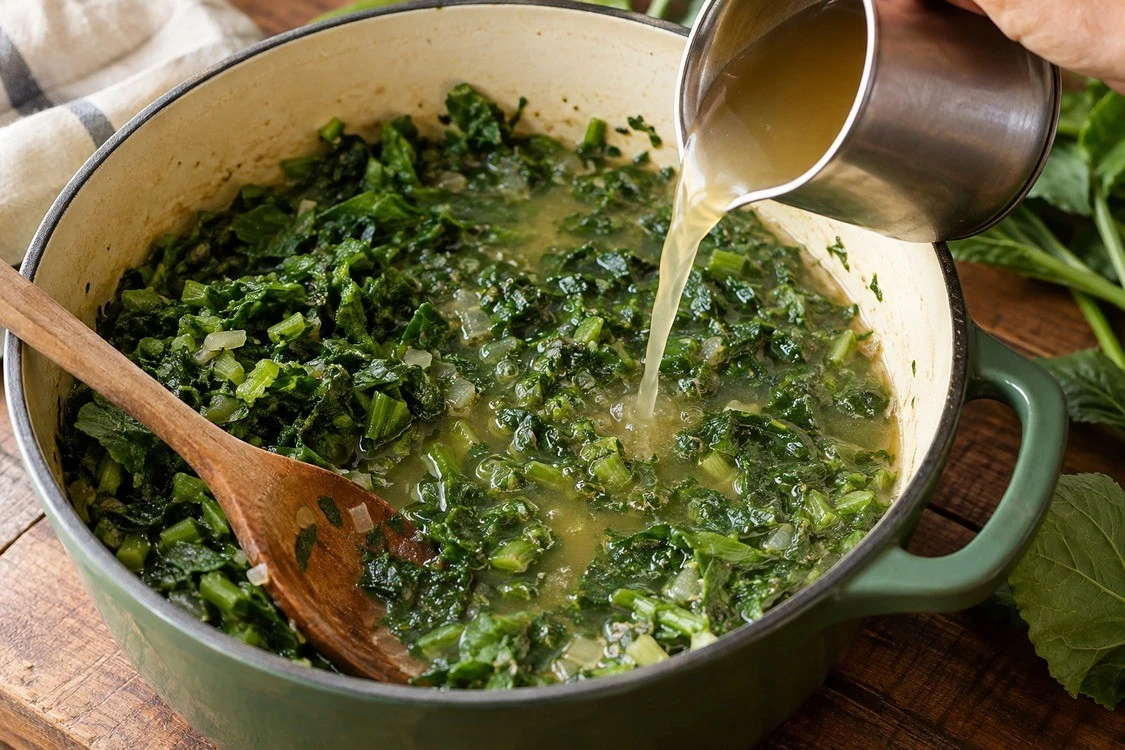
Illustrative Malva scene. Add measured liquid gradually and reassess at the same serving condition.
Acidic ingredients deserve their own trial. Lemon juice, tomato and vinegar are common flavour choices in different dishes, but they change more than perceived thickness. They affect flavour balance and may influence colour and the behaviour of the mixture. Add them according to the recipe, then assess the complete dish. Avoid treating acid as a universal switch that removes mucilage or guarantees a particular viscosity across Malva and Corchorus products.
Fat and other ingredients can also change the impression of smoothness. A garlic oil finish may give the surface a sheen without establishing how much mucilage is present. Beans, starches or pureed vegetables can add body of their own. If the purpose of a trial is to compare leaf products, use a simple base first, then confirm the result in the finished recipe. This separates the leaf's contribution from the texture created by the rest of the formulation.
After an adjustment, taste and observe at the planned serving point. A soup that pours neatly from the kettle may become awkwardly dense in a small bowl after a short service interval. A filling that seems dry enough while hot may release liquid during the next processing step. The correct endpoint belongs to the food the customer receives, so retain that final condition in the recipe approval.
Diagnose a thin, thick or uneven dish
When a soup seems too thin, check the amount and source of liquid first. Include broth, water released from frozen material and moisture introduced by other ingredients. Confirm that the leaves have fully separated and that the recipe contains the intended leaf mass. A large-looking pack does not necessarily represent the same leaf concentration as another product. Adding more cooking time before checking these details can soften the leaves while leaving the basic dilution problem unresolved.
When the mixture seems too thick, distinguish dense leaf packing from thick liquid. Large whole leaves can gather around a spoon even when the broth flows easily. A fine-cut product can create a more uniform resistance throughout the spoonful. The first problem may respond to different portioning or a coarser mixing arrangement; the second may require a measured liquid adjustment. Describe which part of the mouthful is difficult before changing the recipe.
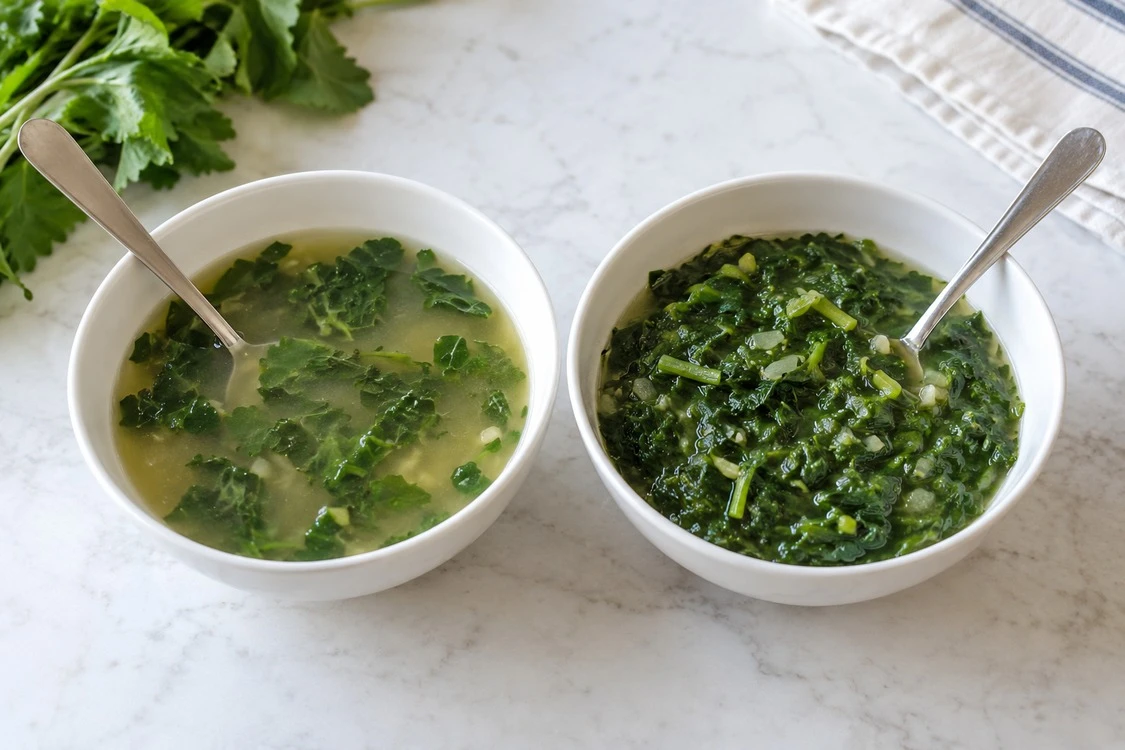
Illustrative Malva scene. Compare liquid proportion before changing the heating method.
Uneven texture often points to uneven preparation. Frozen clusters may not have broken apart uniformly, or a wide leaf-size range may include more mature material. A cook may also have mixed one sample more aggressively than another. Spread a small cooked portion on a plate and inspect the leaf pieces and stems. If coarse stems explain the resistance, extending the cook until everything is soft may sacrifice the leaf texture the dish was intended to retain.
A watery edge around a dense centre can come from incomplete mixing or separation during holding. Stir using the approved method and reassess a representative portion. If the effect returns, examine the formulation and the service route. An immediate correction may make one bowl acceptable while leaving the next portion different. For repeated production, the more useful question is which controlled change prevents the same distribution problem in the next batch.
An overly dark or dull appearance should be interpreted with the cooking history. Prolonged heating, an acidic formulation and the starting product condition can all be relevant. Do not diagnose a supplier defect from colour alone, and do not add an ingredient solely to make the green look brighter without checking its effect on the food. Retain a plain cooked reference and the finished recipe so the source of a colour change is easier to locate.
If a dish sticks or develops an unwanted cooked flavour, inspect heat contact, load depth and mixing before adding more seasoning. A strong sauce can conceal the symptom during a quick tasting but leave the process problem intact. Check whether the issue appears only at the bottom of the vessel or throughout the batch. That distinction helps separate local overheating from an ingredient or formulation issue.
Change one major variable at a time in a development trial. For example, compare two liquid levels while keeping the leaf mass, vessel and cooking route constant. Then, if needed, compare two mixing patterns at the preferred formulation. Record the observation in ordinary language and keep the sample identity. This produces a usable method faster than changing heat, liquid, seasoning and leaf form together and trying to guess which change mattered.
Keep the cooking result repeatable in foodservice
A repeatable method begins with a defined ingredient. Record the confirmed species, supplied cut, treatment, pack size and declared ingredients. If any of these change, review whether the existing cooking instruction still applies. A switch from a finely chopped block to a whole-leaf product can alter separation, mixing and serving even when both packages have the same net weight. Treat the new material as a product change that deserves a practical trial.

Leaf-and-stem material pictured on our mallow product page. Confirm the botanical name and agreed stem allowance for the ordered product.
Write down the details that control the result: starting condition, batch mass, liquid formulation, vessel, heating procedure, mixing action and serving endpoint. The record does not need to describe every kitchen movement. It does need enough information for another operator to reproduce the accepted dish. Include the point at which any optional liquid is added and the observation used to decide whether that addition is needed.
Check the intended holding or reheating route within the food business's approved controls. Use the actual container and portion size where practical. Observe whether the leaves remain evenly distributed, whether liquid gathers at the edges and whether the dish still pours or serves as intended. A newly cooked bowl can pass while a reheated meal fails, so the final route must be part of product approval when that is how the food will be sold.
For quality comparison, sample more than one portion and more than one pack where the programme allows. A single spoonful from the top of a kettle may miss settled particles or a dense cluster. Record the variation that matters to the customer, such as uneven leaf distribution or a different flow between early and late servings. The aim is a method that gives an acceptable range under ordinary operation, rather than one carefully selected attractive bowl.
If instrumental viscosity is useful, specify the method and temperature and relate it to the actual sensory target. A number without sample preparation and measurement conditions is difficult to compare. A simple kitchen observation may be sufficient for one operation, while a larger manufacturing programme may need a more formal procedure. The method should be chosen for the decision it supports, with limits based on representative results.
When discussing frozen mallow leaves with GreenLand-food, send the intended dish, confirmed identity requirement, leaf form, cooking route, packing, quantity and destination. We can use those details to clarify the sample and specification discussion. Botanical identity, treatment and any ready-to-eat claim require their own confirmation for the offered product. The most useful approval record is a clear description of the cooked food your operation intends to serve.
Continue reading
Separate drip loss, cooked recovery and piece integrity when evaluating an ingredient in its actual recipe.
Choose a texture test that matches the cooked bite, piece geometry and serving condition you need to approve.
Investigate a cooked-texture change after a documented handling event without treating a stress trial as shelf-life proof.
Source Frozen Mallow Leaves with GreenLand-food
GreenLand-food is a professional frozen mallow leaves supplier and manufacturer in China, providing factory-direct wholesale supply for importers, food manufacturers and foodservice distributors.
Tell us your application and destination. We can discuss product form, specification, packing, quantity, private-label needs and requested documents with your purchasing team.