


Creamed Spinach from Frozen Spinach: Build a 10 kg Trial Around Drained Yield and Sauce Stability
Sep 28, 2026
Leave a message
Research This Article & Topic with AI
Verify key claims, compare reliable sources, and explore GreenLand-food's practical frozen food knowledge.
Article details and research questions are prepared in the links. Sign-in or sending may be required.

This guide gives a proposed development method for a foodservice kitchen, commissary or prepared-meal team. It compares a roux-and-milk base, a cream base and a cream-cheese base while keeping the spinach and assessment conditions consistent. No numerical GreenLand yield, approved recipe or holding-stability result is asserted. The kitchen supplies its measured results and acceptance limits, and its responsible food-safety team defines the applicable process controls. A spoonable, attractive sauce and a safe production process each require their own evidence.
Set the creamed-spinach serving target
Define the finished dish before selecting a sauce. A steakhouse side may show generous pieces of leaf coated in cream, while a prepared meal may need a finer cut that portions cleanly into a small compartment. Both can be described as creamed spinach, yet they impose different demands on the ingredient and sauce. Agree the serving weight, visible leaf character, colour, flavour and spoon behaviour at the intended eating temperature. A photograph of the reference portion helps keep the discussion concrete.
Choose the service route at the same time. Immediate service, a period in a hot-holding pan and a cook-cool-reheat operation are different development conditions. A sauce may look appropriate when first mixed and become too thick, too loose or visibly separated later. Write the planned equipment, portion depth and observation point into the brief. This prevents the team from approving a fresh pan and discovering only after scale-up that the actual delivery route changes its appearance or texture.

Set the intended leaf texture before selecting a sauce.
Keep the product identity precise when reviewing recipes. Some dishes called creamed spinach contain egg and are baked until set. The Dairy Farmers of Canada example uses that approach. It provides a useful boundary for development: an egg-set spinach custard has a different structure from the spoonable side dish considered here. Choose a reference that matches the serving target, rather than using the shared name as proof that the recipes are comparable.
Decide how much spinach should remain visible. A coarse leaf can provide recognisable vegetable texture, but long pieces may bridge a scoop or pull from the plated portion. A fine chop distributes more evenly and may create a smoother appearance. Pureeing after cooking changes the product again. Inspect the actual cut in a sample and test it with the intended portioning utensil. A cut-size description on a purchase order is useful only when the kitchen knows how that cut appears in the finished sauce.
Our frozen spinach range includes chopped, cut and portioned formats subject to the confirmed specification. We discuss leaf condition, cut dimensions, moisture requirements, packing and application before an order. A cube or ball describes a frozen portion shape, while the leaf material inside still needs its own specification. Do not infer an identical creamed-spinach texture from two products simply because both arrive in convenient portions.

GreenLand spinach product photograph: confirm the cut and prepared-yield test.
Set a practical reference for spoonable thickness. Use the same scoop or spoon, serving temperature and plate for each observation. Record whether the portion sits as a soft mound, spreads slowly, or releases a liquid ring. These descriptions are more informative than thick enough when different people perform the trial. If the business later needs an instrumental viscosity measurement, define the equipment and method separately. A visual spoon test should be described honestly as a practical quality observation.
Keep flavour decisions within the same brief. The target may emphasise spinach, dairy richness, cheese or a mild seasoning profile. A sauce that masks the leaf flavour could be acceptable in one meal and unsuitable in another. Note the intended accompaniment and portion size, because a small side eaten with a rich main dish is assessed differently from a larger standalone vegetable portion. This prevents a sauce comparison from drifting into a general preference contest without a clear product objective.
Measure the 10 kg spinach mass balance
Begin by confirming the net frozen input. Weigh the product without cartons, bags or other packaging, using a suitable scale and tared containers. Record lot identity, format and the condition received. If the trial combines several packs, retain the pack counts and individual lot information. Ten kilograms issued from storage should refer to actual food mass, rather than the nominal weight of a carton that also contains packaging or an unrecorded partial bag.
Choose a preparation and draining method compatible with the product instructions and the site's approved process. Record whether the spinach is prepared from frozen or thawed under controlled conditions, the equipment used, the batch depth, draining duration and any pressing step. These details determine what the measured yield means. A gently drained leaf and a strongly pressed mass are different inputs to a cream sauce, even if both are described casually as squeezed spinach.

Weigh prepared spinach separately from released liquid.
Collect the prepared spinach, released liquid and identifiable handling losses separately where practical. Record material left in bags, on strainers or on utensils. If the preparation involves heating, evaporation may also contribute to the difference between input and output. Do not automatically classify the full weight difference as free water. The purpose is to understand where material went well enough to compare methods and batches, with any unmeasured loss recorded as a limitation of the trial.
The basic calculation is prepared spinach yield equals prepared drained spinach mass divided by frozen input mass, multiplied by one hundred. With a 10 kg starting input, the measured prepared mass provides the numerator. Leave it blank until the trial is run. This is a method-specific yield, not a general property of all frozen spinach. It also does not measure dry solids: the drained material still holds water within the leaf tissue and between pieces.
The USDA school creamed-spinach recipe distinguishes its frozen input from the amount obtained after squeezing. That distinction is useful. Its listed yield belongs to that recipe and preparation context, so it should not be converted into a promised output from your 10 kg lot. Use the example to justify measuring both stages, then calculate your sauce against the material your own method actually produces.
Record the condition of the drained spinach as well as its mass. Look for persistent clumps, long stems, visible grit, unexpected colour or water collecting after the initial drain. A higher measured yield can represent more retained water or a different leaf condition; it does not automatically mean better value. Conversely, aggressive pressing may lower the yield and change texture. The correct endpoint is the prepared ingredient that gives the required finished dish under a repeatable method.
After weighing, distribute the prepared spinach evenly before taking trial portions. A wet layer at the bottom of a container or a compact clump can bias one sample. Use equal prepared masses for the sauce comparison and document how much remains for repeat trials, retained samples or handling checks. If the material is divided into three portions, the portion calculation should start from the actual prepared mass. There is no need to pretend that each sauce receives one third of the original frozen weight.
Keep the mass record connected to cost. Divide the spinach purchase cost for the trial by its measured usable prepared mass to understand the ingredient cost at the mixing stage. Later, combine it with sauce cost and saleable finished portions. These calculations answer different commercial questions and should remain visible. A low frozen price may lose its advantage if the required preparation produces less usable material or demands extra labour, while a more expensive form may simplify the process.
For background handling guidance, our frozen-spinach cooking guide covers the general preparation choices. The creamed-spinach trial adds the specific mass balance needed for a dairy sauce comparison. Keep the proposed test sheet beside the actual cooking record so that another operator can repeat the preparation before comparing the next delivery. Without that continuity, a yield number can become a target detached from the method that produced it.
Compare three sauce systems on equal spinach portions
Prepare the chosen sauce bases separately before folding in measured spinach. This makes lumps, incomplete mixing or an uneven base easier to identify. Record every ingredient by mass and identify compound ingredients such as cream cheese or prepared soup. Their formulations can differ, so a substitution may change salt, water, fat and stabilising ingredients together. Keep the first trial simple enough that the team can identify the cause of a texture difference.
A roux-and-milk system gives the kitchen a familiar way to build a smooth coating around the leaf. The Pillsbury method develops the milk-and-flour base before adding drained spinach. Treat that as a method example, then use your own approved formula and equipment. Record how the base is cooked and mixed, because a lumpy or insufficiently developed base creates a different problem from water released by the spinach later.

Compare the selected sauce bases using equal prepared spinach portions.
A cream-based system should be assessed on its actual finished concentration and texture. Record the cream specification, starting mass and any reduction during cooking. Two pans held for different periods may finish with different amounts of water, even when the original ingredient weights match. The Cuisinart creamed-spinach recipe illustrates a cream approach in a particular appliance. Its settings describe that equipment and recipe; they cannot establish a suitable process for a large kettle or steam-jacketed pan.
A cream-cheese system introduces another ingredient structure and flavour. Check its label and specification, disperse it consistently, and inspect the base before adding spinach. The Campbell's example combines cream cheese with prepared soup and milk. That is a composite sauce, so its performance cannot be attributed to cream cheese alone. If the purpose of your trial is to compare sauce families, document all components and avoid presenting a branded recipe as a controlled single-variable experiment.
For the first comparison, give each candidate the same prepared spinach mass and assess it at the same intended serving temperature. Set the initial sauce addition on a recorded basis and capture any adjustment. Equal sauce mass is one possible screening design, but it does not guarantee equivalent solids, fat or eating character. Explain what is held constant and why. A later optimisation can adjust each system to its best acceptable formulation, after the team understands the first comparison.
| Comparison field | Roux and milk | Cream | Cream cheese |
|---|---|---|---|
| Prepared spinach mass | Same measured portion | Same measured portion | Same measured portion |
| Base composition | Record flour, fat and milk | Record cream specification and reduction | Record cheese and other liquid ingredients |
| Immediate observation | Smoothness and leaf coating | Coating and richness | Dispersion and spoon body |
| After service route | Liquid ring and thickening | Separation and concentration | Graininess, separation and thickness |
| Commercial calculation | Actual ingredients and saleable yield | Actual ingredients and saleable yield | Actual ingredients and saleable yield |
Taste and inspect the same characteristics in every candidate. Record free liquid, leaf coating, graininess, greasiness, flavour and ease of portioning. A thick sample may hold a neat shape but feel heavy or floury. A lighter sample may taste pleasant while spreading into another meal compartment. Separate these observations instead of assigning one overall score too early. The intended use determines which compromise is acceptable, and the record should explain the decision.
Add seasonings consistently and account for salt already present in cheese or prepared ingredients. If one candidate contains Parmesan and another does not, note that the comparison includes a flavour and composition change. A fair trial does not require all sauces to taste identical, but it does require an accurate description of what changed. For a later cost comparison, include all ingredients used to bring each candidate to its approved sensory target.
Repeat the more promising system before scaling it. Small pans can lose water differently from a production vessel, and the mixing action can change how leaf pieces disperse. Record the final mass at the end of cooking so that concentration changes remain visible. A batch that appears stable only after excessive evaporation may create a different yield and cost from the recipe sheet. The measured result should guide the next trial, rather than being adjusted afterward to fit an expected number.
Test the actual holding or reheating route
Move the selected candidate through the route defined at the start. Use the intended pan, depth, cover, equipment and portioning method. Record the starting mass and the observations made at each quality checkpoint. The timing should match the operation's service plan and validated safety controls. A shallow test dish and a deep service pan expose different amounts of surface and can behave differently, so keep the test geometry connected to the real operation.
For hot service, observe the dish before stirring, after the defined stir and during portioning. Record whether a water ring appears, whether the surface dries, whether spinach settles, and whether the sauce coats the last portion as well as the first. Stirring can temporarily hide separation, so its timing belongs in the method. If staff normally replenish a pan or combine batches, that practice needs its own approved procedure and should not be introduced casually during a controlled development comparison.

A watery edge and a coherent spoon path are separate observations.
For a cook-cool-reheat route, inspect the product after each relevant stage using the site's approved process. A sauce can change during cooling and change again during reheating. Record the finished pack or pan depth and the amount reheated together. Check the centre and edges for differences in texture and liquid release. The quality observation should describe the actual product at service, while the temperature records demonstrate compliance with the applicable process requirements.
The FDA Food Code is a model used by jurisdictions, rather than a single rule that automatically governs every kitchen worldwide. Confirm the code and local adoption relevant to the operation, plus any additional requirements for manufacturing and distribution. The USDA school recipe also includes controls for its stated process. Do not transfer those values into an unrelated commercial operation without checking scope and applicability with the responsible team.
Keep safety verification and sensory acceptance on separate lines of the trial record. A sample with an attractive spoon shape can still fail a required process control, while a safely handled sample can be commercially unacceptable because it is watery or grainy. Record who reviews each part and what action follows a failure. This prevents a positive tasting panel from being treated as permission to release a batch with incomplete process evidence.
Use photographs that reveal the defect rather than flattering the dish. Take a side view of the portion and a view of the pan edge under consistent light. Show a spoon path where useful, and include a plain background that makes free liquid visible. Keep the same portion mass and delay between plating and observation. A photograph taken immediately after vigorous stirring should not be compared with one taken after a long rest unless that difference is the actual subject of the trial.
Record additions made during service. Staff may loosen a thickening sauce with milk or water, but an undocumented addition changes composition, flavour and portion yield. If adjustment is part of the approved operating method, state the ingredient, allowed basis, measurement and required checks. If the dish repeatedly requires unplanned corrections, return it to development. A repeatable product should give operators a clear method and a defined response to variation rather than relying on individual judgement at every pan.
At the end of the route, weigh the remaining product and account for portions served, samples removed and losses where practical. This helps separate evaporation, handling and portioning effects. Compare the cost per saleable portion using actual results. The preferred sauce is the one that meets the eating and service requirements at an acceptable operating cost, with documented controls. An ingredient-only price comparison misses the yield and labour consequences that often drive the commercial decision.
Write the passing result into the spinach specification
Translate the successful trial into an ingredient brief that purchasing and receiving can use. Name the spinach form, leaf cut, preparation status, packing unit and agreed draining test. Describe acceptable appearance and the defects that matter in the finished sauce. Set numerical limits only after enough representative testing and supplier agreement. A proposed worksheet can contain blank fields; an untested number should not become a claimed GreenLand tolerance merely because it makes the sheet look complete.
Keep the 10 kg trial record concise and traceable. It should connect frozen input, prepared spinach, sauce inputs, finished mass and saleable portions. Include the selected service route and the observations that supported approval. The comparison table below is intended for measured entries. Each sauce column uses the same preparation method and inspection definitions so that the results can be compared without reconstructing the trial from memory.

Connect the purchased spinach form to the finished serving target.
| Trial record | Roux and milk result | Cream result | Cream-cheese result |
|---|---|---|---|
| Frozen input allocation and lot | Enter measured allocation | Enter measured allocation | Enter measured allocation |
| Draining method and prepared mass | Enter method and mass | Enter method and mass | Enter method and mass |
| Sauce ingredients and final dish mass | Enter weighed inputs and output | Enter weighed inputs and output | Enter weighed inputs and output |
| Immediate and final texture | Enter observations | Enter observations | Enter observations |
| Service route and safety record | Link approved process record | Link approved process record | Link approved process record |
| Saleable portions and cost | Calculate from actual run | Calculate from actual run | Calculate from actual run |
Repeat the approved method on another representative spinach lot. If the prepared yield or finished texture changes, compare leaf cut, portion form, storage history and draining practice before changing the sauce. Receiving inspection can then focus on the attributes that the trials show to be meaningful. A carton that matches a broad product name may still require confirmation of the detailed specification, particularly when switching between loose chopped material and compact frozen portions.
Our frozen-spinach application guide covers other uses such as fillings, sauces and prepared meals. The creamed-spinach specification should retain the narrower decisions established here: measured prepared yield, the selected dairy system and performance after the actual service route. Those are the details that distinguish this ingredient approval from a general statement that spinach is suitable for cooking.
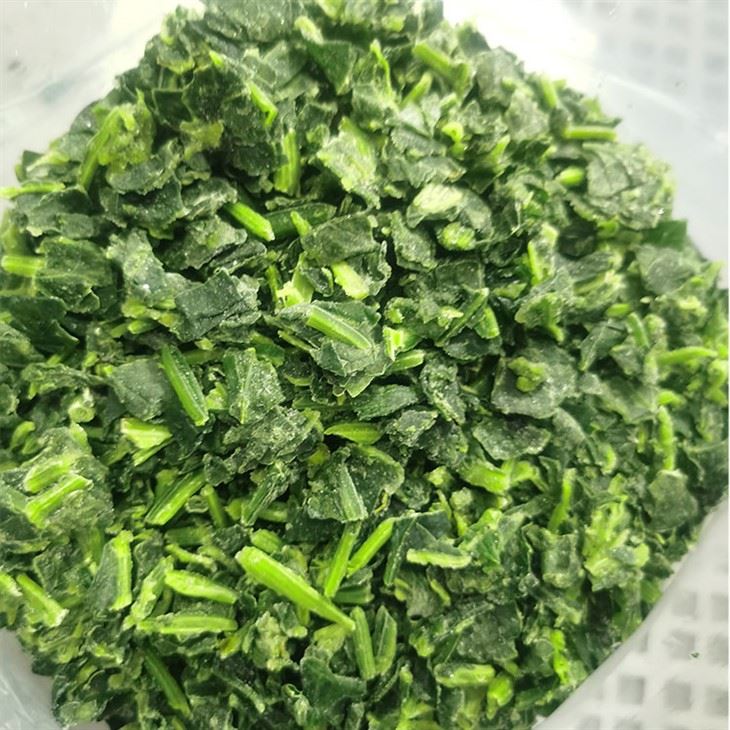
GreenLand spinach product photograph: confirm the cut and prepared-yield test.
When requesting supply, include the expected quantity, packing, destination and production schedule alongside the technical brief. Confirm sample handling, required documents and the specification for the proposed order. Ask about current availability rather than assuming every listed form is immediately stocked for every market. Keep the approved sample and its test method linked to the quotation so that the commercial discussion remains anchored to the product the kitchen assessed.
Finally, give the operating team a controlled version of the method. Identify the weighing point, draining endpoint, sauce preparation, portion check and service observations, with a clear route for reporting deviations. Retain the original trial record and any subsequent approved change. That allows the 10 kg exercise to become a practical production standard, with measured ingredient use and a finished creamed spinach that can be judged consistently from one batch to the next.
Source frozen spinach with GreenLand-food
GreenLand-food manufactures frozen spinach in China. We fill factory-direct wholesale orders for foodservice, food manufacturers, importers and private-label programmes.
Send your required product form, specification, packing, quantity, application, destination, private-label needs and requested documents. Include the preparation and acceptance method used in your trial so we can discuss a sample and order brief that fits your process.