


Daylily Buds as Food: Species, Plant Part and Processing Checks
Oct 19, 2026
Leave a message

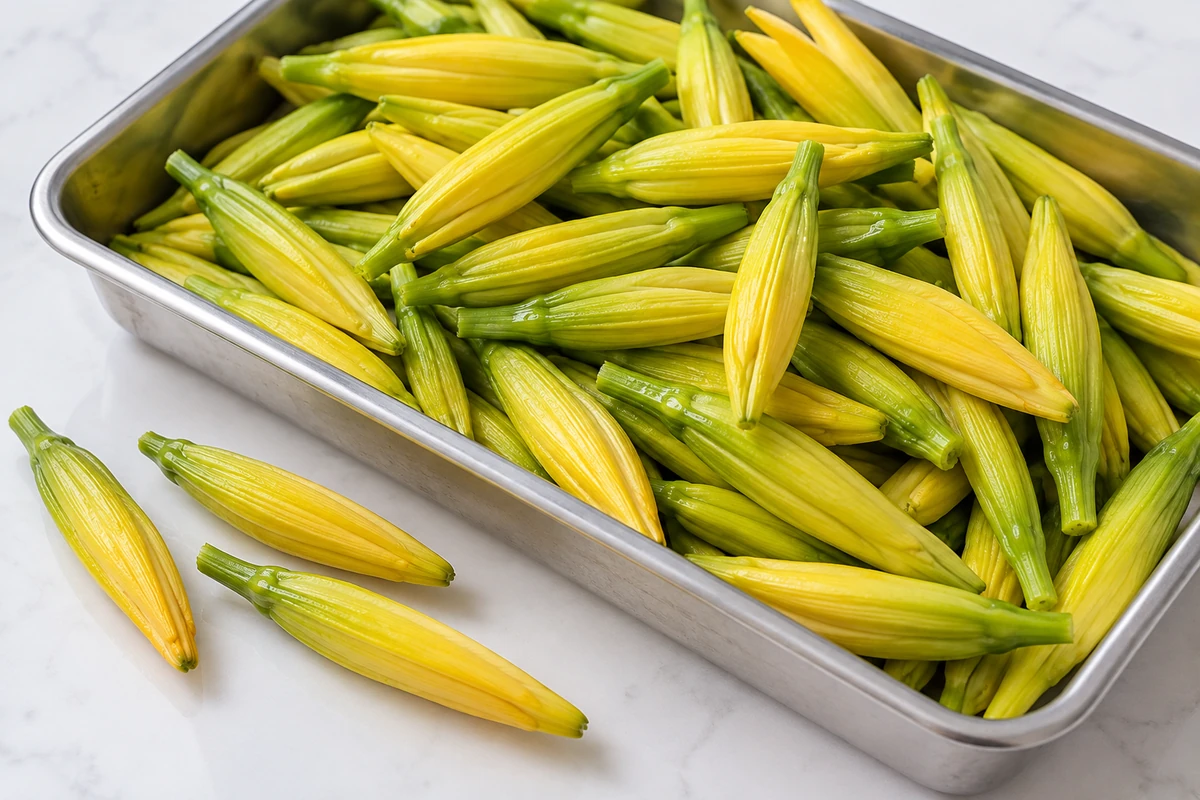
Hemerocallis citrina is a food-crop species discussed in primary research, but that does not authenticate an individual shipment or make every ornamental daylily interchangeable. We recommend approving identity and process before comparing bud length, yellow-green color or price. Those physical qualities matter to the dish only after the ingredient has passed the appropriate technical review.
This guide follows a purchasing team from the first product description to the sample and shipment file. It concerns commercially supplied food buds. It gives no wild-plant identification method or universal treatment that makes an unknown flower edible. The checks below help distinguish a documented food ingredient from a sample whose species, plant part or processing history still needs clarification.
Confirm the food species before approving a sample
A specification should identify the botanical species and the intended food use together. Ask the supplier to connect that identity to its raw-material source and to the product code on the quotation. A botanical name copied into a sales email is a starting description; the supporting source and approval records establish how it applies to the supplied lot. Keep any accepted commercial synonyms alongside the botanical identity so the purchasing and receiving teams can recognize the same ingredient.
The name daylily usually points toward Hemerocallis, while other products described as lily can belong to different plants and involve different parts. Dried golden needles, ornamental flowers and edible lily bulbs should not be substituted on the strength of an English common name. If a quotation uses only lily buds, ask for a corrected description before treating it as equivalent to an approved daylily item. Translation should preserve the identity that the technical team accepted.
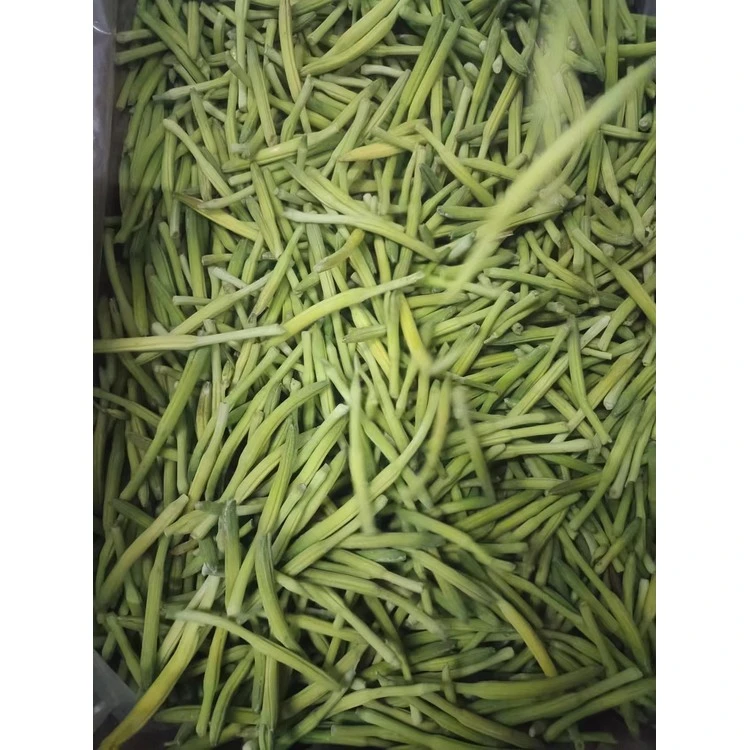
The supplied product photograph supports discussion of bud form; identity and processing require their own records.
A 2021 Hemerocallis citrina genome study describes the crop and investigates its chemistry. It supports discussion of that named species, but it does not verify GreenLand-food stock, every cultivar, other Hemerocallis species or garden plants. The commercial decision still needs a supplier declaration and suitable evidence for the actual source. Where identification is uncertain, the responsible specialist should resolve it before a cooking trial proceeds.
Inspecting a product photo helps the buyer recognize the offered form, including the elongated closed bud and trimmed base. It cannot establish botanical identity with the reliability needed to release an unfamiliar food. Request photographs as part of the sample record, then reconcile them with the source description. If the photographed buds and the delivered sample look materially different, hold the comparison open until the discrepancy is explained.
For a repeat order, define which identity changes require fresh approval. A different cultivar, agricultural source, plant-part mix or supplier product code may affect the agreed description and the evidence behind it. The buyer and supplier should decide how changes are communicated, who reviews them and whether another sample is needed. This makes an approved identity useful beyond the first purchase.
An importer also needs to confirm that the intended ingredient and use are acceptable in the destination market. A history of culinary use somewhere else is useful context, but it does not settle every local food classification or label requirement. Send the botanical name, part, preparation state and intended finished food together for that review. Resolving these items early avoids developing packaging around a product description that later needs to change.
Keep the order tied to unopened flower buds
For this product, write unopened flower buds into the order rather than leaving the plant part implicit. The bud is a distinct structure with a tapered closed tip, joined petal surfaces and a base where it was detached. A specification for buds does not automatically cover open flowers, leaves, flowering stalks, roots or bulbs. If another part is proposed, it requires its own identity, intended-use and safety assessment.
Maturity affects the physical result the kitchen can expect. A closed bud, a bud beginning to open and a fully opened flower present different surfaces and behave differently during transfer and cooking. Agree which stage the product should represent, and use sample photographs to make the boundary practical. Avoid a broad premium-grade description that leaves the receiving team to decide whether an opening flower is acceptable.
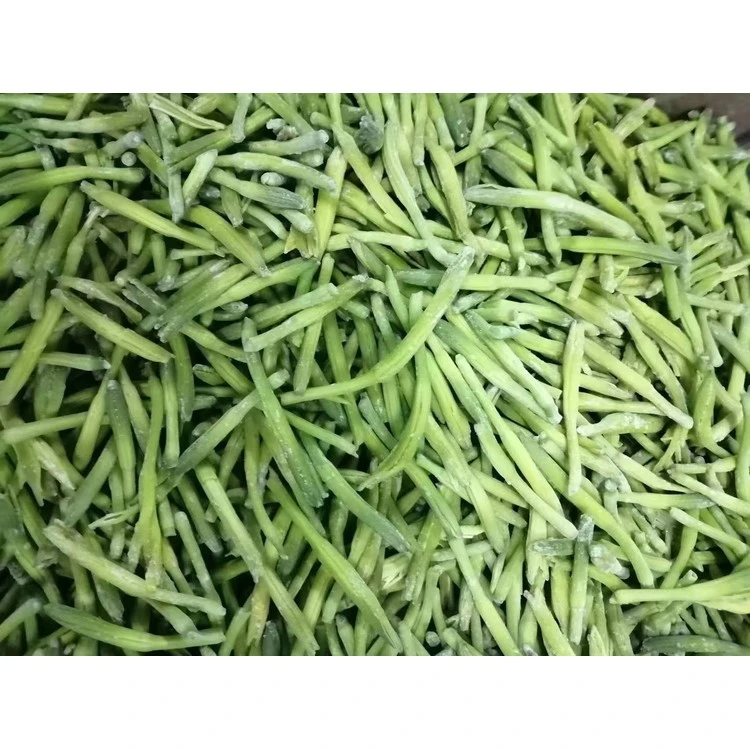
Look at the tip, joined sides and trimmed base when defining an unopened whole bud.
The base also deserves attention. A short, cleanly trimmed attachment point may fit a whole-bud dish, while a longer or firmer stem end can interrupt the bite. Set the required trim around a cooked sample and a realistic inspection method. An extremely close trim may remove usable material or increase damage; a loose trim allowance may shift work into the kitchen. The agreed sample should show the intended balance.
When the dish needs recognizable whole buds, distinguish an intact closed bud from a long fragment. Length alone cannot establish integrity. A split bud can remain long, and detached petals can look like narrow strips in a frozen sample. Inspect the tip, sides and base together, then check the same attributes after the required cooking process. The kitchen may accept a different level of opening than the frozen receiving specification.
An image of green or yellow plant material also says little about preparation state. Surface frost, moist sheen and color can alter how the bud looks without revealing whether it was washed, blanched, otherwise treated or fully cooked. Keep the plant-part description in the physical specification and the processing status in its own documented field. Both are necessary, and one should not be inferred from the other.
If the buyer needs a cut or broken-bud ingredient for a particular formulation, describe that form directly. Confirm the permitted plant parts, cut distribution and foreign-material criteria instead of accepting an undefined mixture of whole buds and fragments. A soup manufacturer may use a different form from a foodservice plate that displays each bud. The product can then be evaluated for its intended role without lowering the identity or process requirements.
At GreenLand-food, the frozen daylily buds product discussion is tied to the agreed bud form and recorded preparation status. Use that commercial reference to start the specification, then confirm the exact sample and order details.
Separate frozen, fresh and dried processing histories
Fresh, dried and frozen buds enter the kitchen with different histories. A dried ingredient commonly needs rehydration to become workable, while a frozen ingredient brings frozen water and its own preparation instructions. A fresh bud has neither the same drying history nor necessarily the same pretreatment as a purchased frozen item. Recipes can suggest a dish, but their preparation sequence must match the ingredient actually bought.
Ask for the frozen product's process description in ordinary, unambiguous language. It should explain the relevant preparation steps, the declared state at packing and the treatment required before consumption. Terms such as processed or ready to use are too broad if they leave the buyer unsure whether further cooking is essential. Resolve that uncertainty before the item is entered into a kitchen recipe or private-label artwork.
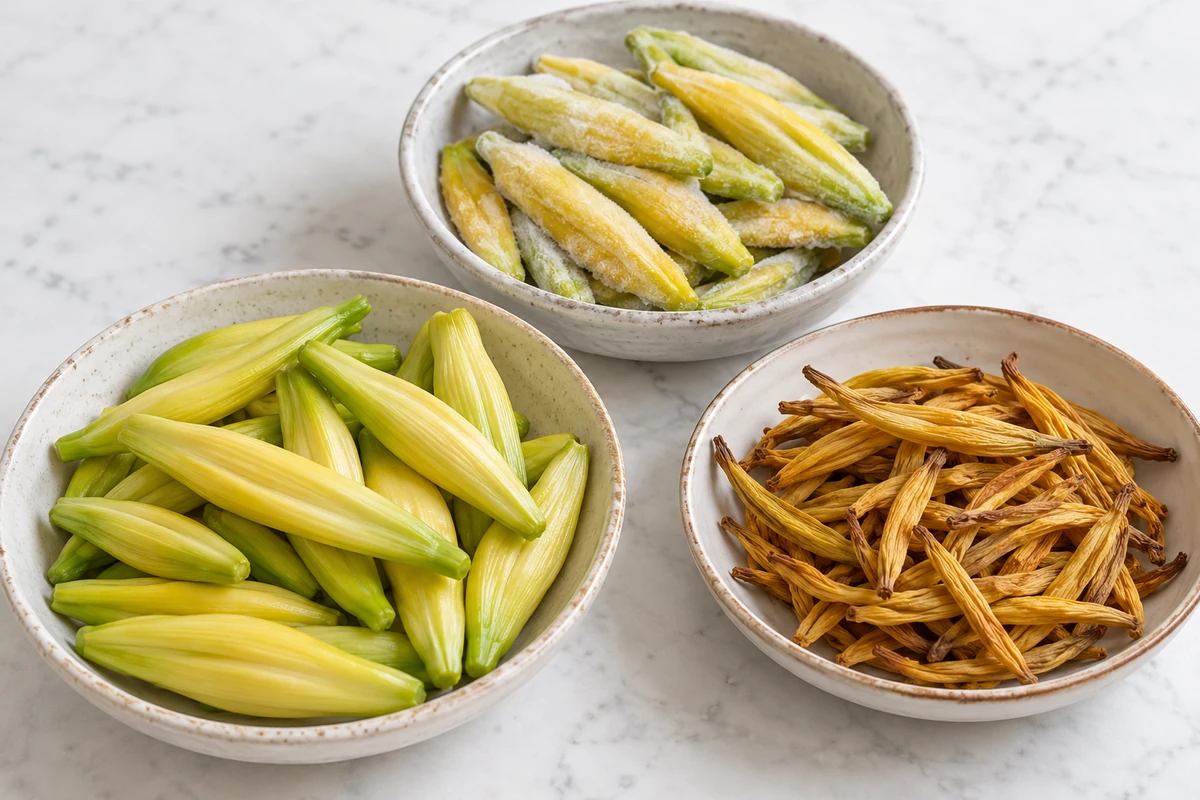
Fresh, frozen and dried bud forms enter preparation with different moisture and processing histories.
Freezing is a preservation step with limits. The National Center for Home Food Preservation explains that freezing does not sterilize food. It therefore cannot stand in for species approval, the food-safety assessment of a plant ingredient or an appropriate final cooking process. A frozen bud can retain an attractive shape while still requiring the treatment stated by its supplier.
Blanching needs equally careful wording. It may be used to support quality during frozen storage, but a statement that a product is blanched does not by itself establish ready-to-eat status. Ask what the step is intended to control and which records support that purpose for the SKU. The broader GreenLand-food blanching guide explains the relationship between process control and frozen quality.
Dried-daylily experience can create a second source of confusion: additive history. Taiwan's Food and Drug Administration discussion of dried daylily describes sulfite-related controls in that product category. This is a reason to ask about the actual formulation and treatment, not evidence that a particular frozen bud contains sulfites. Obtain the declaration for the product being purchased and review any relevant analytical or labeling requirements for its destination.
Treat a change of product state as a formulation change. If a recipe developed with dried buds is switched to frozen buds, review the input weight, water contribution, texture and cooking route together. Equal purchase weights do not necessarily provide equal prepared portions. Run the accepted process with the actual ingredient and measure the usable result before setting a production cost or pack declaration.
Keep shelf-life and storage instructions connected to that same state. A date assigned to a sealed frozen SKU cannot be transferred to a thawed, cooked or reformulated dish. The receiving team should know the required frozen storage condition, while the kitchen should have its own approved handling instructions for each subsequent stage.
| Form | Preparation evidence | Kitchen check |
|---|---|---|
| Fresh buds | Confirmed edible identity and required treatment | Use the approved preparation before sensory assessment |
| Frozen buds | Actual pretreatment and cooking instruction | Account for frozen loading, water and cooked texture |
| Dried buds | Drying history, declaration and preparation direction | Use a defined rehydration and cooked-weight basis |
Read safety evidence without inventing a detoxification rule
Safety writing about daylily often repeats a simple chemical explanation followed by a fixed soaking or boiling instruction. The published evidence requires more care. Qing and colleagues reported that they did not detect colchicine in the H. citrina tissues they tested using high-resolution mass spectrometry and did not identify the expected biosynthetic pathway in their genome analysis. A later 2024 study of treated daylily leaves reported colchicine measurements using an HPLC method.
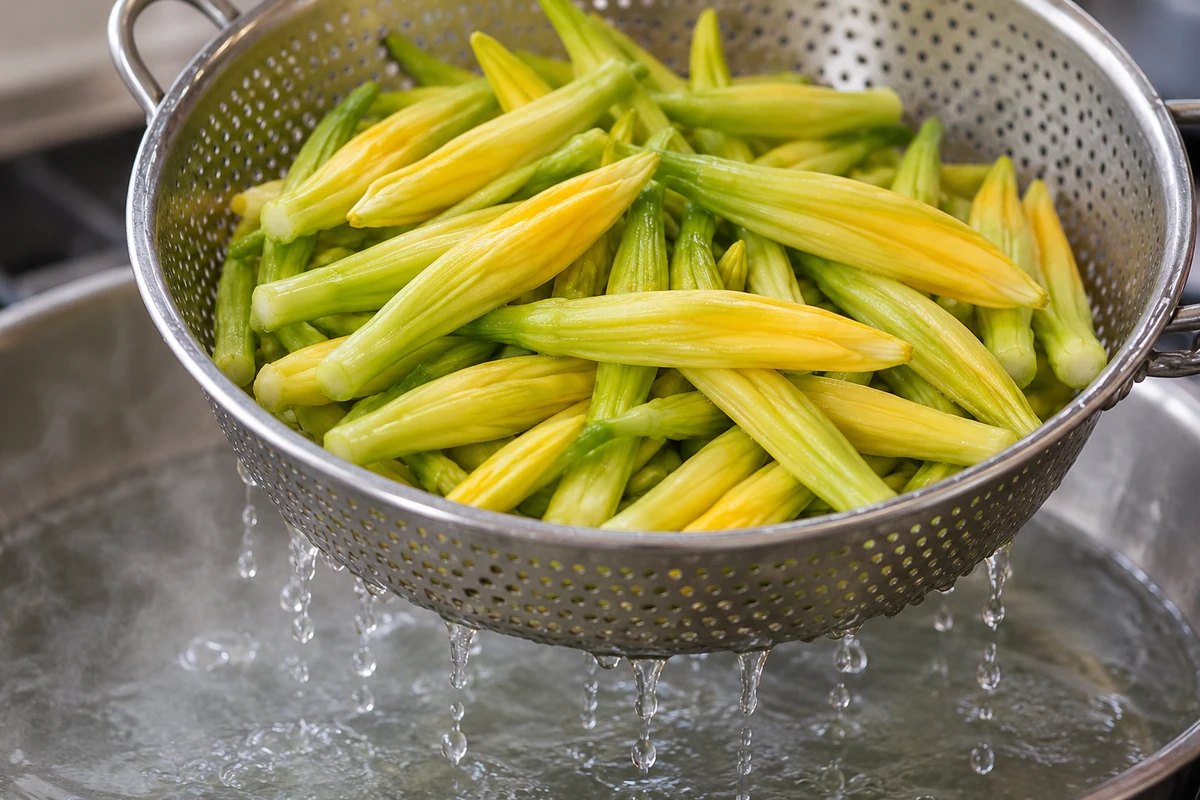
The required cooking route belongs to the identified product and its documented preparation state.
These findings concern different experimental materials and analytical approaches. They should not be turned into a claim that every bud contains the same toxin, or that an arbitrary home treatment removes it completely. They also do not justify declaring all fresh buds safe to eat raw. For purchasing, the defensible response is to require authenticated food material, an assessed processing route and an appropriate use instruction for the actual product.
The Hong Kong Centre for Food Safety booklet advises thorough cooking of fresh Jin Zhen, or fresh lily flower. That practical advice supports a cooked-use approach. It does not give a universal commercial validation for every frozen bud size, pretreatment, kettle load or finished food. The supplier and responsible technical team must establish how the instruction applies to the specific SKU and process.
A safety assessment should state what is known, what is controlled and what still needs evidence. Identity uncertainty is resolved through identity work. A microbiological concern calls for the relevant hygiene, process and verification program. An additive or residue question requires the appropriate declaration, legal review and testing scope. Combining all of these under a vague safe after blanching statement leaves the buyer unable to tell which issue has actually been addressed.
Ask a laboratory report to answer a defined question. Check the material tested, lot relationship, method, analyte, reporting limit and date. A report on a different plant part or an unrelated extract may be scientifically interesting without being a release document for frozen buds. Similarly, a general certificate about a facility does not replace the evidence needed to approve a particular ingredient or intended use.
Tasting is a sensory activity after the required safety conditions have been met. It is not a way to identify an unknown plant, prove that a treatment was adequate or decide whether a questionable shipment is harmless. If an ingredient's identity or history is unresolved, keep it out of the tasting session and refer the issue to the responsible technical reviewer.
A supplier instruction should be clear enough for the next operator to follow without inventing a missing step. If the process includes a required preliminary treatment, drainage or final heating condition, identify its sequence and responsibility. Do not silently replace that sequence with a familiar dried-bud recipe because the finished dishes look similar.
Inspect the buds and define visible defects
Once identity and process documentation are satisfactory, physical inspection can focus on what the buds must deliver in the dish. Examine a representative sample for closed form, broken tips, split sides, retained stem ends, color range and foreign material. Keep the sampling method visible in the record. A few carefully selected attractive buds do not describe the distribution in a whole carton.
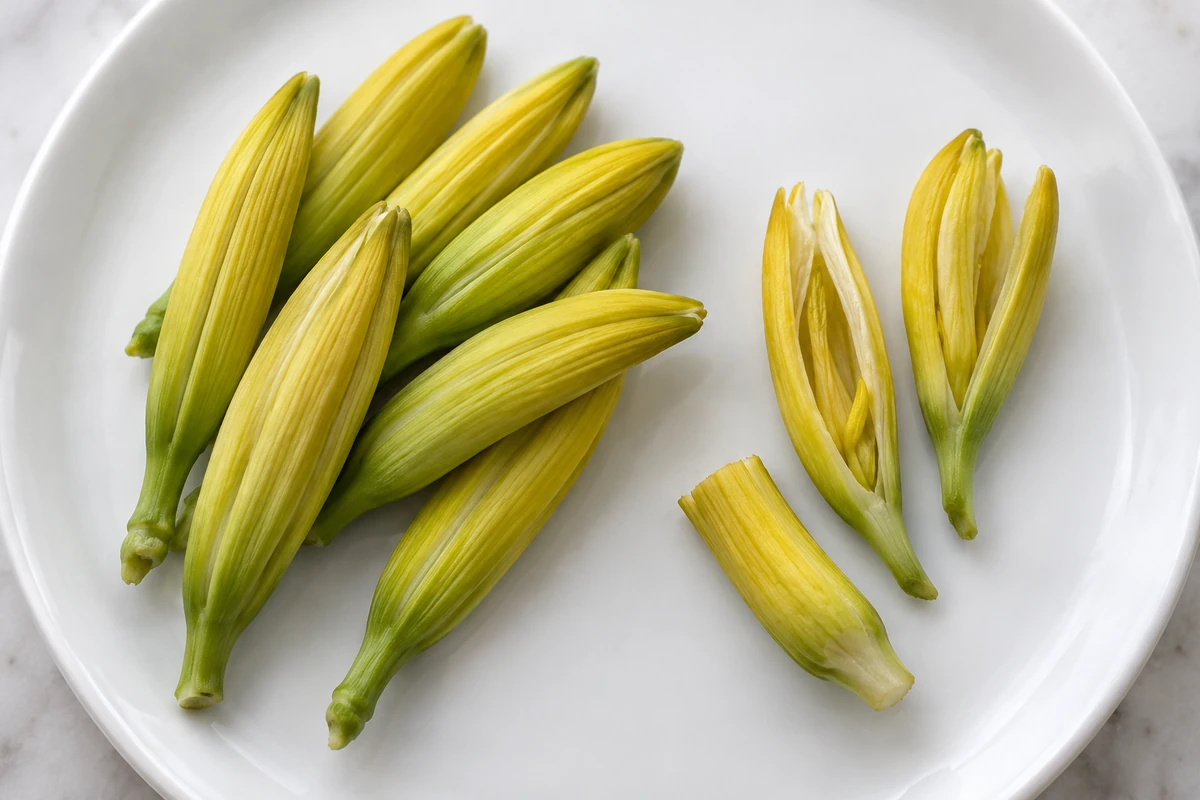
Intact buds, split sides and broken pieces need distinct inspection definitions.
Agree whether each defect is counted by number, assessed by weight or judged against a photographed reference. Whole-bud presentation often benefits from a count-based integrity check, while loose fragments may be easier to quantify by weight. Either method can be useful if both parties apply it consistently. State how overlapping defects are recorded so one damaged bud does not create misleading totals in several categories.
Color should be inspected under a repeatable light source and in the same physical state. Frost can lighten a frozen surface, wetness can deepen its apparent color and a dark tray can change the impression of yellow or green. Use a neutral dish and compare like with like. A frozen reference photograph is useful for frozen receipt; it should not be the sole acceptance reference for a cooked serving.
Look at distribution as well as an average impression. A lot with mostly intact buds and a small number of severely damaged pieces may need a different decision from a lot with slight uniform opening. The same applies to long bases or discolored material. Record the type and frequency of the issue so the supplier can investigate a plausible cause and propose a focused correction.
Foreign material belongs in the agreed rejection and investigation procedure. Do not treat an unexpected plant fragment as harmless merely because it is green, or blend it into a broad broken-bud allowance. The inspection should distinguish normal pieces of the approved bud from unapproved plant parts and non-product material. Detection methods and escalation responsibilities should match the product and the buyer's program.
Clumping and frost need their own observations. They can affect separation and portioning, but a clump alone does not reveal the full storage history. Review pack integrity and temperature evidence alongside the physical sample. If the material cannot be separated under the intended handling route, record the operational effect, including any additional damage caused during separation. Avoid forcing it apart and then attributing every broken tip to production.
Retain a clear record of the received condition before cooking. Photograph the sample, note its lot and record the preparation used for the next assessment. That makes it possible to distinguish damage already present in the bag from damage that appears during cooking, draining, mixing or portioning. The distinction is useful when agreeing what the ingredient supplier and kitchen each need to change.
Build cooking instructions around the actual SKU
The kitchen trial begins with the approved cooking instruction for the exact product. Confirm the starting state, portion or batch weight, equipment and required heating conditions before judging tenderness or appearance. If the supplier instruction is incomplete for the intended industrial application, obtain technical clarification. A development cook should not fill that gap by stopping as soon as the buds look bright or feel soft.
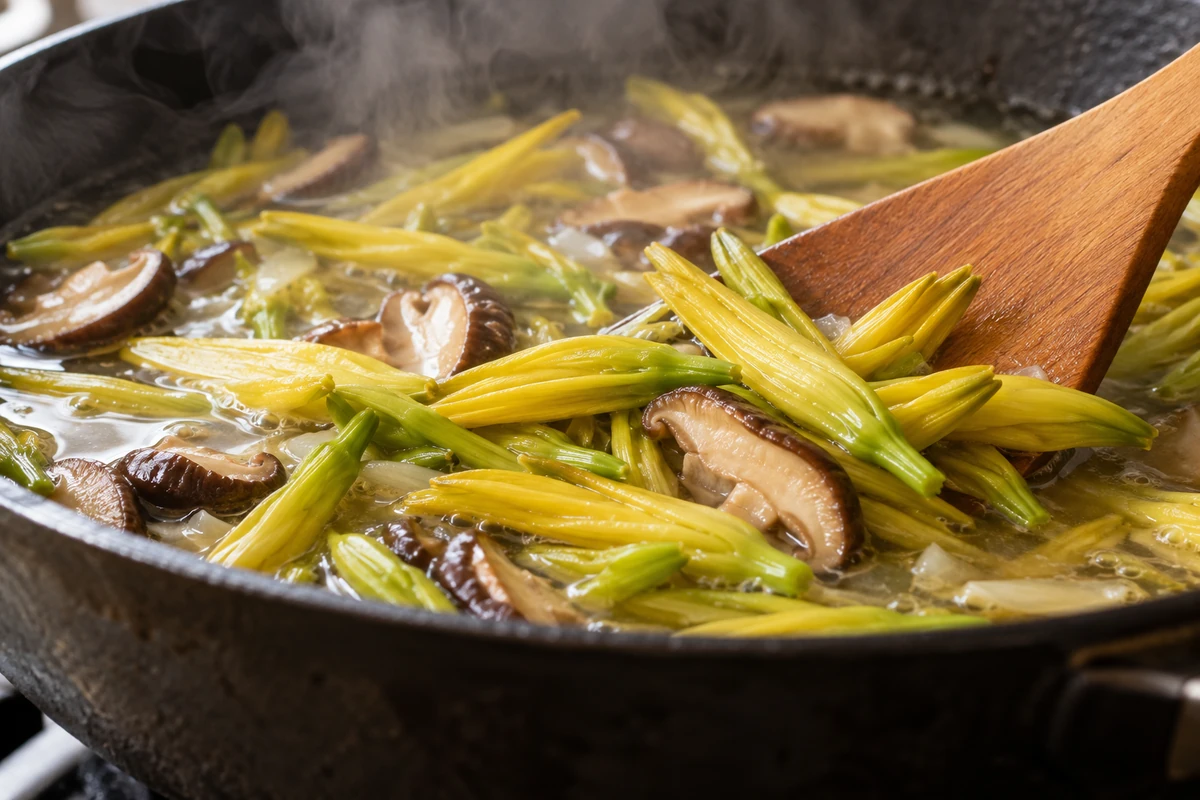
Gentle handling can be evaluated within the product's required cooking process.
A practical sequence helps preserve the distinction between required processing and quality optimization:
- Identify the sample and confirm its documented route.
- Prepare it using that route and record the loading conditions.
- Assess the cooked bud and the finished dish after the planned handling stages.
- Connect any accepted result to the ingredient and process versions used.
These are proposed development steps, not evidence that a GreenLand-food trial has already been performed.
Control mechanical handling within the accepted cooking process. Long, tender buds may split during vigorous stirring, squeezing or a high drop into a colander. A broad utensil, shallow receiving container or gentler transfer can be worth evaluating where it still allows the required process. Record the handling change and the resulting condition so the trial explains what helped.
Judge the base and bud body separately. The petal structure may be tender while a retained base remains firm, or the whole bud may become too soft after extended cooking. This can point toward trim, maturity or size distribution as well as the cooking route. A specification adjustment may provide a better result than repeatedly increasing heat exposure to compensate for a structural mismatch.
Inspect the prepared buds before a dark sauce or mixed dish makes their condition difficult to see. Then evaluate them in the real formula. Broth, seasoning, other ingredients and mixing can alter perceived color, flavor and firmness. A plain cooked sample establishes a useful reference, while the finished dish determines whether the product fits the actual menu or manufacturing purpose.
Include the final service stage. A bud that looks intact immediately after cooking may open or fragment during holding, packing and reheating. Use the intended containers, portioning utensils and approved handling conditions. Record first and last portions where a batch is served over time, because loose material can collect toward the bottom of a pan.
The accepted recipe should preserve the required cooking instructions even when the kitchen later changes seasoning or presentation. If the product form, pack weight, equipment or process changes materially, review whether the previous approval still applies. Keep the new trial linked to the same type of records so improvements in appearance do not create uncertainty about the treatment each portion received.
Connect approval, packing and records to the lot
The final approval should connect the identity decision, sample, process description and commercial specification. Record the exact botanical identity and unopened-bud part, the accepted form and defects, the declared preparation state and the customer's required cooking route. Add the agreed sampling and inspection methods. This provides a shared reference when the order moves from development to purchasing, production and receipt.
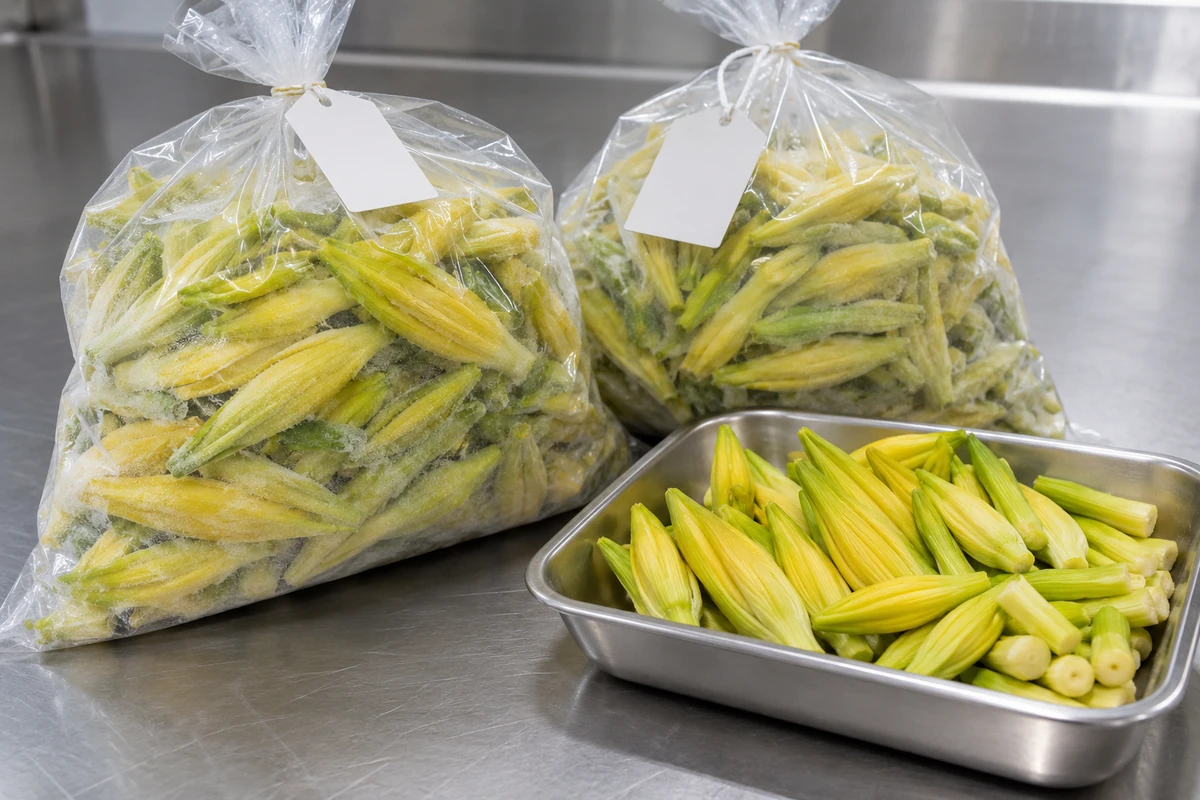
Keep the approved sample and packed ingredient connected through the order record.
Packing should support the way the ingredient is used. A kitchen that needs small measured additions may value a format that separates reliably, while a manufacturer may use an entire inner bag in one batch. Confirm the actual freezing and packing form rather than assuming that every frozen product is freely flowing IQF. Test separation using the intended handling method and include the practical result in sample approval.
Keep the inner bag and carton linked through lot identification. When a kitchen removes a bag from its outer case, the information needed to identify the ingredient and follow its use instruction should remain accessible. Agree the label language, product name, date coding, storage condition and relevant preparation statement before artwork is finalized. Private-label claims need the same factual support as the technical sheet.
For shipment documents, define what is needed for the product, destination and buyer program. The file may include the accepted specification, ingredient declaration, relevant analytical reports and a lot map alongside commercial papers. Confirm availability and scope before committing the order. A document title on a checklist does not establish that the correct report has been issued for the material being shipped.
At receipt, reconcile the cases with the approved item and review temperature evidence, seals and physical condition. An identity or processing discrepancy remains a technical issue even when the product arrives frozen. Conversely, correct paperwork does not erase a damaged pack or a documented handling problem. Keep the lot on the appropriate hold while the responsible parties resolve the discrepancy and record the disposition.
When discussing repeat supply with GreenLand-food, include the intended cooked dish, the bud presentation required at service and the buyer's inspection method. We can use those details to clarify the proposed specification and the evidence still needed for the selected order. Confirm quantity, pack size, destination and shipment window together; MOQ, lead time and available documents depend on that final program.
The most useful approval record is one the next team can apply without guessing. A receiver should know what product arrived, a cook should know how it must be prepared and a buyer should be able to trace the accepted sample to the shipment. When those links are clear, bud color and intactness become manageable quality decisions within a documented food supply arrangement.
Source frozen daylily buds with GreenLand-food
GreenLand-food is a professional frozen daylily buds supplier and manufacturer in China, providing factory-direct wholesale supply for importers, food manufacturers, foodservice distributors and private-label programs.
Send your required product form, specification, packing, quantity, application, destination, private-label needs and requested documents. Include the accepted cooked result and preparation route so we can discuss the sample and order details that need confirmation.