


Do You Peel Eggplant for Eggplant Parmesan?
Sep 24, 2026
Leave a message


The decision is more visible in a layered dish than in a puree: a diner may meet the peel on the edge of every forkful. Variety, maturity, slice thickness, and the number of heating stages change that experience. With frozen slices, the buyer must also check what peel remains and how much liquid the product releases before layering. We supply frozen eggplant for prepared-food applications, and a peel decision belongs in the slice specification rather than being left to chance on the production line.
When skin helps or hinders the layered dish
Eggplant skin is edible. On a tender, moderate-size slice, it forms a colored edge that can make the cooked piece easier to lift and portion. If the dish uses breaded slices, the peel can help keep the perimeter intact while the flesh softens. The purple outline also makes individual layers visible through sauce and cheese. These are practical reasons to leave it on, especially when the recipe aims for distinct slices rather than a melting casserole.
The same edge can be a drawback when it remains chewy after the center is soft. In a thick mature eggplant, the skin may pull away as a long strip or resist the fork. A diner then experiences a soft interior with a tough boundary. Sauce and cheese do not necessarily fix that contrast. If the peel is objectionable in a cooked sample, remove all or part of it for that lot. Do not assume that a longer bake will solve the edge without overcooking the flesh and dairy.
Peel status also affects assembly. An intact unpeeled slice may tolerate handling and stacking better. A fully peeled slice has no colored rim and may be more delicate once cooked, particularly if it was sliced thinly or pretreated with heat. This is not a reason to reject peeling; it means the kitchen may need gentler handling, a suitable slice thickness, and a pre-cook that leaves enough structure for layering.

When skin helps or hinders the layered dish visual explanation.
The goal is the finished bite, not an abstract rule about authenticity. Some established recipes leave skin on; others remove it or use a mixture. The University of Illinois Extension eggplant guide notes that young eggplant skin is edible and that mature skin may be tougher. That offers a sound starting point for choosing. The decisive test remains a cooked slice from the actual variety and lot, tasted with the planned sauce and cooking sequence.
If customers have a strong presentation expectation, include that in the specification. A menu photograph showing purple edges sets a different expectation from a pale, soft layered portion. A food manufacturer also needs consistent appearance across lots. Alternating peeled and unpeeled slices without a deliberate design can make portions look uneven. State the chosen peel treatment before approving bulk volume.
Choose by variety, maturity and slice thickness
Eggplants differ in shape, peel thickness, seed development, and flesh density. A small, recently harvested fruit can carry a relatively tender peel; a large mature fruit can have a firmer surface. Color alone does not reveal toughness. Take a representative raw slice, note the peel's thickness, and then cook it by the intended method. A raw peel that feels acceptable may still become noticeable against very soft baked flesh, while a slightly firm raw peel can soften enough in a longer cook.
Slice thickness changes the ratio of peel to flesh in each bite. A thin round has a narrow band of flesh, so the peel can dominate if it remains firm. A thicker round gives more tender center but needs enough pre-cooking to avoid a spongy or underdone middle. Long lengthwise slices can yield wide layers with fewer small pieces, yet the skin runs along a long outer edge. Test the shape used in the final pan rather than extrapolating from a small cube or a different cut.
Uniform cutting matters. If some rounds are much thicker, they may still be firm when the thinner ones are collapsing under sauce. A sharp knife or slicer set to a controlled thickness improves both cooking and portioning. Record the thickness in millimeters for a commercial line or in a clear range for a kitchen. "Medium slices" leaves too much interpretation when suppliers, prep cooks, and final assemblers are different people.

Choose by variety, maturity and slice thickness visual explanation.
Large seed clusters or a fibrous interior may indicate a mature fruit that will not make an ideal delicate slice regardless of peeling. Removing the peel addresses only the edge. If the center is coarse or bitter in a sample, consider a different lot, size grade, or variety. Salt treatments and sauce may moderate some perception, but a specification should begin with suitable raw material. This is especially important for a product expected to serve as a visible vegetable layer.
Consider the cooking path. Breaded and pan-fried slices receive an initial hot step, then another bake under sauce. Unbreaded grilled or baked slices follow a different path. Peel tenderness after one stage may not predict the final bite after both. Make two or three sample portions and judge them at the intended serving temperature. The strongest choice is based on the final forkful, not on a raw peel pulled from an uncooked eggplant.
Published advice reaches different conclusions because the cook's preference and product vary. The Takeout describes leaving the peel as a matter of preference and texture, while Coley Cooks uses a particular preparation to get its intended result. Rather than turn one recipe into a universal rule, use the variables above to decide which result your menu needs.
Peel fully, stripe peel or leave skin on
Leave the peel on when a trial slice has a tender edge and the finished dish benefits from a visible outline and extra handling strength. Wash the surface, trim the stem end, cut uniform slices, and cook one as a test. If the edge disappears pleasantly into the bite, extra peeling work may add little value. This approach is practical for a foodservice operation where yield and prep time matter, provided the raw material remains consistent.
Fully peel when the skin is thick, when customers expect a very soft bite, or when the final portion should have no distinct purple edge. Use a sharp peeler or knife and remove only the peel, not a thick layer of usable flesh. Full peeling reduces the risk of chewy strips but makes some cooked slices fragile. Choose a thickness and handling method that keep them intact through pre-cooking, sauce assembly, baking, and service.
Striped peeling removes lengthwise bands of skin while leaving alternating bands attached. On rounds, this produces several shorter arcs of peel rather than one continuous ring. It often balances structural support with a gentler bite. The exact width of the stripes is a kitchen choice; the important point is consistency. A partly peeled lot should not contain random, heavily peeled pieces beside untouched ones if the finished appearance must be uniform.

Peel fully, stripe peel or leave skin on visual explanation.
For a sample comparison, cook three slices from the same eggplant: one unpeeled, one striped, and one fully peeled. Keep thickness, salt treatment, pre-cook, sauce, and bake identical. Compare fork resistance at the edge, slice integrity, visible color, and liquid released in the pan. This controlled side-by-side test is far more informative than comparing different recipes or different varieties with different peel treatments.
Do not remove peel only because older recipes do. Some older preparations were designed around larger or more mature fruit than the current lot, and some authors favor a specific texture. Equally, do not insist on the peel because it is edible. Edibility is a lower bar than suitability for a layered baked dish. The peel treatment should serve the eating quality, appearance, yield, and repeatability the operation actually needs.
If a distributor sells pre-cut frozen slices, ask whether peel treatment is available as a controlled specification. A case photograph may show a few slices but not the range across a production lot. Inspect several pieces from more than one pack. Record whether the peel is intact, striped, removed, or variable; then taste the slices after the complete eggplant parmesan process.
Prepare fresh slices for cooking and layering
Wash and dry the eggplant before cutting. Use a uniform slice thickness suited to the recipe. Many kitchens salt slices briefly, then blot them, especially when they want to manage surface moisture before breading or frying. The effect depends on slice thickness and time. If salting is part of the process, apply it consistently; if the kitchen omits it, judge the unsalted result rather than borrowing another recipe's moisture expectations.
Pre-cook the slices enough that the center will finish tender under sauce without leaving the surface waterlogged. Frying, baking, grilling, and air frying create different moisture and fat profiles. A breaded fried slice can hold crispness briefly, but sauce will soften it during the bake. A baked unbreaded slice may release more visible moisture. The peel decision should be tested with the chosen method because surface treatment and heat can alter how noticeable the edge feels.
Let hot slices shed excess oil or moisture before layering. A rack can keep fried pieces from sitting in pooled oil; a tray can collect released liquid from baked pieces. Stack the slices only after the prep step has reached its intended endpoint. If they go straight into a deep pile while steaming hot, trapped vapor can soften them and add moisture to the casserole. That effect can be mistaken for a problem with the eggplant itself.

Prepare fresh slices for cooking and layering visual explanation.
Use enough sauce for the desired dish but avoid treating sauce as a remedy for undercooked slices. The vegetable should already be close to its final tenderness before assembly because the center of a dense layered pan heats slowly. Evaluate a cut portion after the full bake and normal rest. The rest matters: a pan cut immediately may appear wetter and less stable than the same pan after it has settled for service.
If the peel pulls free when the portion is cut, consider thinner skin, striped peeling, or a different slice geometry. If peeled slices disintegrate, try a slightly thicker cut or a gentler pre-cook. If the pan releases too much water, check initial slice moisture and sauce consistency. Those adjustments target separate causes. Changing peel status alone cannot correct every texture issue in eggplant parmesan.
Check frozen slices for peel and released water
Frozen eggplant can save cutting labor and offer a defined cut, but it must be assessed as a prepared ingredient. Ask whether the slices are raw, blanched, pre-cooked, breaded, or otherwise treated. "Frozen slice" does not describe its readiness for layering. The supplier should identify the cut thickness and peel status. The kitchen should confirm how the slice behaves when heated in its own recipe.
Freezing can disrupt plant tissue, and thawing may release liquid. The amount varies with the raw material, pretreatment, cut, freezing, storage, and thaw method. Do not assume every frozen eggplant slice is excessively wet; do not assume it can be laid into sauce directly with no effect. Run a measured trial. Weigh a representative portion, thaw or heat it according to the intended workflow, drain consistently, and note liquid release and usable slice integrity.

Check frozen slices for peel and released water visual explanation.
If the product is loose IQF, take out only the amount needed for a trial and keep the rest frozen. A mass of slices stuck together may tear when separated and heat unevenly. Follow the supplier's handling instructions, then test one small assembly. Some frozen slices may perform best from frozen in a hot process; others may need controlled thawing and draining. The correct sequence is product-specific, particularly if a coating or pretreatment is present.
Look at peel distribution after cooking. An unpeeled frozen slice may hold its outline, but a peel band can become more prominent if the flesh softens and contracts. A fully peeled slice may be more delicate after thawing. Striped peeling can shorten the edge without losing all the visual color. Compare the final baked portion, not just the frozen piece on a tray. The sauce, cheese, and rest period all affect whether the slice stays recognizable.
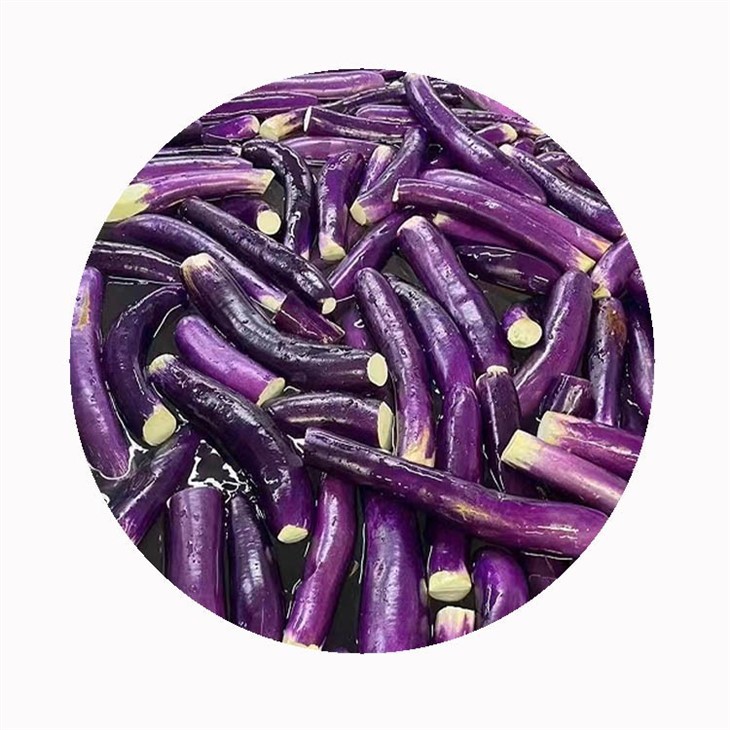
Frozen eggplant strips with skin.
When comparing offers, request a written specification for size, thickness, peel treatment, broken pieces, pretreatment, packaging, and storage conditions. A broad IQF frozen eggplant description is a conversation starter; the actual sample and agreed tolerances determine suitability. Trial several packs if the program is large enough to depend on lot consistency.
Specify slices for foodservice eggplant parmesan
Begin with a finished portion standard. State whether the diner should see defined purple edges, a partially peeled pattern, or a uniformly soft pale layer. Describe the desired fork resistance and whether slices must lift intact. Then specify the raw or frozen slice dimensions and peel treatment. A supplier can act on measurable requirements; "good for parmesan" leaves too much room for interpretation.
Run the ingredient through the entire operation: incoming storage, tempering or thawing if needed, pre-cooking, layering, baking, rest, hot hold, and service. A slice that looks good after the first cook may fail after a long hold. A frozen sample that releases little water on a rack may still thin the sauce in a deep pan. Record the finished pan weight, visible free liquid, slice breakage, and eating quality at the actual serving interval.
Compare costs on finished usable portions. Peeling in-house consumes labor and removes some weight; a pre-peeled frozen slice may cost more per incoming kilogram but save preparation time. A lower-priced unpeeled slice may be right if its skin is tender and the visual appearance suits the menu. Purchase price alone cannot decide the peel treatment because the processing yield and final rejection rate matter.
At GreenLand-food, we would ask for the slice dimensions, peel preference, pretreatment, packing, intended cooking method, volume, and destination before recommending a frozen form. Then we would check a sample in the customer's layered dish. The answer to "do you peel eggplant for eggplant parmesan?" is therefore practical: leave tender skin on when it improves structure and appearance; remove thick skin when it harms the bite; use striped peeling when the trial shows the best balance.
A three-pan approval test
For a menu or manufactured entrée, make a small controlled test before choosing peel treatment. Use slices of the same variety, lot, thickness, and size. Leave one set unpeeled, stripe peel a second, and fully peel a third. Apply the same salt or moisture preparation, the same breading or pre-cook, and equal amounts of sauce and cheese. Bake in equally sized pans and let them rest for the normal serving interval. A comparison made from three different recipes will confuse the peel effect with changes in heat and moisture.

Specify slices for foodservice eggplant parmesan visual explanation.
Cut a portion from each pan with the utensil used in service. Note whether the slice stays together, whether the peel drags or pulls free, and whether the layers are visibly distinct. Taste a forkful containing the outside edge as well as a center forkful. The center alone will not reveal a chewy peel. Ask more than one taster to describe the texture without telling them which treatment is supposed to be best. The preferred result should match the menu's desired appearance and bite, not a preconceived rule.
Repeat the winning treatment at the planned holding time. Hot holding can make the flesh softer and sauce wetter, changing the contrast with the peel. A peel that was barely noticeable immediately after baking may stand out later. If the dish is chilled or frozen after assembly, evaluate it again after reheating. This is especially important for a prepared-food buyer approving frozen slices for a multi-stage process.
Record usable yield. Fully peeling removes weight and takes labor; striped peeling takes less material but can require careful, consistent cutting. Unpeeled slices retain weight and a visible edge, yet may lead to rejected portions if a particular lot's skin is tough. Compare cost per accepted finished portion rather than raw eggplant price alone. The calculation can favor any of the three treatments depending on fruit quality and the operation's labor and service model.
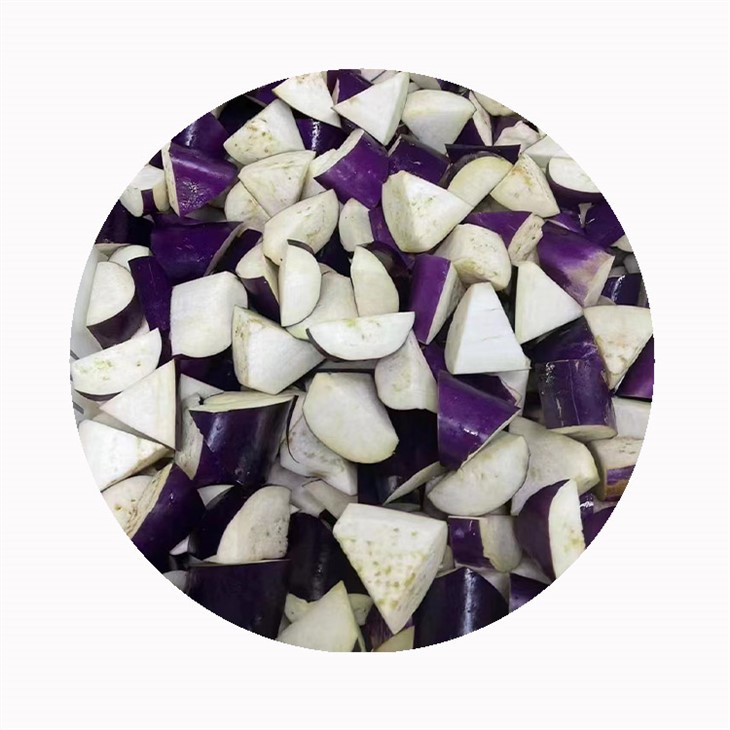
Frozen eggplant cubes with skin.
Keep the choice consistent across supply
Once a treatment is approved, define it plainly in the purchase and prep standard. For fresh fruit, specify size or grade and the peel treatment the kitchen will apply. For frozen slices, specify whether skin is intact, striped, or absent; slice thickness and diameter range; allowable broken pieces; and pretreatment. Request a representative sample from the form and pack that would be supplied at scale. A picture of one ideal slice is not enough to show lot variability.
If the peel experience changes between lots, compare the raw material first. A thicker or more mature skin can be the underlying cause even when the supplier followed the same cut. Ask whether the size grade or variety changed. Then run the established three-pan reference test on the new lot. A measured, repeatable comparison lets the supplier investigate a real deviation and helps the kitchen avoid changing several recipe variables at once.
Moisture is a separate acceptance issue. A frozen peeled slice can be tender yet release too much liquid for a layered pan; an unpeeled slice can hold its edge yet remain watery inside. Record free liquid after the actual thaw, pre-cook, and bake. If needed, adjust draining or pre-cooking, or seek a different product form. Do not assume peeling will solve a moisture problem. Treat peel resistance, slice integrity, and liquid release as distinct results.
The final specification should describe the dish at service: defined or melting layers, desired visible skin, fork tenderness, and acceptable free liquid after the hold. A supplier can then propose a suitable eggplant form and the kitchen can verify it through a full process trial. This turns a subjective "peel or not" debate into a documented product choice that can be repeated across purchases.
Source frozen eggplant with GreenLand-food
GreenLand-food is a professional frozen eggplant supplier and manufacturer in China, providing factory-direct wholesale supply for importers, food manufacturers, foodservice distributors, and private-label programs.
Send the product form, specification, packing, quantity, application, destination, private-label needs, and requested documents.