


Pesticide Residue Testing for Frozen Produce: EU MRLs and Batch Control
Aug 27, 2026
Leave a message
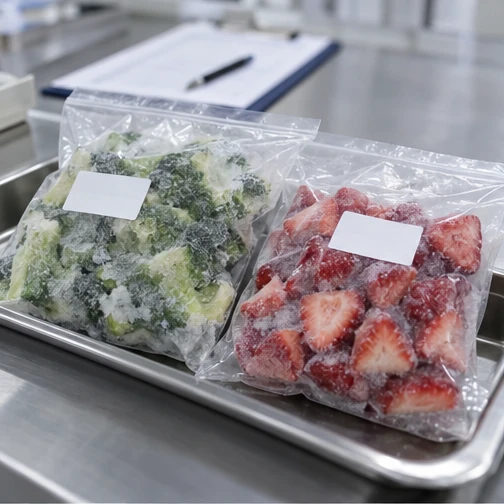
Start with the crop, residue definition and current limit
The current EU Pesticides Database provides a useful worked comparison. Broccoli is commodity 0241010 and strawberries are 0152000. The following selected entries were retrieved from their official product pages on 15 October 2026. They are commodity reference entries, not a complete release panel and not an instruction to apply the same assessment to every processed product. The linked regulations and their application provisions remain the legal reference.
| Regulated residue | Broccoli reference MRL, mg/kg | Strawberry reference MRL, mg/kg | Detail to retain in the test scope |
|---|---|---|---|
| Bifenthrin | 0.4 | 1.0 | Sum of isomers; the strawberry entry has a confirmatory-information footnote |
| Chlorpyrifos | 0.01* | 0.01* | Asterisk denotes the analytical determination limit |
| Chlorate | 0.4 | 0.05 | Special footnote A concerns additional contributions in processed food |
| Lambda-cyhalothrin | 0.1 | 0.2 | Includes gamma-cyhalothrin and the sum of specified R,S and S,R isomers |
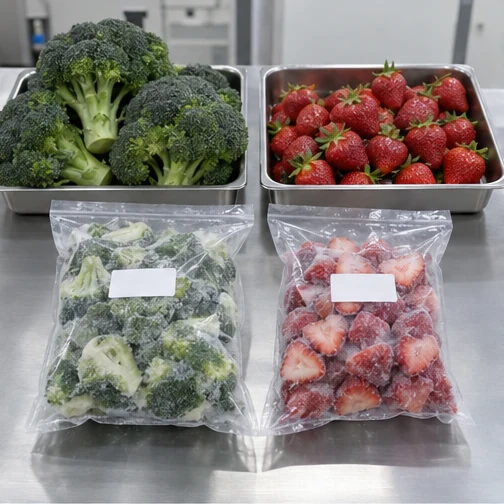
Broccoli and strawberries kept as separate commodities before and after freezing.
For these examples, the official references include 2018/687 for bifenthrin, 2020/1085 for chlorpyrifos, 2020/749 for chlorate and 2025/115 for lambda-cyhalothrin. The last entry also carries a footnote about information on metabolites under sterilisation conditions. A buyer preserves such notes and assesses their relevance; a short laboratory result line cannot replace the full legal entry.
The Commission's legislation overview explains the conditional default of 0.01 mg/kg. It is not the value for every substance. A published specific MRL, an AnnexIV exemption or another applicable provision changes the answer. Equally, a blank database cell cannot responsibly be filled with zero. We resolve the substance and commodity status before deciding how a laboratory should report against it.
A pesticide residue test can show the amount of specified analytes detected in the submitted laboratory sample using stated methods and limits of quantification. When the sample identity, method performance and legal comparison are sound, the report can support a lot-release decision. It does not prove that the supplier never used pesticides, that every unit in a container has the same residue profile, or that compounds outside the laboratory scope are absent.
EU maximum residue levels are set under Regulation (EC) No 396/2005. The European Commission pesticide Q&A explains that an MRL is the legally permitted maximum concentration for a pesticide residue in or on food or feed. Imported and EU-produced food are subject to the EU MRL framework. The MRL is not a general toxicology threshold copied onto every product; it is linked to a commodity and a legal residue definition.
The EU Pesticides Database is the practical research starting point. It lets users search current and historical MRLs by product and active substance. The Commission warns that the database is informative and that the Official Journal text controls. Save the product code, substance, residue definition, MRL, regulation and application date used for the decision. A screenshot with no retrieval date is not a controlled legal reference.
Testing is one part of supplier assurance. A buyer also needs farm and input controls, supplier approval, traceability, change notification and a risk-based sampling programme. A broad laboratory panel cannot compensate for an undisclosed origin change, a mixed lot, a weak sampling plan or a test performed on a different crop.
Leafy vegetables need a crop- and origin-specific residue plan rather than a generic supplier panel.
Control the field programme and processing water
For an order programme, our first chemical-control step is to identify the proposed raw-material origin and the production lot it will enter. We review crop-protection information, harvest and intake records, supplier approval and relevant findings with the matched factory. A change of growing area or harvest source can change the risk profile even when the commercial product name remains "IQF broccoli". The laboratory quotation follows that review rather than creating the risk assessment by itself.
The raw-material discussion includes actual input records and the pre-harvest controls relevant to the crop. A country's authorisation for a field use does not automatically establish that the resulting food meets an EU import MRL. We ask how the destination programme is communicated to growers and how a discrepancy would prevent an unsuitable intake from being mixed into a production lot. This gives a detected residue a traceable starting point for investigation.

GreenLand IQF broccoli florets showing crown and cut stem proportions.
Water requires separate attention. Chlorate can be associated with water and sanitation practices, so an otherwise well-documented crop programme may leave an important source unexamined. We review the proposed water source, treatment and use with the production partner, including washing, blanching or cooling contacts where relevant. The aim is a controlled food-safety process whose chemical contribution can also be assessed. Simply weakening disinfection to reduce one chemical result could create another food-safety problem.
The Article 20 information note specifically explains that changes in chlorate from washing with chlorinated water cannot be handled through an ordinary processing factor. FootnoteA addresses additional contributions under its stated conditions and places the burden of evidence on the food business operator. A claimed allowance therefore needs the actual supporting basis. It is not a general permission to add an arbitrary amount to the crop MRL.
The customer receives a testing plan linked to those sources of risk. Where chlorate or another polar compound needs a different method, the requirement is written separately from the broad multi-residue screen. Where source or process conditions change, the sampling and scope are reviewed again. This is how the chemical control becomes part of purchasing and processing rather than a final-day request for a generic certificate.
Decide how the actual frozen process affects assessment
The word "frozen" does not establish one universal residue-removal effect. We describe the actual sequence: cleaning, trimming, cutting, any blanching, cooling, draining, freezing and any subsequent preparation. The product identity and the nature of those operations determine how the commodity MRL and Article 20 assessment relate to the finished sample. That description also tells the laboratory which matrix it will receive.
The March 2025 revision of the Commission's processing information note recognises that freezing or deep freezing may include blanching when it does not substantially alter the initial product. Cleaning and trimming before freezing are generally not processing operations for the purpose of that note. We therefore do not classify every blanched IQF vegetable as a product requiring a made-up processing factor.
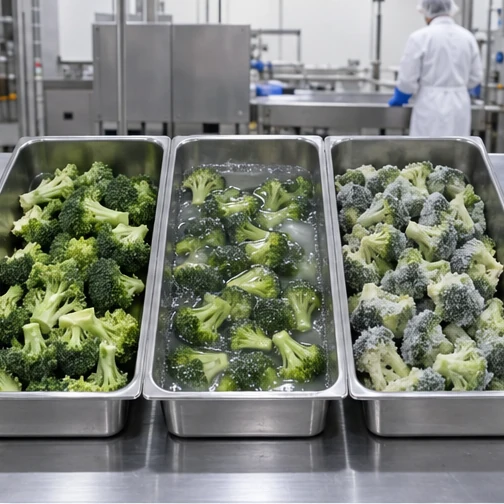
Trimmed, cooled and frozen broccoli shown as different product states.
Where a processing assessment is appropriate, the factor must match the substance, commodity and representative process. A factor supported for one pesticide in another vegetable cannot be transferred to broccoli merely because both products were heated. Concentration, dilution, changes in moisture and the legal residue definition all matter. The explanation supplied for an order needs to show which evidence supports the proposed interpretation and who has reviewed it.
We also separate processing control from legal correction. Blanching settings are selected and verified for their relevant quality and safety objectives. They are not adjusted on the assumption that more heat will make an unsuitable raw-material lot compliant. Field approval and finished-product assessment stay connected. A processing claim that cannot be supported triggers an investigation before shipment, rather than an undocumented reduction percentage on the COA.
Commission methods that can answer the specification
The laboratory should receive a buyer-defined scope, not a request to "test EU pesticides." Start with agronomic and market risk. Use the product, origin, crop-protection history, supplier programme, current EU alerts and customer requirements to select multi-residue and single-residue methods.
| Matrix field | What to record | Release risk if missing |
|---|---|---|
| Product | Exact crop, form, processing and Annex I database identity | Wrong MRL commodity or unjustified processing assumption |
| Destination market | EU Member State/customer programme and intended use | Customer or national risk programme not covered |
| Active substance | Parent compound and full legal residue definition | Laboratory reports a related compound but not the regulated sum or metabolite set |
| Applicable date | Regulation, publication, application date and lot/placing-on-market relevance | Old MRL used after a change or new limit applied too early |
| MRL | Value, unit, legal product code and source | "Pass" cannot be independently reproduced |
| Method and LOQ | Method family, reporting limit, accreditation scope and matrix validation | LOQ is above the decision limit or method does not cover the residue definition |
| Sampling | Lot definition, increments, aggregate sample, sampler and chain of custody | Result cannot be extended to the commercial lot |

Analyst preparing vegetable homogenate and separate extraction vials.
Substance applicability dates deserve special attention. The Commission Q&A notes that MRL regulations usually provide an application date after entry into force. Transitional provisions can depend on when food was produced or placed on the market. Do not assume the laboratory's reference library contains the legal date relevant to your lot. The importer's matrix should document it.
The EU coordinated control programme changes over time. The Commission's multiannual control programme page lists the 2026 programme under Implementing Regulation (EU) 2025/854 and a 2026 correction. Those official programmes help identify regulatory attention, but they do not define a complete private release panel for every frozen shipment. Add origin- and supplier-specific substances where the risk assessment supports them.
A written decision tree prevents an unclear or out-of-scope result from becoming an automatic release.
- Is the exact frozen matrix within the method validation and accreditation scope?
- Which analytes and residue-definition components are included, and which require separate methods?
- What are the analyte-specific LOQs, and can they demonstrate the current decision limits?
- How are conjugates, metabolites, sums and conversion factors reported where required?
- How will measurement uncertainty and results near the MRL be communicated?
- Will any analysis be subcontracted, and is the subcontractor's scope available?
- How should the frozen sample be packed, sealed, transported and retained?
- Can the report include the buyer lot, supplier lot, sample seal and chain-of-custody references?
We start with the buyer's exact product, origin, destination, intended use and required testing scope. We coordinate order-specific sampling and laboratory documents with the matched production facility. Because MRLs and customer panels can change, we do not treat one old "EU panel" as permanent coverage for every crop or lot.
Our broader quality references include chemical residue and heavy-metal control, traceability, and the frozen-food catalog. Send your destination-market requirements before sampling so the scope can be confirmed for the order.
Keep sampling and the laboratory report connected to the lot
Pesticide residues can be unevenly distributed. A handful taken from the top of one carton is not automatically representative of a container lot. Define the lot before sampling: product, origin, grower or farm group, harvest window, production line, production date and batch code. If a container combines multiple production lots, decide whether each needs separate release or whether a justified composite plan applies.
A frozen edamame kernel report in practice
A September 2026 test of frozen edamame kernels from our supply programme reported all tested items as not detected. The package was described by the laboratory as a 293-pesticide panel, and the appendix listed LOQ/LOD values of 0.01 mg/kg (10 μg/kg). The reported method was BS EN 15662:2018 (E1–E7, C0–C5, Q1).
The appendix has 324 numbered entries, including individual substances, metabolites and summed residue definitions. We preserve those definitions rather than treating every row as a different pesticide. "Not detected" means below the stated LOQ/LOD; it does not give an exact residual concentration. The result applies to the received kernel sample and listed items.
For a new shipment, we confirm the product matrix, required residues and reporting limits, then review the batch result against the agreed destination requirements. See the shelled edamame batch example and enquiry details.
The sampling record should identify the trained sampler, time, location, number of primary increments, aggregate quantity, packaging, seal, chain of custody and frozen transport condition. Keep a retention sample under controlled conditions and define who may authorise retesting. A supplier-created sample is not necessarily unacceptable, but the buyer should understand independence and selection bias.
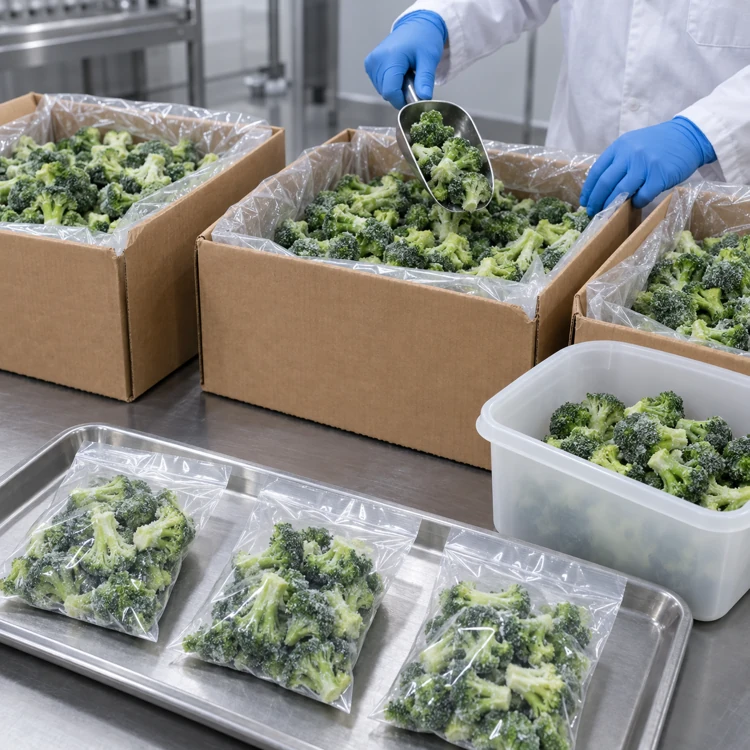
Broccoli increments collected from several cartons of the same product lot.
Multi-residue methods based on GC-MS/MS and LC-MS/MS cover many compounds efficiently. They do not cover every relevant pesticide. Polar pesticides, fumigants, dithiocarbamates or other groups may require separate methods. Ask for the actual analyte list and method mapping rather than a marketing claim such as "600+ pesticides." Panel size is not the same as risk coverage.
The LOQ must support the legal comparison. If the MRL is at or near a default level and the laboratory reports only to a higher LOQ, "not quantified" may still be insufficient. The matrix should flag every substance for which the reporting limit cannot demonstrate conformity.
Lots stay controlled until identity, results, deviations and shipment records have been reviewed.
| Document | Primary job | Minimum residue information | What it cannot replace |
|---|---|---|---|
| Buyer specification | Defines the agreed requirement and change-control rules | Destination framework, MRL rule, panel or risk process, sampling responsibility and release criteria | Lot-specific analytical evidence |
| Certificate of analysis | Summarises the supplier's lot results and conformity statement | Product, lot, sample date, actual result or clear reference to attached report, specification limit and approval | Full analyte list, method details and laboratory evidence unless attached |
| Laboratory report | Records the tested sample, analytes, method, LOQ, result, uncertainty where relevant and laboratory status | Sample ID, receipt/analysis dates, matrix, analyte-specific results, units, methods and authorised signatory | Buyer's legal interpretation and representative-lot decision |
A COA that says "pesticides: pass" may be acceptable only when it unambiguously references a controlled, accessible laboratory report and the buyer has approved the test scope. Otherwise the buyer cannot know whether 50, 300 or 700 analytes were covered, whether difficult single-residue compounds were omitted, or whether the LOQ was suitable for the MRL.
The full report should use actual results. "ND" must be defined as below a stated detection or quantification limit. A detected result below the MRL should not be rewritten as zero. For results close to the MRL, involve a qualified laboratory or regulatory specialist to apply the appropriate decision rule and measurement-uncertainty framework. Do not subtract uncertainty opportunistically to release a lot.
Check laboratory competence at method and matrix level. ISO/IEC 17025 accreditation is valuable, but the accreditation schedule should cover the relevant method or analyte group and food matrix. A laboratory can be accredited while a particular outsourced or novel test sits outside its accredited scope. Record subcontracting and the laboratory that actually performed the analysis.
The accepted residue scope should follow the product, origin, crop programme and destination market.
Review results before releasing the shipment
- Approved product and supplier: signed specification, facility, production scope, origin and current crop programme.
- Lot identity: production code, farm or raw-material link, quantity, pallets, container and seal.
- Legal matrix: product code, active substances, residue definitions, MRLs, regulations and application dates.
- Sampling: lot definition, increment plan, sampler, chain of custody, sample seal and frozen transport record.
- Laboratory: report, analyte list, methods, LOQs, units, accreditation scope and subcontractor details.
- COA reconciliation: actual results, agreed limits and references aligned to the same lot.
- Deviation review: detected residues, scope gaps, near-limit results, investigation and corrective action.
- Release decision: approver, date, disposition, conditions and retained-sample location.
Use document names that contain the lot identifier. Cross-check quantity and dates against the packing list and production record. If a laboratory report lists a sample code unrelated to the supplier lot, add a signed chain-of-custody bridge. A report that cannot be connected to the shipment is not shipment evidence.
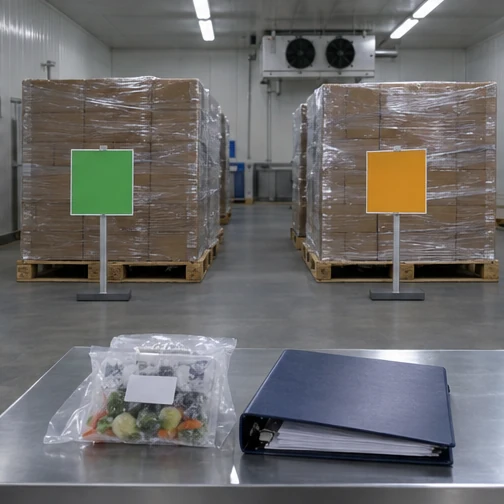
Separated frozen lots and retained samples during release review.
Release when the lot and sample are traceable, the approved scope is complete, methods and LOQs are suitable, results comply with the applicable MRLs and customer requirements, and no material document conflict remains. Record detected compliant residues; do not erase them from the history.
Use an investigation hold for mismatched lot codes, missing analytes, unclear residue definitions, outdated MRL references, reporting limits that are too high, unexplained detections or results close to a decision threshold. The investigation should state the question and the evidence needed. Avoid repeated broad retesting without a root-cause hypothesis.
Reject, return, destroy or redirect only under an approved legal and commercial process when non-compliance is confirmed or required evidence cannot be established. A product unsuitable for one market may not be lawfully or commercially suitable for another; any redirection requires a new destination assessment and full traceability.
Do not blend a non-compliant lot with compliant product to dilute a residue. Do not select a new sample solely to obtain a better result. Retesting rules should be agreed before the first test and interpreted by competent personnel.
- Confirm exact frozen product, origin, lot and EU destination.
- Select the legal product identity in the current EU database.
- Build the active-substance, residue-definition, MRL and date matrix.
- Map every required substance to an accredited method and adequate LOQ.
- Approve the lot definition and representative sampling plan.
- Verify chain of custody and frozen sample transport.
- Reconcile the full laboratory report, COA and specification line by line.
- Review detections, missing scope, uncertainty and legal-date questions.
- Document release, investigation hold or rejection with an approver.
- Feed findings back into farm, supplier and next-lot risk controls.
Keep the customer programme current across crops and seasons
Lot testing frequency should not be identical forever. Score product, origin, supplier performance, crop-protection system, alert history, intended use, volume and customer sensitivity. New suppliers, changed origin, new crop, adverse findings and unusual agronomic conditions can justify increased testing. Consistent, verified performance can support a different frequency where law and customer contracts allow.
Separate surveillance from release testing. Surveillance helps discover emerging substances and validate the risk assessment across seasons. Release testing supports a defined lot disposition. A broad annual surveillance screen on one spinach lot should not be presented as the release test for every container shipped during the year.

GreenLand frozen broccoli florets in a lined bulk product pack.
Trend detections below MRL. Repeated increases can reveal a changing farm practice before a breach occurs. Group results by supplier, origin, field group, season and active substance. Investigate unexpected compounds, including substances not declared in the crop-protection programme. The objective is preventive control, not only finding failures at the port.
Review the programme when EU MRLs or residue definitions change. Maintain a watchlist of announced regulations and application dates. Where a lower MRL will apply to future crop or market dates, communicate early enough for growers, laboratories and purchasing to adapt. Late testing cannot repair an unsuitable field programme.
EU rules are implemented through coordinated and national control programmes. The Netherlands Food and Consumer Product Safety Authority (NVWA), for example, explains that it samples food including fruit and vegetables at importers, wholesalers, supermarket distribution centres and retail. Businesses remain responsible for controlling their products. The NVWA inspection-results page publishes annual findings.
The practical message is not that a Dutch result predicts your lot. It is that official sampling can occur after border clearance and at different points in distribution. Your batch file must survive a regulator or customer asking how the lot was sampled, what was covered and which legal limit applied. A generic supplier declaration is unlikely to answer those questions.
National risk priorities can also differ. An EU-wide MRL remains the legal reference, while Member States select higher-risk products, origins and substances for controls. Monitor RASFF notifications and destination-market guidance as risk inputs. Do not convert a notification about one origin-product-substance combination into an unsupported claim about all frozen produce.
Follow the import route: EU requirements · Germany import steps · IQF broccoli supply plan · Import & Compliance Center
Source frozen food with GreenLand-food
GreenLand-food is a professional frozen food supplier and manufacturer in China, providing factory-direct wholesale supply for importers, food manufacturers and foodservice programmes.
Tell us your product and destination. We will discuss the product form, specification, packing, quantity, application, private-label needs and requested documents with your team.