


FDA Import Alerts and Frozen Berry Recalls: What U.S. Buyers Should Recheck
Aug 27, 2026
Leave a message
Buyer guide · Updated August 26, 2026
A practical control system for distinguishing import alerts, detention scope and recalls while keeping supplier approval and lot release evidence separate.
Quick answer: When an FDA import alert or frozen-berry recall appears, do not suspend or clear every berry supplier from the same country by instinct. First identify the legal mechanism, then test the exact country, firm, facility, product, product code and affected lot. Reapprove the supplier only after the hazard, corrective actions, verification evidence, intended use and traceability records support a documented pause, conditional-release or continue decision.
What U.S. buyers should do first
- An import alert tells FDA staff when detention without physical examination may apply. It is not a recall announcement and does not mean every shipment from a country is affected.
- A recall addresses food already in distribution or commerce. Its scope is defined by the recalling firm's and FDA's product, lot, date and distribution information.
- Match four scope levels before deciding: country, named firm or facility, exact product or product code, and shipment or lot.
- For frozen berries, intended use matters. A no-cook smoothie or retail RTE programme needs a different control conclusion from a validated further-processing application.
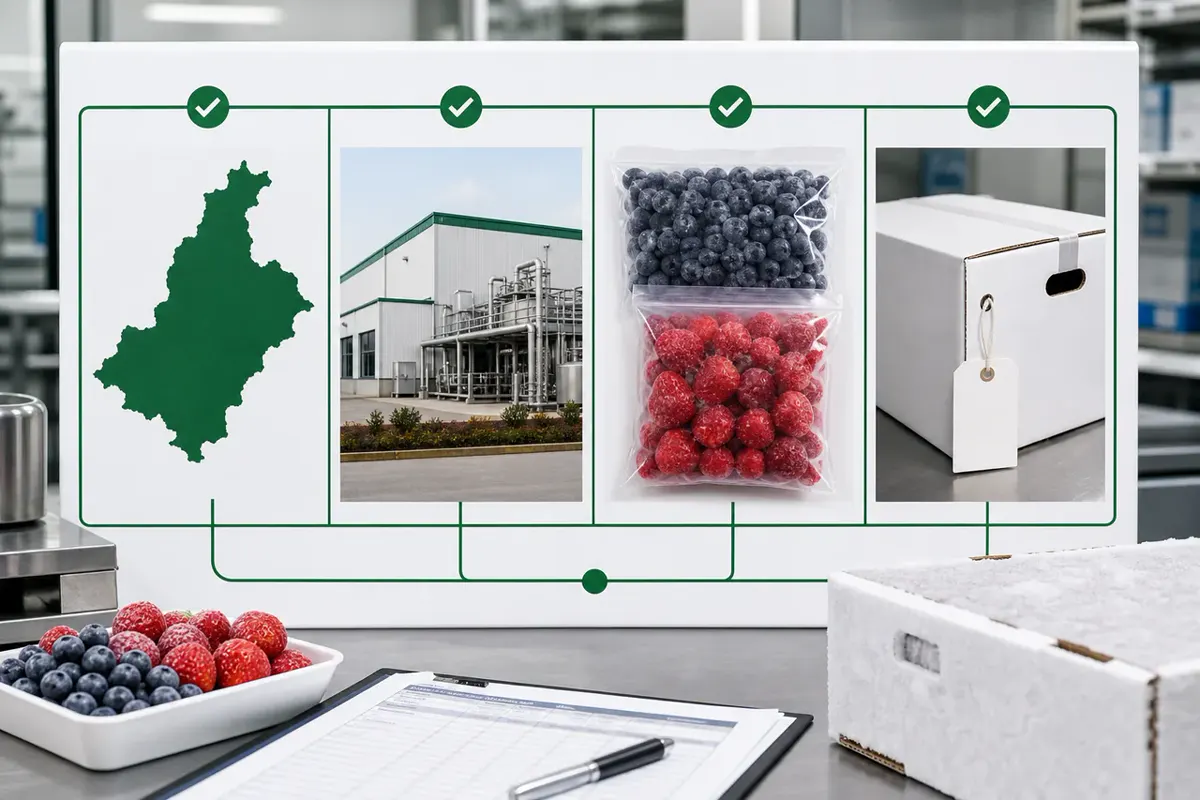
A useful alert review identifies the exact product, listed entity, geography and effective date before action.
Import alert and recall are different operational events
FDA import alerts are enforcement tools for products offered for import. They communicate that FDA has enough information to detain specified products without first physically examining each shipment. The alert can identify a country, manufacturer, shipper, product and reason for detention, and it can include green-list or red-list information. An entry that matches the alert may require evidence to overcome the appearance of a violation.
A recall is a firm's removal or correction of a marketed product that FDA considers in violation and against which the agency would initiate legal action. A recall may be voluntary, requested by FDA or, in limited circumstances, ordered under statutory authority. It concerns product already distributed or held in commerce, not simply the entry screening rule at the border.
| Question | Import alert | Recall |
|---|---|---|
| Primary point in the chain | FDA admissibility review for offered imports | Correction or removal of distributed product |
| Typical scope fields | Country, firm, product, product code, reason and list status | Brand or product, lot/date codes, pack, distribution and hazard |
| Immediate buyer action | Check whether planned entries match; hold release assumptions and contact importer/FSVP owner | Identify inventory and customers; stop distribution and execute the recall plan if matched |
| What it does not prove | That every firm, product or lot from the country is violative | That every similar berry from every supplier is affected |
Confusing the two creates opposite errors. A buyer may overreact by cancelling a compliant supplier that does not match an alert. Or the buyer may underreact by treating a lot-specific recall as a border paperwork issue while affected cartons remain in customers' freezers. Name the mechanism at the top of the incident file and route it to the right owner.

Berry purchasing controls should define the product, intended use and lot-release evidence before shipment.
Use a four-level scope test before changing supplier status
The current FDA Import Alert 99-35 concerns fresh and frozen fruits, vegetables and juices associated with pathogen findings. It is a dynamic record. Entries can be added or removed, and the page records revision information. Save the live page or controlled screenshot used for your decision, not an undated third-party summary.
Level 1: country
Confirm whether the country stated in the alert is the country connected to the firm and product in the relevant entry. Do not infer scope from a shipping port. If raw berries come from one country and are blended or packed in another, trace the alert's firm and product relationship carefully. Country is the widest screen, not the final match.
Level 2: firm and facility
Match the legal name, address and facility identity. Suppliers may operate more than one plant, and commercial names can differ from the registered entity. Confirm whether the manufacturer, shipper or grower named by FDA is the entity in your approved supply chain. A certificate carrying the same corporate group name is not enough if the production address differs.
Level 3: exact product and product code
Check species, frozen or fresh state, form, blend and FDA product code. A listing for frozen blueberries cannot automatically be extended to strawberries, but a mixed-berry product may require component-level review. Match the reason for detention as well. Evidence designed for Salmonella may not close a viral-hazard question.
Level 4: shipment, production window and lot
An import alert can apply to future offered shipments even when no recall has been announced. A recall may be limited to specific production and distribution codes. Connect purchase order, supplier lot, pallet, container, entry and customer shipment records. If that chain breaks, treat scope as unresolved rather than assuming the lot is outside the event.
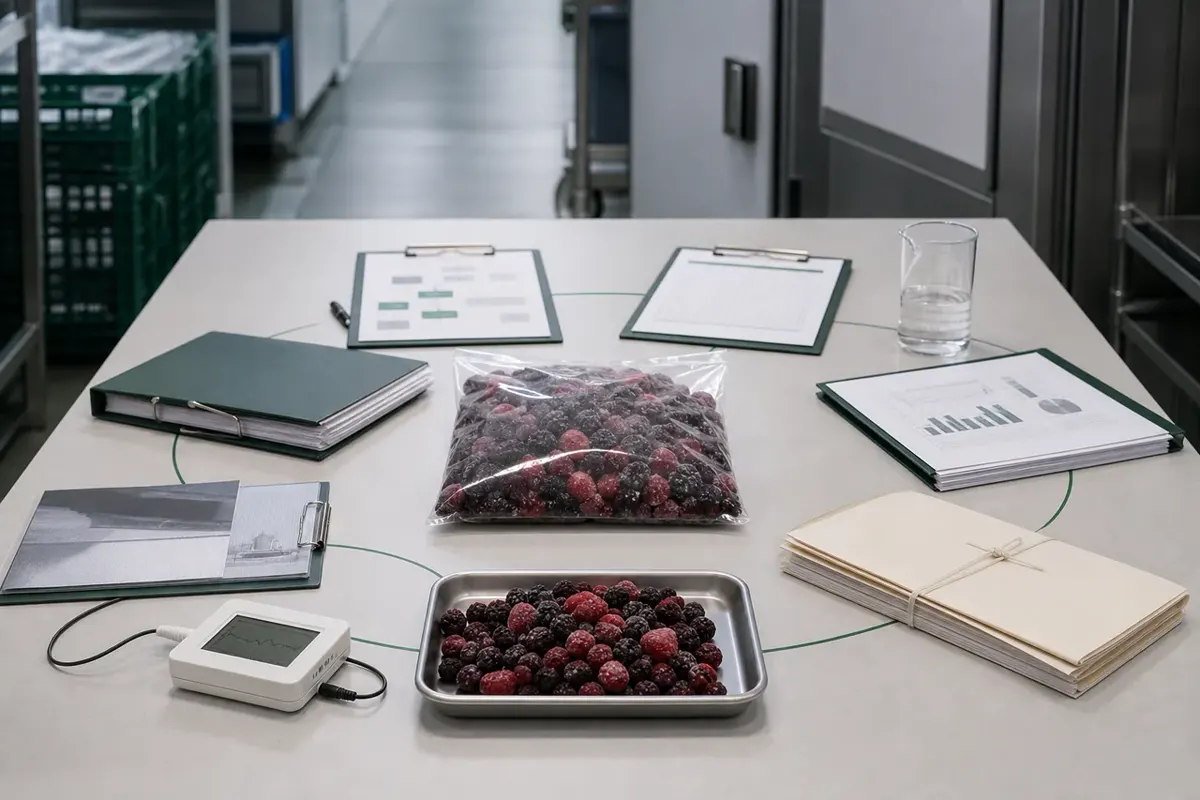
Lot identity connects the purchase order, sample, test report, production record and shipping documents.
Frozen berries need an intended-use decision
Freezing preserves berries but should not be described as a reliable pathogen kill step. Frozen berries are often eaten in smoothies, yogurt, desserts and retail packs without further cooking. For those uses, a buyer should define whether the supplied product is intended for ready-to-eat or no-cook application and what preventive controls support that use.
Further processing can change the control design only when the downstream process is validated for the relevant hazard and applied to every affected unit. "Used in a bakery" is not enough: some berries are added after baking, while others may not receive a uniform time-temperature treatment. Record the actual process, validation and responsibility in the specification.
Blends add scope complexity. One recalled or alerted berry component can affect the finished blend even if the other components came from approved sources. Your supplier should retain component-lot genealogy through blending, rework and packing. Ask whether the system can identify every finished lot containing one inbound berry lot within a defined response time.
Pathogen verification also needs careful language. A negative result from a small sample does not prove the absence of contamination throughout a large heterogeneous lot. Testing supports a broader preventive-control and supplier-verification programme; it does not replace sanitation, water controls, worker hygiene, harvest controls or traceability.
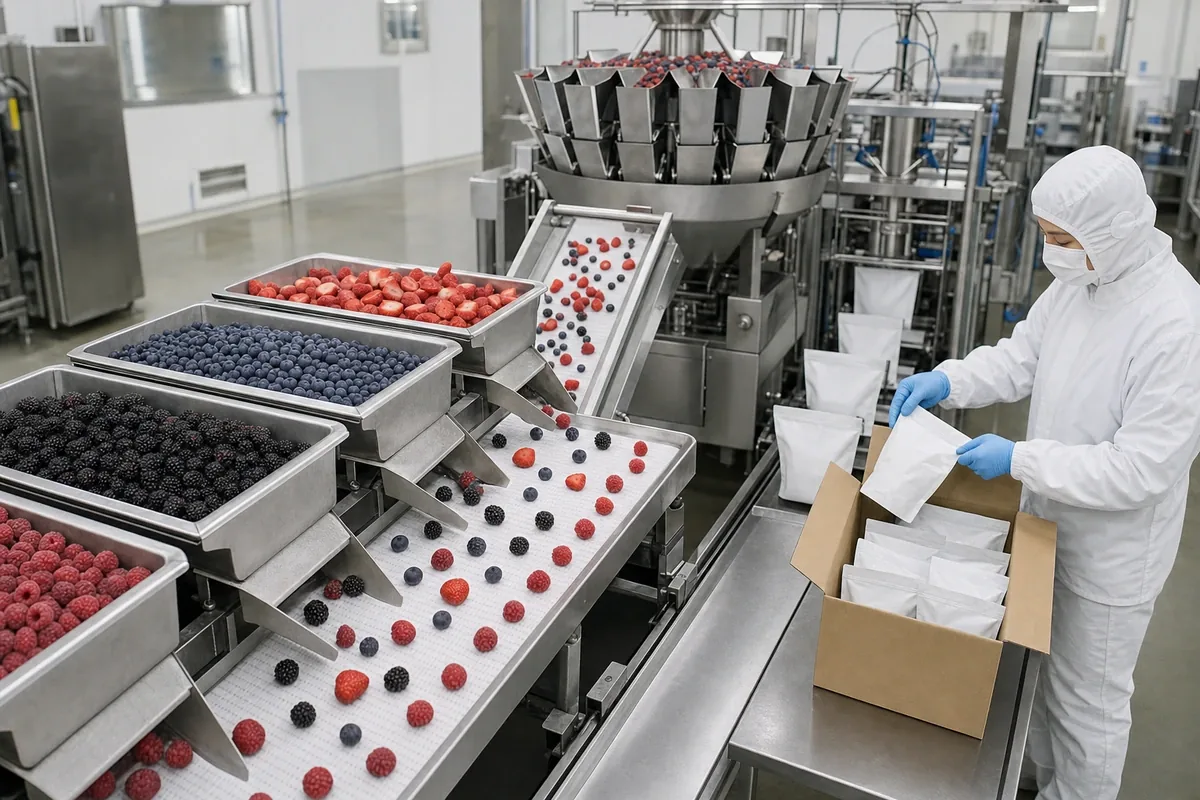
Reapproval should combine regulatory status, facility controls, traceability, test plans and shipment-specific evidence.
Eight checks for supplier reapproval
1. Scope and root-cause statement
Require the supplier to state which facility, line, product, dates and lots are implicated and which are not. The explanation should connect evidence to the boundary. "Our other products are safe" is not a root-cause analysis. If the cause is not yet known, record that uncertainty and keep the disposition conservative.
2. Hazard analysis and intended use
Review the hazard analysis for the exact berry, origin and application. Confirm whether hepatitis A virus, norovirus, Salmonella, pathogenic E. coli or other relevant hazards were evaluated. The FDA FSVP guidance explains the importer's need to evaluate hazards, supplier performance and appropriate verification activities.
3. Corrective and preventive actions
Look for actions tied to a supported root cause: water-source control, worker illness and hygiene controls, sanitation correction, raw-material approval, environmental or product monitoring, line segregation, retraining or supplier change. Each action needs an owner, completion date and effectiveness check. A new procedure with no implementation evidence is incomplete.
4. Facility and food-safety system status
Confirm current registration, third-party certification scope where used, recent audit outcomes, regulator inspections and unresolved major findings. Certification can support the review, but it does not override an FDA enforcement record or a recall. Verify that the certificate covers the named site and frozen berry process.
5. Laboratory and sampling evidence
Check lot identity, sample plan, method, laboratory accreditation scope, result, detection limit and dates. Decide whether the analysis addresses the event hazard and the production period after corrective actions. A certificate of analysis with only "pass" and no actual result, method or lot link is weak evidence.
6. Traceability and mass-balance test
Run a timed exercise from one finished lot back to inbound fruit, farm or supplier, production line and rework, then forward to every customer shipment. Reconcile quantities. Missing cases or unexplained yield differences can indicate an incomplete recall boundary.
7. Entry and FSVP record alignment
The FDA importing-human-foods page summarizes the information required for entry and points importers to import alerts and FSVP duties. Confirm that the approved foreign supplier, facility, importer, FSVP importer and product details match the entry data. A commercial supplier switch that never reached the FSVP file is a control gap.
8. Post-reapproval verification plan
Define enhanced verification for a limited period: document review, targeted testing, audit, first-shipment inspection or increased lot traceability checks. State the criteria for returning to routine approval and the triggers for immediate suspension. Reapproval is a managed state, not a one-time signature.

Different berry products and origins require product-specific hazard and supplier-control decisions.
Build one incident and reapproval document file
| File group | Minimum contents | Buyer question |
|---|---|---|
| Regulatory event | Live FDA alert or recall notice, retrieval date, revisions and scope summary | What exactly did FDA or the recalling firm say? |
| Approved supply route | Legal firms, facility addresses, product codes, origin and FSVP record | Does our route match the event? |
| Lots and distribution | PO, supplier lots, production dates, pallets, container, entry and customer shipments | Which physical product is affected or unresolved? |
| Technical response | Hazard analysis, root cause, CAPA, validation and effectiveness evidence | Was the problem understood and controlled? |
| Verification | Audits, sampling plan, lab reports, traceability drill and enhanced monitoring | What independent or objective evidence supports reapproval? |
| Decision | Pause, conditional release or continue; approvers, date and review trigger | What is allowed now, under which conditions? |
Version-control this file. Import-alert pages can change, recall classifications can be updated, and new distribution information can expand scope. Record who monitors the event and when the decision will be revisited. Do not leave a supplier on indefinite "temporary hold" with no next evidence requirement.
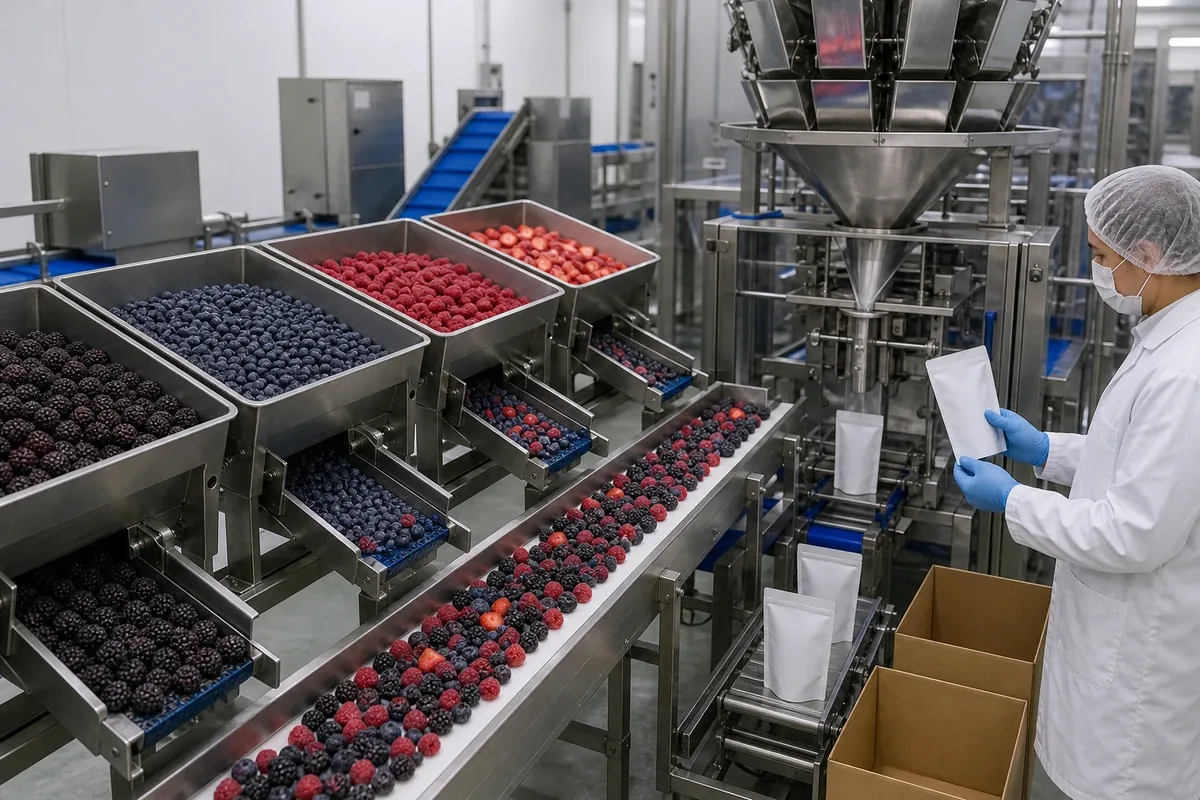
A released shipment needs consistent lot codes, documents, seals and cold-chain records.
Choose pause, conditional release or continue
Pause
Pause new releases when your approved firm or product appears to match the event; when lot genealogy is incomplete; when the root cause or corrective action is unresolved; when intended use is no-cook and preventive controls are not supported; or when entry admissibility is uncertain. Isolate stock physically and electronically, preserve samples and notify the FSVP owner, legal team and affected customers as required.
Conditional release
Conditional release may be appropriate when the event does not directly match the lot but a material residual question remains. Conditions might include a specific verified further-processing step, targeted testing, first-shipment audit, increased document review or a reduced allocation. The condition must be feasible, documented and accepted by the party responsible for applying it. Testing alone should not be used to "test a lot into safety" without a statistically and scientifically justified plan.
Continue
Continue routine purchasing only when the scope test shows no match and the supporting supplier, facility, product and lot records are complete. Record the reason. "Different supplier" is too weak if the plants share raw material, co-packers or corporate systems. Keep monitoring the alert or recall until the event stabilizes.
For every outcome, distinguish commercial approval from regulatory admissibility. A buyer can approve a supplier commercially while FDA still detains a matching entry. Conversely, an entry that is not detained may still fail your specification or customer requirements.
A numbered buyer response workflow
- Open the live FDA source and record the mechanism, retrieval time and revision.
- Freeze shipment and supplier-master changes until the scope check is complete.
- Match country, firm/facility, product/product code and lot or production window.
- Identify all stock, entries in transit, customer shipments and retained samples.
- Notify the importer-of-record and FSVP owner; assign one incident lead.
- Review intended use and whether a validated downstream kill step actually applies.
- Collect the eight reapproval evidence groups and identify gaps.
- Run the traceability and mass-balance exercise.
- Approve pause, conditional release or continue with written conditions and expiry.
- Monitor updates and close only when all affected product and corrective actions are reconciled.
Common reapproval errors
- Searching only the country name. Country is a screen; firm and product scope control the match.
- Using a certificate as the answer. Certification scope and current corrective-action evidence still require review.
- Accepting one negative sample. Sampling limitations and lot heterogeneity remain.
- Ignoring no-cook use. Freezing and blending are not validated kill steps.
- Checking the finished blend but not its components. One component lot can define the affected scope.
- Approving the supplier without updating FSVP. The importer's verification records must reflect the actual foreign supplier and current performance.
- Confusing release with admissibility. Buyer QA approval does not bind FDA.
One further error is allowing commercial urgency to define the evidence threshold. A promotion, vessel cut-off or low inventory does not change the alert scope or the importer's FSVP responsibilities. If a conditional path is used, state the technical basis, authorised channel, verification and expiry. The incident lead should be able to explain why the disposition protects consumers and how it will be enforced after the product leaves the importer's warehouse.
How GreenLand-food handles a buyer evidence request
Worked case: the country matches, but does the supply route?
Assume an importer buys IQF blueberries from Country X through Supplier North. A new line in Import Alert 99-35 names a Country X processor for frozen blueberries after a pathogen finding. The sales team wants to reassure customers immediately because Supplier North has a different name. QA should not stop at the company name.
Level one matches: country. Level two initially appears different, but the approved-supplier file shows that Supplier North is a trading company and the manufacturing address was never entered in the master data. The most recent COA carries a plant name similar to the alert entry. The importer pauses new release while it obtains the legal manufacturer, address and FDA product information. That pause is based on unresolved identity, not an accusation.
The facility check confirms the shipping lot came from a different plant in the group. Level three also needs work because the alert lists frozen blueberries while the buyer imports both blueberries and a mixed-berry blend containing blueberries from the group. The team traces component lots and confirms that the alert-listed plant supplied none of the finished blueberry or blend lots. Production and transport records support the boundary.
The importer then reviews supplier performance. Although the exact plant does not match, the event reveals a weak manufacturer-disclosure control. The firm remains approved conditionally: manufacturing facility must appear on every PO, COA and FSVP record; changes require preapproval; the next two shipments receive enhanced document review and targeted verification. The team records why no recall or customer notification was required for existing lots.
This is a better outcome than both extremes. Cancelling every Country X supplier would have ignored the alert scope. Continuing without identifying the actual plant would have left a serious FSVP and traceability gap. The four-level test turned public information into a proportionate control.
Customer and authority communications need controlled language
Prepare an incident statement from verified facts. Name the source and retrieval date, the mechanism, the scope tested, your product status and the next update. Avoid "FDA cleared our supplier" unless FDA has actually taken the stated action. A buyer's non-match determination is not an FDA endorsement.
When product is on hold, tell customers whether the hold is precautionary, which lots are involved and what they should do. Do not use "recall" for stock that has not been released, and do not use "withdrawal" or "market removal" interchangeably without the responsible team's decision. Precise terms prevent customers from taking incompatible actions.
If affected product was distributed, the recall plan should define regulatory notification, consignees, public communication, effectiveness checks and product disposition. Distribution records must support direct notification; a website notice alone is not a trace-forward system. Reconcile responses and recovered quantities by customer and lot.
Keep privileged legal advice separate from the operational evidence pack where counsel directs. The shared file should still show product identity, lot scope, hold status, technical evidence, decisions and communications. One source of current operational truth reduces the risk that sales, logistics and QA issue different messages.
Evidence quality hierarchy for reapproval
Not all documents deserve equal weight. A signed supplier assurance is weaker than a record generated during the actual corrective action. A generic annual audit is weaker than a targeted audit of the affected process. A laboratory certificate is weaker when the sampling plan, method or lot identity is missing. Rank evidence as direct lot/facility evidence, independent or regulatory evidence, controlled system evidence, and unsupported statement.
After regulatory scope is resolved, the frozen strawberry sampling guide helps structure a separate inbound inspection for unaffected lots.
Resolve contradictions explicitly. If the root-cause report says contaminated water while the new hazard analysis says the hazard is not reasonably foreseeable, the package is not ready. If a certificate names one facility and the invoice another, do not choose the more convenient document. Ask the supplier to reconcile the records and update the approved supply route.
Set an expiry for conditional approval. Evidence can age, production can move and corrective actions can drift. Review after a defined number of lots, a season, an audit or any new regulatory information. Return to routine approval only when the enhanced controls demonstrate sustained performance.
When a U.S. buyer asks us to review a frozen berry supply route, we start with the exact product, origin, facility, intended use, pack, destination and required documents. We then coordinate the order-specific information available from the matched production facility. We will not represent an import alert as a countrywide ban or claim that a negative result eliminates all risk.
You can review our frozen fruit range, our traceability approach, and the full frozen-food catalog. For a meaningful document check, include your intended use, specification, destination, forecast volume and the FDA event or product code you are reviewing.
Frequently asked questions
Does an FDA import alert mean all frozen berries from the listed country are banned?
No. Read the live alert's country, firm, product, product code, reason and list status. Detention without physical examination applies according to the alert's scope; it is not automatically a countrywide ban on every berry or supplier. Confirm matching entries with the importer and customs/FDA specialists.
Can a supplier be reapproved after a frozen berry recall?
Yes, but not merely because the recall ended. Reapproval should be supported by a defensible scope, root cause, completed corrective actions, effectiveness evidence, current hazard analysis, traceability, laboratory and audit records, and a risk-based verification plan. The decision should state conditions and monitoring triggers.
Request a product- and facility-specific berry review
Share the berry, origin, intended use, pack, lot status and regulatory source you are checking. We will coordinate the relevant supplier-side documents available for that exact supply route.