


How Do Water Chestnuts Grow?
Aug 31, 2026
Leave a message

Water chestnuts grow below the mud, not on a tree
A sound corm or nursery transplant is planted in heavy, wet soil. Upright green stems emerge and carry out photosynthesis while the root system spreads through the mud. During the vegetative phase, underground rhizomes create daughter shoots and fill the growing bed. As day length shortens and the crop reaches the right stage, some stolons turn downward and swell at their tips. Those swollen storage organs become the dark-skinned, white-fleshed corms sold as Chinese water chestnuts.
Mature crops are commonly recognized by yellowing or brown top growth. Water is reduced or drained when the production system and cultivar call for it, then the corms are dug or lifted from the mud. For frozen supply, the growing story still matters after harvest: corm maturity, size, skin condition, soil removal, and physical damage affect peeling yield, slice appearance, texture, defects, and final IQF performance.
It is a corm
The edible part is a swollen underground stem. Calling it a nut describes its shape, not its botanical structure.
Warmth builds the stand
The crop needs a long warm period, saturated soil, sunlight, and controlled water before it can support strong corm formation.
Shorter days trigger storage
Photoperiod research shows that shorter days encourage the plant to shift dry matter into rhizomes and corms.
Harvest quality follows the field
Uniform maturity and low-damage digging make peeling, cutting, sorting, and texture control more predictable.
First, make sure you mean Chinese water chestnut
The common name causes avoidable confusion. The cultivated vegetable used in stir-fries, fillings, soups, canned products, and frozen ingredient programs is normally Eleocharis dulcis. It belongs to the sedge family. Its green top looks like a dense clump of smooth, upright rushes, while its marketable corms remain hidden in the mud.
A different aquatic plant, usually placed in the genus Trapa, is also called water chestnut or water caltrop. It forms floating leaf rosettes and horned fruits or seeds. The two products differ in botany, appearance, growing habit, culinary use, and trade description. A procurement specification should therefore use the scientific or unambiguous commercial name when there is any risk of confusion.
| Comparison point | Chinese water chestnut | Water caltrop / Trapa |
|---|---|---|
| Scientific identity | Eleocharis dulcis | Trapa species |
| Plant form | Upright, cylindrical sedge stems rooted in mud | Floating rosettes with broad leaves |
| Harvested part | Underground corm | Horned fruit or seed |
| Frozen buyer wording | Frozen water chestnut, whole, sliced, or diced | Identify separately; do not treat as the same SKU |
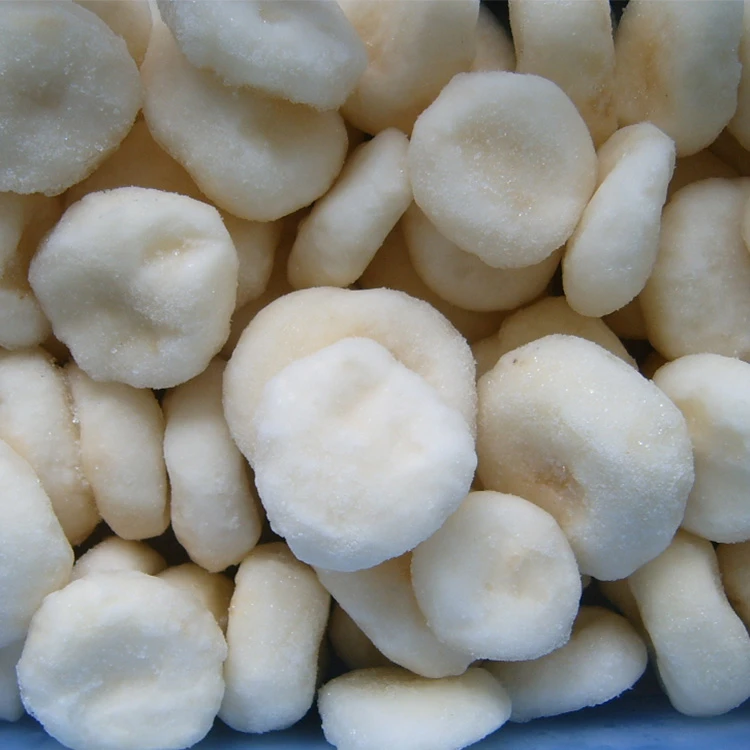
Clean, pale slices make size variation, broken pieces, browning, and surface frost easy to assess during sample review.
What the plant looks like above and below the mud
Above ground, a water chestnut field resembles a stand of green rushes more than a vegetable patch. The stems are leafless or nearly leafless in the familiar broad-leaf sense. They are the main photosynthetic surface, so healthy stem density matters: the plant needs enough green area to build carbohydrates before it can store them underground.
Below the mud, the original corm develops roots and rhizomes. Some rhizomes rise and produce daughter plants, expanding the clump. Later, downward-growing stolons create storage sites. Their tips enlarge through recognizable swelling stages until mature corms have a firm dark skin and crisp interior.
This architecture explains why water and soil management cannot be separated. The stems need light and air above the water, while roots, rhizomes, and corms need stable saturated soil below. Deep uncontrolled water, weak establishment, compacted or stony ground, or excessive vegetative growth can make the stand harder to manage and the corm crop less uniform.
The growth cycle, step by step
- Plant a sound corm or established transplant. Commercial plantings commonly begin with selected seed corms or nursery-raised plants. Planting material should be true to the required cultivar, free from serious rot and mechanical damage, and vigorous enough to establish a uniform stand. A weak or mixed planting lot creates variation before the crop is even flooded.
- Allow shoots and roots to establish. New cylindrical shoots rise while roots secure the plant in heavy soil. Many growers keep the bed moist or only shallowly flooded at first rather than placing a small sprout under excessive water. The aim is an even plant population with active roots and green stems.
- Build a dense photosynthetic canopy. Once established, the field is kept saturated or under managed shallow water. The green stems capture light and produce the carbohydrates that later fill the corms. Nutrient supply supports this phase, but uncontrolled nitrogen late in the cycle can favor top growth when the crop should be moving resources underground.
- Spread through rhizomes and daughter plants. Underground rhizomes extend from the original plant and create more shoots. The bed gradually fills. This clonal spread is why starting density matters: too sparse a stand wastes time and area, while excessive crowding can intensify competition and make corm size less consistent.
- Respond to shorter days. Chinese water chestnut is strongly influenced by photoperiod. Published research places a critical range near 12 to 12.5 hours for the tested material: below that range, corm formation accelerated; longer days favored vegetative growth. The practical calendar still varies with cultivar, latitude, planting date, and temperature, so this is a physiological guide rather than a universal harvest date.
- Swell and mature the corms. Downward stolon tips enlarge through initial, middle, late, and mature swelling stages. A 2024 corm-development study found major gene-expression changes during the middle swelling stage, including activity related to starch metabolism. In field terms, the plant is converting the season's growth into the crisp storage organs the buyer eventually receives.
- Let the tops senesce, then harvest to the market plan. Yellowing and brown stems indicate that the crop is reaching maturity. Water may be reduced or drained so the soil can firm enough for lifting, especially with larger-corm systems. The corms are then dug, separated from roots and mud, protected from cuts and bruises, and moved into washing, grading, storage, or processing.
Which growing conditions matter most?
No single water depth, fertilizer schedule, or planting date fits every production area. Cultivar, latitude, soil, mechanization, and target market change the field plan. The useful question is what each condition does to stand development and corm formation.
| Growing factor | Crop function | What can go wrong | Commercial consequence |
|---|---|---|---|
| Warm soil and long frost-free period | Supports sprouting, stem growth, rhizome spread, and a complete corm cycle | Cold slows establishment; frost can end top growth before the crop has built enough reserves | Low yield, small corms, or an irregular size distribution |
| Sunlight and photoperiod | Stems build dry matter; shorter days help redirect growth into corms | Too little light weakens the stand; long days can delay corm initiation in sensitive material | Late maturity and uneven harvest readiness |
| Heavy loam or clay-rich mud | Anchors plants, holds moisture, and gives stolons a stable medium | Stones and hard clods can mark corms; unsuitable media may drain too fast or restrict lifting | Skin injury, misshapen corms, and higher cleaning load |
| Managed shallow water | Keeps the root zone saturated while stems remain exposed to air and light | Large fluctuations can stress plants; deep water can suppress small transplants | Uneven stand, variable maturity, and difficult field access |
| Balanced fertility | Supports canopy building and later storage-organ filling | Excess late nitrogen can prolong vegetative growth; poor nutrition limits biomass | Inconsistent corm size and delayed maturity |
| Planting density and pest control | Balances bed coverage with light, nutrient, and space access | Crowding, snails, rodents, stem disease, or nematodes can reduce effective canopy and harvestable corms | Yield loss, damaged raw material, and greater sorting cost |
Harvest timing is a quality trade-off, not a fixed date
Growers watch top dieback, skin development, corm size, interior color, firmness, and the intended market. A slightly earlier harvest may favor a bright, tender fresh-market appearance. More mature corms develop a darker, firmer skin and can accumulate more dry matter, but excessive delay may increase fiber or reduce tenderness in some conditions. Weather and frost risk limit how long the crop can remain in the soil.
Field drainage is also system-specific. Drying the bed can make larger corms easier to lift and reduce the amount of free mud carried into the packing area. Smaller-corm systems may still be harvested from wet mud. Either way, digging must protect the skin and flesh. Cuts, punctures, and bruises create trimming loss and can accelerate discoloration or decay before freezing.
For a frozen program, the right maturity is the one that meets the finished-product target after peeling, cutting, treatment, freezing, storage, and cooking-not merely the one that looks attractive at the field edge.
How field choices appear in frozen product quality
A frozen-water-chestnut buyer never receives the paddy, but the paddy still shows up in the carton. Mixed maturity can produce a wide corm-size spread, which affects peeling yield and the diameter available for uniform slices. Mud lodged around roots and stem bases raises washing and trimming demand. Skin damage becomes a brown edge, soft area, or broken piece after processing.
The crisp bite comes from the structure of the corm tissue. Processing research has shown that water chestnut can retain notable firmness through heating, but that does not make texture automatic. Raw-material maturity, time before processing, peeling damage, blanching choice, cut thickness, freezing control, and thawing history all influence the result.
This is why we recommend approving frozen water chestnuts against both frozen appearance and a standardized cooking test. A white, free-flowing sample can still disappoint if slices soften too quickly, release excessive water, or break during the buyer's real stir-fry, soup, filling, or ready-meal process.
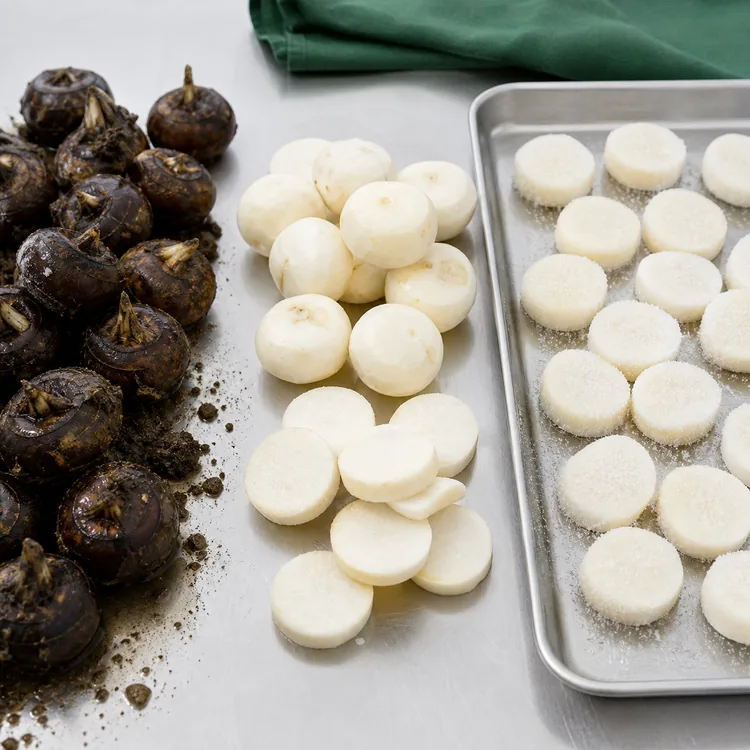
The commercial quality path begins with mature, low-damage corms and continues through peeling, cutting, treatment, and freezing.
From harvested corm to IQF water chestnut
Freezing cannot repair poor raw material. It preserves a condition created by the crop and the processing line. A practical field-to-IQF sequence is:
- Receive and identify the raw-material lot. Record origin, harvest timing, cultivar or approved source, corm condition, and quantity.
- Sort for size and freshness. Remove rotten, seriously damaged, sprouted, or unsuitable corms before they consume washing and peeling capacity.
- Wash away mud and field material. Root fragments, stones, soil, and plant debris need controlled removal rather than relying only on final visual inspection.
- Peel and trim. Inspect peel residue, black spots, brown edges, root bases, and damaged tissue. Peeling yield is a real raw-material cost indicator.
- Prepare the agreed form. Whole peeled corms, slices, and dices need defined nominal dimensions and tolerances. Uniform cuts support even treatment, freezing, and cooking.
- Apply the confirmed pretreatment. Blanched or unblanched supply should match the buyer's formula, texture target, food-safety plan, and destination requirements.
- Control drainage before freezing. Excess surface water increases loose ice and clumping risk.
- IQF-freeze and post-sort. Pieces should remain reasonably separate. Inspect clumps, broken slices, color defects, and foreign matter before packing and metal detection.
- Pack, store, and load under a stable cold chain. Finished goods should remain at or below the specified frozen temperature, normally -18°C for this supply program, with carton, label, batch, and loading records matched.
For a deeper process audit, see our IQF processing guide from harvest to packing. It explains why receiving, washing, cutting, dewatering, freezing, and cold storage must be evaluated as one connected system.
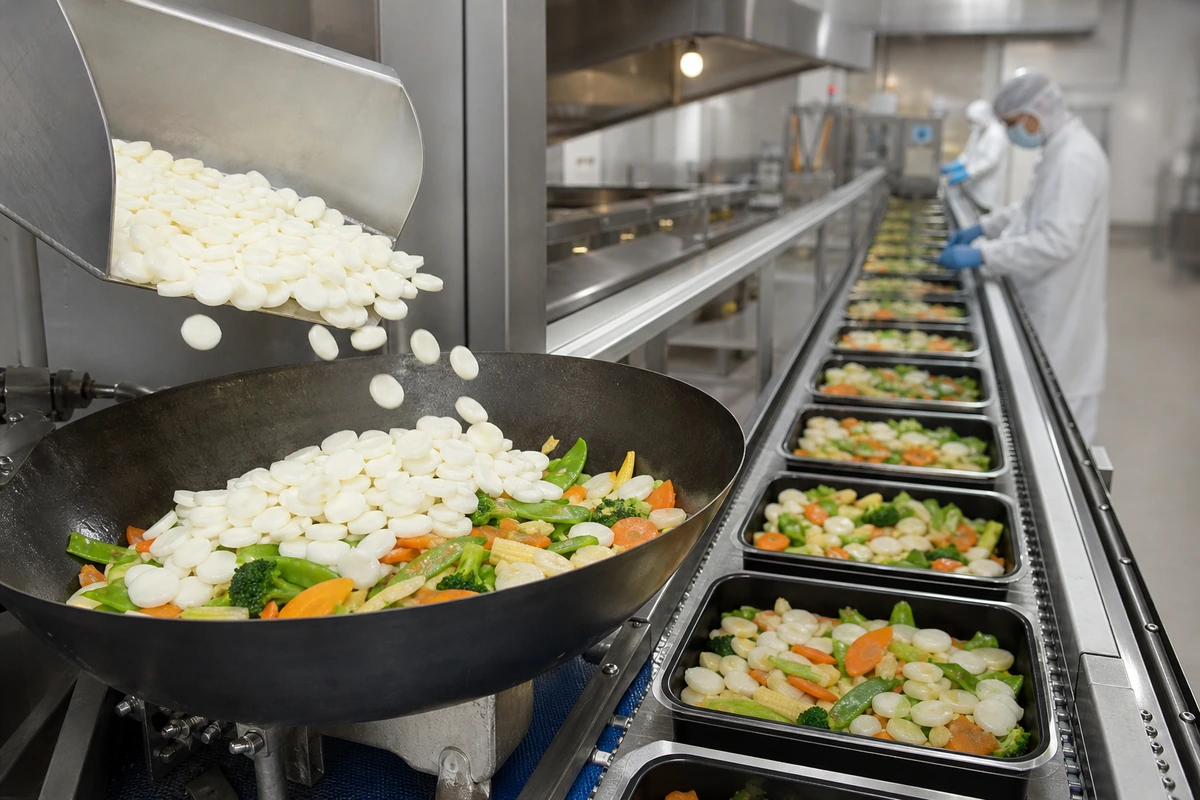
Controlled slice thickness helps a ready-meal producer balance visible piece identity with cooking and reheating texture.
Why water chestnut stays useful in cooked applications
Water chestnut is valued less for a strong flavor than for a clean, mildly sweet profile and a distinctive crisp bite. That texture can remain noticeable after heat treatment, allowing slices or dice to add contrast to softer vegetables, sauces, fillings, and proteins.
Application conditions still matter. A thin slice in a long-cooked soup experiences a different heat load from a thicker piece added late to a stir-fry. A diced filling may need small, consistent pieces that survive mixing and reheating without puncturing wrappers. A retail vegetable blend needs visual uniformity, free-flow, and portionability.
Tell the supplier how the product will be cooked, held, reheated, and served. That information is more useful than asking for "crunchy" in isolation because it allows sample tests and cut specifications to reproduce the real process.
Match product form to the application
| Product form | Typical fit | Specification focus | Approval test |
|---|---|---|---|
| Whole peeled | Foodservice, canning, display pieces, or further processing | Minimum diameter, peel cleanliness, root trimming, black spots, whole-piece integrity | Count or size distribution, cut inspection, and cooking bite |
| Slices, commonly 19–40 mm diameter and 4–6 mm thick | Stir-fries, hot pot, soups, Asian ready meals, retail blends | Diameter, thickness, broken-slice tolerance, color, free-flow, treatment | Thickness measurement, broken ratio, pour test, and application cooking |
| Dices, such as 5, 6, 8, or 10 mm | Fillings, mixed vegetables, sauces, prepared foods, industrial dosing | Nominal cube size, fines, undersize/oversize, texture, dosing behavior | Sieve or measurement check, mix distribution, and reheating test |
| Customized cut or blend | Formula-specific ready meals, private label, mixed-container programs | Cut drawing, ratio, compatibility with other ingredients, label and packing | Pilot sample in the buyer's complete product system |
These are current discussion ranges rather than automatic order specifications. Confirm the final diameter, thickness, tolerance, blanching status, pack, and acceptance method for each contract. Review the full frozen water chestnut supply page for available forms and order details.
Inspect more than color
Natural white to light ivory color is an important first check, but it is not a complete quality decision. Measure slice thickness and diameter. Separate whole pieces, broken pieces, fines, and clumps. Look for peel residue, root residue, mud, black spots, brown edges, foreign vegetable matter, and excess loose ice.
Then cook a defined sample. Record the water-chestnut-to-water or recipe ratio, starting state, time, temperature, holding period, and evaluation point. Compare texture, piece integrity, water release, flavor, and visual color. Repeat the same test on later pre-shipment or arrival samples so "crisp" has a consistent reference.
A useful specification defines defects and methods, not only adjectives. Our frozen vegetable specification guide shows how to connect product identity, size, tolerance, safety requirements, packing, traceability, and sampling rules.
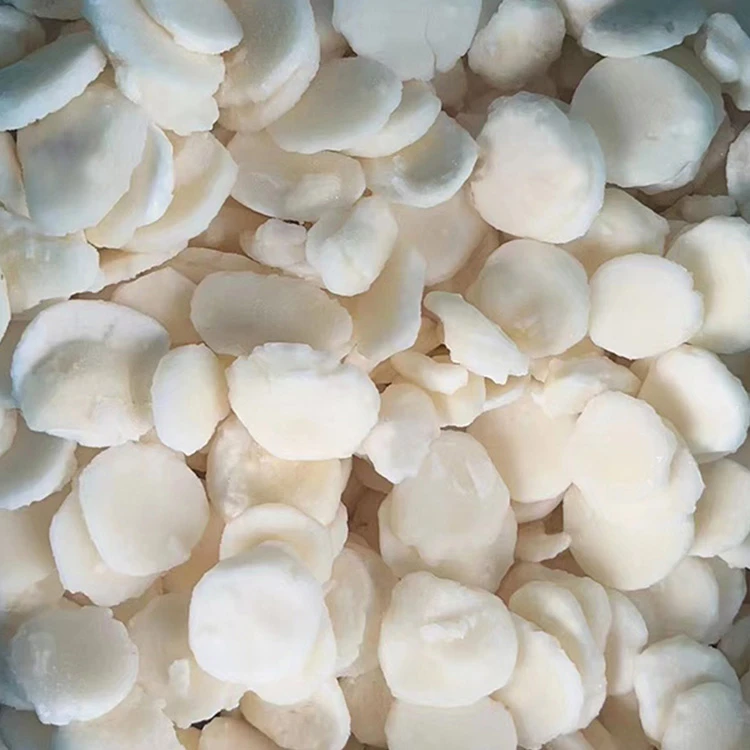
A mixed-form sample should be separated and measured so whole pieces, slices, fragments, and fines are evaluated against the agreed tolerance.
Frozen water chestnut procurement checklist
1. Product and application
State whole, sliced, diced, or custom cut; blanched or unblanched; final recipe; cooking method; holding or reheating time; and the texture result that matters.
2. Measurable specification
Define diameter or dice size, thickness, tolerances, peel residue, black spots, brown edges, broken pieces, root and mud residue, foreign matter, free-flow, and loose ice.
3. Sample and test method
Agree how the sample is drawn, weighed, measured, cooked, and scored. Keep approved photos and a retained sample when practical.
4. Packing and volume
Confirm bulk carton, foodservice inner bags, retail pack, or private label; net weight; carton strength; artwork; pallet plan; MOQ; annual volume; and mixed-container feasibility.
5. Documents and market
List destination, label requirements, specification sheet, COA, microbiology, residue or heavy-metal requirements, certificate scope, packing list, origin documents, and inspection needs.
6. Cold chain and receipt
Specify frozen storage at -18°C or below, loading temperature checks, reefer plan, carton condition, arrival temperature, clumping inspection, lot code, and claim evidence.
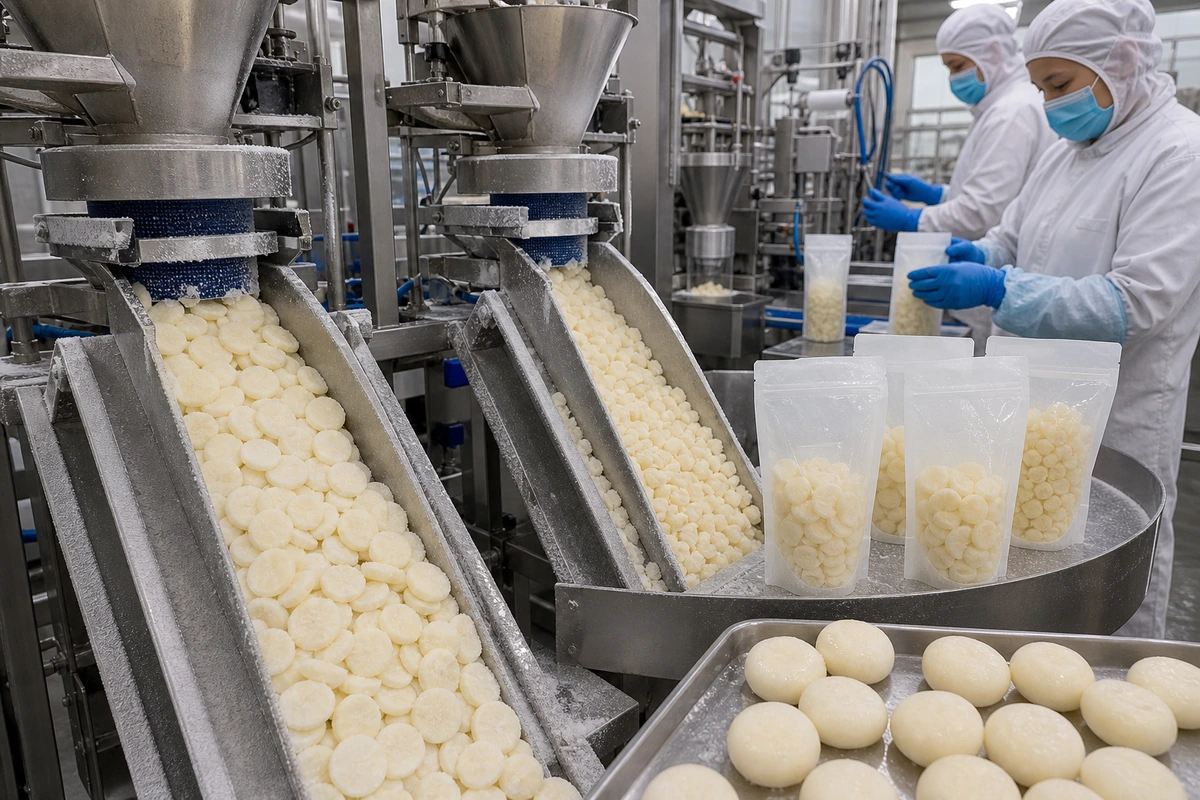
Retail and private-label programs add pack weight, seal integrity, artwork, coding, and carton-mark controls to the product specification.
Packing changes what the buyer must control
A 10 kg bulk carton for a processor is judged differently from a 500 g retail bag. Bulk users prioritize usable yield, easy dosing, low clumping, inner-liner strength, and efficient pallet handling. Foodservice buyers may prefer several inner bags per carton so kitchens can control exposure after opening.
Retail and private-label programs add presentation, declared net weight, seal consistency, cooking directions, language, nutrition and ingredient declarations, barcode position, date coding, carton marks, and artwork approval. The same frozen slice can succeed in bulk and fail in retail if the packing brief is incomplete.
Current GreenLand-food discussions can include 1×10 kg, 20 lb, 40 lb, 4×2.5 kg, and market-specific retail formats, subject to product, artwork, quantity, and production feasibility. Standard MOQ guidance is usually around 10–12 metric tons, but packing and mixed-loading plans must be confirmed for the actual order.
Common sourcing mistakes
Comparing only the quoted cut name
"Slices" does not define diameter, thickness, broken ratio, or tolerance. Two suppliers can quote the same name and deliver very different usable yield and cooking performance.
Approving color but not texture
Frozen appearance is quick to inspect, but the application decides value. Use the buyer's stir-fry, soup, filling, hot-pot, or ready-meal process for approval.
Ignoring soil- and root-related defects
Water chestnuts are dug from mud. Root bases, grit, peel residue, and field debris deserve explicit defect definitions and inspection methods.
Leaving treatment unspecified
Blanched and unblanched products can behave differently. Confirm treatment, formula fit, cooking performance, and destination-market requirements before production.
Treating the cold chain as logistics only
Temperature fluctuation affects frost, clumping, dehydration, and texture. Arrival inspection and lot-linked evidence belong in the quality plan.
Buying without traceability inputs
Ask how the finished lot connects to raw-material receiving, processing date, COA, packing record, carton code, cold storage, and container loading.
Frequently asked questions
Do water chestnuts grow on trees?
No. Chinese water chestnut is an aquatic sedge. Its edible part is a corm, or swollen underground stem, that forms in saturated soil at the end of a stolon.
How long do Chinese water chestnuts take to grow?
Many traditional production guides describe roughly seven to nine months from field establishment to mature corms, but tropical trials and different cultivars can use shorter cycles. Temperature, planting date, day length, and market target determine the local schedule.
Are Chinese water chestnuts and water caltrops the same?
No. Chinese water chestnut is Eleocharis dulcis, a sedge harvested for an underground corm. Water caltrop belongs to Trapa and produces a horned fruit or seed from a floating aquatic plant. They should be identified as different products.
Why can water chestnuts remain crunchy after cooking and freezing?
Their corm tissue has structural characteristics that resist softening better than many vegetables. Final bite still depends on maturity, freshness, peeling, cut thickness, pretreatment, freezing, storage, and the buyer's cooking method, so texture should be approved through an application test.
Source Frozen Water Chestnut with GreenLand-food
GreenLand-food is a professional frozen water chestnut supplier and manufacturer in China, providing factory-direct wholesale supply for importers, food manufacturers, foodservice distributors, and private-label programs.
Send the product form, specification, packing, quantity, application, destination, private-label needs, and requested documents. We will review slice or dice size, treatment, defect tolerance, MOQ, cold-chain plan, and export support against your order.