


Do Mandarins Have Seeds?
Aug 31, 2026
Leave a message
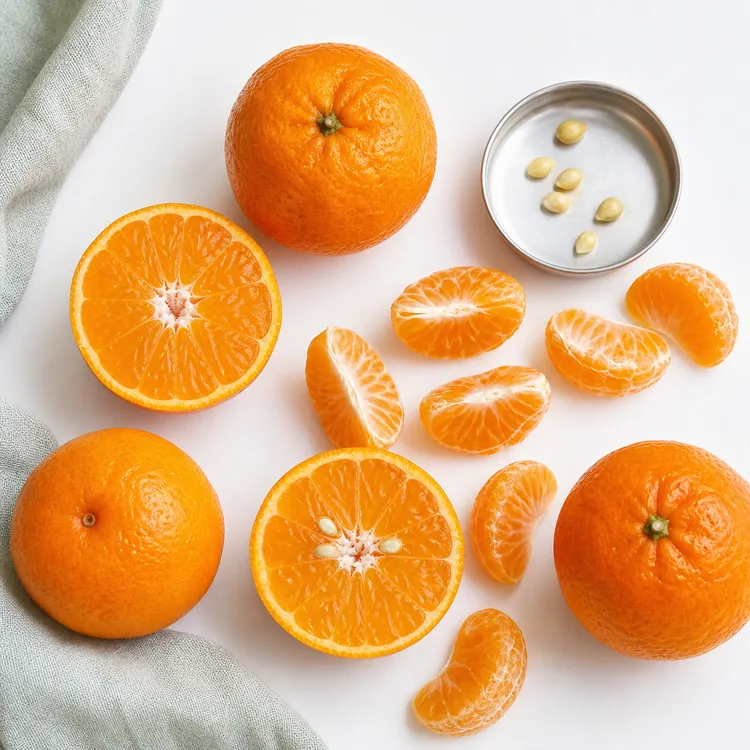
Mandarins can be seeded, low-seeded, or commercially seedless
"Mandarin" names a large citrus group, not one seed profile. A Satsuma, Clementine, Tango, Ponkan, Kinnow, and Dancy can all be sold within the wider mandarin family, yet their normal seed behavior is different. Even a cultivar known for seedlessness may occasionally contain a seed, and some self-incompatible cultivars become seedy when cross-pollinated.
If you are buying frozen mandarin segments, puree, or a beverage ingredient, do not approve the order from the word "seedless" alone. Confirm the variety or accepted variety group, the maximum permitted seed count or seed-fragment rule, the sample size, the inspection stage, and what happens when a lot fails.
1. Seedless is not universal
Mandarin seed count changes with cultivar. A category name or orange peel appearance cannot predict the result reliably.
2. Pollination is a real exception
Clementine and W. Murcott/Afourer-type fruit may carry more seeds when compatible citrus pollen is present nearby.
3. Application sets the tolerance
A visible fruit-cup segment needs tighter seed control than a screened puree, but both need a written acceptance rule.
4. Verify the lot, not the label
Use representative samples, a defined seed size/count method, and an application trial before approving repeat supply.
Mandarin, tangerine, Clementine, and Satsuma are not interchangeable variety names
The naming is confusing because trade language, horticultural classification, and regional retail labels overlap. Mandarin is the broad group. Tangerine is a name used most often in the United States for some reddish, easy-peeling mandarins and mandarin hybrids. Clementine is a mandarin group with many named selections. Satsuma is another distinct mandarin group, usually associated with loose peel, early maturity, and very low seed count.
This hierarchy matters because a purchase order that says only "mandarin orange" leaves too much room for interpretation. Two fruits may both be orange, easy to peel, and sweet, yet differ in segment size, membrane thickness, seed count, acidity, aroma, harvest window, and performance after freezing. A processor that needs intact segments for a visible fruit inclusion should not accept a silent switch to a smaller or more fragile type merely because both products fit the same broad name.
For GreenLand-food projects, we start with the finished application and product form. The product name can then be supported by the required variety direction, seed tolerance, segment integrity, Brix and acidity direction, packing, and lot documents. This is more useful than arguing over whether one market would call the same fruit a mandarin or a tangerine.
For a closer explanation, see Are Mandarins and Tangerines the Same?.

Why do some mandarins have seeds while others do not?
Seed formation begins with genetics. Some cultivars can develop fruit without fertilization, a behavior called parthenocarpy. Some have sterile pollen, sterile ovules, or chromosome arrangements that interrupt normal seed development. Others are self-incompatible: their own pollen does not complete fertilization effectively, so the fruit may be seedless when it is isolated from compatible pollen.
Cross-pollination explains many of the surprises in a bag labeled seedless. Bees can move compatible pollen between citrus blocks that bloom at the same time. A Clementine or W. Murcott/Afourer-type orchard that produces low-seeded fruit in one location may produce more seeds when another compatible cultivar flowers nearby. The printed variety name therefore describes expected behavior, not an infallible count for every fruit.
Frozen segments should be evaluated for seed defects together with frost, color, membrane, pith, breakage, and piece uniformity.
Which mandarin varieties are seedless?
The table below is a buying orientation, not a substitute for the specification of the actual crop. Cultivar behavior can be influenced by pollination and production location. The strongest decision is to combine the variety name with a measurable seed tolerance and a representative pre-shipment sample.
| Variety or group | Typical seed behavior | Important exception | Buyer action |
|---|---|---|---|
| Satsuma, including Owari and many named selections | Usually seedless or only occasionally seeded | A few seeds can still occur; individual Satsuma cultivars are not identical in size, season, or texture | Strong starting point for visible segments, followed by lot sampling and segment-quality checks |
| Clementine group | Often seedless when cross-pollination is prevented | Compatible nearby pollen can increase seed count, and named selections differ | Ask for the named selection, growing area, crop sample, and seed tolerance rather than relying on "Clementine" alone |
| Tango, Gold Nugget, Pixie, Seedless Kishu | Known for seedless or very low-seed commercial performance | Availability, fruit size, flavor, crop timing, and processing suitability still vary | Confirm whether the exact cultivar is available for the required frozen form and loading window |
| W. Murcott/Afourer-related fruit | Can be low-seeded or seedless under controlled pollination conditions | Seed count can rise under cross-pollination; "Murcott" and "W. Murcott/Afourer" should not be treated as one guaranteed seed profile | Require precise naming and a lot-specific seed inspection |
| Ponkan, Kinnow, Dancy, Fallglo and other traditionally seeded types | Normally seeded, sometimes heavily | Seeded fruit may still offer desirable aroma, flavor, juice, season, or cost for a screened process | Do not reject automatically; compare seed-removal yield, flavor, finished-product performance, and total usable cost |
What does "seedless" actually mean on a commercial order?
In everyday speech, seedless usually means that a person can eat the fruit without expecting a hard seed in most segments. It rarely functions as a universal promise that every fruit contains exactly zero seeds. A UC Agriculture and Natural Resources citrus FAQ notes that fruit may still be described as seedless with a small number of seeds. That observation is useful for consumer expectations, but a B2B buyer needs a definition written for the product being purchased.
Start by distinguishing three statements. "Seedless cultivar" describes the expected biology of the named cultivar. "Low-seeded lot" describes the observed result in a sample or crop. "Seeds removed" describes a processing step. None of these statements automatically proves the other two. A normally seedless cultivar still needs lot verification, while a seeded cultivar may be processed into a low-seed puree through effective removal and screening.
The definition also needs a measurement. Will you count only developed seeds, or also fragments? What minimum dimension qualifies as a defect? Is the result expressed per fruit, per kilogram, or per 100 grams of drained segments? How many cartons and inner bags form the sample? A numerical limit without a sample method is difficult to enforce because a supplier and buyer can inspect different portions and reach different conclusions.
The Codex standard for certain canned citrus fruits provides a useful example, not an automatic frozen-product rule: for canned mandarin oranges, it limits seeds larger than 4 mm to one per 100 g of drained fruit on the sample average. A buyer of frozen segments can use that structure as a discussion model, then set the actual tolerance required by the destination, customer, and application.
Buyer control
Do not turn "zero seeds" into an unverifiable promise
A strict zero-defect target may be appropriate for a visible retail inclusion, but it needs an agreed inspection volume and decision rule. Otherwise one party may mean "no seed found in the approval sample" while the other interprets it as "no seed anywhere in the shipment." Those are not equivalent claims.
Write the defect category, measurement threshold, sample size, acceptance rule, and corrective action together. This protects the buyer more effectively than placing "100% seedless" in a product description with no way to test it.
How seed control changes by processing application
Seeds are primarily a quality and usability issue, not a shortcut for judging the microbiological safety of the fruit. Their commercial impact changes with visibility and process intensity. One hard seed in a clear fruit cup is immediately noticeable. In a puree, a seed may be removed before or after milling, but fragments and extraction conditions still need control. In a beverage, flavor, acidity, maturity, membrane, peel oil, and limonin behavior matter alongside seed removal.
Do not assume that buying a seeded variety is always cheaper after processing. The relevant figure is usable yield after peeling, membrane removal, seed separation, screening, and defect sorting. Extra labor, product loss, line interruption, rework, or complaints can erase a lower raw-material price.
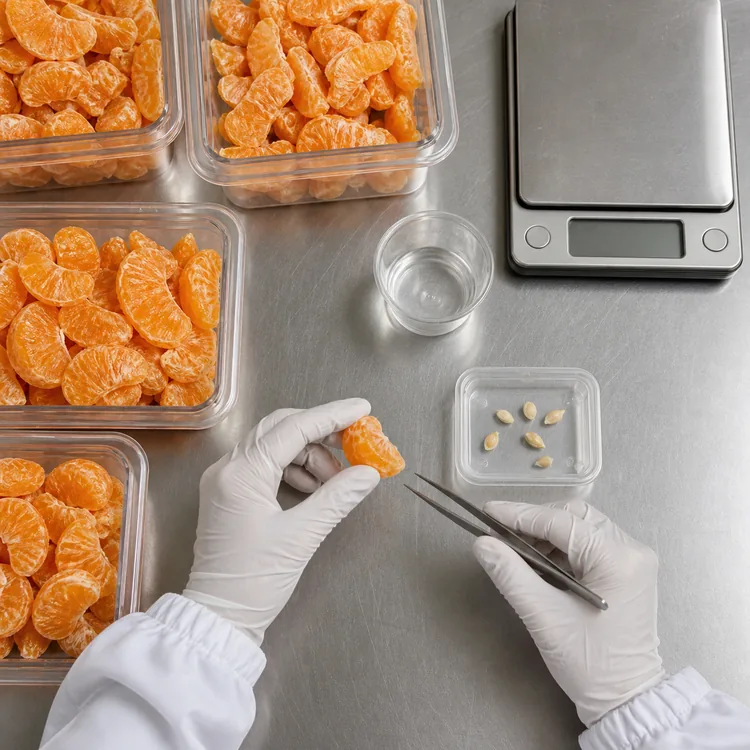
The inspection image shows the basic principle: separate the seed defect from the fruit sample, count it consistently, and keep the tested portion traceable to the lot.
| Product or application | Seed-control priority | Processing implication | Buyer verification |
|---|---|---|---|
| Retail IQF segments and private-label packs | Very high because the consumer sees and bites the whole segment | Seed removal must protect segment integrity; overhandling can increase breakage and drip after thawing | Seed count, fragments, broken ratio, membrane, pith, piece size, free-flow condition, and pack presentation |
| Fruit cups and visible dessert inclusions | Very high because one seed can damage the eating experience and visible quality claim | Segment size, firmness, membrane removal, syrup or juice behavior, and drained yield matter with seed control | Pilot cup test, drained sample, segment count, seed tolerance, breakage, color, and final filling performance |
| Yogurt, dairy, ice cream, and bakery inclusions | High when pieces remain perceptible in the finished product | Hard fragments are objectionable; fruit must also survive mixing, frozen storage, baking, or dairy acidity | Run the actual recipe trial and check seed fragments, particle size, bleed, texture, Brix/acidity balance, and distribution |
| Puree, sauce, filling, and jam | Moderate to high depending on screen size and whether seeds are milled | Seed exclusion before size reduction and controlled finishing can reduce fragments; finished viscosity and yield must still be tested | Screen or finisher condition, particle specification, seed-fragment result, usable yield, flavor, and batch consistency |
| Juice, nectar, and beverage base | Depends on extraction and finishing, but seeds should not enter uncontrolled crushing | Bitterness is not predicted by seed count alone; cultivar, maturity, peel/membrane contact, limonin, heat, and holding time also matter | Pilot extraction, finished flavor after holding, Brix, acidity, pulp level, screen performance, and yield |
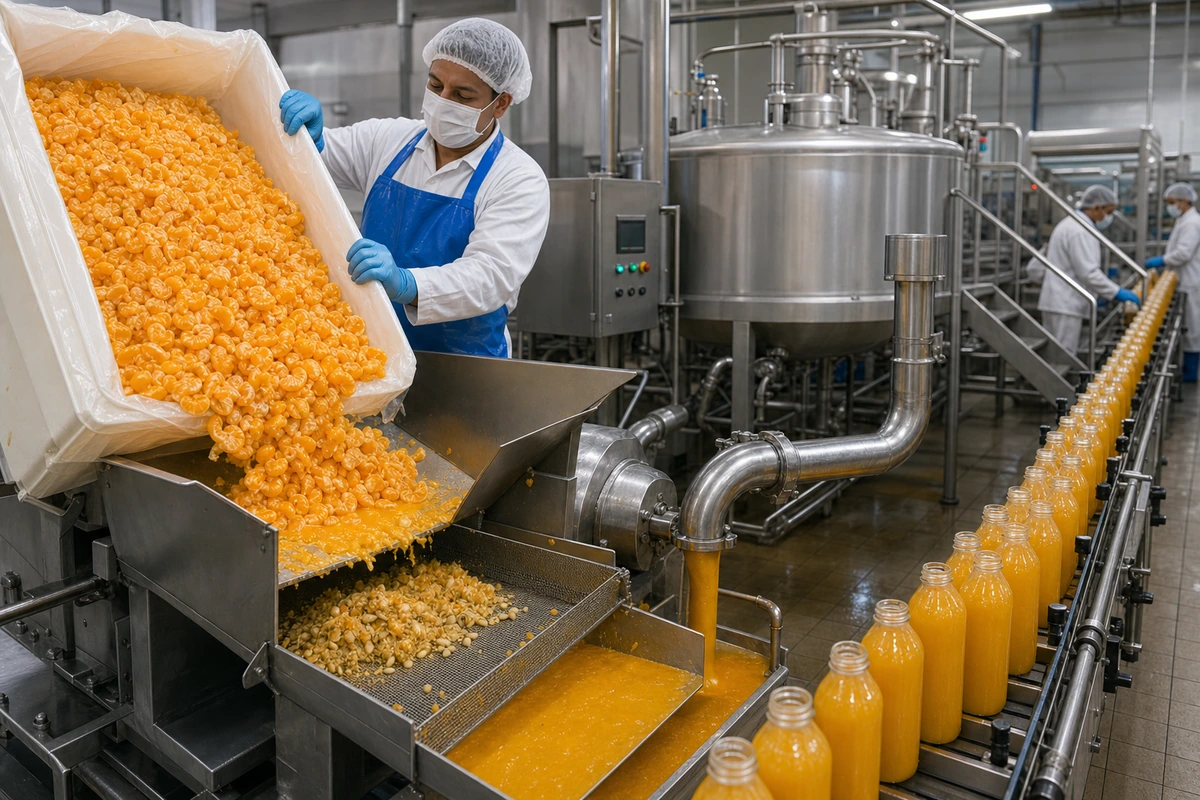
Seeds can affect beverage processing, but they are not the whole bitterness story
A processor should keep seeds out of uncontrolled crushing because hard particles and seed compounds are not wanted in the finished drink. However, a bitter mandarin beverage should not be diagnosed from seed count alone. Citrus bitterness is commonly associated with limonin and, in some citrus products, naringin. Cultivar, fruit maturity, extraction pressure, contact with peel and membranes, heat treatment, and time after extraction can all change the result.
For Ponkan and other mandarin juice, a pilot trial should follow the planned thawing, extraction, finishing, heating, and holding process. Taste the product immediately and again after the relevant hold, because delayed bitterness may appear after extraction. Record usable yield rather than judging only the raw fruit price.
GreenLand-food's guide to juicing frozen fruit explains why frozen format, controlled thawing, solids, and pilot extraction belong in the beverage decision.
Five-step buyer checklist
How to specify and verify seed control in frozen mandarin orange
- Name the product and accepted cultivar direction. State whether you require Satsuma, Clementine, another named cultivar, or an approved equivalent. Add the required form: IQF whole segments, broken segments, puree, juice, or a preparation. Do not allow a variety change without written approval when seed behavior or segment performance could change.
- Define the seed defect. Record whether the limit applies to whole developed seeds, seed pieces, or both. Add a size threshold and unit of measurement. If the target is zero seeds in the sample, identify the sample mass and the lot decision rule instead of writing an unlimited zero claim.
- Review the removal and inspection stage. Ask where seeds are removed, how segments are protected from breakage, which inspection or screening method follows, and how findings are recorded. For puree or juice, confirm the screen or finishing step and the finished particle expectation.
- Approve a representative sample in the real application. Inspect multiple portions, not one attractive bowl. Test visible segments after thawing, fruit cups after filling, dairy inclusions after mixing, bakery fillings after heating, or beverage ingredients after the planned extraction and hold.
- Carry the rule into documents and receiving. Keep the final wording in the specification, purchase order, approved sample record, inspection plan, and complaint agreement. At arrival, connect seed findings with lot code, carton position, product temperature, package condition, breakage, and thaw history.
Seed control belongs inside the full frozen mandarin specification
A seed-free sample can still fail in production if the segments are too soft, too broken, covered with membrane, excessively frosted, or inconsistent in size. Build the specification around the finished use. For a retail bag or fruit cup, emphasize recognizable segment shape, color, seed and membrane limits, breakage, and eating texture. For puree or beverage use, emphasize usable yield, Brix and acidity direction, screen performance, flavor after processing, and batch consistency.
The specification should identify the product form and ingredients, cultivar direction, segment size or grade, whole-to-broken ratio when relevant, seed and seed-fragment tolerance, membrane and pith limits, color, maturity, Brix/acidity direction, foreign matter controls, free-flow expectation, glazing or added medium if any, net weight, pack style, and storage condition. For the exact freezing methods and thawed-texture tradeoffs, use our separate guide: Can Mandarin Oranges Be Frozen?
Documents should match the order and destination. Depending on the program, the buyer may request a product specification, COA or test report, ingredient and allergen statement, packing list, commercial invoice, certificate of origin, health or phytosanitary documentation when applicable, certificate copies within their valid scope, and lot traceability records. The certificate list should never be assumed from a generic product page; confirm the required standard, certified site, scope, and validity for the actual order.
Packing, MOQ, lead time, and loading plan are also order-specific. Tell us whether you need bulk foodservice cartons, industrial bags, retail-ready packing, or private-label development; then add quantity, destination, target loading period, language and label needs, pallet requirements, and requested documents. A trial order or production sample can be discussed, but it should represent the intended cultivar, crop, specification, and processing route.

Measure more than seeds in the approval sample
A segment-size check helps explain why two samples with the same seed result may behave differently. Small and large segments freeze, thaw, fill, and break differently. A fruit-cup program may need a narrow piece range for even filling, while a puree program may accept mixed sizes if usable yield and flavor remain stable.
Record the sample date, cultivar or lot identity, frozen state, thawing method, inspected mass, seed findings, whole/broken result, membrane and pith defects, size range, Brix/acidity result when required, and application outcome. Photos are useful when they show the full sample and the measured defect, not only the best pieces.
This turns the approval sample into a reference for repeat orders rather than a one-time sales presentation.
Cold chain and arrival checks still matter
Freezing does not remove seeds, and it does not correct a weak raw-material or sorting decision. It also changes how the buyer can inspect the fruit. Heavy frost, clumping, and thaw-refreeze exposure can hide segment surfaces or increase breakage during sample preparation. Keep the agreed frozen storage temperature-commonly -18°C / 0°F or below for commercial frozen fruit-through storage and transport, while following the actual product label and contract.
At receipt, first examine the reefer or delivery record, carton condition, inner-bag seals, lot code, product temperature, free-flow condition, frost, and leakage. Then take samples across relevant carton positions. Thaw them under one documented method before evaluating seed defects, membrane, color, aroma, texture, and drip. If the product is used frozen, also test portioning and dosing without a full thaw.
Keep safety and quality decisions separate. A found seed is usually a product-quality nonconformance; a broken cold chain, damaged package, off odor, or unsuitable microbiological result requires its own assessment. One defect should not be used to overlook another.
When is a more seeded variety still the better choice?
Seedlessness is valuable, but it is not the only quality attribute. A seeded or pollination-sensitive variety may offer a stronger aroma, a useful harvest window, higher juice yield, a preferred sugar-acid balance, better local availability, or a lower starting price. If the final process already includes efficient seed separation and finishing, that variety may deliver a better total result than a premium seedless fruit.
The comparison should use total usable cost. Include raw fruit or ingredient price, seed-removal labor, screen losses, segment breakage, puree or juice yield, line speed, rework, sensory performance, and complaint risk. A low-priced fruit with heavy seed load and weak usable yield can be more expensive in the finished formula.
For visible retail segments, the balance often favors a reliably seedless cultivar and tighter sorting. For juice, sauce, or puree, a broader cultivar set may work after a controlled plant trial. We help your purchasing team compare the product form and specification with the process you actually run.
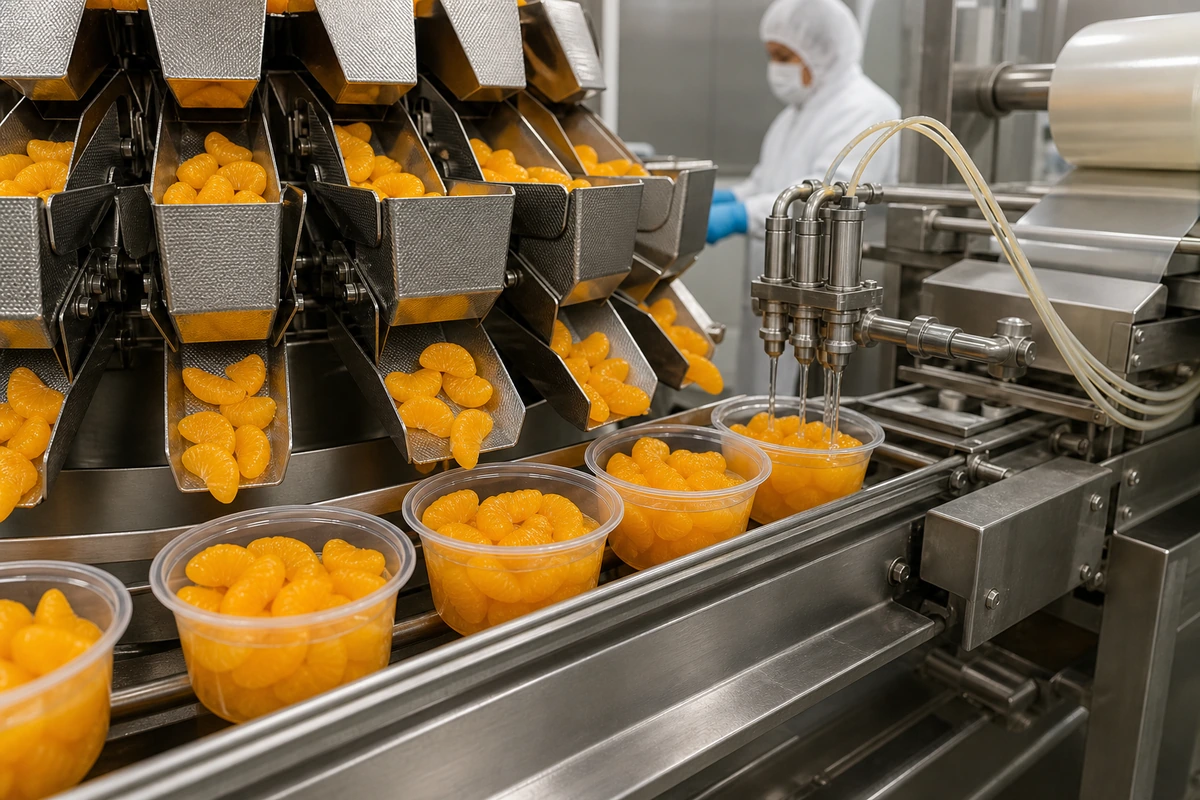
Visible fruit-cup applications place tight demands on seed control, segment integrity, drained yield, and consistent portioning.
Frequently asked questions
Are mandarins seedless?
Some are, and some are not. Mandarin is a broad citrus group. Satsumas and several modern cultivars are usually seedless or very low-seeded, while Dancy, Kinnow, Ponkan, and other traditional types commonly contain seeds.
Why did a seedless mandarin have a seed?
"Seedless" often describes normal commercial performance rather than a guarantee of zero seeds in every fruit. An occasional seed can occur, and pollination-sensitive cultivars may develop more seeds when compatible citrus pollen is carried from nearby trees.
Which mandarins are most consistently seedless?
Satsuma cultivars are among the most consistently seedless mandarins. Tango, Gold Nugget, Pixie, and Seedless Kishu are also known for low-seed or seedless performance, but availability and processing suitability still need confirmation.
Do Clementines have seeds?
Clementines are often seedless when cross-pollination is prevented. They can contain seeds when compatible citrus cultivars flower nearby, so the named selection and a lot sample matter more than the broad Clementine label.
Do tangerines have seeds?
Some tangerines have seeds and some modern tangerine or mandarin hybrids are seedless. Because "tangerine" is used differently across markets, ask for the cultivar name and measured seed result.
Does freezing remove mandarin seeds?
No. Seeds must be excluded through raw-material selection, segment inspection, separation, or screening. Freezing preserves the prepared product; it does not dissolve or remove seeds.
Can frozen mandarin segments be specified as seedless?
Yes, but the order should define what seedless means. State the allowed whole-seed and fragment level, size threshold, sample mass, inspection method, and lot decision rule, then verify a representative sample before shipment.
Source Frozen Mandarin Orange with GreenLand-food
GreenLand-food is a professional frozen mandarin orange supplier and manufacturer in China, providing factory-direct wholesale supply for importers, food manufacturers, foodservice distributors, and private-label programs.
Send the product form, cultivar or variety direction, seed tolerance, specification, packing, quantity, application, destination, private-label needs, and requested documents. We will review the required frozen format, sample plan, current availability, and shipment needs with your team.