


How Long Do Frozen Vegetables Last?
Aug 31, 2026
Leave a message

Use the date for the pack, then judge temperature history and quality
The National Center for Home Food Preservation lists about 8–12 months at 0°F / -18°C as an approximate best-quality range for home-frozen fruits and vegetables. Other extension guidance uses 12–18 months for many properly prepared vegetables. Those figures are quality guides, not interchangeable commercial expiry dates. A sealed retail or foodservice product should be handled according to its label, supplier specification, and storage instructions.
Continuous freezing slows microbial growth but does not reverse damage from a warm period, a torn seal, dehydration, oxidation, or repeated temperature cycling. If a bag has thawed, become warm, leaked, developed an unusual odor after opening, or has an uncertain abuse history, the printed date alone cannot make it acceptable. Investigate the real condition instead of relying on one calendar number.
Best-quality guidance
Home storage guides commonly use 8–12 months at 0°F / -18°C. Some properly prepared vegetables may keep high quality longer.
Commercial shelf life
Use the product-specific label and specification. Packaging barrier, process, validation, market, and cold chain support that claim.
Opened bags
Opening increases air and moisture exposure. Reseal tightly, return the bag promptly, and use a first-in, first-out date.
Thawed products
Once vegetables thaw, frozen-storage guidance no longer applies. Use safe chilled limits, package directions, and the actual thaw history.
Frozen vegetable shelf life by storage state
The phrase "How long do they last?" hides several different products and conditions. Use the row that actually describes the food. A sealed commercial carton at a controlled cold store, a repeatedly opened household bag, and cooked leftover vegetables do not share one shelf-life rule.
| State | Working guide | What governs | Main risk |
|---|---|---|---|
| Unopened commercial pack | Use the printed date and confirmed specification | Validated process, barrier packaging, -18°C or colder storage, distribution evidence | Seal failure or undocumented temperature abuse |
| Home-frozen vegetables | Often 8–12 months for best quality at 0°F / -18°C | Blanching, fast freezing, airtight packaging, stable temperature | Slow freezing and air exposure |
| Opened retail or foodservice bag | Use promptly within the labeled life; date the opening | Resealing, portion handling, time outside the freezer, frost exposure | Dehydration, contamination, clumping, stock rotation failure |
| Thawed but uncooked | Follow package directions and a safe chilled process | Thaw temperature, time, product state, contamination controls | Using frozen-life guidance after the food is no longer frozen |
| Cooked leftovers | Use applicable leftover cooling and refrigerated-storage guidance | Cooking, cooling, container depth, refrigerator temperature, reheat | Slow cooling or repeated warming |
Safety, best quality, and labeled shelf life are three different claims
Safety under continuous freezing describes what happens while food remains solidly frozen at 0°F / -18°C or below. Federal U.S. storage guidance explains that freezer time limits are primarily about quality and that continuously frozen food can remain safe indefinitely. That does not mean every damaged or temperature-abused bag should be eaten. It means the calendar alone is not the hazard while the food has stayed continuously frozen and protected.
Best quality describes the period when flavor, color, texture, piece identity, and cooking performance remain closest to the intended standard. Home-preservation sources often use 8–12 months for fruits and vegetables, while some extension guidance gives 12–18 months for many properly prepared vegetables. The difference reflects preparation, packaging, product type, and the fact that a range is an estimate, not a laboratory expiry point.
Labeled commercial shelf life is a product-specific claim. It should be supported by the manufacturing process, raw-material condition, blanching or other pretreatment, packaging barrier, seal integrity, frozen-storage temperature, distribution system, microbiological and sensory plan, and destination-market rules. It cannot be created simply by copying a home-freezer chart.
GreenLand-food commonly works with commercial specifications that state 24 months at or below -18°C for suitable IQF vegetable products, but this is not a universal promise. The final shelf life follows the confirmed product, pack, factory process, evidence, and contract. A buyer should read the actual specification rather than assume that every vegetable, blend, sauce system, or retail pack shares the same term.
For ingredient format details, see Freeze–Thaw Stability Tests for IQF Produce: A Stress Test Is Not a Shelf-Life Claim.
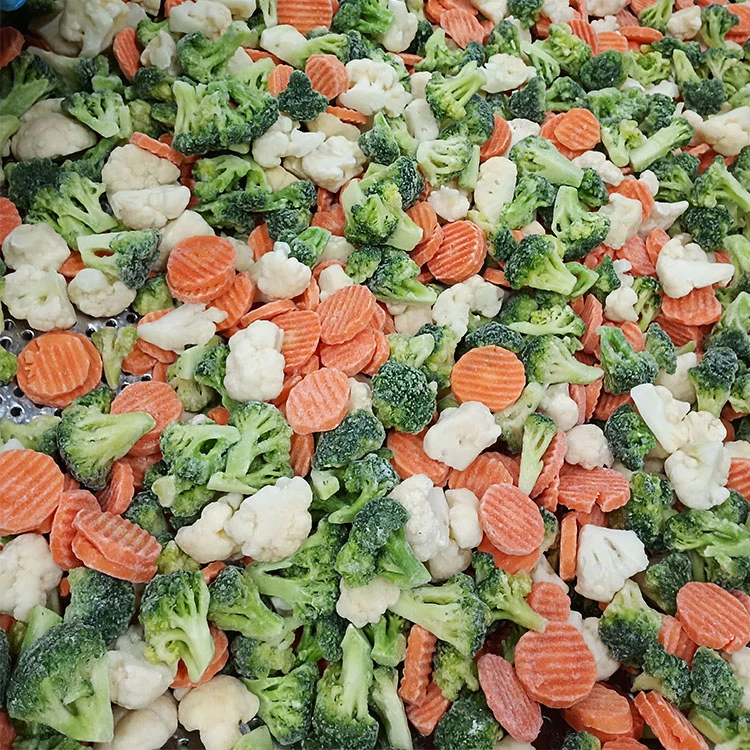
A good bag should portion without becoming a solid block
IQF pieces are expected to remain substantially separate so the user can take the required amount. Some light frost and minor contact are normal. A heavy shell of ice, large fused mass, torn seal, or evidence of leakage deserves investigation because it affects portion control and heat distribution.
Clumping alone is not a complete time-temperature record. Compression, natural surface moisture, and the shape of the pieces can also cause contact. Treat it as an observation, then check receiving temperature, logger data, packaging, carton condition, pallet location, storage alarms, and retained samples before deciding the cause.
Why official storage ranges differ
A home-preservation guide starts with vegetables prepared in a household, often blanched, cooled, packed, and frozen in a domestic freezer. A commercial IQF product may be processed quickly, frozen in individual pieces, packed in a selected film, tested under a defined specification, and held in a controlled distribution chain. Those products do not begin with the same evidence.
Vegetables also respond differently. Leafy greens, peas, sweet corn, mushrooms, root cuts, broccoli florets, coated products, seasoned blends, and sauce-containing vegetables have different surface area, fat, moisture, pigments, enzymes, and packaging needs. Cut size and broken pieces expose additional surface to dehydration and oxidation.
Finally, a "best before" statement may target consumer acceptability, while a B2B specification can define tighter color, drip, piece integrity, cook yield, or application performance. A product may remain usable at home after its brightest color has declined, yet fail a restaurant or ready-meal buyer's agreed sensory limit. The right answer always includes the intended standard.
How to store unopened frozen vegetables
Keep the product at the temperature stated on the label and specification, commonly at or below -18°C / 0°F. Place it in a freezer zone with stable airflow and avoid repeated warming near doors, defrost exhausts, damaged curtains, or overloaded evaporators. Household users should close the freezer promptly; commercial stores should monitor calibrated sensors, alarms, door activity, and pallet locations.
Protect the package from puncture and crushing. A carton can look sound while an inner bag has a pinhole or weak seal. Air entry accelerates dehydration and oxidation, producing dry pale areas, brittle texture, and flavor loss. Stock rotation should use the printed production or best-before information, not the date a carton happened to be moved to a front location.
Do not assume that a colder freezer repairs earlier damage. Returning a warmed product to -18°C stops further warming, but it does not reconstruct cells, remove drip, reverse freezer burn, or erase a time-temperature event. Preserve logger records and investigate at the moment the event is found.
How long do opened frozen vegetables last?
An opened bag does not immediately become unsafe, but its protection becomes less reliable. Warm humid air enters each time the bag is opened, then moisture can condense and freeze on the product. Loose pieces may absorb freezer odors, dry at exposed surfaces, or fuse where moisture collects. The practical approach is to remove the needed quantity quickly, push out excess air, reseal tightly, date the opening, and return the bag at once.
Use opened stock well inside the labeled life and follow a documented first-in, first-out system. Foodservice kitchens should not leave a large bag on a preparation bench through repeated service periods. Portion smaller working quantities while preserving the rest of the case in frozen storage. Use clean utensils and prevent contact with raw foods, dirty gloves, wet scoops, and allergen residues.
There is no honest universal "opened bag equals 30 days" rule. Film barrier, closure design, air removed, opening frequency, freezer stability, vegetable surface area, and the user's quality tolerance all matter. Set a conservative in-house period, verify it by inspection and cooking, and never extend beyond the product's labeled or contracted life without support.

Separate normal frost, quality loss, and abuse evidence
A light dry frost on otherwise separate pieces is different from a thick ice layer, widespread dehydration, or a wet refrozen mass. Look at the entire sample: seal condition, loose ice, clump hardness, color, odor after opening, drip during controlled thawing, and cooked texture.
No photograph can replace the lot history. A dramatic-looking clump may result from compression; a visually clean bag may still have experienced a warm period. Combine product examination with receiving records, temperature logs, transport evidence, alarms, and supplier communication.
Can frozen vegetables go bad?
Frozen vegetables can lose quality through dehydration, oxidation, pigment change, enzyme activity that was not adequately controlled, physical damage, seal failure, and temperature fluctuation. Freezer burn appears as dry, pale, grayish, or tough surface areas where moisture has left the food. It is primarily a quality defect, but the damaged package and unknown history still need evaluation.
Discard decisions become more serious when the product has thawed or warmed beyond an approved limit, leaked, developed an unusual odor or slime after thawing, contacted contaminated material, or has an unknown abuse history. Do not taste an uncertain ready-to-cook vegetable to decide. Household users should follow official food-safety guidance; businesses should follow their HACCP or food-safety plan, legal requirements, customer specification, and disposition authority.
Color dulling, more drip, soft texture, dry edges, weak flavor, and lower cook yield can signal quality decline without proving a safety hazard. For procurement, those defects still matter because the lot may fail the contract or the finished product even when it is not a health emergency. Quality and safety decisions should be documented separately.
What if the freezer loses power?
Keep the door closed and document the event. U.S. federal guidance notes that a full unopened freezer may hold temperature for about two days and a half-full freezer for about one day, but those are emergency estimates, not acceptance criteria for a specific shipment or business. Freezer insulation, ambient temperature, product mass, door openings, and starting temperature all change the outcome.
Use actual product temperature, time records, ice-crystal condition, approved emergency guidance, and your food-safety authority. A commercial cold store should preserve logger traces, alarm time, corrective actions, affected pallet positions, and disposition decisions. Never hide an excursion by simply refreezing the load and resetting the clock.
A five-step keep, use, investigate, or discard check
- Identify the product state. Is it an unopened commercial pack, opened bag, home-frozen product, thawed ingredient, cooked leftover, or product involved in a power or transport event? Use guidance for that state.
- Check the governing date and instruction. Read the best-before or use-by information, storage statement, lot code, preparation direction, and confirmed B2B specification. Do not replace them with a generic web number.
- Reconstruct temperature history. Review freezer settings, alarms, door events, transport logs, receiving measurements, product temperature, ice condition, and how long the bag was outside storage.
- Inspect package and product. Look for seal damage, leakage, heavy loose ice, unusual clumping, discoloration, dehydration, odor after safe opening, and abnormal drip or cooked texture. Document the observations rather than relying on memory.
- Apply the correct decision authority. A household can use official emergency and storage guidance. A business should use its approved food-safety plan, QA authority, legal/customer limits, supplier evidence, and documented disposition process. When the abuse history is unknown, do not guess.
This sequence prevents two opposite errors: discarding an acceptable product only because it passed a quality guide, and accepting a damaged product only because its printed date has not arrived. The date is one evidence point; condition and history complete the decision.

The same vegetable can need different evidence in different bags
A bulk liner, resealable retail pouch, pillow bag, microwave steam bag, and sauce-containing pack do not have the same barrier, seal area, consumer use pattern, or cooking claim. Film thickness alone is not enough; material structure, water-vapor transmission, oxygen exposure, seals, print, and distribution abuse all matter.
Private-label buyers should approve the actual pack with the actual product and declared period. Test seal integrity, dehydration, frost, color, odor, texture, cook performance, label legibility, and carton protection across the proposed storage life. A result from a different film or pack size cannot automatically support the new format.
How commercial shelf-life validation should be framed
A commercial claim begins with a defined product: variety, crop condition, cut, blanching or other pretreatment, IQF process, ingredient statement, allowed defects, pack material, fill weight, seal method, carton, storage temperature, and intended market. If any of those change materially, the business should assess whether the evidence still applies.
Build a sampling plan across the proposed period, including initial, intermediate, and end-of-life checks. Sensory work can score color, aroma, visible frost, piece integrity, tenderness, fiber, dryness, drip, flavor, and application result. Packaging work can examine seal strength or integrity, puncture, film condition, and weight loss. Microbiological and chemical work should follow the risk assessment and applicable requirements.
Test under the declared frozen condition and consider a justified distribution-abuse design when the market requires it. Abuse testing should not become permission for routine warm storage. It is a way to understand sensitivity and establish controls. Preserve raw results, methods, sample identity, storage records, deviations, photographs, and the decision rationale.
Shelf-life evidence must match the claim language. "Best quality for 24 months at -18°C or below in unopened packaging" is different from a safety claim, a use-by date, or a guarantee after opening. Write the label and specification so the buyer, warehouse, distributor, retailer, and consumer can apply the same condition.
Florets expose different surfaces than peas and dice
Broccoli and cauliflower crowns contain many exposed tips and small broken fragments, while a pea or corn kernel has a more compact surface. Large florets also trap air spaces inside the bag and can be damaged by compression. Those physical differences affect dehydration, frost appearance, breakage, and cooking after storage.
A mixed blend adds ratio drift. Small pieces can settle, broken material can accumulate, and one component may lose color or texture faster than another. End-of-life evaluation should score every component and the final formula, not only the most attractive piece in the sample.
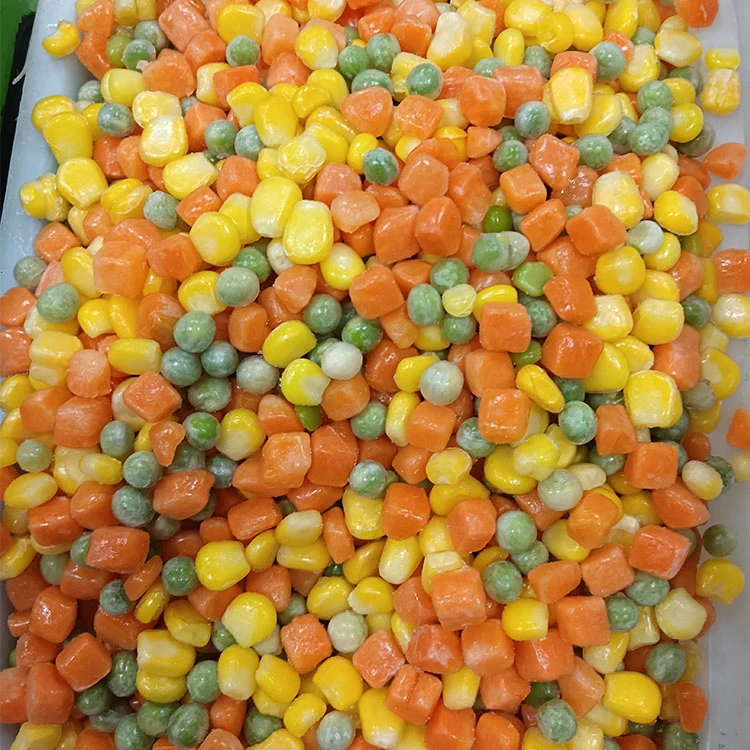
Receiving and cold-chain investigation for B2B buyers
At receiving, confirm vehicle or container condition, set point, available logger data, air and product temperature method, carton integrity, pallet stability, seal or liner condition, lot identity, and quantity. A single surface reading at the door may not represent the pallet center or a product near a damaged opening. Use the buyer's approved sampling and thermometer procedure.
When a deviation appears, isolate the affected lot and preserve evidence. Record time, location, readings, instrument identity, photographs, product condition, logger file, carrier information, and who controlled the product. Do not mix suspect cases with accepted stock. Contact the relevant QA, supplier, carrier, insurer, or authority according to the contract and food-safety plan.
The investigation should answer both safety and commercial questions. Even when disposition permits use, excessive clumping, frost, dehydration, broken pieces, or cooking loss may breach the specification. Conversely, a visual defect should not be described as a safety failure without the evidence to support that claim.
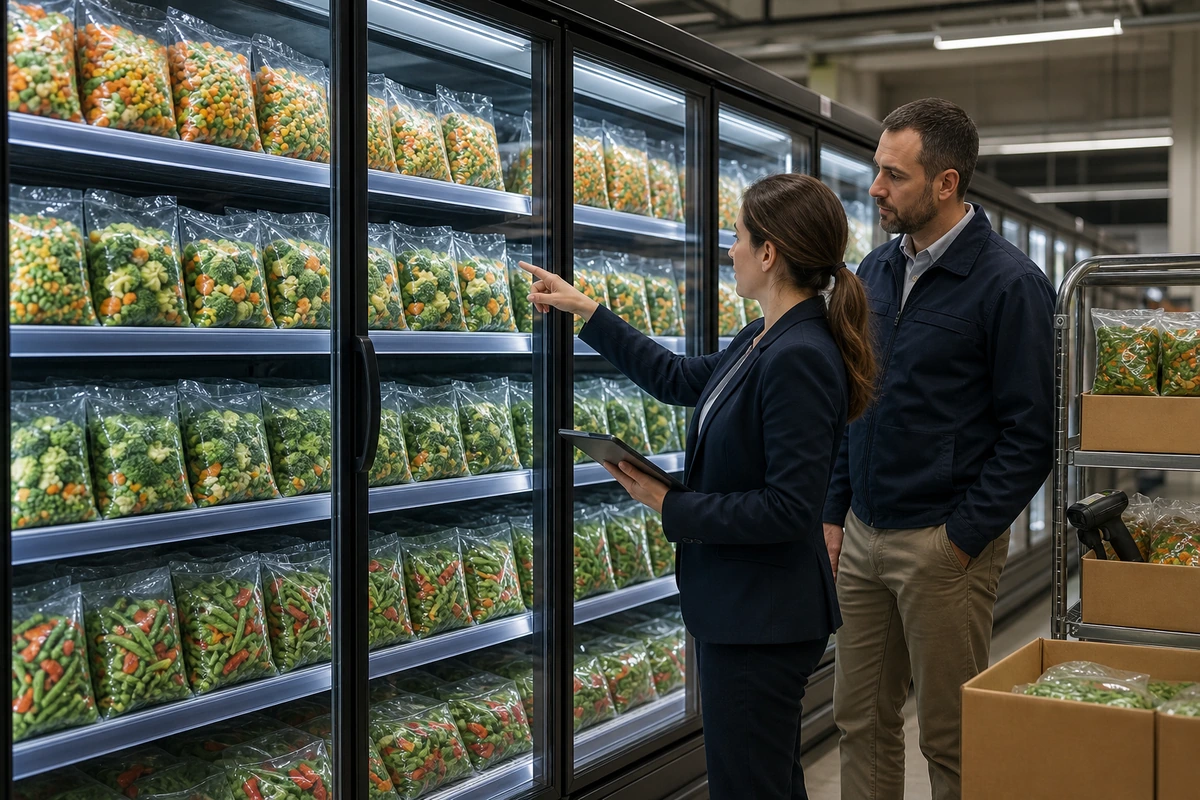
Shelf life only works when rotation and cabinet conditions work
A correct date on the bag cannot compensate for stock hidden behind newer cases, product stacked beyond the load line, repeated door opening, damaged seals, weak airflow, or a cabinet operating above its target. Retail checks should combine date rotation with pack condition and temperature control.
Review complaints by lot and location. If one store reports clumping while retained samples and other stores remain normal, examine cabinet performance and handling. If the pattern follows a lot across locations, investigate production, packing, transport, and common storage history.
What to request in a frozen vegetable shelf-life specification
Request the product name and cut, ingredient statement, blanching or processing state, pack format and materials, net weight, storage temperature, shelf-life period, date-code format, lot definition, microbiological criteria, sensory and physical tolerances, packaging requirements, loading plan, transport temperature, and handling after opening. Include the destination-market label and legal requirements.
Ask what evidence supports the declared period and whether it applies to the exact product and pack offered. A summary can identify study design, storage condition, checkpoints, parameters, deviations, and conclusion without disclosing unrelated confidential data. For sensitive documents, agree on controlled-copy handling.
Finally, connect shelf life to the application. A soup factory may accept softer pieces than a retail side dish; a ready meal may require the vegetable to survive a second freeze and reheat; a private-label bag may need strong visual separation through the end of sale. The commercial endpoint belongs in sample approval and ongoing complaint review.
FAQ: frozen vegetable storage and shelf life
How long do frozen vegetables last in the freezer?
For home-frozen fruits and vegetables, 8–12 months at 0°F / -18°C is a common best-quality guide. Use the printed date and specification for a commercial pack because its validated shelf life may differ.
For storage and handling details, see The Basics of Freezer Storage.
Are frozen vegetables safe after 12 months?
Food held continuously frozen at 0°F / -18°C can remain safe beyond a quality guide, but quality declines and unknown temperature abuse changes the decision. Check the product state, package, history, and official guidance.
Do frozen vegetables expire?
Commercial packs carry date and storage information that should be followed. A best-before date generally addresses quality under stated conditions; other date types and local rules may have different meanings. Do not assume they are interchangeable.
What does freezer burn look like on vegetables?
It may appear as dry, pale, grayish, shriveled, or tough surface areas caused by dehydration and air exposure. It is mainly a quality defect, but inspect the packaging and history before deciding how to use the product.
Does clumping mean vegetables thawed and refroze?
Not by itself. Temperature cycling can cause clumping, but compression, shape, and surface moisture can also join pieces. Review temperature logs, seal condition, ice pattern, carton damage, and retained samples.
How should I store an opened bag?
Remove only what you need, push out excess air, reseal tightly, date the opening, and return it promptly to 0°F / -18°C or below. Use clean utensils and rotate opened stock first.
Can thawed frozen vegetables be refrozen?
The answer depends on the thaw temperature, time, product, package direction, and official guidance. Refreezing can reduce quality. A business should use its approved food-safety and disposition process, not a general shortcut.
How long do cooked frozen vegetables last?
Once cooked, treat them as cooked leftovers. Cool promptly, refrigerate at the required temperature, and follow the applicable local leftover-storage and reheating guidance rather than the original frozen shelf life.
Why do some commercial frozen vegetables say 24 months?
A longer commercial period can be supported by controlled processing, IQF freezing, selected packaging, stable -18°C storage, testing, and distribution controls. It applies only to the specified product and pack under its stated conditions.
What should an importer verify?
Verify the exact shelf-life statement, storage condition, date coding, pack and carton, supporting evidence, transport temperature, receiving method, lot traceability, complaint process, and destination-market requirements.
Need a frozen vegetable specification for your market?
Tell us the vegetable or blend, cut, pack format, expected shelf life, storage and transport condition, volume, destination market, and final application. We can review suitable specifications, packaging options, available evidence, and representative samples before order confirmation.