


What Color Should Ginger Be Inside?
Aug 31, 2026
Leave a message
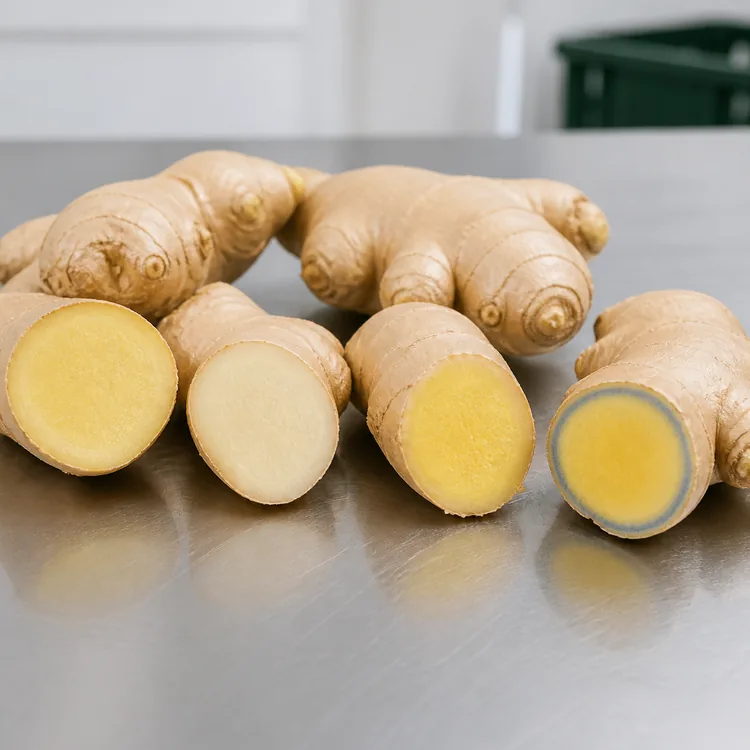
Judge ginger color as a range, then verify the condition
The usual inside color is grayish white to creamy white, pale yellow, or yellow. USDA inspection guidance notes that some cultivars may show a bluish ring or tinge when cut crosswise. Research also shows that ginger's yellow intensity varies with cultivar, cultivation region, and maturity. These are normal reasons why two sound pieces do not look identical.
The decisive question is not simply "What color is it?" but "Is the color uniform and natural for the agreed product, and is the tissue firm, clean-smelling, and free from wet breakdown or mold?" A receiving team should hold a lot when color falls outside the approved reference range, then check a wider sample, temperature records, texture, odor, cut-form uniformity, and defect distribution before disposition.
1. Use a target range
Specify creamy white, pale yellow, or natural yellow as a range tied to approved samples, not as one impossible universal shade.
2. Blue is not automatically bad
A clean blue or blue-green ring in otherwise firm, aromatic ginger may reflect cultivar or natural pigmentation rather than decay.
3. Brown needs context
Dry, slightly woody tissue suggests age or dehydration; brown tissue that is wet, soft, spongy, slimy, or foul-smelling suggests breakdown.
4. Sample the lot
Cut pieces from multiple cartons, positions, and production time points. One attractive top layer or one bad piece cannot represent a shipment.
5. Separate quality from safety
A pale but dry sample may be safe yet weak for premium slicing. Visible decay, mold, or off-odor is a food-condition issue, not a cosmetic downgrade.
Inside color guide: target, acceptable variation, hold, or reject
The table below is a receiving decision framework, not a substitute for the contract specification. Natural color varies by ginger type and maturity. Your final disposition should follow the approved product description, sampling plan, defect tolerance, and destination-market requirements.
| Inside appearance | Likely interpretation | What to check next | Commercial disposition |
|---|---|---|---|
| Creamy white or grayish white | A normal color for some cultivars and commercial types, especially when the flesh is clean and uniform. | Firmness, typical aroma, moisture, fiber, and match to the approved origin and reference photo. | Accept when within specification. Do not downgrade only because it is less yellow than another origin. |
| Pale yellow to yellow | The most familiar target for mature fresh or frozen ginger. Intensity changes with cultivar, region, and maturity. | Uniformity across the sample, clean cut surface, pungent aroma, fiber level, and absence of dark wet patches. | Accept when the shade and other sensory points match the confirmed specification. |
| Blue or blue-green ring | May be a natural cultivar trait or pigment expression. It is different from fuzzy surface growth. | Whether the ring is clean and consistent; tissue firmness; aroma; absence of slime, mold, wetness, or cavity breakdown. | Hold only if outside the agreed appearance. Re-sample and confirm cultivar/origin before rejecting. |
| Dry tan or slightly woody | Often maturity, moisture loss, or extended storage rather than active rot. Flavor and processing yield may still be affected. | Fiber, peel loss, trimming yield, aroma strength, rehydration or cooking performance, and distribution through the lot. | Accept, downgrade, or redirect by application if the product is sound but misses a premium texture target. |
| Localized brown or gray patch | Could be bruise, oxidation, dehydration, chilling injury, or early internal deterioration. | Cut beyond the patch, press the tissue, smell the fresh cut, inspect the cavity, and widen the sample. | Place the affected lot on hold until defect type, frequency, and tolerance are confirmed. |
| Brown, dark gray, or black with wet/soft tissue | Strong evidence of internal breakdown or rot, especially with sponginess, slime, cavities, or off-odor. | Extent, odor, temperature history, package leakage, microbial or pathology follow-up, and cross-carton distribution. | Reject affected units; reject or quarantine the lot according to the agreed defect limit and food-safety procedure. |
| Pink near young tips or after acid processing | Can be a normal feature of young ginger or an acid-related color change in pickled products. | Product identity, maturity, processing declaration, ingredient list, and approved color standard. | Accept only when consistent with the declared ginger type and process; investigate unexplained pinking in a frozen raw product. |
Useful reference point: USDA inspection instructions describe ginger flesh as grayish white to creamy white and explicitly note that some cultivars may show a bluish ring or tinge. That is why a color chart should separate natural variation from deteriorated texture.

For peeled frozen ginger, buyers usually define the target as a clean natural light-yellow-to-yellow color together with controlled fiber, defects, and cut form.
Why sound ginger does not have one universal inside color
Ginger is a rhizome, and its internal appearance reflects biology before it reflects a defect. Cultivar is the first variable. A USDA inspection reference describes the flesh of ginger as grayish white to creamy white and records a bluish ring or tinge in some cultivars. A food-science study of many ginger samples found that the basic color is pale yellow but that intensity changes with cultivar, cultivation location, and maturation stage.
Maturity changes more than color. Young ginger is usually tender, juicy, mildly aromatic, and low in developed fiber. Mature ginger becomes more fibrous, more strongly flavored, and often more yellow. Those differences affect cutting yield and application suitability. A buyer ordering tender slices for pickling has a different target from a sauce factory ordering minced mature ginger for pungency and cooked flavor.
For ingredient format details, see How to Dehydrate Ginger: Slices, Powder and Quality Control.
Origin, harvest timing, curing, storage, peeling depth, and cut-surface exposure also shift appearance. A deeper peel can remove darker peripheral tissue; oxidation may darken an exposed surface; moisture loss can make the flesh dull and woody. These variations should be controlled through a product-specific range rather than through a web color name such as "bright yellow."
Color alone cannot separate age, damage, and decay
A cut piece can be off target without being rotten. Dry, stringy ginger may simply be over-mature or dehydrated. It can remain usable for extraction, sauce, or soup applications, yet fail a premium slice specification because the buyer will lose trimming yield or see coarse fibers in the finished product. That is a quality and application decision.
Rot has a different pattern. Published plant-disease work describes internal rhizome rot as yellowish-brown to brown discoloration with tissue progressing from firm to spongy. Other ginger soft-rot descriptions include water-soaked brown lesions and foul odor. Commercial inspectors therefore look for combinations: spreading discoloration, tissue collapse, wetness, slime, cavities, mold, or an abnormal sour, fermented, or musty odor. One signal reinforces the next.
The distinction matters because "trim the dark part" is not a complete receiving decision. Trimming may be possible in a kitchen for one dry bruise, but an importer or factory must quantify the affected weight, evaluate whether the defect is localized, check whether handling conditions could have spread the problem, and apply the written lot tolerance. Active decay should not be converted into a cosmetic downgrade.
A visual comparison is useful only when every tray has a decision rule
A color board should not contain only "good" and "bad." Use at least four conditions: target, acceptable natural variation, investigate/hold, and reject. The target represents the approved saleable product. Acceptable variation captures clean cream-to-yellow differences or an approved blue ring. Hold covers unexplained patchy discoloration, excess dryness, or a change from the pre-shipment sample. Reject covers decay, mold, severe internal breakdown, and off-odor.
Reference photos work best when they use the same cut, lighting, and thawing state as inspection. A frozen ginger cube photographed under warm retail lighting cannot be compared fairly with a freshly cut raw rhizome under a cool lamp. Record whether the reference is fully frozen, tempered for cutting, or thawed under a controlled method.
The four-tray visual shows why "yellow versus brown" is too simple. Clean cream and yellow tissue can both be acceptable. A blue ring may be a natural variation. Dry fibrous tissue can be sound but unsuitable for a tender application. Wet brown breakdown is the clear defect condition.
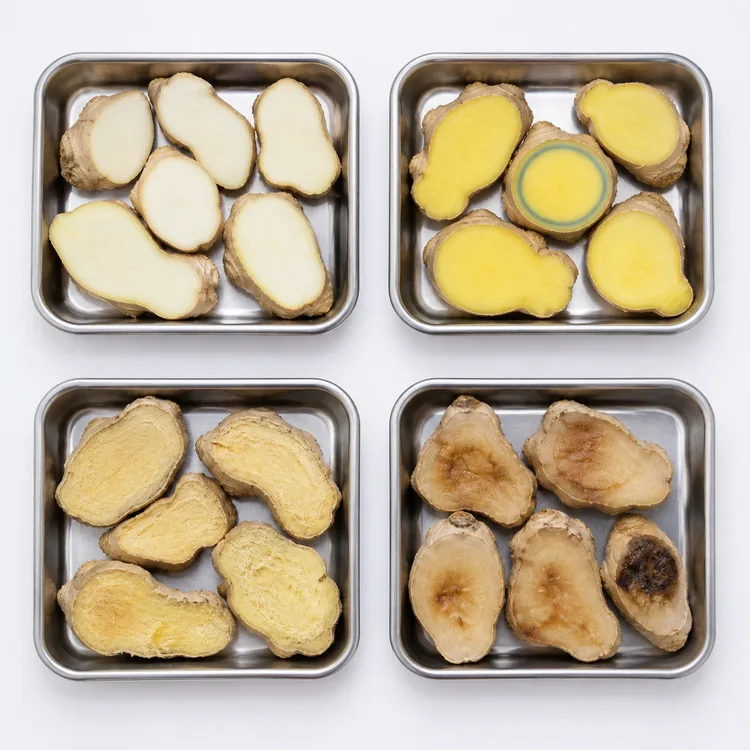
Cream, yellow, blue-ring, dry-fibrous, and wet-brown conditions lead to different receiving decisions; color should be paired with tissue and odor.
Fresh and frozen ginger require different inspection timing
The original rhizome and the finished frozen ingredient are related, but the receiving controls are not identical. Fresh ginger is assessed as a living harvested crop with skin, plumpness, sprouting, dehydration, and chilling sensitivity. Frozen ginger is assessed against its declared process, form, frozen condition, packing integrity, free-flowing performance, and appearance after a controlled cut or thaw check.
| Control point | Fresh ginger | Frozen ginger |
|---|---|---|
| Initial condition | Plumpness, firm skin, cuts, bruises, sprouting, shriveling, soil, and external decay. | Case and liner integrity, frozen temperature, ice accumulation, piece separation, dehydration, and thaw/refreeze clues. |
| Inside color check | Cut immediately with a clean knife; compare multiple rhizome positions and cartons. | Inspect frozen appearance first, then cut a safely tempered piece or thaw a defined test portion under refrigeration. |
| Texture meaning | A crisp, firm cut supports freshness; woody fiber may show maturity or dehydration; softness may show breakdown. | Some softening after thawing is expected. Compare against a validated control and the intended application, not against raw crispness. |
| Color tolerance | Set by cultivar, origin, maturity, and fresh-market class. | Set by raw material plus peeling, cut form, freezing, storage, and agreed finished-product reference. |
| Temperature record | Review the fresh-storage program because mature ginger is chilling-sensitive below its recommended range. | Review reefer and receiving data against the frozen specification, commonly at or below -18°C for GreenLand frozen ginger programs. |
| Final decision | Accept, trim/downgrade, hold, or reject by grade and decay tolerance. | Accept, re-sample, hold, or reject by finished specification, cold-chain status, application test, and defect distribution. |
If your question is specifically about whether freezing is suitable, see our guide to freezing ginger. For lot-condition questions after storage, the related frozen ginger quality and spoilage guide provides additional context.
Six-step receiving procedure for an unusual ginger color
Use the same sequence whether the first observation is pale, blue-green, brown, or gray. The sequence prevents a single striking slice from deciding the fate of a full shipment.
- Quarantine the sample, not automatically the whole lot. Identify the pallet, carton, bag, batch, and sampling location. Photograph the unopened pack, the frozen or fresh state, and the cut surface under neutral light. If there is clear active decay, leakage, or off-odor, move directly into the site's food-safety hold procedure.
- Confirm product identity and inspection state. Check cultivar or commercial type when declared, origin, harvest or production date, fresh versus frozen status, peeling condition, cut form, and whether the sample was fully frozen, tempered, or thawed. A blue ring in a whole cultivar sample and unexplained green patches in minced product are not the same observation.
- Expand to a representative sample. Pull units from different cartons and pallet levels, including edges and center positions. For production lots, include early, middle, and late packing time points when available. Record both the number and weight inspected so the defect rate can be compared with the agreed tolerance.
- Run a consistent cut and sensory check. Use clean utensils. Cut across thick sections and through any visible patch. Record internal shade, uniformity, ring pattern, moisture, firmness, fiber, cavity condition, and aroma. Do not taste material with visible mold, slime, wet rot, or abnormal odor.
- Compare with the specification and retained evidence. Review the approved pre-shipment sample, reference photos, product specification, COA where relevant, inspection report, and cold-chain record. For frozen lots, evaluate free-flowing condition, excessive ice, clumping, damaged liners, and temperature deviation alongside color.
- Make and document the disposition. Accept when the lot matches the agreed range; accept with a documented quality concession only when safe and commercially usable; hold when cause or frequency is uncertain; reject when decay, contamination, or out-of-tolerance defects are confirmed. Preserve photos and samples according to the claim procedure.
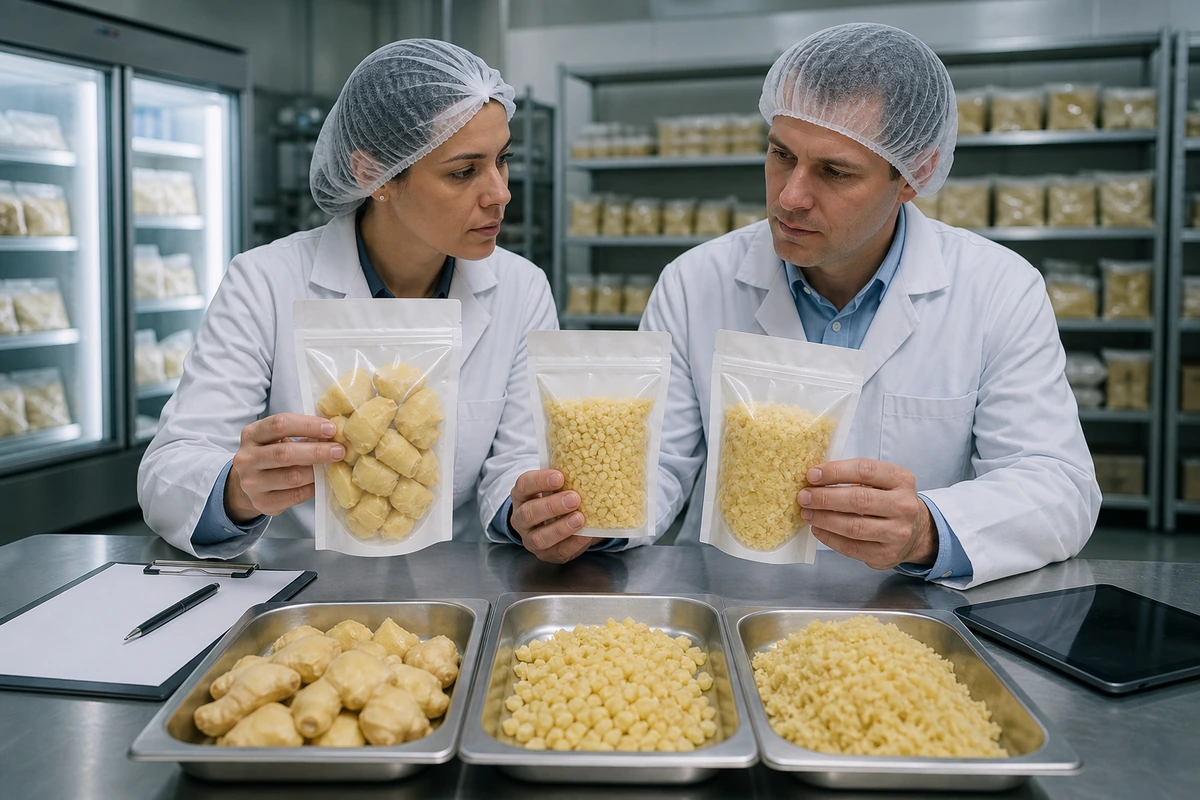
Compare the same product form and thaw state: whole pieces, dice, and grated ginger expose different amounts of cut surface and therefore look different.
For a closer explanation, see How to Use Frozen Ginger.
Sampling must match the way the product is packed and used
Whole peeled ginger gives the inspector a clear cross-section but can hide a localized center defect until cut. Dice exposes more surface and makes scattered dark pieces easier to count, yet it also shows more natural tone variation from different parts of the rhizome. Minced or grated ginger should be assessed for overall color uniformity, oxidation, excess liquid after thawing, fiber, aroma, and foreign matter; individual ring patterns are no longer visible.
Blocks and puree require a defined thawing and mixing protocol. The top layer may appear darker through air exposure while the center remains within target. Take portions from more than one depth, then compare the mixed sample with the approved standard. For cubes, check cube weight or dimensions and inspect broken material because exposed fragments can create an impression of darker overall color.
Record the intended application before deciding whether a sound but non-ideal color is usable. A retail transparent pack may need tighter visual uniformity. A dark sauce can tolerate a broader natural shade if aroma, pungency, fiber, and safety are controlled. The application does not excuse decay, but it can determine whether a harmless natural variation is commercially acceptable.
Write the color requirement so two inspection teams can reach the same decision
"Natural ginger color" is too vague on its own. A workable specification names the product form and inspection state, defines the target color range, identifies acceptable natural variations, lists reject defects, states the sampling unit and tolerance, and attaches controlled reference photos. It also tells the inspector what to do when the observation falls between categories.
For example: "Peeled IQF ginger dice, inspected frozen and after controlled refrigeration thaw; natural creamy light-yellow to yellow color, reasonably uniform for the raw-material origin; clean cultivar-related blue ring permitted only when tissue is firm and free from off-odor; brown water-soaked tissue, soft rot, visible mold, and black internal breakdown not permitted; other discoloration subject to the agreed defect tolerance and representative sampling plan." The final wording must match the buyer's risk, application, and legal requirements.
Build a color specification around measurable commercial points
Product identity
Name whole peeled pieces, slices, dice, mince, grated ginger, cubes, block, or puree. State raw or blanched when relevant and confirm the ingredient declaration.
Target and variation
Define cream-to-yellow limits with approved photographs. Record whether a clean blue ring, slight peripheral darkening, or minor shade variation is acceptable.
Defect definitions
Separate dry woody tissue, bruise, oxidation, peel residue, and harmless natural pigmentation from water-soaked rot, mold, slime, off-odor, and foreign matter.
Sampling and tolerance
State how many cartons, bags, pieces, or kilograms to inspect, how affected weight is calculated, and which defects have zero, critical, major, or minor tolerance.
Inspection condition
Define lighting, frozen or thawed state, thaw time and temperature, cut method, and whether the assessment is before or after cooking or blending.
Corrective action
Define accept, re-sample, sort, rework, downgrade, claim, hold, and reject authority so disposition does not depend on an improvised email after arrival.
Product form and application determine how much appearance matters
For visible retail packs, pale-to-yellow uniformity and clean cut edges support consumer confidence. Buyers normally set a tighter limit for dark fragments, peel residue, clumps, broken dice, and excess frost because each defect is visible through the bag. Private-label artwork and photography should show the same general product form and color range that the buyer will receive.
For foodservice, portion control and prep reduction may matter more than a perfectly matched shade. Frozen cubes or pre-cut pieces should still have typical ginger aroma and a clean color, but kitchens may prioritize cube weight, bag opening performance, free-flowing condition, and predictable cooking. A pale cream batch can perform as well as a deeper-yellow batch when the specification and flavor target are met.
Sauce, seasoning, marinade, soup-base, and beverage processors usually evaluate aroma, pungency, fiber, dosing format, microbiological requirements, and extraction performance alongside color. Minced or grated ginger with excessive browning can darken a light sauce, while coarse mature fiber can remain visible in a smooth beverage. Application trials clarify whether a sound natural shade difference is meaningful.
GreenLand-food supplies frozen ginger in root, slice, dice, cube, minced, grated, and other confirmed forms. We match the color target with peeling, cut size, fiber condition, packing, application, and destination requirements rather than quoting a color word in isolation.

Cube programs add portion weight, shape, breakage, and packing performance to the normal color, aroma, fiber, and defect checks.
Cold-chain and package evidence can explain a color complaint
A color difference at receiving may originate before freezing, during processing, or after packing. Review the evidence in that order. First confirm raw-material origin and maturity, because those affect the normal cream-to-yellow baseline and fiber. Next review washing, peeling, trimming, cut-size control, exposure time, freezing method, and final inspection. Finally, check cold storage, reefer data, loading inspection, arrival temperature, case condition, liner seals, ice accumulation, and clumping.
Thawing history is especially important. Repeated or uncontrolled thawing can change texture, release liquid, increase clumping, and accelerate surface discoloration. A shipment can still be deeply frozen at arrival even if part of the journey experienced a temperature excursion, so a single probe reading should be considered with the recorder data and physical signs. Damaged cartons, wet cases, collapsed liners, large ice masses, or blocks formed from nominally IQF pieces deserve follow-up.
Documents do not replace inspection, but they connect the result to the order. Review the product specification, approved sample record, batch COA, production date, lot code, packing list, temperature record, and applicable inspection or test reports. If color is the only deviation and the product is otherwise sound, a controlled application test may support a commercial concession. If decay, abnormal odor, or loss of package integrity is present, application testing is not a substitute for the food-safety hold process.
For a detailed comparison of processing performance, see frozen ginger versus fresh ginger. That decision depends on the application; the color check is one part of a broader specification.
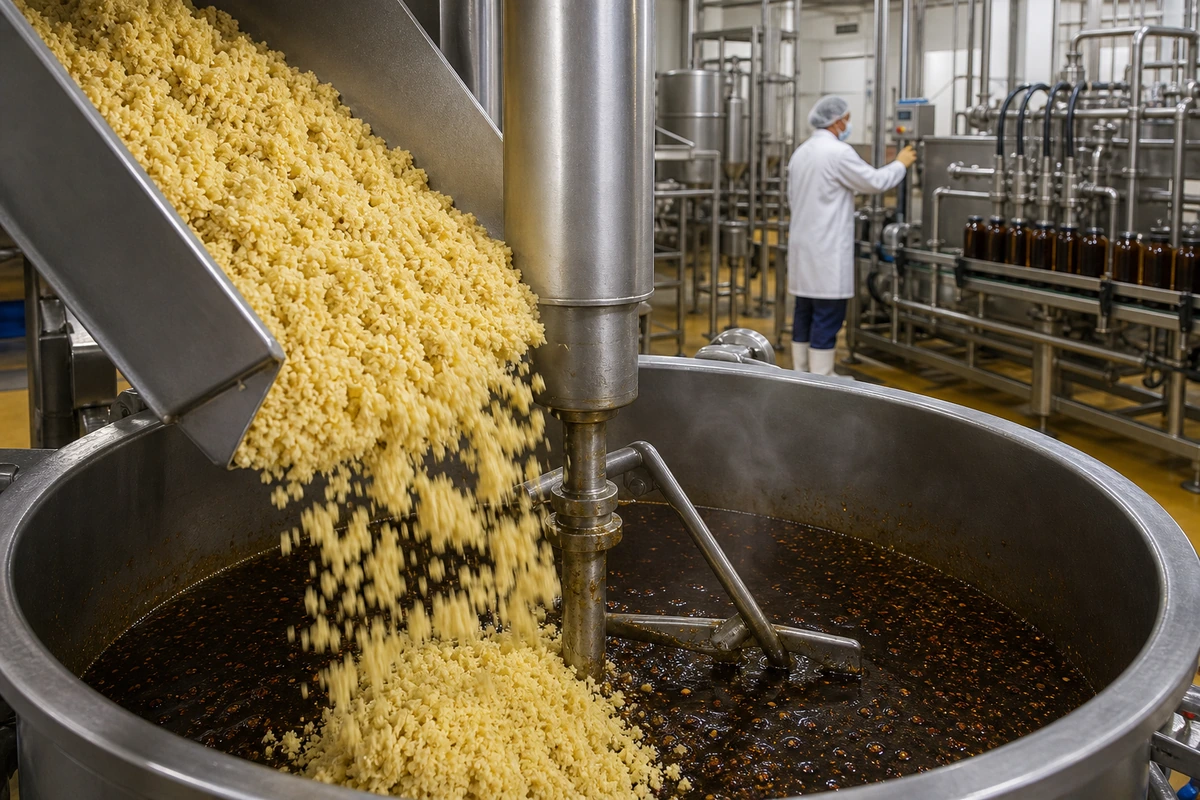
In sauce processing, a sound color variation may be less critical than aroma, pungency, fiber, dosing consistency, and the finished sauce appearance.
When to accept, re-sample, downgrade, or reject
Accept when the representative sample matches the approved color range, the tissue or thawed product has the expected condition, aroma is typical, packing and cold-chain evidence are satisfactory, and defects remain within tolerance.
Re-sample or hold when an unfamiliar blue-green ring, patchy gray area, unusual dryness, or shade shift appears without clear decay. Confirm product identity, inspect more cartons, and compare with the reference sample. A hold preserves options while the cause and distribution are checked.
Downgrade or redirect only when the product is sound but misses a commercial quality target such as tenderness, visual uniformity, or premium slice appearance. The alternate application must be technically suitable and accepted by the buyer; it cannot be used to bypass a safety or regulatory requirement.
Reject or quarantine when brown or dark discoloration is combined with soft, wet, spongy, slimy, moldy, or off-odor tissue; when the agreed critical defect tolerance is exceeded; or when cold-chain or package failure creates an unacceptable condition. Record the evidence before disturbing the lot further.
Buyer checklist before approving a ginger color specification
- Product form, peeling condition, cut size, cube weight, or block size is defined.
- Target inside color and acceptable natural variation are shown with controlled reference photos.
- Blue-ring or blue-green tissue is addressed explicitly rather than left to inspector opinion.
- Dry/woody tissue, bruise, oxidation, peel residue, brown discoloration, mold, soft rot, and foreign matter have separate definitions.
- Sampling quantity, inspection lighting, cut method, and frozen/thawed state are fixed.
- Tolerance is stated by count or weight, with critical defects separated from minor appearance defects.
- Aroma, pungency, fiber, free-flowing condition, excess ice, and drip or liquid condition are included where relevant.
- Packing, private-label requirements, carton marks, storage temperature, and destination are confirmed.
- Required documents-specification, COA, traceability, tests, certificates, temperature records, and shipment documents-are agreed before production.
- Accept, hold, re-sample, concession, claim, and reject authority is clear to both parties.
FAQ about ginger color inside
Should ginger be white inside?
Yes. Grayish-white, creamy-white, and pale flesh can be normal for sound ginger, depending on cultivar, origin, and maturity. Check firmness, typical ginger aroma, moisture, and the approved product reference rather than requiring every lot to be bright yellow.
Why is some ginger blue or green inside?
Some cultivars naturally show a bluish ring or tinge when cut. Clean, firm, aromatic tissue with a consistent ring is different from fuzzy mold, slime, wet patches, or soft breakdown. Commercial buyers should confirm cultivar and sample distribution before deciding.
Is gray ginger automatically bad?
No. Creamy or grayish-white flesh can be normal. Patchy dark gray tissue needs investigation, especially when it is wet, soft, spongy, hollow, slimy, or off-smelling. Cut beyond the area and expand the sample rather than deciding from the shade alone.
What color should frozen ginger be after thawing?
It should remain within the confirmed natural cream-to-yellow range for its origin and form, without abnormal dark, water-soaked, or moldy areas. Some softening and liquid release can occur after thawing, so compare it with a validated control under the same thaw method.
How much ginger discoloration is acceptable in a bulk order?
There is no universal percentage for every form and market. Agree the defect definitions, sampling unit, and tolerance in the specification before production. Active decay, visible mold, and off-odor should be treated separately from harmless natural shade variation.
Source Frozen Ginger with GreenLand-food
GreenLand-food is a professional frozen ginger supplier and manufacturer in China, providing factory-direct wholesale supply for importers, food manufacturers, foodservice distributors, and private-label programs.
Send the product form, specification, packing, quantity, application, destination, private-label needs, and requested documents. We will confirm the available cut, color and defect standard, fiber target, MOQ, lead time, cold-chain plan, and order-specific documentation.