


How Long Does Frozen Broccoli Last? Storage and Quality Signs
Sep 23, 2026
Leave a message

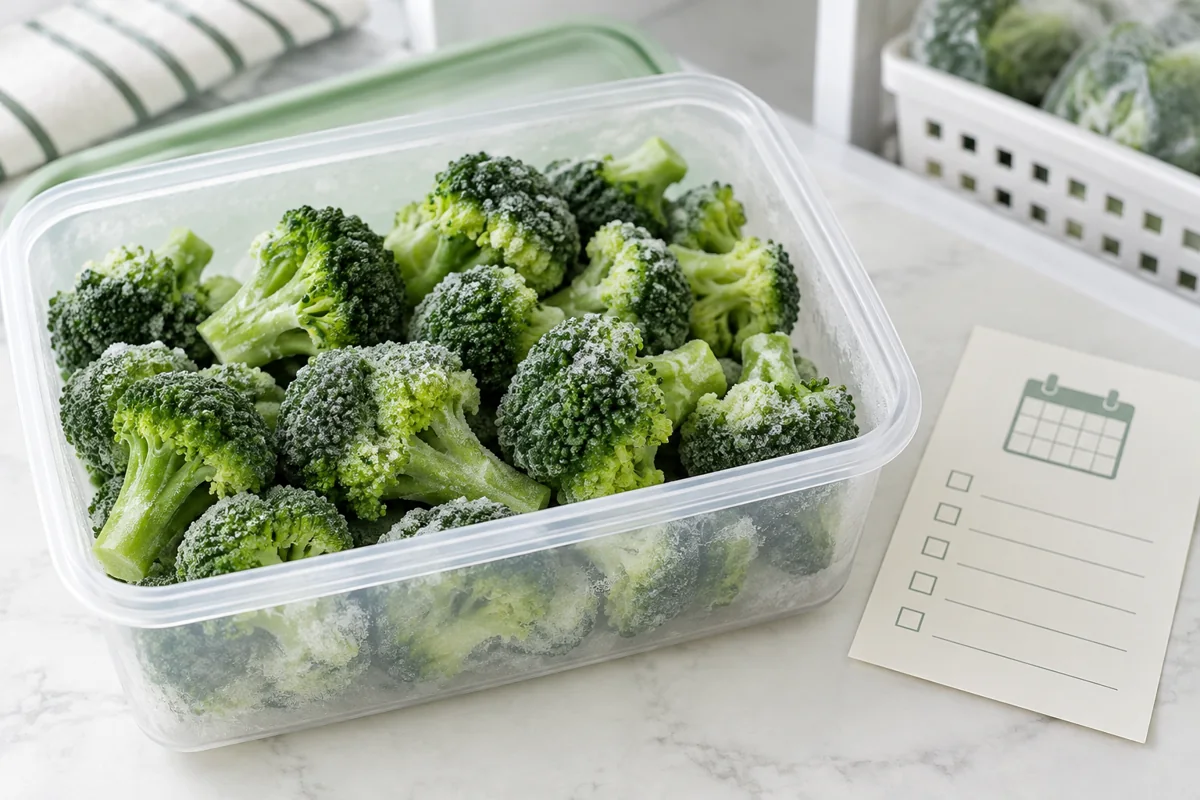
How Long Frozen Broccoli Keeps Its Best Quality
How Long Frozen Broccoli Keeps Its Best Quality.
A 10-to-12-month range is commonly used for best quality, provided broccoli remains continuously frozen at 0°F (-18°C) or below. Quality still changes gradually as moisture migrates, pigments fade and exposed surfaces dehydrate.
In practice, this is where many otherwise careful batches go wrong. The clock should be read with the packing date, best-quality date and actual freezer history rather than as a stand-alone guarantee. The useful control is to decide the endpoint before starting, then keep the preparation, package and later use consistent.
For a buyer or production manager, the same issue becomes a specification question. Commercial users may set a shorter internal window when bright color, firm bite or low dehydration is critical. Record what was tested, including starting condition, portion or load, equipment and the observed result, so the next batch can be compared on the same basis.
Safety and sensory acceptance are separate decisions; a quality estimate cannot clear a package with unknown temperature abuse. That boundary matters because a convenient household method is not automatically a validated commercial process. A best-quality range is not a universal safety cutoff; the package, temperature history and applicable food-safety plan control the decision.
Authoritative background for this section includes USDA FSIS Freezing and Food Safety USDA AMS Frozen Broccoli Standards. These sources support the preservation or handling principles; the application recommendation still needs to be confirmed against the actual product and operating procedure.
A useful working check for "How Long Frozen Broccoli Keeps Its Best Quality" is to write down the starting material, the intended finished use, the variable being controlled and the point at which the result will be accepted. Quality still changes gradually as moisture migrates, pigments fade and exposed surfaces dehydrate. Then repeat the method with the normal production or household portion rather than judging only a tiny demonstration. Watch what happens during packing, freezing, heating or thawing as applicable, because a problem that appears at the end may have started much earlier. Commercial users may set a shorter internal window when bright color, firm bite or low dehydration is critical. If the result changes, investigate the material, load, temperature history, equipment and holding sequence before changing several settings at once. This simple record also makes supplier conversations more useful: both sides can discuss a defined form and observed performance instead of relying on broad adjectives. Finally, keep the limitation visible. Safety and sensory acceptance are separate decisions; a quality estimate cannot clear a package with unknown temperature abuse.
Why a Date Is Not the Whole Storage Answer

Why a Date Is Not the Whole Storage Answer.
| Route or format | Useful when | Main control |
|---|---|---|
| Printed date | Stock rotation and best-quality planning | Not a stand-alone safety clearance |
| Stable 0°F storage | Protecting frozen condition | Quality still declines gradually |
| Unknown thaw history | Hold and investigate | Do not rely on appearance alone |
Dates support stock rotation, but they do not describe every interruption in the cold chain or every package barrier. The decision should follow the intended use rather than a habit carried over from another format. Frozen food held continuously at 0°F stays safe indefinitely in USDA's general guidance, although quality declines over time.
A practical trial should change one variable at a time. A torn seal, heavy air space, repeated door opening or partial thawing can reduce useful quality well before a printed date. If several variables move together, a wetter, softer or less even result cannot be diagnosed reliably.
For business review, combine the lot code and date with receiving temperatures, storage records and package inspection. For repeat production, write the relevant cut, starting state, load, package and endpoint into the method. Staff should not have to infer them from a photograph.
Do not extend a weak lot simply because another brand carried a longer best-before period. We treat that as a quality-control choice, not a marketing promise. A best-quality range is not a universal safety cutoff; the package, temperature history and applicable food-safety plan control the decision.
The core preservation and handling references are USDA FSIS Freezing and Food Safety USDA AMS Frozen Broccoli Standards. They are used for factual limits and process logic, while exact product directions retain priority.
A useful working check for "Why a Date Is Not the Whole Storage Answer" is to write down the starting material, the intended finished use, the variable being controlled and the point at which the result will be accepted. Frozen food held continuously at 0°F stays safe indefinitely in USDA's general guidance, although quality declines over time. Then repeat the method with the normal production or household portion rather than judging only a tiny demonstration. Watch what happens during packing, freezing, heating or thawing as applicable, because a problem that appears at the end may have started much earlier. For business review, combine the lot code and date with receiving temperatures, storage records and package inspection. If the result changes, investigate the material, load, temperature history, equipment and holding sequence before changing several settings at once. This simple record also makes supplier conversations more useful: both sides can discuss a defined form and observed performance instead of relying on broad adjectives. Finally, keep the limitation visible. Do not extend a weak lot simply because another brand carried a longer best-before period.
Quality Signs You Can Check Before Cooking

Quality Signs You Can Check Before Cooking using the specific product form shown.
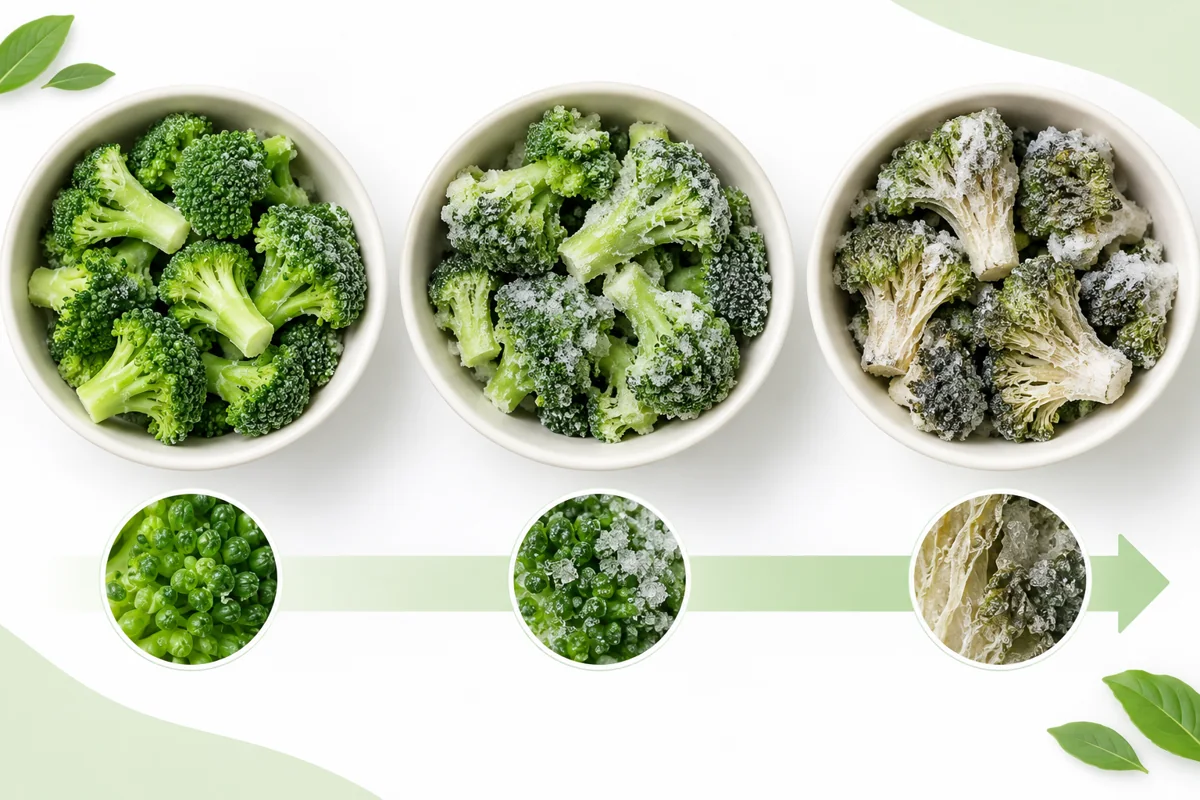
- Look for normal green color, identifiable florets and stems, a sound seal and a frost pattern consistent with the pack.
- Pale dry patches, excessive crumbs, severe yellowing or a dense fused block can indicate aging, dehydration or temperature movement.
- Cook a representative sample using one controlled method before judging flavor, aroma, bite and water release.
- Compare the result with the approved specification or retained reference rather than relying on memory.
Look for normal green color, identifiable florets and stems, a sound seal and a frost pattern consistent with the pack. Pale dry patches, excessive crumbs, severe yellowing or a dense fused block can indicate aging, dehydration or temperature movement.
The most useful check is not whether the method can work once, but whether it works with the exact material, portion and equipment that will be used. Cook a representative sample using one controlled method before judging flavor, aroma, bite and water release. Keep the first comparison small enough to observe clearly.
In procurement, translate the observation into something confirmable. Compare the result with the approved specification or retained reference rather than relying on memory. A written requirement makes supplier review and incoming inspection more objective.
Discard or hold product under the applicable food-safety plan when the package is damaged or its thaw history is uncertain. Avoid converting a quality range into a safety guarantee or a photograph into proof of an unseen process. A best-quality range is not a universal safety cutoff; the package, temperature history and applicable food-safety plan control the decision.
Reference points: USDA FSIS Freezing and Food Safety USDA AMS Frozen Broccoli Standards. Use the applicable label, local food-safety plan and product specification whenever they are more specific.
A useful working check for "Quality Signs You Can Check Before Cooking" is to write down the starting material, the intended finished use, the variable being controlled and the point at which the result will be accepted. Pale dry patches, excessive crumbs, severe yellowing or a dense fused block can indicate aging, dehydration or temperature movement. Then repeat the method with the normal production or household portion rather than judging only a tiny demonstration. Watch what happens during packing, freezing, heating or thawing as applicable, because a problem that appears at the end may have started much earlier. Compare the result with the approved specification or retained reference rather than relying on memory. If the result changes, investigate the material, load, temperature history, equipment and holding sequence before changing several settings at once. This simple record also makes supplier conversations more useful: both sides can discuss a defined form and observed performance instead of relying on broad adjectives. Finally, keep the limitation visible. Discard or hold product under the applicable food-safety plan when the package is damaged or its thaw history is uncertain.
What Freezer Burn, Ice and Clumping Mean
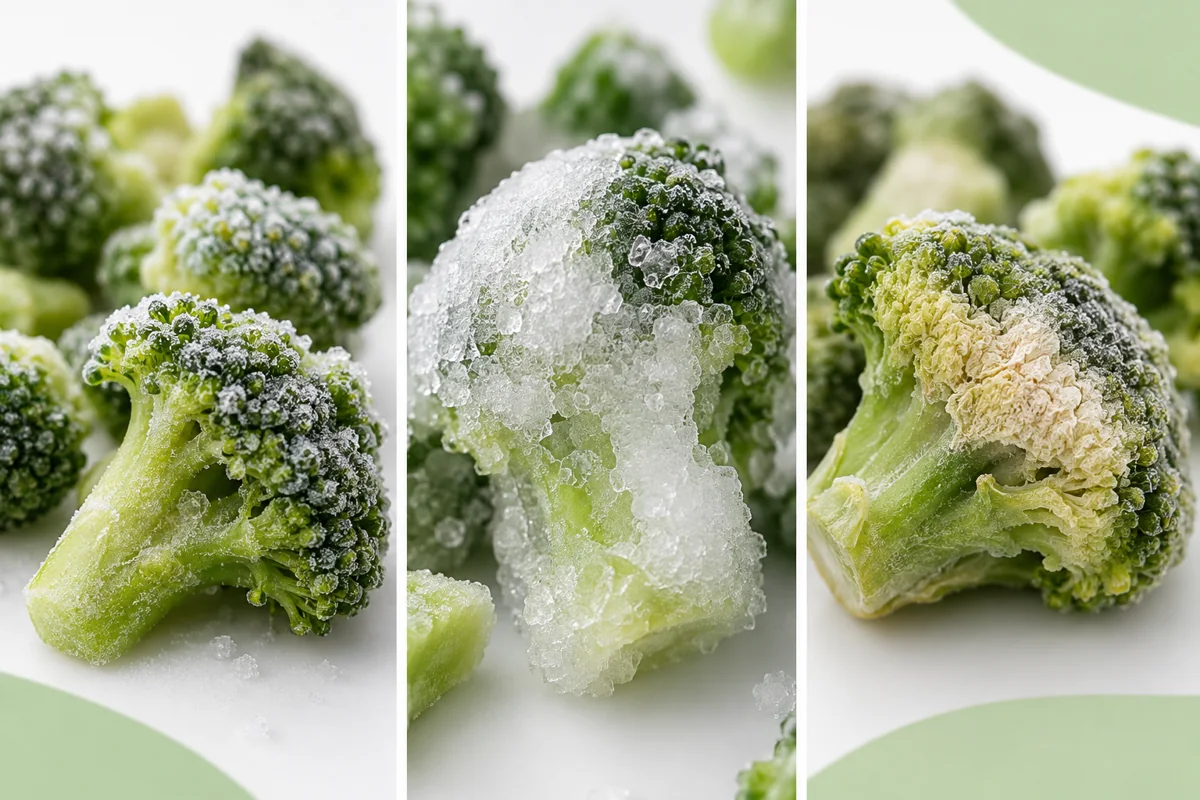
What Freezer Burn, Ice and Clumping Mean.
Freezer burn is dehydration caused when moisture leaves exposed food and later forms frost elsewhere; it is mainly a quality defect. That is the physical reason behind the recommendation. A light dusting of frost can occur in ordinary storage, while thick snow, large crystals or ice sheets deserve investigation.
Work in a clean, controlled sequence and avoid adding an unnecessary thawing or holding step. Clumping may result from surface moisture at packing, pressure in storage or partial thawing followed by refreezing. A shorter process is not automatically better, but every extra transition introduces another variable.
These signs do not all prove the same cause, so examine several bags, case condition and temperature records together. In a commercial review, compare the same quantity under the same conditions and record yield, appearance, texture and handling loss.
Trim or redirect mildly dehydrated broccoli only where the quality plan allows; do not use cooking to conceal mishandling. The result should be described honestly: useful for the named application, not perfect under every condition. A best-quality range is not a universal safety cutoff; the package, temperature history and applicable food-safety plan control the decision.
Process principles were checked against USDA FSIS Freezing and Food Safety USDA AMS Frozen Broccoli Standards. Those references do not verify a supplier-specific specification; current product documents do.
A useful working check for "What Freezer Burn, Ice and Clumping Mean" is to write down the starting material, the intended finished use, the variable being controlled and the point at which the result will be accepted. A light dusting of frost can occur in ordinary storage, while thick snow, large crystals or ice sheets deserve investigation. Then repeat the method with the normal production or household portion rather than judging only a tiny demonstration. Watch what happens during packing, freezing, heating or thawing as applicable, because a problem that appears at the end may have started much earlier. These signs do not all prove the same cause, so examine several bags, case condition and temperature records together. If the result changes, investigate the material, load, temperature history, equipment and holding sequence before changing several settings at once. This simple record also makes supplier conversations more useful: both sides can discuss a defined form and observed performance instead of relying on broad adjectives. Finally, keep the limitation visible. Trim or redirect mildly dehydrated broccoli only where the quality plan allows; do not use cooking to conceal mishandling.
How Packaging and Temperature History Change the Result
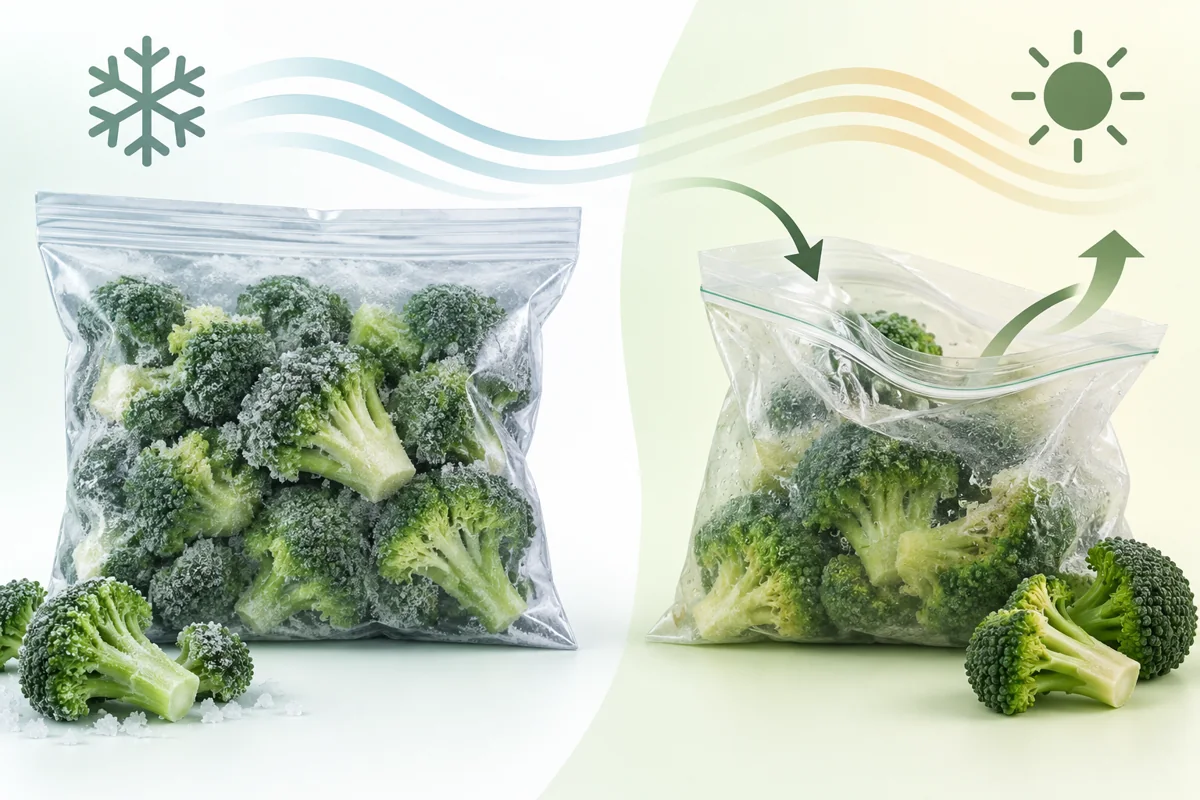
How Packaging and Temperature History Change the Result.
A strong moisture-vapor barrier and a reliable seal slow dehydration, odor pickup and frost formation. Stable storage matters because repeated small temperature swings encourage recrystallization and larger damaging ice crystals.
In practice, this is where many otherwise careful batches go wrong. Cases near doors, defrost airflow or warm loading zones may age differently from pallets held in a stable core position. The useful control is to decide the endpoint before starting, then keep the preparation, package and later use consistent.
For a buyer or production manager, the same issue becomes a specification question. Record receiving temperature, freezer set point, alarms and transfer time so quality complaints can be traced. Record what was tested, including starting condition, portion or load, equipment and the observed result, so the next batch can be compared on the same basis.
A package claim should be evaluated under its stated storage condition and the buyer's real distribution route. That boundary matters because a convenient household method is not automatically a validated commercial process. A best-quality range is not a universal safety cutoff; the package, temperature history and applicable food-safety plan control the decision.
Authoritative background for this section includes USDA FSIS Freezing and Food Safety USDA AMS Frozen Broccoli Standards. These sources support the preservation or handling principles; the application recommendation still needs to be confirmed against the actual product and operating procedure.
A useful working check for "How Packaging and Temperature History Change the Result" is to write down the starting material, the intended finished use, the variable being controlled and the point at which the result will be accepted. Stable storage matters because repeated small temperature swings encourage recrystallization and larger damaging ice crystals. Then repeat the method with the normal production or household portion rather than judging only a tiny demonstration. Watch what happens during packing, freezing, heating or thawing as applicable, because a problem that appears at the end may have started much earlier. Record receiving temperature, freezer set point, alarms and transfer time so quality complaints can be traced. If the result changes, investigate the material, load, temperature history, equipment and holding sequence before changing several settings at once. This simple record also makes supplier conversations more useful: both sides can discuss a defined form and observed performance instead of relying on broad adjectives. Finally, keep the limitation visible. A package claim should be evaluated under its stated storage condition and the buyer's real distribution route.
Choosing Uses for Older but Acceptable Broccoli
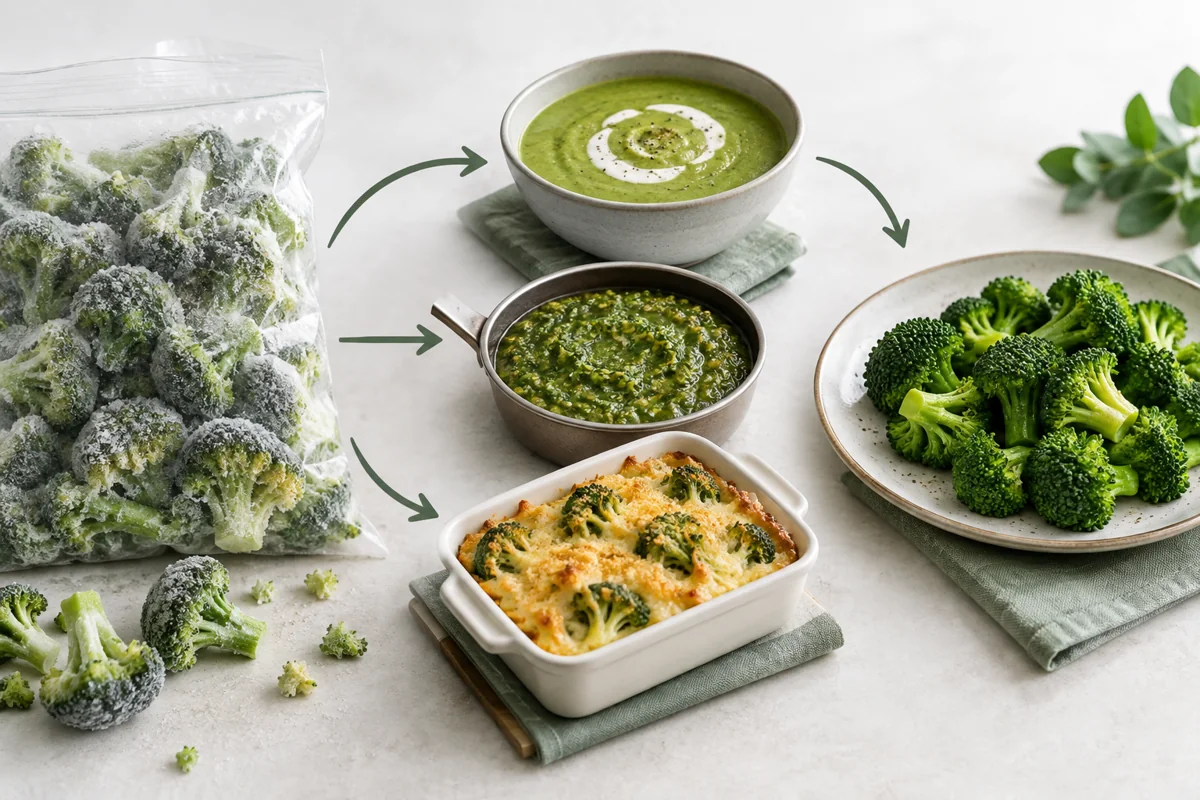
Choosing Uses for Older but Acceptable Broccoli.
Broccoli with sound flavor but a softer bite can work in soup, puree, sauce, filling or a blended vegetable base. The decision should follow the intended use rather than a habit carried over from another format. A visible side dish, stir-fry or premium bowl usually demands better floret integrity, color and bite.
A practical trial should change one variable at a time. Cook directly from frozen when the recipe allows, because an unnecessary thaw can add handling time and free water. If several variables move together, a wetter, softer or less even result cannot be diagnosed reliably.
Run a small application test and measure yield, drip, color and texture after the actual cook and hold sequence. For repeat production, write the relevant cut, starting state, load, package and endpoint into the method. Staff should not have to infer them from a photograph.
Using a lower grade deliberately is different from hiding a defect; the finished-product standard still needs to be met. We treat that as a quality-control choice, not a marketing promise. A best-quality range is not a universal safety cutoff; the package, temperature history and applicable food-safety plan control the decision.
The core preservation and handling references are USDA FSIS Freezing and Food Safety USDA AMS Frozen Broccoli Standards. They are used for factual limits and process logic, while exact product directions retain priority.
A useful working check for "Choosing Uses for Older but Acceptable Broccoli" is to write down the starting material, the intended finished use, the variable being controlled and the point at which the result will be accepted. A visible side dish, stir-fry or premium bowl usually demands better floret integrity, color and bite. Then repeat the method with the normal production or household portion rather than judging only a tiny demonstration. Watch what happens during packing, freezing, heating or thawing as applicable, because a problem that appears at the end may have started much earlier. Run a small application test and measure yield, drip, color and texture after the actual cook and hold sequence. If the result changes, investigate the material, load, temperature history, equipment and holding sequence before changing several settings at once. This simple record also makes supplier conversations more useful: both sides can discuss a defined form and observed performance instead of relying on broad adjectives. Finally, keep the limitation visible. Using a lower grade deliberately is different from hiding a defect; the finished-product standard still needs to be met.
What Buyers Should Confirm in a Frozen Broccoli Specification

What Buyers Should Confirm in a Frozen Broccoli Specification using the specific product form shown.
Confirm floret or cut format, size range, stem ratio, color, defect tolerances, loose-flow condition and any glazing. Align pack size, case weight, origin, crop or production date, frozen storage condition and shelf-life statement.
The most useful check is not whether the method can work once, but whether it works with the exact material, portion and equipment that will be used. Request the relevant microbiological, residue, traceability, certification and inspection documents for the destination market. Keep the first comparison small enough to observe clearly.
In procurement, translate the observation into something confirmable. We review the required application and commercial specification before confirming a frozen broccoli offer. A written requirement makes supplier review and incoming inspection more objective.
Approve a representative sample with the written specification so receiving teams have objective acceptance criteria. Avoid converting a quality range into a safety guarantee or a photograph into proof of an unseen process. A best-quality range is not a universal safety cutoff; the package, temperature history and applicable food-safety plan control the decision.
Reference points: USDA FSIS Freezing and Food Safety USDA AMS Frozen Broccoli Standards. Use the applicable label, local food-safety plan and product specification whenever they are more specific.
A useful working check for "What Buyers Should Confirm in a Frozen Broccoli Specification" is to write down the starting material, the intended finished use, the variable being controlled and the point at which the result will be accepted. Align pack size, case weight, origin, crop or production date, frozen storage condition and shelf-life statement. Then repeat the method with the normal production or household portion rather than judging only a tiny demonstration. Watch what happens during packing, freezing, heating or thawing as applicable, because a problem that appears at the end may have started much earlier. We review the required application and commercial specification before confirming a frozen broccoli offer. If the result changes, investigate the material, load, temperature history, equipment and holding sequence before changing several settings at once. This simple record also makes supplier conversations more useful: both sides can discuss a defined form and observed performance instead of relying on broad adjectives. Finally, keep the limitation visible. Approve a representative sample with the written specification so receiving teams have objective acceptance criteria.
Source frozen broccoli with GreenLand-food
We supply and coordinate frozen broccoli for wholesale and factory-direct programs. As a manufacturer-facing supplier, GreenLand-food will review the requested form, packing, documents and application before confirming an offer. A best-quality range is not a universal safety cutoff; the package, temperature history and applicable food-safety plan control the decision.