


How Many Calories Are in Cauliflower Rice?
Sep 08, 2026
Leave a message

That estimate applies to cauliflower alone. Oil, butter, cheese, sauces and added grains can change the result substantially. A product called cauliflower rice may be plain chopped cauliflower, a seasoned vegetable side or a mixture containing actual rice. Read the ingredient list before comparing the numbers.
The FDA's raw vegetable nutrition table lists 25 calories, 5 grams of carbohydrate and 2 grams of fibre for a 99-gram cauliflower serving. We use that as a clearly stated reference below. For a finished retail pack or prepared meal, use its own nutrition declaration and cooking instructions. Those details matter more than a generic claim that cauliflower rice is a low-calorie substitute.
Use a weighed portion to answer the calorie question
Cauliflower rice is cauliflower cut into small pieces resembling rice grains. Cutting changes its shape and cooking behaviour; it does not add calories. Plain fresh and plain frozen versions can therefore be compared sensibly when their ingredient lists and weight bases are equivalent. A seasoned microwave pouch needs a separate comparison because it may contain oil or other ingredients.
The FDA reference is approximately 25 calories per 100 grams after rounding. That makes a 150-gram uncooked portion approximately 38 calories and a 200-gram portion approximately 50 calories. These are calculations from a reference food, not laboratory results for every brand. A label may round individual values, so multiplying the displayed number can produce a slightly different result from the manufacturer's calculation.
| Plain cauliflower reference portion | Approximate calories before additions | What the estimate represents |
|---|---|---|
| 100 g | 25 | A convenient comparison weight |
| 150 g | 38 | A larger vegetable portion |
| 200 g | 50 | Double the 100 g reference |
| A loosely filled cup | Weigh it first | Piece size and packing affect the weight |

The portions use one rounded raw-cauliflower reference. Weighing the food makes the comparison clearer than using cups that can hold different amounts of fine or coarse pieces.
A kitchen scale removes much of the uncertainty. Put the bowl on the scale, reset it to zero and add the cauliflower rice. If you are using frozen cauliflower, weigh it in the state specified on the label. Do not compare an uncooked frozen portion with a cooked portion from another product without explaining that change. Water lost during cooking can make the cooked serving lighter without removing the same proportion of food energy.
For a family meal, an approximate portion estimate may be enough. For menu development, retail nutrition information or a commercial recipe, record the actual product, starting weight, added ingredients and finished yield. A scoop described as one cup is difficult to reproduce across operators, particularly when one batch is dry and loose and another is wet and compacted.
At GreenLand-food, we encourage buyers comparing frozen cauliflower to confirm the cut and ingredient declaration alongside nutrition information. A rice-sized cut is a physical specification. It does not, by itself, establish a particular serving size or support a finished-product nutrition claim.
Read carbohydrate and fibre figures on the same basis
The carbohydrate question usually accompanies the calorie question. Using the same FDA reference, raw cauliflower provides about 5 grams of total carbohydrate and 2 grams of fibre per 99 grams. Those figures are useful for understanding plain cauliflower rice, but the declaration on the actual pack remains the appropriate number for tracking that product.
Keep the measurement basis consistent. A 150-gram portion contains more carbohydrate than a 100-gram portion even when both come from the same bag. Comparing the first product per serving and the second per 100 grams can make two similar products appear very different. Convert both to the same weight, then compare the portions you intend to eat or serve.
Terms such as total carbohydrate, available carbohydrate and net carbs are not interchangeable across every market or label. In a declaration where total carbohydrate includes fibre, subtracting fibre gives an informal estimate sometimes described as net carbs. The result depends on the labelling convention. Do not subtract fibre again from a figure that already excludes it, and do not assume a marketing phrase is a regulated calculation everywhere.
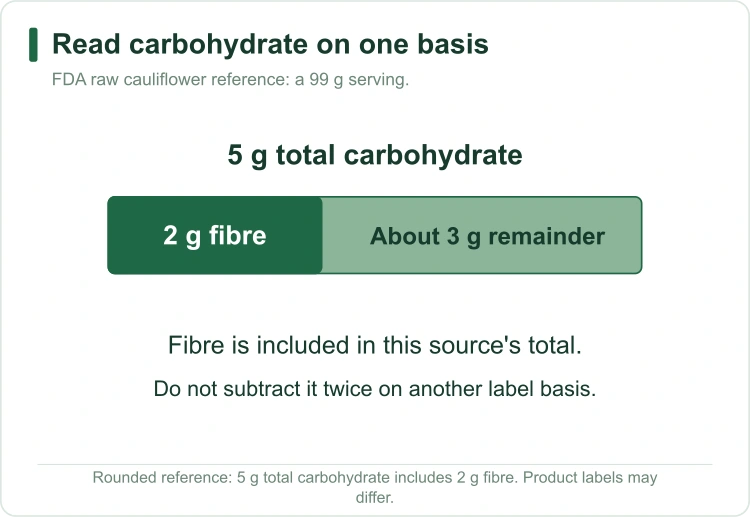
Fibre is included in the total carbohydrate figure shown for this source. Check the declaration basis before applying a subtraction to a product sold in another market.
For example, subtracting the FDA table's rounded 2 grams of fibre from its rounded 5 grams of carbohydrate gives approximately 3 grams on that reference serving basis. That is arithmetic using rounded source values. It is not an exact composition result or a declaration suitable for copying onto a new product. Commercial claims need the correct jurisdiction, recipe and supporting data.
Cauliflower rice also differs from cereal rice in structure and starch content. It will not absorb liquid, bind a rice pudding or give a risotto the same consistency simply because the pieces look similar. A recipe that relies on rice starch may need another ingredient or a different cooking method. That addition belongs in the carbohydrate calculation too.
If you use a carbohydrate target for a medical reason, the relevant meal includes sauce, protein coating, drinks and other sides. This article provides a food-comparison method rather than a personal treatment plan. For procurement, the practical task is to obtain a consistent nutrition basis for the supplied ingredient and then calculate or test the finished formulation using the requirements of its destination market.
Compare plain, seasoned and grain-blended products
Start the comparison with the ingredient list. Plain cauliflower rice should identify cauliflower as its ingredient. A seasoned product might include herbs, salt, oil or a sauce. A blended product might contain cauliflower together with white rice, brown rice, quinoa or another grain. Each can be useful, but their nutrition figures answer different questions.
The Green Giant Riced Cauliflower product page describes a vegetable product without sauce or seasoning. That is an example of why product identity comes first: the name alone does not tell you whether another brand uses the same formulation. Always read the current pack rather than transferring one manufacturer's values to a similarly named item.
| Product type | First label check | Likely reason the numbers differ |
|---|---|---|
| Plain cauliflower rice | Cauliflower as the ingredient | Product variation, water content and rounding |
| Herb-seasoned cauliflower | Oil, butter and sauce ingredients | Added fat or other recipe components |
| Cauliflower with cheese sauce | Full sauce formulation and serving basis | Cheese, fat, starch and portion size |
| Cauliflower and cereal rice blend | Percentage and type of added grain | A different balance of vegetable and grain |
| Ready meal with cauliflower rice | Nutrition for the whole meal | Protein, sauce, toppings and total portion |

A similar product name can describe different ingredient lists. Compare the same weight and preparation basis before deciding what a calorie difference means for the finished portion.
Seasoning does not automatically mean a large calorie increase. A small amount of dried herbs has a different effect from a generous cream sauce. Equally, a product promoted as vegetable based can still contain substantial added fat. Specific ingredients and quantities are more informative than broad descriptions such as healthy, light or clean.
Check whether the panel describes the food as sold or as prepared. A frozen pack may show nutrition before cooking while its suggested method asks you to add oil. Another pack may include the oil in a sauce pouch. Unless the basis is clear, the two panels cannot tell you which finished side dish contains fewer calories.
A grain blend can offer a useful compromise when diners want a familiar rice texture with more vegetables. It should be evaluated as that blend. Calling it equivalent to plain cauliflower rice creates confusion for both nutrition calculations and cooking trials. Grain proportions also affect liquid requirements, hot holding and the way the dish reheats.
For an own-label enquiry, send us the intended ingredient statement and whether the product will be sold plain or further formulated. We can review the cauliflower cut and packing requirements against that intended use. Any seasoning recipe, nutrition calculation and label wording should be confirmed for the actual finished product, rather than inferred from a plain vegetable specification.
Calculate oil, sauce and portion changes
Added fat often has a larger effect on the calorie total than small differences between plain cauliflower products. Fat supplies about 9 calories per gram. In a simple calculation, 5 grams of oil adds approximately 45 calories and 10 grams adds approximately 90. Measure the oil if the number matters; a free pour is difficult to reproduce.
Consider an illustrative batch containing 400 grams of plain cauliflower rice. At the rounded reference value, the vegetable contributes approximately 100 calories. Adding 10 grams of oil brings the batch to approximately 190 calories before any sauce or other ingredients. If the finished batch is divided equally into two portions, each contains approximately 95 calories. These figures assume all the added oil remains in the food.
The same batch divided into four portions provides approximately 48 calories per portion. Nothing changed in the ingredients; only the serving size changed. A comparison between those two portions would be misleading without their weights. For a recipe card, record the number of portions and the finished portion weight together.
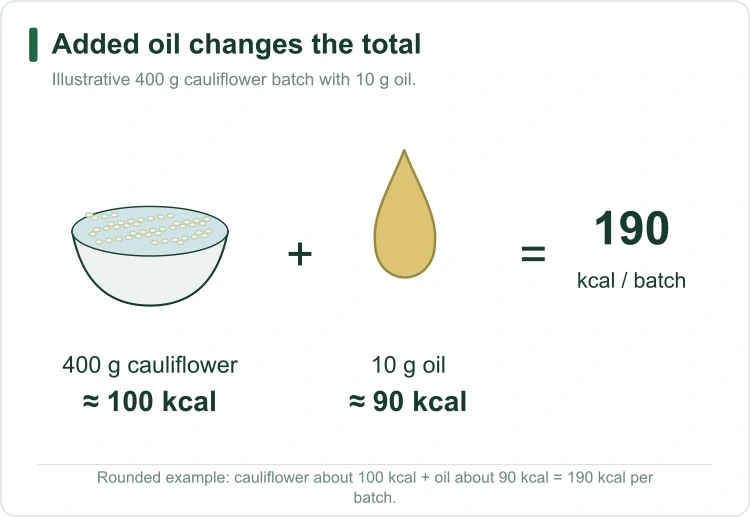
In this example, ten grams of oil contributes about ninety calories to the batch. The portion total depends on how the complete cooked recipe is divided.
Sauces need their own calculation. Weigh the amount actually added and use the sauce label or a reliable recipe calculation. Include butter used to finish the pan, cheese sprinkled on top and nuts or seeds used as garnish. These can be small additions by volume while still making a noticeable contribution to the finished meal.
There is also a difference between oil issued to the kitchen and oil retained in a serving. Some may remain in a mixing bowl or roasting tray. For a home estimate, counting the amount added is a straightforward and usually conservative approach. A commercial nutrition declaration may require a more controlled recipe and an accepted calculation or analysis method.
When comparing cooking methods, keep the desired result in view. A small measured amount of oil can improve flavour and separation in a sautéed dish. A steam-in-bag method may need no added fat, but it produces a different surface texture. Choose the method that fits the dish, then calculate its ingredients accurately. Nutrition comparisons become more useful when they describe food someone will actually prepare.
Understand why cooking changes calories per 100 grams
Cooking can change the weight of cauliflower rice considerably. A wide pan allows moisture to evaporate; a covered bowl retains more of it. If the same amount of cauliflower becomes lighter through water loss, its calories are distributed through a smaller finished weight. The calories per 100 grams can therefore rise even when nothing caloric has been added.
Take a simplified example: 500 grams of plain cauliflower rice starts with approximately 125 calories on the rounded reference basis. Suppose it weighs 400 grams after cooking and no meaningful amount of solids is lost. The whole batch still contains approximately 125 calories, but 100 grams of the cooked product now represents about 31 calories. This is a yield illustration, not a prediction for a particular pan or frozen product.
Adding oil changes both the energy total and, slightly, the weight. Draining liquid can also remove a variable amount of dissolved material, so a precise commercial calculation should not pretend that every process is a perfect water-only system. The simplified example explains the direction of change. It does not replace measured recipe data.
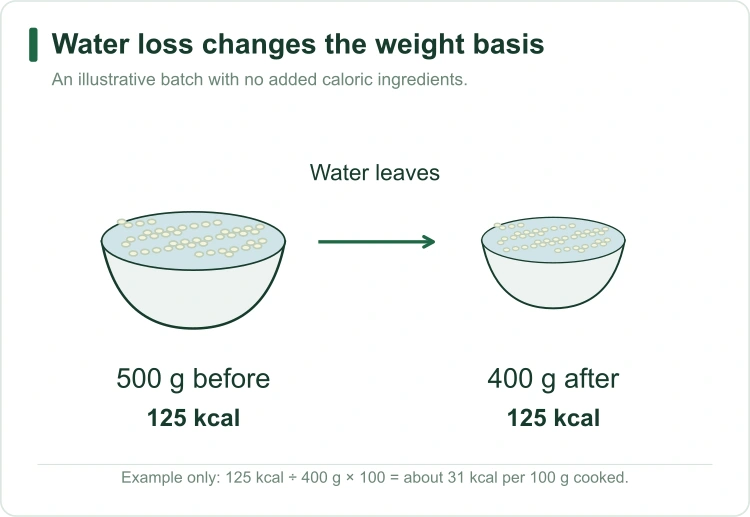
Water loss changes the weight over which the batch's calories are distributed. This illustrative calculation explains why a cooked value per 100 grams can be higher.
This distinction helps explain why online calorie values can disagree. One entry may describe raw cauliflower, another boiled cauliflower, and another a sautéed recipe. Their water contents, ingredients and portion definitions differ. Before deciding that one source is wrong, check what food and preparation state it actually describes.
For a repeatable trial, weigh the frozen ingredient, record the cooking method and weigh the finished batch after the same resting or draining period. Note pan dimensions, batch depth and cooking endpoint. A crowded pan can hold more water and produce a heavier finished batch than a shallow pan, even when both began with the same product.
Avoid using moisture loss as a reason to overcook the vegetable. A dry, finely chopped product can become soft or break down before it achieves the desired separation. In foodservice, the useful result is a portion with the right bite, appearance and holding performance. The yield measurement should describe that acceptable result, not an extreme endpoint chosen to improve a number.
Build a meal around the portion you actually serve
Cauliflower rice is often used as a vegetable base under a stir-fry, curry or protein portion. Its own calorie content is only one part of that meal. The sauce, cooking fat, meat or alternative protein, and additional sides can contribute much more. Evaluate the whole plate if the purpose is meal planning or a menu nutrition statement.
It also behaves differently from cooked rice when served. Its smaller, less starchy pieces may release water into a sauce, and a lightly cooked portion can feel less substantial by volume. Increasing the cauliflower portion is one option. Combining it with grains, beans or other ingredients is another. Each creates a different dish and should be calculated on its own terms.
For a lunch bowl, a useful trial might compare equal finished weights of plain cauliflower rice and a cauliflower–grain blend. Record the complete meal weight, sauce quantity, flavour and texture after the intended holding period. This reveals whether the lower-calorie vegetable base actually fits the eating occasion, rather than assuming that a one-for-one volume substitution will satisfy every diner.
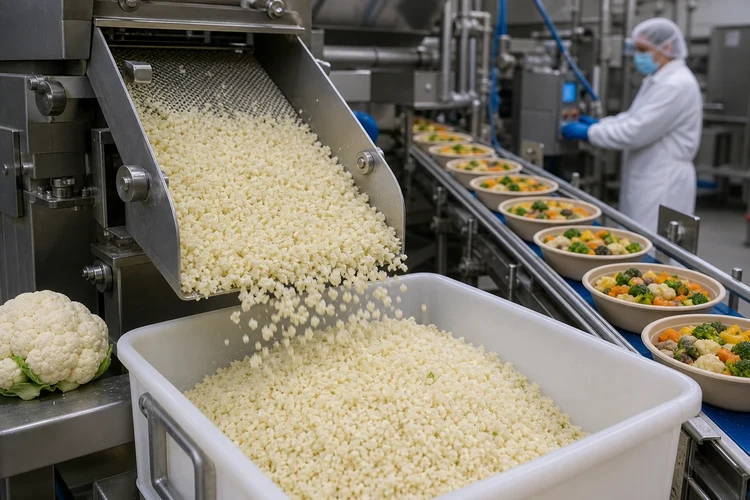
Illustration of meal assembly using cauliflower rice. Evaluate the complete serving, including sauce and other components, when calculating nutrition and assessing reheating performance.
The same care applies to portion descriptions such as a generous serving or a small bowl. These phrases can help communicate a recipe, but they are poor calculation units. A serving spoon may deliver a different weight after the product has settled or absorbed sauce. Portion scales and a defined recipe provide better consistency when multiple operators prepare the dish.
Avoid suggesting that a low calorie count makes a food nutritionally complete. Cauliflower rice can contribute vegetables to a meal, while the rest of the formulation determines its protein, fat and overall balance. It is also possible for a dish with more calories to be appropriate for a different person, appetite or eating occasion. The number is useful information, not a complete judgement of a meal.
For a ready-meal developer, the most helpful comparison is between two finished recipes that meet the same portion and sensory requirements. Evaluate taste, texture, reheating and nutrition together. A vegetable base that performs well after freezing and reheating offers a more meaningful product advantage than a favourable number calculated from an unrealistic serving.
Confirm nutrition and cooking yield before a bulk order
A bulk purchase needs a clear distinction between the ingredient being supplied and the dish made from it. For plain frozen cauliflower rice, the starting specification should identify the ingredient, cut range, acceptable fines, packing and intended cooking use. Nutrition information should state its basis, including whether values refer to the product as sold.
Cut size affects practical yield. Very fine particles can compact, hold surface water and soften quickly. A coarser rice-style cut may retain more bite but look less uniform in a small retail portion. Ask for a representative sample and cook it in the intended process. A photograph of loose frozen pieces cannot establish the final eating texture.
Record the outcome in weights: input product, additional ingredients, finished batch and saleable portions. If your process drains the product, define when and how it is drained. If it goes directly into a sauce, assess the liquid balance of that complete formulation. These details make a second trial comparable with the first.

A caliper check illustrates the particle-size side of a cauliflower-rice specification. Nutrition, seasoning and cooking yield need separate confirmation: two products can look similarly fine while differing in added oil, sauce or the weight of the finished serving.
For private-label products, confirm who is responsible for the nutrition calculation, any laboratory analysis and final label approval. Destination-market rules can differ in serving definitions and carbohydrate declarations. We will review the information needed for the supplied vegetable specification, while the finished recipe and its claims need to match the actual product placed on sale.
A useful enquiry includes the destination market, pack size, plain or seasoned format, target cut, expected order volume and cooking method. Add any required nutrition declaration format and whether the product is intended for retail, foodservice or further processing. These inputs allow the discussion to focus on a product that can be sampled and assessed.
For a worked menu trial, keep one sheet for the ingredient calculation and another for portioning. The first records the cauliflower, oil, sauce and toppings used in the full batch. The second records the cooked weight and the number of portions actually served. If the kitchen changes either sheet, review the portion calculation before reusing the previous nutrition figure.
A supplier comparison can then use the same recipe and portion target for each sample. Record whether extra cooking time, draining or sauce adjustment was needed to obtain an acceptable dish. These observations help explain a cost or yield difference that the plain ingredient's calorie value cannot capture. Keep the approved recipe version with the product specification so a later formulation change is visible.
Review plain cauliflower rice for your product
GreenLand-food is a professional frozen cauliflower supplier and manufacturer in China, providing factory-direct wholesale supply for importers, food manufacturers, foodservice distributors and private-label programmes.
Share the desired rice-style cut, ingredient statement, pack size, destination and expected volume. Include your cooking method and whether nutrition information is required as sold or for a finished recipe. We will review the supplied ingredient specification and the information needed for a representative trial.
For preparation details, see How to Cook Frozen Cauliflower Rice Without Making It Watery.
Use the product range and downloadable catalogue to review the wider selection, then send the specification and order details that matter to your application.