


Where Did Cauliflower Originate?
Sep 08, 2026
Leave a message
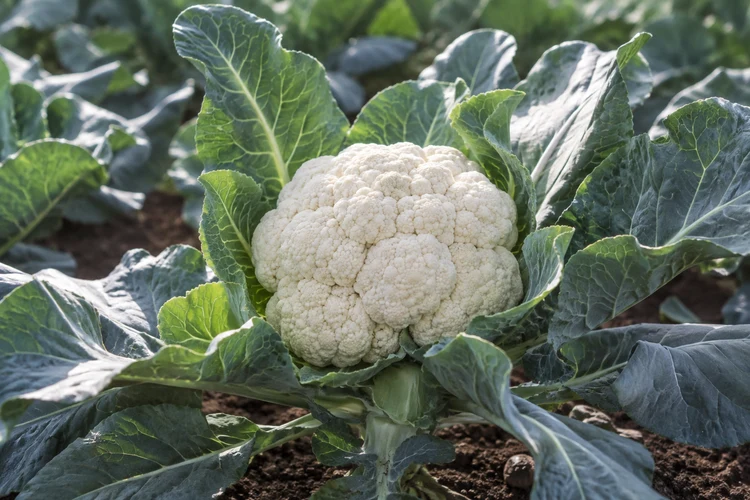
There are three different origin questions here. One concerns the wild relatives of the crop. Another asks where people developed the recognisable cauliflower head. The third concerns where a particular bag of fresh or frozen cauliflower was grown. Those questions can have different geographic answers.
Historical records, crop diversity and genetic research each contribute evidence, but they do not provide a single uninterrupted travel record. This article follows the evidence at that level of certainty, then explains how the crop's development relates to the colour, maturity and cut quality that matter in modern food production.
Separate cauliflower domestication from the range of wild cabbage
Cauliflower belongs to Brassica oleracea. Within that species, people selected plants for different edible structures: leaves in some crops, enlarged stems in others, and developing flower-bearing structures in broccoli and cauliflower. A modern cauliflower therefore shares a close botanical relationship with vegetables that can look quite different on a plate.
The broccoli and cauliflower relationship guide clarifies the shared crop ancestry behind their different edible forms.
The species name alone does not locate the first cauliflower field. Kew's Plants of the World Online entry for Brassica oleracea provides information about the wild species and its distribution. The native range assigned to a wild taxon and the regions in which a domesticated crop developed are separate matters. Moving seed and selecting plants can establish a crop well beyond a wild population's original range.
This distinction matters because many short histories compress the entire process into one sentence: cauliflower came from wild cabbage in a named country. Such a sentence can hide several different claims. It may be referring to wild ancestry, an early written description, a centre of crop diversity or a later commercial introduction. Each requires different evidence.
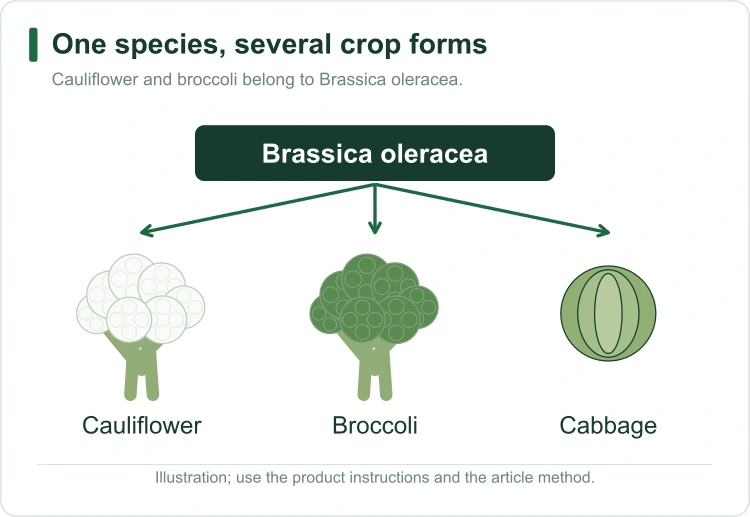
Shared species identity helps explain the biological relationship. Historical domestication, movement of seed and the origin of a current food shipment require separate evidence.
A useful way to read the history is to separate ancestry, selection and spread. Ancestry concerns the biological material from which cultivated forms developed. Selection concerns the repeated choice of plants with useful features. Spread concerns the movement of seed, growers and methods between regions. These processes can overlap without occurring in one place or at one time.
Cauliflower's identity is also more specific than membership of the cabbage family. Radish and mustard are relatives in the wider Brassicaceae family, but they are not simply other forms of the same crop species. Broccoli and cauliflower have a closer relationship. That closeness helps explain why genetic studies can investigate transitions between broccoli-like and cauliflower-like plant forms.
For a reader interested in food, the visible result is a crop whose edible head became unusually compact. For a grower, the result includes requirements for temperature, season and harvest timing. For a buyer, the useful lesson is that a species name establishes identity while leaving considerable variation in cultivar and performance. Botanical origin is a starting point for understanding the product, rather than a complete specification.
Follow the Mediterranean history without inventing a birthplace
The Mediterranean is the most defensible broad setting for cauliflower's early development. Cyprus and the eastern Mediterranean recur in historical accounts, while Italy became an important centre of cultivation and diversity. These associations help explain the crop's later European spread, but they do not prove that one named village or year marks its invention.
Older plant names are a particular difficulty. An author describing a cabbage with edible flowering growth may have meant something resembling broccoli, cauliflower or a form that no longer corresponds neatly to a modern market category. A translation can preserve the general idea while losing distinctions that would matter to a botanist. A familiar modern name is therefore not sufficient evidence of a familiar modern head.
Research on the linguistic and literary history of cole crops examines this problem directly. Historical descriptions and names can support a regional account, while leaving the exact crop form uncertain. Their value increases when they are considered alongside illustrations, cultivation records and biological evidence.
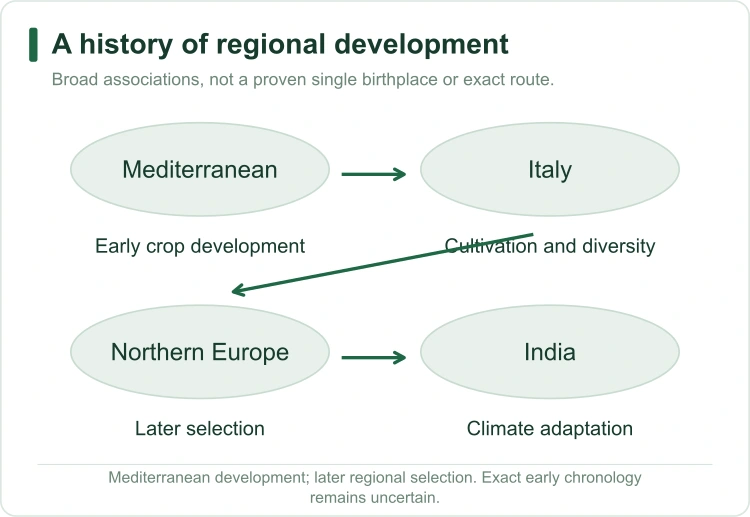
This relationship diagram presents broad historical associations. It does not claim a proven first field, a precise introduction year or a complete route of seed movement.
| Evidence in a crop history | What it can help establish | What it cannot establish alone |
|---|---|---|
| An old crop name | A plant was recognised in a language or market | That it was identical to a modern cultivar |
| A written growing description | Cultivation knowledge existed in that setting | The first place the crop was domesticated |
| Regional cultivar diversity | A region contributed important variation | A single original birthplace |
| Genetic relationships | Biological connections among sampled plants | A precise historical journey without other evidence |
| Seed trade records | Movement between particular places | Every earlier stage of development |
The PROTA account of cauliflower and broccoli describes Italy's importance and the subsequent development of cauliflower in central and northern Europe. It also describes later adaptation in India. This supports a history of continuing regional selection, rather than a finished crop being copied unchanged around the world.
A cautious historical timeline should therefore use broad phases: Mediterranean development, expansion and diversification in Europe, adaptation to additional climates, and modern breeding and processing. Where an exact introduction date is uncertain or depends on a later retelling, a century or broader period may be more honest than a precise year.
For food writing, that restraint improves the story. The interesting part is the accumulated work of growers selecting useful plants under different conditions. It explains why the cauliflower in a modern supermarket has both a recognisable identity and many possible forms. A confident but unsupported birthplace would obscure that longer development.
Understand how a cauliflower curd developed
The compact edible head is commonly called a curd. It consists of tightly packed, repeatedly branching immature structures associated with the plant's reproductive development. At normal harvest, it is taken before the plant proceeds into the open flowering stage. The familiar white surface is therefore a particular developmental form, rather than a collection of fully opened flowers.
Broccoli shows a different arrangement, with more visibly distinct green flower buds on branching stalks. The close relationship between the two crops makes them useful subjects for studying how plant development changes during domestication. A difference that looks obvious in a kitchen can involve several interacting biological processes in the growing plant.
A 2024 Nature Genetics study of cauliflower domestication analysed a large collection of cauliflower and related accessions. It reported evidence for stepwise domestication and investigated genetic mechanisms involved in curd formation. The work supports a developmental relationship with broccoli-like material, while also showing that the modern cauliflower form reflects more than one stage of selection.
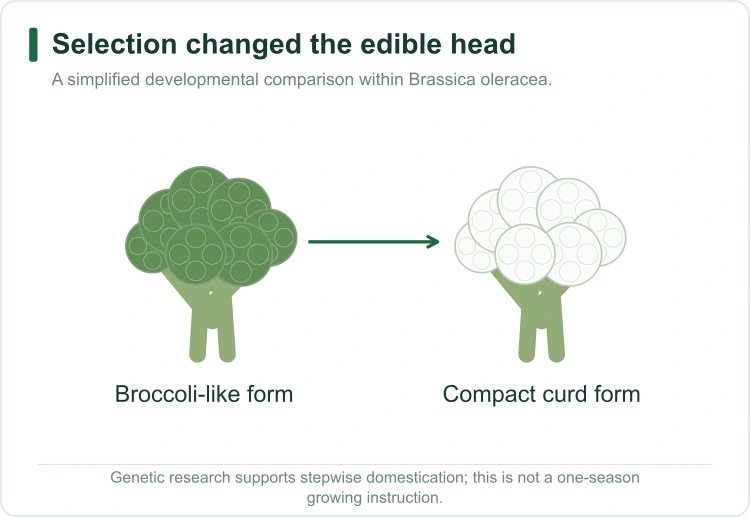
The comparison illustrates a developmental distinction investigated in domestication research. It represents inherited crop selection over generations rather than a change caused by one harvest decision.
That finding should not be turned into a claim that a grower can obtain cauliflower simply by leaving ordinary broccoli in the field. Domestication describes inherited differences selected across generations. Harvest management influences the quality of a plant's existing crop type; it does not instantly convert one established cultivar into another.
The head's development also explains why harvest timing is so visible in the finished vegetable. A compact curd can become looser as growth proceeds, and the surface can lose the appearance required for a particular grade. Once the structure has developed beyond the desired stage, chilling or freezing cannot recreate the earlier compact arrangement.
Think of curd quality as the meeting point of inherited crop characteristics and growing conditions. Cultivar choice sets an important part of the plant's response. Temperature and crop management influence how that response appears in the field. Harvest selection determines which heads enter the fresh market or processing stream at an acceptable stage.
For frozen florets, the processor then divides that head into smaller units. A tight head does not automatically guarantee every cut will be uniform: branching geometry and stem attachment still affect floret size and breakage. Understanding how the head forms helps explain why buyers should assess the actual cut alongside the whole-head appearance.
Trace the crop into different growing climates
As cauliflower spread, growers needed plants that could form acceptable heads in their own seasons. A cultivar successful in one region could respond differently to temperature and day-to-day growing conditions elsewhere. The crop's history therefore includes adaptation as well as geographic movement. Seed travelled, and local selection changed what growers could produce from it.
PROTA describes central and northern Europe as later centres of diversity and notes the development of tropical cauliflower types in India from introduced material. That history is relevant because it shows why cauliflower cannot be assigned one universal growing calendar. Regional adaptation can affect when plants initiate heads and how they perform under warmer conditions.
A simple country-by-country chronology misses this practical point. Two farms in the same country can have different seasonal conditions, while farms in different countries may operate under comparable temperatures. A crop calendar needs the production region, cultivar and planting period. A national origin statement alone cannot tell a buyer when the best processing window occurs.
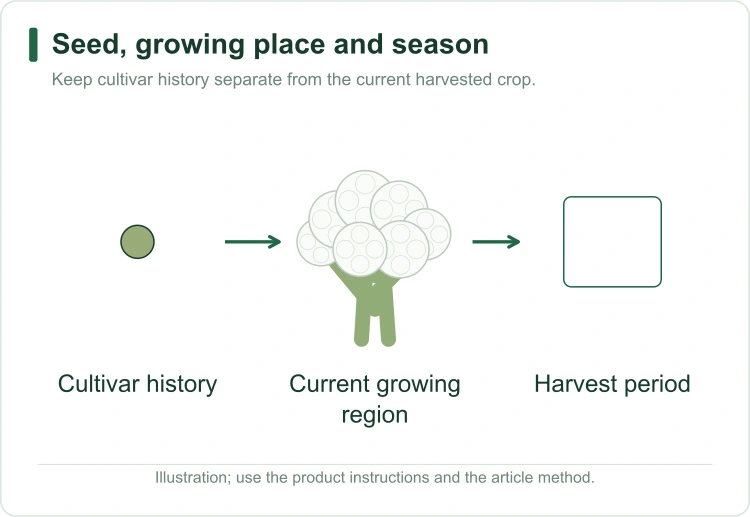
A cultivar's development history does not establish where a current crop was grown. Record the growing region and relevant harvest period for the supplied product.
It is also useful to distinguish seed origin from crop origin. A cultivar may have been bred in one country, its seed multiplied in another, and the vegetable grown somewhere else. Historical references to where a variety developed do not establish the origin declaration for a current consignment of food.
For a grower planning a crop, locally appropriate cultivar information is more useful than a general statement that cauliflower prefers cool conditions. Head initiation and quality can respond to temperature differently between types. Follow regional horticultural guidance and seed information, then assess the crop in the field. A calendar copied from another climate can give a misleading harvest expectation.
Modern sourcing discussions can use this history constructively. Ask about the actual harvest period and whether a proposed specification is based on a current crop or stored frozen inventory. Where seasonal variation may affect head structure or colour, compare samples from the relevant production period rather than relying on an unrelated display sample.
At GreenLand-food, we treat crop origin, harvest timing and product form as separate pieces of information when reviewing a frozen cauliflower enquiry. The historical story explains why regional variation exists. The order documents and approved sample establish what a buyer is purchasing now.
Read white, green, purple and orange cauliflower accurately
White cauliflower is the most familiar form in many frozen vegetable ranges, but cauliflower is not restricted to white heads. Green, purple and orange cultivars are also sold. Their appearance reflects different inherited characteristics and pigments, together with how the crop is grown and handled. Colour alone does not establish a separate country of origin.
A coloured cultivar should also be distinguished from discolouration in a product specified as white. A uniformly purple cultivar and irregular marks on a white head are different questions. One concerns product identity; the other may concern growing conditions, handling or deterioration. A photograph without the cultivar and condition details can easily confuse them.
The Academy of Nutrition and Dietetics overview of cauliflower recognises the range of colours and describes basic selection considerations. For a commercial specification, move beyond the colour name to an agreed visual reference. Terms such as creamy white, bright white or green can be interpreted differently across buyers and suppliers.
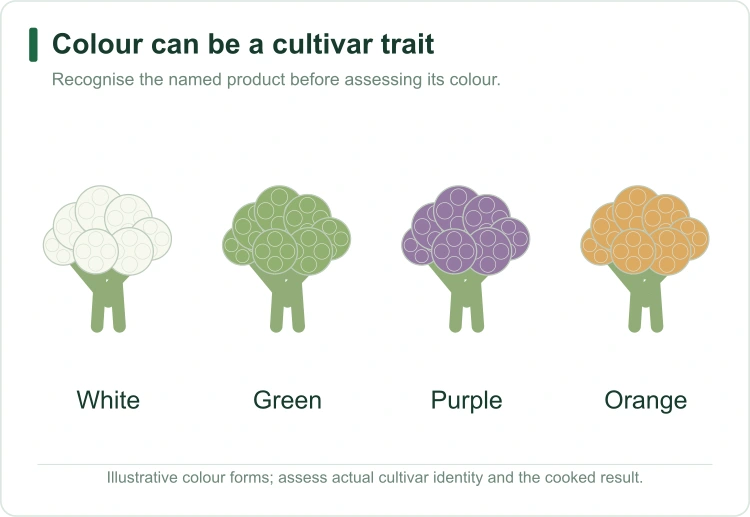
Named colour forms should be distinguished from discolouration in a product specified as white. Assess the actual cultivar and its appearance after the intended cooking process.
Romanesco creates another naming complication. Its pointed, repeating head pattern is visually distinctive, and commercial descriptions may place it alongside broccoli or cauliflower. Rather than using an image as a substitute for identity, specify the exact named product and intended cut. A mixed vegetable blend can look different if one pointed green form is substituted for a rounded green floret.
Colour also needs to be assessed after preparation. A fresh sample may look attractive but change during blanching, cooking or contact with a sauce. The result can depend on the cultivar and process. Do not promise colour stability from a raw photograph. Cook the proposed product in the intended recipe and record the result.
For an illustrative comparison, place the products under the same neutral light, on the same background and without colour filters. Include a cooked comparison if the buyer's application depends on the finished shade. This makes the image useful evidence for an approval discussion. A highly saturated promotional photograph is much less reliable for setting acceptance limits.
The history of crop selection helps explain why these forms exist, but it should not be used to infer nutrition or superiority from colour alone. Any composition claim needs evidence for the relevant food and preparation basis. A buyer choosing coloured cauliflower may primarily be seeking visual variety, a distinctive portion or a specific blend appearance, all of which can be tested directly.
Connect historical selection with present-day harvest quality
Generations of selection made cauliflower more useful as a food crop, but every harvest still contains variation. Heads differ in size, compactness, stem proportion and surface condition. Modern grading turns those differences into decisions about fresh sale, floret cutting, rice-style processing or rejection. The intended product determines which characteristics deserve the closest attention.
A head suitable for attractive florets needs a structure that supports the desired cut. Large diameter alone does not guarantee a high yield of uniform pieces. Stem branching, density and trimming requirements affect the outcome. For rice-style cauliflower, a different cut process can use material that would not produce the same display florets, provided it meets the agreed quality and safety requirements.
Harvest maturity influences that decision. A loose head may break differently during cutting and produce more irregular pieces. A head harvested at an appropriate compact stage may still contain variation between outer and central branches. A useful processing trial measures the resulting size distribution, rather than assuming the whole-head grade predicts every feature of the frozen cut.

The compact curd pieces and attached stem portions are visible in these trimmed cauliflower florets. Modern processing buyers evaluate that physical result alongside colour, tenderness and usable yield; the photograph does not establish the crop's historical place of origin.
| Crop or head characteristic | Possible effect on a processed product | Useful observation |
|---|---|---|
| Curd compactness | Floret appearance and separation during cutting | Compare loose material and intact pieces |
| Branching and stem structure | Stem length and floret shape | Review a representative cut sample |
| Head size | Cutting options and handling | Measure the resulting grades, not diameter alone |
| Surface colour | Appearance after blanching and cooking | Use an agreed visual reference |
| Harvest condition | Suitability for further processing | Inspect before processing and after preparation |
Freezing preserves an acceptable starting product for later use, but it does not correct every field or cutting defect. A poorly formed piece remains poorly formed. Excessively soft material will not gain fresh structure through freezing. This is why the historical development of a useful head and the modern control of processing both matter.
For a kitchen, those differences appear as cooking consistency and presentation. For a processor, they appear as yield, fines and the distribution of pieces in a pack. For a distributor, they can affect customer expectations when the same product description covers visibly different shipments. Clear grading language connects those perspectives.
We recommend approving a cooked sample as well as a frozen sample when the application is texture sensitive. Record the cooking method, portion size and acceptable result. That gives the buyer a reference tied to actual use, while keeping the history of the crop in its proper role as background knowledge rather than a substitute for quality evidence.
Ask what origin means on a modern frozen specification
On a modern enquiry, the word origin should be made specific. It might refer to the country where the cauliflower was grown, the processing location, the exporting company's location or the cultivar's breeding history. These are different facts. The documents needed for a shipment should match the relevant commercial and destination-market requirements.
For an IQF product, also identify the product itself: plain cauliflower florets, rice-style cut, a coloured variety or a blend. IQF means individually quick frozen. It describes a freezing approach and the intended separation of pieces, while leaving other matters such as cut size, ingredient composition and cooking instructions to the specification.
Ask for traceability information appropriate to the order. A product description should connect to an identifiable batch and the agreed documentation. Where a certificate is required, confirm its holder, scope and relevance to the supplied product. A general statement about a country's agricultural history cannot provide that assurance.
The historical origin question and the commercial origin question can therefore sit comfortably together. Cauliflower developed through a long Mediterranean and later international history of selection. A present-day frozen lot has a specific production and supply history that should be recorded. Both are interesting, but only the latter can establish the facts of that purchase.

These white cauliflower florets illustrate a modern frozen product form. Country of cultivation, processing location and crop season should come from traceable order documents, while a representative sample helps confirm the agreed cut, curd condition and stem proportion.
For a first enquiry, share the destination market, desired cut, pack format and expected volume. If colour, regional origin or a particular harvest window is essential, state it early. Include the intended application so that the sample can be assessed against a realistic cooking method rather than appearance alone.
A specification can make the current origin question easy to answer by giving growing origin and processing location their own fields. The cultivar name, where relevant, belongs in a separate field. This avoids interpreting an exporter's address or a seed company's location as evidence about the harvested vegetable. The information should agree with the documents required for the particular shipment.
For a buyer using origin in a product story, check that the wording describes the supplied food accurately and can be maintained across the supply programme. A historical reference to Mediterranean crop development is background information. A statement on a commercial pack refers to an actual product and needs evidence appropriate to that statement. Keeping those records clear allows the history to enrich the page without confusing the purchasing decision.
Confirm origin and cut for a frozen cauliflower order
GreenLand-food is a professional frozen cauliflower supplier and manufacturer in China, providing factory-direct wholesale supply for importers, food manufacturers, foodservice distributors and private-label programmes.
Tell us the destination, product form, packing and volume, together with any specific growing-origin or harvest-period requirement. We will review the current supply information and the documents needed to connect the agreed specification with an identifiable product and batch.
Use the product range and downloadable catalogue to review the wider selection, then send the specification and order details that matter to your application.