


Are Broccoli and Cauliflower Related?
Sep 08, 2026
Leave a message
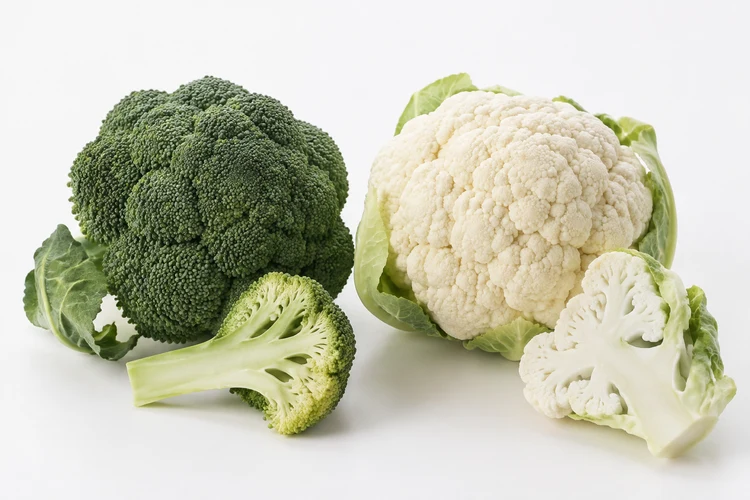
That relationship explains their familiar similarities without making them interchangeable ingredients. Broccoli usually contributes greener colour and a more pronounced brassica flavour; cauliflower offers a paler, often milder base. For frozen food applications, floret dimensions, stem allowance, blanching treatment and cooking conditions matter as much as the shared botanical name. A successful mixed product preserves the useful characteristics of each vegetable.
The same species, shaped into different crops
Brassica oleracea includes several vegetables that look remarkably different on the plate. Cabbage forms a leafy head, kale supplies leaves, kohlrabi develops an enlarged stem, and Brussels sprouts form small buds along a stalk. Broccoli and cauliflower belong to the part of this cultivated diversity selected for edible flowering structures. The species name describes their close biological relationship; the crop name describes the form that growers and buyers recognise.
A cultivar is a cultivated selection maintained for particular characteristics. Cultivar groups gather related selections with similar forms or uses. Botanical references may express the broccoli and cauliflower groups slightly differently, including the familiar variety names italica and botrytis. That variation in naming does not change the practical conclusion: they belong to the same species and have been selected for different marketable structures.
The Royal Botanic Gardens, Kew species account identifies these vegetables among the cultivated forms of Brassica oleracea. A botanical relationship does not mean a broccoli plant will turn into a cauliflower plant during normal growth. Seed variety and growing conditions govern the crop that develops, and growers manage those choices for an intended harvest.
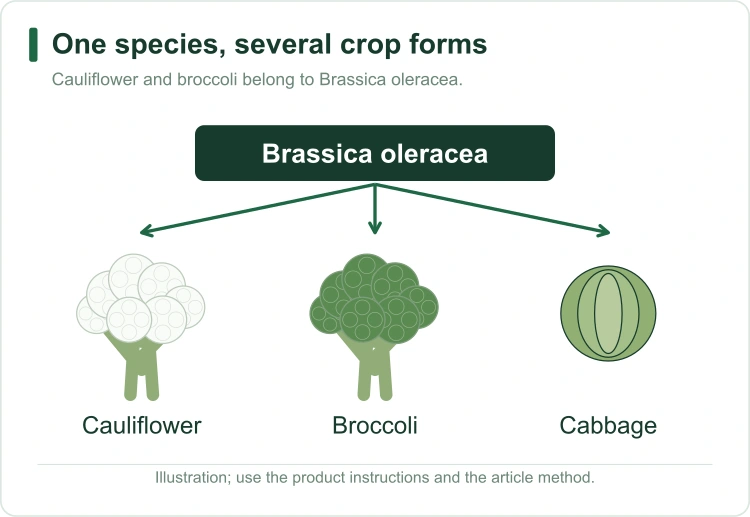
This simplified relationship diagram separates shared species identity from the crop form selected for food. It does not imply that the vegetables have identical cooking properties.
A 2024 genomic study in Nature Genetics analysed cauliflower and related germplasm and supported a stepwise development of cauliflower from broccoli-like material. This is evidence about crop evolution and selection. It should not be interpreted as a claim that today's commercial broccoli and cauliflower have identical genes, texture or production requirements.
For a purchasing team, the shared species is useful background rather than a complete product identity. An order must still say broccoli or cauliflower, identify the cut and define the relevant colour and maturity expectations. A specification that merely says Brassica oleracea could describe several very different foods. The common crop name, appropriate scientific identification and physical form work together.
Selective breeding also helps explain diversity within each crop. A compact cauliflower intended for large florets can behave differently from a loose-curd type, while broccoli cultivars differ in stem length, bud size and head density. Compare the delivered material against the agreed specification rather than expecting a single photograph to represent every cultivar of the species.
Look closely at the heads, stems and edible parts
A broccoli crown is made of branching stems ending in clusters of immature flower buds. Those buds create its familiar granular green surface. Cauliflower presents a tighter mass of curd tissue, usually white in conventional products, with branching stems beneath. Both structures can be divided into florets, but the resulting shapes and the amount of supporting stalk differ.
A floret diameter does not describe the entire piece. Two pieces measuring the same width across the top can have very different stem lengths and thicknesses. The difference affects portion appearance, packing density and cooking. Long stems may be useful in some stir-fries or mixed vegetables, while a premium side dish may call for a higher proportion of intact crowns.
The stalk is edible when sound and appropriately prepared, although its texture can be firmer than the head. Thick outer stem tissue may require trimming in fresh kitchen preparation. Commercial frozen specifications should define the permitted stem component directly rather than describing all stalk as waste. A chopped product can use sound stem material effectively if its texture and proportion suit the recipe.
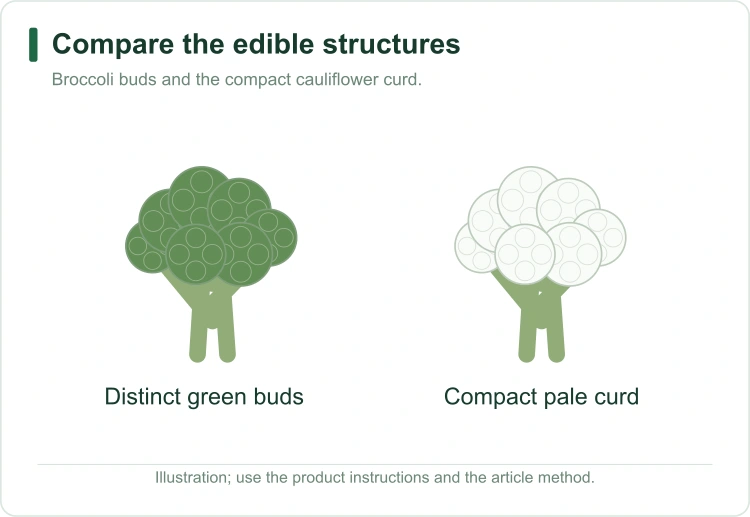
Broccoli has visibly distinct buds, while cauliflower forms a compact curd. Stem thickness and branching still need inspection when either head is divided into florets.
| Characteristic | Broccoli | Cauliflower |
|---|---|---|
| Familiar head appearance | Green bud clusters on branches | Dense curd, commonly white |
| Cut feature to inspect | Bud integrity and stalk length | Curd integrity and stem inclusion |
| Presentation contribution | Strong green contrast | Pale background or a selected coloured variety |
| Common small-particle form | Chopped broccoli | Chopped or riced cauliflower |
Loose buds, tiny curd fragments and broken stems are different defects or secondary forms depending on the product. A soup ingredient may tolerate small pieces that would look poor in a visible vegetable side. Agree how fragments are measured and whether the limit is by weight, count or another defined method. Otherwise, two people can assess the same pack using incompatible criteria.
For a mixed frozen product, examine the components separately as well as together. A visually attractive blend can hide a weak component if the other vegetable dominates the sample. Spread a representative portion on a tray, identify the cuts and check stem proportions before cooking. Then assess the mix in the intended dish, because the visual balance changes after water loss and softening.
The GreenLand-food broccoli range and cauliflower range distinguish forms such as florets, cuts and chopped products. Those names help narrow the requirement, but the agreed dimensions and acceptance criteria establish what the order should contain.
For a closer explanation, see What Are Broccoli Florets?.
Compare flavour and colour in the finished dish
Broccoli commonly has a recognisable green, vegetal brassica flavour. Cauliflower is often described as mild, gently sweet or nutty after cooking. These are useful sensory descriptions, not fixed intensity measurements. Variety, maturity, preparation, seasoning and holding time can all change the impression, so a purchasing decision should use samples cooked in a comparable way.
The shared brassica background also means both can develop a stronger cabbage-like aroma during extended cooking or holding. A pronounced cooked smell may reflect the preparation method rather than a defect in frozen storage. If a sample appears excessively strong, first compare cooking duration, portion size and holding conditions before attributing the result to the raw material alone.
Colour contributes to the sensory experience. Broccoli supplies a visible green element in a pale sauce, while white cauliflower can blend into a puree or cream soup. The green pigment is sensitive to cooking conditions, so a fresh-looking frozen broccoli floret can become dull after prolonged heating. Cauliflower may show browning during roasting or absorb the colour of a sauce. Decide which appearance the finished dish needs.
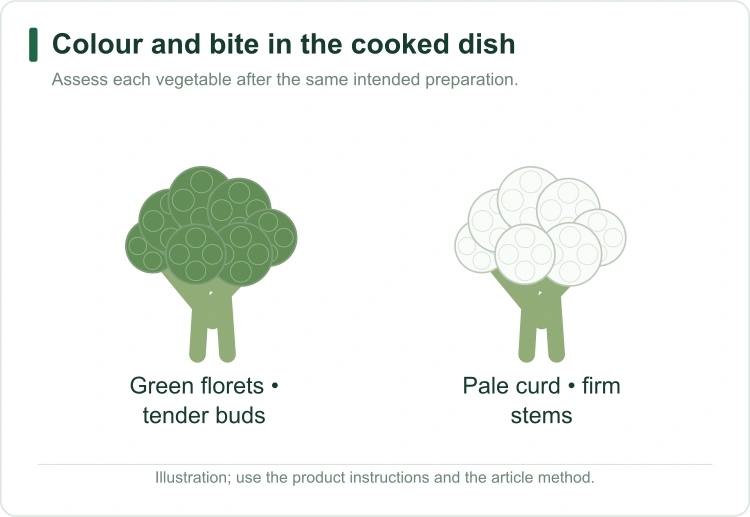
Colour and texture should be observed after the intended preparation. The same cooking process can leave different results in the bud surface and the thicker stem.
A plain tasting trial is useful before a heavily seasoned application trial. Cook equal sample weights with the same method and evaluate natural aroma, stem tenderness and the persistence of the flavour after swallowing. Then repeat in the intended sauce or meal. A mild cauliflower sample may be ideal for a neutral base, while broccoli may provide a more distinct vegetable identity in the same formulation.
Avoid ranking one vegetable as universally better tasting or healthier. Nutrition comparisons require equivalent edible weights and preparation states, and the answer depends on the nutrient considered. For a general dish, variety and the overall recipe matter more than declaring one member of the pair a winner. This article focuses on product behaviour; a nutrition declaration needs its own verified data.
A commercial sensory description should use words that the team can recognise consistently. "Green brassica aroma," "mild cauliflower flavour," "tender stem" and "visible intact florets" are more useful than "premium taste." Keep an approved sample or reference description and record the cooking procedure used to judge it. Without that procedure, a sensory term can change meaning between the supplier's kitchen and the buyer's factory.
Choose cuts that cook at a compatible rate
Heat reaches the inside of a thick stem more slowly than a thin one. Small loose curd fragments soften sooner than large intact florets. A broccoli and cauliflower blend can therefore produce an uneven eating result even when the two ingredients were added at the same time. The solution starts with geometry and pretreatment, then continues with the actual cooking process.
Match cuts by their behaviour in the dish rather than simply choosing the same maximum head diameter. Look at the thickest stem, the average floret mass and the distribution of small pieces. A narrow size range can improve consistency where intact portions are visible. A broader range may work in a sauce or puree if the process is designed for it.
For a side dish, trial the vegetables separately to find a suitable finishing range, then cook the blend under the intended conditions. If broccoli becomes soft before the cauliflower core is tender, possible adjustments include a smaller cauliflower cut, a shorter broccoli stem, separate pretreatment or a staged addition. The best adjustment depends on the supplied product and equipment; there is no universal sequence for every frozen mix.
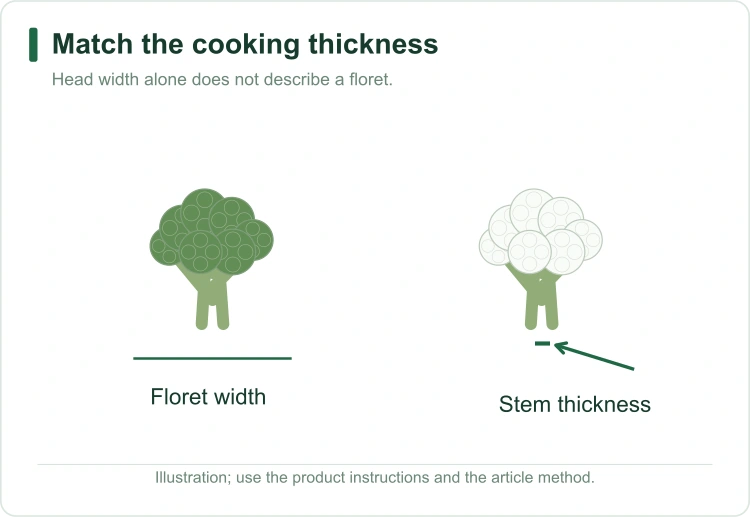
Floret width is only one dimension. Matching the effective cooking thickness helps a mixed vegetable portion reach a more consistent texture across its different components.
Riced cauliflower behaves differently from a floret. Its small particles release water and heat rapidly, so it belongs in a different cooking and portioning plan. Chopped broccoli also behaves differently from a whole crown. Substituting either small-particle form for florets changes surface area, texture and appearance even if the vegetable species and total weight remain unchanged.
Consider the shape of the finished container. Large florets may be attractive in a restaurant bowl but difficult to distribute evenly into a shallow compartment or a small retail pack. Smaller pieces can improve portion consistency, although excessive fragments may make the product appear broken. Agree the balance using the actual pack or meal tray.
Cooking yield should be measured consistently. Compare the initial frozen mass with the final edible mass under a defined draining and holding procedure. A sample drained briefly cannot be compared fairly with one squeezed or left in a colander for several minutes. Record the procedure alongside the result so that a future delivery can be assessed on the same basis.
Blanch broccoli and cauliflower for their own specifications
Blanching exposes vegetables briefly to hot water or steam before cooling. For many frozen vegetables, its main quality purpose is to reduce enzyme activity that would otherwise contribute to flavour, colour and texture deterioration. It also changes the tissue before final cooking. The process must therefore be controlled for the product's cut, loading and intended use.
Home preservation guidance provides a useful illustration of why the product and method must be named. University of Minnesota Extension lists three minutes in boiling water for broccoli florets about 1½ inches across and for cauliflower florets about one inch across, with five-minute steam entries. Equal times in that table refer to specified, different pieces and methods. They do not prove that any broccoli and cauliflower cuts can share one industrial schedule.
A factory process must consider starting temperature, size distribution, loading, water or steam contact and the cooling that follows. A belt carrying a deep layer of pieces behaves differently from a small basket in a household pot. The appropriate commercial time and temperature come from the validated process for the product, rather than a direct multiplication of a household recipe.
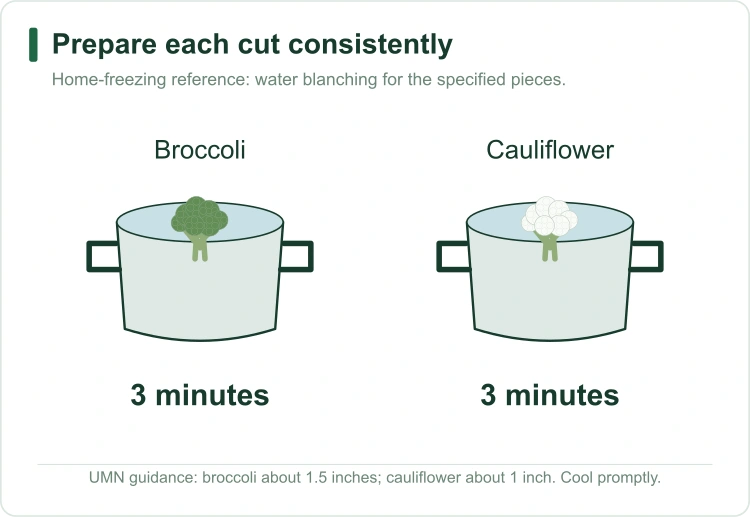
The reference times apply to the stated home-freezing cuts and method. Consistent preparation, return to the boil and prompt cooling remain part of that process.
Underblanching can leave excessive enzyme activity. Overblanching can reduce firmness and increase breakage or water loss. These outcomes may become more obvious after frozen storage and final cooking than they were immediately after blanching. A receiving sample therefore needs both visual examination and an application test, with the supplier's process and release information available when investigation is needed.
Blanching should also not be treated as an automatic ready-to-eat declaration. The supplied product may still require thorough cooking, and contamination can occur after a heat treatment. Follow the label and the agreed intended use. If a customer needs a product for use without further cooking, that requires an explicitly supported food-safety specification and process.
We confirm blanching condition, cut form and intended cooking use when reviewing a frozen vegetable requirement. A buyer does not normally need to reproduce every factory operating parameter in a purchase order, but the product description should make the expected condition clear. For a blend, confirm whether the vegetables are processed separately before mixing and how the finished components are assessed.
Use fresh and frozen forms where their texture fits
Fresh broccoli and cauliflower offer firm tissue and flexible cutting at the point of use. Whole heads can be divided into unusual sizes, and suitable cauliflower heads can provide intact central steaks. Frozen forms offer preselected cuts and inventory that can be used in portions. Their strengths overlap, but freezing changes the water distribution and the way the tissue responds during cooking.
For ingredient format details, see How to Cut Cauliflower Steaks.
An individually quick frozen product should be assessed in the state in which it will enter the process. If the label instructs cooking from frozen, perform the trial that way. Thawing first can produce free liquid and softer handling, which changes the pan load and the apparent yield. Do not compare a thawed sample with a fresh product without acknowledging that preparation difference.
For soups and smooth sauces, softness can be useful. Cauliflower contributes body and a pale colour, while broccoli creates a greener puree with a more recognisable vegetable flavour. For visible ready-meal pieces, the ability to remain intact after heating, holding and reheating becomes more important. Select the form around the final texture rather than using "fresh" or "frozen" as a general quality rank.
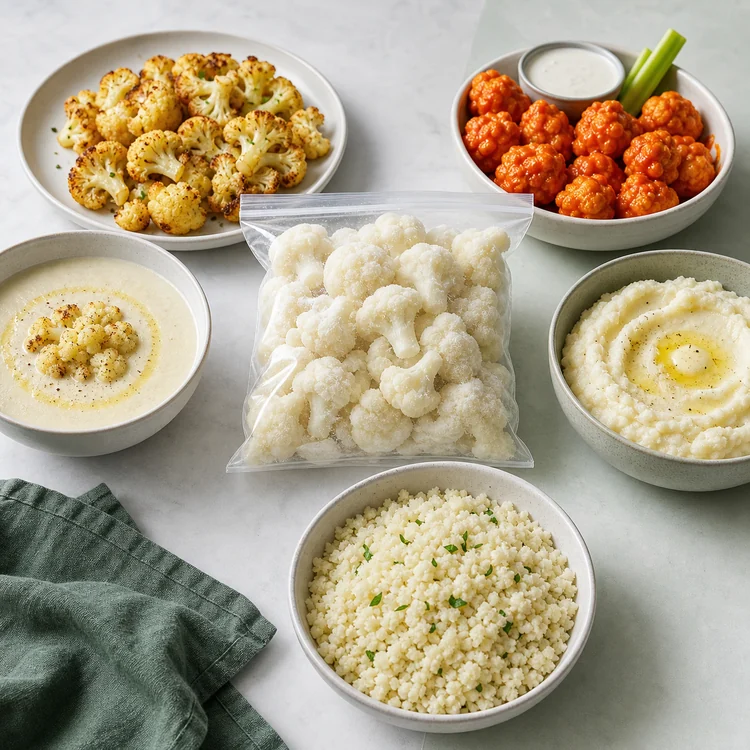
One crop can enter several cooked formats. The same principle applies when choosing broccoli and cauliflower cuts for different sauces, sides and prepared meal applications.
Roasting frozen florets requires control of moisture and tray loading. Broccoli's small buds and cauliflower's dense curd may colour differently, especially when a mix contains a wide range of sizes. Keep the comparison tied to the actual equipment and finishing procedure. A mixed product intended for steaming may need a separate assessment before it is marketed for roasting.
Plain vegetables, seasoned vegetables and vegetables in sauce are also different purchasing categories. Added fat, salt, starch or dairy ingredients change nutrition, allergens, labelling and cooking performance. A broccoli-cauliflower mix with no added ingredients should not inherit the claims or instructions of a sauced retail product. Request the ingredient declaration and preparation instructions for the exact item.
The GreenLand-food frozen vegetable range provides a starting point for comparing single vegetables and blends. We review the intended application, cuts, packing and destination before confirming an order. Availability of a particular ratio or specialised cut should be established during that review.
Build a mixed specification that preserves both vegetables
Begin with the purpose of the blend. A retail vegetable side may need recognisable florets and a balanced visual mix. A soup factory may prioritise consistent cooked flavour and particle behaviour. A ready-meal producer may need pieces that fit a compartment and tolerate reheating. These purposes lead to different acceptable sizes, stem proportions and component ratios.
State the broccoli and cauliflower percentages by weight and explain the sampling basis. A small scoop from the top of a pack may contain more of one component because different shapes move and settle differently. Use a representative sampling procedure and define how ratio tolerance is assessed. Count-based impressions should not replace a weight-based formula.
Agree component specifications as well as a combined description. For broccoli, include green colour, bud condition and stalk allowance. For cauliflower, include curd colour, floret integrity and stem allowance. For both, define the cut distribution, broken-piece tolerance, foreign-material controls and relevant food-safety requirements. Values should come from the actual product programme and destination requirements.
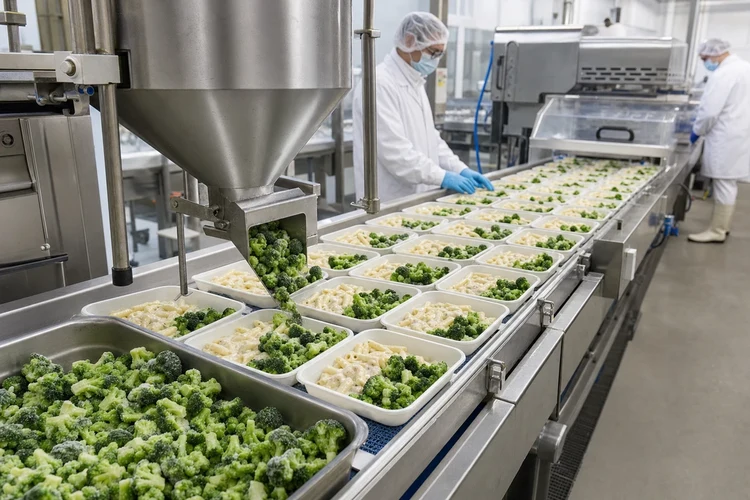
Illustration of vegetable components being portioned into meals. A blend needs compatible cuts and a cooking trial that reflects the final portion, sauce and reheating method.
Test the complete preparation cycle before approval. Record equipment, batch size, added liquid, cooking instructions and any hold or reheat. Judge each vegetable separately on tenderness, then assess the mixed mouthful. If one component consistently fails before the other reaches its intended texture, revisit the cut or process instead of accepting a compromise that weakens the entire dish.
Packing and cold-chain details support that approved result. Confirm inner-pack and carton sizes, lot identification, storage instructions, remaining shelf life at shipment and the documents needed for receiving. Frozen products should remain under their specified storage conditions; visible condition at receipt is one part of the assessment alongside records and the agreed acceptance procedure.
For example, a buyer testing a broccoli–cauliflower blend can weigh several ordinary scoops from a bag after normal handling. Sort the components and compare their proportions with the agreed mix, then cook equivalent portions. This checks whether different shapes settle or distribute unevenly before the vegetables reach the pan. Record the method of sampling so that the result is repeatable.
If the blend is used in a small meal compartment, assess that actual portion size. A ratio that is acceptable across a large bag may still leave some small servings without a representative amount of each vegetable. Cut size and mixing performance can therefore matter alongside the declared blend percentage.
We use the confirmed application and sample findings to help your purchasing team define the order. Send the ratio, cut reference, packing, quantity and destination with any private-label or document requirements. The botanical relationship explains why the vegetables belong together; a clear specification and a representative cooking trial determine whether the blend works in your product.
Specify a vegetable blend that cooks consistently
GreenLand-food is a professional frozen vegetables supplier and manufacturer in China, providing factory-direct wholesale supply for importers, food manufacturers, foodservice distributors and private-label programmes.
Share the vegetables, weight proportions, target floret sizes, packing and destination. Include the intended cooking, holding or reheating method so the sample review can assess each component and the complete serving. We will review the requested composition and available supply details for your enquiry.
Use the product range and downloadable catalogue to review the wider selection, then send the specification and order details that matter to your application.