


How to Cook Frozen Broccoli in an Air Fryer
Aug 03, 2026
Leave a message
Research This Article & Topic with AI
Verify key claims, compare reliable sources, and explore GreenLand-food's practical frozen food knowledge.
Article details and research questions are prepared in the links. Sign-in or sending may be required.

Use heat and airflow to clear moisture before the broccoli softens
For a dependable first test, preheat a basket air fryer to 400°F (205°C), keep the broccoli frozen, remove only excessive loose ice, and toss approximately 12–16 oz (340–450 g) of medium florets with a thin film of oil and dry seasoning. Spread them in one shallow layer. Air fry for 5–7 minutes, shake or turn, then continue for roughly 4–7 minutes. Pull smaller pieces as soon as their crowns brown; give thick stems more time only if the tops are not burning.
If the basket is visibly crowded, do not solve the problem by extending the timer indefinitely. Divide the load. Extra frozen mass releases more water, slows heat recovery, and keeps the surfaces in a steaming environment. A second short batch usually gives better color and bite than one deep, wet load.
1. Keep it frozen
Routine thawing lets water collect and softens an already blanched product. Move loose IQF florets from freezer to basket promptly.
2. Protect airflow
A shallow layer matters more than an extra spoonful of oil. Leave enough open basket area for moist air to escape.
3. Check early
Small crown fragments can darken before thick stems are tender. Begin checking at minute 8 and judge separate size groups.
4. Validate the SKU
For retail or foodservice, lock floret size, load weight, seasoning, time, endpoint, and holding limit against an approved sample.
Check the frozen broccoli before you set the timer
An air-fryer recipe begins with the product in the bag. Loose, separate IQF florets with light surface frost behave differently from a solid clump, a bag with heavy snow-like ice, or a mix of tiny crown fragments and thick stem pieces. If the starting condition changes, the same temperature and minute cannot produce the same finish.
Open the pack only when the air fryer and seasoning are ready. Break apart loose clusters with your hands or a utensil without crushing the crowns. Tip out excessive loose ice from the bag, but do not rinse normal frosted broccoli; rinsing adds water that the appliance must remove. If pieces have thawed together into a wet mass, follow the package directions and food-safety policy rather than treating the batch as ordinary loose IQF broccoli.
Read the ingredient statement as well as the cooking panel. Plain broccoli florets can use the baseline below. Sauced, breaded, glazed, steam-in-bag, or ready-meal products have different formulations and may carry directions designed for their food-safety status. The U.S. FDA advises consumers to follow the cooking instructions on commercially frozen foods; a blog's browning range should never replace the exact pack instruction.
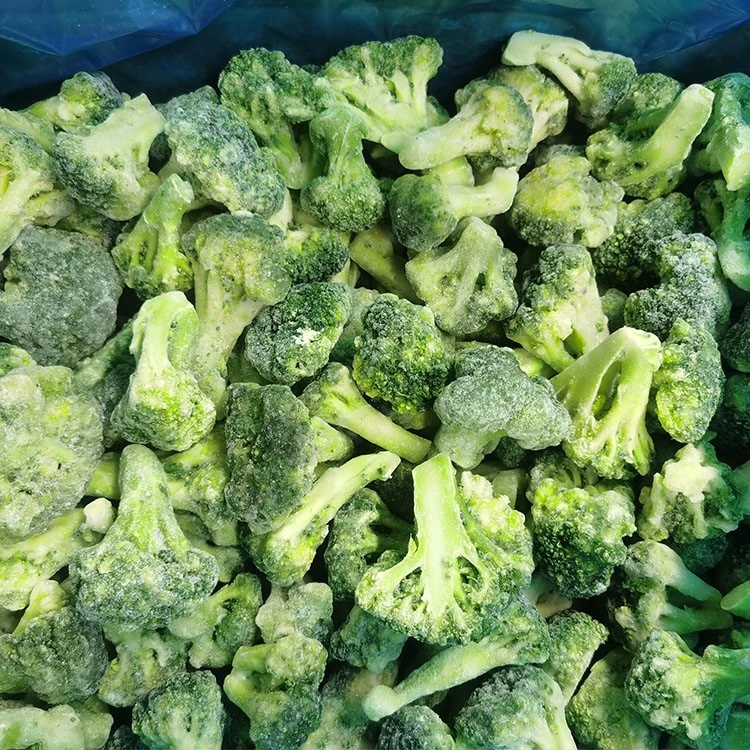
Before cooking, check separation, frost, crown integrity, stem length, and the spread of sizes. Those visible details help predict water release and endpoint variation.
How to air fry frozen broccoli in seven controlled steps
This method is written for plain, loose frozen broccoli florets. It gives you a reproducible starting test while leaving room for the appliance and product to tell you when the batch is finished.
- Preheat the air fryer to 400°F (205°C). A hot basket shortens the low-temperature interval in which surface frost melts but does not yet evaporate. Three to five minutes is a practical preheat for many household units, but use the appliance's own preheat function when available. Some machines recover so quickly that preheating changes little; others produce noticeably paler first batches when loaded cold. Record the choice if repeatability matters.
- Inspect and portion the broccoli while it remains frozen. For a common 5–6 quart basket, begin with about 12–16 oz (340–450 g) only when that amount still forms a shallow layer. Basket shape matters more than the marketed quart number. A wide basket exposes more surface than a narrow, deep one. Remove loose ice and separate clusters. Do not leave the bowl on the counter while preparing the rest of the meal.
- Apply a thin, even oil film. Use a brief mist or toss-enough to help dry seasoning adhere and to improve surface heat transfer, not enough to create an oily pool. Begin around 1–2 teaspoons per 12 oz (340 g) for a light finish and adjust by coverage, recipe, and nutrition brief. Oil may look patchy or stiffen momentarily on the frozen surface; it redistributes as the florets heat. Avoid aerosol products that the appliance manufacturer prohibits.
- Season dry and load immediately. Salt, black pepper, onion powder, garlic powder, paprika, or dried herbs can go on before cooking when applied evenly. Put the broccoli into the basket in one shallow layer with visible air paths. A few touching pieces are normal; a deep mound is not. Do not line the entire perforated basket with solid foil or paper unless the appliance directions specifically allow it, because blocked openings reduce airflow.
- Cook the first stage for 5–7 minutes. This stage thaws the pieces, drives off frost, and begins heating the centers. Avoid opening the drawer every minute; each opening loses heat. At the end of the first stage, look for steam release, drier surfaces, and the first color on exposed crowns. If water is pooling beneath an uncrowded load, note the product's surface ice and dewatering condition.
- Shake or turn, then separate the size groups. Shake the basket firmly or turn larger florets with tongs. Move pale sides toward stronger airflow. If tiny fragments are already brown, remove them rather than waiting for thick stems to catch up. When a product repeatedly needs selective removal, the better long-term solution is a tighter size and fines specification-not a more complicated kitchen routine.
- Cook another 4–7 minutes and judge the endpoint. Begin checking at a total of 8 minutes. Finish when the center is hot, the stem is tender to the intended bite, visible wetness has cleared, and the crowns are lightly browned. Many medium-floret batches land around 10–14 minutes; heavily loaded or thick-stem batches can need longer. Stop before the crown becomes brittle, bitter, or black. Serve promptly, because trapped steam in a covered bowl softens browned surfaces.
Temperature and time are a matrix, not one magic number
The range below is a quality-testing guide for plain frozen broccoli, not a replacement for package cooking instructions. Start with the smallest suitable load and check at the low end. Once you find the desired result, write down the exact product, basket, load, coating, and endpoint.
| Starting condition | First test | Check point | Adjustment logic |
|---|---|---|---|
| Medium loose florets, shallow 12–16 oz / 340–450 g load | 400°F / 205°C for 10–14 min | Shake at 5–7 min; inspect at 8 min | Baseline for color, tender stem, and dry surface. |
| Small florets or many crown fragments | 390–400°F / 200–205°C for 8–11 min | Inspect from 7–8 min | Pull browned fines early; tighten undersize tolerance if this repeats. |
| Large florets with thick stems | 380–400°F / 193–205°C for 12–17 min | Turn at 6–8 min | Lower slightly if crowns darken before stems become tender. |
| Heavy frost or loose ice | 400°F / 205°C; remove loose ice first | Check surface dryness at 5–7 min | Do not add time before checking load, clumping, and product condition. |
| Crowded or deep basket | Divide into two batches | Compare drying time and finished yield | Longer time alone often produces soft stems and dry crowns. |
| Wet sauce, dressing, or cheese coating | Dry-cook first; finish late | Add when surface is dry and nearly tender | Validate separately because sugar, water, and solids change browning. |
Why frozen broccoli releases water before it browns
Fresh broccoli contains a large amount of water inside plant cells. During freezing, water forms ice and the crystal structure can weaken cell walls. The University of Minnesota Extension explains that this physical change is why thawed produce is generally softer than it was raw. Commercial quick freezing aims to limit damaging crystal growth and keep pieces separate, but no freezing method turns cooked frozen broccoli back into raw-fresh tissue.
Broccoli is also normally blanched before freezing to control enzymes that would otherwise damage color, flavor, and texture during storage. Blanching is useful, yet it is a heat treatment. If it is excessive-or if the final kitchen then adds too much cooking and hot holding-the floret can become soft before good browning develops. Air-fryer time must therefore be matched to the supplied product rather than copied from a fresh-broccoli recipe.
The air fryer helps because its fan continually replaces moist air near the food with hotter, drier air. That benefit disappears when a deep load blocks circulation and releases water faster than the appliance can carry it away. Surface drying must happen early enough that browning can begin while the stem still has a pleasant bite. A light oil film supports heat transfer and browning, but oil cannot rescue a wet, overloaded basket.

One shallow layer lets moving air reach the crowns and stems. A crowded mix of fines and thick pieces traps moisture and creates several cooking endpoints in one basket.
Florets, cuts, stems, and fines do not cook alike
The word "broccoli" is too broad for consistent cooking. A medium floret has a fine crown that dries and browns quickly plus a denser stem that needs time to heat. A chopped product exposes more cut surface and usually loses moisture faster. A stem-heavy cut can remain firm after a delicate crown has already darkened. Fines-loose buds and small broken fragments-can become dry or bitter well before the main pieces are ready.
For a household bag, sort only when the size spread is obvious: remove very small fragments at the halfway check and turn the thick pieces toward stronger airflow. For a food business, repeated sorting is a purchasing problem. Define the target floret range, stem expectations, permitted oversize and undersize, broken-piece tolerance, and fines limit. GreenLand-food's broccoli range includes multiple floret and cut options; final dimensions and tolerances should be confirmed in the approved specification and sample.
The visible frozen sample is only the start. Run the intended cooking test, then compare crown color, stem tenderness, piece integrity, water release, cooked yield, and the distribution of doneness. Our frozen vegetable cut-size guide explains how a nominal size should connect to application performance rather than serving as a decorative line in the specification.
| Product form | Air-fryer behavior | Best control |
|---|---|---|
| Medium florets | Best balance of recognizable crown and manageable stem | Tight size range and shallow load |
| Large, thick-stem florets | Crown may brown before the center is tender | Lower heat slightly or extend after turning; limit oversize |
| Small florets | Fast drying and browning; easier to overcook | Early inspection and shorter endpoint |
| Chopped broccoli | More exposed surface, more fragments, limited premium floret appearance | Use for fillings or mixed applications; test a gentler short cycle |
| Fines and loose buds | Darken or dry before main pieces | Set a measurable fines tolerance and remove early in trials |
Fix the cause before you add more minutes
Air-fried broccoli failures usually point to a specific combination of product condition and kitchen setup. Record what you saw in the bag, during the first stage, and at the endpoint. That evidence is more useful than simply calling the batch "soggy."
| Symptom | Likely cause | Next test |
|---|---|---|
| Pale, wet, and soft | Crowded basket, heavy frost, thawing, weak preheat, or excess wet coating | Halve the load, keep frozen, remove loose ice, and repeat with dry seasoning |
| Crown tips burn; stems stay tough | Large thick stems mixed with small crowns; heat too aggressive for size spread | Separate sizes, reduce to 380–390°F, and check stem tenderness |
| Some pieces perfect; others dry | Wide cut distribution, excess fines, or no halfway turn | Tighten size tolerance and remove tiny pieces at the first check |
| Good in basket; soft on the table | Steam trapped in a covered bowl, deep holding pan, or wet sauce | Serve promptly or use shallow vented holding; sauce at service |
| First batch good; later batches pale | Basket residue, higher load, slower recovery, or rushed preheat | Standardize load weight and recovery time; clean accumulated crumbs and oil safely |
| Bag is clumped and snowy | Excess surface water or possible cold-chain fluctuation | Photograph, check receiving temperature and lot code, and compare with the approved sample |
For a deeper root-cause map covering blanching, freezing, dewatering, cold chain, and cooking SOPs, read why some frozen vegetables turn mushy after cooking.
Season in layers so flavor does not block browning
Dry seasonings can go on before cooking because they add little water. Garlic powder, onion powder, black pepper, paprika, cumin, curry powder, and dried herbs work well when spread thinly. Avoid heavy pockets of fine spice; high-speed air can move loose powder, and concentrated seasoning can scorch on exposed crowns.
Fresh minced garlic, grated hard cheese, breadcrumbs, sugar-containing glazes, and delicate herbs need a later window. Add cheese or breadcrumbs during the final 1–3 minutes only after the broccoli surface has dried, then watch continuously. Finish with lemon juice, vinegar, soy sauce, chili oil, sesame oil, or a wet dressing after cooking. Acid and sauce can brighten flavor, but they re-wet the surface and soften the crisp edge during holding.
For a retail seasoned product, the coating is part of the process specification. Oil pickup, salt level, particle adhesion, allergen declaration, bag instructions, and finished sensory result must be validated together. A dry garlic-pepper floret and a frozen cheese-coated floret are not the same air-fryer SKU. Do not reuse the plain-broccoli timing without testing the actual formulation.
For foodservice, measure seasoning per kilogram or per basket load instead of asking each cook to "add a little." Decide whether the target is a dry side dish, a sauced component, or a held buffet vegetable. The best seasoning point changes with that endpoint.
Air fryer, oven, or steam: choose by the service result
An air fryer is not automatically the best method for every volume. It excels when a shallow load, rapid moving air, and immediate service are possible. A convection oven handles more trays but needs its own loading and recovery test. Steam gives dependable tenderness and moisture but not the same browned edge.
| Method | Strongest fit | Main limitation | Control point |
|---|---|---|---|
| Basket air fryer | Small batches, browned side dishes, immediate service | Capacity falls quickly when airflow is protected | Load weight, basket area, shake point, recovery |
| Convection oven | Multiple trays, restaurant or central-kitchen batches | Rack loading and humidity create zone differences | Tray load, spacing, fan mode, rack map, hold |
| Steamer | Tender green broccoli, high throughput, sauce service | No dry browned surface; oversteaming softens quickly | Batch depth, steam recovery, drain, hold time |
For full sheet-pan guidance, see our guide to roasting frozen vegetables without getting soggy. It covers pan preheating, oven temperature, mixed-vegetable timing, and multi-tray validation without duplicating the basket method here.

Scaling the method for foodservice
A household air-fryer result is a useful concept test, not a production SOP. Foodservice buyers must decide whether a basket unit is being used for made-to-order portions, small-batch finishing, or reheating. The equipment capacity, load frequency, staff handling, and holding time determine whether the browned result survives service.
Build the SOP around a fixed frozen load weight, identified broccoli SKU, measured oil and seasoning, defined preheat, first-stage time, turn method, final check, and maximum hold. Test the first and last batch of a busy service window. If later batches become paler, the basket may be overloaded, wet, or insufficiently recovered.
When the required volume exceeds the basket's shallow-layer capacity, move to a convection-oven or other validated method. Throughput should not be won by sacrificing airflow and then masking the resulting softness with a longer cook.
Reheating and holding: protect the surface you just created
Air-fried broccoli is at its best immediately. As it sits, moisture from the hot center moves toward the drier surface. A covered bowl or deep pan traps that vapor and softens the crown. If service is delayed, use a shallow vessel and avoid sealing the broccoli while it is steaming. Keep wet sauces separate until service when the menu allows it.
For household leftovers, cool promptly, refrigerate in a covered container, and follow your local food-safety guidance. Reheat a shallow amount in a preheated air fryer at about 350–375°F (175–190°C) for a few minutes, checking early. The goal is to warm and re-dry the surface, not to repeat the original full cook. Discard leftovers that were held unsafely; air frying cannot reverse temperature abuse.
For foodservice, validate quality at the end of the real holding and reheating sequence. Record texture immediately after cooking, after the maximum planned hot hold, and after any customer reheat. A broccoli floret that looks excellent at the fryer but collapses in a lidded meal tray has not passed the actual application test.
The supplier specification decides how easy the recipe is to repeat
For retail and foodservice programs, ask for more than a photograph and a bag weight. Define IQF/free-flow condition, ingredient statement, floret or cut style, target size range, stem length, broken pieces, fines, color, blanching effect, surface ice, foreign matter requirements, and packaging integrity. The exact acceptance method should be agreed with the supplier and tied to a representative sample.
Add a cooking-performance annex for the target appliance. State the air-fryer model or useful equipment characteristics, frozen load, basket area, temperature, turn point, total range, finished color, stem bite, maximum visible water, cooked yield, and holding condition. This turns "works in an air fryer" into a testable commercial requirement.
Review our frozen broccoli supply options and the frozen broccoli florets page when selecting the product form for a retail, foodservice, or prepared-meal program.

A liner sample lets the buyer inspect separability, frost, color, stems, broken pieces, and fines before the cooking test begins.
Run one frozen-state check and three cooking checks before approval
At GreenLand-food, we help purchasing and QA teams connect the product specification with the real preparation method. A practical approval sequence is short enough to repeat and detailed enough to explain a failure.
- Inspect frozen condition: record lot code, bag integrity, sample weight, color, size spread, clumping, frost, loose ice, broken pieces, and fines.
- Run the baseline basket test: use the fixed appliance, preheat, load, oil, seasoning, turn point, and target time; photograph the start, midpoint, and finish.
- Run the full-load challenge: test the maximum intended load rather than assuming the small batch will scale. Record drying time, color distribution, texture, and cooked yield.
- Run the service test: hold or pack the broccoli for the real interval, then judge water release, crown softness, stem bite, flavor, and appearance at the customer's endpoint.
Approve the sample only when the frozen specification and all three cooking stages agree. Keep the photos, weights, settings, sensory notes, and batch identity with the approval record.

Turn the cooking result into a retail instruction
A clear retail panel should state whether the broccoli is ready to cook from frozen, the tested portion, air-fryer temperature, turn or shake point, approximate range, and the visual or texture endpoint. It should also state that appliances vary and retain any safety wording required for the product and destination market.
Test the instruction on more than one representative appliance and more than one production lot. Compare a lower-powered or slower-recovery unit with a stronger basket model. If the range becomes too wide, reduce the pack's suggested portion or tighten the floret specification.
For private label, confirm pack size, material, artwork space, preparation language, nutrition and allergen review, barcode, case configuration, pallet plan, destination-market documents, and the version control process before printing. Cooking copy is part of the product specification, not a last-minute marketing line.
What to include in a frozen broccoli RFQ
A useful inquiry lets the supplier match product, sample, quotation, packing, and documentation without guessing. Send the intended application first: household retail air-fryer pack, foodservice side dish, ready meal, soup, stir-fry, or another use. Then provide the following details.
- Product form: florets, cuts, chopped broccoli, stem pieces, or a custom blend.
- Target floret or cut range, stem expectation, broken-piece and fines limits, and approved color/texture direction.
- Plain, seasoned, sauced, coated, conventional, organic, or other formulation and claim scope.
- Retail bag, foodservice bag, bulk liner/carton, private-label requirement, net weight, case configuration, and pallet preference.
- Trial quantity, forecast or annual volume, delivery window, destination country and port, and any mixed-container plan.
- Required product specification, COA, microbiology or residue testing, certificates, traceability records, label documents, and shipment paperwork.
- Cooking method, tested load, target texture, maximum water release, cooked-yield expectation, hold/reheat requirement, and complaint history if this is a replacement project.
We confirm feasible MOQ, lead time, packing options, certificate support, and loading plan against the exact project rather than publishing one number that may not fit every crop, pack, or destination. You can also download the GreenLand Food frozen food product catalog to review the wider vegetable range before sending the RFQ.
Frequently asked questions
Should frozen broccoli be thawed before air frying?
Usually no. Loose plain IQF florets are best tested directly from frozen because thawing releases water and starts softening the tissue before the hot airflow can dry the surface. Follow the package directions when the product is clumped, sauced, coated, or specifically instructs thawing.
What temperature should I use for frozen broccoli in an air fryer?
Start at 400°F (205°C) for plain medium florets in a shallow basket load. Reduce toward 380–390°F (193–200°C) if small crown pieces burn before thick stems are tender, or use the appliance and package instructions when they specify another setting.
How long does frozen broccoli take in an air fryer?
A practical first range is 10–14 minutes at 400°F (205°C) for about 12–16 oz (340–450 g) of loose medium florets in one shallow layer. Shake after 5–7 minutes and check from minute 8. Size, frost, load, coating, and appliance recovery can move the finish outside that range.
Why is my air-fried frozen broccoli soggy?
The most common causes are an overcrowded basket, unnecessary thawing, heavy loose ice, weak preheating, too much wet coating, or broccoli that releases excessive water. Halve the load and repeat with frozen, separated pieces and dry seasoning before extending the cook.
Can frozen broccoli be air fried without oil?
Yes, but the surface is usually drier and less evenly browned. A very light oil film improves seasoning adhesion and heat transfer. If you omit oil, protect airflow, check early, and judge whether the result meets the intended recipe or nutrition brief.
How should a foodservice buyer validate frozen broccoli for air frying?
Fix the broccoli SKU, floret range, frozen load, basket area, preheat, oil, seasoning, turn point, endpoint, and maximum hold. Test a baseline load, the maximum intended load, and the real service interval; record cooked yield, water release, crown color, stem bite, and piece integrity against the approved sample.
Evidence behind the method
The 400°F starting point is consistent with the LSU AgCenter frozen broccoli air-fryer recipe, which uses 12 oz and an 8–10 minute cook. Our wider range reflects the larger household loads and product variation visible across current recipes.
The University of Minnesota Extension blanching guidance explains why correct blanching supports frozen quality while excessive heat can weaken texture. Its freezing guidance also explains how ice crystals can rupture plant cell walls and soften thawed produce.
For safety, the U.S. FDA advises following cooking instructions on commercially frozen foods. That rule takes priority over a general blog temperature or visual browning endpoint.
Match frozen broccoli to your cooking and packing program
Send us the product form, floret size, texture target, air-fryer or service method, packing, quantity, destination, private-label needs, and required documents. We can help your purchasing team compare broccoli options, prepare a sample plan, confirm MOQ and lead time for the exact pack, and align shipment details with the approved specification.