


How to Cut Cauliflower Steaks
Sep 08, 2026
Leave a message
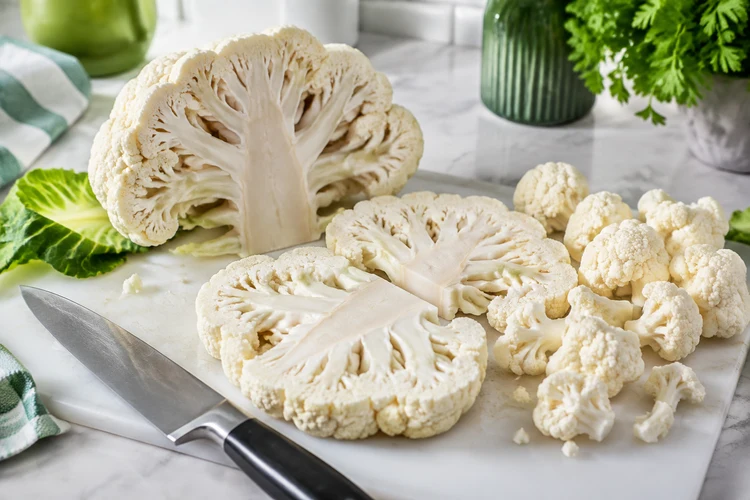
The outer portions usually separate into florets because they no longer connect to that central support. Those pieces remain useful food. For a restaurant, the important calculation is how many presentable portions the head produces and where the remaining edible cauliflower will be used. Frozen florets offer convenient stock for many dishes, but they cannot be cut back into an intact steak.
Choose a head with enough core to support the slices
A cauliflower steak is a cross-section of a branching plant structure. The stem rises into a core, and smaller branches connect the dense curd to it. A slice stays together when enough of that branching structure remains inside its thickness. The diameter of the white head therefore gives only part of the answer. A large, loosely formed head may produce less reliable steaks than a slightly smaller head with a compact curd and a broad, well-positioned core.
Turn the head over before deciding how to cut it. Look at the stem position, the spacing of the main branches and any cracks running into the curd. Choose sound cauliflower with firm tissue and tightly held florets. A head that already sheds pieces during ordinary handling will be difficult to portion cleanly. A thick external stem is useful only if the internal structure supports the slices you intend to take; leave the final assessment until the first central cut exposes it.
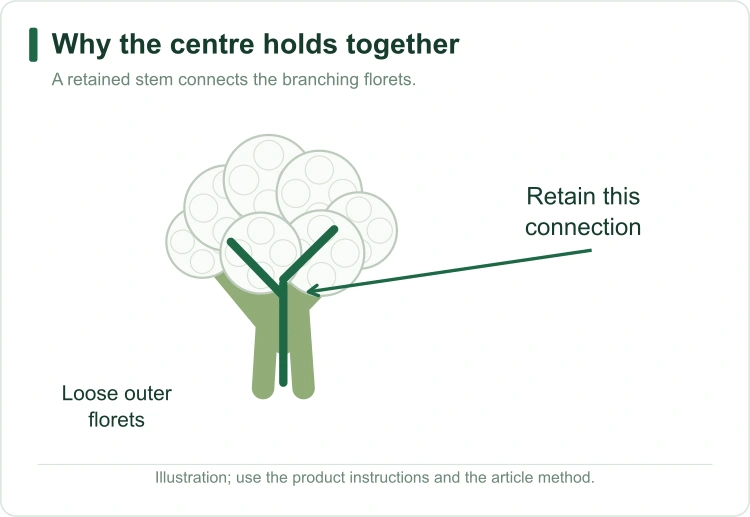
The highlighted connection explains why central slices remain intact. Removing that stem before cutting separates the branches and reduces the number of usable steak portions.
For a small meal, one large head may provide two main pieces with plenty of smaller florets alongside. For a fixed menu, buying a head for every two required steaks provides a more realistic initial trial than assuming every head will yield four. That is an operational allowance, not a guaranteed yield. Actual purchase quantities should come from a representative cutting test, with a little extra provision for breakage during cooking and plating.
Compare heads from the same delivery rather than choosing one unusually perfect sample. Different varieties, growing conditions and maturity can change curd shape and stem arrangement. If a restaurant uses a regular fresh supplier, a photograph of an acceptable cut surface can help communicate the desired structure. Head weight and diameter can then support that photograph, but they should not replace it. Record whether the supplied weight includes leaves and a long stem, because those details affect the amount entering the kitchen's usable-yield calculation.
White colour is also a purchase characteristic, although it does not tell you whether a steak will hold together. Purple or orange cauliflower can be cut in the same general way if its structure is suitable. Specify the intended colour and presentation separately from structural quality. This prevents a visually striking head being accepted for a menu that needs uniform pale slices, or a sound coloured variety being treated as a defective white one.
Cut through the centre while keeping the stem intact
Prepare a stable board with enough space for the whole head and the pieces you remove. Use a sharp chef's knife long enough to pass through the head in a controlled movement. A small knife encourages repeated pressure and twisting, which can loosen the curd. Keep your supporting hand clear of the blade's path and avoid trying to cut a head that rocks on the board.
The FDA's produce-handling guidance recommends washing produce under running water and does not recommend soap or commercial produce washes. Wash the cauliflower before cutting, then drain and dry it sufficiently to keep the board and your grip secure. Remove damaged material during preparation and keep the clean produce away from surfaces or utensils contaminated by raw meat.
- Pull or trim away the large outer leaves, exposing the base without cutting deeply into the core.
- Remove only the dry, projecting end of the stem so the head can sit securely.
- Place the head upright and make a vertical cut through its centre, including the stem.
- From the newly exposed face of each half, cut a parallel slice of the chosen thickness.
- Support each slice as it separates and transfer it flat to a tray.
- Inspect the remaining halves before attempting another steak; collect disconnected outer florets separately.
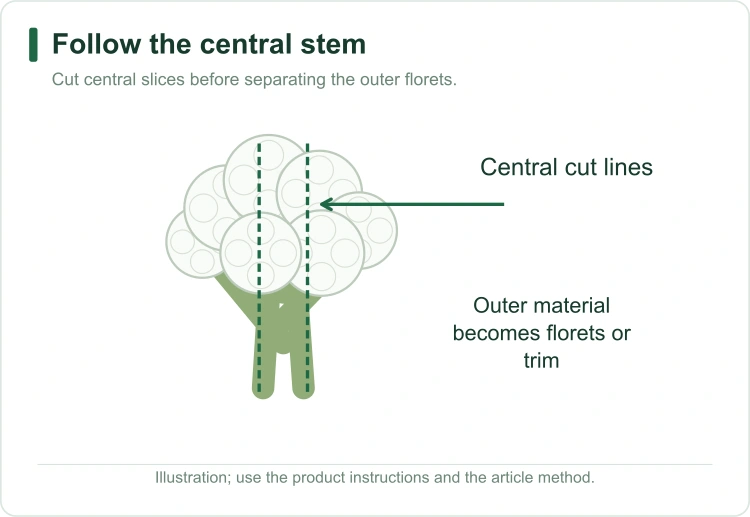
Cut lines pass through the central stem. The diagram shows the structural principle; the actual head shape determines how many supported slices can be recovered.
The first two slices taken beside the centre generally have the strongest connection to the stem. Inspect the back of each piece before lifting it. A steak can look complete from above while a large portion of its outer curd is attached by only a narrow branch. Slide a wide spatula underneath rather than pinching the top with tongs. If the connection breaks now, record the piece as a floret portion instead of trying to conceal it beneath a sauce.
Leaving the core in place does not require serving a long, woody stem. Once the steak is separated, trim the protruding end carefully while preserving the branch connections within the slice. Judge tenderness after cooking during the trial. Removing a large cone from the base, as you might when separating florets, destroys the structure needed for steaks.
Keep the cuts parallel. A wedge that measures 25 mm on one edge and 10 mm on the other can brown and soften unevenly, with the narrow edge breaking first. For repeated production, use a clean ruler during the sample trial and agree where thickness is measured. A simple written instruction with a reference photograph is easier to reproduce than "cut thickly."
Match slice thickness to the cooking method
A starting thickness of 19–25 mm gives a useful balance between a slice that can be lifted and one that cooks through within a practical finishing period. This range is a kitchen starting point rather than a preservation or safety specification. The ideal thickness depends on the density of the curd, the toughness of the core, the pan or oven and the texture expected on the plate.
Thinner slices expose more surface relative to their mass and can develop browned edges quickly. They also contain less supporting tissue and tolerate less movement. Very thick slices are easier to recognise as a substantial portion, but the stem may remain firm while the outside colours. If that happens, adjust the cooking sequence or thickness instead of simply increasing surface heat until the edges burn.
| Starting cut | Handling tendency | Cooking consideration |
|---|---|---|
| Below about 19 mm | More fragile, especially at outer branches | Shorter path for heat, but edges may dry quickly |
| About 19–25 mm | Useful trial range for intact central slices | Check both surface colour and core tenderness |
| Above about 25 mm | Heavier portion with more internal support | May need a gentler finishing stage after browning |
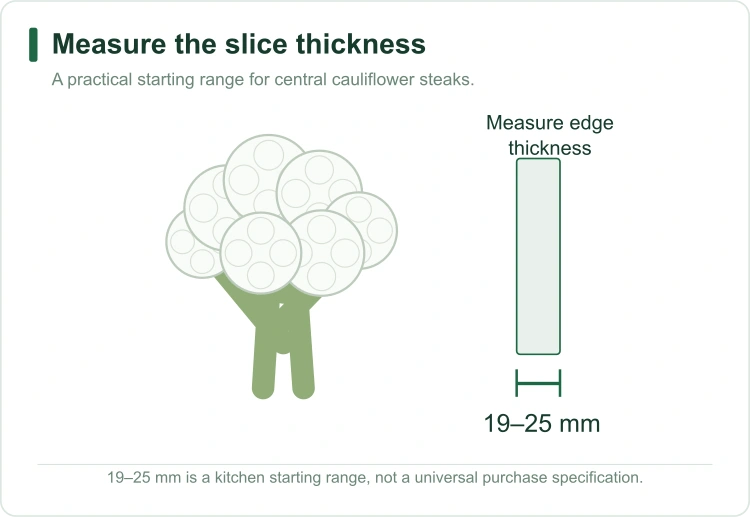
Measure the edge thickness separately from the face width. A 19–25 millimetre starting range can be tested against the cooking method and the desired cooked bite.
Use the table to organise a trial rather than to select a universal cooking time. Cook a thin, middle and thick sample from comparable heads using the same seasoning, tray position and equipment. Record whether each can be lifted, turned and plated intact. Cut into the core to assess tenderness and taste the curd as well. A soft outer floret attached to a hard centre is an unfinished cooking result even when the surface has attractive colour.
The equipment changes the acceptable cut. A broad oven tray supports the whole slice, while an open grill exposes weak edges to gaps and requires more careful turning. A crowded pan can trap moisture around the base and delay browning. Smaller air-fryer baskets introduce another limit: a large intact steak may sit against the sides or overlap another portion. Select head size with that equipment constraint in mind.
Thickness also affects the finished portion weight. Two steaks of equal thickness can have very different areas, so a thickness specification alone will not make plate portions equal. If the menu needs a weight range, define it separately and allow the kitchen to allocate smaller pieces to another dish. Avoid trimming away sound outer florets merely to force every natural slice into an exact outline.
Count intact steaks and usable trim separately
Steak count, steak weight and total edible yield answer different questions. Count tells the kitchen how many plates can be served. Steak weight helps control portion size. Total edible yield shows how much purchased cauliflower becomes usable food across all dishes. Combining those measurements into one percentage hides the reason a particular delivery performs well or poorly.
An illustrative trial might start with a 1,200 g purchased head. After cutting, the kitchen could have 450 g of acceptable steaks, 550 g of sound florets and tender trim, and 200 g of rejected leaves, dry stem or unsuitable material. Steak yield would be 37.5% of purchase weight; total usable yield would be about 83.3%. These figures describe a worked example only. They are not typical yields, a GreenLand specification or a promise for a future delivery.
The example explains why a low steak percentage does not automatically mean high food waste. If the 550 g of edible pieces goes into soup, mash, cauliflower rice or a vegetable mix, it has a planned use. If it remains in a container until it deteriorates, the theoretical yield never becomes a realised benefit. Plan that secondary dish before increasing the number of steaks on the menu.
For sound trim destined for rice, see the cauliflower rice freezing guide for particle size, moisture and portioning decisions. Evaluate whole steaks separately.
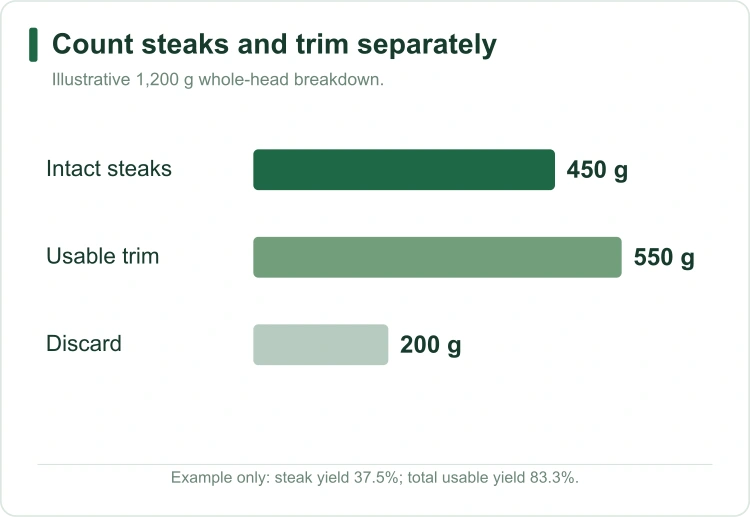
This hypothetical 1,200-gram head produces 450 grams of steaks and 550 grams of usable trim. Actual purchase yield needs a weighed trial with the intended head grade.
Use the same denominator when comparing deliveries. A head purchased with extensive leaves cannot be compared directly with a pre-trimmed head using only the final steak weight. Record purchase condition, initial weight, steak count, accepted steak mass, edible secondary material and discarded mass. In a kitchen trial, also record the time spent washing, trimming and portioning, since labour can change the economics even when edible yields are similar.
A sensible cost calculation allocates value to both streams. The steak menu may carry most of the head's purchase cost, while the remaining florets replace cauliflower that would otherwise have been bought for another dish. Do not credit the trim at full value unless it actually replaces a required ingredient. The purpose is to compare practical menu options, not to produce an impressive yield number.
The GreenLand-food cauliflower range includes florets, cuts and riced forms for cooked applications. These formats can be considered alongside fresh heads when a kitchen needs a predictable secondary ingredient. They should be evaluated as their own products, with their own cutting and cooking behaviour.
Keep cut steaks stable through preparation and cooking
Support the slices flat during preparation. Stacking heavy pieces on top of fragile outer branches creates cracks that may become visible only when the steaks are turned in the pan. A shallow tray with an appropriate cover protects the cut surfaces without requiring the kitchen to keep handling each piece. Keep prepared cauliflower refrigerated when it is not being cooked and follow the site's established preparation and holding limits.
Drying after washing helps control the first stage of cooking. Surface water has to evaporate before the cut face can brown effectively. Water collected in the curd can also run into the pan after the outside appears dry. Drain the head well before cutting, then blot accessible surfaces gently. Avoid squeezing or pressing the steak, which can damage the connections that make the piece presentable.
Apply oil and seasoning evenly to both broad faces when the recipe calls for them. Excess liquid marinade can change a roasting method into a steamy cook and encourage the steak to soften before it colours. Wet sauces can be added later if that better suits the intended result. Salt, spices and finishing ingredients should be measured during the trial so that a change in seasoning does not get mistaken for a difference in cauliflower quality.
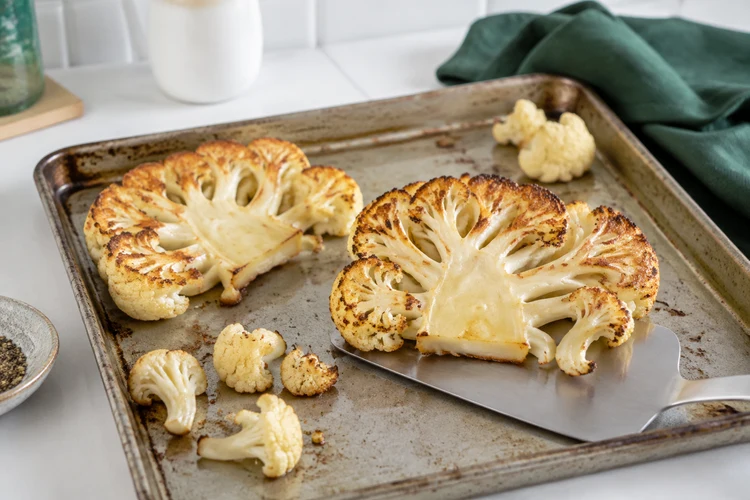
A broad spatula supports the retained core and nearby branches during lifting. The roasted outer florets can be used separately from the intact central portions.
Give the cooking surface enough room. Pieces touching or overlapping produce different contact and evaporation conditions from separated slices. When testing a batch for service, use the actual number of steaks expected on a tray. A result achieved with one piece in an otherwise empty oven does not establish how a full service load will perform.
Lift with a broad utensil and minimise turning. The cooking process softens plant tissue, so a steak that was robust when raw becomes more delicate near the end. Assess the finished slice after the full service sequence, including transfer to a warm plate, sauce addition and any short hold. Breakage during plating matters just as much to the customer as breakage during cutting.
Use sound loose florets as a separate cooked portion, soup ingredient or mash component. A portion reconstructed from loose florets may taste excellent, but its preparation and presentation differ from an intact central slice. Describe that menu item honestly and use a preparation method designed to hold the pieces together if a formed product is intended.
Understand what freezing changes in a cauliflower steak
Freezing preserves cauliflower for later use, but the formation of ice changes the tissue. After thawing or cooking, the vegetable usually releases more water and has less of the firm resistance found in a freshly cut head. A broad, connected steak can be especially sensitive because several thin branch connections must survive handling, freezing, packing and final cooking.
Ordinary frozen florets have already been separated from the head. They cannot be sliced into a continuous piece containing the original core. A bag labelled cauliflower cuts may contain a range of broken or trimmed shapes, so the word "cuts" does not establish steak availability. Ask for an image and specification of the actual frozen form before designing a plated main around it.
The NCHFP cauliflower preservation method gives instructions for pieces about one inch across and a three-minute water blanch. That method does not validate the same treatment for a large intact steak. Heat penetration, cooling and structural performance differ with the geometry. A commercial steak product needs its own process confirmation and application test.
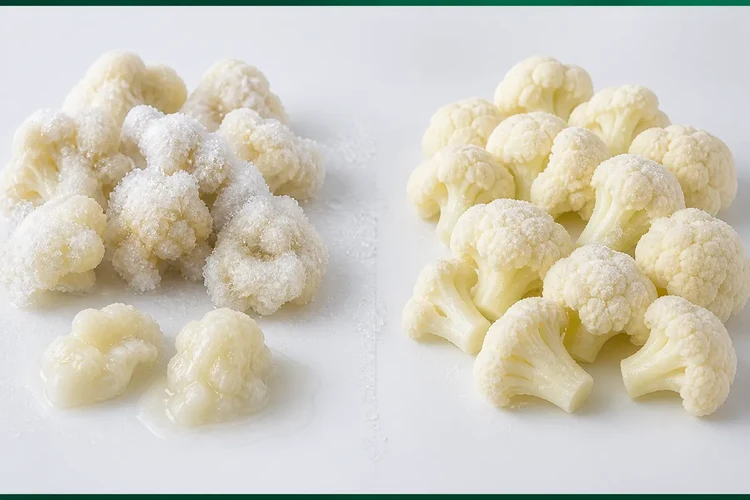
Prepared florets show why product form must be identified before comparison. Frozen florets do not provide the continuous central structure needed for a whole-head steak.
For a prepared frozen steak, useful purchase details include whether it is raw, blanched, partly cooked or fully cooked; whether it is individually frozen; and whether it should be cooked from frozen or thawed under a specified procedure. Those are distinct product conditions. They influence water release, handling strength and the amount of finishing still required in the kitchen.
Evaluate frozen samples under the intended use conditions. Record the starting frozen weight, the cooked weight, the number of intact plated portions and the amount of loose material left on the tray. Inspect the core as well as the curd. Large ice deposits or damaged packs deserve investigation, although a photograph of ice alone cannot establish the exact storage history.
Where a reliable frozen steak format is unavailable, choose a dish built around verified florets or riced cauliflower. Roasted florets can provide browned edges; mash can provide a smooth base; cauliflower rice can provide a small-particle vegetable component. Each format has a clear use without assuming that freezing reproduces every feature of a fresh central slice.
Specify the cut and test the finished portion
A useful steak specification starts with the intended plate. Describe the desired portion appearance, cooked texture and preparation equipment, then work backwards to the raw material. Include whether one intact central slice is required, whether attached smaller branches are acceptable and how much breakage can be tolerated. A photograph of the approved cooked portion gives those words a shared reference.
For fresh heads, establish purchase condition, head size range, compactness and the expected cutting method. For a prepared frozen product, establish the cut dimensions, core inclusion, individual piece weight range, pretreatment and cooking instructions. Set tolerances through supplier discussion and trials. Avoid inserting attractive numerical limits that nobody has measured or agreed to meet.
Check samples from a representative production lot. Prepare them with the same tray loading and finishing method planned for service, then assess portion count, cooked yield, colour and tenderness. If the product will be held and reheated, include that stage. A sample that looks good immediately from the oven may soften further or release liquid in a covered meal container.
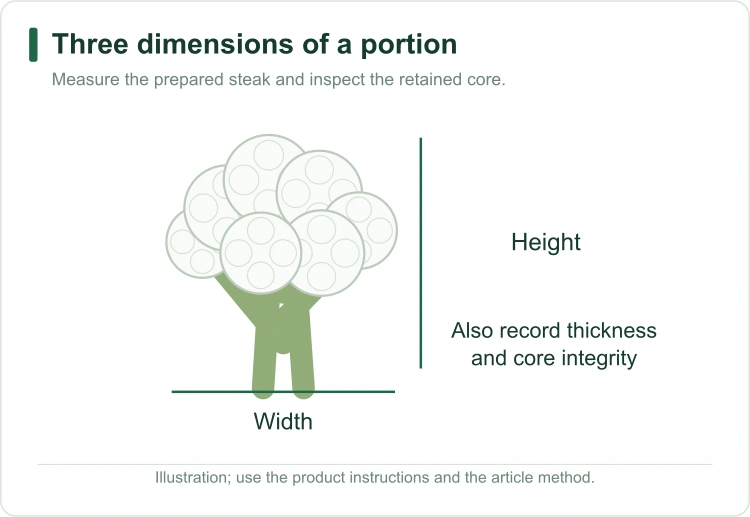
Record width, height, thickness and core integrity together. A sample that meets one dimension can still fail to provide the portion shape required for the finished dish.
Packaging needs to protect the portion shape. Confirm whether steaks are layered, separated or loose within the pack and how they can be removed without breaking neighbouring pieces. Carton and inner-pack size should fit actual daily usage. Repeatedly opening a large pack to remove a few fragile portions may introduce avoidable handling damage and temperature exposure.
We help purchasing teams compare available frozen vegetable forms against their application. For a cauliflower requirement, send the cut reference, portion target and intended cooking process with the quantity, packing and destination. We will review available forms and confirm the specification that can be supported for the order. Steak availability needs separate confirmation.
Keep the approved sample record with the agreed specification. It should connect the purchase description to the result on the plate, including the secondary use for sound trim. That connection makes the cutting method commercially useful: the kitchen knows what to expect from each delivery, and the purchasing team can distinguish a raw-material problem from a change in preparation.
Review a cauliflower cut for your menu
GreenLand-food is a professional frozen cauliflower supplier and manufacturer in China, providing factory-direct wholesale supply for importers, food manufacturers, foodservice distributors and private-label programmes.
Tell us whether you need florets, a rice-style cut or another proposed portion, together with the destination, pack size and expected volume. For a steak-shaped request, include a reference image, dimensions and the cooking method so feasibility and sample requirements can be reviewed before an offer is confirmed.
Use the product range and downloadable catalogue to review the wider selection, then send the specification and order details that matter to your application.