


How to Make Sorbet With Frozen Fruit in a Blender
Aug 28, 2026
Leave a message
How to Make Sorbet With Frozen Fruit in a Blender
Use very little added liquid, watch the texture inside the jar and adjust sweetness and acidity for the fruit you actually have.
Key takeaways
- Start with 2 cups frozen fruit and only 2 to 3 tablespoons liquid.
- Pulse first, then tamp or scrape so the mixture moves without becoming a drink.
- Sweetener affects texture as well as taste; acid can sharpen a flat fruit flavor.
- For production trials, record fruit Brix, acidity, form, seed level and finished yield.
Quick Answer: A Reliable Blender Sorbet Ratio
To make sorbet with frozen fruit in a blender, start with 2 cups of frozen fruit, 2 to 3 tablespoons of liquid, 1 to 2 tablespoons of sugar, honey or syrup if needed, and 1 to 2 teaspoons of lemon or lime juice. Pulse until the fruit becomes coarse, stop and scrape or tamp safely, then blend just until the mixture forms thick folds or mounds. Serve immediately for soft sorbet, or freeze it for 30 to 60 minutes for a firmer scoop.
The key is restraint with liquid. A smoothie needs enough liquid to circulate freely; blender sorbet is supposed to remain dense. Add only one tablespoon at a time when the blades stop moving. Fruit varies in natural sugar, acidity, fiber, seed content and piece size, so the final sweetness and texture should be adjusted after a small test rather than copied blindly from another fruit.
For an easy first batch, use frozen mango or strawberries cut into manageable pieces. Mango often creates a smoother body because of its pulp and fiber. Strawberries bring more water and acidity. Raspberries and blackberries produce an intense flavor but keep noticeable seeds unless the fruit is strained or supplied in a refined puree form. The blender method is forgiving when you watch the texture, but it is not a fixed formula for every fruit.
What Makes Frozen-Fruit Sorbet Work
Sorbet is a frozen mixture of fruit, water and dissolved solids, usually sugar. In a blender shortcut, the fruit is already frozen, so the machine breaks the pieces into small crystals while the limited liquid and fruit pulp bind them into a soft mass. The goal is not simply to crush ice. The goal is to distribute tiny ice crystals through enough fruit solids and dissolved sugar that the mixture feels smooth rather than snowy or watery.
Sugar affects more than sweetness. Dissolved sugar lowers the temperature at which the water phase freezes and can help the sorbet remain scoopable. Too little may produce a hard or icy result after storage. Too much can make the mixture soft, sticky or slow to freeze. Honey, agave and syrups bring their own flavor and water. A tablespoon of dry sugar and a tablespoon of syrup are not identical formula changes.
Fruit supplies water, natural sugars, acids, pulp, fiber and sometimes seeds. Ripe mango generally contains more body-building pulp than strawberries. Pineapple can be juicy and fibrous. Berry skins and seeds change mouthfeel. A puree behaves differently from IQF whole fruit because its particle size, heat treatment and entrained air may differ. That is why a practical sorbet method uses sensory cues and measured corrections rather than claiming that two cups of any fruit will always need exactly the same sweetener.
Acid brightens flavor. Cold temperatures mute aroma and sweetness, so a sorbet can taste flat even when the fruit tasted pleasant before freezing. Lemon or lime juice may restore balance, but acid cannot repair weak, immature fruit. Add it in teaspoons, not a large pour. Too much citrus can make mango harsh or overwhelm a delicate peach. Taste the base after it begins to soften slightly on the spoon.
Numbered Blender Method
- Confirm that the blender is approved for processing frozen ingredients. Read the maximum fill guidance and use the manufacturer's tamper only as directed.
- Measure 2 cups of frozen fruit. If the pieces are larger than the blender handles comfortably, let them temper for five to ten minutes or cut them when safely possible before freezing.
- Add 2 tablespoons of liquid to the jar. Use water for a neutral base, juice for added fruit character, or a small amount of coconut water for a lighter tropical profile.
- Add 1 tablespoon sweetener and 1 teaspoon citrus juice if the fruit needs them. You can always add more after the first blend.
- Add the frozen fruit. Pulse several times so large pieces break down without the bottom becoming a liquid pool.
- Start at low speed. Use the tamper through the lid opening if the machine is designed for it, or stop fully before scraping the sides.
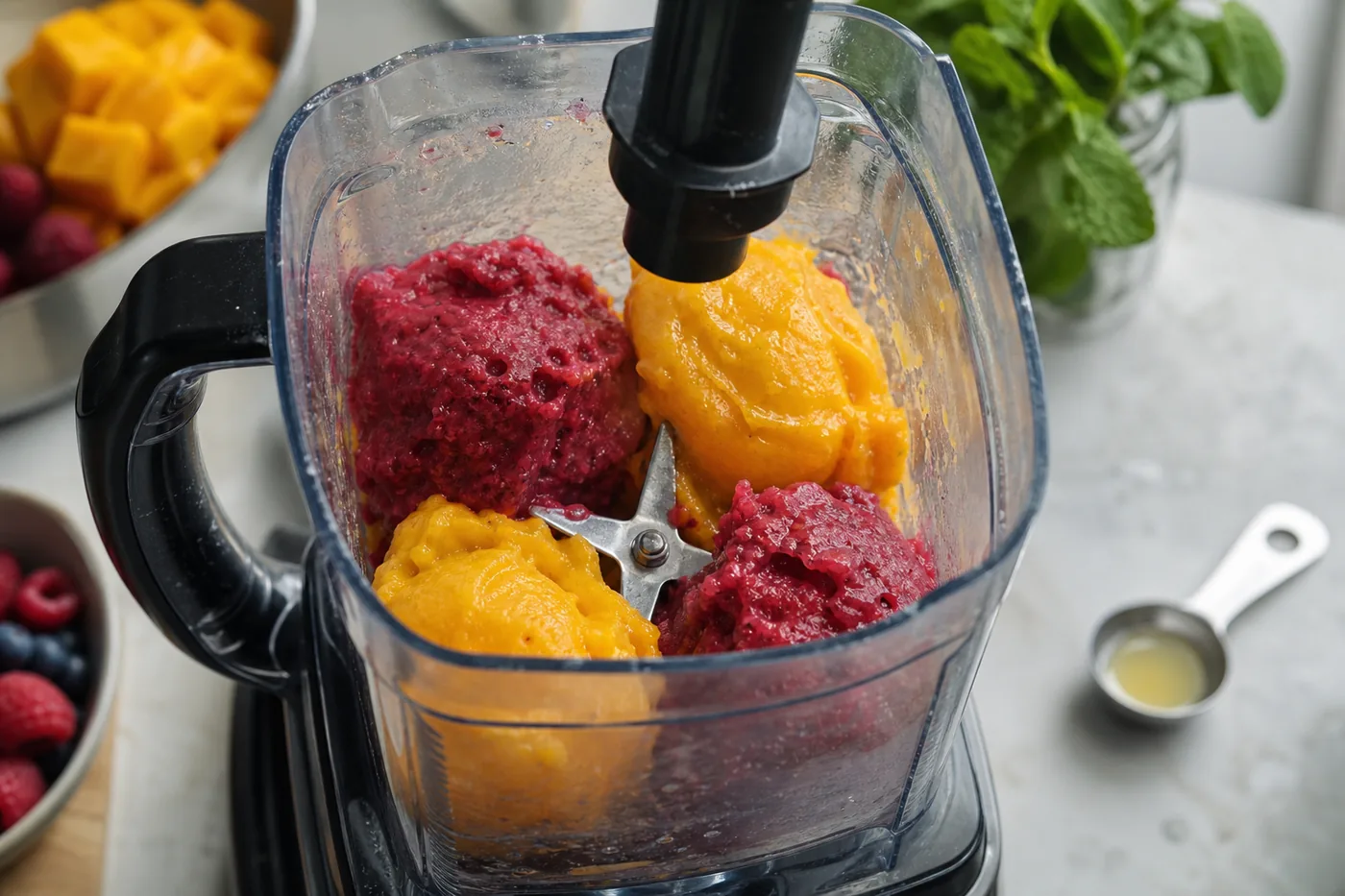
- Increase speed briefly once the mixture moves. Stop when four thick mounds or a continuous folding mass appears above the blades. Do not keep blending until it pours.
- Taste a small spoonful. Add sweetener, acid or a pinch of salt only if needed. Blend for a few seconds to distribute the change.
- Serve immediately for a soft texture, or spread into a shallow pre-chilled container and freeze for 30 to 60 minutes.
If the fruit spins at the sides while an empty pocket forms around the blades, stop. More high-speed running adds heat without moving the mass. Scrape the jar, redistribute the fruit and add one tablespoon of liquid. A blender batch also needs enough total material to reach the blades effectively; an extremely small portion may never form the circulation pattern the jar was designed to create.
Blender Sorbet Troubleshooting
| Result | What probably happened | Immediate correction | Next-batch control |
|---|---|---|---|
| Blender stalls | Batch is too dry, pieces are too large or fruit bridges above the blades | Stop, scrape, add 1 tablespoon liquid and restart low | Temper briefly, use smaller pieces or increase batch to the jar minimum |
| Sorbet turns slushy | Too much liquid or too much melting during blending | Add frozen fruit and blend briefly | Start with 2 tablespoons liquid and shorten the cycle |
| Sorbet is icy | Too much free water, too little dissolved sugar or large crystals after storage | Let it soften, reblend a small portion with fruit or syrup | Record fruit Brix and adjust solids in a controlled test |
| Sorbet freezes rock-hard | Simple formula stored too long or dissolved solids are low | Temper at room temperature for several minutes before scooping | Increase appropriate sugar solids or serve the blender batch fresh |
| Sorbet is sticky and will not firm | Too much sweetener or syrup | Fold in more unsweetened fruit puree and refreeze a test | Weigh sweetener and account for syrup water |
| Flavor is flat | Cold temperature, weak fruit or insufficient acidity | Add citrus by the teaspoon and a tiny pinch of salt | Approve fruit on aroma, Brix and acidity, not color alone |
| Berry texture is gritty | Seed load is high | Strain a thawed puree for the next batch | Choose refined or seed-reduced puree for a smoother target |
How to Read the Texture in the Blender
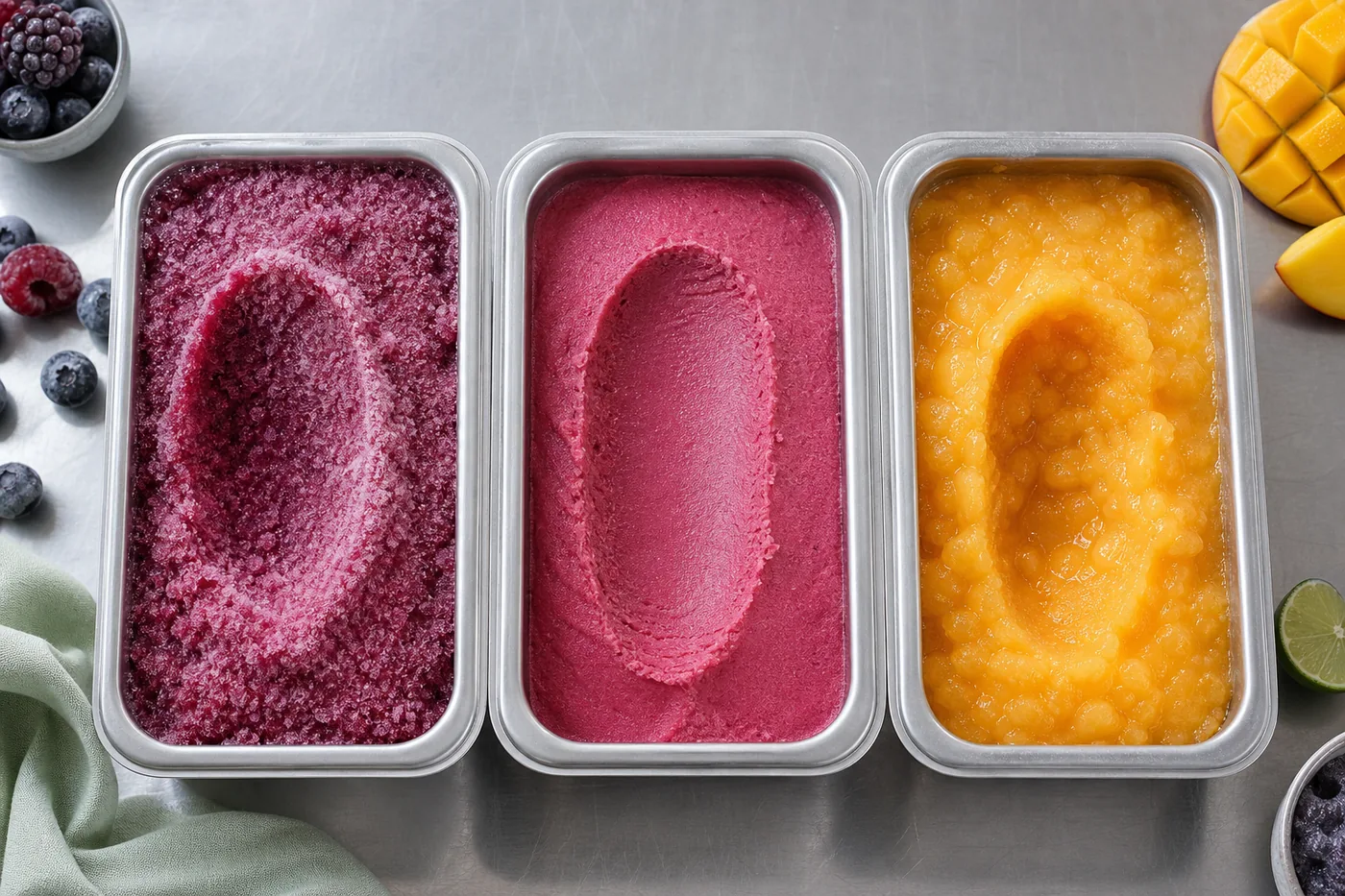
Correct blender sorbet does not pour. It moves slowly, folds over itself and may form several heavy mounds above the blades. A tamper can push unmoving frozen fruit from the jar wall into the cutting zone. Once the entire batch circulates, the change from coarse pieces to smooth sorbet can happen quickly. Stop early and inspect; another minute of blending often melts the texture you worked to create.
An icy sorbet has visible or perceptible crystals and may break apart rather than smear smoothly. The reason is not always "not enough blending." Fruit with a large water phase and very little dissolved sugar can be perfectly blended and still refreeze hard. Slow freezing in a deep container can also create larger crystals. Repeated softening and refreezing encourages crystal growth. Texture must be managed through formula, processing and storage together.
A slushy sorbet rotates like a thick drink and settles level as soon as the blender stops. It may still taste good, but added water or melting has moved it away from a scoopable dessert. Add more frozen fruit only if you can preserve the flavor balance. Otherwise serve it as a granita-style or frozen beverage rather than disguising a failed formula with excessive sweetener.
Fruit-by-Fruit Adjustments
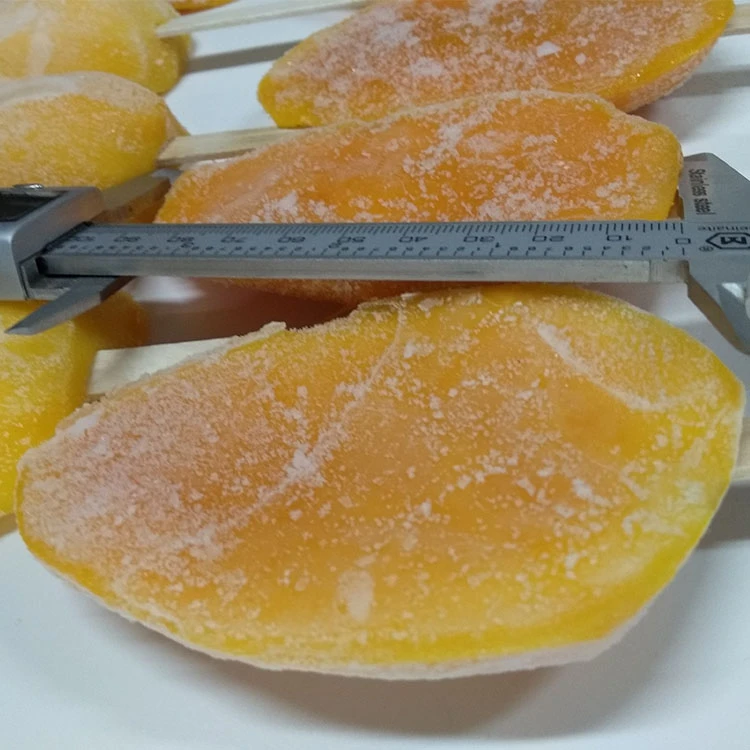
Mango is one of the easiest fruits for blender sorbet. Ripe pulp supplies color, aroma, natural sugar and a dense smooth body. Begin with water or lime juice rather than a strongly flavored juice. Evaluate fiber: some varieties or maturity levels leave a stringy finish even after blending. Large chunks may require tempering, while 10 to 20 mm pieces reach the blades more predictably.
Strawberries contain more free water and less dense pulp than mango. The result can taste bright and fresh but may refreeze harder. Whole frozen strawberries also create a high blender load. Halves, slices or dice are easier to portion. Taste before sweetening; color is not a reliable measure of ripeness. A little lemon can support weak acidity, while too much turns the finished sorbet sharp.
Raspberries and blackberries make an aromatic, deeply colored sorbet. Their seeds are the main decision. Whole-fruit sorbet has a rustic texture. For a fine restaurant scoop or a smooth retail product, a refined seedless puree may fit better. Straining a thawed puree changes yield, so weigh the retained puree rather than assuming the original fruit weight still represents the formula.
Blueberries have skins that may remain visible as small dark flecks. They are easy to portion from IQF whole form and pair well with lemon, vanilla or another berry. Their flavor can become muted at very low serving temperatures. Small cultivated berries and larger blueberries differ in skin-to-pulp ratio, so a change in berry type can be a real formula change.
Peaches and apricots create a gentle stone-fruit sorbet. They often benefit from lemon and a small pinch of salt. Remove every pit fragment. Slices and dice blend more easily than large halves. Because the flavor is subtle, an excessive syrup or citrus dose can dominate. A clean neutral sweetener usually works better than a strongly flavored honey.
Pineapple and passion fruit bring high acidity and tropical aroma. Pineapple fiber can produce a slightly aerated or fibrous body. Passion fruit seeds are either a desired visible cue or a textural problem, depending on the concept. A blended tropical formula may use mango for body, pineapple for acidity and passion fruit puree for aroma, with each ingredient controlled separately.
For a related dessert format, see pineapple soft serve when dispensing and melt behavior matter.
Banana makes a creamy frozen dessert, often called nice cream, but its characteristic starch, sweetness and flavor move the product away from a classic clean fruit sorbet. It can be useful in a home dessert, but it is not a neutral solution to every texture problem. If the menu promises raspberry sorbet, a large banana addition may make the name misleading.
Sweetener, Acid and Solids: Avoid False Precision
Home recipes often say to add one or two tablespoons of sweetener. That is a sensible sensory starting point for a blender batch. It is not a commercial sorbet specification. Fruit Brix may change by variety, maturity, crop and lot. The same weight of sugar dissolved in a juicy strawberry puree and a dense mango puree does not create the same total solids or freezing behavior.
For a household batch, taste the fruit and begin low. Granulated sugar needs time and liquid to dissolve, so a fine sugar or syrup may distribute more quickly. Honey brings aroma and glucose/fructose composition that changes sweetness perception. Maple syrup is distinctive. A simple syrup adds water along with sugar. Record the form and weight if you want to reproduce the result.
For product development, measure the fruit puree Brix and the finished mix, but do not rely on Brix alone. Acids, fibers, pectin, other dissolved solids and stabilizers influence texture. A refractometer reading can also be affected by suspended particles and temperature. Use it as one controlled observation, then confirm scoopability, melt, flavor and stability under the actual process.
Acidity can be described by pH and titratable acidity, which answer different questions. pH matters for microbial and formulation considerations; titratable acidity often corresponds more closely to the total acid taste. A small foodservice operator does not need a laboratory to make one blender dessert, but a manufacturer should define which result belongs on the specification and COA instead of requesting "acidity" without a method.
Serving, Firming and Freezer Storage
Blender sorbet is at its best immediately, when the crystals are small and the mixture is soft. Scoop it into chilled dishes so it does not melt on contact. If the blender added heat, a shallow container firms the batch more evenly than a deep bowl. Thirty to sixty minutes is often enough for a soft formula, but the actual time depends on freezer temperature, batch depth, sugar and fruit.
Longer storage changes a simple recipe. Home freezers cycle, containers are opened, and water migrates into larger crystals. Press a cover close to the surface, keep the container tightly closed and avoid repeated warm-cold cycles. A hard sorbet is not necessarily spoiled; it may simply need several minutes of tempering. Storage safety still depends on clean handling, sound ingredients and uninterrupted frozen conditions.
Do not assign a long shelf life to a commercial sorbet because a household batch remained frozen. Retail production requires a defined formula, process, hygienic design, packaging, label review, storage testing, microbiological plan and market-specific compliance. Stabilizers or sugars may be used for legitimate texture reasons, but their use and declaration must follow the intended product and local rules.
Scaling a Frozen-Dessert Formula Trial
Start with a one-kilogram pilot rather than jumping from two blender cups to a production tank. Weigh fruit, added water, sugar or syrup, acid and any stabilizer separately. Record fruit temperature, Brix, pH or acidity when relevant, piece or puree form, blender or processor model, cycle time, finished weight and product temperature. These records tell you what actually changed between samples.
Create three versions around one base. Sample A uses the starting sweetener. Sample B changes only sweetener solids. Sample C changes only acid. If texture is the main problem, run a separate set changing water or fruit solids. Changing sugar, acid, stabilizer and fruit variety in one round may produce a better sample, but it does not reveal why.
Evaluate immediately, after one hour, after 24 hours and after the intended service hold. Score sweetness, acidity, aroma, seed perception, crystal size, scoop force, melt pattern and color. Use the same serving temperature for comparisons. A sample served five degrees warmer will seem softer and sweeter even if its formula is identical.
Foodservice batches also need portion yield. A dense sorbet may contain little overrun, so container fill and scoop count are closely tied to mass. Track what remains on equipment, the loss during straining and the weight of a standard scoop. Price per kilogram of fruit is only one part of portion cost; yield, labor and rejected texture matter too.

Choosing Frozen Fruit for Sorbet
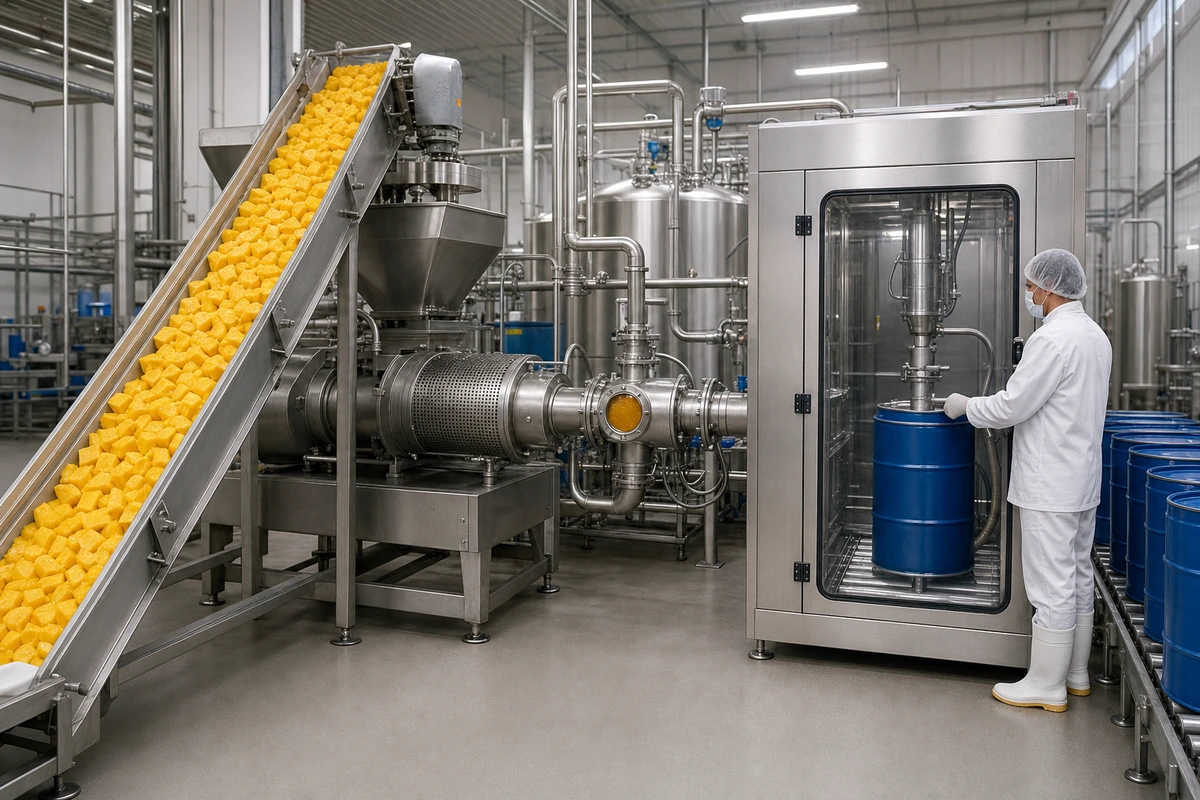
The first procurement question is product form. IQF pieces give flexibility and visible proof of fruit before blending. Puree reduces cutting and blending load. Seedless puree can improve berry mouthfeel. Bits and pieces may be economical for complete blending, but their maturity, peel and defect controls still need a specification. A puree block and an IQF dice should never be treated as the same product because both eventually enter a blender.
Ask for variety or commercial type, origin, natural Brix range, color, flavor and odor, maturity, fiber where relevant, seed condition, peel or pit-fragment control, defect tolerance and foreign-material control. For puree, confirm single strength or concentrate, refining screen, seeded or seedless condition, pasteurized or non-pasteurized status, added sugar or water, flow properties and pack size.
The intended use is essential. Frozen fruit for a sorbet consumed without a later heat treatment needs a hazard assessment and microbiological program suited to that use and market. Freezing is not a universal pathogen kill step. The buyer and supplier should state whether the ingredient is for further processing, a validated heat treatment or a ready-to-eat program. Label wording should follow the actual control plan.
Packing affects production. A small dessert kitchen may prefer 1 or 2.5 kg bags, while an industrial puree user may need pails, bags or drums. Large blocks take time and controlled temperature to temper. IQF pieces should remain free-flowing enough for dosing. Confirm storage, shipping temperature, pallet plan, carton marks, lot coding and documents before the first order, not after the container arrives.
Our frozen fruit range includes pieces and puree formats that can be reviewed for dessert applications. Buyers considering mango can compare the IQF mango chunks page. Send the target flavor, fruit percentage, desired seed level, pack size, annual volume and destination so we can review a realistic program.
From a Blender Recipe to a Repeatable Product
The fastest home method remains simple: two cups frozen fruit, very little liquid, optional sweetener and citrus, then pulse, tamp and stop at a mound. The commercial lesson is equally simple: the ingredient is part of the formula. Fruit Brix, acidity, fiber, seed, form and temperature affect how much added water and sugar the mix can tolerate.
A repeatable sorbet comes from controlling one variable at a time. Use the same fruit lot for initial formula comparisons, then test an approved range across realistic lots. Define the serving temperature and storage interval. Approve the fruit specification against the finished dessert. That approach produces useful flexibility without pretending that nature supplies identical fruit every season.
Frequently Asked Questions
Can you make sorbet with only frozen fruit?
Some naturally soft or sweet fruit can blend without added sweetener, but most blenders still need a small amount of liquid to start circulation. The result may freeze harder if the formula has very little dissolved sugar.
What is the best frozen fruit for blender sorbet?
Mango, peach, pineapple, strawberries and raspberries are practical choices. Mango and peach are naturally smooth; berry sorbets may need seed management; pineapple can need a sweetness adjustment.
Why is my sorbet icy?
It may contain too much free water, too little dissolved sugar, large ice crystals from slow refreezing or repeated temperature changes. Blend a small test and adjust one variable at a time.
Why will my blender not move the frozen fruit?
The batch may be too small, too dry or packed above the blades. Stop the machine, scrape or tamp safely, add one tablespoon of liquid and restart at low speed.
How long should homemade fruit sorbet freeze?
Serve it immediately for a soft texture or firm it for about 30 to 60 minutes. Longer storage usually makes a simple blender formula harder, so temper it briefly before scooping.
Do I need an ice cream maker?
No. A strong blender or food processor can make a soft sorbet from frozen fruit. An ice cream maker offers different control over freezing and texture for larger or more stable batches.
What should a sorbet manufacturer specify when buying frozen fruit?
Confirm fruit variety, Brix, pH or titratable acidity where relevant, cut or puree form, seed condition, fiber, defects, heat-treatment status, packing and cold-chain requirements.
Build a Frozen-Fruit Trial Around Your Application
Tell us the fruit, form, packing, quantity, application and destination market you need. We will review the practical specification, sample route, documents and cold-chain plan for the order.