


Is Bamboo a Tree or a Grass?
Sep 09, 2026
Leave a message

The thick upright stems are called culms, and the young growth emerging from the ground is what becomes a bamboo shoot. The contrast between a tender edible shoot and a hard mature culm is a change in growth stage within the same kind of plant.
That classification explains more than a botanical label. It helps make sense of bamboo's joints, underground rhizomes and rapid upward growth, and it shows why the harvest stage matters so much for food texture. For buyers of prepared bamboo shoots, the useful questions then become more specific: which edible material is supplied, how was it prepared, what cut is required, and how tender should it be after the final cooking process?
Bamboo belongs to the grass family
Bamboos form the subfamily Bambusoideae within Poaceae. The family also contains familiar lawn grasses and cereal crops, although a mature bamboo grove looks very different from a field of wheat. Botanical families are based on relationships and plant characteristics, not simply on height or whether a stem feels woody. The American Bamboo Society identifies bamboo as a perennial grass and describes the structural features that distinguish it from a conventional woody tree. The American Bamboo Society's introduction is a useful starting point for the classification.
The word perennial means that the plant persists across growing seasons. A living bamboo plant can produce new culms from its underground system while older culms remain above ground. The visible stems are therefore parts of a larger growing plant, rather than each being a separate seedling tree. That distinction becomes clear when several new shoots emerge around established growth. The underground system supports the renewal of the stand, while individual culms have their own ages and conditions.
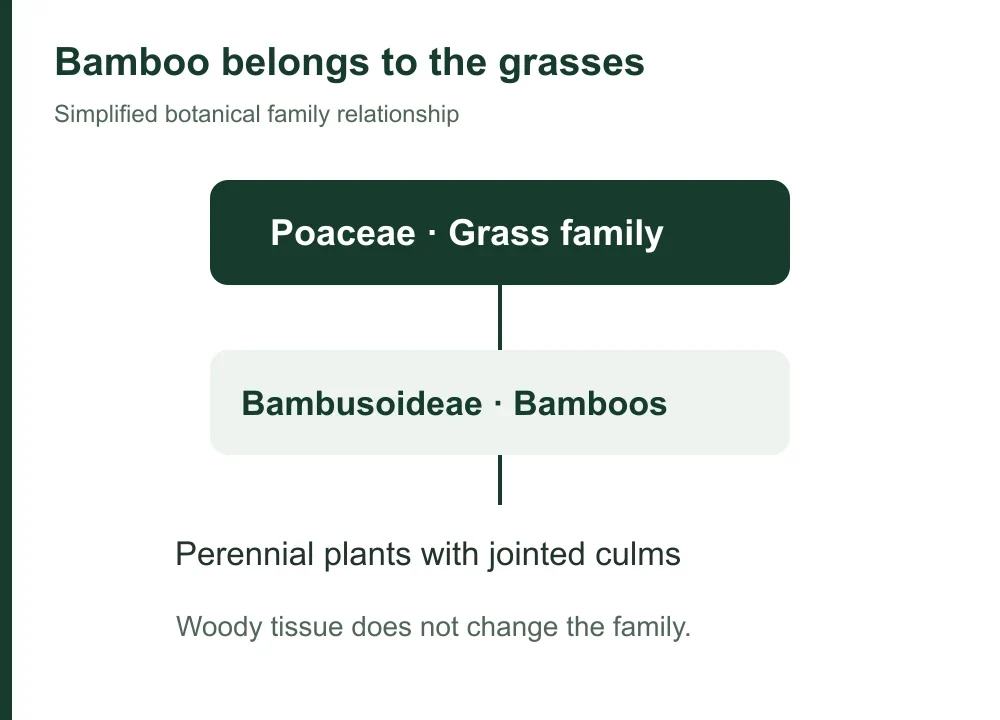
Bamboo does not need to resemble soft lawn grass to belong to the same family. Its culms can contain strong, lignified tissues that give mature stems stiffness. Grass classification and woody texture are compatible descriptions here. Calling bamboo a woody grass can be helpful because it acknowledges the material people can touch without moving the plant into a tree category. The food implication is that woody mature material and tender young shoot tissue should not be treated as equivalent raw materials.
There is considerable variation within bamboo. Species differ in height, culm diameter, growth habit and other characteristics. Some familiar structural descriptions are common rather than universal: many bamboos have hollow internodes, for example, but a single hollow tube is not an adequate definition of every bamboo. An article that treats every species as identical can quickly overstate what follows from the family name. The same caution applies to edible shoots, where species and preparation cannot be inferred from a generic picture of a grove.
For a food buyer, the classification is background knowledge that helps organize the next questions. A supplier's botanical or commercial identity should be sufficiently clear for the ingredient being purchased. The name bamboo shoots identifies a food category, but it does not by itself define tenderness, cut dimensions, processing state or suitability for a particular recipe. Those characteristics need to be confirmed in the product specification, just as they would for other vegetables whose varieties and harvest stages differ.
Why bamboo can look like a tree
Height is the most obvious reason bamboo is mistaken for a tree. A mature grove can create a canopy, shade the ground and present a wall of tall, rigid stems. From a distance, those features resemble woodland. The comparison is understandable, but it describes the landscape rather than the plant's family. San Diego Zoo's bamboo account explains this contrast between a grass identity and the size and strength of mature growth. Its bamboo overview connects the familiar appearance with the plant's growth form.
Look more closely at a culm and the repeated joints become easier to see. The solid-looking rings are nodes, with internodes between them. Branches and leaves arise in relation to this jointed structure. A conventional tree trunk has a different organization and usually increases its diameter through secondary growth. Bamboo's culm structure is not simply a young tree trunk with an unusual bark pattern. The joints are part of the reason a cut bamboo stem has such a recognizable appearance.
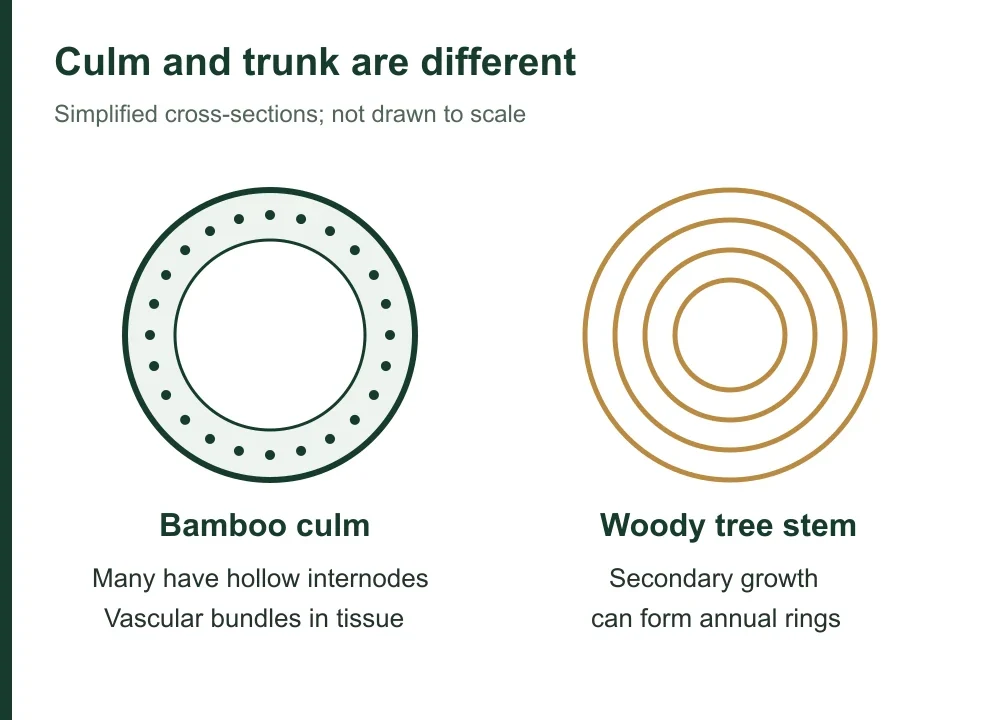
Bamboo culms and conventional woody tree stems have different internal growth structures. Simplified diagram.
View larger diagram| Feature | Bamboo | Conventional woody tree |
|---|---|---|
| Plant group | Grass family, Poaceae | Many different plant families. |
| Upright structure | Jointed culm | Trunk and branches. |
| Diameter growth | New culm emerges near its eventual diameter | Secondary growth commonly increases trunk diameter. |
| Food connection | Suitable prepared young shoots | Tree appearance alone says nothing about edible use. |
A new bamboo culm generally emerges at close to its eventual diameter rather than thickening in the same manner as a tree trunk over many years. It extends upward as the shoot develops, then matures and hardens. This does not mean every shoot reaches the same size, nor does it justify a universal daily growth rate. Species, plant condition and growing environment matter. The useful comparison is the pattern of development: a new culm's growth should not be imagined as decades of tree-like trunk expansion.
Inside the culm, vascular bundles are distributed through the tissue rather than arranged as the familiar annual rings of many trees. This helps explain why a cross-section looks different from a sawn woody branch. It is a structural comparison, not a claim that every material property can be predicted from a diagram.
The visual similarity has little value as a food-safety shortcut. A tall ornamental bamboo in a garden is not automatically a suitable source of edible shoots, and a young-looking shoot is not automatically ready to eat. The classification tells us why the plant looks and grows as it does. Identification and preparation determine whether particular shoot material belongs in a food process. Keeping those questions separate prevents an interesting botanical explanation from becoming an unsafe invitation to taste unidentified garden growth.
Rhizomes, roots and shoots have different jobs
The underground rhizome is a stem, not simply another name for a root. It connects growth below ground and carries buds that can develop into new shoots. Roots arise from the underground system and perform their own functions in anchoring the plant and taking up water and nutrients. A soil cutaway is useful because the visible culms alone hide this arrangement. What looks like a cluster of independent poles above ground may be connected through living stem tissue below it.
Rhizome growth patterns help explain the familiar distinction between running and clumping bamboos. Some extend more broadly through underground growth, while others form tighter groups. These are useful descriptions of how a plant occupies space, but they do not identify an edible product or guarantee a particular shoot quality. A food specification should not replace species and processing information with a casual statement that the bamboo is clumping or running. Landscape behavior and ingredient suitability answer different practical questions.
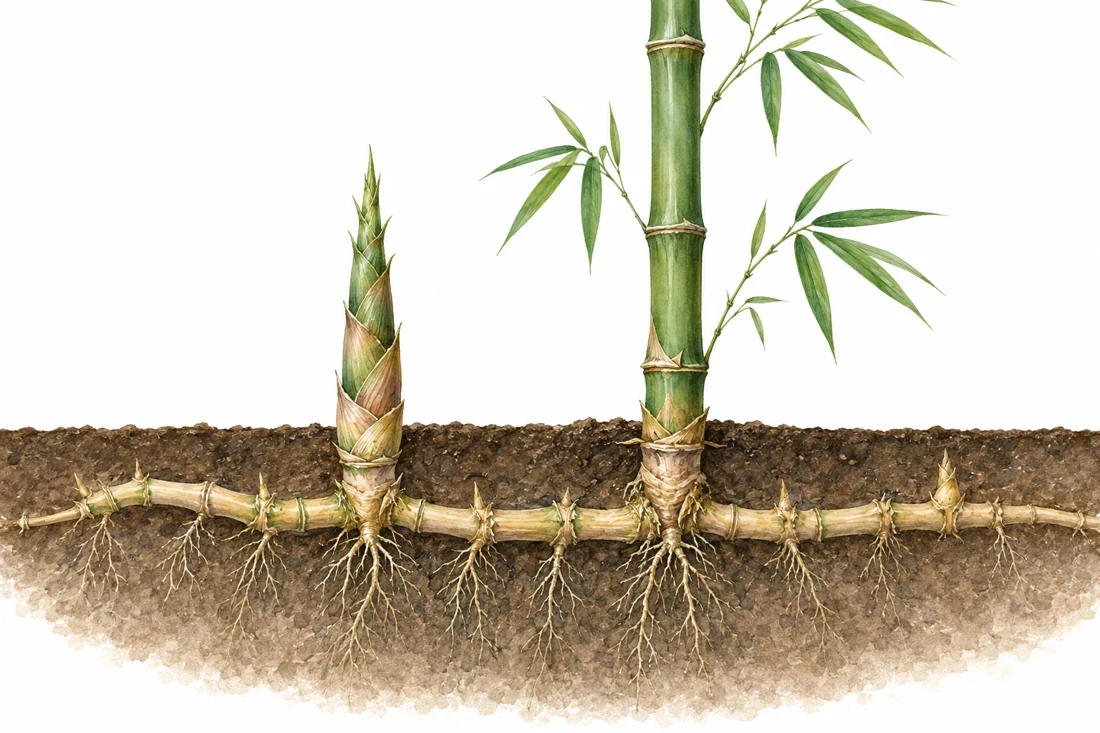
An underground rhizome connects roots and emerging shoots. Botanical cutaway.
A shoot begins as new growth from a bud associated with the underground system. As it emerges, protective sheaths cover the developing culm. The edible material used for prepared bamboo shoots is obtained from suitable young growth, with tough outer material removed according to the process. The exposed interior is therefore not a root vegetable in the same botanical sense as a swollen root. It is young stem growth, which helps explain the layered form visible when a shoot is cut lengthwise.
The mature plant must also continue supporting itself. Shoot harvest is an intervention in the production of new above-ground growth, rather than the collection of a separate fruit hanging from branches. The balance between harvest and continued stand growth depends on the production system. We would not infer a universal harvest allowance from a simple anatomy diagram. For purchasing, the important consequence is that crop availability has a biological and seasonal basis even when prepared shoots are offered in several preserved formats.
Understanding the parts of the plant also improves communication when samples are discussed. A buyer asking for shoot tips means a particular portion of young shoot material, not the leafy tips of a mature bamboo branch. A request for slices normally concerns prepared edible shoot tissue, not cross-sections of a hardened culm. Clear terminology avoids errors when photographs, translated descriptions and cut names move between growers, processors, trading teams and the customer developing the final dish.
Young shoots become woody culms as they mature
The edible appeal of a bamboo shoot is closely connected to its early growth stage. Suitable young tissue can provide a firm but tender bite after correct preparation. As growth develops into a mature culm, the structure becomes harder and more fibrous. The change is not just an increase in size. It alters how the tissue behaves when cut, chewed and cooked. A large mature stem cannot be made equivalent to a tender shoot simply by slicing it more thinly.
Even within prepared shoot material, texture may differ between portions. The tip, middle and base can offer different shapes and degrees of tenderness. A longitudinal cut makes these differences easier to discuss because it reveals the progression through the shoot. For a visual side dish, a buyer may value an intact tip shape. For a filling or soup, a regular strip or slice may matter more than preserving the original outline. The specification should reflect the portion's actual role.
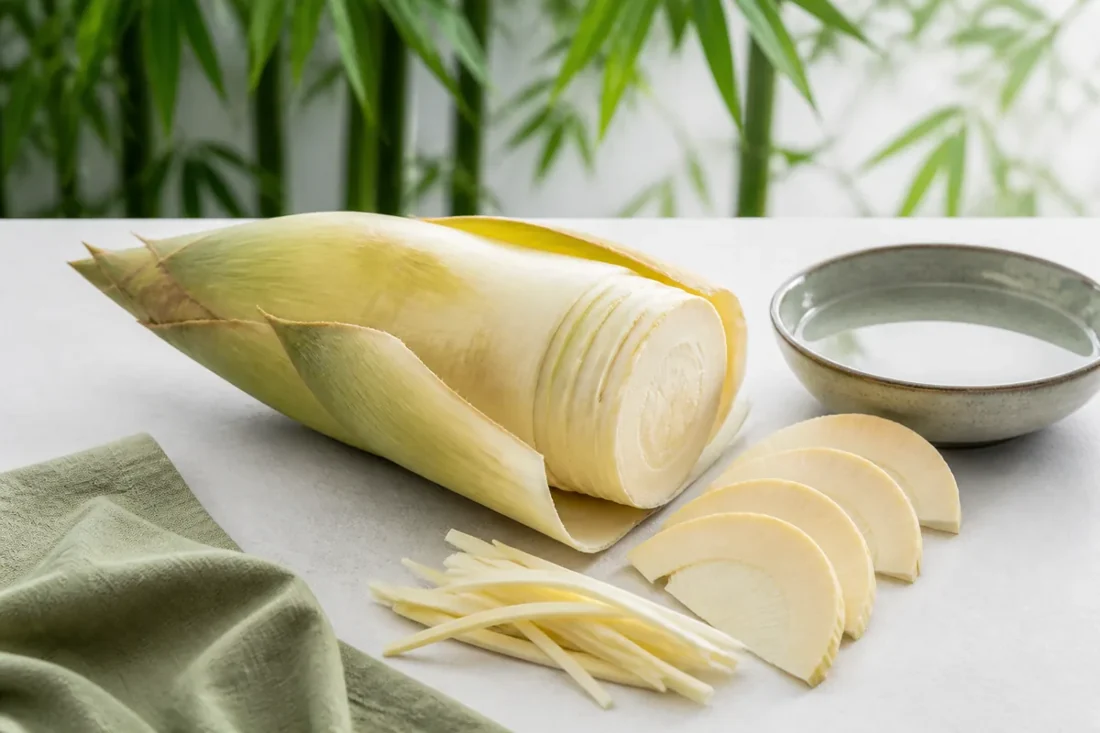
A lengthwise cut reveals the young shoot tissue used for prepared food ingredients.
Harvest timing and raw-material selection therefore influence the finished ingredient before freezing or packing begins. Processing can prepare and preserve suitable material, but it should not be described as erasing every difference in maturity. If a sample has a tough bite, the investigation should include the raw material and the part of the shoot used, as well as cut thickness and the customer's cooking method. Blaming the freezer alone can miss a texture difference that began much earlier.
Appearance is useful but incomplete. Pale color and smooth slices can look attractive while the bite remains too fibrous for a delicate filling. Conversely, a naturally shaped piece may perform well in a dish where uniform outlines are not important. Evaluate a representative sample after the intended cooking process, including the time spent in sauce or hot holding. The test should answer whether the tissue is comfortably chewable and whether the selected cut behaves as the recipe requires.
At GreenLand-food, we treat tenderness as a specification discussion rather than a decorative description. Buyers can explain whether they need a crisp strip for stir-fry, a softer slice for a braised dish, or a recognizable shoot portion for presentation. We can then review the available format and sample requirements. The botanical story explains why young shoots are used, while the sample and written acceptance criteria establish whether a particular prepared product meets the customer's texture needs.
Edible bamboo shoots need correct identification and preparation
The fact that bamboo is a grass does not mean its shoots can be eaten straight from the plant. Food Standards Australia New Zealand explains that bamboo shoots can contain cyanogenic compounds and require appropriate preparation. Its consumer guidance describes peeling, trimming and thin slicing followed by boiling and discarding the cooking water for the fresh material covered by that advice. FSANZ's bamboo shoot safety guidance is the relevant source for that preparation issue, rather than a general gardening description.
For an unfamiliar fresh shoot, begin with reliable identification as a food species and suitable edible material. Do not identify a garden plant from this article's illustrations or assume that a shoot is suitable because a similar-looking item is sold in a market. When preparation instructions are needed, use guidance applicable to the actual fresh product. This classification article does not provide a universal treatment schedule for every species, shoot size or commercial process that might be encountered.
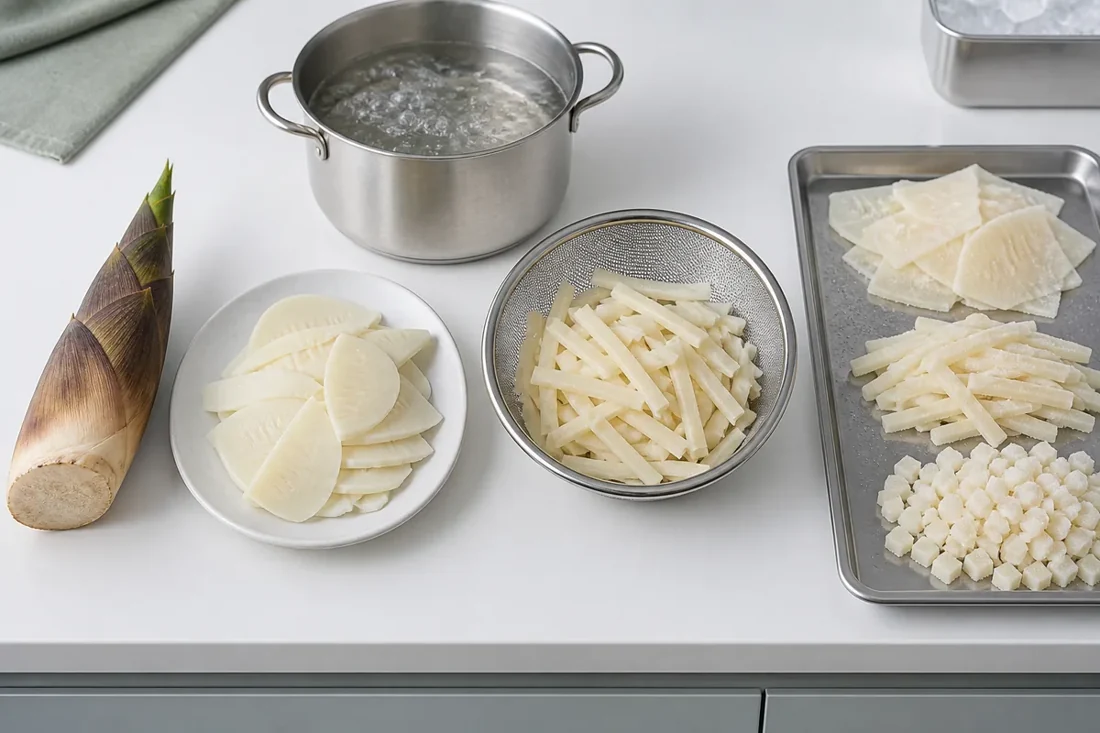
Correct preparation belongs to the identified product; frozen status alone does not establish readiness to eat.
Prepared commercial products require a different starting question: what processing has already been completed, and what further preparation does the supplier require? A frozen bag may contain material that has been peeled, cut and pretreated, but frozen does not automatically mean ready to eat. A canned or otherwise processed item may have different directions. Read the label and specification for the particular format instead of applying a raw-shoot method or a canned-product assumption to every product bearing the same name.
Commercial buyers should ask for the processing description and any relevant safety documentation as part of ingredient approval. The wording needs to match the item and the buyer's intended use. A statement that shoots have been blanched is not, by itself, a complete explanation of every safety requirement or of the finished food's preparation. Where the application has a specific limit or verification requirement, state it clearly so the supplier can review what evidence and process information are available.
Taste should not be used to prove that an uncertain preparation is safe. Nor should a photograph of pale cooked slices be treated as evidence of a validated treatment. The practical boundary is straightforward: use correctly identified food material, follow applicable preparation directions, and confirm the processing state of purchased ingredients. Once those conditions are addressed, the kitchen can focus on texture, cut and flavor without asking a botanical classification to do the work of a food-safety process.
How shoot structure affects slices, strips and tips
A slice crosses a larger area of shoot tissue and creates a broad surface that is visible in soups, mixed vegetables and braised dishes. Thickness changes both the bite and the way a piece sits among other ingredients. Very thin slices and thicker pieces should not be grouped under the same description merely because both are pale and flat. For a buyer, the useful measurement is the agreed thickness range together with the expected shape and any acceptable variation in the pieces.
Strips emphasize length and can distribute through noodles, stir-fries and fillings. Their width, thickness and length each matter. A long strip that looks attractive on a plate may interfere with portioning a small dumpling filling. Short pieces that work well in a filling may disappear visually in a noodle dish. The best cut is therefore the one that fits the finished food and handling equipment, rather than the one that appears most regular in a supplier's sample photograph.
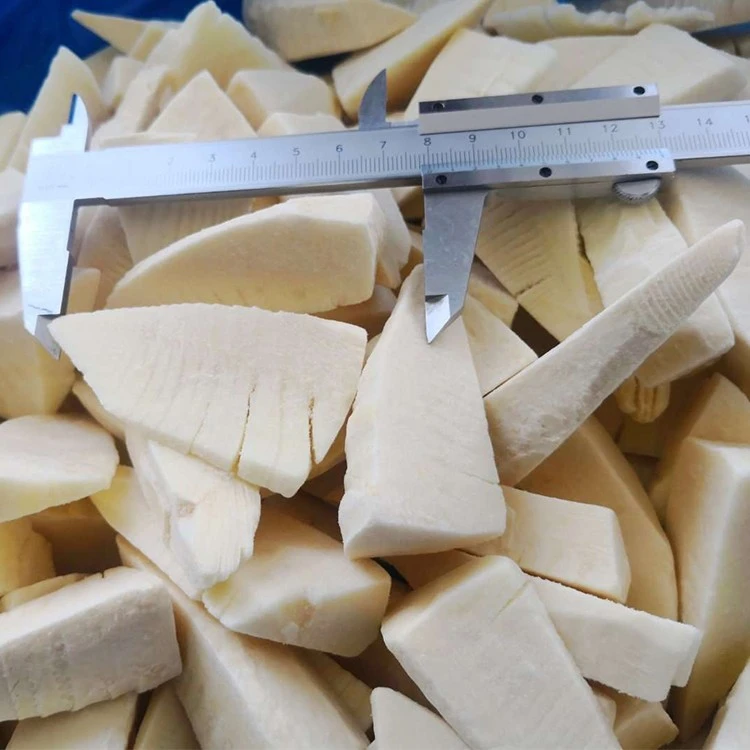
Bamboo shoot slices beside a caliper. Shoot structure remains visible in the prepared cut.
Tips and larger natural pieces preserve more of the shoot's original shape. That can be valuable when the vegetable is intended to be recognized by the diner. It also creates a different size and presentation question from diced or uniformly sliced material. Buyers should clarify the portion definition, expected piece size and tolerance for broken material. A carton description that only says bamboo shoots does not establish whether the contents are intact tips, irregular pieces, slices or a mixed format.
The direction and extent of cutting can expose fibrous texture differently, but cut size cannot compensate for unsuitable raw material. A fine strip may reduce the size of each bite while still feeling tough. During evaluation, compare like-for-like cuts under the same preparation conditions and note whether any fibrous pieces remain objectionable. For our sliced bamboo shoot product discussions, the final dimensions and texture requirements should be confirmed against the intended order and application.
The surrounding recipe also changes the experience. A strip in a thick filling is encountered differently from a slice in a clear broth, where its shape and bite are more exposed. A long simmer and a brief stir-fry place different demands on the same ingredient. Describe that final process when requesting a sample. It gives the supplier a more useful target than tender or premium alone and helps the buyer decide which observations belong in the approval record.
Specifying frozen bamboo shoots for texture and use
A practical frozen bamboo shoot specification begins with identity, edible format and processing state. It then defines the cut, pack, intended preparation and the quality characteristics important to the dish. Size ranges should be measurable, while texture requirements should be supported by an agreed evaluation method or approved sample. The aim is to make a future delivery recognizable as the product that was approved, rather than relying on a general description that different people may interpret differently.
Freezing extends the period in which a prepared crop can be supplied, but it does not remove the need to manage storage and handling. Confirm the labeled storage conditions and the instructions for using the product from frozen or after controlled thawing, as appropriate. Avoid repeated, unplanned handling changes during trials. If the sample is cooked directly from frozen but production material is held after thawing, the comparison no longer represents the same process and may produce a different texture result.
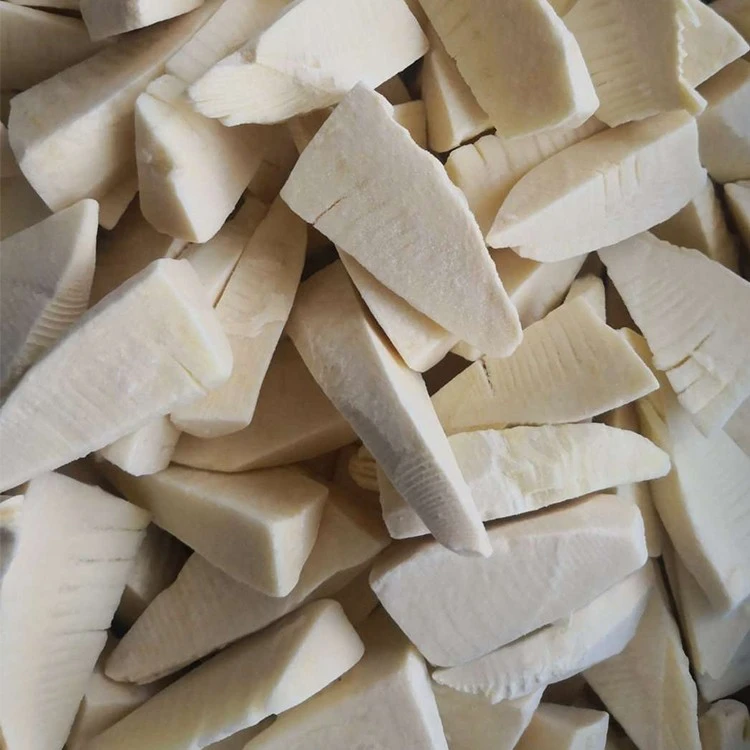
Bamboo shoot slices with visible longitudinal fibers. Confirm the cut and processing state, then test the texture in the intended dish.
We supply frozen bamboo shoot formats for commercial ingredient and packing requirements. A useful inquiry identifies the dish, desired cut, expected volume, pack format and destination. If the buyer has a target for tenderness, residual fiber or a specific processing requirement, include that information before sample selection. We will review the available product against the requirement and confirm the details for the proposed supply, rather than assuming every bamboo shoot format behaves the same way.
The freezing question has its own practical details, including preparation before freezing and the difference between home handling and a purchased IQF ingredient. Our guide to whether bamboo shoots can be frozen covers that related topic. Here, the important connection is simpler: freezing preserves prepared young shoot material for later use; it does not turn mature woody culms into a food ingredient or establish that a frozen pack needs no further cooking.
Bamboo's classification as a grass makes its growth easier to understand, from the rhizome below ground to the jointed culm above it. For food use, the decisive transition is from suitable young shoot to increasingly woody mature growth. Buyers get the most value from that knowledge when it leads to precise questions about identity, harvest-stage quality, preparation and cut. Those answers, checked in a representative cooked sample and written specification, determine whether the ingredient fits the dish.
Discuss frozen bamboo shoots supply with GreenLand-food
GreenLand-food is a professional frozen bamboo shoots supplier and manufacturer in China, providing factory-direct wholesale supply for importers, food manufacturers, foodservice distributors and private-label programs.
Send the bamboo shoot cut, tenderness target, processing requirements, pack, quantity and destination.