


Importing Frozen Spinach from China to Malaysia: FoSIM, MAQIS and Buyer Controls
Oct 19, 2026
Leave a message
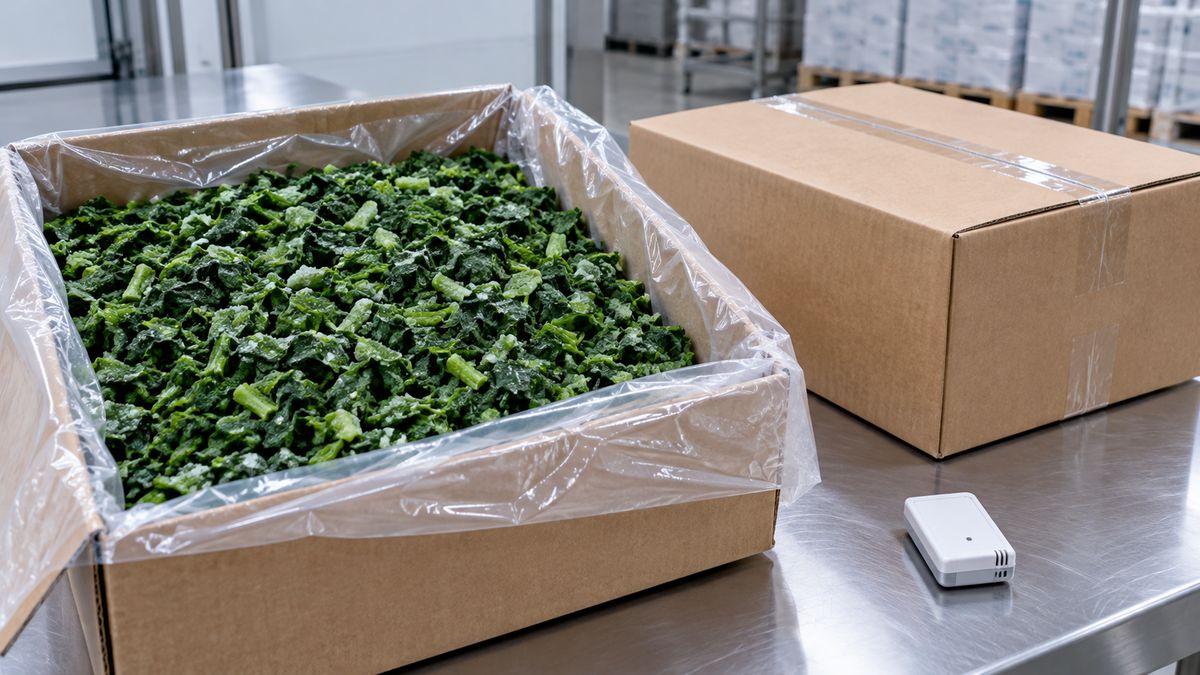
Explanatory illustration: the proposed bulk frozen product form and cold-chain handling context.
Reviewed: 19 October 2026. The route and product scope below should be checked again before a commercial shipment.
A Malaysian buyer of China-grown, China-processed blanched chopped spinach needs two linked plans: an actual frozen ingredient that survives the customer's cooking process, and a route through Malaysian food control, any applicable agricultural permit and Customs. For a commercial shipment, the importer or its agent should establish FoSIM access before filing. The Malaysian Ministry of Health says imported food is released through FoSIM using risk-based inspection, while the Customs (Prohibition of Imports) Order and MAQIS determine whether a separate agricultural approval applies to the classified item and entry point. We would settle the tariff and product description with the Malaysian importer first, then build a lot-specific document and laboratory pack. The example here is a single-ingredient industrial spinach cut that requires subsequent cooking. A direct-use salad, smoothie or other ready-to-eat programme would need a separate validated safety route.
Map the Malaysian importer, FoSIM account and entry point

GreenLand product-gallery photograph showing the relevant frozen form; confirm the ordered lot against its signed specification.
The Ministry of Health's commercial food-import procedure says the importer and forwarding or customs agent register with FoSIM; the system is linked to Customs' information system. The importer should name the company responsible for the food declaration, the authorised FoSIM user and the broker lodging the K1 import declaration. The Chinese supplier cannot log in as the Malaysian importer merely by providing an invoice. Before a trial shipment, the buyer can test its account, confirm that the exact product description can be entered, and check which port officer will handle a document or label query.
The Ministry's May 2025 notice announced activation of MOH OGA 135 approval for food declared on Customs Form K1 at 71 entry points from 1 June 2025. This makes a shipment timeline that stops at Customs filing unreliable. The broker should capture both the K1 reference and the FoSIM/MOH status. Ask the importer to record the intended Malaysian port, cold store, receiving truck, entry date and contingency contact. A choice between Port Klang and another gateway can change terminal operations even if the underlying food law is national.
Before loading, the importer should check whether the product appears on the Ministry's current additional-document list, including any current health certificate, analysis certificate or licence condition. The Ministry says an original health certificate is needed where one is required. Do not request a broad "food certificate" and assume it covers every requirement. Confirm the precise authority issuer and wording before the Chinese application is prepared. Any required phytosanitary or agricultural document is a separate determination from an ordinary commercial COA.
Determine the MAQIS and Customs condition for frozen chopped spinach
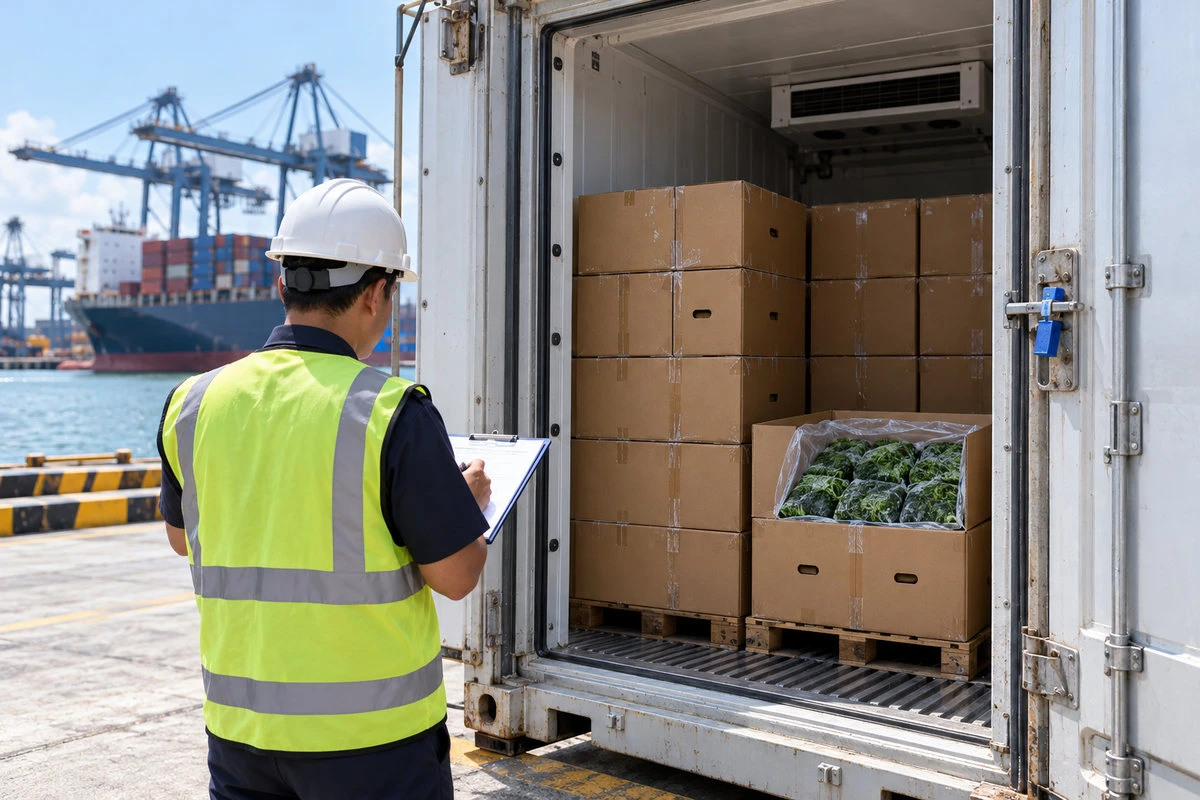
Explanatory illustration: spinach cartons checked against an import document at a Malaysian cold-chain handover.
The Customs (Prohibition of Imports) Order 2023, item 8(2), covers vegetables fresh, chilled or frozen above three kilograms per consignment and includes heading 07.10. For import into Peninsular Malaysia and Labuan, the item states that the consignment must carry a Certificate of Conformity of Agricultural Produce or Letter of Exemption issued by MAQIS, and is subject to MAQIS inspection and approval. The continuation for Sabah and Sarawak names FAMA as the issuer of the certificate or exemption and inspection/approval authority. These are the order's geographic distinctions, not a universal standalone import-permit claim. The importer should have Customs classify the actual plain, blanched chopped spinach, confirm the 07.10 tariff suffix and port, then obtain the applicable certificate or exemption and inspection arrangement before loading. A processed presentation does not itself erase a condition printed against frozen vegetables.
The broker's written applicability note should identify item 8(2), proposed HS code, Peninsular/Labuan or Sabah/Sarawak destination, Certificate of Conformity versus exemption route, issuer and inspection booking. The MAQIS FAQ gives SPEED and New ePermit as service entrances when a different item actually requires an import permit; it does not override this order row with a blanket spinach permit. If the broker cannot resolve classification from the public text, obtain Customs or MAQIS confirmation before the purchase order is final. Keep the answer with the lot's master file.
The importer should also calculate tariff, sales tax and any official inspection cost under its declared code using the current Customs tools. A duty estimate on a sales quotation is provisional until classification and origin evidence are accepted. China origin must be supportable through growing and processing records, not simply a flag printed on the case.
Define the spinach cut and acceptance method
IQF chopped spinach for cooked fillings and sauces
Confirm Spinacia oleracea identity, chopped-leaf size and stem tolerance; then agree a draining and heated-application trial with bag size and lot test list.
A purchase order for frozen produce becomes a regulatory file as soon as a product description is copied into the invoice, label, laboratory request and import entry. We propose starting with one signed identity sheet. It should state the botanical or ordinary commodity identity, China as the growing and processing origin where supported, whether there is one ingredient, the actual cut, blanching or other heat history, freezing method, package format, intended industrial use and the customer's later heat step. Calling the shipment merely "frozen vegetable" hides its chopped Spinacia identity, blanched state and the tariff and residue mapping the Malaysian importer must settle. The importer should approve the description in its own language and tariff system before the first commercial shipment. Our sales team can supply product evidence; the local importer and its broker make the destination filing.
Classification must follow the goods that actually cross the border. A frozen plain fruit is generally explored under Chapter 08 and a frozen vegetable under Chapter 07, but the national tariff suffix, any process distinction and the applicable import controls require the importer's current tariff ruling or broker review. An invoice code copied from a different market is not a decision. Record the proposed code, authority search date, description relied on and the person who confirmed it. If the proposed code changes after a sample has been approved, recheck every registration, permit and label tied to that code before loading.

GreenLand product-gallery photograph showing the relevant frozen form; confirm the ordered lot against its signed specification.
The same identity also protects the use claim. Blanching is commonly a processing step for spinach; it does not by itself validate a ready-to-eat safety case. Freezing preserves a product but is not a microbial kill step. For these example shipments, we write "industrial ingredient; cook or otherwise apply a validated subsequent heat process before consumption" into the technical exchange and verify that the customer's manufacturing instructions actually implement it. If a buyer wants direct use in a drink, dessert topping or other no-heat application, pause that route. It needs its own hazard analysis, raw-material and process validation, microbiological specifications, handling plan and label review. Do not convert an industrial sample into a ready-to-eat sale by changing only the marketing description.
Specify chopped Spinacia for the buyer's cooking line
The first commercial identity is blanched, chopped Spinacia oleracea, individually frozen as a single ingredient. Confirm the requested nominal cut and its distribution with a retained reference sample, not a picture of loose greens alone. The buyer should state the permitted proportion of stems and any root, mud, grit, other leaves, yellow pieces or compact clumps. Inspect a representative weighed sample under a written sorting method. Record the outcome by final lot, together with bag seal, case net weight and pallet count. An offer for leaf portions or compressed spinach balls should not silently replace a loose chopped-leaf approval.
For an industrial filling or cooked sauce, the useful yield is measured after the buyer's real preparation. Agree whether the trial starts frozen, is thawed under control or is added directly to the cooker. Weigh the spinach before and after a defined draining step, record cooking time and endpoint at the customer's scale, then assess colour, leaf visibility, stem texture and water released into the finished filling. The signed sample should fix the cut and drained-yield test method; the first shipment should be accepted against that same method. A percentage measured from an unrelated kitchen does not belong on the purchase specification.
Food safety and commercial quality have separate decisions. A wider cut may be commercially negotiable; wrong botanical identity, foreign matter, a broken seal or a legal contaminant failure needs a formal hold. For each residue or microbiological result, the Malaysian importer and laboratory must agree commodity mapping, analyte definition, sample plan, method and units before the lot is released. The current August 2026 legal metal row and Regulation 41 hierarchy are explained below. A supplier COA reading only "pass" cannot establish which value and method were applied.
Use the FoSIM inspection result correctly
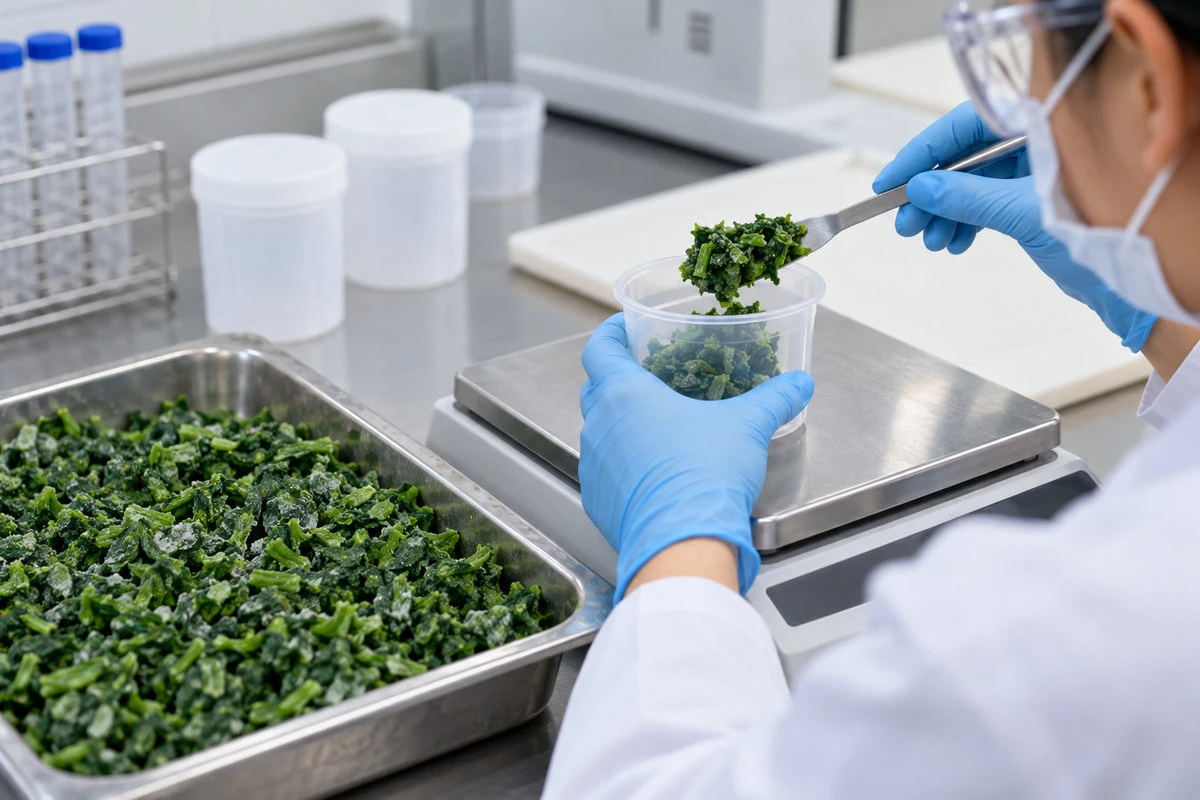
Explanatory illustration: a labelled spinach sample kept linked to its production lot.
MOH describes six food import inspection levels. At Level 1 the consignment may receive automatic unconditional release; Level 2 requires review of specified documents. Level 3 involves mandatory inspection and possible sampling. Level 4 requires inspection and sampling and allows release after sampling. Level 5 is hold, test and release only after compliant laboratory results. The Ministry's page also describes a further enforcement level. The importer should read the actual assigned status rather than promise an "automatic" spinach route from a prior shipment. Source, product, risk alert and record history can change the applied level.
For a Level 2 query, have the signed product specification, lot COA, invoice, packing list and any required official certificate accessible. For a Level 4 sample, collect the sampling record and note that subsequent adverse results can still trigger action. For Level 5, book a cold store able to hold the cargo under control and budget the possible laboratory delay. The food authority's decision and the Customs K1 release are separate; the terminal may still need shipping-line instructions and fees before collection.
If MOH requests a relabel, reprocess, return or re-export disposition, the importer should use the current FoSIM forms and follow the authority's instructions. The public FoSIM entrance displays several such forms and notices. We should not promise that relabelling can always cure a legal defect. Keep photos of original cartons and the authority-approved correction in the trace file.
Review Malaysian label, contaminant and halal claims
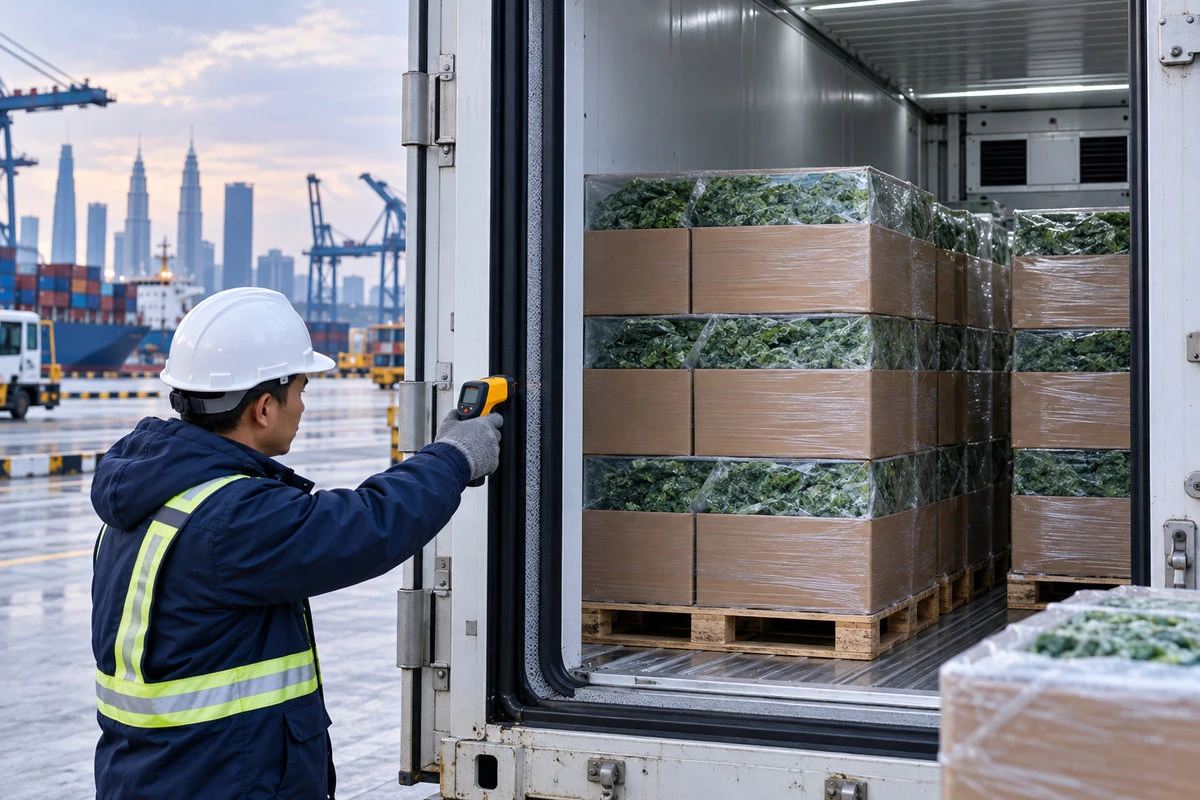
Explanatory illustration: frozen spinach cases moving through a refrigerated loading point.
The Food Act 1983 and Food Regulations 1985 govern food safety, standards and labelling. MOH's legislation page now offers English regulations and schedules updated through August 2026, uploaded in September 2026; the importer should use this edition and any later amendment for the industrial pack. The artwork should identify the food accurately, show China origin, net quantity, lot and date information in the form that the Malaysian reviewer requires, and distinguish "blanched" from "fully cooked" or "ready to eat." An industrial outer case can still be examined at the port; it is not exempt merely because a factory will open it. Agree the language and importer details with the Malaysian account holder before printing.
The current Fourteenth Schedule, Regulation 38, Table I includes a published row for "vegetable product and fruit product other than vegetable juice and fruit juice": arsenic 1, lead 2, mercury 0.05, cadmium 1 and antimony 1 mg/kg. That named row is the starting point for plain blanched frozen spinach sold as a vegetable product, subject to a check for a more specific row or legally relevant product interpretation. The importer should record that mapping rather than treat every vegetable form alike. For pesticide residues, Regulation 41 has an ordered decision: first the specific food–pesticide limit in the Sixteenth Schedule; if the pesticide is not specified there for that food, the Codex Alimentarius food–pesticide limit; if neither specifies it, Regulation 41(3)(c) prohibits food containing 0.01 mg/kg or more of that pesticide residue, unless the Director gives prior written approval under 41(3A). The 2020 federal gazette amendment explicitly changed the wording from "more than 0.01" to "0.01 or more." A text search of the August 2026 schedule did not identify a literal Spinacia or spinach entry. "Bayam" in local usage may denote Amaranthus; mapping it automatically to Spinacia oleracea would be unsafe. Have the importer and competent laboratory establish the exact commodity, analyte, processing interpretation and the applicable Schedule/Codex/default branch before sampling. Microbiological criteria depend on the product and intended use; use a cook-required specification with a documented further heating step and validate a separate RTE branch if the customer changes the application. Do not silently apply a retail salad criterion or imply that blanching sterilises the ingredient.
Halal has a commercial and claims dimension. JAKIM's official portal states that imported food marketed as halal must satisfy the applicable recognition or certification conditions, while its compulsory import discussion focuses on meat and meat-based products. Plain single-ingredient spinach is not automatically subject to a meat-style halal import certificate. If the buyer wants a halal claim, logo or certified downstream product, request the precise JAKIM-recognised body, certificate scope, plant, product name and label approval; verify the current recognition list before making that promise.
Build the source, processing and document file
Our proposed source-to-delivery record starts at the field and receiving dock. Identify the Spinacia growing area, harvest window, washed-leaf intake lot and blanched chopped production run. Record the produce identity and any crop-protection declarations against the agreed residue screen. Incoming acceptance should document condition, damage, foreign matter and the link between field lot and production lot. The spinach processing record should show wash controls, blanch route and monitored parameters, cooling, chopped cut check, freezing and post-freeze handling under the actual site hazard plan. We do not claim that a specific camera, metal detector, blancher logger or certificate is installed for this proposed shipment; the applicable line records must be reviewed during supplier qualification.
At packing, reconcile the production lot with carton count, net weight, label version and retained sample. A practical master list has one row per final lot and joins field source, processing run, lab sample ID, packaging batch, pallet IDs and seal number. Before booking freight, another person compares that list with the invoice and packing list. A late change to pack size or net weight creates a new label and registration check. A repacked pallet needs its own trace entry rather than a handwritten correction that hides the original lot. Retained samples should be stored under a documented policy that allows a later investigation into identity, appearance and laboratory results.
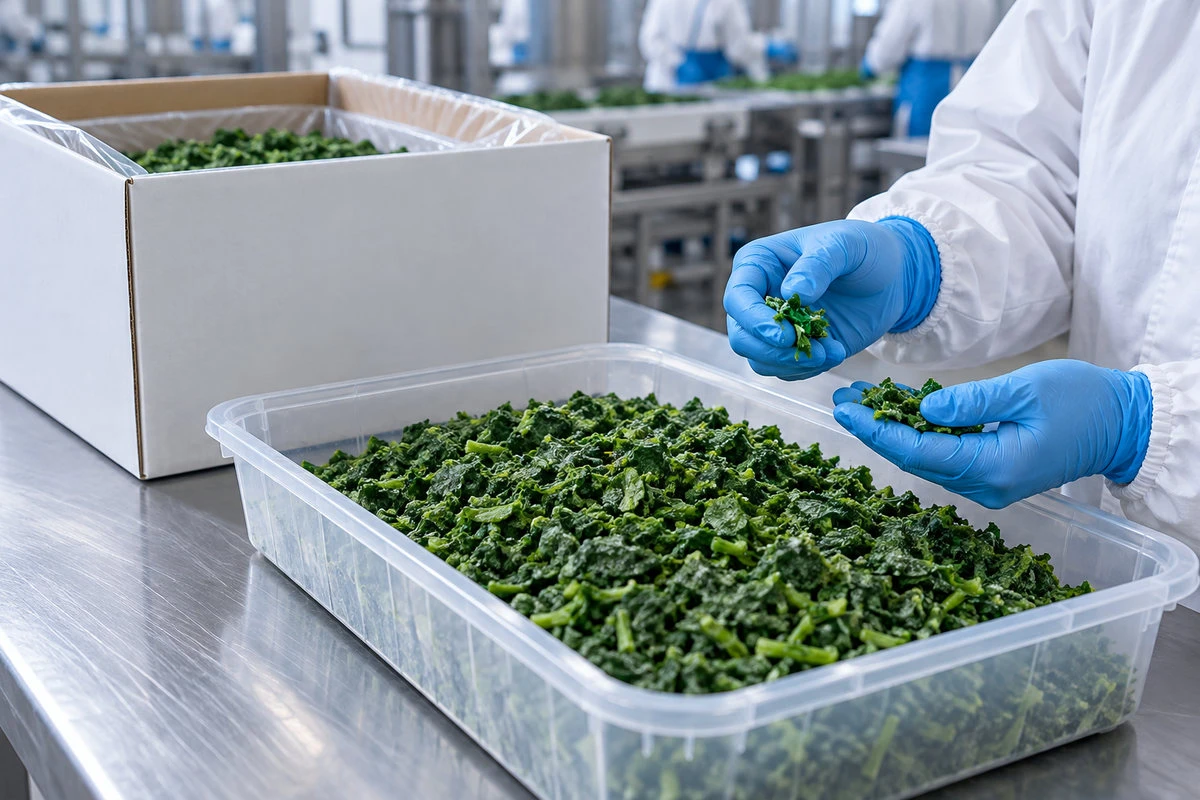
Explanatory illustration: chopped spinach spread for cut and stem inspection.
Cold-chain evidence begins at release from storage. Agree the transport set point and the buyer's receiving tolerance as contract values, then record loading product condition, vehicle or container pre-cooling where relevant, seal and handover time. Ask the forwarder for the journey temperature file and exception notes; ask the carrier for bill of lading and arrival notice. A reefer set point is not proof that every carton stayed at the same temperature. At destination the buyer should check seal, carton integrity, surface frost or thaw signs, product core or representative temperature under its procedure, and data gaps before accepting stock into its freezer. A deviation report connects the time interval, affected pallets, temperature evidence, disposition owner and signed release or rejection.
Reconcile the document pack before the vessel sails
A useful document matrix names the issuer, reviewer, shipment reference and deadline. GreenLand prepares the agreed commercial invoice, packing list, product specification, lot and production trace, label artwork and testing evidence that its actual source can support. The carrier or forwarder issues the transport document. Any official health or phytosanitary certificate must come through the competent authority and the importer should first establish whether that document is required for the exact product and port. We should not promise a certificate that has not been requested, issued and linked to the final lot. The local importer owns its establishment and product registrations, permit applications and import declaration, usually with a licensed broker or agent.
Match the commercial name, botanical identity where used, Chinese origin, gross and net weights, case count, lot, production and expiry dates, consignee, port and container number across the invoice, packing list, certificate application, registration and declaration. A mismatch can consume more port time than a laboratory result. Make a pre-dispatch comparison file with highlighted fields and an approval date. If a production date, Malay or English label line, or importer identity is amended after Malaysian approval, repeat the cross-check; do not assume a cosmetic edit has no regulatory consequence. The buyer should receive readable drafts before the carrier cut-off, and final signed documents through the agreed secure channel.
Commercial documents also need a real handover plan. Record which party books the reefer, buys cargo insurance, pays demurrage, manages any authority sample and instructs the cold store during a hold. The Incoterm belongs in the contract, but it does not automatically make the exporter the local importer of record or transfer statutory filing duties. A named destination contact needs authority to answer a regulator's document question while the shipment is still at the port.
Run a realistic Malaysian first order
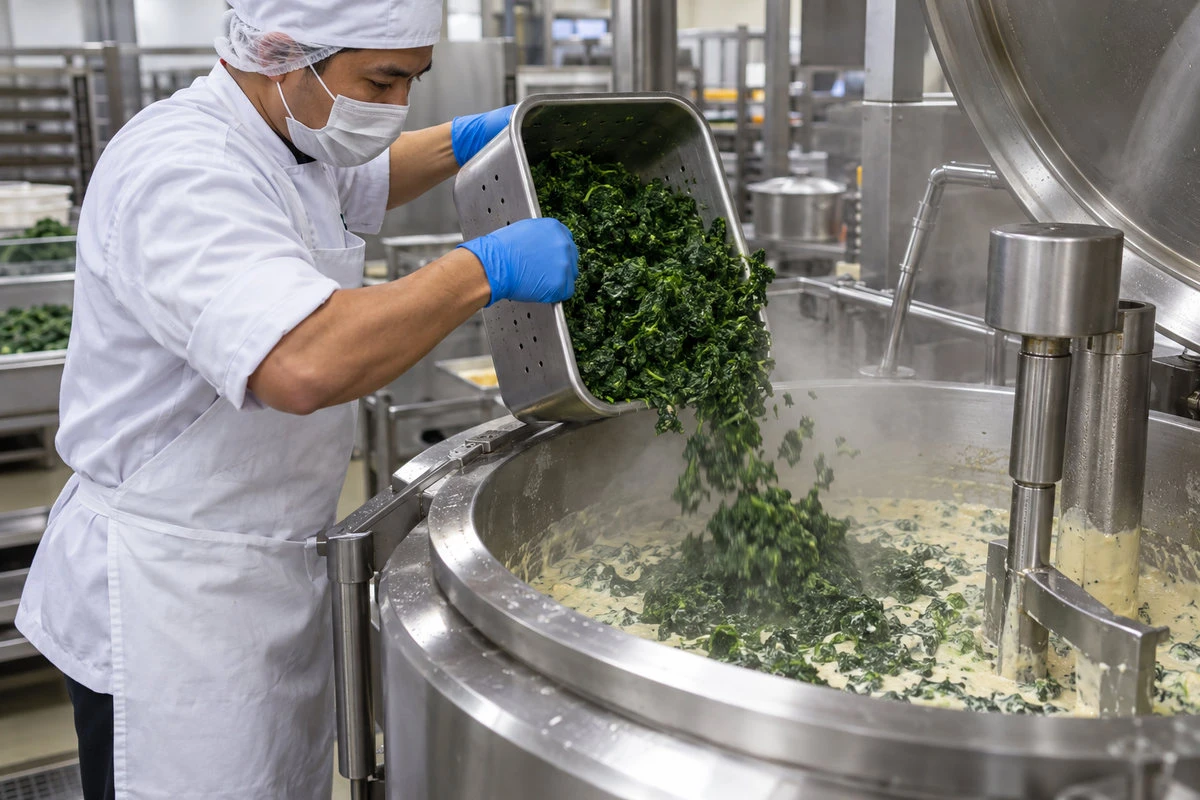
Explanatory illustration: chopped spinach assessed after a cooking trial.
A first order can start with a small, documented application trial rather than a full reefer. Agree whether the buyer wants loose IQF chopped leaf or compressed portions, the target cut distribution, stem tolerance, pack size and cooking process. Supply a sample that is traceable to its source and process; label it as a sample and ask the importer whether any sample import permission or exemption applies before shipping it. A 10 kg kitchen trial can measure drain yield and colour after the buyer's actual cook, but such a trial does not replace regulatory sampling or a commercial lot COA.
Before confirming the shipping week, the importer signs the FoSIM account and broker plan, any MAQIS determination, proposed HS code, document list, label proof and cold-store booking. GreenLand can then freeze the specification, obtain the agreed lot tests and prepare draft invoice and packing list. The buyer should compare document fields while amendment is still possible. Build time for original certificates if required, vessel booking and the risk of official sampling. If the first arrival passes the authority controls and the buyer's application trial, record the accepted specification and exception findings for the repeat order.
Manage release, delivery and exceptions
At arrival, distinguish at least three decisions. MOH records a FoSIM inspection or release state and MAQIS separately records the applicable agricultural document and inspection decision. Malaysian Customs assesses K1, tariff classification, restrictions and duty. The carrier or terminal releases the container or cargo only after its own delivery-order, charges and operational steps. A screenshot from one system is not evidence that the other two processes are complete. The buyer then performs its own contract acceptance after receiving the goods. Keep the individual transaction references and timestamps in the shipment file.
If an inspector takes a sample, identify the sampled lot and quantity and ask whether the consignment may move to a designated cold store while results are pending. Any movement under control must follow the authority's written direction. A release after sampling can still be followed by an adverse laboratory result or recall instruction; it is not a promise of final marketability. In an adverse result, stop onward use, preserve temperature and custody evidence, notify the importer and exporter contacts, assess related lots and follow the authority's disposition. For documentary holds, submit a corrected document only through the official route and retain the original and amendment history.
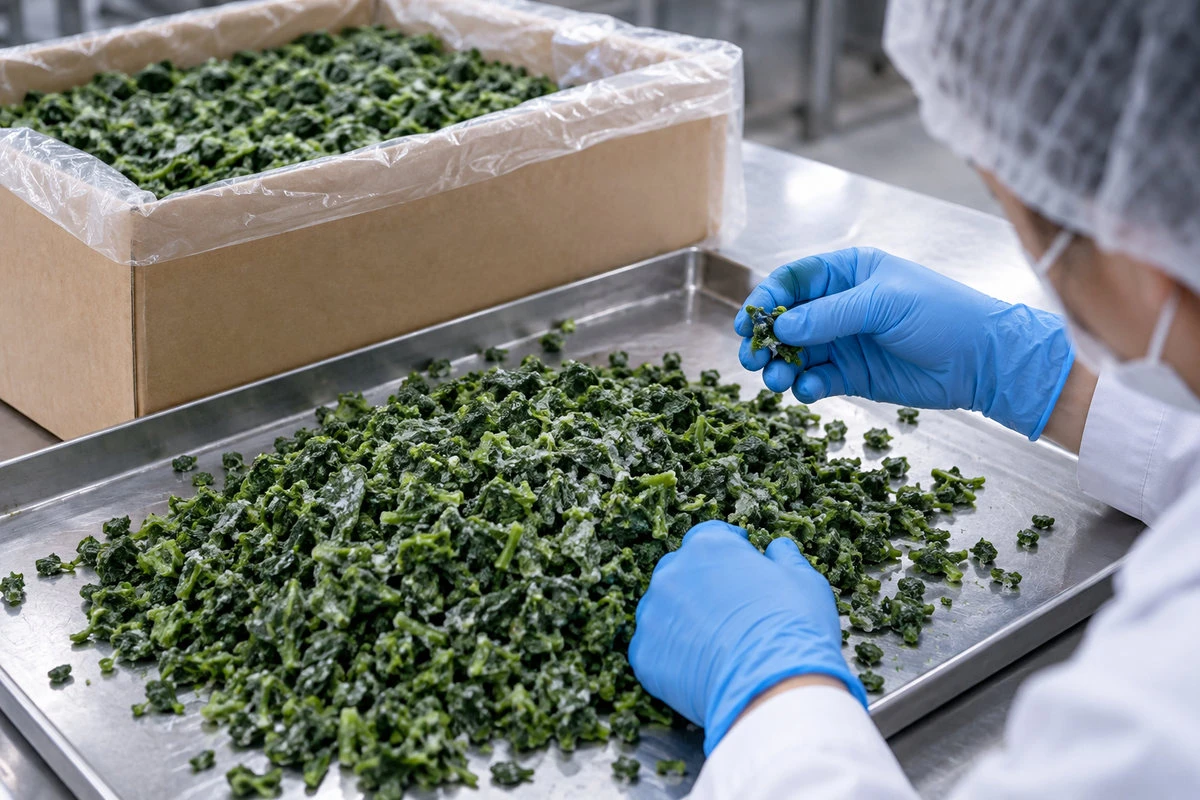
Explanatory illustration: compare chopped-leaf form before agreeing a cut distribution.
Customer acceptance is a separate commercial decision. The buyer should sample according to the agreed plan, inspect the actual cut and condition, run the application trial if reserved, and document acceptance or a claim within the contract window. A customs release cannot force a buyer to accept a wrong cut. Conversely, an attractive production sample cannot override an official food hold. Keeping these distinctions explicit lets the sales team give a realistic delivery date and protects the buyer's production schedule.
Plan an exception route before quoting a delivery date
The first trial shipment should have a decision tree for predictable exceptions: a 07.10 classification query, FoSIM/K1 mismatch, missing MAQIS conformity or exemption, an unapproved spinach residue mapping, port sampling, reefer excursion, cut-size complaint or use change. Name the decision owner for each. A sales colleague can coordinate evidence, but a local broker must resolve customs codes and a qualified food-safety or regulatory owner must decide whether a lot can be released to its intended use. A laboratory result alone cannot explain a broken cold chain, and a revised invoice cannot repair a food-safety failure.
For a suspected thaw event, quarantine the affected pallet IDs, collect independent receiving observations and the complete reefer data, and calculate the time and severity against an agreed product-specific assessment. Do not casually refreeze and reoffer stock as unchanged. For a residue result above a claimed limit, first confirm the commodity mapping, residue definition, unit, sampling and laboratory uncertainty, then keep the food on hold while the authority and buyer decide its fate. For a rejected consignment, record whether destruction, return or re-export is permitted and who carries each cost; never imply those are automatic alternatives.
The order file closes only when it contains the released status, final transport and temperature records, receiving report, customer disposition and any corrective action. Review the first shipment with the importer before repeating the route. If the country's service entrance, list of restricted products or standard edition changes, refresh this file. These checkpoints make the next quotation faster because uncertainty is resolved with an owner and a record, rather than a claim that every frozen product follows one universal path.
Official starting points
The importer should verify the current rule, product mapping and portal status at these official pages before each first order or material change:
- Malaysia MOH commercial food-import procedure
- MOH FoSIM importer service
- MOH K1 OGA 135 notice effective June 2025
- MAQIS import FAQ and service entrances
- Customs (Prohibition of Imports) Order 2023, item 8(2), pages 262–264
- JAKIM halal recognition portal
- MOH Food Regulations 1985 and August 2026 schedules
- Federal Gazette 2020 amendment to Regulation 41
Plan your frozen spinach shipment
GreenLand-food is a professional supplier and manufacturer in China offering factory-direct wholesale supply. Tell us the product form, specification, packing, quantity, application, destination, private-label needs and requested documents. We can prepare a lot-specific proposal for your import team to review.