


Passion-Fruit Set Yogurt: Faster Early Acidification Can Hide a Slower Finish
Oct 09, 2026
Leave a message

Research This Article & Topic with AI
Verify key claims, compare reliable sources, and explore GreenLand-food's practical frozen food knowledge.
Article details and research questions are prepared in the links. Sign-in or sending may be required.

That finding gives a dairy developer a useful reason to examine stages separately. It does not supply a commercial recipe, a validated safety schedule or proof that frozen pulp behaves like the experimental juice. We would first confirm what GreenLand supplies and how the customer turns it into the preparation used in milk. Seed removal, dilution, soluble solids, acidity and the point of addition can all change the trial being interpreted.
The decision is practical: keep enough information to distinguish the starting condition, the changing acidification rate, completion under the approved process and the structure after cooling. A developer can then decide whether an ingredient change achieved the intended flavor and texture without overlooking a slower finish or a weak gel.
Separate early acidification from fermentation completion
The early stage needs a clear definition before two yogurt trials are compared. It might mean the first scheduled readings after inoculation, a specified pH interval or an initial rate calculated from a continuous trace. Those definitions describe different aspects of the process. A statement such as "the fruit batch acidified faster" remains incomplete until the report identifies the interval, the starting pH and the calculation used. Keeping the original trace is more useful than retaining only a favorable summary sentence.
Fruit acidity can change the starting mixture as soon as juice is incorporated. The first reading therefore deserves its own place in the record. If one mixture starts at a lower pH, an early low value may partly describe that initial condition. To interpret fermentation, compare the subsequent change over a defined period with a suitable reference prepared on the same basis. This is a reason to separate formulation measurements from biological development, even where both appear on the same graph.
The later stage should also be named explicitly. A developer may be interested in the maximum acidification rate, the time to a defined process endpoint or the length of the finishing interval. A slower finishing interval can affect incubator occupancy, cooling arrangements and production timing even when the first part of the curve looks favorable. Those commercial consequences depend on the customer's equipment and approved process. They should be assessed with the whole trace rather than assumed from the initial slope.
Completion is a decision made against the established production controls. A texture preference alone does not define it, and a single point copied from a paper does not approve a new process. The responsible team should retain the endpoint rule, the monitoring method and the action taken when the rule is met. That makes it possible to distinguish a batch that reaches the intended endpoint later from a batch stopped at the usual clock time while still following a different trajectory.

Conceptual acidification traces distinguish the early response from a slower finishing interval; no measured values are plotted.
Consider an illustrative GreenLand inquiry: a dairy developer asks whether a fast early pH drop is enough to approve its passion-fruit set-yogurt trial. We would ask for the full records of the reference and fruit batches, including the initial mixture, culture, temperature history and endpoint rule. We would also ask what "approve" means in that project: flavor selection, ingredient approval, process validation or release of finished food. These decisions require different evidence. This scenario describes how we would respond; it is not a historical customer case.
For purchasing, the distinction changes the sample request. The ingredient sample should represent the intended commercial form and the planned preparation step. A small cup of hand-filtered juice may answer a development question, but it may not represent an industrial pulp preparation with a different seed-removal yield or solids content. We help the purchasing team state the actual input so the developer can repeat the same trial with the same preparation basis when another lot arrives.
An early pH observation is still useful. It can reveal a changed starting condition, suggest when closer monitoring is needed or identify a reproducible difference between trials. Its value increases when the report links it to later measurements and the final cooled product. The correct record leaves room for both findings: an early advantage and a later limitation can coexist in the same formulation. That is the central reason to resist collapsing fermentation into one favorable number.
The original juice response changed between stages
The original study, "Fortification of set yogurt with passion fruit juice: Effects on fermentation kinetics, physicochemical properties, and functionality," compared juice-enriched set yogurts within a defined dairy formulation. Its abstract reports assistance with early milk acidification and a reduced rate later in fermentation. It also reports structural deterioration at the highest tested addition. These are the bounded observations that matter here. The experimental addition levels describe the researchers' comparisons; they are not settings we prescribe to a commercial dairy developer.
Original publication: Fortification of set yogurt with passion fruit juice: Effects on fermentation kinetics, physicochemical properties, and functionality. The reported observations refer to its experimental preparations and methods.
The research context must travel with the result. This was a set-yogurt experiment using a particular juice and milk system, with its own culture and preparation conditions. A set product develops structure in its container and can respond differently from a stirred product that is mechanically worked after fermentation. The customer should therefore identify which yogurt architecture is intended before using the paper to frame a trial. A conclusion about one architecture does not establish the same response in another.

The prepared juice, dairy formulation and culture form the system being assessed.
Read "earlier" and "later" as descriptions of parts of a measured process. They do not mean that every early interval became faster or that every commercial culture would finish more slowly. Even a directional result needs the original methods to explain how readings were taken and the rate was derived. Where the developer intends to reproduce the study, the complete protocol must be obtained and reviewed. An abstract can support the question being investigated while leaving those operational details unresolved.
The complete dairy formulation deserves as much attention as the fruit. Milk solids, protein balance, sugar and water basis affect what the juice addition changes. Adding a preparation on top of an existing recipe differs from replacing an equivalent amount of water. A comparison that alters several of these features may still be commercially useful, but its conclusion belongs to the complete formulations tested. Record the formulation by mass and make clear which components were displaced or increased.
The starter record should identify the actual culture rather than simply saying "yogurt culture." Different culture preparations and handling histories can complicate interpretation when the fruit trial is performed on a separate day. A developer should establish a suitable reference using the intended culture and its qualified handling procedures. This article does not recommend changing culture handling to reproduce an early curve. It recommends preserving the details needed to know whether the observed difference belongs to the fruit preparation, the broader formulation or another changed condition.
The paper's proposed interactions involving fruit constituents and caseins provide a scientific hypothesis for formulation work. They do not prove that one isolated fruit molecule controls every commercial outcome. A whole juice contains multiple constituents, and its incorporation changes the mixture in several ways. If a customer needs a molecular explanation, additional controlled analytical work is required. Ingredient purchasing can proceed on a demonstrated application response without overstating the certainty of the mechanism behind it.
Our interpretation separates the original result from a proposed customer test. The result says that stage direction and final structure should be read together. The proposed test asks whether that pattern appears with the customer's actual ingredient, dairy base and process. This distinction protects a useful paper from being turned into an unsupported guarantee. It also gives the team an economical development path: obtain a representative preparation, compare complete traces and inspect the cooled gel before expanding the trial.
A promising trajectory can still end in gel failure
A set-yogurt gel has to do more than accompany a falling pH. It must develop the intended structure, retain an acceptable amount of liquid and survive the handling expected for the product. A favorable early curve can coexist with a weak network or unacceptable whey separation. The original passion-fruit experiment makes that concern concrete because its highest juice addition damaged the gel. The lesson is to measure the product at the point where its structure actually matters to the buyer.

A conceptual gel comparison illustrates cohesive structure and fragmented curds; it is not a measured sample result.
Gel failure should be described with observable terms. A cup may release free whey, break into coarse fragments when sampled, resist spooning differently or lose its intended shape during normal handling. These observations are not interchangeable. A texture instrument can help distinguish them when its method is suitable, but the report should also explain what the result means for the consumer's experience. Photographs of a controlled sample comparison can preserve visible structure without replacing a properly defined acceptance method.
Cooling and conditioning belong to that assessment. Comparing a recently incubated cup with a reference that has already rested under chilled conditions creates an avoidable mismatch. Record the elapsed period, temperature and handling before the structure is evaluated. Use consistent sample geometry and avoid disturbing one cup more than another. A difference that disappears after matching these conditions may have a different implication from a difference that remains across the planned chilled evaluation period.
The commercial gel target depends on the product. A spoonable set yogurt, a drinkable fermented milk and a fruit preparation blended into a finished dairy base require different responses. We would ask the buyer to show the intended finished format and describe the unacceptable defect. That discussion keeps the sample review focused. It also prevents a supplier from promising "better texture" without knowing whether the customer needs firmness, smoothness, water retention or a particular combination of those properties.
The experimental percentages should remain in the research record rather than becoming a shortcut to formulation. A different juice concentration, water replacement basis or milk-solids level changes what the same nominal percentage represents. Commercial ingredients may also be specified on different bases. A developer should state whether an addition refers to supplied material, prepared juice or fruit solids in the complete mixture. Without that basis, a trial recommendation can be misunderstood even before the first cup is fermented.
When a higher addition produces a defect, retain both the successful and unsuccessful observations. Do not report only the best-looking cup and omit the condition that weakened the structure. The failed condition can identify the edge of the tested application space and help choose the next controlled comparison. It should not be presented as a universal threshold. A well-kept development record makes that distinction visible so another team member does not convert an experimental boundary into a supplier specification.

Show the actual frozen or liquid fruit form; no derivative or finished-application equivalence implied.
A practical purchasing response is to approve an ingredient against a defined preparation and finished-product trial. The supplied passion fruit may meet its agreed specification while a particular yogurt formulation still fails its gel target. The development team should keep those decisions separate in the approval record. That allows an application problem to be investigated accurately and avoids rejecting a compliant fruit lot solely because an unqualified recipe produced a weak cup.
Evaluate the actual preparation in the approved process
Begin with the supplied form. GreenLand's passion-fruit range includes preparations that must be confirmed against availability and the order specification. Pulp containing seeds, a seedless preparation, juice and concentrate are distinct inputs. Review the verified product page and identify the exact material requested for the trial. The passion-fruit puree guide explains extraction and seed-removal questions that should be resolved before the dairy developer compares fermentation records.
Document how the supplied material becomes the yogurt ingredient. Record thawing arrangements under the customer's qualified handling procedure, the treatment of released liquid, filtration or finishing, any dilution and the yield used to calculate addition. If the developer discards part of the thawed liquid, the resulting preparation may differ from one that incorporates it. Treat that as a defined preparation choice and assess its effect in the trial. Do not silently change it between lots and then attribute the difference to fermentation alone.
Characterize the preparation using methods appropriate to the project. Acidity, soluble solids, pH, pulp content and particle or seed presence help describe the input. No one result completely represents flavor or gel behavior. State the measurement basis and retain the original report so the laboratory and purchasing teams read the same information. When an assay is unavailable, record the gap plainly and decide whether it prevents the particular approval being considered.
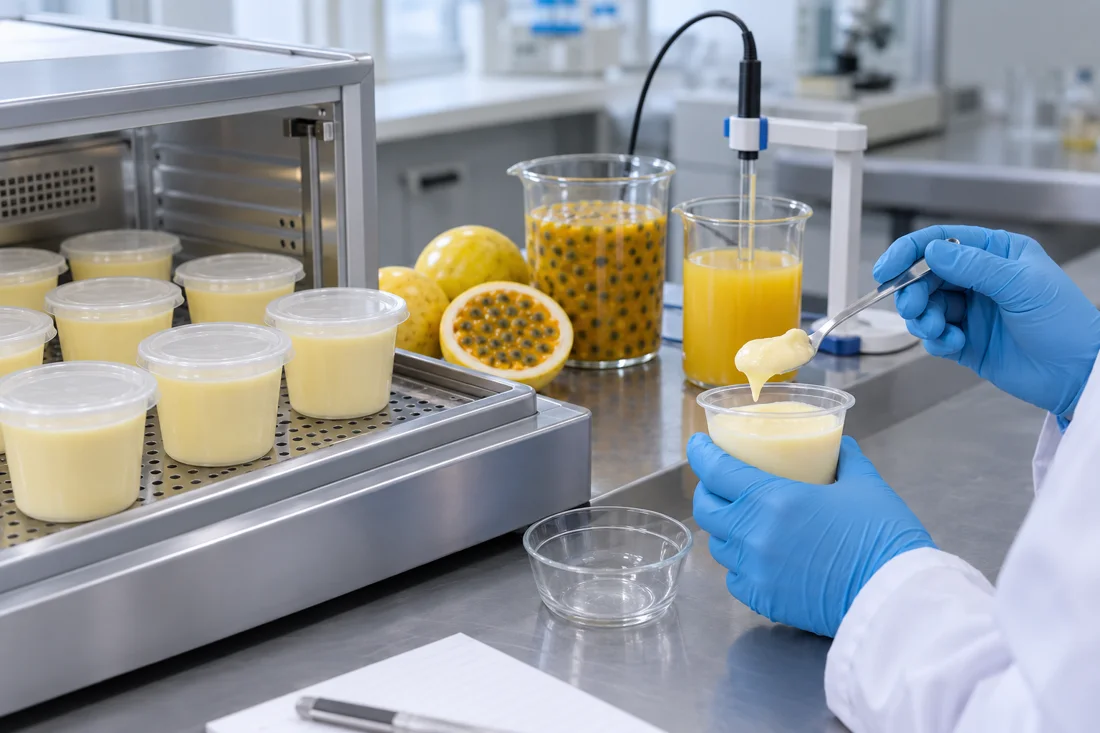
An illustrative pilot scene separates seed-bearing pulp, prepared juice and yogurt assessment.
The dairy trial should use a qualified process and a reference that makes the comparison meaningful. Match the conditions that are intended to stay fixed and record deliberate formulation differences. Sampling times should cover the initial response, the changing fermentation rate and completion. If continuous monitoring is available and validated for the process, it can preserve more detail than a few isolated points. A development laboratory should choose its method according to the decision and its capability rather than copying an instrument from a paper.
Follow structure with suitable methods after cooling and during the intended evaluation window. A texture measurement, a defined whey-separation assessment and sensory observations can answer different questions. Report the sample temperature, container or specimen geometry and handling. If the product is expected to experience distribution movement, design an appropriate qualified handling assessment rather than assuming that an undisturbed laboratory cup represents delivery. The exact acceptance conditions belong to the customer's product specification.
Food-safety completion criteria require independent support. A cup that tastes pleasantly tart or forms a convincing gel does not validate ingredient hygiene, a heat treatment, fermentation control or shelf life. The customer's responsible food-safety team must assess the process and finished product using the relevant validated controls and destination requirements. We can coordinate the fruit specification and requested documentation within the confirmed supply scope; we do not turn a texture study into authorization for a dairy production schedule.
For the illustrative developer inquiry, the next useful evidence would be the two complete traces and matched cooled-product results. We would also request the commercial packing, application, destination and expected quantity so the sample represents the proposed order. If the buyer plans to change from laboratory juice to a frozen pulp input, that transition needs its own preparation and application comparison. A positive juice result is a reason to design that comparison, not a reason to omit it.
Approve the supported final yogurt response
An approval statement should name the response that was demonstrated. It might say that a defined passion-fruit preparation achieved the agreed flavor and gel targets in the tested dairy formulation, with fermentation completion assessed under the qualified process. Include the trace and the cooled-product observations that support that statement. Avoid a broad declaration that passion fruit "speeds fermentation" when the actual finding includes a slower finishing stage. The useful statement retains the parts that matter to production.
Record the ingredient lot and the preparation identity alongside the complete formulation. This makes later comparisons possible when crop, origin or processing changes are considered within the agreed specification. A new lot may be acceptable as supplied while still requiring a representative application check for a sensitive dairy recipe. The approval record should explain when such a check is needed and which result would trigger investigation. That helps purchasing and development agree before volume is scheduled.

The full trace, cooling and gel assessment address connected but distinct endpoints.
The finishing behavior should appear in the production assessment. If the tested fruit formulation reaches the approved endpoint later, evaluate the implications for incubator capacity, cooling sequence and sampling. A laboratory success that cannot fit the intended production plan may need further development. Equally, a slower finish may be acceptable when the final product and operation meet the agreed requirements. The decision belongs to the complete commercial context, with measured evidence rather than an assumption that faster is always preferable.
Keep the gel target specific through the approval. A favorable spooning assessment should be linked to the sample conditions and the intended product. If liquid separation was evaluated, retain that result as a distinct endpoint. If movement or storage was assessed, state the scope. A customer can then distinguish the conditions demonstrated from those still needing work. This provides a clearer handover than a broad "passed texture" note that cannot be interpreted after the development samples have been discarded.
Functional or health claims require a separate evidence path. The original paper examined properties beyond fermentation and gel behavior, but this article does not infer a health benefit from a favorable pH trace, fruit constituent measurement or laboratory antioxidant result. Commercial claim wording and destination-market requirements need qualified review. Similarly, the term "probiotic" cannot be adopted merely because a research culture included organisms described that way. The approval should stay with the food and process properties actually supported.
Frozen-input equivalence also remains a separate question. Freezing history, thawing, seed removal and concentration can alter the preparation used by a customer. A trial using fresh experimental juice cannot approve every frozen passion-fruit form offered under the same fruit name. We confirm the form and specification being supplied, then help the purchasing team coordinate a representative sample. The developer remains responsible for demonstrating the required response after the customer's preparation steps and in the customer's dairy system.

Show the actual frozen or liquid fruit form; no derivative or finished-application equivalence implied.
The most useful final record is one that another responsible person can read without reconstructing the experiment. It connects the supplied lot, prepared ingredient, dairy formulation, fermentation trace, completion decision and cooled gel result. It states any remaining gap and gives a clear reason for proceeding, repeating the trial or holding the application approval. That record turns a promising early observation into a defensible development decision while preserving the later behavior that could otherwise be missed.
A useful purchasing handover distinguishes the raw-fruit specification from the yogurt development record. The fruit specification identifies the supplied form, packing, lot and agreed quality attributes. The development record identifies the preparation made from that fruit and the dairy system in which it was evaluated. Attach the approved reference sample or a clear reference identifier where the customer uses one. If production later changes the preparation step, the team can then see which application comparison has become uncertain. This prevents a frozen-fruit certificate from being treated as proof of set-yogurt performance. It also gives the supplier a concrete question to answer when a new crop or lot is considered: whether the supplied input still meets the agreed fruit specification, while the customer confirms the preparation and final yogurt response.
Related reading
How to Make Passion Fruit Puree
Define extraction yield and seed removal before comparing dairy trials.
Understanding Frozen Passion Fruit
Review the frozen input form before preparing an experimental juice.
Source Frozen Passion Fruit with GreenLand-food
GreenLand-food is a professional frozen passion fruit supplier and manufacturer in China, providing factory-direct wholesale supply according to the confirmed product specification and order scope.
Send the intended product form, specification, packing, quantity, application, destination, private-label needs and requested documents. Include your preparation basis and the application results that need to be compared, so we can confirm a representative frozen-fruit sample and a supply plan for your purchasing team.