


Understanding Frozen Passion Fruit: Forms, Brix, Acidity and Seed Control
Mar 18, 2026
Leave a message

Research This Article & Topic with AI
Verify key claims, compare reliable sources, and explore GreenLand-food's practical frozen food knowledge.
Article details and research questions are prepared in the links. Sign-in or sending may be required.

Reviewed 22 October 2026. Contract limits and destination requirements require current confirmation.
Types and Product Forms of Frozen Passion Fruit
Frozen passion fruit can be supplied in different forms according to the buyer's application. A beverage factory may need pulp or juice base, while a dessert factory may prefer puree. A foodservice operator may want cubes for easy portioning, and a premium dessert brand may need frozen passion fruit halves for visual presentation.

Current GreenLand product-gallery photograph; product-form reference, not this lot's test result.
Frozen passion fruit pulp usually keeps more of the natural fruit character, including pulp texture and, depending on specification, seeds. It is suitable for products that need a visible fruit image, natural mouthfeel or stronger tropical identity. Common applications include fruit tea, juice, smoothies, dessert sauces, cocktail bases and fruit preparations.
Frozen passion fruit puree is usually smoother and easier to blend into beverage, dessert, dairy, ice cream, sauce and bakery systems. It is useful when the final product needs a more uniform texture. Buyers should confirm whether the puree is seedless, seed-in, filtered, sweetened or unsweetened before ordering.
Frozen passion fruit juice base is more suitable for beverage factories and foodservice drink programs that need easier mixing and a cleaner liquid format. It can be used in fruit tea, juice blends, sparkling drinks, mocktails, smoothies and RTD beverage concepts. Buyers should check Brix direction, acidity, added sugar status and packaging before confirming the product.
Frozen passion fruit cubes or portioned packs are useful for drink shops, dessert chains, smoothie bars and foodservice operators. They support easier portion control, faster preparation and more consistent recipe execution. For this format, cube size, free-flowing condition, packaging and thawing behavior are important buying points.
How to Apply Frozen Passion Fruit in Different Fields
Frozen passion fruit is widely used in fruit tea, juice, smoothies, cocktails, mocktails, milk tea, sparkling drinks and beverage bases. Its natural acidity and tropical aroma help beverage brands create a recognizable flavor profile. For beverage factories, the main buying points are flavor consistency, Brix direction, acidity, pulp level, seed content and mixing behavior.
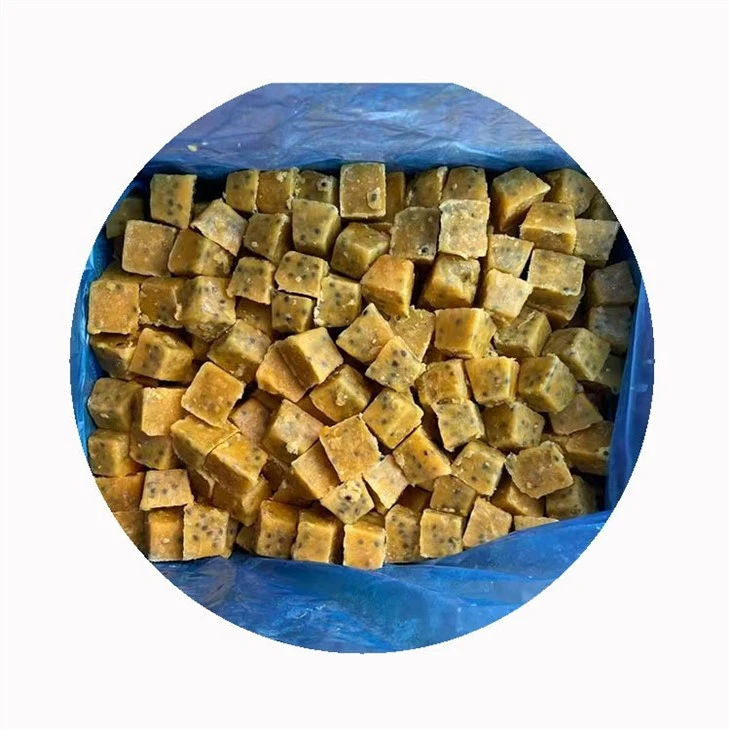
Current GreenLand product-gallery photograph; product-form reference, not this lot's test result.
Frozen passion fruit pulp and puree can be used in cakes, pies, mousse, cheesecake, ice cream, sorbet, jelly, dessert sauces and fruit fillings. Its acidity can balance sweetness and add a refreshing tropical note to dessert formulas. Before volume purchasing, dessert and bakery buyers should test how the product behaves after thawing, heating, blending or mixing with cream, dairy, starch, pectin or gelatin.
Frozen passion fruit can also be used in jams, fruit preparations, yogurt fruit bases, dessert toppings, sauces and industrial fillings. In these applications, buyers should pay attention to acidity, sweetness direction, pulp content, seed level, cooking behavior and batch consistency.
Why Choose Frozen Passion Fruit Instead of Fresh Passion Fruit?
Fresh passion fruit is affected by harvest season, transport conditions and short handling windows. Frozen passion fruit helps buyers reduce seasonal pressure and maintain more stable production planning. For beverage chains, dessert brands and factories, year-round availability is often more valuable than fresh-only sourcing.

Illustration of why choose frozen passion fruit instead of fresh passion fruit?; not an actual lot result.
Frozen passion fruit can reduce losses caused by fresh fruit spoilage, over-ripening, trimming and urgent use. It is easier to store, portion and plan in production. For manufacturers, this can reduce procurement pressure and make recipes easier to repeat.
Frozen passion fruit gives buyers a more predictable ingredient format. Instead of handling fresh fruit batch by batch, factories can work with a defined pulp, puree, juice base or cube format. This supports more consistent beverage flavor, dessert texture and industrial processing performance.
Need frozen passion fruit for beverage, dessert or food manufacturing?
Tell us your target application, product form, packaging, destination market and expected volume. GreenLand-food can help match frozen passion fruit specifications with beverage factories, bakeries, dessert brands, foodservice and industrial fruit preparation projects.
How to Choose the Right Frozen Passion Fruit Product
Choosing the right frozen passion fruit product starts with the final product. Fruit tea, juice, mousse, ice cream, bakery filling, jam and yogurt fruit preparation do not need the same specification. Before comparing price, buyers should confirm the target use, texture requirement, sweetness direction, packaging and production process.

Illustration of how to choose the right frozen passion fruit product; not an actual lot result.
Passion fruit is valued for its aroma and acidity. Brix direction, acidity, seed level, pulp level and color should match the buyer's finished product. Some drink formulas need visible seeds and strong acidity, while smooth desserts may require seedless puree and a more uniform texture.
Buyers should confirm pack size, inner bag, carton strength, shelf life, storage temperature, batch traceability, COA support, microbiological standards and certificate support when required. These details help reduce import, production and customer-approval risks.
GreenLand-food Perspective on Frozen Passion Fruit Supply
At GreenLand-food , we understand that frozen passion fruit is not a single product for every buyer. Beverage factories may need consistent acidity and clean mixing performance. Dessert factories may focus on aroma, color and compatibility with cream or stabilizers. Importers and distributors may care more about pack size, shelf life, documents and repeat supply.

Illustration of greenland-food perspective on frozen passion fruit supply; not an actual lot result.
Our suggestion is simple: choose frozen passion fruit according to your final product, not only by product name. Confirm whether you need pulp, puree, juice base, cubes or halves. Then check Brix direction, acidity, seed content, packaging, shelf life, cold-chain condition and documentation support before placing volume orders.
Send us your required product form, target application, packaging, destination market and expected volume. GreenLand-food can discuss frozen passion fruit options for beverage, bakery, dessert, foodservice, retail and industrial use.
Coordinate a form-specific supply route before testing
Frozen passion fruit is a useful tropical fruit ingredient for beverage, bakery, dessert, jam, foodservice and industrial applications. It supports year-round use, easier storage, recipe consistency and flexible product development. But the product form must match the application.

Illustration of coordinate a form-specific supply route before testing; not an actual lot result.
Before a supply option is quoted, we confirm whether the inquiry is for seeded pulp, seedless puree, juice base, portioned cubes or whole fruit. The current product-gallery photographs help identify two forms, but they do not show a Brix reading, acidity result or a representative production lot. The first sample request should name the exact form, ingredients, pack, lot code, intended recipe and receiving condition, then reserve material for both bench measurement and the customer application trial.
Choose the exact passion-fruit form before comparing a Brix result
Frozen passion fruit can mean whole fruit, halves, seedy pulp, screened puree, single-strength juice or concentrate. These are different purchasing objects. A whole-fruit buyer pays for peel and seeds and needs a usable pulp recovery method. A beverage buyer may need a seedless base with a defined screen and viscosity. A dessert buyer may want visible black seeds for appearance, but a smooth filling may reject them. Before interpreting a certificate, write the form, ingredient declaration, whether added sugar or water is permitted, the treatment route, the pack and the intended recipe. A Brix result from concentrated juice cannot be compared with a single-strength puree simply because both share the fruit name. The existing product-form guidance remains useful; the extra approval step is to tie every analytical result to a precisely named form and process version.

Illustration of choose the exact passion-fruit form before comparing a brix result; not an actual lot result.
For a seedy pulp, define retained seeds by a physical method. One workable buyer trial thaws a representative bag under the written time and temperature, mixes it without grinding seeds, weighs a measured aliquot and passes it through an agreed sieve for an agreed drain period. Dry or wet seed mass, sieve size and whether adherent pulp is rinsed must be recorded; otherwise two laboratories may produce different percentages from the same lot. A seedless puree still needs a residual-seed category, distinguishing intact seeds from hard fragments and fine specks. The buyer signs the appearance and mouthfeel reference. We can provide the supplier's current process and sample, but we should not imply that every 'seedless' grade has an identical screen or zero seed material.
The same form distinction governs thermal and nonthermal processing. A raw frozen pulp, a pasteurized frozen puree and an aseptic concentrate may have different flavor, viscosity and microbial plans. Record whether the tested sample was taken before or after heat treatment and whether the commercial shipment follows the same route. The research on passion-fruit puree shows that processing can affect physicochemical and sensory attributes; it does not validate any particular GreenLand process or shelf life. We therefore ask the buyer to choose a target form and a reference sample before discussing a numerical acceptance range. If the process route changes, that is a new approval event, even when the front label still reads passion fruit.
A practical request for quotation can therefore use one line per form: botanical identity and origin, whole or processed state, seed treatment, ingredient statement, concentration basis, primary pack, net weight, frozen storage and intended final application. The buyer may attach a reference sample, but a reference photograph alone cannot establish Brix, titratable acidity or seed grit. We should confirm whether a desired form is currently available from the proposed supply route before describing it as an offer. The product page for frozen juice/puree is a useful current commercial reference for that form; it cannot stand in for a technical sheet covering whole fruit or a different concentrate. Put uncertainty visibly in the quote rather than collapsing all forms into the most convenient specification.
Measure Brix, titratable acidity and pH on the same defined sample
Brix is a soluble-solids reading, not a full sweetness or flavor certificate. A refractometer result needs an identified instrument, calibration check, temperature or compensation convention, sample homogenization method and replicate rule. A seedy sample may need a defined filtering step so seeds do not interfere with the optical cell; a concentrate may need reconstitution to the specified strength. The COA should state which product basis was tested. For a frozen bag, select cartons across the lot according to the signed plan, thaw without uncontrolled water addition, mix consistently and record both individual and composite results if the contract uses both. Do not silently average a low carton away. The current GreenLand juice product page states its own working single-strength range, but a pictured refractometer value is a sample illustration, not the result for a future lot or a guarantee for every form.

Illustration of measure brix, titratable acidity and ph on the same defined sample; not an actual lot result.
Titratable acidity measures how much base is needed to reach an agreed endpoint, expressed with a named acid equivalent and unit. pH describes hydrogen-ion activity at the measurement conditions. They answer different questions and should be recorded alongside Brix. The opened primary study measured soluble solids by refractometer, pH around 20°C and titratable acidity by titration to pH 8.1 as citric-acid equivalents. That study is a method reference, not a GreenLand release specification. For the buyer protocol, state sample mass or volume, dilution if any, NaOH concentration and standardization, endpoint, temperature, replicate count and calculation. A lab that reports percent citric acid by mass must not be compared directly with a result expressed as grams per 100 milliliters without density and method reconciliation.
A useful formulation trial puts these three readings beside sensory and dose. Prepare the customer's beverage or filling with the same puree mass, added water, sweetener and process time for candidate and approved reference. Blindly compare aroma and tartness; record the pH after formulation if it affects stability or process control. If one lot is high in soluble solids but also much more acidic, the nominal Brix advantage may not reduce the sweetener dose. Likewise two lots with similar pH can have different titratable acidity and perceived sourness. Buyer R&D owns the recipe decision, QA owns analytical method and release criteria, and procurement owns the cost comparison after those decisions. A supplier COA alone cannot resolve all three.
For comparability across laboratories, include the actual sample preparation in the approved method, not just an instrument name. Record how long the sealed bag thawed, whether free liquid was remixed, how many aliquots were taken, whether seeds were removed before optical measurement and whether automatic temperature compensation was checked. A refractometer that reads a clear supernatant after settling may differ from one reading a mixed puree; neither result should be relabeled as the other. For the acid test, document the blank, titrant standardization and endpoint trace. Keep individual replicate values and the rule for reporting their average or range. If a measured result disagrees with the supplier COA, the first step is method reconciliation and sample identity, followed by retained-sample testing under the agreed procedure. Buyer QA decides whether a discrepancy is material and whether the lot remains on hold.
Test seed behavior and usable yield in the buyer process
Use the customer's actual dosing, pumping, mixing, filling and final hold steps. For a beverage line, observe whether black seeds are intended decoration or become a screen blockage or sediment complaint. For yogurt, check whether seeds remain distributed during filling and after the finished product's normal handling. For a frozen dessert, evaluate seed hardness and aroma at service temperature. For bakery filling, record color and flavor after the bake, not only immediately after thaw. A bench sample should be retained beside a matched reference under the same conditions. Note bag identification, thaw time, test batch size and the stage at which a defect appeared so that a repeat test can isolate material variation from process variation.

Illustration of test seed behavior and usable yield in the buyer process; not an actual lot result.
Measure usable mass from one physical input without changing the denominator midstream. For a whole-fruit quote, record frozen gross fruit, usable pulp after cutting, seed removal if required, and any processing loss. For purchased puree, start with net ingredient mass, then account for packaging residue, sieve removal and line hold-up. The first ratio is pulp recovery from whole fruit; the second is process yield from a puree. Calling both a single 'yield' prevents a fair comparison. If drained or separated liquid is reused in a drink but rejected from a high-viscosity filling, record two recipe-specific accepted masses. Do not infer a GreenLand extraction yield from another supplier's commercial brochure. The buyer's application team defines which output counts as usable; QA records the measurement.
Keep defects on their own bases. Count hard seed fragments or foreign matter against a clearly stated sample mass and apply the critical hold rule. Report whole seeds, fine seed residue, peel flecks, browning, free ice and off-flavor separately. A seed percentage by mass is not the same as a number of fragments per kilogram; a visual speck count cannot be translated to a mass share without measurement. Where microbiological or residue requirements apply, agree destination-market and customer rules, method, laboratory and release timing in the purchase file. That file should also say what happens if one carton is anomalous. A second sample may help determine the affected extent, but it should not erase the first finding or permit an unauthorized blend of lots.
Application acceptance should have a defined decision moment. A cold beverage can look attractive after mixing and separate after refrigerated holding; a yogurt can distribute seeds evenly at deposit and show sediment at the end of shelf-life simulation. The trial record should specify observation times and conditions chosen by the buyer, with photographs taken under repeatable lighting and containers. If any benchmark is confidential, the buyer can provide a pass/fail or scored outcome without releasing the recipe. We can still map the tested lot and material form to that outcome. A new packaging size or thaw method may affect practical dosing and loss, so the line trial must use the commercial pack. Otherwise the accepted-yield arithmetic describes a laboratory beaker rather than the material the line will receive.
Use a DEMO calculation, then lock the actual approval authority
DEMO ONLY: consider a 10.00 kg frozen single-strength puree trial. After defined thawing, transfer and a buyer-selected sieve, 9.35 kg enters the accepted beverage base; 0.25 kg remains on the screen and 0.40 kg is measured packaging and line residue. The mass balance is 9.35 + 0.25 + 0.40 = 10.00 kg. Accepted yield is 9.35 / 10.00 × 100 = 93.5%. If the illustrative carton costs 50 currency units, cost per kilogram of accepted base is 50 / 9.35 = 5.35, compared with 5.00 per invoiced kilogram. These numbers are invented to show a workbook formula. They are not a GreenLand lot result, normal loss, quoted price or buyer threshold. A seed-inclusive yogurt use might accept some material held on that sieve and require a different test and denominator.

Illustration of use a demo calculation, then lock the actual approval authority; not an actual lot result.
The calculation must be reproduced across representative cartons and, where the contract requires, across production dates. The buyer should choose a minimum accepted yield, Brix and TA windows, visual seed rule and application acceptance before the lot is inspected. For each failed field, record raw results, calibration, sample identity, operator, photo and retained sample. Quality can hold the lot, request a repeat under the agreed method, investigate a specific segment or propose a documented disposition. Do not replace an individual failing carton with a favorable pooled average unless the signed sampling plan explicitly allows it. A conditional acceptance must name the approved end use and any segregation; it is not a blanket approval for all customers.
Changes to fruit origin or variety, seed-screen aperture, added ingredients, concentration, heat process, pack or lab method may alter flavor and yield without changing the commercial name. We provide a dated change notice with affected lot codes, technical reason, revised specification, comparison sample and proposed effective date. Buyer QA signs analytical and safety implications; buyer R&D or operations signs the application trial; procurement then updates the price and usable-cost analysis. If the evidence is incomplete, the former approved baseline remains the reference and affected material stays on hold. This approval chain makes a recurring product form reliable without turning an illustrative method into a claim of present factory capability.
Keep the DEMO's accepted mass separate from analytical content. A 93.5% transfer yield says nothing about whether the resulting base has the signed aroma or acid balance. Conversely, a compliant Brix and TA pair cannot compensate for a seed fragment that fails the hard-particle rule. The workbook should display analytical pass, physical-defect pass and recipe-trial pass as separate columns, with an overall approval only when all required columns have an authorized decision. Show missing values as blank or pending, never as a zero defect or an automatic pass. When a proposal changes the test method, version the formula and preserve the former calculation for traceability. That simple discipline prevents a price comparison from hiding a quality exception.
Build your frozen passion fruit order with GreenLand-food
GreenLand-food manufactures frozen passion fruit in China. We fill factory-direct wholesale orders for importers, food manufacturers and foodservice programmes.
Tell us how you'll use frozen passion fruit and where you need delivery. We'll review the product form and specification with you, then confirm packing, quantity, private-label details and requested documents.