


How to Make Passion Fruit Puree
Sep 07, 2026
Leave a message

Keep extraction yield separate from dilution
The result may be quite fluid: passion fruit does not naturally produce the thick texture associated with mango puree. For repeat production, define whether seeds are allowed and measure the recovery from both whole fruit and extracted pulp. Frozen pulp can be used as the starting material when its composition and handling instructions match the intended product. The preparation record should identify whole-fruit input, seeded pulp and the final accepted base. These are different stages of one process. Added water or sugar changes the formula and should never be counted as extra fruit recovery.
For ingredient format details, see Can You Freeze Passion Fruit Whole? Whole Fruit vs Pulp.
Prepare the intended fruit base without unrecorded water or sugar additions; a naturally fluid result can still be undiluted.
Calculate whole-fruit recovery and pulp-to-base recovery separately so the purchase requirement is not overstated or confused.
Approve screen choice, seed tolerance and pack format in the real filling, dairy or beverage process before repeat supply.
Define the puree you actually need
Before preparing the fruit, decide what "puree" means in the recipe. Some kitchens use the term for strained, undiluted passion fruit material; some suppliers offer seeded forms; others sell sweetened preparations under names that sound similar. The word alone cannot tell a buyer the fruit content, seed content or concentration. Write those attributes explicitly.
For the method here, the target is an undiluted fruit base with no added sugar. It can be prepared with seeds retained or removed according to the application. A smooth seedless base suits many drinks and fillings. A seeded version may be preferred when visible fruit character is part of the serving. Neither format should be confused with a finished sauce that has been sweetened, thickened or blended with other ingredients.
Codex defines fruit puree by its fruit material and processing, including mechanical processing without removing the juice. Commercial descriptions and market rules still need to be checked for the actual product. For purchasing, pair the product name with a complete ingredient declaration and a specification instead of assuming every item called passion fruit puree is interchangeable.
Prepare an undiluted passion fruit base
Use sound fruit with the expected mature color for its type and acceptable pulp inside. Do not rely on wrinkles as a compulsory maturity test. A small cut-open sample is more useful than a fruit count when size, shell thickness or internal development varies. Prepare the work area before opening the fruit so extracted pulp does not sit while equipment is being found.
- Clean and inspect. Wash the whole fruit under running water and use a clean board and knife. Reject fruit with decay, leakage or compromised condition. Keep shells and edible material in separate containers.
- Halve and scoop. Cut the fruit across the middle and lift the seeded pulp into a tared bowl. Avoid scraping large pieces of the white inner rind into the food material.
- Weigh the pulp. Record the mass before seed removal. This establishes a recovery point that remains useful even when different batches contain different numbers of fruit.
- Finish to the required texture. Leave the pulp seeded if that is the specification, or work it gently through a suitable sieve. Collect the passed material in another tared bowl.
- Check the result. Assess seed fragments, shell contamination, aroma and uniformity. Weigh the finished base and record the retained material separately if yield matters.
- Protect and identify. Cover, label and refrigerate the prepared material under the applicable handling plan. Use promptly or follow an established preservation process suitable for the intended use.
Adding water to push more material through a screen changes the composition. If a process intentionally uses water, record it and name the resulting preparation accurately. Do not report the extra mass as improved fruit recovery.

Control seed removal without grinding the seeds
The purpose of sieving is to separate the surrounding fruit material from intact seeds. A flexible spatula can move the pulp across the mesh without crushing the seeds. Use modest pressure and inspect the retained material. Once additional effort mostly produces seed fragments rather than useful pulp, continued scraping may reduce product quality while adding little worthwhile yield.
Screen choice creates a tradeoff. A coarser mesh may recover more fruit body but permit small particles; a finer mesh may improve smoothness while retaining more solids and requiring more time. Test the screen against the intended application. A base that seems smooth in a spoon can still leave an objectionable particle in a delicate dairy product or obstruct a narrow filling nozzle.
Avoid treating a powerful blender as a universal shortcut. It can disperse pulp but also break seeds and introduce air. If the operation uses blending before screening, establish a tested setting with the actual equipment and fruit load. Keep a record of the screen used and the condition of the passed material. That record is more transferable than a vague instruction to blend "until smooth," which does not define what should happen to the seeds.
Measure whole-fruit and pulp-to-puree yields separately
Two different yields are often reported as though they were the same. Whole-fruit yield includes shell losses. Pulp-to-puree yield begins after the shells have already been removed and may include seed removal. A high percentage at the second stage says nothing by itself about the amount of whole fruit needed for the order.
Consider an illustrative preparation run, not a promised natural yield. You purchase 5.0 kg of whole fruit, recover 2.0 kg of seeded pulp and collect 1.4 kg of the required seedless base. Whole-fruit-to-base recovery is 1.4 ÷ 5.0, or 28%. Seeded-pulp-to-base recovery is 1.4 ÷ 2.0, or 70%. Both numbers describe the same run, but they answer different purchasing questions.
| Measurement | Example mass | What it helps calculate |
|---|---|---|
| Whole fruit received | 5.0 kg | Purchased raw-material requirement |
| Seeded pulp collected | 2.0 kg | Shell-removal recovery |
| Seedless base collected | 1.4 kg | Ingredient available for the recipe |
| Whole fruit less finished base | 3.6 kg | Combined non-base material and handling losses |
Measure several representative runs before setting an expected range. Keep the fruit type, screen, operator method and definition of the finished base consistent. Record spilled material and equipment residue where significant; otherwise these losses disappear into a misleading "peel and seeds" total. A purchasing estimate should show the basis and the observed variability rather than present one small trial as a universal yield.
A recovery worksheet should avoid double-counting a stream. If 2.0 kg of seeded pulp has already been recorded as an intermediate output from whole fruit, it is not added again to the final output total alongside 1.4 kg of seedless base. The pulp is a stage in the same process. Only the final accepted base and the material removed or lost at each stage should reconcile with the original whole-fruit input.
The distinction also matters when a supplier offers frozen seeded pulp. That product starts the buyer's calculation after shell removal. Compare its purchase weight with the seedless base recovered at the buyer's screen, rather than applying the whole-fruit percentage again. Using both losses would overstate the quantity needed and make the prepared ingredient seem less efficient than it is.
Record seed-removal losses in the context of the specification. A seeded dessert base may use the entire acceptable pulp, while a smooth filling cannot. Neither team has necessarily extracted the fruit incorrectly; they are making different ingredients. A useful worksheet names the accepted output clearly enough that purchasing can compare like with like.
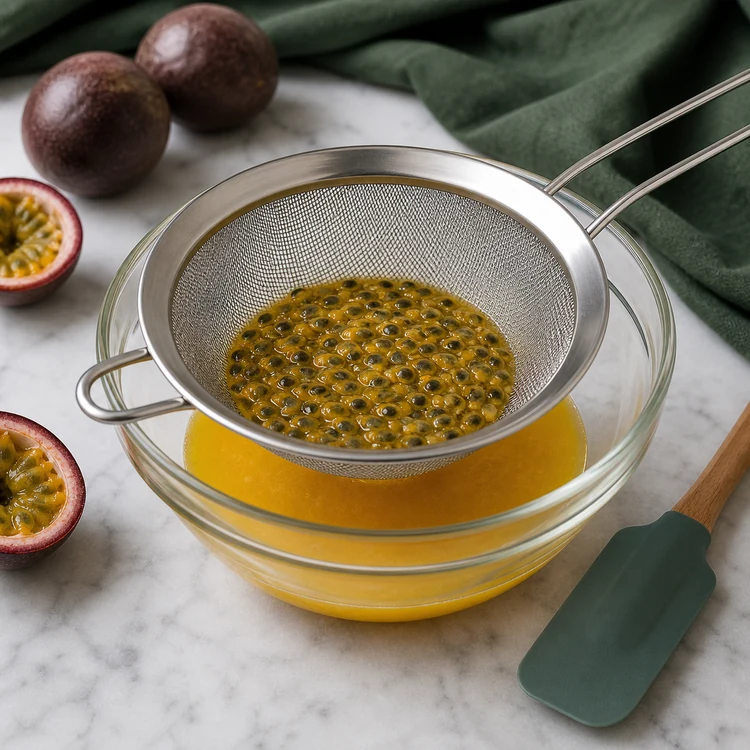
Why a thin puree can still be undiluted
Passion fruit pulp surrounds seeds in a naturally fluid material. Removing the seeds does not necessarily create a thick spoon-standing paste. A thin result is therefore not proof that water has been added. Conversely, a thick result is not proof of high fruit content: concentration, stabilizers or other ingredients can change texture.
Confirm composition through the product declaration and specification. Assess Brix, acidity and viscosity only with the agreed methods and conditions. Temperature affects flow, and a partially thawed sample may appear much thicker than the same material after uniform thawing and mixing. A photograph cannot provide a reliable viscosity specification, especially when the product is shown frozen.
If a recipe requires a thicker base, decide how the finished food should achieve that texture. A bakery filling may use its own formulation and cooking system; a beverage may intentionally need a fluid base. Do not quietly cook down a sample or add a thickener and continue treating it as the same undiluted puree. Those changes create a different ingredient behavior that needs to be recorded and tested.
Fresh extraction versus thawed frozen pulp
Fresh extraction lets a kitchen choose individual fruit and control screening directly. It also introduces shell handling, variable recovery and a preparation schedule tied to fresh fruit condition. Frozen pulp moves some of that work upstream, but the buyer still needs to know whether the material is seeded, sweetened, diluted or concentrated.
Follow the supplied thawing or direct-use instructions. Where refrigerated thawing is required, use a covered food-safe container and allow sufficient time for the pack size. A large frozen block does not thaw like a small portion. Avoid assessing only the first liquid released from a partially thawed pack; it may not represent the composition of the whole product.
Mix the fully usable material as instructed before weighing a recipe portion. Compare fresh and frozen inputs using the same finished formulation and measurement basis. We supply frozen passion fruit puree in forms confirmed for the order, and we review the required seed content and application during sample selection. Frozen storage supports planning, but it does not make an ingredient sterile or automatically suitable for consumption without further processing.
Puree, juice, concentrate and sweetened sauce
These names should guide a discussion, not replace a specification. A recipe author may call strained passion fruit liquid "juice" while a supplier describes a closely related undiluted fruit material as puree. Resolve the composition before arguing about a name. Concentrate and sweetened sauce introduce more substantial differences because their water or added-ingredient content has changed.
| Product description | Main distinction to confirm | Consequence in a recipe |
|---|---|---|
| Undiluted puree or fruit base | Fruit composition and permitted seeds | Establish the fruit addition rate |
| Extracted juice | Extraction and solids characteristics | Check body, cloud and separation |
| Diluted fruit drink | Added water and other ingredients | It cannot replace an undiluted base by default |
| Concentrate | Water removal and concentration basis | Recalculate reconstitution or inclusion |
| Sweetened sauce or topping | Sugar, thickeners and other ingredients | Rebalance the whole formulation |
FAO's fruit processing definitions provide useful background on these distinctions. For a purchase contract, use the agreed product description and the destination's applicable requirements. An unsweetened recipe can be altered substantially by a sweetened topping even when both products have a similar golden appearance and are sold in equally sized containers.
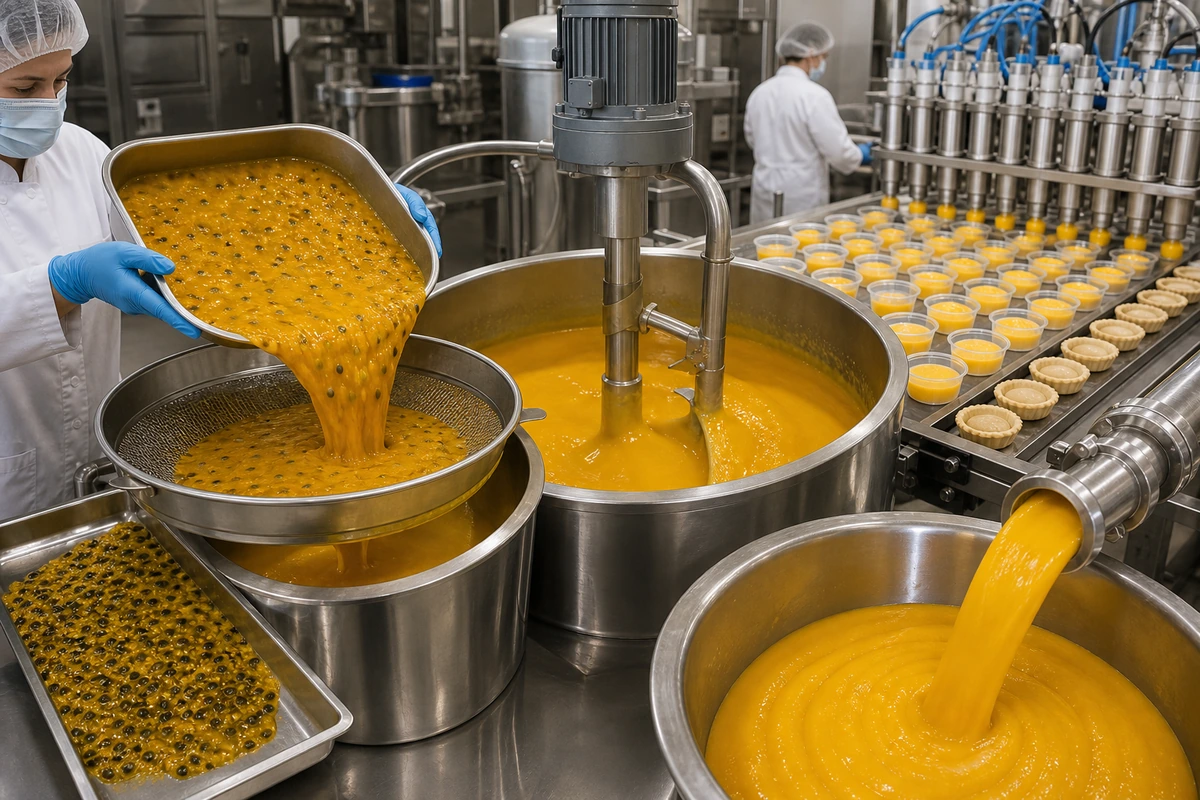
Pack portions around the next production run
The best portion is one the operation can use without unnecessary repeated handling. A pastry kitchen using a small amount each morning has different needs from a filling line consuming a full bulk pack in one run. Start with the daily recipe requirement, then choose a pack size and opening routine that fit the actual workflow.
Identify prepared portions with the source lot and preparation or opening information required by the site's system. Do not combine an older remainder with a new batch simply to empty a container. That practice obscures age and traceability. If several small portions are needed, prepare them under controlled conditions and return them promptly to the appropriate storage environment.
For frozen purchasing, confirm whether the product is a block, pouch, smaller portion or another supplied form. Ask how it is expected to be handled after opening and whether the intended use requires a further process. A carton weight alone does not describe the work at the user's site. Review pallet quantity and freezer space too, because a convenient inner pack can still arrive in a shipment that exceeds the receiving operation's usable capacity.
Use the base in dairy, bakery and beverages
For dairy applications, test the actual dairy or alternative base, fruit inclusion and order of mixing. The acidity and suspended fruit material can affect appearance and texture. A successful spoon tasting of the puree does not establish that it will remain acceptable after incorporation, chilling and the expected holding period. Evaluate the finished product under its intended process conditions.
For bakery and dessert fillings, assess performance after the relevant heat, cooling and storage stages. Decide whether seeds are wanted as a visible cue or excluded for a smooth texture. A base that is pleasantly fluid on its own may need a carefully developed filling formulation to avoid leakage. That is a recipe-development decision rather than a defect that can be judged from puree thickness alone.
For beverages, set the fruit level before adjusting water and sweetener. A puree is the starting ingredient, not the final drink. The broader frozen passion fruit range allows the form to be matched to the application. Keep the beverage recipe in its own controlled instruction so changes to dilution do not accidentally redefine the specification of the purchased fruit base.
Consider a pastry kitchen testing the same passion fruit base in two products. The first is a smooth filling applied through a small nozzle; the second is a fruit layer where intact seeds are part of the presentation. The nozzle trial should inspect particle size and blockage as well as flavor. The visible layer should assess seed distribution and appearance after the required hold. One generic spoon tasting cannot approve both uses.
Prepare each trial with the same identified lot and retain the recipe weights. If the smooth filling requires additional screening, weigh what remains and include the labor in its ingredient cost. If the seeded layer settles unevenly before portioning, test the mixing and filling sequence. These are different operational questions even though the purchase order may use the same fruit name.
A second comparison can examine pack size. A larger frozen block may produce the same finished flavor but need an inconvenient thawing schedule for a small pastry run. A smaller pack can reduce partial-pack handling while changing packaging cost. Record those practical differences beside the sensory results. The best puree choice is the one that supplies the defined fruit base in a form the team can handle reliably, not necessarily the thickest sample or the lowest quoted price.
Keep the approved process with the ingredient specification. If a new operator changes the screen or takes only the first thawed liquid from the pack, the recipe has changed even though the product label has not. A short preparation instruction prevents that avoidable drift.

Trial viscosity, acidity and aroma in the real recipe
Design a trial that changes one main variable at a time. Begin with the approved recipe and a reference ingredient. Replace the fruit base with the proposed sample at the same mass, keep the rest of the formulation unchanged and record what happens. If adjustment is needed, document it as a second trial rather than silently changing the first comparison.
Assess the characteristics that matter to the customer: recognizable aroma, acid balance, visible seeds, smoothness, flow and any separation after the intended hold. Define the assessment temperature and time. A warm freshly mixed sample and a chilled next-day sample are different test conditions. The comparison should reproduce the actual point of use closely enough to reveal operational differences.
Retain the sample code, specification version and recipe record. If the ingredient later changes, those records allow the team to distinguish a raw-material change from a mixing or storage change. We review sample feedback most effectively when it describes a specific result, such as excessive seed particles after a defined screen or weak aroma at the approved addition rate, rather than a general request for "better quality."
From kitchen sieving to commercial finishing
A kitchen sieve makes the separation visible, but commercial finishing involves different throughput, residence time and equipment contact. Scaling up requires confirmation that the selected process gives the required texture and seed tolerance without excessive product loss. A fine laboratory sample is useful evidence, yet it should be followed by a trial appropriate to the intended production scale.
Define acceptable seed fragments, shell contamination and other physical defects using practical inspection criteria. The receiving team needs to know what to observe and how to report it. If a screen requirement is specified, clarify whether it describes the manufacturer's processing equipment, an inspection method or a performance requirement at the buyer's line. Those are related but different commitments.
Processing and preservation requirements also depend on the finished use. A fruit base intended for a subsequently cooked filling may not have the same intended-use conditions as an ingredient added after the final heat step. Ask for the relevant technical information before use. Do not infer a validated microbial reduction process from the words "puree," "IQF" or "frozen."
Confirm a frozen puree specification and purchase plan
An effective inquiry begins with the intended product: for example, a smooth fruit base for a chilled dessert, or a seeded base for a visible fruit layer. Include whether added sugar or water is acceptable. Then provide the proposed inclusion rate, processing stage and the physical constraints of the equipment. These details help us identify the sample that deserves a trial.
Confirm the product description, ingredient declaration, seed status, agreed analytical checks, sensory reference, pack size and storage conditions. Ask for the specification, lot information and documents required for the destination. Establish which requirements apply to the exact item and shipment rather than relying on a general company document. Any claim about formulation, certificates or testing should be tied to the supplied product.
Send the order quantity, destination, packing preference, private-label requirements and target timing. We confirm MOQ, lead time and loading arrangements against the request. Evaluate cost per usable kilogram of the approved base, including any screening or thawing loss at your site. A lower carton price may not reduce the recipe cost if the ingredient needs extra finishing or a higher addition rate to reach the same flavor.
Questions about puree substitutions
Should I include seeds when reporting puree recovery?
State the accepted product first. A seeded base can include acceptable seeds in its output weight; a seedless base cannot. Report the measurement stage and use the same definition for every comparison, rather than presenting the two recovery percentages as equivalent.
Can I approve one base for both a nozzle filling and a seeded topping?
Possibly, but each application needs its own trial and may require different finishing. Check particle passage for the nozzle and seed distribution for the topping. Include any extra screening loss and labor in the comparison.
Source frozen passion fruit with GreenLand-food
GreenLand-food is a professional frozen passion fruit supplier and manufacturer in China, providing factory-direct wholesale supply for importers, food manufacturers, foodservice distributors and private-label programs.
Tell us the product form, required specification, packing and quantity, along with the application, destination and delivery timing. Include seed or cut preferences where relevant, private-label requirements and the documents your team needs. We will review the sample, MOQ, lead time and loading arrangement for the proposed order.