


Pectinase Trials: The Fastest Early Reaction Can Lose the Long-Conversion Ranking
Oct 09, 2026
Leave a message

Research This Article & Topic with AI
Verify key claims, compare reliable sources, and explore GreenLand-food's practical frozen food knowledge.
Article details and research questions are prepared in the links. Sign-in or sending may be required.

An illustrative scenario is a fruit processor asking GreenLand why the preparation with the highest initial assay value performs less well at the conversion endpoint that matters to its product. At GreenLand-food, we would first clarify the supplied frozen fruit form and the customer's intended process. This is a decision example, not a past GreenLand customer case. GreenLand-food supplies the frozen fruit input; the processor and enzyme provider qualify enzyme treatment.
Choose the endpoint before ranking preparations
The first question in an enzyme trial is what "best" means. A laboratory screening program may value rapid release of reducing sugars in the first few minutes because it wants a convenient activity measure. A fruit processor may care about juice yield after an extraction hold, a target viscosity before pumping, cloud behavior after filtration, or the amount of pectin converted before the next production step. These endpoints are related through enzyme action, but one cannot assume they move together. The trial should define its decision endpoint before ranking candidates so an appealing early number does not quietly become a claim about finished product performance.
The 2014 paper by Biz and colleagues examined pectinase complexes on pectic substrates. The researchers sampled reaction profiles closely at the beginning and followed longer courses. They reported an early deceleration in the release of reducing sugars and showed that the activity assigned to the same preparation could change substantially when the single-time-point assay interval changed. In their comparison on citrus pectin, one preparation led early while another slightly exceeded it by the long endpoint. That is a bounded observation from those preparations, substrates and conditions. It illustrates why the selection target matters; it does not promise a reversal in every pectinase or fruit system.

Early and later fruit-pulp sample states
For a purchasing or R&D team, a clear trial brief can state both a screening endpoint and a use endpoint. The screening endpoint might be a reproducible short assay used to reject clearly weak preparations. The use endpoint might be residual viscosity in the actual fruit pulp, clarification after a specified treatment, or a yield target at the process hold time. A candidate that ranks well in screening still needs confirmation at the use endpoint. The difference is especially important when the downstream operation has its own physical limits, such as a filter, membrane or filling line. A laboratory value only matters insofar as it predicts a relevant operational result.
Make the sample basis explicit. If the buyer plans to use frozen apple dice, identify cultivar or blend when known, peel inclusion, cut size, freezing pretreatment, storage history and the process by which the dice become pulp or juice. Pectin availability and the liquid matrix differ from a purified citrus pectin solution. Fruit pulp also contains suspended particles, soluble solids, acids and other components that can influence the observed outcome. The original assay is valuable for understanding measurement limits, yet its model substrate is not a production validation for apple, berry or other GreenLand-food fruit formats.
An enzyme specification may list activity units, but units require the test method to have meaning. Ask which substrate, pH, temperature, concentration, incubation interval, analytical method and reporting basis produced the number. Even two reputable certificates may be incomparable if one uses pectin and the other polygalacturonic acid, or if they stop the reaction at different times. In the Biz study, relative activities on polygalacturonic acid did not correlate with those on pectin. The selection exercise should therefore hold the assay conditions constant when comparing candidates and still test the actual fruit-process endpoint separately. A high number under a different method is not a shortcut around this work.
When the product's main aim is clarity, do not substitute reducing-sugar release for clarity without evidence. Pectinase complexes may depolymerize pectic material, but turbidity, viscosity, pressing behavior and sensory quality are different measurements. The useful endpoint depends on the final beverage or ingredient: a clear juice, a cloudy juice with controlled stability, a puree that should retain body, or a fruit preparation for bakery may call for different results. A processor should choose the relevant endpoint first, then ask whether the early assay predicts it for the selected matrix.
Early release was not a straight-line response
Many simple activity calculations divide the amount of reducing sugars produced by the chosen incubation time. That arithmetic implies an average rate over the interval. If product release were perfectly linear, extending the reaction interval would produce a proportional increase and the calculated rate would remain stable. The 2014 study observed a different profile: release decelerated markedly during the first ten minutes in its tested systems, followed by a longer slower change. Dividing a later product total by a longer interval therefore gave a different apparent activity, even when the same enzyme preparation and other assay conditions were used.
This is a measurement issue as well as a process issue. Suppose a laboratory calls a five-minute result an activity value and another uses a thirty-minute result. Those values may look like direct competitor scores, yet they contain different portions of a curved reaction trajectory. The paper showed that assay time, pectin concentration and temperature could make the reported activity of one extract differ by an order of magnitude under different combinations. A buyer should demand the method and reaction interval with the number, and compare candidates under a common protocol. The number on a certificate is not self-explanatory.
The early curve should be measured with enough resolution to reveal its shape. In the source study, close sampling intervals exposed deceleration that coarser time points could miss. A single early point and one long point can tell a team that two endpoint totals differ, but it cannot describe the path between them or establish when ranking changed. If the intended process depends on a narrow hold window, more intermediate samples are useful. The sampling plan should be proportionate: dense near the period where the curve changes quickly, then enough later points to show the operational endpoint and any plateau. A claimed rate from a curved interval should name that interval.

Closely spaced aliquot sampling
Analytical chemistry also needs careful wording. The original assay detected reducing sugars released from pectic substrates; it did not measure every molecular change in pectin or all forms of juice performance. An endo-acting enzyme can produce oligomers that contribute to a reducing-sugar reading while leaving other properties to be assessed separately. A viscosity measure can respond strongly to chain scission even before complete saccharification. A processor who wants clarification should measure clarity or filtration behavior, while one seeking conversion yield should use a corresponding chemical or mass-balance endpoint. The assay should follow the question.
The customer's qualified process or R&D team can build a side-by-side comparison from the same fruit input where possible. It can split one well-mixed sample into equal portions, run candidate enzyme preparations at a defined dose and temperature, and sample the reaction through the intended period. The team should preserve blanks and control samples, measure the chosen endpoint, note pH and soluble solids, and specify whether results refer to wet pulp, juice volume, dry matter or another basis. If a candidate looks fast at the first reading, the trial should continue through the actual process hold rather than extrapolate a straight line. We can support this comparison by confirming the GreenLand-food fruit form and lot. The original study is an alert about extrapolation, not a processing recipe.
The reported experimental temperature and long reaction duration from the model study should never be copied into a commercial standard operating procedure merely because they generated a clear research result. Enzyme approval, dose, temperature, pH and hold time depend on the product, market, supplier documentation and validated process. For GreenLand-food fruit supply, our contribution is to help define and deliver the fruit form and lot information needed for a fair customer trial. The enzyme vendor and processor must qualify the enzyme route and finished product independently.
Research context: original pectinase activity study. These sources describe their own tested material and conditions.
An early leader need not stay ahead
The most instructive feature of the original comparison is the change in rank. In a particular citrus-pectin experiment, the preparation leading at an early stage was slightly behind another at the extended endpoint. A team selecting only the early leader would have chosen for a different target than the long conversion result. The difference was not an enormous universal effect, and the paper did not demonstrate that every preparation changes rank. Its importance is logical: when curves have different shapes, a ranking at one time does not fix the ranking at another time.
This matters commercially because enzyme costs and process windows are real. If a juice line has a short, fixed hold, the fast early performer may be useful even if another preparation eventually converts more. If an extraction step allows a longer hold and the final conversion is the binding target, a slower starter may be preferable. A processor may also have a maximum dose, thermal budget or filtration constraint that changes the comparison. The ranking should be reported for the buyer's defined process, not as a general winner. The price per unit of catalog activity is a weak purchasing metric when the unit method and use endpoint differ.

Illustrative crossing reaction trajectories; qualitative, not measured data
The assay curves can be compared in a table without reducing them to one number. For each preparation, record the substrate and concentration, initial sample response, apparent activity over the stated short interval, response at intermediate times, and final conversion or application outcome. Add the variability across replicate runs. If differences are small relative to measurement uncertainty, call the result unresolved and repeat or broaden the trial. The paper's late crossing was slight; treating every small numerical difference as a decisive commercial advantage would overread the experiment.
An actual fruit process needs additional performance endpoints. For a clear apple beverage, monitor turbidity, viscosity, filter load and yield under the target process. For a cloudy fruit beverage, complete removal of pectic structure may not be desirable; stability and mouthfeel may matter more than the reducing-sugar total. For a puree, excessive thinning could harm the product even if the chemistry suggests stronger pectin breakdown. The product form from GreenLand-food must therefore enter the trial at the same preparation stage that the customer will use, whether frozen dice thawed into a puree or fruit pieces combined with other ingredients.
Control variation in the fruit input before attributing a crossing to the enzyme. Split one homogenized batch when testing preparations, or use a blocked design when multiple lots must be represented. Keep dose expressed on a common meaningful basis and document the preparation's stated activity method. If each candidate is run on a different fruit lot or at a different pH, the observed ranking mixes enzyme and matrix effects. Run the same downstream clarification or filtration step for both candidates. A laboratory time course is most useful when it leads directly to a reproducible plant or pilot decision.
The illustrative buyer asking why an early assay leader failed at the intended endpoint can then receive a precise answer: the early reading sampled a different part of the reaction trajectory, and the published study shows that such curves can decelerate and even change rank in a bounded comparison. We would ask for the two assay reports, substrate and timing details, fruit form and customer endpoint. If the reports used different methods, align the comparison first. If methods matched, evaluate the full trajectory and the finished product. That reasoning does not require claiming a hidden inhibitor or any particular process mechanism.
Do not fill the mechanism gap with an invented cause
An observed slowdown invites explanations, but a plausible mechanism is not the same as a tested cause. The source paper considered whether thermal denaturation accounted for its early deceleration and did not demonstrate that explanation under the conditions examined. Other possibilities may be discussed in enzyme science, including substrate accessibility, product effects or changes in the mixture of pectic fragments, but the buyer-facing conclusion should stay with what the experiments established. Do not tell a processor that a preparation "burned out" merely because its curve bent.
There are two errors to avoid. One is to treat any decline in apparent activity with assay time as proof that the enzyme itself lost activity. The calculated value can change because the product-release curve is not linear, even if the enzyme remains present. The other is to turn an untested alternative mechanism into a diagnosis of a customer's line. A fruit matrix is more complex than the model substrate; an observed plant result may reflect substrate differences, mixing, pH, temperature exposure, dose, analytical interference or equipment operation. Each candidate explanation needs its own evidence.
In the laboratory record, distinguish observation from interpretation. Write that reducing-sugar release slowed in the measured interval, that the apparent activity depended on assay time, and that the later endpoint ranked the compared preparations differently in the specified trial. If the team wants to investigate why, design a separate experiment that isolates the proposed factor. For example, direct residual activity measurements may help examine enzyme stability; substrate characterization may address accessibility; and mass balance or product analysis may clarify what reducing-sugar readings capture. None of those mechanisms should be asserted as settled for a GreenLand-food fruit application without data.

Controlled laboratory temperature and preparations
Do not assume that extending a two-point test solves the problem. A start and final reading can establish a net change, but a curved reaction may have a rapid initial phase, an intermediate bend and a slower later phase. If the operational decision is sensitive to crossing or plateau timing, the profile needs enough intermediate points to resolve those changes. Replication matters too: an apparent reversal within analytical noise should not drive a supplier or enzyme switch. Record instrument calibration, blank subtraction and the sampling time relative to mixing and heat-up so the early portion of the curve is interpretable.
Food safety and legal suitability are separate decisions. The original paper is a methods study, not an approval to use a specific enzyme preparation in every destination market. The processor must check enzyme source, permitted use, manufacturing documentation, allergen or labeling implications as applicable, and process validation through the correct suppliers and regulatory advisers. GreenLand-food can provide frozen fruit information and supply documents tied to the ingredient. We should not claim to certify an enzyme or a customer's finished processing conditions from a research paper.
The practical benefit of preserving uncertainty is better problem solving. If a processor reports a mismatch between an early assay and pilot yield, the team can first confirm comparable methods and material, then look at the actual time course and end-use outcome. It can investigate mechanisms after observing a reproducible discrepancy. That sequence avoids unnecessary reformulation based on an attractive story about denaturation, and it keeps the evidence request focused on the decision the customer must make.
Qualify the actual fruit-process decision
For a customer using frozen fruit, start with the ingredient stage. Identify whether the trial uses IQF dice, chunks, puree or another form; whether peel is present; how the fruit was thawed or heated; and whether added water or other ingredients change the solids basis. A pectinase comparison made on purified citrus pectin is useful background, but the final decision belongs to the real fruit matrix. We would confirm the offered form and representative lot before the customer runs a pilot trial. If a processor wants to compare lots, use the same enzyme preparation and process route first so fruit variation can be seen without an enzyme change mixed in.
Then define the end condition. State the chosen treatment period, target product temperature, pH range, solids level and acceptable variance, as determined by the customer's validated process. Decide whether the required result is viscosity, yield, turbidity, filter throughput, stability, sensory quality or a combination. Some goals conflict. An enzyme that helps a clear juice may over-thin a fruit preparation intended to have body. A numerical activity certificate cannot resolve that product tradeoff by itself. A scored pilot sheet should record each endpoint separately and identify the one that is binding for release.

Illustrative fruit-pulp processing at the application endpoint
When comparing enzyme preparations, use a common analytical protocol for initial screening and report the full reaction trajectory where long conversion matters. Capture multiple time points, replicate enough to see variance, and record the basis of every result. Add a no-enzyme control and appropriate blanks so naturally occurring changes in the fruit are not attributed to the preparation. If the product will be pasteurized or further processed, inspect the result after that step as well. A preparation can behave acceptably in a beaker yet yield a different final appearance after the plant's separation, heating or packing process.
Commercial feasibility also includes ingredient supply. The purchasing team needs frozen fruit cut size, defect tolerance, packing, quantity, crop timing, lead time, destination and traceability documentation aligned with the customer's process. A change from peeled apple dice to chunks, or a shift in raw material composition, may alter pulp preparation and the assay's relevance. We would help specify the fruit input and sampling plan, while the processor and enzyme provider qualify enzyme dose and legal status. Keeping those responsibilities clear makes a useful trial possible without implying GreenLand-food performs enzyme treatment.
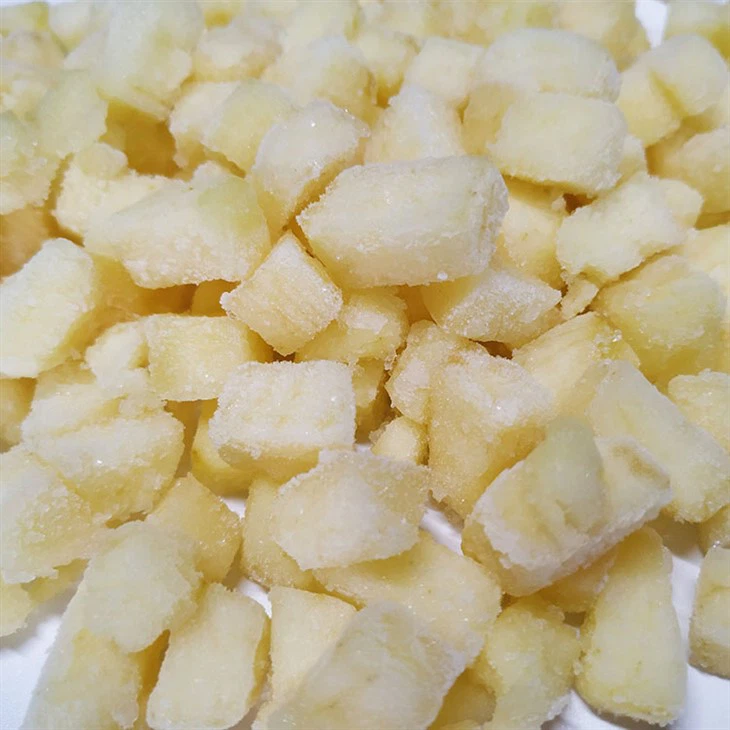
Frozen apple pieces document the supplied fruit form
The final evidence package can be concise: both enzyme method sheets, the fruit lot and sample-preparation record, matched time-course data, the selected end-use metrics, replicate variability, and the completed product evaluation. A buyer can then see why one candidate was chosen for the actual process, even if a different one led at an early assay point. If the data do not separate candidates reliably, repeat with representative lots or choose on other verified criteria. The original pectinase paper supplies the warning against early-rate extrapolation; it does not supply the customer's approval result.
The approval sheet should also state when a change requires a fresh comparison. A new fruit form, a different preparation activity basis, a changed hold time or a revised finished-product target can make the earlier ranking less useful. This does not mean every routine shipment needs a complete enzyme study. It means the processor should identify the variables that made its qualification representative and check them when the ingredient or process changes. For GreenLand-food, that translates into a clear frozen-fruit specification, traceable lot information and a practical retained sample when requested. The customer's technical team can then decide whether the existing enzyme evidence still covers the material being purchased.
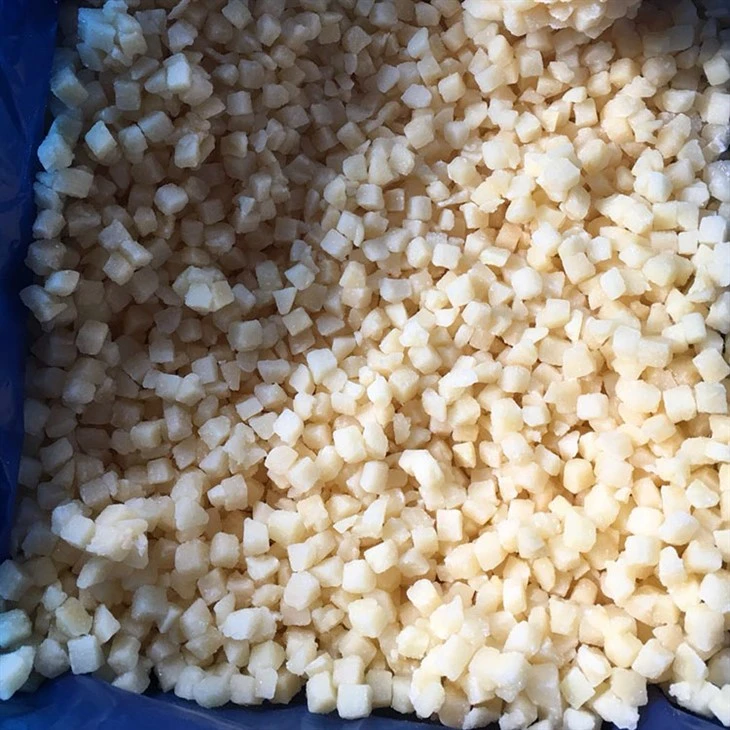
Alternative view of frozen apple pieces and packing form
Source Frozen Fruit with GreenLand-food
GreenLand-food manufactures frozen fruit in China. We fill factory-direct wholesale orders for importers, food manufacturers, foodservice distributors and private-label programs.
Send your product form, specification, packing, quantity, application, destination, private-label needs and requested documents so we can confirm a relevant sample and supply brief.