


Frozen Cauliflower Florets: Import Standards, Grading and Supplier Controls
Oct 20, 2026
Leave a message


Define the frozen floret that the buyer actually orders
We would name the material in the purchase specification as cauliflower, Brassica oleracea var. botrytis, with the edible immature head separated into florets. That is different from broccoli, broccoflower, Romanesco, cauliflower rice or a mixed vegetable. A catalog category may show several cuts; the lot description has to say which one enters the carton. For this guide the proposed form is trimmed, blanched, individually quick-frozen florets with no sauce, seasoning or other added ingredient, packed for an industrial customer and labeled to cook thoroughly before use. We would confirm the exact commercial cultivar, origin farms, processing site and ingredient statement for the proposed order rather than infer them from the category name.
The buyer should state both the target end use and what the floret must look like after that use. A tray-meal producer may need compact heads with short, unobtrusive stems so portions distribute evenly. A soup plant may accept more stem but reject long woody branches after heating. A meal-kit packer may prize visible white crowns, while a puree manufacturer may prioritize usable solids and price. Those are distinct specifications, even when the bag says "frozen cauliflower florets." Before quotation we would ask for finished application, required cut and pack weights, destination, expected annual and first-order volume, storage condition, private-label artwork needs and documents required by the importing party.

The processing description matters as much as the ingredient. "Blanched" should identify an actual heating step in a controlled sequence, followed by cooling, draining, IQF freezing, metal-detection and packing as applicable at the selected plant. It does not, by itself, promise ready-to-eat safety or define the Japanese frozen-food category. The buyer's label and process should require a full cook; cooking instructions need validation for the buyer's portion size and appliance. We would request a site process flow, the lot's heat/cool/freezing records and a written product designation before approving any market-specific statement. If a different plant, blanch regime or raw-material season is proposed, the change goes back through the specification and sample approval.
GreenLand's frozen cauliflower product page is the relevant product route for inquiry. The genuine floret images in this guide show actual company product material and illustrate why one head or stem length cannot define a whole lot. They are not a production record, certificate or evidence that a pictured lot is the lot offered today. We would attach a coded photo set, sample label and approved physical sample to the order file so purchasing, quality and production evaluate the same form.
Measure size, whiteness, stem share, insects and fragments
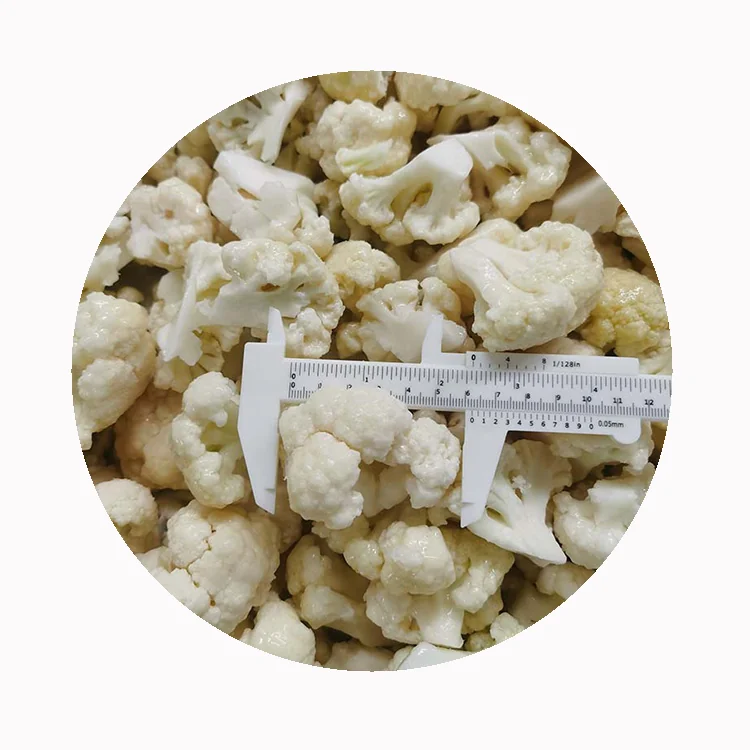
An order should say how a floret is measured. We propose measuring the greatest crown span with a caliper on a thawed or specified frozen state, while recording whether the projecting stem is included. If the buyer writes only "20–40 mm," one team may measure the crown and another the total piece length. The quality lead should issue a one-page illustrated measurement instruction, agree the number and mass of cartons to sample across a lot, and report size as a distribution by count and mass, not a single average. Record pieces below and above band separately and set the acceptable percentages in the signed buyer sheet. Any numerical example in a pilot sheet is a proposed customer tolerance, not an import-law limit.
White color is also a defined visual decision. Cauliflower heads can have pale cream or faint yellow areas without being spoiled; a buyer of a visible side dish may nevertheless reject them. Agree the viewing light, frozen or thawed state, reference panels, and the distinction between normal cream tone, surface bruising, black specks, yellowing and brown tissue. Inspect a spread-out representative mass, photograph borderline examples with a scale, and record affected-piece count and affected mass. A product page's whiteness adjective is no substitute for a signed boundary sample. The quality lead should hold a lot whose defect share exceeds the agreed limit or whose discoloration suggests damage requiring investigation.
The stem needs two measures: proportion and quality. Separate and weigh the stem extending beyond the crown or use a pre-agreed cut plane; document that definition before testing. Then cook and bite the stem portion because a short stem can still be fibrous. A compact crown may have good appearance but high trim loss if hidden thick core is present. The two genuine GreenLand photos in this article depict visibly different crown-and-stem geometry; neither photo is a quantitative grade sample. For a commercial comparison we would place coded sample pieces on a marked board, measure fifty or more pieces from cartons selected across the shipment, and keep the raw observations rather than only a pass/fail conclusion.
Fines, loose crumbs and broken florets change filling behavior. Sieve a known frozen sample mass using the buyer-agreed aperture, weigh retained and passing fractions and report percent by mass. If the customer uses a 12 mm cut-off, the method must say whether pieces that pass after gentle shaking count as fines and whether ice fragments are removed before weighing. Record loose leaves, root or woody tissue separately. For insect and foreign-matter inspection, take the agreed sample mass and spread or thaw it under adequate light; identify and count insects, insect fragments, soil, plastic, metal and other material by category. Any hard foreign body is an immediate hold and investigation, regardless of whether an aggregate defect allowance exists. The factory QA team documents the finding and traces upstream sorting and line inspection before release is considered.
The USDA AMS frozen cauliflower grade standard offers useful vocabulary for color, defects, clusters and fragments. It is a voluntary US grade framework unless it is made part of a contract; it is not an automatic import permit or a substitute for the buyer's own cut. The Codex quick-frozen vegetables standard is likewise a reference that must be mapped to a commercial agreement. We would translate any adopted clause into a measurable lot plan, including its preparation, sample size, defect categories, acceptance number and reinspection rule.
Compare cooking performance and usable yield
Two bags that look alike frozen can behave differently in a kettle. We would run a reproducible cook trial on the approved sample and on bulk-lot samples, using the buyer's real application where possible. Record the starting frozen mass, bag temperature, batch size, water or steam ratio, equipment, loading sequence, endpoint and elapsed time. Fully cook the floret under a validated food-safety and product-use instruction; a quick blanch appearance or residual crunch is not a safety endpoint. Drain through the same sieve for the same time without pressing, then record hot drained mass and any breakage. A simple usable-yield calculation is 100 × acceptable cooked drained mass ÷ starting frozen mass. Report water retained separately if the customer needs plate yield, because apparent mass gain can hide a poor eating texture.
Texture deserves a written scale rather than a single "firm" word. On matched coded samples, score crown bite, stem bite, mushiness, fibrous mouthfeel and pieces that disintegrate during mixing. Keep the cook's endpoint consistent and have at least two trained evaluators record independent judgments before discussion. A tray-meal line may need florets to survive freezing, dosing and reheating; a soup kettle may tolerate some crown breakdown but reject a chewy branch. If a texture difference matters commercially, photograph the cooked pieces next to a size card and retain a frozen reserve sample for a repeat. The buyer's application owner should sign the acceptance before procurement treats a pilot as representative.

Use the yield trial to detect avoidable loss at several stages. At raw receiving, weigh heads and record how much trimming removes. After blanching and cooling, distinguish water changes from usable floret mass. During IQF and packing, weigh fines and over- or undersize rework. At the customer trial, separate crowns and stems after cooking if stem acceptance drives final yield. These measurements reveal where the cost sits: a lower unit price with more woody stem or breakage can deliver less usable product per meal. We would compare offers on delivered acceptable cooked kilograms, with the calculation and sample provenance visible to both sides.
GreenLand can propose a trial method and request the buyer's target, but we should not promise an untested yield for every cultivar, harvest or line. Seasonal raw heads can alter crown density and stem length. The site production manager records trim and line yields by run, QA reviews the defect and cook results, and commercial staff tells the buyer if a change threatens the approved specification. A lot with a materially different cooked behavior is held for buyer disposition or a documented alternative use; it is not silently blended into the original grade.
Separate EU, US and Japan law from grades and buyer limits
The destination review starts with the identified commodity and finished process, then checks current legal texts on the shipment date. For the EU, raw cauliflower sits in the "flowering brassica / cauliflower" commodity entry, code 0241020, under Regulation (EC) No 396/2005. The European Commission's current pesticide database showed azoxystrobin 5.0 mg/kg with residue definition "azoxystrobin" and bifenthrin 0.4 mg/kg with residue definition "bifenthrin (sum of isomers)" for that raw commodity in our 20 October 2026 research snapshot. Those figures are examples of named entries, not a two-analyte release panel. Article 20 requires processing or dilution factors to be taken into account for processed or composite products where a specific MRL is not set. The EU importer and competent lab must decide the test portion, raw-equivalent interpretation and relevant current residues for the actual frozen blanched lot. A generic "EU compliant" COA with no commodity code, residue definition, analytical method, reporting limit or lot number cannot answer that question. See our EU pesticide residue document guide and Germany/EU import guide.
For metals in the EU, Commission Regulation (EU) 2023/915, as consolidated on 19 August 2026, lists cauliflower with non-leafy brassica vegetables: lead 0.10 mg/kg in §3.1.5.1 and cadmium 0.040 mg/kg in §3.2.5.1, wet weight. The edible portion and applicable washing or preparation matter; for this blanched frozen product, Article 3's processed-food rule and concentration or dilution factor need review. Sampling and analysis for official control are governed by Commission Regulation (EC) No 333/2007 as amended; an internal commercial sample plan is not automatically the official control method. We would request the lab's sample preparation statement, method, limit of quantification and uncertainty, then have the importer confirm the legal interpretation for the actual form. These are legal values tied to the cited EU category, not universal cauliflower numbers for other destinations.
For the United States, 40 CFR §180.108 lists acephate 2.0 ppm for cauliflower, measured as acephate under paragraph (a)(1). Paragraph (a)(3) separately lists methamidophos 0.5 ppm in or on cauliflower resulting from acephate application, measured as methamidophos. Those are distinct residue rows with different conditions; they are not a combined "acephate plus metabolite 2.0 ppm" claim, nor a green light to use methamidophos directly. The exporter needs an actual farm pesticide-use history, a hazard-led testing plan and a COA with each analyte and method matched to the finished lot. US import also requires the importer to address FDA facility registration where applicable, Prior Notice and the Foreign Supplier Verification Program (FSVP), plus USDA APHIS admissibility if the commodity and route trigger it. Our US import guide covers the route. We found no universal federal heavy-metal maximum specifically for ordinary frozen cauliflower in the reviewed US sources; the FDA's baby-food lead action level should not be copied into an industrial floret contract. Set a justified buyer limit and request the importer to review other applicable obligations.

Japan's government pesticide database lists cauliflower as its own food entry, not broccoli or a generic brassica. On the current government lookup, acetamiprid 1 ppm, residue definition acetamiprid, and azoxystrobin 5 ppm, residue definition azoxystrobin, appear for "Cauliflower"; the display identifies the agricultural-product multi-residue LC/MS method. The Japanese legal notice and any later amendment govern if the database display and notice diverge. A buyer should supply the relevant Japanese food classification and ask the laboratory to state whether its method and limit of quantification cover the named residue definition in the imported frozen form. The Japan import guide connects this to importer notification and border checks. We did not find a cauliflower-specific Japanese statutory cadmium or lead number in the reviewed official material; Japan's rice cadmium or mineral-water limits and Codex's voluntary vegetable figures cannot be transplanted to this SKU. Agree a buyer screen and obtain the Japanese importer's current legal review instead.
Japan's Food Sanitation Act Notification No. 370 also makes the exact heat-to-freeze sequence decisive for packaged frozen food intended to be cooked before eating. If it was heated immediately before freezing, the stated microbiological standard is viable count 100,000/g or less and coliforms negative. If it was not heated immediately before freezing, the branch is viable count 3,000,000/g or less and E. coli negative. Both use the notice's prescribed sample preparation and methods: the frozen package is cleaned and opened aseptically, contents minced, a random 25 g placed in 225 mL sterile phosphate buffer and homogenized, with subsequent dilution and culture as specified. One cannot pick the more convenient threshold from the word "blanched." QA needs the real lot time-temperature sequence, label/use category and laboratory report that identifies the selected branch. Keep the product at −15°C or colder under the notice's frozen-food preservation standard, while any stricter buyer or transport set point belongs in the contract.
These rows are a starting matrix. Regulatory staff should version the legal lookup at quotation and immediately before dispatch, record the source URL and date, and resolve every ingredient, additive, treatment and destination classification for the actual order. The buyer's narrower pesticide screen, micro limits, metal limits and certificate conditions remain contractual limits; USDA/Codex grades are voluntary references unless adopted. No single certificate covers all those independent decisions.
Frozen cauliflower florets for industrial cooking
For tray meals, soups or meal kits, confirm the botrytis identity, blanched IQF floret cut, stem and fines limits, fully cooked trial and single-ingredient industrial pack. Match the coded sample to the proposed source and process before bulk approval.
View frozen cauliflower detailsAsk for a specification and sampleApprove the sample and a demonstration order
A representative sample needs an identity chain. Sales logs the inquiry and target market, product development drafts the cut/quality sheet, and QA selects a coded sample from a named source and process. The sample label should state commodity, cut, blanch and freezing route, factory, lot or trial run, pack date, declared ingredient, storage and the intended "cook thoroughly" use. Send a frozen retained portion to the buyer and keep an identical reserve at the site. Record dispatch temperature and transit, since a thawed courier sample can distort both breakage and texture. The buyer returns a signed result sheet with visual, measurement, cooking and pack observations. An emailed "looks good" without the tested sample identity is not a transferable approval.
For a demonstration order, we would write a small but real purchase specification. It names the exact floret size measurement and permitted distribution, stem and fines method, visual reference, insect and foreign-body decisions, pack net weight, label language, carton marks, pallet format, destination and documents. It also states the sample plan: how many cartons from which points in the lot, who selects them, whether a third party witnesses, what constitutes rejection and how a disputed result is retested. These are negotiated customer conditions. A sample from one selected bag cannot by itself prove the defect distribution of a full container.

The first production lot is then compared with the signed pilot. QA checks receiving origin, approved line and process settings; production records size and trim distribution during the run; the lab tests the agreed risk panel; and commercial staff reviews the buyer-specific pack and shipping documents. The buyer may choose an independent pre-shipment inspection using sealed random cartons from the staged lot. If the production data differ from the reference or a legal result is unresolved, QA applies a hold. Possible dispositions are rework where safe and lawful, regrading with a buyer-approved use, additional valid sampling, or rejection. Only a documented decision signed by the responsible QA manager releases the lot.
Price negotiations should preserve this evidence chain. Replacing a compact floret with a stem-heavy grade may be a perfectly useful lower-cost option for a soup manufacturer, but it needs a new cut code, sample and yield comparison. A lower price achieved by relaxing defect limits without a documented application trial transfers cost and variability to the buyer's line. We would show both options on separate specification versions, with their tested yield and packing assumptions. If the buyer changes destination during production, regulatory and label checks must reopen before any diversion.
Control the source, line, pack and cold chain
Start with a farm and processor map for the specific order. The sourcing lead confirms approved growing areas and farm IDs, harvest windows, crop-protection program and traceability from field lots to receiving loads. Farm pesticide-use records should identify active substances, dates and pre-harvest intervals so QA can select a destination-appropriate residue panel. The receiving team records lot, time, vehicle condition, head integrity, visible insects, decay and foreign material. Failed material is segregated and investigated, not processed to hide a poor raw grade. No public site claim or certification logo replaces that receiving record.
At preparation, production records trim criteria and raw-to-edible yield, wash and sorting checks, blanch operating limits validated for the chosen product, cooling, drainage, IQF inlet and outlet conditions, metal detector challenge checks where used, and pack-code reconciliation. The actual critical limits and validation must come from the selected factory's food-safety plan; we do not publish invented blanch seconds or temperatures as if they were proven for GreenLand. QA verifies the records, investigates any missed limit and decides whether product needs evaluation or disposal. A documented time gap between blanch and freeze is especially important for the Japanese microbiological branch described above.
Pack controls keep the buyer's order identity intact. For an industrial bag and carton, the approved drawing should state material, food-contact status, net weight, seal integrity, inner-bag count, language, batch code and pallet marks. If a private-label version is requested, artwork approval and barcode check are separate from food-safety release. The packing supervisor reconciles printed labels and bags against filled cartons at changeover so one market's label cannot be used on another market's lot. QA should retain the signed artwork, start-up samples and line-clearance record. A mixed carton or unreadable code is held for identification, not sent with a reassuring but unmatched COA.

Frozen logistics need observable temperatures and custody, not an unsupported promise of a perfect journey. The warehouse records frozen storage checks, carton condition and pallet position. Before loading, the logistics lead checks container cleanliness, suitability, set point, pre-cool as agreed, door seals and data logger placement. Record seal number, container number, pallet and batch map, loading start and finish, and departure temperature. The buyer or forwarder needs a route for receiving and reviewing logger data; an alarm, extended loading delay or temperature excursion triggers QA assessment and customer notification before disposition. Japan's minimum preservation rule is one legal floor; the contract may require a colder set point for quality.
Link every record with the same batch and order identifiers: field intake, process run, finished carton, analytical sample, warehouse position and shipping document. That linkage lets a buyer trace a retained sample back to the material and forward to the affected pallets. If the selected site or farm cannot demonstrate it for the demonstration order, keep the order in qualification. Our cauliflower texture and storage article can help application teams understand quality change, but shipment decisions belong to the measured lot and contract.
Release the lot and certificate claim only with matching evidence
Before booking a container, QA should build a release dossier. It contains the signed current specification and reference-sample ID; supplier and production-site approval; farm and receiving trace; process and temperature records; in-process grading sheets; finished-carton inspection; laboratory reports with named matrices, methods and limits of quantification; pack/label checks; frozen-storage logs; and a draft document set for the destination. QA signs the lot disposition, commercial staff confirms the order and document identities, and logistics loads only released pallet IDs. Where independent inspection is required, its sample and seal IDs are added to the same file.
A certificate is relevant only when its holder, address, activity and scope match the site and SKU in the order. A food-safety-system certificate might cover one processor and product category yet say nothing about a different subcontracted line; an organic certificate needs the relevant organic operator, product, chain of custody and destination recognition. Sales can send a current certificate copy and scope schedule for review, but should not state that every offered cauliflower SKU has every certification. The buyer should ask for certificate number, issuer, validity, site address, product/process scope and verification link; QA compares those with the production route before any logo or claim goes on artwork.
The COA itself should identify the actual lot and sample, product form, sampling date, test date, lab identity, methods, units, results and reporting limits. For pesticide compliance, a "not detected" result is useful only if the reporting limit is below the applicable MRL and the tested residue definition matches the law. For Japanese frozen-food microbiology, the report should show which heat-sequence category and statutory method it addresses; for EU metals, the commodity and processed-food calculation must be explicit. QA reviews outliers and trends, not just bold pass stamps. A failed or ambiguous result triggers hold while the root cause, retest validity and destination options are assessed; commercial urgency does not authorize release.

Release also depends on the shipment documents. Match the invoice, packing list, bill of lading instructions, origin statement, label artwork, health or phytosanitary documents if required, and any buyer-specific declaration to the same product description, weights, carton count and lot IDs. The importer confirms its own filing obligations, including US Prior Notice and FSVP or Japanese import notification. GreenLand's commercial team coordinates the supplier-side documents and tells the buyer what can actually be issued for the chosen route. If a document or border requirement is uncertain, pause shipment booking until the importer and QA settle it in writing.
The decision is then simple to audit: who checked, what evidence was checked, which version of law and buyer sheet applied, what deviation occurred, and whether the named QA authority released or held the lot. That is the standard we would use for a China-origin frozen cauliflower inquiry. Send us the application, destination and desired floret profile; we can prepare the proposed specification and evidence list, then qualify the source and first lot against them rather than asking you to rely on a catalog adjective.
Related reading
Frozen Cauliflower Texture and Storage
Understand how storage and handling affect bite after cooking.
How to Cook Frozen Cauliflower Without Making It Mushy
Use cooking behavior to design an application trial.
Pesticide Residue Testing for Frozen Produce: What EU Importers Should Recheck in Batch Documents
Build a lab request around food identity, residue definition and current limit.
Discuss frozen cauliflower florets with GreenLand-food
GreenLand-food supports China-origin frozen cauliflower wholesale orders and can discuss a factory-direct route for the named source. Send the floret size and stem profile, industrial pack, volume, cooking application, destination, private-label needs and requested documents. We will identify the supplier and manufacturer for the proposed order and confirm the relevant source and evidence scope before quotation.