


US ISF 10+2 for Frozen Food: Data, Deadlines and Shipment Handover
Oct 20, 2026
Leave a message


Before loading, request the accepted ISF record, the actual lowest-bill reference and match status, plus the owner and due point for every provisional value. A supplier spreadsheet sent to a forwarder is only the information handover.
Reviewed 20 October 2026. Shipment requirements are checked for the actual product, route and filing date.
Identify the ISF owner and the ocean shipment
Start with the mode and customs destination. The standard ISF-10 concerns goods arriving by vessel for US import, including relevant foreign trade zone or immediate transportation movements. An air sample, a truck movement and a rail movement do not acquire an ocean ISF merely because the same buyer later orders a reefer container. Cargo remaining aboard, moving under immediate exportation or transportation and exportation can fall into the distinct ISF-5 route. The importer and its customs adviser should identify the actual movement before filling a convenient template. CBP's ISF explanation describes the importer and carrier data sets and the ocean scope.
The marine bulk-cargo exception has a specific definition: homogeneous goods stowed loose in a vessel hold, without boxes, bags or similar containers. A 10 kg or 20 kg industrial food bag inside a reefer is commercial bulk packing, not that exception. Break-bulk cargo has a separate conditional timing provision. A containerised IQF purchase should use the ordinary container route unless its filer establishes a different lawful branch. ISF-5 applies to FROB, IE and T&E movements: FROB data is due before loading; IE/T&E data is normally due at least 24 hours before loading. Sections 149.1–149.4 provide the definitions and exceptions.
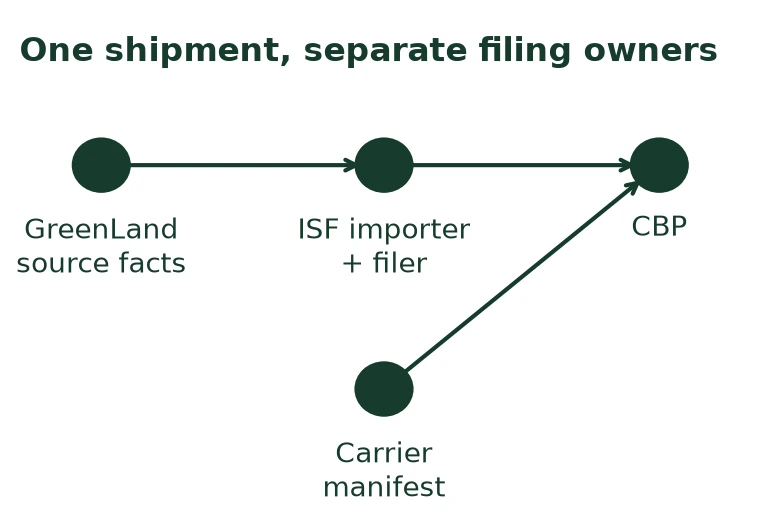
Exporter facts feed the authorised filing; the carrier submits its own transport data.
The ISF importer is the party causing the goods to arrive in the United States under the rule. In an ordinary purchase that may be the owner, purchaser or consignee, but do not select a name from an Incoterm alone. The booking, sale terms, title arrangements, customs importer identity and responsible US party need to agree. A US broker can transmit as authorized agent while the ISF importer remains responsible for the filing. Before placing the booking, record the full legal name and importer number, identify the filer, confirm its electronic route and bond arrangement, and give one contact authority to approve corrections. If the freight forwarder says it can "handle ISF," the buyer should still ask who is named as the ISF importer and which receipt will come back.
We establish an order reference that follows product, lot, container and bill through the handover. For example, keep a green-bean order separate from a strawberry order even if the same buyer negotiates both. A mixed reefer may carry several line items under one shipment; each item's manufacturer, origin and tariff treatment needs to survive the consolidation. The production record might identify a packing site, while a trading company's invoice identifies the seller. Those are different parties and should occupy the correct fields. GreenLand can prepare a proposed source and product identity packet; the US importer and broker should verify how those facts map into the filing.
ISF is a cargo security record submitted before loading, so the scheduling event is the vessel's foreign-port load, not the expected US arrival. A tender cut-off at the reefer yard is a commercial or carrier deadline, while the statutory filing clock runs against loading. The practical handover must occur earlier than the legal minimum to leave time for data review and rejection correction. A team can set an internal deadline with the carrier, but label it as an agreed working deadline rather than a CBP rule. Save the booking version and time zone used to calculate both.
The first decision receipt should be a role matrix signed off by the buyer: ISF importer, authorized filer, exporter, actual manufacturing supplier, carrier, NVOCC if present, and party that stuffs the container. Record who supplies the data, who transmits, who checks the acceptance and who revises it when information changes. Without this ownership, the exporter may send a spreadsheet believing the task is done while the filer has no bill number or authorization. We ask the purchasing team to nominate a single exception contact so a last-minute vessel roll or manufacturer change reaches the party able to act.
Build the first eight ISF fields from a controlled order
The initial eight importer elements are seller, buyer, importer of record number or foreign trade zone applicant identification number, consignee number, manufacturer or supplier, ship-to party, country of origin and commodity HTSUS number. The first four have their own 24-hour pre-loading rule. The latter four also have that filing deadline but may initially use the best available data and must be updated when more precise information becomes available, subject to the final arrival limit. 19 CFR 149.2 is more precise than a simplified statement that all ten fields must be final at the same instant. The CBP definitions for the individual elements should govern the filer's interpretation.
Build a field worksheet from the purchase order, proforma or commercial invoice, product specification, source confirmation and destination instructions. For seller and buyer, use the actual sale transaction that brings the goods to the US. A trading exporter can be seller without being the manufacturer. For importer of record and consignee numbers, ask the US responsible party and broker to verify the exact identifiers already present in customs systems. A contact name or warehouse address cannot replace an identification number. Where a number is being established, do that before the load window rather than improvising a company name as a substitute.
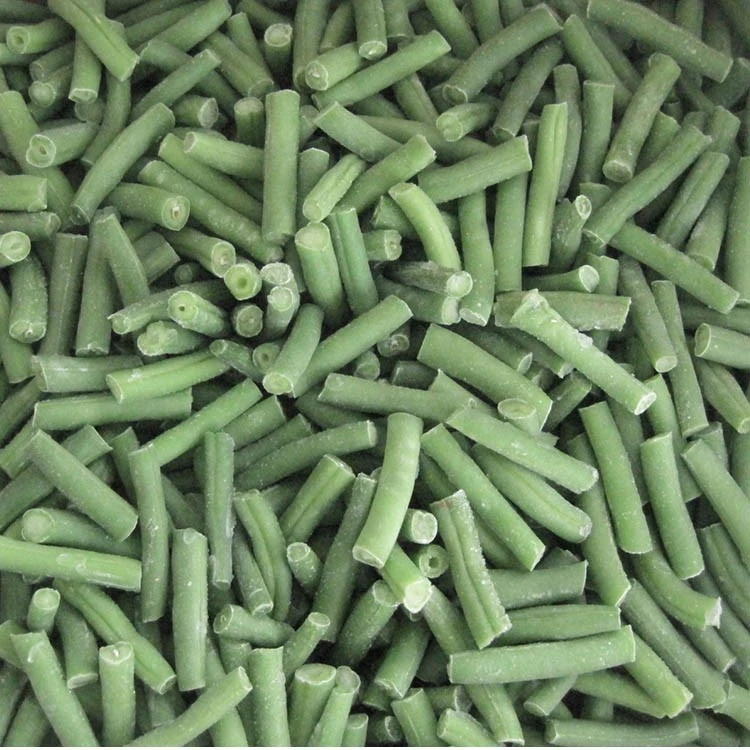
Frozen cut green beans: identify the actual form, packing and intended use in the shipment file. Product photograph; not evidence of a filing result.
Frozen cut green beans for your import programme
Tell us your destination, intended use, cut or grade, packing, quantity and preferred shipment window. We can coordinate the proposed source, sample specification and origin documents with your importer and appointed filing team. The actual lot, factory and required documents are agreed before dispatch.
View product and supply details
Request Specifications & QuoteThe manufacturer or supplier field deserves attention with frozen food. A packing label may display a brand or trading company, while an actual processing facility, approved supplier or manufacturer is relevant to the cargo. We would identify the entity that produced or supplied the specific IQF lot and provide its legal name and address for the filer's review. If raw green beans were grown at several farms, avoid asserting that each grower is the manufacturer of the packed finished food without checking the field definition. Keep farm and finished-lot traceability in the supplier file, while the filer resolves the correct ISF entry with the buyer.
For the ship-to party, document the first scheduled delivery party after US release rather than guessing from the ocean port. A final distribution customer and a cold store may be different. Country of origin must be assessed for the actual goods, not inferred from the port of loading or a Chinese invoice header. The IQF cut green beans and strawberries could require separate classification lines even in one reefer. The broker determines the HTSUS classification; a supplier's broad six-digit commercial description is a starting input, not a legal classification decision. Record the version, reviewer and basis so a later change does not leave invoice, ISF and customs entry on different codes.
As a practical control, place an evidence column beside each value: document source, date, owner, status and issue. "Confirmed" means the named owner has reconciled it with the shipment; "provisional" means the best available value is explicitly subject to update; "missing" stops handover. A blank field should not be populated from a different customer's previous shipment. We can send product form, manufacturer or supplier details, China-origin evidence and agreed shipper information early. The US importer supplies or approves the importer and consignee identity, tariff number and ship-to arrangement. The filer should return a field-level preview before transmission.
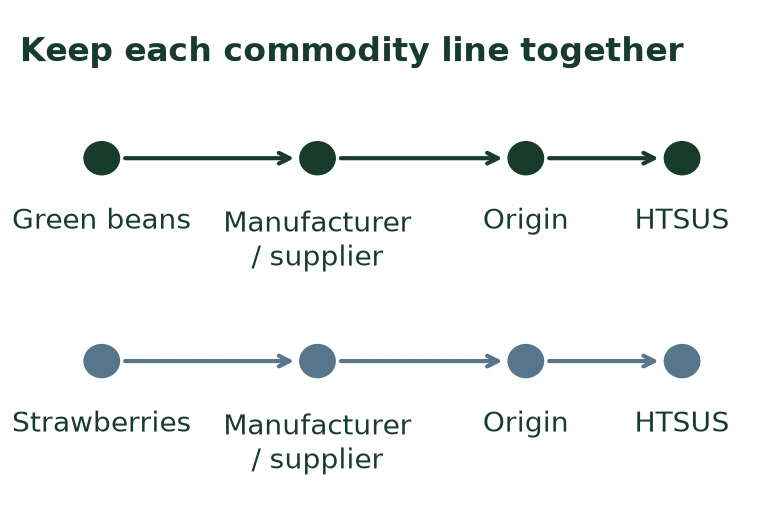
Illustrative commodity rows: manufacturer/supplier, origin and HTSUS stay linked to each food, even when the container is shared.
A useful example is a reefer with cartons of blanched cut green beans for foodservice and separate cartons of IQF whole strawberries for an industrial fruit preparation. The two foods share a container and perhaps a bill, yet their commodity descriptions, manufacturing records, use specifications and line-level tariff treatment stay distinct. The GreenLand proposal would include the cut and blanching status for beans, fruit form for strawberries, lot references, carton counts, production/packing location and anticipated load date. The importer should authorize the final security description and tariff lines. A glossy product photo can help confirm visual form but cannot establish the legal code, country of origin or ISF acceptance.
The manufacturer-or-supplier definition permits specified alternatives, including the last manufacturing/assembly/production entity or the qualifying supplier of the finished goods in the exporting country. The filer applies that definition; GreenLand should not replace an unknown entity with a marketing brand, nor insist that the ISF field can only ever be the physical factory. FDA food-manufacturer and facility-registration data serve a different purpose. Section 149.3 also requires manufacturer/supplier, origin and HTS information to be linked at commodity-line level.
| ISF element | Origin of the information | Proposed handover owner / check |
|---|---|---|
| Seller | Sale bringing the goods to the US; name and address | GreenLand and buyer reconcile actual selling entity |
| Buyer | Purchasing transaction; name and address | Buyer confirms purchasing entity, not a notify-party shortcut |
| IOR / FTZ identification | Applicable recognised customs identifier | US importer and filer validate the number |
| Consignee number(s) | Applicable recognised consignee identifier(s) | Importer / filer supply the required identifier |
| Manufacturer or supplier | Name/address satisfying §149.3(a)(5) | GreenLand supplies source facts; filer applies allowed alternatives |
| Ship-to party | First scheduled receiving facility after release | Buyer confirms actual receiving party and address |
| Country of origin | Origin for each commodity line | GreenLand supplies production/source facts; importer assesses origin |
| Commodity HTSUS | At least six digits; link with origin and manufacturer | Broker / importer approve line classification |
| Container stuffing location | Actual location(s) goods were stuffed | Loading operator supplies actual site; exporter coordinates |
| Consolidator / stuffer | Party stuffing or arranging stuffing under the definition | Forwarder / loading operator identifies responsible entity |
Separate loading deadlines from the two later fields
Container stuffing location and consolidator or stuffer make up importer elements nine and ten. Submit them as early as possible. The normal absolute limit is 24 hours before arrival at a US port, while for a voyage shorter than 24 hours to the closest US port the rule places the limit at foreign-port loading. The short-voyage provision is easy to overlook because broad ISF summaries repeat only the general 24-hour arrival phrase. The timing paragraph should sit in the shipment calendar, with the carrier's actual route and voyage duration checked by the filer. A China-origin deep-sea example will ordinarily have more lead time, yet a transshipment or changed itinerary still calls for confirmation.
The stuffing location is the place where goods are loaded into the container, not automatically the exporter's office, factory registered address or departure terminal. If cartons are stuffed at a third-party cold store, use its actual location after verification. The consolidator is the party that stuffed or arranged stuffing as defined in the rule; a freight forwarder's name appearing in correspondence does not by itself establish that role. Where a container is partly loaded at more than one location, the filer should review the actual movement and CBP guidance rather than silently using the last address. The booking party needs to collect these details from the operator controlling the loading event.
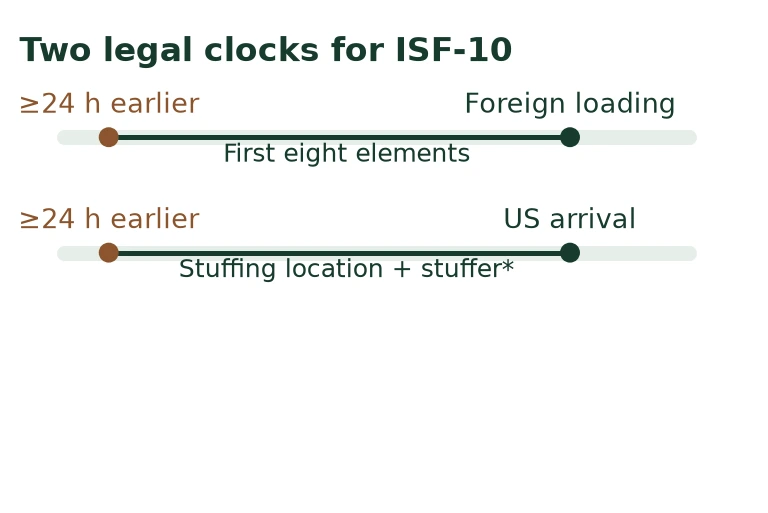
*Short voyage under 24 hours: the two stuffing elements are due upon foreign loading. Four flexible elements also require timely updates.
For frozen goods, the origin loading record should connect the physical container to the filing. Retain the reefer number, seal, stuffing date and site, product/lot/pallet count, packing list revision and temperature instruction. Those facts support checking the stuffer and location, though they are not substitutes for the electronic ISF fields. If the container changes after a refrigeration failure, the logistics coordinator should notify the importer and filer immediately; the old stuffing location may be correct while the old container and bill relationship becomes wrong. Keep the actual replacement record rather than overwriting the original evidence.
The same calendar should show four flexible fields-manufacturer/supplier, ship-to party, country of origin and commodity HTSUS number-because a best-available initial response is not permission to leave stale data in place. The filer updates when more precise information is available, and by the applicable final deadline. This differs from changing a buyer name after a sale restructuring: any ISF information that changes before US port limits triggers the broader update obligation. A document control log should distinguish which original field changed, when the team learned it, when the filer amended, and the new CBP acknowledgment.
Calculate working deadlines backward from the loading appointment and the first US arrival using time zones. If the carrier shifts the vessel, re-evaluate both rather than carrying over the first calendar entry. If the freight moves under a different bill following a roll, the revised bill needs matching attention even if all food facts are unchanged. We recommend an earlier internal freeze for the eight fields and a later monitored check for the two stuffing fields. The internal freeze is a buffer agreed with the broker and carrier, not a federal deadline; it helps the buyer secure a filing receipt before the reefer misses a vessel.
The completion receipt for this stage is a time-stamped acceptance from the electronic filer plus a status log for provisional values. A supplier email saying "ISF sent" only proves that information was shared with an intermediary. Ask for the accepted filing reference, field preview or record, bill association and any rejection message. If a transmission is rejected, the owner must repair and retransmit within the applicable clock. The goods being physically loaded does not cure a missing advance filing.
Match the lowest bill and carrier records
The ISF has to connect to the carrier's manifest at the appropriate lowest bill of lading level. In a direct carrier bill there may be no separate house bill; with an NVOCC or forwarder, a master ocean bill and one or more house bills can coexist. The buyer should ask which bill number will appear in the advance manifest, which is the lowest matching bill for the cargo and when the number becomes stable. A mere booking reference may not perform this match. CBP's ISF FAQ explains the lowest bill relationship.
Keep a small bill map: purchase order, GreenLand shipment reference, container number, master bill, each house bill, actual filing reference and entry reference when later assigned. If two customers share a consolidated reefer, do not attach one customer's ISF to the other's house bill because the container and vessel coincide. If green beans and strawberries are sold under one house bill to the same buyer, preserve the two article lines in the associated filing and invoice. The map should be reviewed against the carrier or NVOCC manifest preview and updated when the final bill is issued.
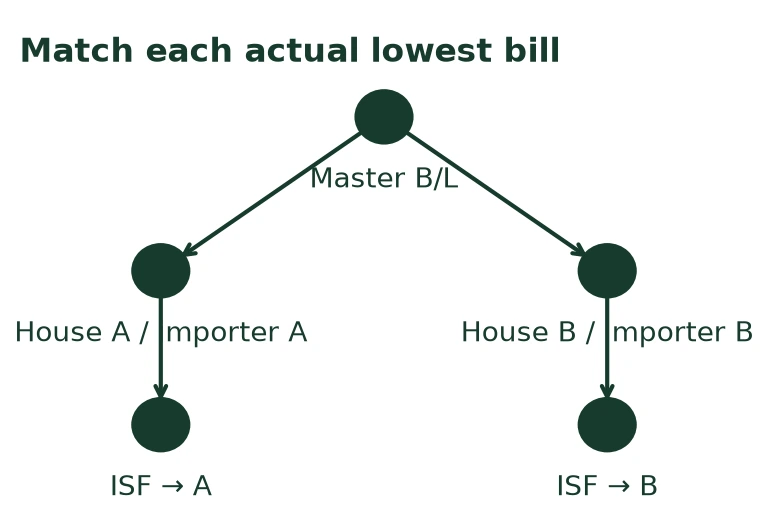
Illustrative different-importer example. A single ISF may cover multiple bills only under the applicable same-importer, same-shipment and same-vessel/voyage conditions.
A single ISF may cover multiple bills when they belong to the same importer, shipment and vessel/voyage under CBP's conditions. The lowest-bill matching requirement therefore does not impose a universal one-house-bill/one-ISF rule. The filer checks the allowed grouping and retains the bill associations. The diagram below illustrates different importers sharing a master movement, for which their identities remain separate. Do not bundle unrelated FROB, IE or T&E shipments under a carrier's identity merely because that carrier is their ISF importer.
The "plus two" in the familiar name belong to the carrier: vessel stow plan and container status messages. They are not two extra fields that GreenLand must place on the importer's ISF spreadsheet. The carrier has separate transmission duties under US regulations. A logistics coordinator can request confirmation that the carrier or NVOCC has the correct container, voyage and bill data, but should not claim to have filed the carrier plan from a supplier email. Stowage and movement information may be updated during the voyage; the buyer's practical control is to keep its importer-side record aligned with the operative booking and manifest.
The carrier's two clocks are separate as well. Under 19 CFR 4.7c, the vessel stow plan is due within 48 hours after departure from the last foreign port; for a voyage shorter than 48 hours, before arrival at the first US port. Under 4.7d, reportable container-status messages that the carrier creates or collects in its equipment system are due within 24 hours after entry into that system. The rule does not require the carrier to create messages it does not otherwise create or collect.
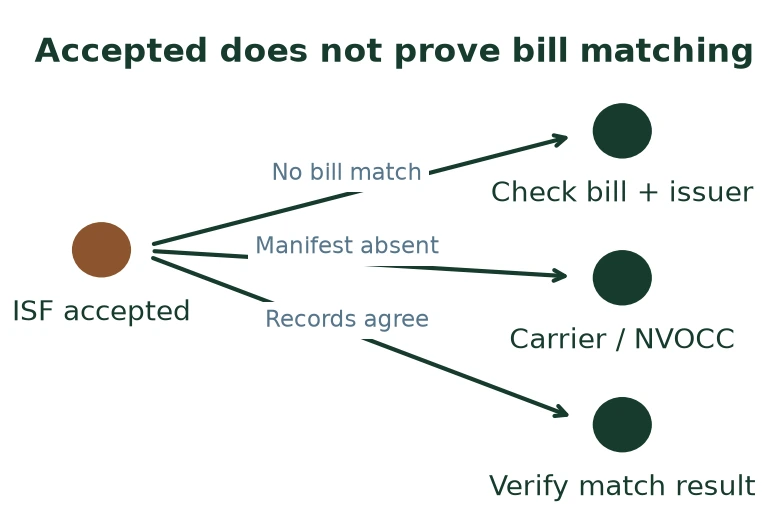
Check the actual lowest bill, its identifier/type and accepted manifest record; preserve the subsequent match result.
The critical points are the container gate-in, vessel load, any transshipment and first US entry. A vessel roll can retain the same bill number or create a replacement. The filer should evaluate whether the ISF needs amendment based on the real data and bill association rather than automatically filing a duplicate. Duplicate filings against an incorrect lowest bill can be harder to reconcile than a controlled amendment. Where a house bill has been split, identify which cartons and lots moved to each new bill, and ask the filer how each security record should attach. A cold-chain note alone is insufficient because customs systems match electronic transport identities.
Require a positive receipt after the bill match is confirmed: the filer reports that CBP accepted the ISF and that the bill identifier used matches the manifest plan. Keep the carrier or NVOCC confirmation of the bill and vessel. If a mismatch is discovered after loading, send the complete before/after bill map, affected lines, container and voyage to the filer at once. Note the time and correction acknowledgment. The importer remains responsible for resolving the security filing even when the carrier generated the wrong bill number.
An accepted ISF can still show that no matching bill is on file. Check the transmitted bill type and full identifier, including the appropriate issuer/carrier code, then compare the actual lowest house bill or direct carrier bill with the carrier/NVOCC manifest record. Confirm that the manifest has actually been transmitted and accepted, and ask the filer to review the returned match/disposition status. A booking number, container number or master bill must not be substituted merely to make a dashboard turn green. Retain the mismatch response, carrier confirmation, corrected association where needed and subsequent match result. The CBP ISF FAQ is the official operational reference.
Handover IQF green beans and strawberries without losing lot identity
We would begin the order discussion with two clear product files. For cut green beans, record the agreed cut range, blanching status, additive status, pack size, carton marking, intended cooking use and batch definition. For whole frozen strawberries, record whole or cut form, size or grade direction, pack and the buyer's intended further-processing or ready-to-use route. These commercial details support a truthful goods description and later FDA work; they do not by themselves determine ISF classification or food admissibility. See the broader US frozen-produce import guide for the full regulatory sequence.
The first handover packet should name the actual seller, buyer, manufacturer or supplier, country of origin, intended ship-to party and the US importer's contact. Add a draft invoice, packing list, product specification, booking, expected foreign load date and expected first US arrival. Mark which entries require importer or broker confirmation. GreenLand can gather source and loading records from the participating production and logistics operators for the proposed shipment. We should not label an unverified production site or document as approved simply because it appeared on an earlier order. The buyer gives the authorized filer the exact version and approves the filed values.

Whole frozen strawberries: identify the actual form, packing and intended use in the shipment file. Product photograph; not evidence of a filing result.
At packing, reconcile each pallet and carton count to product lot and purchase order before the container is sealed. Record any short load, replacement lot or changed form. A bean lot from a different producer may change the manufacturer/supplier field; a strawberry order redirected to another US cold store may change the ship-to party. A different shipper's invoice may change the seller. These are filing issues as well as commercial changes, so the loading team must route them to the importer and filer before the applicable deadline. A packing list that changes after filing needs an explicit security-data impact review; do not assume every packing adjustment affects an ISF field, but do not assume none do.
The reefer handover also needs physical controls. Confirm container suitability, clean and dry condition, set point according to the agreed frozen specification, operating condition, loading temperature evidence as agreed, airflow space, seal and final count. Keep responsibility for the cold-chain decision with the named parties and the contract. These controls do not appear as a substitute for ISF, but they prevent a correct security filing from being attached to a physically different load. An invoice listing 1,000 cartons while 950 are sealed requires a corrected shipment file and a check of all downstream filings.
The importer should compare the ISF field preview to the latest buyer-approved packet, not just scan it for spelling. Is the selling entity the one on the commercial transaction? Does the manufacturer or supplier describe the lot actually loaded? Is the country of origin supported for each article? Do tariff lines distinguish the bean and strawberry products? Does the ship-to party correspond to the planned first delivery after release? Does the lowest bill belong to this cargo? Each answer has a document and reviewer. We would answer origin-side questions promptly; the broker and importer control the US filing decision.
The handover is complete when the buyer holds the accepted ISF receipt, final field version, bill map, stuffing details and list of any still-provisional elements with owners and dates. A later change to destination, goods or vessel reopens the relevant entries. Keep this packet adjacent to the commercial invoice, packing list, temperature and seal records, and the separate FDA and CBP entry file. That arrangement lets the importer respond to a hold without searching across unrelated email chains.
Amend or withdraw the ISF when the shipment changes
Under 19 CFR 149.2(d), the submitting party must update the ISF when information changes or more accurate information becomes available before the goods enter the limits of a US port. This is an active monitoring duty after the first acceptance. The rule also requires withdrawal with a reason if the goods are no longer intended for US import. Withdrawal is a specific ISF branch; it is not the default response to a routine vessel roll, and it should not be copied into a different jurisdiction's ENS process. The filer should choose the correct electronic action on the actual shipment facts.
Changes worth escalating include a new manufacturer/supplier, a different US buyer or consignee, revised ship-to destination, corrected country of origin, changed HTSUS classification, new stuffing site, different consolidator and changed bill association. The exporter may learn first of a production-site substitution; the carrier may learn first of a vessel roll; the buyer may learn first of a warehouse change. Give each party a short escalation path to the ISF filer. An amendment request needs the old value, new value, effective shipment, reason, source document and time the change became known.
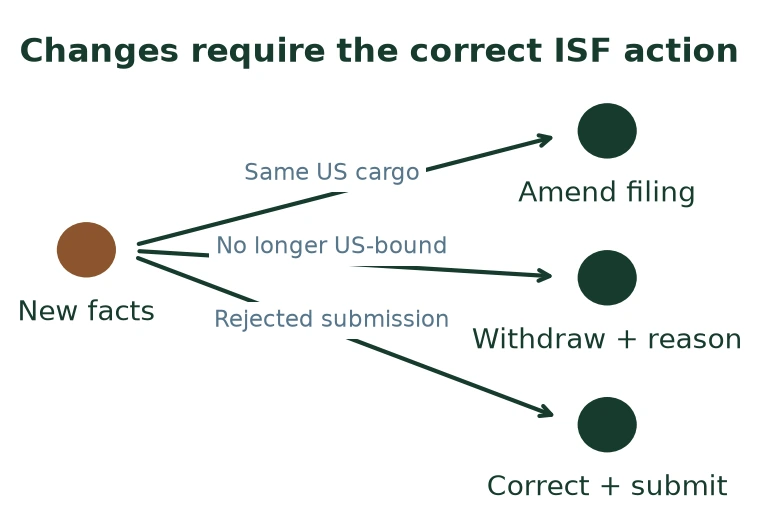
A vessel roll needs a data and bill review; it does not automatically require withdrawal.
If the buyer cancels the US order and the goods are redirected to another country, notify the filer immediately so it can assess and transmit the required withdrawal with its reason. Keep the cancellation instruction, carrier routing change and CBP response. If only part of a consolidated shipment is redirected, do not cancel all cargo blindly; map the affected house bill and line items first. Conversely, a nominal US delivery address left on an invoice does not override actual diversion. The importer should reconcile the new commercial plan with the port and manifest records before instructing a change.
When an electronic filing is rejected, distinguish a rejected initial transmission from an accepted ISF that later needs an amendment. The former needs a corrected submission that is actually accepted; the latter needs the proper update. A broker's dashboard may show "sent" before CBP acceptance. Ask for the acknowledgment type and time, then preserve any error code and resolution. If the loading deadline is close, the importer and carrier must decide whether the container can still meet a legally compliant booking. We can furnish missing origin documents, but cannot declare the filing valid on their behalf.
At arrival, maintain the update log even after the final stuffing fields have been sent. The end of the flexible timing for four elements does not remove the obligation to correct other changed data before US port limits. Record the final accepted version so a later FDA or CBP query can be answered against the shipment as imported. A customs entry correction is a different task and may involve different systems and deadlines; the broker should review both where the same source change affects each.
A late, inaccurate, incomplete or missing ISF can expose the responsible party to liquidated-damages claims; CBP's published guidance discusses US$5,000 claims for specified violations. This is not an automatic filing charge or a guaranteed fixed fine on every late container. CBP's liquidated-damages guidance addresses circumstances and mitigation. Escalate a missed clock immediately to the importer/filer and carrier, preserve the true timeline, and follow their lawful correction and cargo-handling instructions. Do not backdate a worksheet or describe a late acceptance as timely.
Keep filing receipts, FDA tasks and arrival release distinct
ISF is one of several decisions in a US frozen-food import. FDA Prior Notice concerns the imported food article and its arrival. The FSVP importer has a supplier-verification responsibility, while a qualifying foreign food facility has registration and US-agent obligations. The customs importer of record arranges the CBP identity, bond and entry. The carrier controls the transport document and release process. These identities can overlap in one organization, but the authority and receipt for one step do not satisfy another. The FDA FSVP summary describes the distinct food-safety importer role.
For the green-bean and strawberry reefer, build an arrival board with four rows: accepted ISF and bill match; FDA Prior Notice confirmation for each applicable food article; customs entry and bond status; FDA admissibility and any examination or hold, followed by carrier and terminal release. Add APHIS or other commodity-specific conditions only after a current product-and-origin check. The buyer should not use a generic phrase such as "FDA cleared" to describe an ISF acceptance. A carrier release order likewise does not prove that a food-safety hold is removed.
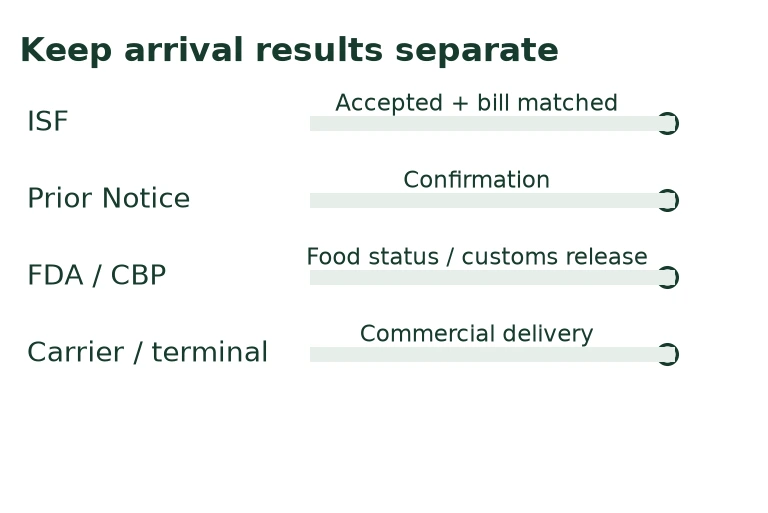
Each actor returns its own result. Security acceptance is not permission to deliver food.
Hold a pre-load review with the importer, broker/filer, freight forwarder and GreenLand order coordinator. The agenda is short but factual: final goods and lot identities, eight early fields, stuffing owner and location, lowest bill, load time, first arrival, any provisional values, and where receipts will be sent. The importer authorizes filing; the filer returns the acceptance; GreenLand supplies and corrects origin-side evidence within its control; the carrier confirms transport data. If a fact is unresolved, name the owner and the latest safe decision point. A meeting note is a handover tool, not a substitute for the electronic acceptance.
At shipment release from origin, archive the versioned purchase order, approved specification, invoice, packing list, source and loading record, final ISF worksheet, filer acceptance, amendment history, lowest-bill map and current reefer details. At arrival, add separate FDA and customs outcomes. Retain the dates and correspondences so a later discrepancy can be traced to its source. Avoid publishing any actual customer's importer number, facility record or lot identifier in marketing examples; the illustrated workflow can show placeholders and the required decision without exposing private records.
For a sourcing enquiry, tell us whether you need cut green beans, whole or processed strawberries, or another frozen item; give the intended use, destination, pack, quantity, timing and required origin-side documents. We can work through the proposed product and shipment file with your nominated importer and filer. They will validate the current US requirements and make the filings. The useful outcome before loading is a coherent set of goods, parties, dates and accepted electronic receipts that still matches the reefer actually sailing.
- Importer names its authorised filer and confirms the actual ocean movement and ISF branch.
- GreenLand coordinates origin product/source facts; importer and logistics owners supply their fields and lowest-bill map.
- Filer transmits by the applicable clocks and returns acceptance, match and any provisional-data status.
- Each change is escalated to that filer; separate food, customs and commercial releases follow at arrival.
Use the existing order worksheets
Use T10 to assign each field or document to its provider, reviewer, due time and returned reference. T12 records changed source, product or transport facts; T11 preserves arrival evidence. Keep the legal deadline separate from the agreed earlier handover.
Build your frozen food order with GreenLand-food
GreenLand-food is a professional frozen food supplier and manufacturer in China, providing factory-direct wholesale supply for importers, food manufacturers and foodservice programmes.
Send your product form, specification, packing, quantity, application, destination, private-label needs and requested documents. We will organise the product and order requirements with your purchasing and quality teams.