


When Are Georgia Peaches in Season? Harvest Windows and Buyer Implications
Sep 27, 2026
Leave a message

That distinction matters to a food buyer as much as it does to a traveler seeking a roadside stand. A menu promotion, retail pack, or processor intake calendar needs a named origin, crop year, grade, quantity, and confirmed shipping schedule. A frozen peach program has another clock: stock can be sold outside the fresh harvest season, but the words "Georgia peach" still require evidence of the lot's origin. GreenLand-food offers frozen peach products; its public product pages do not establish that those peaches are Georgia grown. We would confirm origin separately before making such a claim.
The practical Georgia peach season window
The straightforward answer is early May to mid-August for commercial production in Georgia. This is the broad span in UGA Extension's commercial harvest guidance, not a uniform peak across every growing area. Georgia Grown's consumer listing emphasizes a somewhat narrower retail window, from mid-May through early August. Both can be sensible because commercial first and last picks do not necessarily become a regular supermarket display. A date range should therefore say what it describes: field harvest, farm-stand sales, store promotion, or a specific supply contract.
Within that span, availability generally builds as successive cultivars come in. The first early varieties can arrive in smaller or more localized volumes. Midseason programs may support wider distribution. Late varieties extend the offering, but they do not guarantee a full range of sizes and grades at the end of summer. An orchard may have fruit in one week and none the next while changing between cultivars. When a buyer asks "Are Georgia peaches in season in June?" the useful next question is which grade, volume, location, and delivery week are required.
A single annual calendar can conceal real variation. A warm spring may advance maturity; a cool period may slow it. Storms can affect packout, while hail or disease pressure can alter the share of fruit that meets a fresh grade. The Georgia industry also operates through multiple orchards and packing programs. A published statewide season does not tell us the size of a particular lot, the strength of its eating quality, or whether it will survive a long transport chain. Confirm the actual season with the seller responsible for the order.
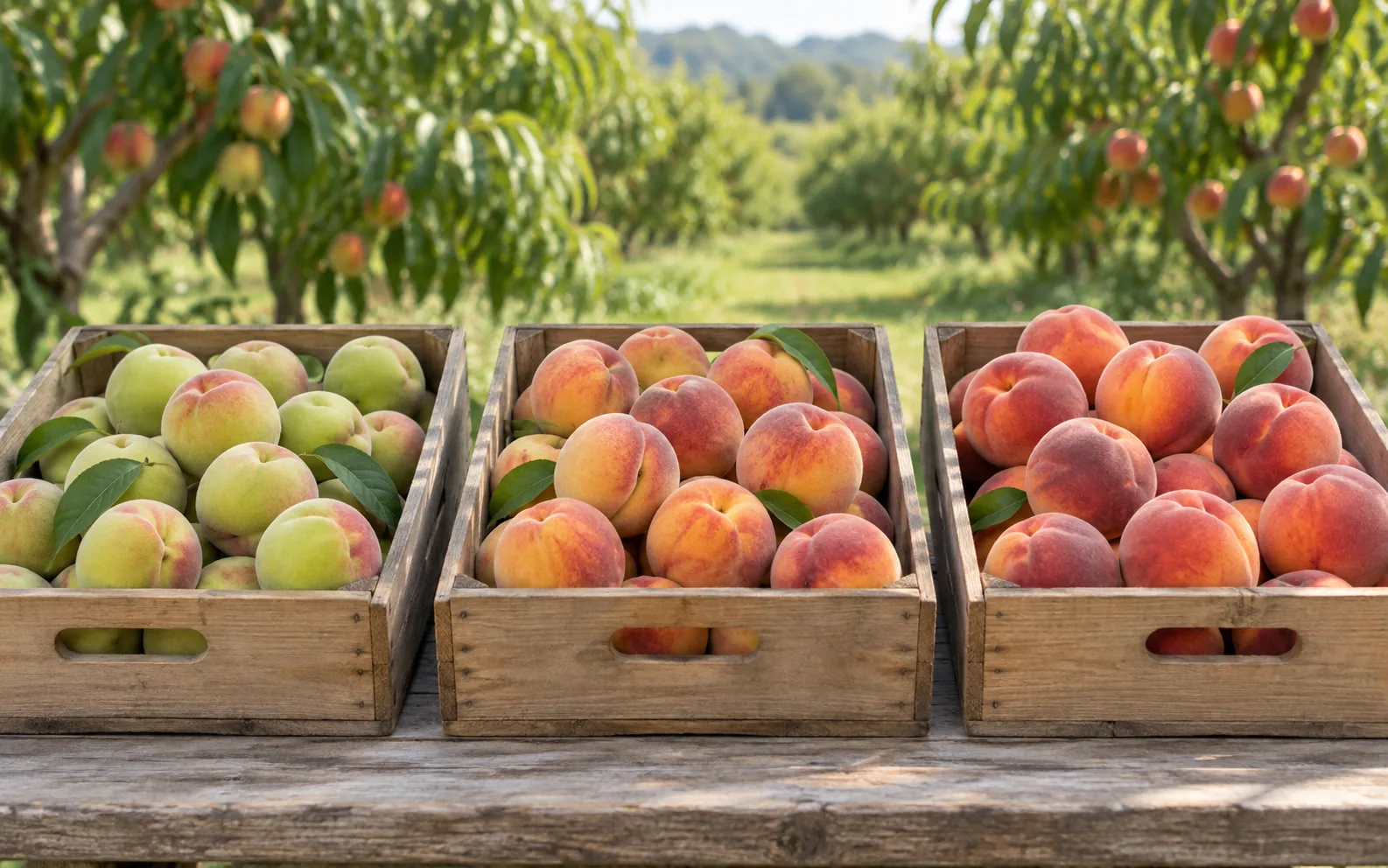
Peach crates representing early, middle and late harvest stages
For consumer guidance, it is fair to say late spring through summer and to check a farm's current notice. For a procurement plan, write a rolling forecast with review points. We would place early-season promotional dates behind confirmation of packout, then keep substitute origin or menu language ready if the planned quantity is unavailable. Retailers should be especially careful about prominent origin signs: a store may carry peaches throughout summer from several states, but that does not make every peach in the display a Georgia peach.
The phrase "peak season" needs similar care. It can mean best local availability, strongest price competition, or best eating quality, and those are not always the same date. Variety and ripening management affect flavor; heavy volumes do not automatically make each lot ripe enough for a premium sliced-fruit application. If the food will be baked, pureed, or frozen, different maturity targets may be acceptable from those for a fresh hand fruit. Buyers should specify the end use before assuming the middle of the calendar is the ideal purchase week.
Cultivars and growing areas move the calendar
Peaches are not one crop that all ripens at once. Early, middle, and late cultivars have different harvest sequences. UGA's home-garden cultivar guide illustrates this spread, and its commercial handling guidance places harvest timing within the broader production window. Even within a named cultivar, local conditions and management can shift the exact picking date. A date that was correct last year for one orchard is a starting estimate this year, not a release schedule.
Growing area adds another layer. Orchard site, soil, elevation, exposure, and local weather influence development. Some orchards may be ready before others, and the first field pick does not necessarily produce the sizes or volumes required by a processor. During transitions, a supplier may offer one cultivar for a few days and then move to another. If the intended product depends on a consistent eating texture or slice appearance, that handover deserves attention. A broad "Georgia peach" specification may include several cultivars with different performance.
For direct procurement, ask the packer which cultivars and blocks are expected for the requested weeks. The answer does not have to become a complicated agronomy lesson, but it should distinguish a forecast from a committed allocation. Request estimated start and finish, anticipated packout by size and grade, harvest maturity target, and how the supplier will report changes. If a branded food promises a particular fresh-origin season, build a review date into the packaging and promotion plan so the claim can be checked before the campaign goes live.
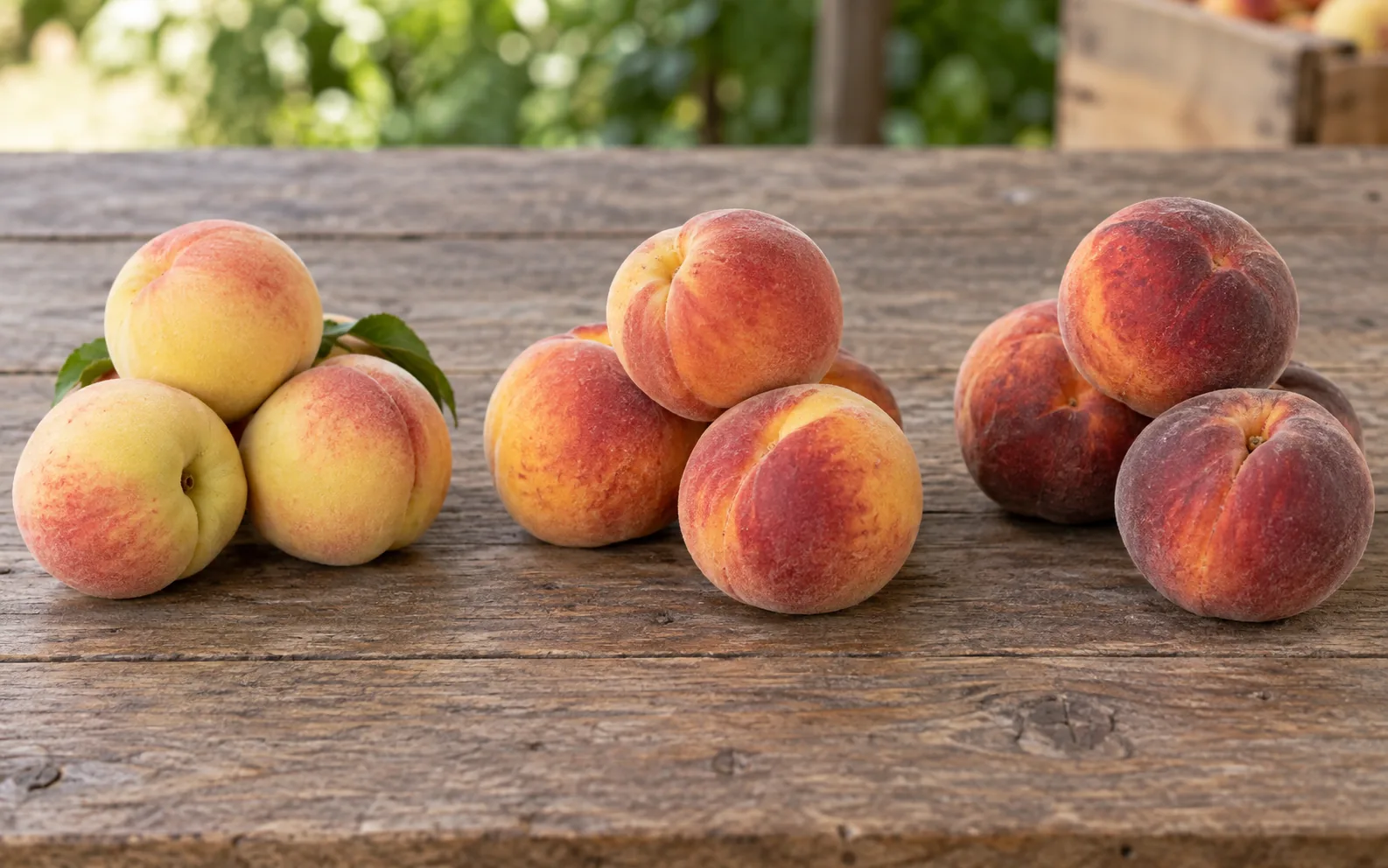
Three illustrative groups of peaches with differing appearance
Selection should follow application. A whole-fruit display needs attractive shape, finish, and sound handling. A slice program needs flesh that cuts cleanly at the chosen maturity and resists excessive bruising. Puree production may accept different external cosmetics but still needs flavor, color, usable yield, and food-safety controls. For freezing, the processor needs to know how the fruit behaves during preparation, freezing, storage, and thawing. The point is not that one cultivar is universally best; it is that cultivar and ripeness change the result a buyer will pay for.
It helps to view the calendar as a sequence of decision gates. Before season, agree specifications and a provisional forecast. During early harvest, check actual fruit maturity and volume. At each cultivar change, recheck the sample against the approved sensory and processing benchmark. Late in the window, verify supply rather than extending a sales claim by habit. This rhythm uses the season window without pretending it is a fixed railway timetable.
If a farm advertises pick-your-own dates, those dates serve a different purpose from bulk procurement. Local visitors can choose a day when fruit is available in the field; a manufacturer needs a repeatable intake volume and the right documentation. A popular orchard guide is useful for understanding consumer experience, but production scheduling should rely on the supplier responsible for the commercial lot. Mixing those two kinds of sources is a common way to turn a sensible seasonal article into a misleading buying calendar.
Harvest maturity changes the shipping decision
Harvest date alone cannot tell a buyer whether peaches will arrive in good condition. Fruit maturity at picking, firmness, temperature management, packaging, journey length, and handling all affect the outcome. A peach intended for a nearby farm stand may be picked at a different stage from one that must travel across a region and remain saleable for several days. Neither is necessarily wrong. Each must be judged against the route and intended eating or processing date.
UGA's harvest and postharvest guidance emphasizes appropriate maturity and careful handling because peaches are perishable. A commercial buyer should agree how ripeness will be assessed at release and receipt. Color, firmness, size, defects, and temperature can all be specified, but the acceptance method must be clear enough that two teams can apply it consistently. An attractive outside color does not replace a representative cut test when internal maturity or flesh condition matters to the application.
For fresh sales, the handoff between orchard, packing house, carrier, warehouse, and store is a chain of quality decisions. Delay or rough handling can erase the benefit of a well-timed harvest. A buyer should ask when fruit was packed, what temperature management is expected, what shelf-life assumptions underlie the offer, and how damage is recorded on arrival. Those questions are more useful than repeating the word "fresh." If the promotion depends on excellent eating quality, conduct a small arrival sample and, where relevant, a ripening test under the same conditions the customer will experience.
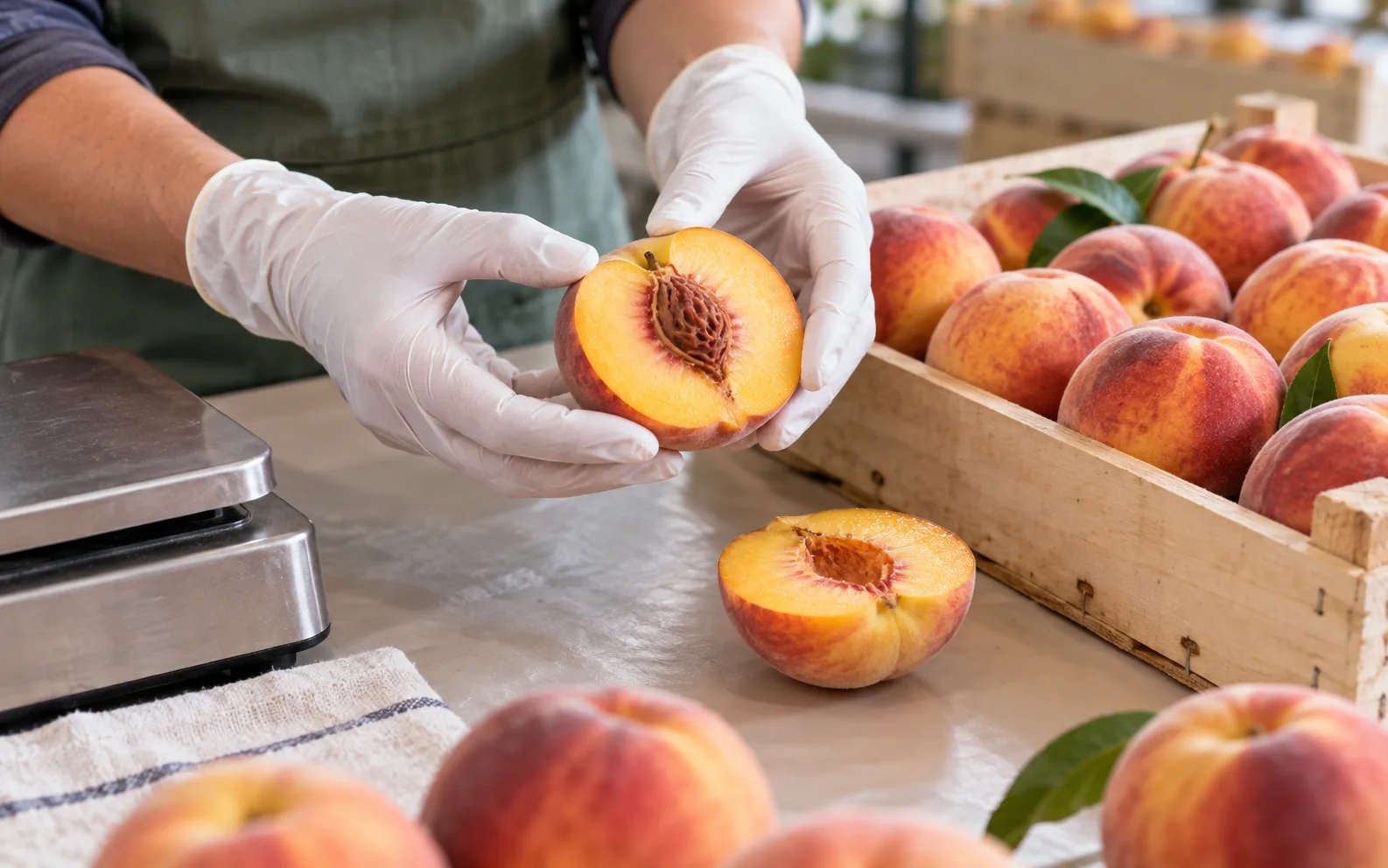
Peach cut open for maturity inspection at a packing table
For processing, the balance changes. A firm peach can be easier to slice, but excessive immaturity may leave a weak flavor and poor color. A softer lot may deliver aroma but lose more usable flesh during peeling and cutting. Run a material-balance trial that records incoming weight, trim, cut yield, defects, and finished product yield. This reveals the true cost of a lot. A cheaper pallet can become expensive if its usable output is low or its variation slows the line.
Season planning should also allow for grade diversion. A weather event may reduce cosmetic grade without making every fruit unsuitable for processing. Conversely, a lot that looks acceptable from a distance may fail a texture or flavor benchmark. The buyer and supplier can agree distinct grades for fresh display, frozen slices, puree, or other uses, with appropriate safety and quality controls. Clear grade language protects both sides when harvest conditions change during the season.
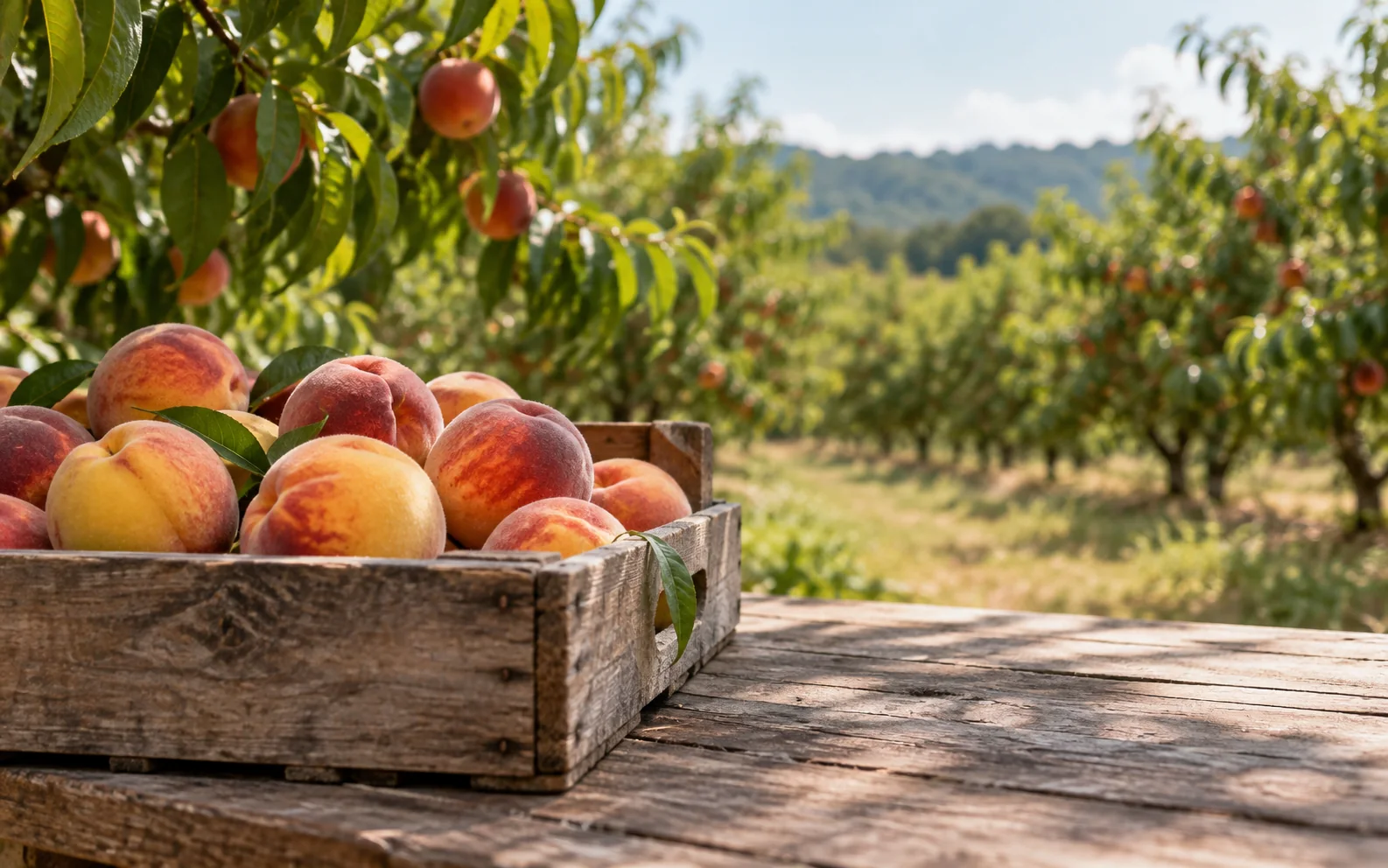
The picture of peaches in an orchard at the top of this article is an illustrative scene, not evidence of a particular origin or crop year. Origin evidence comes from the commercial records linked to a lot. This may sound like a fine distinction, but it matters in product development: strong images can make an unverified seasonal claim feel more certain than it is. Keep the visual story and the purchase evidence in separate places, then connect them only when the documents justify it.
What harvest season means for freezing and stock
Frozen peaches make a seasonal fruit usable in applications outside the fresh picking months. That does not mean every frozen peach pack comes from the most recent harvest, from Georgia, or from a specific cultivar. Freezing changes the inventory timetable, while origin and crop-year facts remain tied to the lot. A food manufacturer planning a year-round peach bakery filling can buy to a stable frozen specification even when fresh Georgia fruit is unavailable, provided the origin claims on the finished product match the actual supply.
The processing route affects the buyer's options. Fruit may be sorted, peeled or left with skin, pitted, cut into halves, slices, or dices, packed, and frozen. The exact process depends on the product offered. Each decision affects appearance and yield after thawing. A large half can be useful for a bakery or further cutting; a small dice may suit a filling; a puree program has different priorities. We inspect the published GreenLand-food peach forms as examples of frozen peach supply, not as proof of Georgia sourcing or of one processing method for every lot.
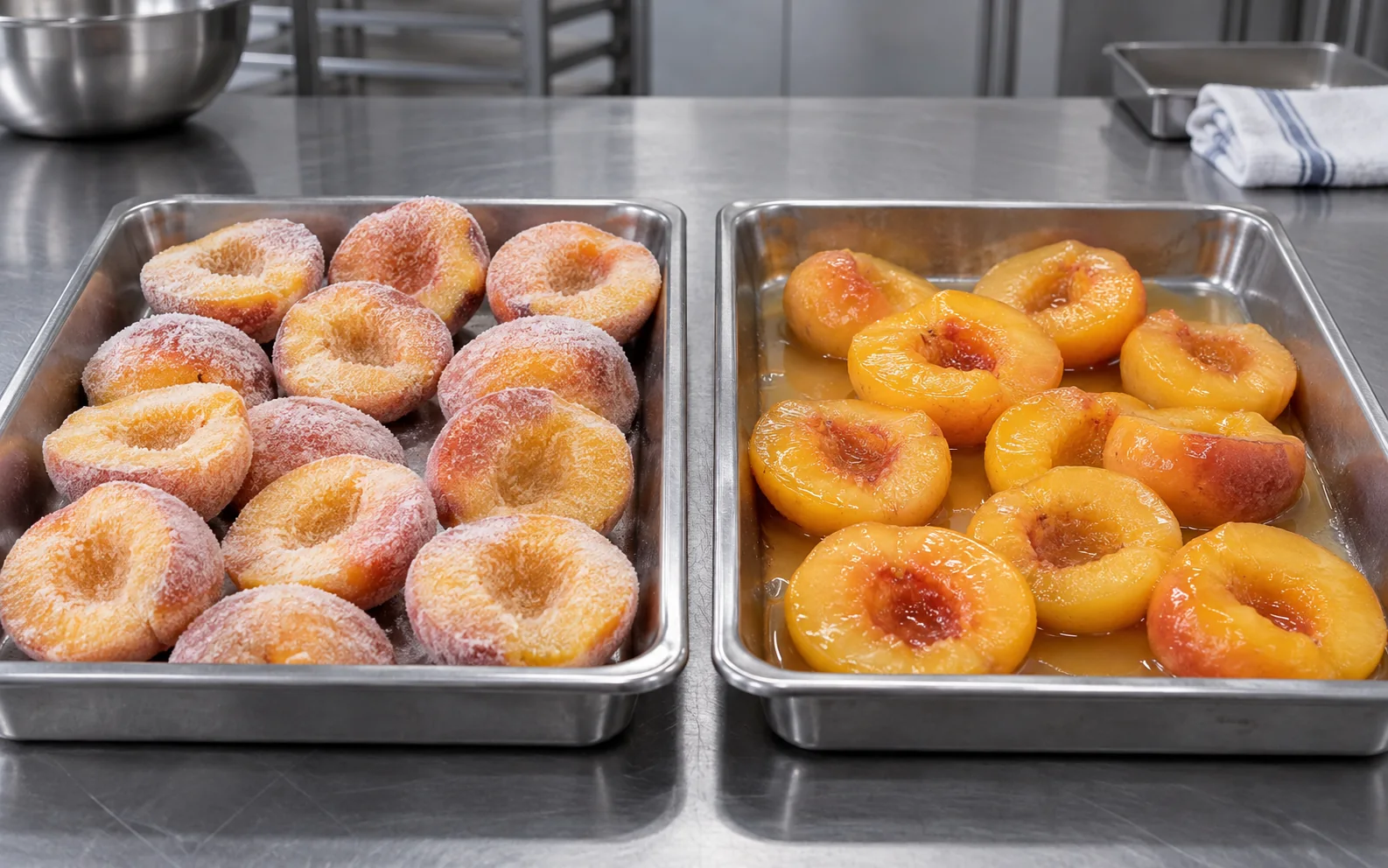
Illustrative frozen and thawed peach halves side by side
Frozen fruit brings a different quality test from fresh fruit. Inspect the pack condition and lot coding, then check color, cut distribution, ice or clumping, broken pieces, and aroma. Thaw a measured sample using the intended process and record drained fruit weight and liquid release. Cook or bake it in the target formula. A peach that tastes appealing after thawing might still release too much liquid in a pastry. Conversely, a somewhat softer frozen piece may work well in a cooked filling where fresh display firmness is irrelevant.
Inventory planning should include volume and consistency, not just the existence of stock. Ask what quantity is available in the needed cut and pack, whether it is a regular offer, how lots are rotated, and whether the approved specification can be repeated. If an origin-specific program is planned, request confirmation of origin, crop year, and traceability for each lot rather than assuming that a frozen pack inherits the origin of the article's seasonal subject. If the fruit is destined for export, confirm destination documentation and labeling needs before artwork is printed.
Frozen-pack photographs deserve a narrow reading. They can help a buyer identify whether a supplier discusses halves, pieces, or another format, but they do not measure the contents of a future shipment. Photograph lighting can make the peach color look warmer or more uniform than a representative sample. The right visual approval is a standard image made from the actual candidate lot under repeatable lighting, paired with a thawed and cooked trial. Product imagery is useful context, not a substitute for sample selection and acceptance limits.

Frozen peach halves photographed on the GreenLand product page
This is where the fresh harvest calendar and frozen purchasing calendar meet. A processor may schedule raw intake during the crop window, then release finished frozen stock across the year. A buyer who needs a defined Georgia-origin frozen lot should discuss that requirement before or during sourcing, when material and records can be segregated as needed. A buyer who simply needs reliable peach pieces has more options, but still needs to approve flavor, cut, yield, and cold-chain condition. Both decisions are valid; they answer different product promises.
Using frozen peach can reduce dependence on day-to-day fresh market arrivals for a foodservice or industrial recipe. It does not eliminate quality variation or guarantee a fixed texture after thawing. The right response is an application test and a written acceptance sample. We would compare several lots if available, cook them in the target system, and keep records of the lot that achieved the desired result. The season tells us when fruit may be harvested; the specification tells us what arrives in the factory.
Confirm a specific purchase year and origin
When a purchase order names Georgia, the buyer should be able to follow that statement to a lot-level record. Ask for the origin declaration, supplier and packer identity, relevant production or packing record, crop year where required, and traceability through any freezing or repacking step. The exact document set depends on the destination market and the claim. A broad website page or a photograph of an orchard cannot replace it. The same principle applies if "Georgia peaches" appears in packaging, menu copy, or a promotion.
Start the request with the product's intended use and form. State fresh whole fruit, frozen halves, slices, dices, or another agreed format; pack size; quantity; delivery window; target maturity or finished texture; and any origin requirement. Then ask the supplier to distinguish what is available now from what is forecast. A confirmed order should specify tolerance for substitutions. If the exact origin is unavailable, the buyer may accept another origin after a new sensory and labeling review, or may decline the substitution. Silence should not make that decision.
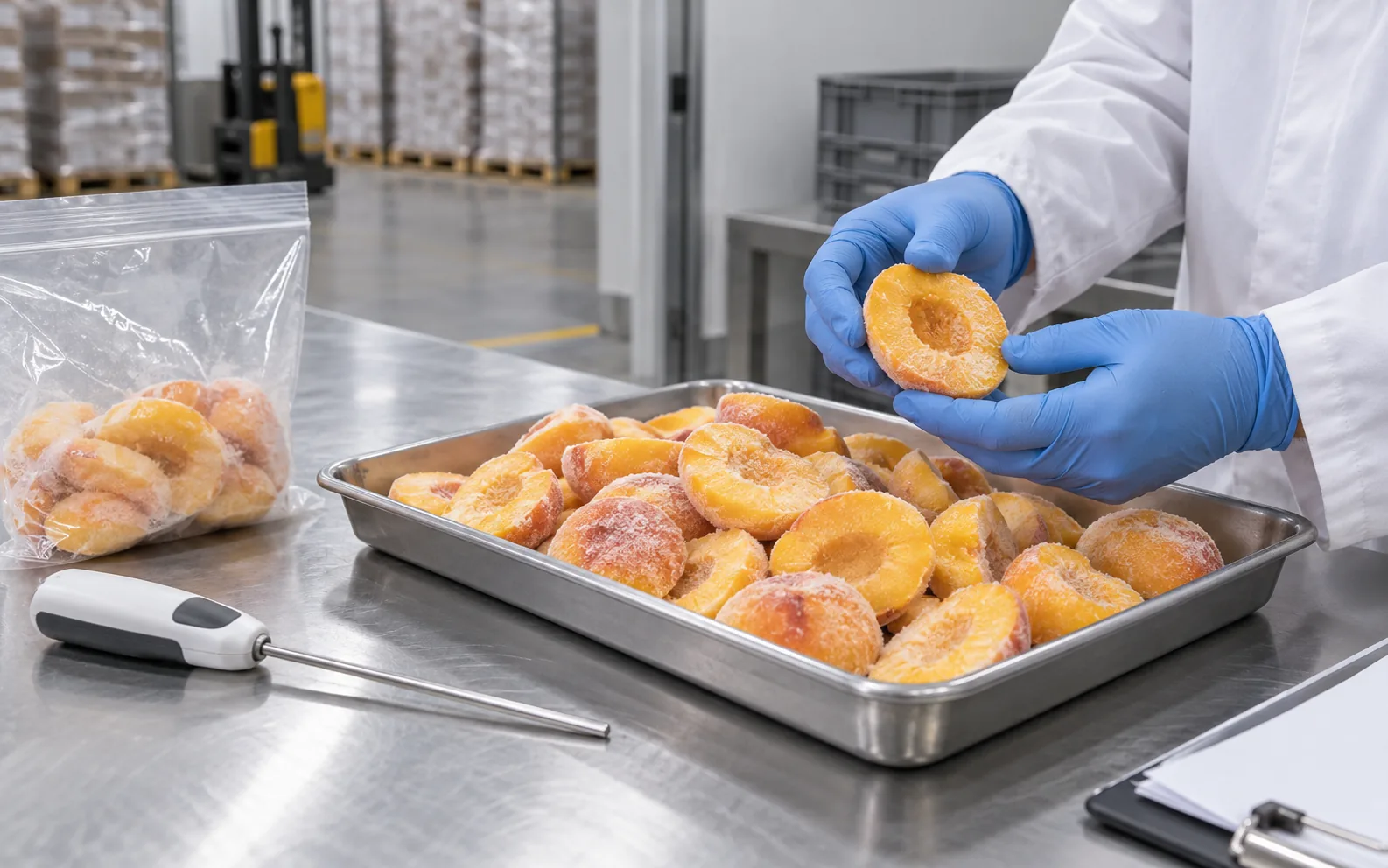
Frozen peach halves inspected at a receiving table
At receipt, connect the physical delivery to the approved offer. Check lot marks, documents, pack integrity, temperature condition, and a representative quality sample. For frozen fruit, take the sample through the actual thawing and production step. For fresh fruit, examine arrival condition and expected ripening behavior. Record exceptions promptly and preserve evidence. A calendar article can help the buying team know when to ask these questions, but it cannot perform receipt approval for them.
Make the records usable by people who were not part of the first negotiation. A receiving checklist can name the approved lot or specification revision, the expected pack, the sample method, and the person who decides on a hold or release. A product developer can attach photographs and test results from the approved peach sample. Purchasing can then compare the next shipment with a real benchmark instead of relying on memory. This modest discipline is particularly valuable when a promotional fresh program switches cultivars or a frozen line changes production lots without changing its outer carton.
Price comparisons should include usable yield and program risk. An early-season premium lot may be worthwhile for a short, high-visibility fresh promotion. A frozen program may deliver a more stable intake price and simpler preparation for a year-round product. Neither conclusion follows automatically from the word "seasonal." Compare delivered cost, trim loss, processing labor, waste, required storage, and the value of the promised origin or eating quality. The correct answer depends on the finished food and its customer.

Frozen peach pieces photographed on the GreenLand product page
GreenLand-food can discuss frozen peach forms and a suitable sample for an industrial, foodservice, or private-label application. We would confirm the current specification, available lot, packing, destination documents, and any requested origin claim before quoting it as part of a finished product. If the project requires Georgia-origin peaches, say so at the beginning; the public GreenLand-food pages reviewed here do not make that promise. If origin is flexible, focus the trial on cut, color, flavor, thaw behavior, and a supply program that can be repeated.
The short answer remains early May through mid-August for Georgia's commercial peach harvest, with retail and orchard dates varying inside that range. The buying answer is more specific: confirm the week, cultivar or grade, lot, origin, and application before making a production commitment. That approach lets a company enjoy the genuine value of Georgia's peach season without using a broad seasonal statement as an accidental shipping guarantee.
### Common planning questions
**Are Georgia peaches available in September?** The typical commercial harvest window cited by UGA ends around mid-August. A particular seller's later stock or product should be verified directly; do not present September as a normal statewide fresh harvest date.
**Is the frozen peach on a supplier page Georgia grown?** A frozen peach listing alone does not establish that origin. Ask for a lot-specific written declaration and supporting traceability before using a Georgia-origin claim.
**Can a buyer rely on one "peak" month?** No single month fits every cultivar, orchard, grade, and use. Plan with a current supplier forecast and confirm the fruit that will actually ship.
**What should a food manufacturer test?** Check cut, usable yield, flavor, color, thaw liquid, and performance in the intended product, then compare the lot's documents with any origin or crop-year claim.
Source frozen peach with GreenLand-food
GreenLand-food is a professional frozen peach supplier and manufacturer in China, providing factory-direct wholesale supply for importers, food manufacturers, foodservice distributors and private-label programs.
Send us the required form, cut, pack, quantity, destination and application. We will confirm available lots and specifications. Any Georgia-origin requirement must be documented and agreed separately.