


Blackcurrant Press Residue: Seed Content and Grind Size Change Its Extraction Value
Oct 09, 2026
Leave a message

Research This Article & Topic with AI
Verify key claims, compare reliable sources, and explore GreenLand-food's practical frozen food knowledge.
Article details and research questions are prepared in the links. Sign-in or sending may be required.

Describe the actual press-residue feed
A press residue is identified partly by the process that produced it. Record the fruit lot, juice preparation, any prior enzyme treatment, pressing or separation route, and handling before the extraction trial. Two processors can use the same berry species and still deliver residues with different compositions and moisture. The feed record should make that history visible enough for the extraction team to understand what is actually entering the comparison.
In an illustrative GreenLand-food discussion, an extraction developer asks whether its own blackcurrant residues can share one recovery specification despite different seed and grinding histories. We would first request the two feed descriptions and comparison reports. A purchasing label alone does not show whether the materials contain a comparable amount of extractable skin, seed, pulp or retained liquid. The customer's intended extract function then determines which differences matter most.
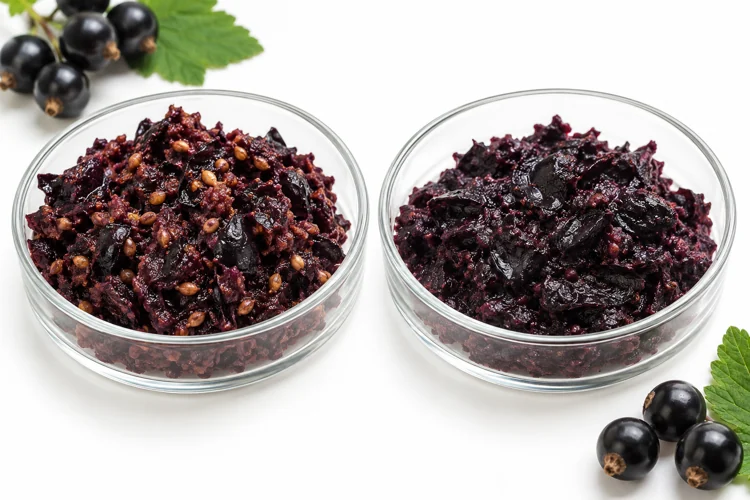
Illustrative seeded and seed-reduced residues make feed composition visible without implying an extraction yield.
Describe seed content with a stated method and basis. A visual estimate can identify a large difference, but it may be inadequate for a narrow acceptance limit. If the team measures a seed fraction, state whether it concerns wet feed, dry material or a separated fraction. Also record whether seeds remain whole or have been fragmented during grinding. A photograph of the feed helps another team recognize the material, while the method defines the reported value.
Particle-size reporting needs similar care. "Fine" and "coarse" can support an initial discussion but do not describe a repeatable feed. Request the sizing method, relevant sieve fractions or distribution, and the sample's preparation state. A single maximum dimension can conceal a mixture of large skin fragments and much smaller particles. A distribution can be more useful when the extractor's mixing or separation step depends on the material that spans those sizes.
Moisture belongs in the same feed description because it defines the relationship between an as-received quantity and its dry material. Record the analytical method and timing used for the sample. If the two feeds have different moisture, compare the relevant recovery on a declared common basis as well as on the operating basis used by the process. An apparent difference per wet kilogram can be misleading if the denominator itself describes a different amount of solids.
Retain the process boundary around the feed. The starting residue, material after seed removal, material after drying and the final ground feed are separate objects. Label samples at those stages and preserve their connections to the same source lot. This makes it possible to distinguish a feed-selection decision from a milling or extraction decision. It also prevents a measurement from an enriched fraction being assigned to the original bulk residue.
The blackcurrant syrup guide explains a different downstream route involving fruit extraction, pectin-related filtration and finished flow. It is useful background when identifying how a juice or syrup stream creates retained solids. The present question concerns the customer's subsequent residue feed and usable recovery. That narrower boundary keeps the analysis from becoming a general article about every blackcurrant application.
Before pricing the two feeds as equivalent, ask which function the recovered material must perform. A pigment extract, an ingredient selected by a declared phenolic assay and a retained fibrous material have different qualification questions. Specify the target product and method rather than assume that all potentially useful components have the same value. The developer can then design a comparison that measures the intended output instead of an undefined total extraction result.

Whole frozen blackcurrants shown on the GreenLand-food product page; these berries are the confirmed supply subject of the article.
The original feed characteristics changed recovery
Landbo and Meyer's original study abstract, also readable in the authors' university repository, examined enzyme-assisted recovery from blackcurrant juice press residues. Smaller particle classes increased phenol recovery, and seed-free pomace produced a higher result than the seed-containing comparator. Several enzyme preparations increased recovered phenols, while the anthocyanin response followed a different pattern. These observations belong to the specific laboratory materials and methods.
The experiment provides a direct reason to preserve seed and particle-size information when comparing feeds. It does not establish a universal milling target, a commercial recovery factor or an economic advantage for seed removal. Those outcomes depend on the actual feed, separation losses, intended extract and process. A developer can use the findings to select meaningful factors for its own trial without assigning the paper's improvement to a future production lot.
Keep the reported analytical object visible. Recovery may be expressed per unit of feed, per unit of dry feed, in a measured liquid fraction or relative to a control. These descriptions answer different questions. When two reports appear to disagree, establish their denominators and sample boundaries before choosing which one is better. A concentrated extract can give a higher concentration even when the process retrieves less target material from the original feed.

Schematic of seed content and particle size as separate feed variables. A comparable analytical basis is needed before evaluating their effects.
The physical comparison also needs a consistent reference. If seed removal changes the total mass and composition presented to the extractor, the enriched feed is a different starting material. State whether the question concerns yield per kilogram of prepared extraction feed or per kilogram of the original residue. Both can be useful, but they should not be combined into one claim that omits the material removed before extraction.
A later original press-residue investigation measured Folin–Ciocalteu-reactive material alongside authentic phenolic compounds and several antioxidant assays. Its assay systems and normalization were explicitly described. This supports a practical reporting question: which chemical or functional measurement is the buyer using? An assay result should remain attached to its method, rather than become an unspecified "antioxidant content" used interchangeably across reports.
Another blackcurrant fruit, pomace and leaf study examined distinct materials in in-vitro systems. We use it as context for the importance of material identity and endpoint. It does not establish a human health outcome or make a customer's residue extract a qualified food ingredient. If an extract is intended for sale or formulation, its suitability and claims require evidence and approval relevant to that actual product and market.
For the illustrative extraction developer, the first controlled comparison would keep seed fraction and grind state visible as factors. Prepare identified feeds, retain an appropriate untreated or current-process reference, and report each output on the declared basis. If multiple factors change together, interpret the test as a comparison of complete routes. That may answer the practical selection question, while leaving the effect of an individual factor unresolved.
The original full protocol is required before reproducing any of its experimental conditions. The accessible abstract supports the directional findings used here, with the named extraction boundary. It does not allow us to invent enzyme dose, preparation, timing or a commercially transferable procedure. The customer's responsible development team should define its own qualified trial, obtain method detail where necessary and keep the interpretation proportionate to the evidence actually available.
Enzyme choice does not move every fraction equally
In the original experiment, Macer8 FJ and Macer8 R reduced anthocyanin extraction yields, while Pectinex BE and the tested protease did not change that endpoint. The preparations' effects on phenol recovery were different. This is why the development report should retain total phenols and anthocyanins as separate fields. Approval of one cannot be inferred from the other when the extract's commercial function depends on a particular component.
An enzyme name also needs a version and functional description appropriate to the actual trial. A historic trade name identifies what a paper tested. It is not proof that a currently offered preparation has the same composition, activity or permitted use. Obtain the relevant supplier specification and application information for the actual product. Record activity basis, dose description and any process requirements that the development team uses, with their source.
Begin the comparison by naming the intended function. If the target is a coloring ingredient, the team may need an anthocyanin result, a defined color test and performance in the intended matrix. If the target is selected by another chemical measurement, state that method and its specification. A general extraction-yield number does not establish that the recovered material meets the required function, even if it is useful for monitoring the operation.

Directional illustration of the original Macer8 FJ finding: phenol yield increased while anthocyanin yield decreased. Arrows show reported directions and do not encode effect sizes.
Separate cell-wall breakdown from target recovery. An intervention can change the material physically, while the final usable output is affected by what is released, retained, transformed or removed in later operations. Measure the relevant result at the declared stage. If a trial ends after clarification, its output is different from a trial that counts all liquid before filtration. The process boundary should remain visible when enzyme options are compared.
Color observations should also be measured consistently. Fix the dilution, matrix, temperature and observation method needed by the intended use. A darker liquid can be a useful visual signal, but it does not on its own identify the amount or form of the desired compound. Keep the chemical assay and application appearance together when both matter. A buyer can then see whether the candidate meets the actual coloring requirement rather than an attractive photograph alone.
Use the current-process or untreated reference to make a treatment effect interpretable. Apply the same feed preparation, analytical basis and downstream collection rule where the trial aims to compare enzymes. If one preparation requires a different route, declare that route and evaluate it as a whole. A practical option can be qualified even when individual causality is not isolated, provided the development decision and its limitations are described honestly.
For the illustrative customer, we would ask which result triggered the proposed approval. Was it greater recovered phenol response, better coloring performance, less retained material, easier separation or another requirement? Request both reports and the method behind each value. If the desired anthocyanin endpoint was never measured, the next action is to measure it under the relevant conditions. Another assay cannot fill that evidence gap merely because the materials share a fruit name.
Keep in-vitro antioxidant results within their assay scope. They can be part of chemical research, but they do not demonstrate that an extract improves a clinical outcome or that a frozen berry lot can support a health claim. The downstream manufacturer's evidence and labeling review remain separate. Our ingredient discussion should identify the offered fruit and application, without converting a laboratory recovery comparison into a promise about the customer's finished product.
Keep the recovered outputs distinct
| Output | Required comparison basis | Commercial question |
|---|---|---|
| Phenol result | Same defined feed, extraction route and analytical endpoint | Did the specified phenol output improve? |
| Anthocyanin result | Same pigment method, fraction and mass basis | Did the selected pigment output meet its target? |
| Usable extract | Recovered amount that meets the finished specification | Does the route produce the ingredient the buyer needs? |
Evaluate usable output against the real feed
Usable output is the amount that satisfies the intended downstream specification after the required process. Define where it is collected and which losses are included. A liquid recovered immediately after extraction may still pass through clarification, purification or drying. If those stages matter to the customer's product, include them in the evaluation or state explicitly that the trial stops earlier. This prevents an intermediate yield from being priced as fully qualified output.
Choose a common reporting basis for the alternatives. Retain the original feed mass, prepared feed mass, relevant dry-matter result and amount of the collected product. If analytical concentration is multiplied by output mass or volume, ensure the units and sample stage agree. The calculation should be traceable to measured quantities. Avoid combining a concentration from one fraction with the total mass of another stream, which can create an apparently strong but invalid recovery estimate.
Seed removal deserves its own mass balance. Record the retained feed and the removed fraction, including material carried with the seeds if it is relevant. The prepared feed may perform differently in extraction, while the overall route also loses some input before that stage. Evaluate both effects against the customer's starting-material boundary. This makes it possible to discuss an enriched feed without claiming that its per-kilogram recovery represents the original residue unchanged.

Illustrative sieving separates coarse and fine residue for a particle-size comparison; no commercial recovery result is shown.
Grinding likewise has an operating context. Confirm how particle size is measured, whether the target can be produced consistently and whether fines or coarse material are retained or discarded. Ask the process team to evaluate mixing, handling and subsequent separation for the prepared feed. Those are proposed qualification questions, not proof that a smaller particle size will improve every operation. The laboratory directional result does not substitute for a trial of the customer's actual route.
Economic evaluation should follow measured usable output. Include the actual costs the developer can document for feed preparation, seed separation, grinding, extraction and necessary downstream handling. Divide by the qualified product quantity appropriate to the intended sale or formulation. We would not invent a seed-removal cost model or a recovery guarantee from the research. A higher assay result may be commercially useful, but its value still depends on the route that produces the accepted output.
Sampling must represent the real stream. Residue composition can vary across a run or among collected containers. Agree where and when samples are taken, how they are combined or kept separate, and how the sample is handled before testing. Retain lot identity and the delay to analysis. The applicable quality and safety team should define storage and handling requirements for the customer's residue; a photograph of a fresh sample is not a storage validation.
The illustrative developer could compare seed-containing and seed-reduced feeds at defined coarse and fine states, with a consistent process reference. The resulting table should show the target assays separately, the mass basis and usable output. If one complete route meets the function and economic requirement, it can proceed to further qualification. If results change when the feed is resampled, investigate that variability before treating one favorable run as a repeatable supply specification.
Retain any independent safety, suitability and documentation requirements for the final extract. An output that meets a phenolic or color criterion can still require other checks before use or sale. The responsible manufacturer determines the applicable process controls, ingredient status and destination requirements. The recovery comparison should produce a clear technical selection while those other acceptance questions are resolved through the evidence appropriate to the actual derivative product.
Keep the derivative decision separate from berry supply
The upstream frozen ingredient and the customer's press residue should have their own specifications. The GreenLand-food blackcurrant range concerns frozen berries and confirmed supply forms. The residue is produced by the customer's downstream route, and an extract is a further product. Keeping those objects separate allows each team to describe what it controls and which measurements belong to its own acceptance decision.
For a frozen-berry inquiry, we would confirm the product form, origin, berry condition, relevant size or defect tolerances, Brix and acidity information required for the application, packing, quantity and destination. Request the sample and documents appropriate to the offered order. If the customer needs a particular processing behavior, evaluate the representative berry input in that process. Do not assume a downstream recovery specification is already guaranteed by the general product description.
For the residue comparison, the customer's extraction team would retain feed origin, pressing history, seed fraction, particle-size distribution, process route, reporting basis and the distinct target assays. It would record qualified usable output and any remaining variability. These fields define the derivative decision. They should not be added to a whole-frozen-berry COA as though they were measured properties of the incoming ingredient before the customer created the residue.

Whole blackcurrants, press residue and prepared extraction feed are different commercial materials. Confirm the fruit order and qualify the derivative route separately.
The illustrative GreenLand-food response would be to request the intended use and both feed or trial reports, clarify the currently offered frozen form, and identify where the customer's route begins. We could then discuss the berry sample needed for development. The customer's team would qualify its own residue and extraction process. This article does not establish that GreenLand supplies pomace, an enzyme-treated feed, a phenolic extract or a health-functional ingredient.
An interface record can connect the two stages without merging them. Carry the berry lot code into the pressing record, then assign traceable identities to the resulting juice and residue streams. Keep the residue-preparation record connected to the extraction trial. If a later result changes, the team can investigate whether the input, pressing route, seed separation, grind or extraction step changed. That is more useful than an unexplained comparison of two final assay certificates.
Define changes that require another derivative trial. A different berry source, declared form, pressing treatment, feed preparation or extraction product may affect the basis of qualification. The responsible team should decide which changes matter to its process and target specification. Retaining the approved reference and method allows that decision to be applied consistently. It also prevents a favorable result from one feed being silently transferred to a materially different residue.

Blackcurrants shown with a size reference on the GreenLand-food product page; berry specification belongs to the upstream ingredient order.
When the two feeds are priced, state the basis of the offer and the acceptance measurement. Price per wet kilogram, per dry kilogram and per unit of qualified extract describe different commercial objects. Agree who measures moisture, seed content and particle size, and how disagreements are handled. Those details make the trade comparison reviewable while leaving unsupported recovery factors and hypothetical processing costs out of the calculation.
Ask the laboratory to identify the sample and calculation basis on each result, including whether a reported value refers to the prepared feed, extraction liquid or isolated dry output. Retain dilution factors, moisture corrections and the treatment of results below the method's reporting limit. An apparently empty anthocyanin result can mean something different from a confirmed zero recovery. If different laboratories are used, check that their analytes and units describe the same endpoint before comparing certificates. These details help the team judge whether the observed difference between feeds survives the reporting method. They also allow a later trial to be compared with the approved reference without reconstructing an undocumented conversion.
Purchasing can then make a bounded choice: accept a defined feed for the qualified route, request a different preparation or continue testing where the target remains unmeasured. The frozen-berry order proceeds against its own confirmed specification. The extraction decision proceeds against the customer's actual residue, separate phenol and anthocyanin results and usable output. That preserves the value of the research while giving each material an acceptance decision supported by its own evidence.
Source frozen blackcurrant with GreenLand-food
GreenLand-food manufactures frozen blackcurrants in China. We fill factory-direct wholesale orders for importers, food manufacturers, foodservice distributors and private-label programs.
Tell us how you'll use frozen blackcurrants and where you need delivery. We'll review the product form and specification with you, then confirm packing, quantity, private-label details and requested documents. We'll confirm the offered ingredient and sample basis before quoting. Approve the application using the material and process tested.