


Can You Freeze Pineapple Juice? Separation, Storage and Best Uses
Sep 23, 2026
Leave a message
Research This Article & Topic with AI
Verify key claims, compare reliable sources, and explore GreenLand-food's practical frozen food knowledge.
Article details and research questions are prepared in the links. Sign-in or sending may be required.
Key takeaways
- Match the method to the exact starting format and final use.
- Control moisture, portion or load, and temperature rather than trusting a single generic time.
- Keep quality guidance separate from food-safety requirements and product-specific directions.
- For buying, confirm the written specification and test a representative sample.
Yes, Pineapple Juice Can Be Frozen-Expect Separation, Not Failure

Yes, Pineapple Juice Can Be Frozen-Expect Separation, Not Failure.
Water in juice forms ice crystals while suspended pulp, soluble solids and natural particles become concentrated in the remaining liquid. When the crystals melt, those components do not always return to the same distribution. A layered appearance can therefore be normal. Pale liquid at the top and denser pulp below do not automatically mean spoilage, and a clean stir often restores a usable drink or ingredient.
In practice, this is where many otherwise careful batches go wrong. Freezing pauses quality loss; it does not reverse age or make questionable juice safe. Freeze juice while it is still sound, within the handling window given for that product. The useful control is to decide the endpoint before starting, then keep the preparation, package and later use consistent.
For a buyer or production manager, the same issue becomes a specification question. Commercial users should define whether the thawed juice must be served clear, blended into a beverage, incorporated into sauce, or used as a flavoring. The acceptable degree of separation depends on that application. Record what was tested, including starting condition, portion or load, equipment and the observed result, so the next batch can be compared on the same basis.
Do not use color alone as a release test. Review package instructions, handling history, seal integrity and normal sensory checks together. That boundary matters because a convenient household method is not automatically a validated commercial process. We supply frozen pineapple pieces, not pineapple juice. The commercial discussion therefore concerns fruit inputs, cut, pack and application rather than an unverified juice offer.
Authoritative background for this section includes Oregon State University Extension UC ANR Freezing Juice. These sources support the preservation or handling principles; the application recommendation still needs to be confirmed against the actual product and operating procedure.
A useful working check for "Yes, Pineapple Juice Can Be Frozen-Expect Separation, Not Failure" is to write down the starting material, the intended finished use, the variable being controlled and the point at which the result will be accepted. A layered appearance can therefore be normal. Pale liquid at the top and denser pulp below do not automatically mean spoilage, and a clean stir often restores a usable drink or ingredient. Then repeat the method with the normal production or household portion rather than judging only a tiny demonstration. Watch what happens during packing, freezing, heating or thawing as applicable, because a problem that appears at the end may have started much earlier. Commercial users should define whether the thawed juice must be served clear, blended into a beverage, incorporated into sauce, or used as a flavoring. The acceptable degree of separation depends on that application. If the result changes, investigate the material, load, temperature history, equipment and holding sequence before changing several settings at once. This simple record also makes supplier conversations more useful: both sides can discuss a defined form and observed performance instead of relying on broad adjectives. Finally, keep the limitation visible. Do not use color alone as a release test. Review package instructions, handling history, seal integrity and normal sensory checks together.
Choose Portions and Containers Before You Freeze

Choose Portions and Containers Before You Freeze.
| Route or format | Useful when | Main control |
|---|---|---|
| Ice-cube portions | Smoothies, sauces and small additions | Protect from air after cubes are solid |
| Cup-size container | One recipe or beverage batch | Leave expansion space |
| Larger rigid container | A planned high-volume use | Slower freezing and a longer refrigerator thaw |
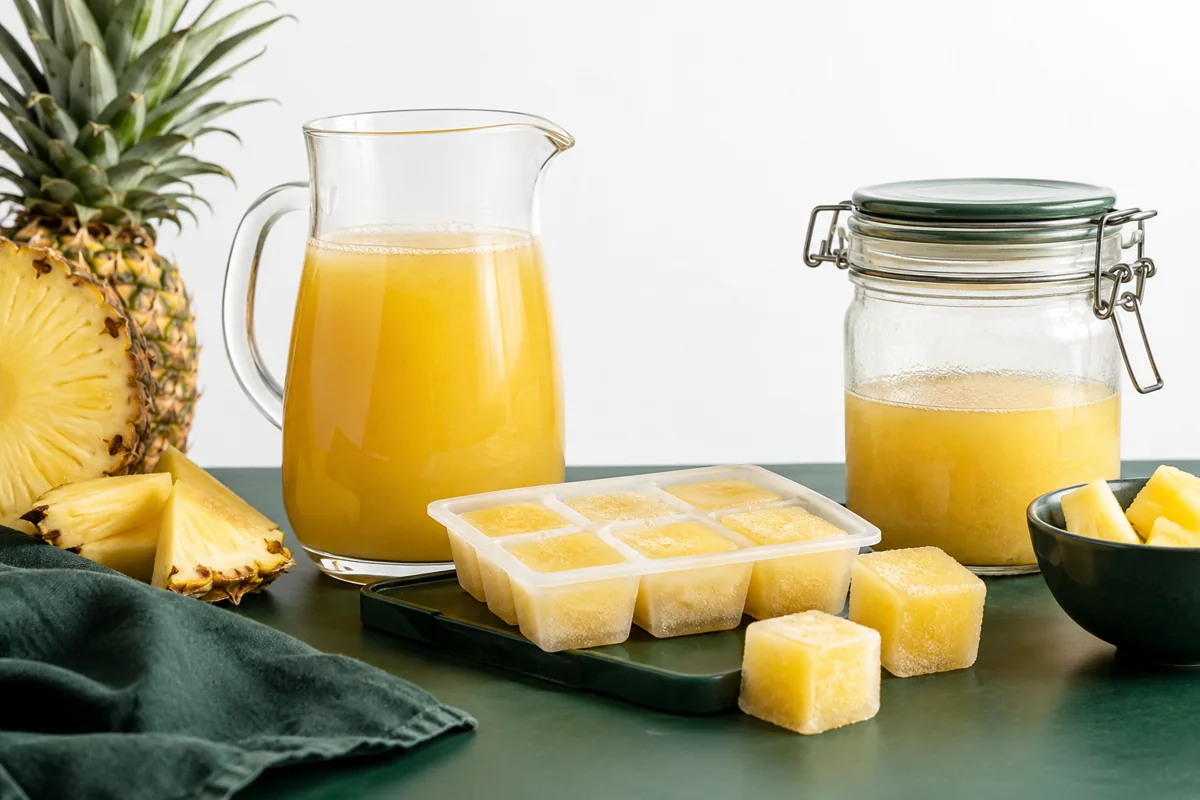
Choose the portion around the next use: small cubes for smoothies and sauces, cup-size amounts for recipes, and larger containers only when the whole volume will be used after thawing. The decision should follow the intended use rather than a habit carried over from another format. Rigid freezer containers resist puncture and make headspace easy to see. Freezer bags save space but need careful sealing and support while the liquid freezes. Ordinary thin glass can break under thermal stress or expansion.
A practical trial should change one variable at a time. Leave expansion space rather than filling to the rim. Oregon State Extension provides container and headspace guidance; the useful lesson is that liquid needs room to expand and the exact allowance depends on container form. If several variables move together, a wetter, softer or less even result cannot be diagnosed reliably.
Label the package with product, portion and freeze date. For a kitchen this prevents mystery cubes; for production it supports stock rotation and traceability. For repeat production, write the relevant cut, starting state, load, package and endpoint into the method. Staff should not have to infer them from a photograph.
Wide, shallow portions freeze faster than one deep block. Faster freezing generally limits large ice-crystal growth and makes later thawing more predictable. We treat that as a quality-control choice, not a marketing promise. We supply frozen pineapple pieces, not pineapple juice. The commercial discussion therefore concerns fruit inputs, cut, pack and application rather than an unverified juice offer.
The core preservation and handling references are Oregon State University Extension UC ANR Freezing Juice. They are used for factual limits and process logic, while exact product directions retain priority.
A useful working check for "Choose Portions and Containers Before You Freeze" is to write down the starting material, the intended finished use, the variable being controlled and the point at which the result will be accepted. Rigid freezer containers resist puncture and make headspace easy to see. Freezer bags save space but need careful sealing and support while the liquid freezes. Ordinary thin glass can break under thermal stress or expansion. Then repeat the method with the normal production or household portion rather than judging only a tiny demonstration. Watch what happens during packing, freezing, heating or thawing as applicable, because a problem that appears at the end may have started much earlier. Label the package with product, portion and freeze date. For a kitchen this prevents mystery cubes; for production it supports stock rotation and traceability. If the result changes, investigate the material, load, temperature history, equipment and holding sequence before changing several settings at once. This simple record also makes supplier conversations more useful: both sides can discuss a defined form and observed performance instead of relying on broad adjectives. Finally, keep the limitation visible. Wide, shallow portions freeze faster than one deep block. Faster freezing generally limits large ice-crystal growth and makes later thawing more predictable.
How to Freeze Pineapple Juice Safely

How to Freeze Pineapple Juice Safely.
- Start with clean equipment and sound juice. If the juice came from an opened commercial pack, follow its instructions; if it was freshly extracted, keep exposure and warm holding time short.
- Chill warm juice before it enters the freezer. Pour into the chosen freezer-safe package, leave the planned headspace, remove excess air where the package allows it, and close without contaminating the rim.
- Set portions upright on a level freezer shelf until solid. Do not stack a large warm load so tightly that cold air cannot move around it.
- Keep the freezer at 0°F (-18°C) or below. That temperature is a storage control, not a promise that quality remains unchanged indefinitely.
Start with clean equipment and sound juice. If the juice came from an opened commercial pack, follow its instructions; if it was freshly extracted, keep exposure and warm holding time short. Chill warm juice before it enters the freezer. Pour into the chosen freezer-safe package, leave the planned headspace, remove excess air where the package allows it, and close without contaminating the rim.
The most useful check is not whether the method can work once, but whether it works with the exact material, portion and equipment that will be used. Set portions upright on a level freezer shelf until solid. Do not stack a large warm load so tightly that cold air cannot move around it. Keep the first comparison small enough to observe clearly.
In procurement, translate the observation into something confirmable. Keep the freezer at 0°F (-18°C) or below. That temperature is a storage control, not a promise that quality remains unchanged indefinitely. A written requirement makes supplier review and incoming inspection more objective.
For operations, record batch identity and the reason for freezing. Rework, sample retention and planned recipe stock have different approval and traceability requirements. Avoid converting a quality range into a safety guarantee or a photograph into proof of an unseen process. We supply frozen pineapple pieces, not pineapple juice. The commercial discussion therefore concerns fruit inputs, cut, pack and application rather than an unverified juice offer.
Reference points: Oregon State University Extension UC ANR Freezing Juice. Use the applicable label, local food-safety plan and product specification whenever they are more specific.
A useful working check for "How to Freeze Pineapple Juice Safely" is to write down the starting material, the intended finished use, the variable being controlled and the point at which the result will be accepted. Chill warm juice before it enters the freezer. Pour into the chosen freezer-safe package, leave the planned headspace, remove excess air where the package allows it, and close without contaminating the rim. Then repeat the method with the normal production or household portion rather than judging only a tiny demonstration. Watch what happens during packing, freezing, heating or thawing as applicable, because a problem that appears at the end may have started much earlier. Keep the freezer at 0°F (-18°C) or below. That temperature is a storage control, not a promise that quality remains unchanged indefinitely. If the result changes, investigate the material, load, temperature history, equipment and holding sequence before changing several settings at once. This simple record also makes supplier conversations more useful: both sides can discuss a defined form and observed performance instead of relying on broad adjectives. Finally, keep the limitation visible. For operations, record batch identity and the reason for freezing. Rework, sample retention and planned recipe stock have different approval and traceability requirements.
Why Pineapple Juice Separates After Thawing

Why Pineapple Juice Separates After Thawing.
Separation reflects the physical structure of juice. Pulp particles, soluble solids and water respond differently during freezing, while ice growth can disturb the original suspension. That is the physical reason behind the recommendation. The effect is more visible in pulpy or minimally clarified juice. A finely filtered beverage may show less sediment but can still develop a different mouthfeel.
Work in a clean, controlled sequence and avoid adding an unnecessary thawing or holding step. A slow refrigerator thaw reduces uncontrolled warm exposure. Once enough ice has melted, turn the closed container gently or stir with clean equipment. A shorter process is not automatically better, but every extra transition introduces another variable.
Whisking or blending can improve uniformity for a smoothie, glaze or sauce. It cannot guarantee the exact viscosity or cloud stability of the original product. In a commercial review, compare the same quantity under the same conditions and record yield, appearance, texture and handling loss.
Reject a leaking, damaged or abnormally swollen package and follow the product's food-safety instructions. Freezing is not a correction for mishandling before the juice entered the freezer. The result should be described honestly: useful for the named application, not perfect under every condition. We supply frozen pineapple pieces, not pineapple juice. The commercial discussion therefore concerns fruit inputs, cut, pack and application rather than an unverified juice offer.
Process principles were checked against Oregon State University Extension UC ANR Freezing Juice. Those references do not verify a supplier-specific specification; current product documents do.
A useful working check for "Why Pineapple Juice Separates After Thawing" is to write down the starting material, the intended finished use, the variable being controlled and the point at which the result will be accepted. The effect is more visible in pulpy or minimally clarified juice. A finely filtered beverage may show less sediment but can still develop a different mouthfeel. Then repeat the method with the normal production or household portion rather than judging only a tiny demonstration. Watch what happens during packing, freezing, heating or thawing as applicable, because a problem that appears at the end may have started much earlier. Whisking or blending can improve uniformity for a smoothie, glaze or sauce. It cannot guarantee the exact viscosity or cloud stability of the original product. If the result changes, investigate the material, load, temperature history, equipment and holding sequence before changing several settings at once. This simple record also makes supplier conversations more useful: both sides can discuss a defined form and observed performance instead of relying on broad adjectives. Finally, keep the limitation visible. Reject a leaking, damaged or abnormally swollen package and follow the product's food-safety instructions. Freezing is not a correction for mishandling before the juice entered the freezer.
How to Thaw, Recombine and Judge Quality

How to Thaw, Recombine and Judge Quality.
Thaw the sealed portion in the refrigerator or use a frozen cube directly in a recipe that will be processed immediately. Do not leave a large container at room temperature simply to speed the center. Stir after thawing and judge the product in its intended use. A slightly separated juice may work perfectly in a blended beverage while being less attractive as a clear table drink.
In practice, this is where many otherwise careful batches go wrong. Use clean utensils and remove only the quantity needed. Repeated thawing, partial warming and refreezing make both handling history and quality difficult to control. The useful control is to decide the endpoint before starting, then keep the preparation, package and later use consistent.
For a buyer or production manager, the same issue becomes a specification question. For a business trial, compare a retained fresh control with the frozen-thawed sample for color, aroma, sediment, flavor, viscosity and recipe performance. Record what was tested, including starting condition, portion or load, equipment and the observed result, so the next batch can be compared on the same basis.
Document what counts as acceptable. A buyer specification should convert vague language such as good quality into observations or test methods the supplier and user understand. That boundary matters because a convenient household method is not automatically a validated commercial process. We supply frozen pineapple pieces, not pineapple juice. The commercial discussion therefore concerns fruit inputs, cut, pack and application rather than an unverified juice offer.
Authoritative background for this section includes Oregon State University Extension UC ANR Freezing Juice. These sources support the preservation or handling principles; the application recommendation still needs to be confirmed against the actual product and operating procedure.
A useful working check for "How to Thaw, Recombine and Judge Quality" is to write down the starting material, the intended finished use, the variable being controlled and the point at which the result will be accepted. Stir after thawing and judge the product in its intended use. A slightly separated juice may work perfectly in a blended beverage while being less attractive as a clear table drink. Then repeat the method with the normal production or household portion rather than judging only a tiny demonstration. Watch what happens during packing, freezing, heating or thawing as applicable, because a problem that appears at the end may have started much earlier. For a business trial, compare a retained fresh control with the frozen-thawed sample for color, aroma, sediment, flavor, viscosity and recipe performance. If the result changes, investigate the material, load, temperature history, equipment and holding sequence before changing several settings at once. This simple record also makes supplier conversations more useful: both sides can discuss a defined form and observed performance instead of relying on broad adjectives. Finally, keep the limitation visible. Document what counts as acceptable. A buyer specification should convert vague language such as good quality into observations or test methods the supplier and user understand.
Best Uses for Frozen Pineapple Juice

Best Uses for Frozen Pineapple Juice using the specific product form shown.
Frozen portions are convenient in smoothies, frozen drinks, marinades, sauces, glazes and bakery formulas where mixing disperses minor separation. The decision should follow the intended use rather than a habit carried over from another format. For a cold drink, thaw and stir before dilution so that one serving does not receive mostly watery top liquid while another gets concentrated pulp.
A practical trial should change one variable at a time. In hot applications, add the portion according to the recipe and account for the extra cooling load and water. A frozen block can slow a sauce or kettle more than liquid juice. If several variables move together, a wetter, softer or less even result cannot be diagnosed reliably.
Pineapple contains active enzymes when raw, but activity varies with processing and heat treatment. Do not build a tenderizing or formulation claim around an unverified enzyme assumption. For repeat production, write the relevant cut, starting state, load, package and endpoint into the method. Staff should not have to infer them from a photograph.
The best use is the one tolerant of small texture changes. Freezing is especially practical when portion control prevents an opened quantity from being wasted. We treat that as a quality-control choice, not a marketing promise. We supply frozen pineapple pieces, not pineapple juice. The commercial discussion therefore concerns fruit inputs, cut, pack and application rather than an unverified juice offer.
The core preservation and handling references are Oregon State University Extension UC ANR Freezing Juice. They are used for factual limits and process logic, while exact product directions retain priority.
A useful working check for "Best Uses for Frozen Pineapple Juice" is to write down the starting material, the intended finished use, the variable being controlled and the point at which the result will be accepted. For a cold drink, thaw and stir before dilution so that one serving does not receive mostly watery top liquid while another gets concentrated pulp. Then repeat the method with the normal production or household portion rather than judging only a tiny demonstration. Watch what happens during packing, freezing, heating or thawing as applicable, because a problem that appears at the end may have started much earlier. Pineapple contains active enzymes when raw, but activity varies with processing and heat treatment. Do not build a tenderizing or formulation claim around an unverified enzyme assumption. If the result changes, investigate the material, load, temperature history, equipment and holding sequence before changing several settings at once. This simple record also makes supplier conversations more useful: both sides can discuss a defined form and observed performance instead of relying on broad adjectives. Finally, keep the limitation visible. The best use is the one tolerant of small texture changes. Freezing is especially practical when portion control prevents an opened quantity from being wasted.
What Commercial Buyers Should Specify for Pineapple Inputs

What Commercial Buyers Should Specify for Pineapple Inputs using the specific product form shown.
Decide first whether the project needs juice, puree, crushed fruit, tidbits, diced pieces or another defined format. Those products behave differently and should not share one loose specification. For frozen pineapple pieces, buyers normally confirm cut size, Brix or sweetness target where applicable, defects, pack format, net weight, glazing if any, microbiological and residue requirements, and required documents.
For ingredient format details, see How to Cut Pineapple into Chunks.
The most useful check is not whether the method can work once, but whether it works with the exact material, portion and equipment that will be used. Application trials matter. Beverage, dairy, bakery, sauce and foodservice users do not place the same value on piece integrity, thaw drip or sweetness. Keep the first comparison small enough to observe clearly.
In procurement, translate the observation into something confirmable. We can discuss verified frozen pineapple pieces and the available commercial specification. We do not present this article as evidence that GreenLand-food currently supplies pineapple juice. A written requirement makes supplier review and incoming inspection more objective.
Ask for a sample and align the written specification before an order. A photograph is useful context, but receiving checks and agreed documents control the transaction. Avoid converting a quality range into a safety guarantee or a photograph into proof of an unseen process. We supply frozen pineapple pieces, not pineapple juice. The commercial discussion therefore concerns fruit inputs, cut, pack and application rather than an unverified juice offer.
Reference points: Oregon State University Extension UC ANR Freezing Juice. Use the applicable label, local food-safety plan and product specification whenever they are more specific.
A useful working check for "What Commercial Buyers Should Specify for Pineapple Inputs" is to write down the starting material, the intended finished use, the variable being controlled and the point at which the result will be accepted. For frozen pineapple pieces, buyers normally confirm cut size, Brix or sweetness target where applicable, defects, pack format, net weight, glazing if any, microbiological and residue requirements, and required documents. Then repeat the method with the normal production or household portion rather than judging only a tiny demonstration. Watch what happens during packing, freezing, heating or thawing as applicable, because a problem that appears at the end may have started much earlier. We can discuss verified frozen pineapple pieces and the available commercial specification. We do not present this article as evidence that GreenLand-food currently supplies pineapple juice. If the result changes, investigate the material, load, temperature history, equipment and holding sequence before changing several settings at once. This simple record also makes supplier conversations more useful: both sides can discuss a defined form and observed performance instead of relying on broad adjectives. Finally, keep the limitation visible. Ask for a sample and align the written specification before an order. A photograph is useful context, but receiving checks and agreed documents control the transaction.
Source frozen pineapple with GreenLand-food
We supply and coordinate frozen pineapple for wholesale and factory-direct programs. As a manufacturer-facing supplier, GreenLand-food will review the requested form, packing, documents and application before confirming an offer. We supply frozen pineapple pieces, not pineapple juice. The commercial discussion therefore concerns fruit inputs, cut, pack and application rather than an unverified juice offer.