


Frozen Cut Green Beans: Import Standards, Tenderness and Supply Specifications
Oct 20, 2026
Leave a message


Confirm the bean, pod and cut before comparing offers
"Green bean" is loose trade language. The offer considered here is the young, succulent pod of Phaseolus vulgaris, green in colour, trimmed and cut transversely into segments, with green bean as the sole ingredient. It is neither a shelled green seed nor a mature dry bean. A yardlong cowpea, a flat Romano bean, and a wax-coloured cultivar can have different identities or commercial expectations even when a seller groups them under beans. The buyer should put the botanical species, edible part, colour, cut direction and cooking instruction on the first line of the signed specification.

Compare whole pod, transverse cut and split pod forms - conceptual illustration; no specific facility or shipment shown.
The cut direction matters on a production line. Transverse segments retain the pod wall and cut face, and their length is measured along the pod. French-cut beans are sliced lengthwise and behave differently in a mix or casserole. Whole pods bring a different short-piece definition. Our French-cut explanation is useful when comparing visual styles; it should not be used to approve a transverse-cut order.
Ask for three views of the offered material: an intact incoming pod, a measured cut sample and the cooked cut. The intact pod reveals whether the crop is young enough, whether the stem end is still attached, whether the seam carries an objectionable string, and whether the seeds have become mealy. The frozen cut shows length distribution, clean cut edges, frost, loose ice and broken pieces. The cooked sample reveals fibres and seed texture that a frozen photograph can hide. A retained reference sample needs a code, preparation method and approval date; "looks green" alone is not reproducible.
On the commercial brief we distinguish the crop and the saleable SKU. The grower and processor must identify the actual growing area and production site for a shipment. We do not infer organic status, a specific factory certificate, pesticide-use history or ready-to-eat status from the generic product page. A change of cultivar, source field, cut setting, blanching route or pack can require a new trial even when the name on the invoice stays the same.
Map three market rules to the whole pod and frozen cut
The raw commodity classification comes before a laboratory panel. In the EU, Annex I of Regulation 396/2005 places common, French and snap beans with their pods under 0260010, beans with pods, and uses the whole product for this legume-vegetable group. That is the correct starting commodity for a young Phaseolus vulgaris pod. In the US, 40 CFR 180.1 names green, snap and wax beans within Phaseolus beans and normally examines the whole raw agricultural commodity unless a specific rule says otherwise. The Japan government database names the crop "Kidney beans, immature (with pods)"; the Japanese sampling table describes immature kidney beans with the flower stalk removed. A finished cut made from the pod does not turn the crop into a shelled-bean entry.

Trace whole pod to trimmed cut and frozen pack - conceptual illustration; no specific facility or shipment shown.
These are the starting legal screens, not three interchangeable finished-pack limits. EU pesticide Regulation 396/2005 Article 20 requires the raw-commodity MRL to be applied to processed food while taking processing changes into account where a processed-food MRL is not separately set. EU contaminant Regulation 2023/915 has its own processing and concentration rules under Article 3. The US expressly excludes freezing from "raw agricultural commodity"; under 40 CFR 180.1(e), a processed food made from a compliant raw commodity must meet the stated conditions, including good manufacturing practice removal and a concentration no greater than the raw tolerance where that route applies. Japan's CAA rule requires the raw material used in processed food to meet its residue standard; the importer must confirm any finished-product interpretation and the current legal analytes for the particular substance.
| Destination | Raw product and sample basis | What the buyer must close for blanched IQF cuts |
|---|---|---|
| EU | 0260010 Phaseolus vulgaris beans with pods; whole raw commodity. | Current substance-specific residue definition, applicable MRL, processing factor or evidence of change, and contaminant assessment for the finished food. |
| US | Snap/succulent bean pod as identified in the individual 40 CFR Part 180 tolerance; normally whole commodity. | Exact crop wording in each tolerance, legal analytes, the frozen processed-food condition in §180.1(e), and any separate finished-food rule. |
| Japan | "Kidney beans, immature (with pods)" in the government MRL database; official sample table removes the flower stalk. | Current CAA notified value and residue definition, raw-pod sample protocol, processed-food application, and the frozen-food microbiological class for the actual line. |
For a cross-market offer, we would maintain separate destination sheets. One laboratory report can serve several destinations only if it measures every relevant legal residue definition at adequate detection limits and the sample is traceable to the correct crop and lot. The lowest number in a comparison table is not automatically the contractual standard for all orders; the buyer may request a tighter internal target, but the legal assessment must retain its own commodity and method.
Translate named pesticide limits into a lot test plan
The following current source readings illustrate how different the same pod can look in three jurisdictions. They are named examples, not a complete pesticide screen or a claim about our lot. On the EU Commission's current 0260010 database response, azoxystrobin is 3.0 mg/kg for beans with pods. Captan is 0.03 mg/kg at the analytical limit, and its displayed enforcement heading is "sum of captan and THPI, expressed as captan." Reporting only parent captan would miss the displayed EU residue definition. For acetamiprid, the bean MRL is 0.6 mg/kg and the enforcement residue is the parent compound. The (R) exception in Regulation 2025/1212 applies to specified animal products, not beans under 0260010. We would commission parent acetamiprid and the captan-plus-THPI sum for this EU commodity, retaining the method, reporting limit and processing assessment with the lot. A star marks a limit of analytical determination rather than permission to treat a result below any convenient laboratory LOQ as compliant.

Separate intact pod sample and finished frozen cuts - conceptual illustration; no specific facility or shipment shown.
Japan's government database, checked against its 13 October 2026 update, gives azoxystrobin 3 ppm and acetamiprid 3 ppm for "Kidney beans, immature (with pods)." Its captan row is 0.01 ppm. These are food-specific database entries. For this agricultural commodity, CAA's November 2025 reference-standard table identifies parent azoxystrobin, parent acetamiprid and parent captan as the respective regulatory analytes. The EU captan-plus-THPI sum must therefore not be copied into a Japanese captan-only result. For azoxystrobin, CAA's notification also lists 未成熟いんげん at 3 ppm, supporting the exact crop match. We would ask the Japan importer and laboratory to sign the analyte, sample-part and method lines, then retain the dated government screen with the order.
In the US eCFR, diazinon is 0.50 ppm on "Bean, snap, succulent" under §180.153, with the section naming diazinon as the residue. Malathion is 8 ppm on "Bean, succulent" under §180.111(a)(1), where that row concerns malathion itself. The same malathion section has separate paragraphs for combined malathion and malaoxon residues on other commodities, so a lab instruction must quote the precise paragraph rather than assume every malathion row has the same analytes. The bean identity should be confirmed against EPA's commodity conventions before relying on the "succulent" row for this order. A pesticide with no applicable US tolerance or exemption cannot be assigned an invented default 0.01 ppm; its legal status needs an individual check.
EU Regulation 2023/915 supplies separate contaminant controls. In the current consolidated Annex I, lead is 0.10 mg/kg for legume vegetables, cadmium is 0.020 mg/kg for legume vegetables, both on wet weight after washing and separation of the edible part. The same Annex has a bean-specific perchlorate limit of 0.15 mg/kg for Phaseolus vulgaris beans with pods. These are not pesticide MRLs. The sampling, analytical method and processing assessment must match contaminant law. A dry-matter report cannot be compared directly to a wet-weight number, and a blanched/frozen result should be interpreted with Article 3's processing factors where applicable.
For each named chemical, the lab order should state destination, raw or finished sample, exact food heading, analytes and expression basis, units, method and validated LOQ, uncertainty, sampling date, and lot identity. Quality assurance then compares the result with the law in force for the shipment and any tighter signed buyer limit. A reported "ND" without a numerical LOQ cannot resolve a 0.01 or 0.03 mg/kg gate. Do not average a noncompliant field lot with a compliant lot, or infer that blanching removed a residue without crop- and process-specific evidence. EU Article 19 prohibits processing or mixing noncompliant products for dilution. We hold the affected field and resulting frozen lots while the raw/finished relationship and any confirmation sample are investigated.
Classify the cook-before-eating bean for microbiology
Blanching and IQF help protect colour, texture and shelf life, but a frozen bean sold with "cook before eating" must be evaluated as that product, with the actual validated heat process and label. A negative peroxidase test can support enzyme inactivation; it is not a complete pathogen kill validation. Cooling water, sorting and packing after blanching also create opportunities for recontamination. The finished product needs a risk-based monitoring and release plan agreed with the importer and actual facility.

Illustrate blanch, cool and IQF sequence - conceptual illustration; no specific facility or shipment shown.
Japan's Notification 370 gives two legally different cook-before-eating frozen-food branches. If a product was heated immediately before freezing, the viable bacterial count is no more than 100,000 per gram and the coliform group must be negative. If it was not heated immediately before freezing, the count is no more than 3,000,000 per gram and E. coli must be negative. These are different organism tests; "coliform negative" and "E. coli negative" are not interchangeable wording. The official preparation wipes the frozen pack exterior, aseptically opens it, finely cuts the contents, randomly takes 25 g, and homogenizes with 225 mL sterile phosphate buffer; further dilution and specified plate or culture methods follow the particular branch. The E. coli procedure uses EC fermentation tubes at 44.5 ± 0.2°C for 24 ± 2 hours, with confirmation on EMB and associated tests as prescribed.
The official MHLW HACCP example for blanched cut spinach still classifies that example as "not heated before freezing / consumed after heating" and uses the 3,000,000/g plus E. coli-negative branch. It is a useful caution against calling a green bean legally "heated immediately before freezing" merely because it passed through a blancher. It is an analogy, not a bean ruling. Before a Japanese order is released, we would send the actual bean flow, blanch purpose and validation, cooling/handling steps, pack and cooking label to the importer and obtain the relevant authority's category decision in the order file. Until then, the supplier must not select the easier branch by assumption. An imported SKU with a different validated full heat sequence could fall in the other branch.
For EU and US orders, the applicable process and intended use drive the food-safety plan; the Japanese numerical branches are not transferable legal limits. A buyer may contract for Salmonella absence in five 25 g finished-product samples, with c=0, as a risk-control condition, but that is a proposed contract term, not a universal EU, US or Japan rule for these beans. The lot plan must also address environmental hygiene, cooling-water control, indicator trending and any destination or customer requirement for Listeria or other organisms. We would state n, c, sample mass, method, product state and decision rule before production. A positive pathogen finding or a gap in a claimed validated kill step holds the affected time window regardless of attractive colour or a good peroxidase result.
Measure tenderness, strings, stem ends and broken cuts
The most useful quality inspection starts by choosing the style and denominator. USDA's voluntary frozen green and wax bean standard defines a single unofficial inspection unit as 400 pieces for styles other than French, while French style uses 500 g. Its cut-style "short piece" is less than 13 mm measured along the longest dimension parallel to the pod seam; the whole-style threshold is different at less than 44 mm. Mechanical damage includes a split into two parts counted as one defect, crushing, or severely ragged cut edges above 8 mm. These definitions are a disciplined vocabulary, not a law that automatically applies to a private China-to-EU order. If a customer specifies "US Grade A," the named style, edition, sample size and acceptance table must travel with that claim.

Actual GreenLand cut-bean photo with caliper size reference - existing GreenLand product photograph; approval of a future lot still needs its own sample.
Our cut-bean product page offers a common 6–10 mm diameter, 20–40 mm transverse length and at least 90% dimensional conformity starting point. For an actual contract, we would set the measurement state and denominator. For example, thaw or temper a coded frozen sample only enough to separate pieces without deforming them, select pieces from multiple cartons, measure 400 intact countable units with a calibrated caliper, and record how many fall within both bands. Under an agreed count-based method, 360 of 400 in band would give 90%; an expressly weight-based specification would need the mass of in-band pieces divided by total examined mass instead. The parties should not mix those denominators in a complaint.
Stem ends, strings and short cuts need separate tallies. A stem-bearing cut is a unit defect counted once among examined pieces; detached stem fragments should be collected and reported by count per stated sample mass or by mass fraction, as the signed specification says. Counting a loose stem and its former pod twice would distort a claim. For strings, we mark sampled pods before trimming, pull any conspicuous seam fibre, and cook coded matched samples under the buyer's actual recipe. USDA distinguishes edible fibre, noticeable but acceptable, from inedible fibre that is objectionable after cooking and separates on chewing. A brittle snap in a raw pod is only a screening cue; cooked chew, seed mealiness and string persistence determine the application verdict. The published GreenLand rupture-force and strings article develops the instrument-versus-bite distinction in detail.
A buyer may choose an illustrative acceptance plan such as no more than 5 stem-bearing units in 400, no more than 41 short cut pieces in 400 and no more than 1 objectionably fibrous unit in 400. Those figures happen to correspond to one single-unit USDA Grade A table and should be adopted only after confirming the exact style, grade, sample-size and inspection plan; they are not regulatory limits or a GreenLand standing promise. A simpler bespoke order could use other signed levels. Either way, define whether the 400 units are drawn over one hour, one packed lot or multiple pallet positions, and how a failed sub-sample triggers expansion, rework or rejection. Keep photos of ambiguous ends and the cooked reference alongside raw counts.
Control harvest maturity, blanching, IQF and packing
Tenderness is first a harvest and receiving decision. Old pods tend to develop larger seeds and more resistant pod wall and seam fibre. Receiving staff should examine whole pods from each identified field lot, record calibre and seed development, isolate visibly overmature or diseased material, and prevent a later young crop from hiding it in a combined freezer lot. An agreed field-to-processing interval matters for colour and turgor, but it should be a record from the actual programme rather than a generic marketing claim. We would link grower code, harvest window, receiving bin and processing run so a quality issue can be traced back to its raw source.

Show maturity and seam-fibre inspection - conceptual illustration; no specific facility or shipment shown.
Trimming removes stems and specified tips before transverse cutting. The cutter setting is only a start: actual piece length can change with pod curvature, handling and blade wear. Production should check a measured set at start-up, after adjustments and at defined intervals, then document out-of-band pieces, stem carryover and ragged edges. Optical or manual sorting can reduce defects but does not replace an inspection result. The cut sample shown to a buyer must represent the final line setting rather than a carefully hand-selected display tray.
Blanching time, product temperature and cooling must be validated for this bean format and desired cooked bite. Too little treatment can allow enzyme-driven colour or flavour loss in storage; excessive heat can soften the pod and increase split skin. Use a documented blancher setting, actual product loading, monitored time/temperature, cooling-water quality and residence time. A peroxidase result may be one verification of enzyme control, but the release record should include the process chart and deviations. Then dewater and freeze rapidly enough to maintain free-flowing pieces. Freezer residence and product temperature are equipment- and load-specific and should be proven by the processor's records. We do not present an ImageGen process illustration as a photograph of our facility.
Packing closes the quality chain. The buyer should specify the industrial liner material, outer carton net weight, coding on inner and outer packs, seal and carton integrity, pallet pattern and agreed frozen storage and delivery temperature. Our product page lists zero added glaze as a standard commercial feature; the signed SKU must confirm it and define how loose ice, frost or clumping will be inspected. A photograph of a good free-flowing sample does not establish the temperature of the whole shipment. Record logger placement, loading product temperature, container setpoint, seal number and arrival condition. If a reefer excursion occurs, isolate the affected pallets and evaluate the temperature history and product condition before QA disposition.
Approve a sample with stated denominators and cooking method
A representative sample is more valuable than a polished brochure photograph. For a proposed EU ready-meal ingredient, a buyer could request coded samples from several production times and carton positions, with the source field and finished lot recorded. We would supply the current specification, ingredient declaration, pack drawing, process description, proposed analytical scope and a retained sample. The buyer would return a signed acceptance method for the particular recipe: for example, cook from frozen under its steam or sauce schedule, hold for its real assembly interval, and score tender bite, visible strings, green colour, seed mealiness, broken pieces and usable yield.
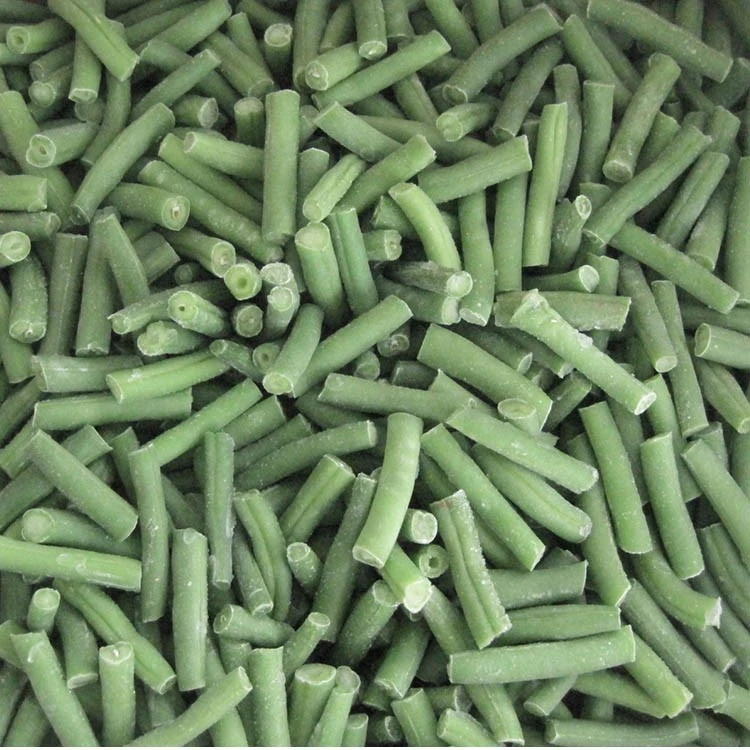
Actual GreenLand transverse-cut green bean product photo - existing GreenLand product photograph; approval of a future lot still needs its own sample.
Define every denominator before the trial. For length and stem ends, count the number of defective pieces over a fixed count of pieces. For loose stem or foreign vegetable fragments, use grams over a stated sample mass if that captures the material more fairly. For cooked objectionable fibre, inspect a fixed number of coded cooked units or pod portions and record the number rejected by the agreed panel. For yield, weigh the frozen input and the usable drained cooked output under a repeatable preparation; state whether drip, sauce or rejected fragments are excluded. A percentage without sample state and denominator is hard to reproduce and easy to dispute.
GreenLand IQF Frozen Cut Green Beans
Transverse-cut pieces for mixed vegetables, ready meals and foodservice preparation. The published starting points are 20–40 mm length, 6–10 mm diameter and at least 90% size conformity; confirm the actual offer, pack and tolerances in the signed specification.
If a trial fails, record the observed failure rather than asking the supplier to "improve quality." A string complaint should identify whether it is a seam fibre, a hard stem or acceptable pod-wall fibre. A short-piece complaint should retain a count and measured examples. A tenderness complaint should carry the cooking method and comparison sample. GreenLand sales can collect the evidence; supplier QA and the actual processor must locate the raw and process cause. The buyer confirms whether revised material must be resampled. A commercial concession cannot substitute for a failed food-safety or legal gate.
Build an order file that can hold or release a lot
Consider a fictional trial order: one industrial pallet of China-origin, single-ingredient, blanched IQF transverse-cut Phaseolus vulgaris green beans for an EU ready-meal plant, labelled cook before eating. The buyer asks for a signed 20–40 mm cut band, a 6–10 mm diameter band, a stated 400-piece size/defect inspection, an application cooking trial, a 10 kg lined carton subject to final pack approval, and destination-specific residue and contaminant evidence. This is an example negotiation, not a record of a shipment or a standing GreenLand guarantee.

Connect carton, retained sample and temperature evidence - conceptual illustration; no specific facility or shipment shown.
- Buyer confirmation. Purchasing signs species, part, style, ingredient, use, destination, quantity, pack, accepted defects, analysis list, sampling plan and document list. Its technical team signs the cooked-reference method and any microbiological contract targets. The Japan importer, if that destination is added, obtains the appropriate frozen-food category decision from the actual flow and label.
- GreenLand and supplier preparation. Our sales team fixes the approved version in the quote and sample record. Supplier QA confirms grower, field input history and incoming pod identity. The processor records trimming, cutter checks, blanch/cool/IQF settings, hygiene and coding. We request site and certificate evidence only for the actual facility and SKU, without assuming a generic certificate covers outsourced steps.
- Laboratory and QA review. The lab receives coded raw-pod and finished-cut samples where the legal comparison needs both, a destination-specific analyte list, method, units and LOQ. Release QA checks the current EU MRL and contaminant rows, processing interpretation, buyer thresholds, process deviations and every report against one lot map. A pass in one destination is not a pass in another.
- Hold or release. A mature/stringy crop, excess stems, failed cut distribution, missing blanch/cooling chart, unexplained microbial result, residue exceedance, wrong sample part, LOQ above the legal screen, traceability break or reefer excursion places the affected material on hold. QA defines the affected time and source range, investigates adjacent lots, records corrective action and obtains buyer/importer agreement where needed. Only the authorised QA sign-off and completed shipment documents release the cartons.
Before dispatch, reconcile carton codes, pallet count, seal, shipping marks, ingredient and cooking statements, origin declaration, laboratory certificates and temperature plan. EU and US buyers should confirm their importer obligations and exact entry documents for the destination and transaction; Japanese buyers should confirm food import notification and the approved test/category route with their importer or quarantine station. We can prepare product and lot information for that review. Certificates, private-label artwork and organic or other claims require exact site, scope, validity and order approval, not an assumption from a catalogue.
Source frozen green beans for your line
GreenLand-food is a China-based frozen green bean supplier and manufacturer offering factory-direct wholesale programmes. Tell us the cut form, target size, pack, volume, cooking application, destination and documents so we can discuss a representative sample and a quote linked to the agreed controls.