


Frozen Taro Dice: Import Requirements, Cooking Trials and Supply Specifications
Oct 20, 2026
Leave a message


Define the Colocasia corm and the frozen dice being bought
The words "taro," "yam" and "purple root" are used loosely in international trade. The target here is the edible corm of Colocasia esculenta. The supplier should give the actual botanical identity and, where known, variety or cultivar, growing source and harvested plant part in its raw-material record. The EU's pesticide commodity taxonomy names dasheen taros, C. esculenta var. esculenta, and eddoe taros, C. esculenta var. antiquorum, under code 0212010. That listing helps classify a documented corm; it does not turn a different plant into Colocasia. A true yam belongs to Dioscorea and the vivid purple ube used in desserts is a different purchasing specification. Xanthosoma tannia and Manihot cassava are different identities too, even though a commodity group may place several edible roots together for a particular legal purpose.
The easiest purchasing error is to accept a pale frozen cube and assume its identity from its color. Variety, soil and cut position can change the taro's white-to-flecked appearance; photographs cannot establish a Latin species. We ask the source manager for grower and receiving documents that connect the named plant to the incoming lot. The processing team then carries that lot identity through wash, peel, cut, blanch, freeze and pack. If the source document calls it "taro" but the botanical record or harvested part conflicts, our QA decision should be hold. The importer may need a new food classification, label and residue review before the material can be offered under the original order.

Define the sold state just as carefully. "Peeled" needs a depth and defect tolerance, because remnants of dark skin and a fibrous ring can remain on a machine-peeled corm. "Blanched" names a heat step but says nothing about its actual severity, cooling, or final eating safety until a validated plan and records are available. "IQF" should describe separated frozen pieces, not a solid block with large frost deposits. "Single ingredient" means the recipe contains only taro: if a buyer needs citric acid, oil, sugar, color or any other addition, that is a different formula and declaration. The industrial inner bag, outer carton, code, net mass and instructions to cook fully complete the identity. These conditions also separate this guide from our broader frozen taro root guide, which covers home freezing and several other forms.
Write measurable cut, peel, color and packing specifications
A good buying sheet gives the inspector a method, not just an adjective such as "uniform." Start with nominal cube dimensions in millimetres and a tolerance measured on three axes after the surface frost has been removed under an agreed procedure. Decide whether a chipped corner stays in the nominal-size count or belongs in a separate broken-piece fraction. A sieve, caliper and scale answer different questions: the sieve estimates fines, the caliper checks retained geometry, and the scale gives mass fractions. Record the sample mass, number and location of cartons, handling temperature, sieve aperture, measured denominator and counting rule before quoting a percentage. One carton from the top of a pallet cannot represent a shipment without a sampling plan agreed in advance.
Peeling loss is an upstream yield measure, whereas peel fragments in a finished bag are an acceptance defect. Production should record incoming washed corm mass, peel and trim discard, sound cut material, blanched and drained material, and frozen packed mass for each batch. The difference between incoming and peeled mass includes skin, damaged spots, hard tissue and other cuts; it is not evidence that a worker overpeeled. The buyer's defect check separately inspects a representative frozen sample for residual dark peel, hard core, discolored cut faces, fibrous patches and foreign matter. Each category needs a visual reference and a count or mass basis. A buyer who wants a very clean pale cube may accept more trim loss and higher price; another who will puree the cooked taro may accept minor corner breaks but still reject peel and hard core.
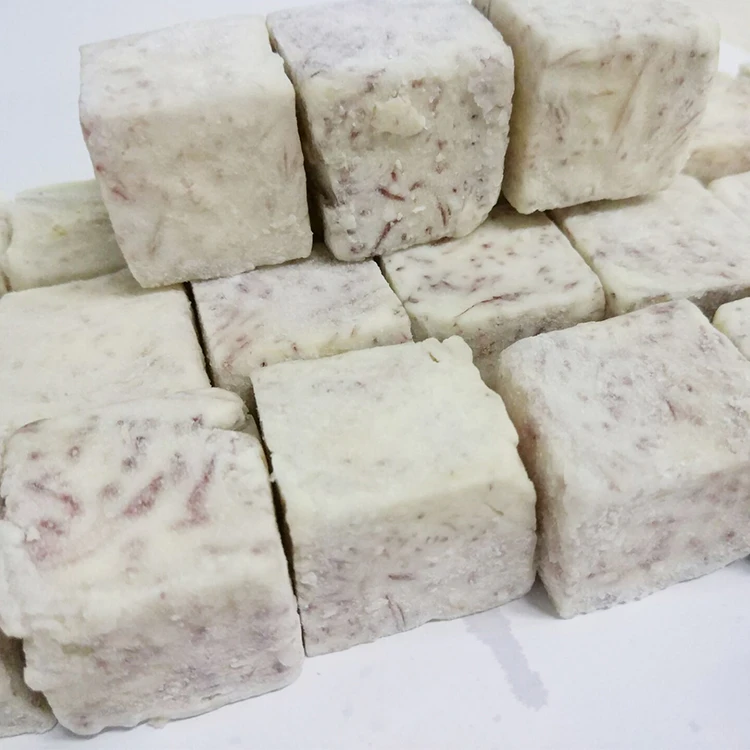
Color is a range to compare under consistent lighting. Pale flesh can carry natural purple specks; a bright uniform purple cube is not the default appearance of this single-ingredient taro. Establish an approved reference photograph alongside a physical retained sample, then define what dark oxidation, gray water marks or brown bruising look like after cooking. We would not set a universal whiteness number from a marketing photograph. The signed sample and the buyer's application determine whether a slight color variation matters. Bag frost and clumping should be examined separately from flesh color; white exterior ice can conceal a poor cut surface until thawed or cooked.
Industrial packing must protect the lot identity and the frozen condition. Agree the net weight of each food-contact inner bag, carton count, pallet pattern, label language, destination, handling statement and traceability code. For a proposed 10 kg carton, specify whether that means a single liner or several sealed inner bags and how net weight is checked. A 10 kg line in an old catalog is a discussion point, not proof that every plant or cut is available in that pack. Confirm film integrity, seal position, carton strength and resistance to the actual reefer and warehouse handling. The commercial specification should state the test method and acceptance tolerance for weight, seal failures, clumps, large pieces, fines and defects, plus who may change any of these after the reference sample is signed.
Trial full cooking, mealiness and usable yield in the real recipe
Raw taro contains calcium-oxalate structures associated with acridity and irritation. Peeling and blanching alter the material but should not be presented as a universal detoxification formula. Studies of cultivar and cooking method do not validate the time, water ratio or largest-cube center in a particular factory. The safe product instruction for this order is to cook the dice thoroughly before tasting or service. The processor must validate its own blanching and any natural-hazard control with the actual Colocasia cultivar, cut, equipment loading, liquid movement and analytical or sensory endpoint. A buyer's kitchen must validate the final full-cook procedure for its intended meal or dessert. Do not call a blanching temperature observed in a paper a GreenLand line parameter.
A practical trial compares the reference sample and candidate bulk lot under one written protocol. Take coded frozen packs without selecting only attractive cubes. Weigh each input, note frost and clumps, and use the same pan, charge mass, liquid volume, start state and heat setting. Record the time and product temperature if those are part of the buyer's process; cut the largest piece open at the planned endpoint and look for a hard, chalky center. Evaluate the properly cooked pieces, not the raw or partially heated material. If the final product is a soup, test in the actual broth and hold time; if it is a dessert inclusion, test the planned simmer, cooling and service period. A cube that seems tender just after boiling may crumble during a second hot hold.

Mealiness deserves its own vocabulary. A pleasant starchy interior may become dry and grainy in a pastry, while the same material thickens a curry effectively. The buyer should grade center tenderness, edge integrity, fork resistance, mouthfeel and free starch in the cooking liquid using a retained reference and a small trained panel. For a formed inclusion, count intact pieces after the real thermal cycle. For a puree, measure how much cooked mass passes the intended screen and whether particles remain hard. If a batch is acrid or has any unresolved irritation during a properly supervised trial, stop acceptance and investigate the raw identity, preparation and cooking process. Do not keep tasting to average away a natural-hazard signal.
Calculate useful yield at the endpoint the buyer pays for. As a purely illustrative calculation, if 1.00 kg frozen input gives 0.84 kg cooked and drained material and 0.76 kg meets the chosen intact-piece criterion, the useful-piece yield is 76% of incoming frozen mass, while the cooked-drained yield is 84%. Those figures are arithmetic examples, not a GreenLand result or contract limit. Record the removed fines, discarded liquid, surface ice and any added recipe liquid separately so the denominator remains visible. Repeating this trial at sample approval and first production gives the buyer a way to see whether a different corm, peel depth or blanching intensity has altered commercial performance. Our existing taro paste guide develops the separate cooked-filling endpoint.
Review EU, US and Japan rules for this exact frozen taro order
The import review begins with the same signed facts: C. esculenta corm, China-grown and processed, peeled, blanched, IQF diced, plain single ingredient, industrial pack and fully cooked by the buyer before eating. This may lead the customs team to frozen-vegetable heading 0710 when the only heat process is steaming or boiling in water before freezing, but the importer must confirm the destination tariff line and any changes in the actual product. A fried, seasoned or formulated taro product needs a fresh classification. Three jurisdictions share food-safety aims but give the importer different roles and different pesticide-food names. These are representative named screens checked on 20 October 2026, not a complete residue panel or a finished-lot certificate.
For the EU, confirm the actual variety and edible corm against Annex I code 0212010 under Regulation (EC) 396/2005, which includes C. esculenta var. esculenta and var. antiquorum in its cassava roots/manioc code. That is a pesticide taxonomy, not permission to apply a cassava-specific natural-hazard rule to taro. The Commission's current product 90 MRL table returned azoxystrobin at 1.0 mg/kg and bifenthrin, sum of isomers, at 0.05 mg/kg for that raw commodity code. Its database is informational; the applicable consolidated legal annex and any amendments control. The edible-part preparation, exact residue definition, laboratory LOQ and Regulation 396/2005 Article 20 treatment of processed food must be documented before a frozen diced lot is judged. The same API has acetamiprid 0.01* mg/kg with an R footnote, which is a good illustration of why a result labelled only "acetamiprid pass" is incomplete. We would check the precise Annex footnote and analytes before using that row. The EU importer also checks Regulation 2023/915 contaminants for the actual root product, hygiene and labeling obligations, and whether the current origin-product combination appears in targeted controls under Regulation 2019/1793. A CHED-D and TRACES route is conditional on that match, not automatic for all frozen taro. For German entry responsibilities, our Germany frozen produce import guide explains EORI, ATLAS and release handoffs.
For the United States, 40 CFR 180.493(a) has a general dimethomorph tolerance of 0.5 ppm on "Taro, corm"; compliance in that section is determined by measuring dimethomorph, despite the section's broader description of residues. This is a named corm row rather than an assumption based on a potato limit. EPA's crop taxonomy and other chemical-specific tolerances or exemptions still require a full check for the actual pesticide history. Separate paraquat and oxyfluorfen taro rows sit under regional-registration paragraphs; they cannot be presented as universally available China-use limits without resolving their legal conditions. The US importer identifies the FSVP importer, customs importer of record, facility registration and U.S. agent, FDA prior notice, customs entry and APHIS permit/ACIR conditions for frozen plant products. The FDA and APHIS paths are distinct. Our US frozen produce import guide covers the filing sequence; the taro corm identity and China origin must be checked in the actual APHIS record before shipment.

For Japan, the current government English pesticide database food entry 055001 is "Taro (including Yatsugashira)." It showed acetamiprid 0.2 ppm, defined for agricultural products as acetamiprid, and azoxystrobin 1 ppm, defined as azoxystrobin, when checked on 20 October 2026. The current Japanese Consumer Affairs Agency notification is the legal original; the English search is a working screen, and process effects, sample part and method validation still matter. Japan's Food Sanitation Act Article 27 import procedure requires a food import notification for each business import to the MHLW quarantine station. Notification No. 370 gives a more immediate finished-food fork: if this cook-before-eating frozen taro is heated immediately before freezing, the viable count must be no more than 100,000 per gram and coliforms negative; if it is not heated immediately before freezing, the viable count must be no more than 3,000,000 per gram and E. coli negative. A blanch step earlier in a longer process does not settle which branch applies: obtain the actual sequence, cooling, any intervening cutting or handling, and freeze record. The official method says disinfect the frozen package exterior, aseptically open it, mince the total content, take a random 25 g, homogenize with 225 mL sterile phosphate-buffered diluent, then use a 10 mL transfer into 90 mL diluent for the original test solution; plate-count and indicator methods follow the notification. This legal procedure cannot be replaced by an unspecified supplier COA method. Notification No. 370 also states frozen food storage at or below −15°C; a buyer may contract for a tighter −18°C chain. The Japan route in our import center extends the importer workflow.
Frozen taro dice for industrial cooking
For soup inclusions or dessert bases, confirm the Colocasia corm identity, peeled-blanched dice, fully cooked trial endpoint and single-ingredient industrial pack. Match a coded sample to the proposed source and process before bulk approval.
View frozen taro formsAsk for a specification and sampleMatch the approved sample to bulk production
A sample is useful only if its relationship to the planned production lot is recorded. Sales should first write the buyer's application, destination, preferred cube, industrial pack, quantity, timing and requested certificate claims. QA then requests a sample drawn from an identified source and process route, with a code, production or stock date, actual botanical name, cut form and pretreatment. A marketing demonstration drawn from a different corm variety can inform a first conversation but should never become the acceptance reference for another plant's production. The buyer signs a reference only after the frozen inspection and the full-cook trial, and GreenLand confirms whether the same source and treatment can serve the order.
For first production, select cartons across the line's start, middle and end or across agreed time/lot strata, rather than from one convenient pallet. The sampling plan should state the number of primary packs, the mass from each, any composite rule and which tests require individually retained samples. Keep the material frozen until the defined examination step. Use the same caliper, sieve, thaw condition and photographic lighting as the approved sample. Inspect cubes for three-axis dimensions, chipped corners, fines, peel, hard core, oxidation, purple fleck range and foreign matter. Run the same cooked endpoint and record the cooked-drained yield and intact-piece fraction. Photos assist comparison but do not substitute for measured mass or a cooked test.
An example decision demonstrates the rule without suggesting a real GreenLand lot result. Suppose a pilot is approved for a soup inclusion because it stays intact after the buyer's boil and hot hold. Production then yields more small fragments and softer corners under the identical trial. The quality manager holds the affected production window, checks cutter wear, corm maturity, blanch load and line speed, and examines retained samples from the last accepted check. The commercial team should present the difference to the buyer with revised measurements and a proposed disposition; it should not quietly switch the reference photograph. The buyer can approve an amended use or grade in writing, accept a reworked segregated lot after appropriate retesting, or reject it. QA signs a release only after the physical, safety, market and documentary questions are all resolved.

GreenLand's frozen taro product range can start that discussion. For a diced industrial ingredient, tell us whether the cubes must remain visible in soup, disperse in a curry or become soft enough for a dessert base. We would confirm the nominal cut and broken-piece allowance, the fully cooked trial endpoint, and the bag/carton format before preparing a representative sample and quote. The product page includes strips and other forms as well; a strip photograph is a useful reminder to write "dice" on the signed SKU. Send the target specification and application so the sample can be linked to the proposed production route rather than to a generic catalog name.
Control each step from the grower to the reefer
The practical supply route is a proposed control chain until the actual order's source and plant records are checked. At grower approval, supplier QA obtains the botanical and site identity, field lot, harvest date, pesticide-use history and any soil-risk information. Receiving logs corm mass, visual condition, soil load and reject fraction against the approved raw-material criteria. A mismatch in species, source, damaged tissue or pesticide history stops the lot before it enters the clean process. Washing records water source and sanitation controls. Peeling and trimming logs input and discard mass; a line inspector checks the cut surface for residual skin and hard or damaged tissue. The point is to find where yield changes, not to promise a standard loss percentage for every crop.
Production records the cutter setup, sieve or gauge check, line clearance and start/end checks for the agreed cube geometry. The blanch step has a validated purpose and operating range for the actual corm and line, documented by the responsible technical team. Time/temperature, equipment loading, water movement and the worst-case cube must be controlled against that validation. Cooling and draining need their own hygiene and time records: product that is heated and then exposed to uncontrolled water or slow cooling can create a microbiological problem, and in Japan an intervening step may affect the "heated immediately before freezing" classification. The factory should map every step honestly rather than selecting the more convenient legal branch. Freezing logs product flow and exit condition; packing logs net mass, seal and code; metal and other foreign-material controls retain challenge and rejection records according to the verified equipment plan.

The frozen warehouse keeps cartons identified by grower, processing batch and packing code. Before loading, logistics matches the released lot numbers to carton marks, pallet count and export documents, checks carton and liner integrity, records container identification, seal and set point, and arranges an appropriate temperature record. The product is intended to stay frozen through transport and buyer receipt. A warehouse air set point alone cannot prove product history; review receiving temperature, loading conditions, alarm and recorder data under the contracted rule. Our proposed route can accommodate industrial bags and reefer delivery only when the actual packaging, route and carrier are agreed. We do not infer a customer's transit result from a photograph of a reefer.
For a deviation, the production owner isolates affected material back to the last documented good check and tells QA which adjacent lots might share the same exposure. The relevant specialist investigates: source QA for identity or residues, production for heat/cooling or cutters, laboratory for method/LOQ or microbiology, and logistics for temperature or seal events. Hold the lot while the evidence is incomplete. A later passing sensory result does not erase an out-of-limit pesticide result; a compliant pesticide panel does not clear missing heat records. The QA authority records the corrective action, retest rationale if legally acceptable, buyer/importer notification where needed, and the signed disposition. This gives purchasing a traceable explanation for both acceptance and refusal.
Release only the documented lot and qualified certificate claim
Final release is a reconciliation, not a folder of unrelated PDFs. QA should see the signed SKU and reference sample, botanical/source record, raw and finished lot mapping, validated process scope, line/cooling/freezing/packing logs, defect measurements, cook trial, destination-specific analytical work, label and certificate review, and shipment identity. The laboratory report should state sampled lot, food matrix, date, sample preparation, method, analytes including the legal residue definition, limit of quantification and result with units. For Japan, obtain the actual Notification No. 370 branch and method evidence as well as the pesticide review. For the EU and US, apply the named commodity and chemical rows only after species, part, process, effective date and any processing factor or exemption are resolved. A zero-looking value without the LOQ and residue definition cannot support a release decision.
The certificate question is equally specific. A BRCGS, IFS, FSSC 22000, ISO 22000 or HACCP document concerns a named legal site and activity, with its own dates and scope; a website image does not show that the actual taro dice were made at that site. Organic, Kosher and Halal claims need their respective accepted scheme, current certificate, plant, product or ingredient scope and chain-of-custody conditions. FDA food-facility registration is a legal registration, not product certification. Before sales offers a certified SKU, QA matches the botanical ingredient, source, outsourced peeling or blanching, freezer, packer, brand, pack, destination and claim to the documents. If one outsourced step falls outside the certificate scope, hold the claim and artwork until the certifier or buyer resolves it.

The importer remains responsible for its legal filing and classification; we are responsible for accurate supply-side facts and records we agree to provide. The release manager should sign only the physically identified cartons that match those facts. When the destination check or laboratory scope is incomplete, the status is hold, even if a customer needs the container urgently. If the buyer later changes from cooked soup to an unheated dessert topping, that is a new intended-use assessment, not an email edit to the same release. When all gates pass, logistics dispatches the coded lot and preserves the reefer and document trail for arrival questions. This proposed discipline makes a repeated taro program possible without pretending that the current guide is itself a batch certificate.
Related reading
Review fresh and frozen preparation before designing the industrial cook trial.
Taro Paste for Desserts: From Cooked Taro to a Consistent Filling
Measure cooked yield and texture when dice will become a filling.
Pesticide Residue Testing for Frozen Produce: What EU Importers Should Recheck in Batch Documents
Build a lab request around food identity, residue definition and current limit.
Discuss frozen taro dice with GreenLand-food
GreenLand-food is a professional frozen taro supplier and manufacturer in China supporting factory-direct wholesale supply. Send the Colocasia identity, dice specification, industrial pack, quantity, cooking application, destination, private-label needs and requested documents. We will confirm the relevant source and evidence scope before quotation.