


Guava Juice, Nectar, Pulp and Puree: Choosing the Right Ingredient
Oct 19, 2026
Leave a message

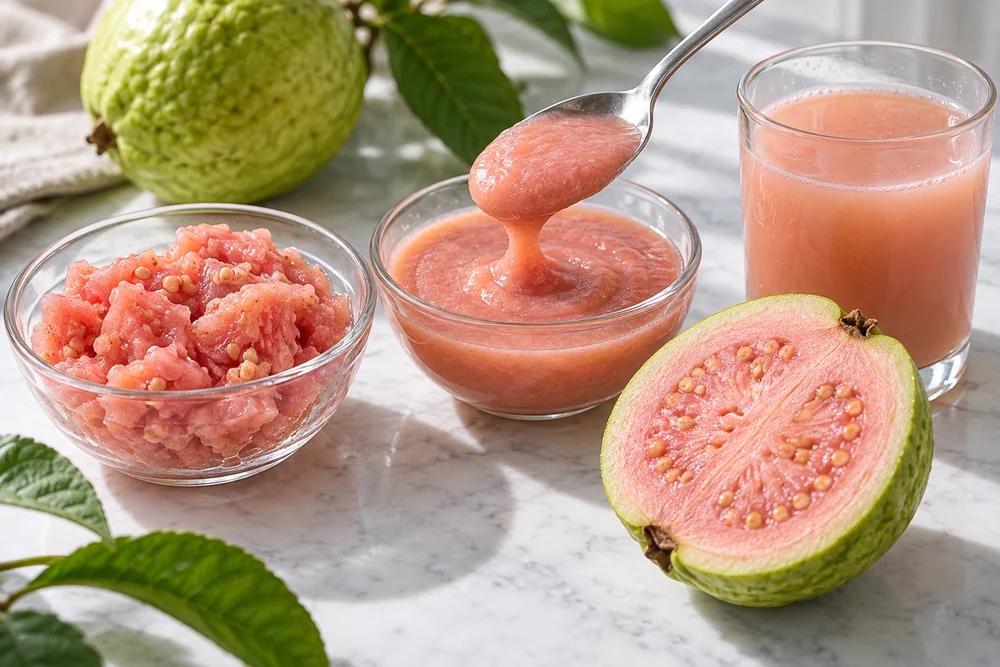
Choose the ingredient by the job it must perform. A drink plant needing a smooth, pourable base asks different questions from a bakery using visible fruit tissue or a processor receiving frozen pieces for its own pulper. Confirm composition, seed and peel state, concentration, packing and process history before comparing prices. At GreenLand-food, the current photographed guava form is skin-on pink pieces; a request for puree or another preparation requires a separate product proposal and sample.
Pieces and pulp describe different starting points
Frozen pieces preserve a visible fruit structure. In skin-on guava, some pieces include green peel and the firm central seed area, while others contain more outer flesh. Their natural irregularity matters to feeding and pulping. The buyer takes responsibility for defining the preparation needed downstream. A puree, by contrast, has already undergone a suitable size-reduction route. It may also have been refined, heat treated, concentrated or packed aseptically, but those properties need confirmation rather than inference from the word puree.
Pulp can mean different things in different commercial conversations. One supplier may use it as another name for a smooth fruit puree. Another may use it for a coarser preparation or a frozen fruit base. The term does not establish that hard seeds are absent, that no peel remains or that the material can pass a particular depositor. Ask for a description of the edible fraction, removal steps, screen or refining route and finished texture. A representative sample usually resolves ambiguity more effectively than another adjective.

Pieces require a defined preparation route before they become a smooth beverage base.
The Codex fruit juice and nectar standard provides a useful terminology framework: puree is prepared from the edible fruit portion without separating out its juice. That distinguishes a retained-fruit preparation from a stream of expressed or otherwise prepared juice. The definition does not tell a purchasing team every physical attribute of a commercial puree. Particle distribution, seed residue, viscosity, added ingredients and storage state still require a specification appropriate to the application.
Our frozen guava supply page shows why this distinction matters in practice. The visible pieces retain skin and central tissue; a buyer should plan the intended screening route when assessing usable yield. A peeled or seed-reduced grade requires separate preparation evidence. It would be misleading to treat the photographed fruit as a seedless base simply because the final recipe is a beverage. Describe what enters the factory and what must leave the preparation stage as two connected decisions.
When comparing quotations, put all candidates on that same basis. One price may include preparation that another plant must perform after receiving the fruit. A raw piece price, a refined frozen pulp price and an aseptic puree price can all be commercially reasonable while representing different work. The comparison becomes useful once purchasing can see the operations, losses, storage demands and acceptance evidence attached to each offered form.
Write seed and peel tolerances as observable outcomes. A request for seedless can mean no whole seeds, no visible fragments, or a stricter sensory requirement; the agreed interpretation affects preparation and cost. Define the sample quantity, how it is inspected and what causes rejection. If the buyer needs a very smooth beverage, include the relevant mouthfeel check after the intended process. An inspection of a handful of frozen pieces cannot establish the coarse-particle condition of an entire prepared base. The sampling and test should match the problem the plant needs to prevent.
Juice can be cloudy or clear
A guava juice does not have to look like transparent apple juice. The AIJN public guava introduction recognizes both cloudy and clear guava juice and identifies Psidium guajava as the source fruit. Appearance therefore needs its own description. An opaque sample can be consistent with a pulpy fruit product; a clear sample may reflect additional processing. The photograph alone cannot establish composition or whether a beverage is properly named for its market.
Cloudiness, coarseness and sediment are related observations, but they describe different things. A uniformly cloudy drink can feel smooth, while a small amount of coarse material can create grit in an otherwise thin liquid. A rested sample may separate into layers even when it pours acceptably after shaking. Define which condition matters to the customer: appearance through the bottle, drinking texture, straw performance, or stability after the expected storage and handling. Each calls for a suitable observation or measurement.
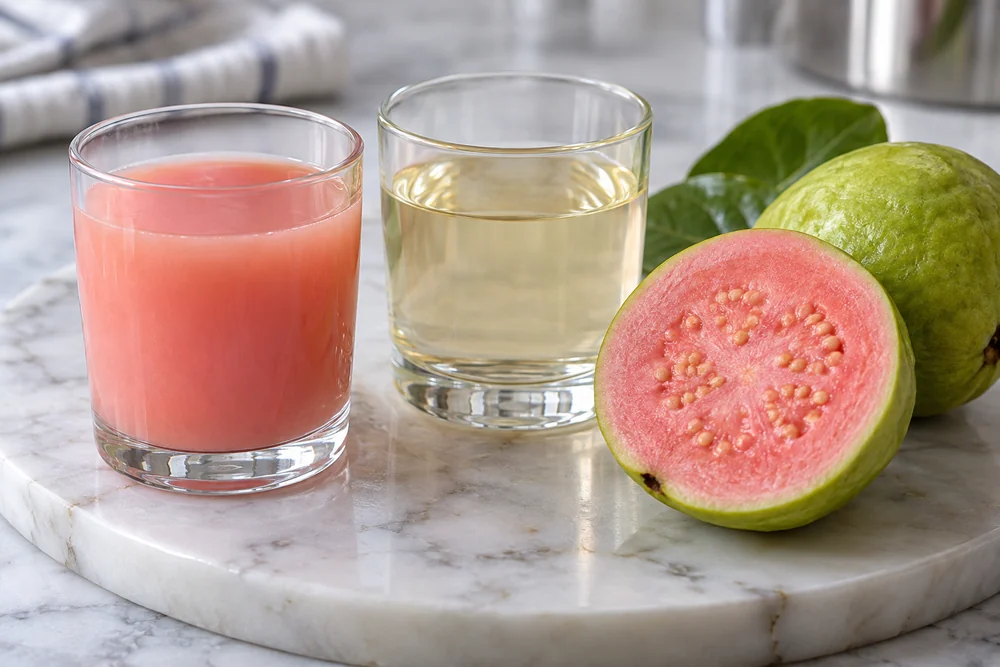
Cloudy and clear are different appearance targets; the photograph does not establish a formulation or legal product name.
Clear guava juice is a separate development objective from merely straining out whole seeds. FAO's guava processing discussion describes clarification as an additional route. That context explains why a beverage developer should ask how clarity was achieved and what changes occurred to flavor and body. It does not mean every puree can be turned into a clear drink by fitting a finer kitchen sieve, or that the economics of the clarified stream match those of a cloudy base.
Request the concentration basis too. Direct juice, reconstituted juice and concentrate are different descriptions. If the product is reconstituted, the relevant rules and agreed composition govern the water added back. An arbitrary dilution of puree should not be called equivalent to a defined single-strength juice merely because it reaches a convenient pouring consistency. Market-specific naming and fruit-content declarations need to be checked against the actual formula and destination requirements.
Assess clarity after the real process, rather than only in a freshly prepared cold beaker. Heat treatment, homogenization, blending and packaging can affect the final appearance. Keep the test conditions consistent when comparing suppliers. Record the resting period and whether the product is examined before or after shaking. These observations help the buyer choose a route, but a short development trial does not establish a finished shelf life or prove compliance with a label claim.
Nectar is a formulated beverage
Nectar gives a thick or strongly flavored fruit base a drinkable form through formulation. Under the Codex framework, water is added to the defined fruit ingredients, with permitted sweetening optional. The exact composition and naming rules depend on the destination market. Buyers should therefore ask what percentage and type of guava ingredient the formula contains, rather than assuming that nectar always has one fixed fruit percentage or must always contain added sugar.
A real product label helps show the distinction. The GOYA guava nectar page lists a formulated ingredient system that includes water, guava puree and sweetening, among other ingredients. That is one commercial example, not a recipe for all nectars. Its manufacturer also directs users to check the actual packaging because formulations can change. The useful purchasing lesson is to read the complete declaration and the current SKU specification.
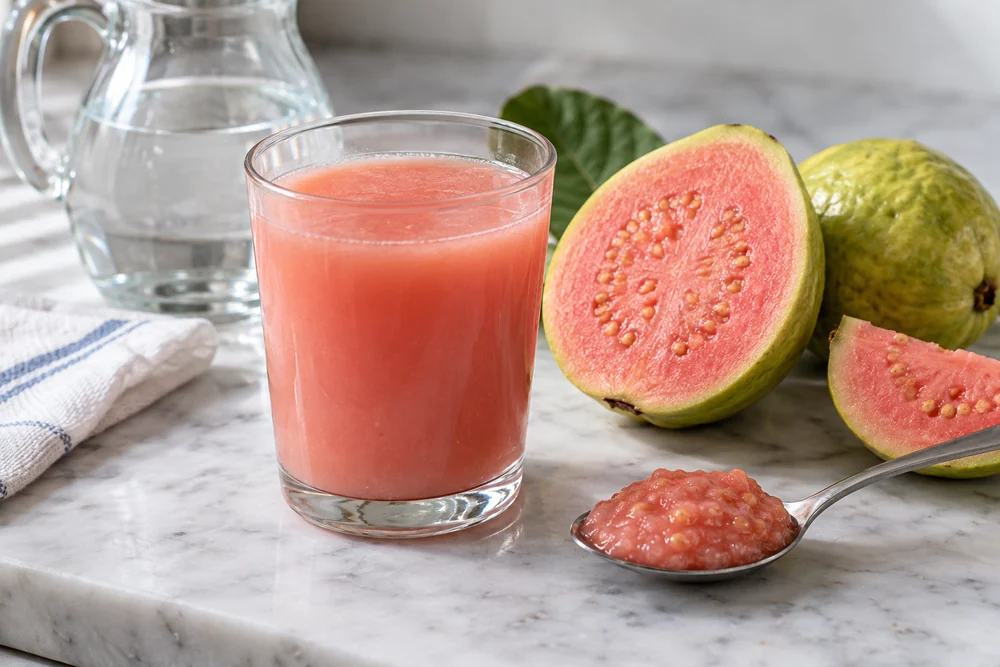
A formulated nectar needs its own declared composition and intended use.
Nectar should not be substituted for unsweetened puree by volume without reformulating the recipe. The swap can change water, sugar, fruit solids, acidity and texture simultaneously. In a bakery filling, the added water may alter concentration time and finished body. In a dairy drink, the balance may influence the intended fruit flavor and the way the mixture behaves during processing. Compare candidates using the fruit contribution and full formulation, then validate the actual application.
A developer can first establish the desired guava character, sweetness and drinking consistency, then evaluate a feasible formulation around those goals. The fruit input still needs to meet seed, peel and quality requirements. Dilution can make a base flow more easily, but it does not remove hard fragments or correct an off flavor. Any stabilizer, acid, sweetener or other addition should be part of the declared formula and the technical trial, with appropriate regulatory review.
Commercial quotations should identify whether the item is an ingredient for further processing or a finished beverage. A nectar sold in a retail carton brings a different pack, distribution route and use instruction from a bulk unsweetened guava base. Comparing their kilogram prices can be helpful only for a defined application. The buyer needs to account for how much usable fruit and other formulation work each route provides, together with the packaging and process that must follow.
A formulation example makes the substitution problem visible. Imagine a recipe designed around 1 kg of unsweetened puree. Replacing it with 1 kg of a hypothetical drink containing 30% puree introduces only 0.3 kg of that puree, together with the drink's other ingredients. Matching the original fruit contribution would require a different quantity and would also bring more water and additions. These figures are an illustration, not a nectar composition rule. The developer needs the candidate's actual declaration and technical data to decide whether a practical reformulation is possible.
Compare composition and measurement methods
The following comparison is a starting framework. Each supplier still needs to define its actual product, especially where pulp is used as a broad trade name.
| Description | Physical starting point | Questions before approval |
|---|---|---|
| Frozen guava pieces | Visible cut fruit, possibly retaining peel and seeds | What preparation remains, and what usable recovery does the buyer's route achieve? |
| Guava pulp or puree | Prepared edible fruit tissue with its juice; texture depends on the route | What is removed, what is added, and how are coarse material and consistency measured? |
| Guava juice | Fruit-derived liquid, cloudy or clear as specified | What extraction or clarification route, concentration basis and legal product description apply? |
| Guava nectar | Formulated beverage using eligible fruit ingredients and added water | What fruit contribution, sweetening, additions and final-use instructions apply to this SKU? |
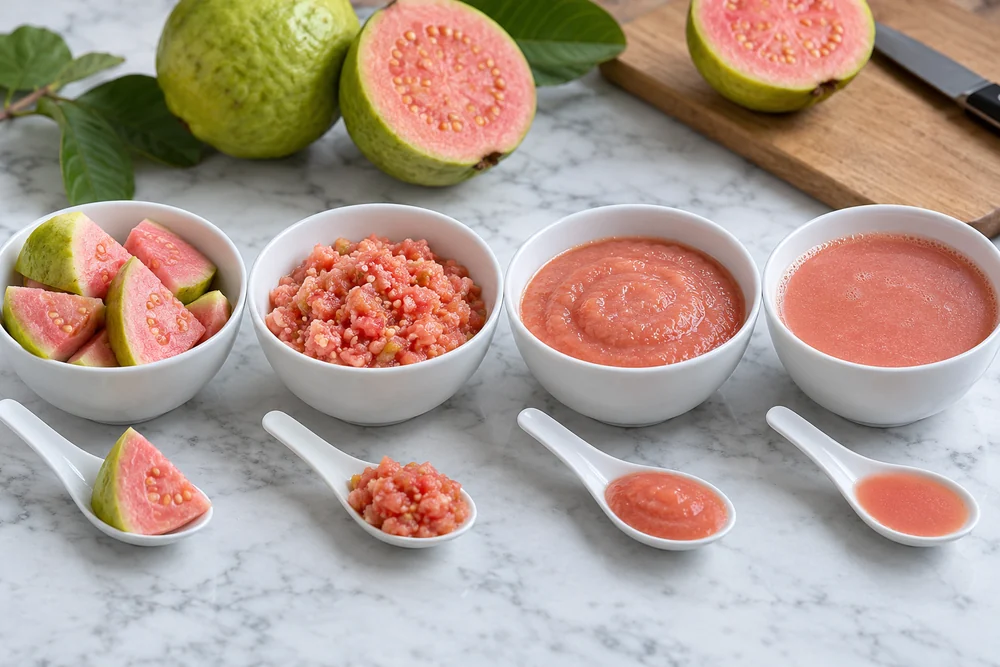
Compare the actual preparation, added ingredients and measurement basis behind each commercial name.
Brix is useful when its method and sample basis are clear. A value measured on a suitable prepared liquid fraction should not be casually compared with an unqualified reading from a coarse, partly frozen pulp. Ask about sample preparation, temperature correction and reporting. Soluble solids are one part of the composition; the same apparent sweetness does not prove the same acidity, aroma or insoluble fruit tissue. Keep those attributes separate when they matter to formulation.
Published manufacturer specifications show the range of commercial presentations. Ceres Fruit Processors lists several guava puree concentrations, while Taj Agro uses pulp and puree together for its white-guava preparation. Those pages are evidence that the market contains distinct products. Their analytical values, varieties, packing and shelf-life statements belong to the described supplier programs. They should not be copied into a specification for another seller's frozen pieces or assumed to describe every pink or white guava lot.
Texture measurements also need conditions. A flow result can change with temperature, preparation and the time allowed after mixing. A screen aperture is a processing detail, while a finished coarse-particle result describes an outcome under a method. Ask which one is being reported. If a few seed fragments could cause rejection, the acceptance method should look for that problem directly instead of relying solely on an average consistency value or a photograph of a smooth spoonful.
Build the sample approval around the attributes that decide the application. For a pourable beverage, the useful set may include aroma, acidity, body, grit and settled appearance. For a deposited preparation, coarse material and flow through the actual nozzle may carry more weight. The specification should connect each consequential attribute to a repeatable test and an approved reference. It does not need to accumulate measurements that no one uses to accept or reject material.
Choose the form around the finished application
A beverage line with an established pulper may prefer frozen pieces because it can control its own refining and blend the recovered base into several products. The same pieces may be awkward for a smaller plant that has no seed-removal equipment. A prepared puree can simplify that operation, provided its texture, composition and packing suit the line. The choice depends on the work the buyer can reliably perform and the outcome the finished product needs.
For a drinking yogurt or cultured dairy application, trial the guava within the intended system. Evaluate flavor, visible specks and mouthfeel at the actual fruit loading and serving condition. The fruit preparation's acid balance and solids are part of that trial, along with the order of addition and any downstream treatment. A successful plain guava drink does not automatically approve the same base for a dairy product. Keep the dairy process and its safety requirements under the responsible manufacturer's control.
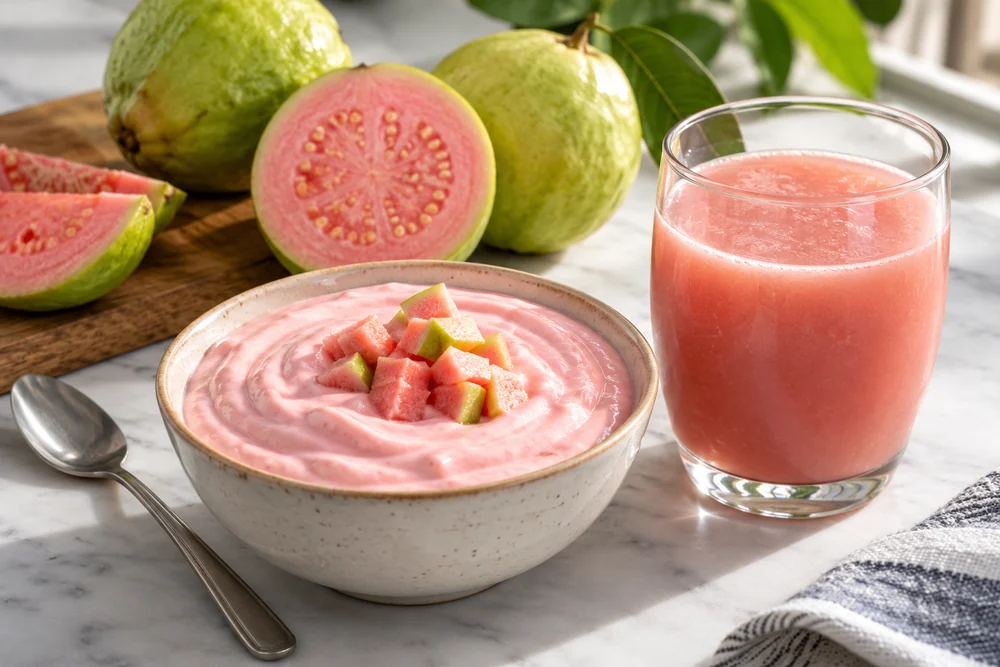
Dairy and beverage applications require different texture trials and confirmed prepared inputs.
Frozen desserts require another view of the same ingredient. A smoothie may tolerate substantial natural fruit body, while a fine-textured ice pop may expose grit more clearly. Freezing the finished recipe changes the eating experience, so judge the product at its intended consumption state. A warm spoonful of puree cannot establish the final frozen texture. Record whether the sample is a base for blending or a visible inclusion and set the seed and peel requirements accordingly.
Bakery and confectionery operations may concentrate the fruit further or combine it with sugar and a gelling system. A thin nectar can introduce formulation work that a prepared fruit base avoids. Conversely, a very thick paste may be unsuitable for a pump designed for puree. The relevant decision is what enters the equipment and how it behaves through the process. A name such as guava filling should carry a composition and application specification rather than stand in for one.
For all these uses, the approved sample should be tested after the operations that can reveal failure. Those might include heating, mixing, freezing, thawing, storage or dispensing. Select the observations around likely defects, such as sediment, leakage, graininess or inconsistent portions. The wider frozen fruit range can support blend planning, but each fruit and preparation still needs its own application check when its structure or composition influences the result.
Pack size also affects which form is workable. A large frozen block may need a planned thaw and mixing procedure before a uniform sample can be drawn. A small prepared pack can simplify a short run while carrying a different packing cost. Consider how the plant will open, protect, portion and use the ingredient within its approved conditions. Include any material left in the pack and any portion that cannot be used within the permitted handling period. Those losses can change the economics even when the fruit base itself is acceptable.
Compare usable fruit and finished performance
Price per delivered kilogram is only one part of the comparison. For pieces, include usable recovery after the agreed preparation route. For puree, establish whether the quoted mass is single strength or concentrated and whether additions are present. For nectar, consider the actual fruit contribution and whether the recipe can use its added water and other ingredients. A lower price can be valuable, but the comparison needs to explain what that kilogram contributes.
Use a simple illustrative calculation to keep the boundary clear. If 10 kg of pieces produces 7 kg of acceptable screened base, the fruit cost for each usable kilogram is the delivered cost of 10 kg divided by 7, before preparation and other expenses. If water is later added, that larger blend mass does not increase the recovery of fruit. This example shows the arithmetic only; it is not a standard guava yield or a quotation basis for an untested lot.
Two bases can also produce different acceptable finished outputs at the same nominal fruit loading. One may need further refining or fail the intended sensory standard. Another may require a different sweetening or acid adjustment. Keep these development observations visible in the cost model. Include labor, equipment time, waste and packaging consequences where material. Do not hide a seed-fragment rejection or an unapproved ingredient addition inside an average sensory score.
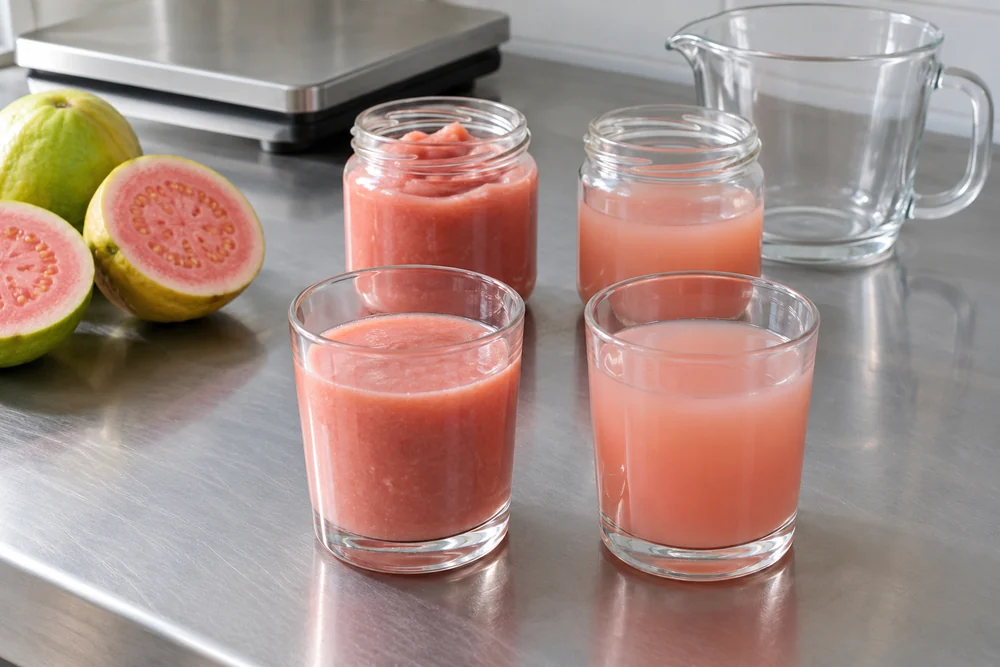
Compare candidates in the same application; these unlabelled samples show no measured commercial result.
Run the comparison with representative samples and controlled conditions. Preserve lot codes, preparation instructions and a reference sample where appropriate. Use the same measurement method for each candidate, and document any change required to make a route workable. If one material is tested after a long controlled thaw and another is evaluated directly from a cold pack, the difference in observed flow may describe preparation history rather than intrinsic product quality.
Scale the trial before making a long-term commitment. A small successful beaker gives direction, while factory equipment can introduce different hold-up, shear and heating patterns. Confirm the relevant controls and final performance on the intended line. The commercial approval should say what result was accepted, which input produced it and what changes require another review. That makes an ingredient substitution a manageable decision instead of a guess based on familiar terminology.
Sensory comparisons benefit from coded samples when practical. Present candidates in the same vessel at the same temperature and fruit contribution, and ask the panel to assess defined attributes before revealing supplier identity. Record the decisions behind acceptance, such as smoothness, aroma or the balance of body and pourability. A preference recorded only as better gives the purchasing team little help when the next crop arrives. Keep the agreed reference and the repeatable preparation method beside the score so a later discussion can identify the attribute that actually changed.
Buy the form that has actually been confirmed
An effective inquiry states the intended finished product first, then the requested input. For guava, include flesh color, skin and seed state, cut or texture, composition, concentration basis, pack, expected quantity and destination. Explain whether the plant will screen the material or needs an already prepared base. A supplier can respond more usefully to those details than to a request for guava pulp that leaves all of them open.
Check storage and processing status separately from physical form. Frozen, chilled and aseptic are not interchangeable supply conditions. Confirm the actual shelf life, storage instruction, handling after opening and intended further processing for the offered SKU. Supplier quality documents and traceability should identify the relevant lot and specification. A general company certificate or product-family brochure does not establish every property of the sample submitted for approval.

The quoted form should match the sample and receiving description.
Request destination-appropriate ingredient and label information, especially if sugar, acid, stabilizers or colors are present. The supplier's commercial name may not be the final legal name of the finished beverage. The responsible manufacturer should review the actual recipe under applicable market rules. That review is easier when the purchased input has a clear declaration and the buyer can distinguish fruit composition from additions made during its own process.
At GreenLand-food, we can discuss the photographed frozen guava pieces and the sample and packing appropriate to the proposed order. Any puree, peeled or seed-reduced request should be confirmed as a separate preparation rather than assumed from those photographs. Tell us which operations your plant performs and which finished defects it must prevent. We can then connect the ingredient discussion to a specific trial and a form that is actually available for quotation.
Keep the approved description consistent across the purchase specification, sample record, invoice and receiving check. When a change in crop, origin, preparation or formulation could affect the application, agree the review route before production depends on it. Clear terms reduce ambiguity, but the final decision rests on the declared ingredient and its demonstrated performance through the buyer's real process.
Source Frozen Guava with GreenLand-food
GreenLand-food is a professional frozen guava supplier and manufacturer in China, providing factory-direct wholesale supply for importers, food manufacturers, foodservice distributors and private-label programs.
Send your required product form, specification, packing, quantity, application, destination, private-label needs and requested documents. Include the seed and peel tolerance and the preparation route your plant plans to use, so the sample and quotation describe the actual ingredient.
We confirm the offered form and pack for the order; any peeled, seed-reduced or puree request needs its own preparation evidence and approval.