


What Is Peach Nectar? Juice, Puree and Concentrate Compared
Sep 23, 2026
Leave a message


What Peach Nectar Is and Why It Is Usually Opaque
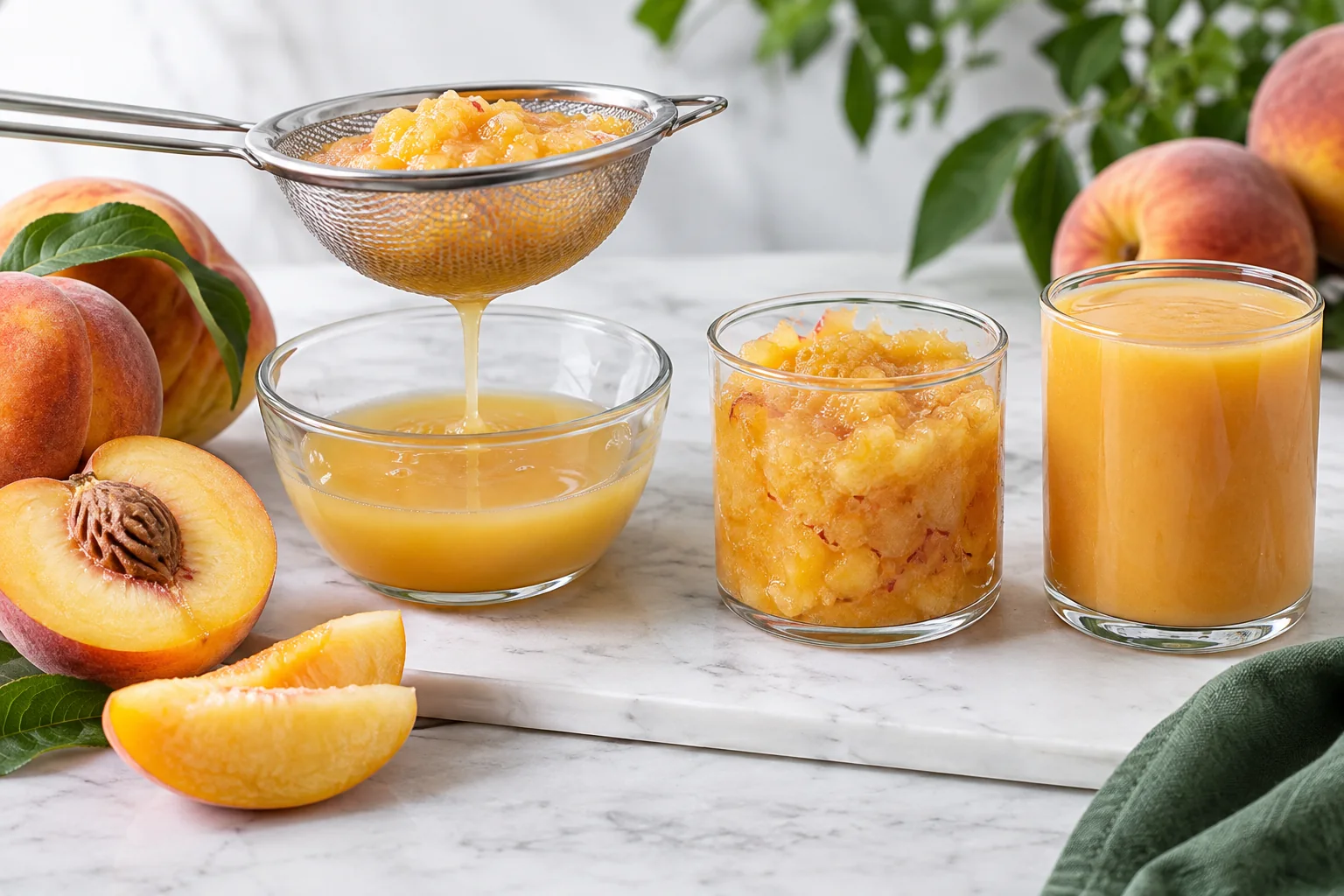
Peach nectar is best understood as a formulated fruit beverage with suspended peach solids. Ripe peach flesh contains insoluble cell material, soluble pectin, fine fibers, and natural pigments. When the fruit is crushed or pulped, much of that material remains in the liquid. It scatters light, so the beverage appears cloudy or opaque. It also creates the body that distinguishes a convincing peach nectar from thin, flavored water.
The opacity can vary. A fine finishing screen produces a smoother beverage with smaller particles; a coarser screen preserves more pulp and a more rustic texture. Enzyme treatment, clarification, centrifugation, homogenization, and heat all change how much material stays suspended. A completely clear result is possible only with more intensive clarification, and at that point the product is behaving more like a clarified juice ingredient than a classic nectar.
A precise cutaway-style food illustration showing peach flesh, expressed liquid, suspended pulp and a smooth nectar texture without text labels.
The FAO fruit-processing guide describes nectar as juice or pulp diluted to a drinkable consistency, with the required fruit share governed by the applicable standard. That definition is useful because it separates the identity of the beverage from the form in which the fruit entered the plant. A nectar can begin with puree, concentrated puree, juice, or concentrate, provided the finished formula and label comply with the destination rules.
Texture is part of the product promise. Consumers generally expect peach nectar to coat the mouth lightly, release aroma as it warms, and show a natural peach color rather than water-like transparency. Yet more pulp is not automatically better. Excess pulp can make filling difficult, increase sediment, trap air, and create a pasty finish. Too little pulp can make the drink seem diluted even when its measured soluble solids are acceptable.
Product developers should define opacity and body with reference samples instead of adjectives alone. "Rich," "natural," and "premium" mean different things to different teams. A better brief states the target fruit percentage, the preferred pour rate, whether visible settling is acceptable, the intended package, and whether the consumer is expected to shake the container. Those decisions give the ingredient supplier and pilot team something measurable to work toward.
Peach Nectar, Juice, Puree and Concentrate Compared
The four terms describe different material states, not a simple quality ranking. Peach juice emphasizes the liquid extracted from the fruit. Peach puree includes the finely divided edible flesh. Concentrate has had part of its water removed. Nectar is the finished or near-finished beverage created by balancing fruit material with water and any other permitted ingredients. A puree may be the main fruit input in a nectar, but the puree itself is not automatically a ready-to-drink nectar.
| Form | Typical character | Processing value | Main point to confirm |
|---|---|---|---|
| Peach juice | Thinner, less pulpy, may be clarified or cloudy | Easier pumping and lighter beverages | Single strength or concentrated; clarity; Brix; acidity |
| Peach puree | Opaque, thick, carries flesh and fiber | Strong body and recognizable peach texture | Screen size; viscosity; particle profile; heat history |
| Peach concentrate | Dense fruit solids with less water | Lower transport volume and flexible reconstitution | Concentration basis; reconstitution ratio; aroma recovery |
| Peach nectar | Pourable formulated beverage | Ready for filling or final adjustment | Fruit percentage; sugar and acid balance; label category |
| Frozen peach pieces | Identifiable fruit, not standardized liquid | Allows in-house pulping and formula control | Variety; cut; ripeness; defects; pit fragments; thaw loss |

A clean beverage pilot bench showing peach puree being blended with measured water into a uniform pourable nectar, with realistic viscosity and no numbers or branding.
Juice and puree also differ in yield behavior. Pressing peach flesh for a relatively clear liquid leaves more solids behind. Pulping aims to recover the edible flesh, so the mass yield is higher but the material is more viscous. A buyer comparing prices per kilogram should therefore compare the usable solids delivered to the recipe, not only the invoice price of each form.
Concentrate adds another calculation. Reconstitution replaces the water removed during concentration, but it does not automatically restore the exact sensory character of freshly pulped fruit. Volatile aroma can change during thermal concentration, and prolonged heat can darken the color. Some beverage developers value concentrate for efficiency and consistency; others blend concentrate with puree or fruit pieces to rebuild fresher aroma and texture.
For a frozen-fruit buyer, cut peach can be useful when the plant already has pulping, screening, blending, and thermal processing equipment. It gives the processor control over screen size and allows the same ingredient to serve beverages, bakery fillings, sauces, and dairy applications. Buyers who need a pumpable, highly standardized ingredient may prefer puree. The right comparison is operational: tank capacity, thawing method, labor, waste, line shear, filtration, microbiological controls, and the finished sensory target all belong in the decision.
How Peach Fruit Becomes a Pourable Nectar
The process begins with fruit suitable for the intended flavor and color. Variety, maturity, crop weather, and time between harvest and processing influence aroma, acidity, and flesh firmness. Peaches that are too firm may produce greener flavor and more resistant pieces; overripe fruit may bring soft texture but also more browning, fermentation risk, and variable solids. Frozen peach preserves the condition established before freezing, so the raw-material specification remains important even when supply is held as inventory.
After sorting and pit removal, the edible flesh is crushed or pulped. A finisher or screen removes coarse skin fragments, fibrous tissue, and any missed hard material while allowing the desired pulp fraction to pass. The screen choice is a product-design tool: a fine screen supports a smoother nectar, while a coarser screen can increase recognizable fruit character. It should not be selected in isolation from the pump, filler, and package opening.

A reconstitution comparison showing dense peach concentrate before dilution and a finished peach beverage after controlled mixing, using visibly different consistencies.
The peach base is then blended with measured water and, where the formula allows, sugar, acid, antioxidant, stabilizer, or other ingredients. The order of addition matters. Dry materials should disperse without clumping; acid addition can change pectin behavior; high shear can smooth the drink but can also entrain air. Plants commonly remove air or control mixing speed because oxygen accelerates flavor loss and browning.
Homogenization may be used to reduce particle differences and slow separation. It does not make an unstable formula permanently uniform by magic. The fruit particle size, pectin level, soluble solids, density difference, stabilizer system, and heat treatment still determine what happens during shelf life. A sample that looks uniform immediately after mixing may settle after several days or after temperature cycling.
Thermal treatment must achieve the required safety and shelf-life objective without cooking away the fresh peach note. The exact time and temperature are process-authority decisions, not a generic recipe number. Package type, pH, fill temperature, equipment, and distribution all affect the validated process. Pilot work should therefore use production-relevant heating and cooling rather than judging only a cold bench blend.
Finally, the team checks fill weight, appearance, soluble solids, pH or titratable acidity, viscosity, and sensory character. These checks create the bridge between a concept and a reproducible batch. When frozen peach is the starting material, the thaw method and the handling of released juice must be fixed as part of the procedure; discarding thaw liquid can unintentionally remove flavor and soluble solids from the formulation.
Fruit Content, Brix, Acidity and Label Decisions
Fruit content answers how much peach-derived material is present, but that number must be calculated on the correct basis. A kilogram of concentrated puree does not represent the same single-strength fruit contribution as a kilogram of ordinary puree. Reconstitution factors, declared soluble solids, and the local legal definition all affect the calculation. Buyers should ask the formulator or regulatory team to document the basis rather than relying on an informal percentage.
Rules vary by destination. The European Union, for example, defines fruit juices and nectars through legislation and minimum fruit-content schedules; the consolidated requirements should be checked for the exact fruit and market through the EU fruit juice framework. Other markets use their own standards, names, sweetener rules, and labeling conventions. "Nectar" may be familiar to one consumer group and unusual to another, so regulatory compliance and market communication have to be solved together.

A beverage quality-control scene comparing three peach nectar samples for color, settling and pour behavior in identical glass cylinders, with no fabricated test results.
Brix is a useful control for soluble solids, but it is not a direct meter of peach quality or fruit percentage in a sweetened beverage. Added sugar raises the reading. Organic acids and other dissolved material contribute as well. A formulation can meet a target Brix and still taste flat, overly sweet, thin, or cooked. For incoming peach ingredients, Brix helps describe lot condition; for finished nectar, it must be interpreted with the recipe.
Acidity shapes both flavor and processing behavior. Peach aroma often seems brighter when sufficient acidity balances sweetness. Too much acid can make the beverage sharp and can alter the way pulp feels in the mouth. pH and titratable acidity answer different questions: pH is closely related to microbial and process decisions, while titratable acidity better reflects the quantity of acid contributing to sensory balance. Product briefs should state which value is required.
Label choices follow the actual formula. A drink made from puree, water, sugar, and acid may need different ingredient wording from one reconstituted from concentrate. Claims such as "no added sugar," "100% juice," "not from concentrate," or "with pulp" have specific consequences and cannot be inferred from the product's appearance. Before purchasing a large fruit lot, the buyer should align the intended claim, ingredient declaration, destination standard, and supplier documents. That prevents a technically acceptable ingredient from becoming unsuitable after artwork has been approved.
Choosing Frozen Peach Input for Beverage Development
Frozen peach is most useful when the beverage plant wants recognizable fruit input, flexible pulping, and supply beyond the short fresh crop window. It is not a drop-in equivalent to standardized commercial puree. Frozen halves, slices, dices, and irregular pieces have different thaw rates, handling labor, and suitability for the pulper. The cut should match the thawing system and the feed opening rather than being chosen only for appearance.
We ask buyers to define the fruit form, variety preference if relevant, peel tolerance, pit-fragment control, ripeness, color range, defect tolerance, pack weight, and destination documents. For a beverage, released juice in the bag or carton is part of the ingredient unless the validated recipe says otherwise. Net fruit weight, glaze if any, and the treatment of free liquid therefore belong in the receiving procedure.

IQF frozen peach halves and pieces in a lined carton.
The GreenLand frozen peach range can be considered alongside other frozen fruit formats when a developer needs to compare pieces, puree preparation, or blended-fruit concepts. Availability and specifications still need order-by-order confirmation. A web image cannot confirm the crop, pack, certification scope, or exact cut that will be supplied for a program.
Thawing deserves a written method. Slow thawing under refrigeration offers more control but requires space and time. Tempering only enough to feed a crusher can reduce idle time, provided the equipment can handle the remaining ice and the process is validated. Warm, uncontrolled thawing encourages microbial growth and can exaggerate softening. Repeated freeze-thaw exposure is particularly damaging to color and texture.
Trial calculations should include true recovery after sorting, pulping, and screening. A nominal one-tonne frozen peach input does not yield one tonne of finished puree because packaging residue, rejected pieces, skin, coarse fiber, and equipment hold-up create losses. The useful figure is kilograms of acceptable peach base per incoming kilogram, measured on the buyer's actual line. That recovery can reverse an apparent price advantage between two cuts or grades.
Texture, Color and Flavor Checks During Product Trials
Texture should be evaluated at the temperature at which the nectar will be consumed and after the processing steps it will actually receive. A warm sample feels thinner than a chilled one. High shear can temporarily mask particle differences. Heat can change pectin and suspended solids. For that reason, we prefer a small sequence of observations: immediately after blending, after thermal processing, after twenty-four hours, and after the planned storage challenges.
A simple pour test is useful when it is standardized. Use the same vessel, sample mass, temperature, and observation time. Record how quickly the nectar leaves the vessel, whether it forms a continuous ribbon, and how much pulp remains on the wall. Instrumental viscosity is better for a formal specification, but the visual test helps product and purchasing teams discuss the same behavior without pretending that "thick" is a precise unit.

A professional product-development table with peach nectar in a carton mockup without branding, smoothie base, and sparkling beverage application, all visibly derived from the same peach base.
Color evaluation should separate acceptable crop variation from deterioration. Peach base may range from pale cream through yellow to orange depending on variety and maturity. Browning, grey notes, or a dull surface can indicate oxidation, excessive heat, long exposure after thawing, or unsuitable fruit. Evaluate samples in consistent neutral lighting and against an approved standard. A bright display light can hide differences that become obvious in a clear retail bottle.
Flavor checks need more than a sweetness score. Assess fresh peach aroma, floral or stone-fruit notes, green character, cooked notes, bitterness, acidity, and the length of the finish. Taste the ingredient alone and in the formula because sugar, dairy, tea, carbonation, and flavorings can change perception. The University of Florida peach processing guidance is a useful reminder that Brix, pH, extraction behavior, and pectin all interact in peach beverages; none should be treated as a stand-alone quality verdict.
Settling is not always a defect in a pulpy nectar, but it must match the package and consumer instruction. If a gentle shake restores uniformity, the product may be acceptable. A dense plug that does not redisperse, a watery top layer, or particles that block the closure indicate a formulation or process issue. Run transport and temperature-cycle trials in the intended package before locking the ingredient, because vibration and storage reveal problems that a beaker on a bench does not.
How Buyers Specify Peach Ingredients for Nectar Programs
A useful peach ingredient specification starts with the beverage, not with a generic request for "IQF peach." State whether the fruit will be pulped, pressed, blended while partly frozen, or used as visible pieces. Describe the target nectar body, color, fruit content, package, process, shelf-life route, and market. This lets the supplier flag a mismatch before sampling instead of after a costly production trial.
For frozen pieces, common discussion points include cut dimensions and tolerance, peeled or unpeeled status, variety or approved variety range, maturity, color, Brix range where applicable, pit and hard-material controls, foreign-material controls, defect limits, microbiological criteria, pack format, storage temperature, and traceability documents. The buyer should also specify the sampling plan and the method used to measure each acceptance criterion. A limit without a method can produce disagreement at receiving.

Frozen peach halves showing pit cavities, color and surface frost.
Commercial planning is equally important. Confirm order quantity, trial quantity, annual forecast, shipment cadence, loading port, destination, pallet or carton requirements, and required certificates before approving the final sample. Frozen fruit availability can be extended through inventory, but inventory is not unlimited. Crop timing, processing bookings, and cold-store allocation affect when a stable program should be contracted.
Ask for samples that represent the proposed grade and crop as closely as practical. Record the lot identity, thaw protocol, recovery, and formula used in the trial. If the production order will use a different pack, cut, or crop, repeat the relevant checks. A beautiful hand-selected sample is not enough; the goal is a specification that routine commercial lots can meet.
Finally, agree on change communication. Natural fruit varies, and a new crop or approved-origin change may shift color, sweetness, or texture while remaining within specification. Define which changes require a new sample, certificate update, label review, or buyer approval. That small piece of governance is often what keeps a nectar program consistent from one season to the next.
The purchase specification should be paired with a production trial sheet. Keep the incoming lot number, frozen and thawed weights, thaw time, recovered pulp weight, screen used, dilution, sugar and acid additions, processing temperature, final batch mass, and sensory observations in one record. This is not paperwork for its own sake. It allows the team to explain whether a later difference came from the fruit, the thaw procedure, the recipe, or the line. Without that record, a buyer may reject a sound ingredient for a problem introduced during processing, or accept an inconsistent ingredient because a skilled operator corrected it informally.
It is also worth separating mandatory limits from working targets. Food-safety criteria, hard-material controls, legal identity, and agreed defect limits are acceptance requirements. Color shade, aroma strength, and viscosity may have a preferred target plus a wider usable range, depending on what the final formula can accommodate. This distinction helps purchasing respond rationally to natural crop variation while protecting the attributes that define the finished nectar. When both sides know which values are critical, sampling and corrective action become much faster.
The distinction between nectar, juice, puree, concentrate, and frozen fruit is therefore practical rather than academic. Each form changes the equipment, recovery, formula, sensory result, logistics, and label. Once those variables are stated clearly, frozen peach can be evaluated as a controlled beverage input instead of an undefined substitute for puree.
Source frozen peach with GreenLand-food
GreenLand-food is a frozen-food supplier and manufacturer supporting factory-direct wholesale programs. We match the requested product form and coordinate the commercial details. Share the required fruit form, cut, crop timing, pack, application and trial quantity. We will review the frozen peach options that fit your nectar or puree program.