


When Are Chestnuts in Season?
Sep 24, 2026
Leave a message


The chestnut harvest window by region
Chestnuts have a real harvest season, but there is no single worldwide chestnut month. In China, Europe and North America, the nuts usually fall and are collected during autumn. Weather, altitude, cultivar and the commercial definition of "in season" can shift the start and end by several weeks. A retail display in January can therefore be genuine fresh-stored produce from the preceding harvest; it does not mean a new crop is being picked in January. In the United States, the USDA's chestnut inspection guidance refers to an October–December marketing window. A European food reference places the season from about mid-September through November. These are useful orientation points, not purchase guarantees for a particular supplier, variety or year.
The Southern Hemisphere creates a different calendar. Chestnuts Australia gives a mid-March to July fresh season, and notes that peeled frozen chestnuts remain available beyond it. That counter-season can matter to a buyer planning an April menu or a midyear pastry promotion. It does not automatically mean an Australian origin is interchangeable with a Chinese or European origin: kernel size, sweetness, peeling yield, cut specification, freight route and commercial volume still have to fit the product. Use the month as a first screening tool, then check the lot you can actually order.

In-shell sweet chestnuts beside peeled kernels.
| Supply region | Indicative fresh crop or market period | Planning implication |
|---|---|---|
| Northern Hemisphere origins | Mainly autumn; often September–December across harvest and early fresh marketing | Confirm origin, current crop year and the supplier's intake schedule before launching a seasonal fresh program. |
| Australia | Approximately mid-March–July | A counter-season option for fresh use; confirm variety, export route and available volume. |
| Frozen peeled inventory | Depends on processing, contract and stock, rather than the date the nuts fall | Ask for available lots, packing dates, frozen storage history and reserved volume for the required delivery months. |
These rows describe broad windows rather than a global standard. A grower may have a narrow picking period, while a distributor can sell inspected, cold-stored in-shell nuts for longer. A buyer should separate three dates in every conversation: when the nuts were harvested, when they were peeled or cooked and frozen, and when the contracted lot will ship. Each date answers a different quality or supply question. A November harvest date alone does not establish that the same lot will remain available for a June factory run.
For ingredient purchasing, the best calendar is built backward from production. List the months when chestnuts must be on the line, the form required, and the time needed for sampling, approval and sea or land freight. Then ask suppliers which crop and inventory can cover that schedule. This prevents "chestnuts are in season" from becoming an attractive but unusable answer to an availability question.
Why fresh chestnuts appear beyond harvest weeks
An in-shell chestnut is still a living, moisture-rich seed after collection. Its appearance in a shop may extend past the day it fell from the burr because growers and distributors grade, cool and store sound nuts. Retail season therefore includes both harvest activity and a postharvest selling period. It is normal to see overlapping claims about when chestnuts are in season when one source means the picking period and another means the months in which consumers can buy acceptable fresh nuts. The distinction is particularly relevant in an import program with time in transit.
This extended presence requires care. Chestnuts are unlike dry walnuts or almonds that are routinely stored at room temperature for long periods. Fresh chestnuts lose moisture, can develop mold or decay, and may sprout if conditions are wrong. Cooling, ventilation, stock rotation and appropriate packaging matter, yet a buyer should still judge the arrived lot rather than rely on a generic storage promise. Ask for handling conditions and the supplier's stated shelf life for the exact pack and route. On receipt, inspect shell integrity, firmness, unusual odor, visible mold and a representative cut sample where the specification permits it. A glossy shell can conceal an inferior kernel, so external appearance is only one check.

In-shell chestnuts in shallow ventilated harvest crates.
The time between picking and sale also affects preparation yield. A nut that feels light for its size, rattles inside the shell or has a shrunken interior may be harder to peel and less useful for a whole-kernel application. Broken shells invite closer inspection. These practical observations are not a replacement for the food-safety program or agreed acceptance criteria, but they help the purchasing and kitchen teams ask for a meaningful sample. A whole roasted chestnut sold at a premium deserves a different whole-rate tolerance from chestnut going into a blended filling.
For restaurants and seasonal retailers, fresh in-shell nuts can be part of the autumn experience. The shell, aroma and roasting ritual may be the product. For a bakery making a chestnut cream every week, that ritual is labor and yield variation. The correct decision depends on what the customer sees and what the production line needs. A menu can truthfully celebrate the autumn crop while using an agreed frozen peeled ingredient for repeatable preparation later in the year, provided the menu and ingredient information remain accurate.
Do not stretch the term "fresh season" to promise availability in any month. If a supplier offers fresh nuts outside the expected period, ask whether they are cold-stored, imported from a different hemisphere, or from another processing form. Record the answer and the lot's condition. That simple distinction turns a broad seasonal statement into a usable procurement record.
How frozen chestnuts extend seasonal use
Frozen chestnuts move the critical timing question from "are nuts falling now?" to "is a suitable frozen lot available and maintained to specification?" Peeled chestnuts can be prepared during or soon after a crop window, packed and held under frozen conditions for later use. The method can spare a foodservice kitchen repeated scoring, roasting and peeling, and can give a manufacturer an ingredient for a winter or spring run planned before the next harvest. It does not create unlimited supply: a sold-out size grade or exhausted contract volume is still sold out, even though freezing is technically possible.
The frozen form is especially useful where the nut will be heated, mashed, chopped or incorporated into another food. Think of soup, stuffing, bakery filling, confectionery paste or a prepared meal. For a visible whole chestnut garnish, the buyer should first examine whole-kernel percentage, surface condition, color and breakage after the intended thaw or cooking step. Frozen peeled chestnuts can perform well in both uses, but "frozen chestnut" is too broad a specification to predict either one. Ask whether the offered product is raw, blanched, roasted or otherwise cooked, because that determines the next safe and practical kitchen step.
Freezing helps preserve an ingredient; it does not reverse defects that existed before freezing. A dry, damaged or poorly peeled kernel will not turn plump in the freezer. Likewise, a bag with excessive loose ice, clumps or broken pieces can add rework to a factory line. Review an actual sample using the same cooking method and portion size as the final product. If the production recipe requires thawing, test whether the thawed chestnuts hold their intended shape. If the pieces go directly into a hot filling, test that route too. The most useful specification is one connected to the application rather than one copied from a catalog.

GreenLand peeled frozen sweet chestnut kernels.
For continuity planning, ask the supplier to identify current inventory, projected replenishment, normal pack size and whether a contract can reserve the volume needed across several shipping dates. Document the lot and pack dates along with the agreed frozen storage conditions. Those details make a year-round use claim operational. A buyer also needs a contingency if the next harvest is late or the whole-kernel yield is lower than expected; this may mean approving a second cut size for a blended recipe or holding safety stock. A substitute should be reviewed before a production shortage, not discovered on the day the line starts.
GreenLand-food's frozen peeled chestnut range is relevant when you need the ingredient outside the fresh crop window. We can discuss the required form, whole rate, packing, quantity and destination against the lots actually available. We would not choose a kernel grade solely because the calendar says "off-season"; the tested recipe and receiving standard should decide.
Choose whole, peeled, diced or puree-grade chestnuts by application
The right chestnut form depends on whether the nut must remain visible. Fresh in-shell chestnuts suit roasting and a deliberate table or retail presentation, but shell removal brings labor, peel loss and batch-to-batch variation. Peeled frozen whole kernels reduce that handling and can serve dishes where a recognizable chestnut piece matters. Diced or broken pieces can be more economical for fillings and prepared foods in which precise whole appearance adds no value. A puree or paste-grade ingredient changes the moisture and formulation question again; the buyer should never assume that the same volume of whole frozen nuts will behave like a finished puree.
| Application | Useful starting form | What to approve in a sample |
|---|---|---|
| Whole garnish or retail-ready meal component | Peeled whole kernels | Whole-rate, color, bite after heating and visible breakage. |
| Stuffing, dumpling or bakery filling | Diced or broken peeled pieces | Piece size, distribution, moisture release and consistency after mixing. |
| Soup, sauce or chestnut cream | Cooked chestnut or suitable puree input | Cooking status, solids, sweetness and final viscosity. |
| Roasted seasonal service | Fresh in-shell nuts | Shell condition, preparation yield, peeling labor and sensory quality. |
This table is a starting point, not a rule that every factory uses. A soup maker may prefer whole frozen kernels because they already have a milling step. A premium stuffing may want visible halves, even though the food will be mixed. The sample must follow the plant's actual process: receiving, frozen storage, thawing if used, heating, blending, holding and final packing. Chestnuts contain starch and can change texture during cooking and cooling. A small pan test that stops before the holding period can miss a problem that becomes obvious in a chilled ready meal.
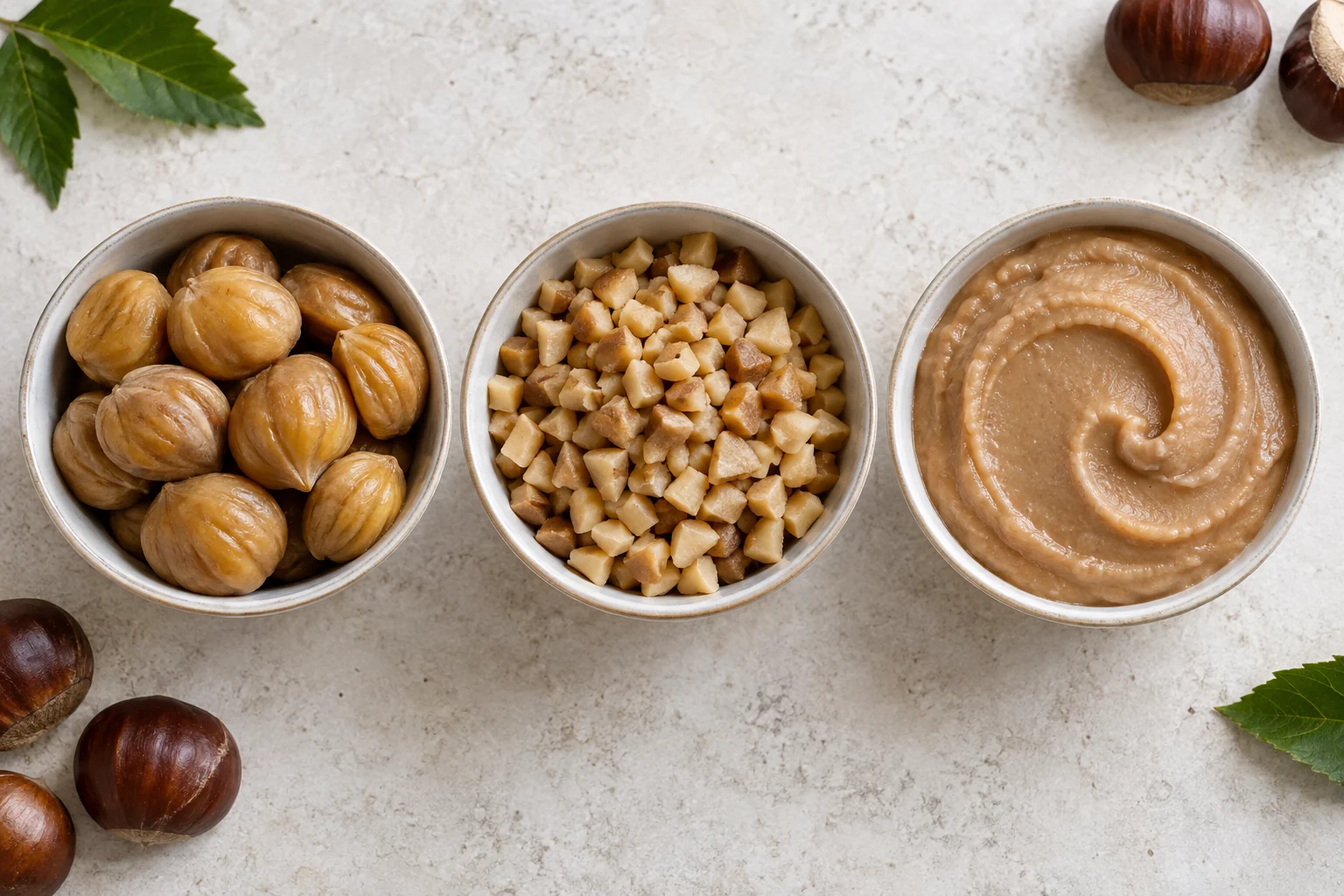
Whole chestnut kernels, diced pieces and smooth puree in separate bowls.
Define the cut in measurable language. "Large pieces" and "good whole rate" mean different things to two suppliers. A specification can state a target size range, the allowable proportion of fragments, whether surface skin remnants are acceptable, and the intended cook status. Also record any sensory standard that matters, such as sweetness, bitterness or a roasted note. Color variation can be natural, but a buyer should agree on limits that fit the presentation. If the product is hidden in a dark sauce, a cosmetic limit may be less important than reliable supply; if it sits on a pale pastry, appearance will be noticed immediately.
Packaging is part of the form decision. A large block or tightly clumped pack may be manageable for a continuous cooker but awkward for kitchens dosing small batches. Loose frozen pieces can improve portioning, yet the bag or carton still needs protection against handling damage. Ask for the number of inner packs per carton and the minimum unit a site will open. A sourcing decision is complete only when the kitchen can use the delivered format without unexpected repacking or thawing.
What crop timing changes about quality and specifications
A chestnut crop is affected by growing conditions, harvest timing and postharvest handling. The months in a generic season calendar do not tell a buyer whether a specific lot has the kernel size, moisture, peel quality or flavor needed for a recipe. When a new crop becomes available, review it against the approved reference sample instead of assuming it matches last year's purchase. A supplier may offer the same named product across crop years while the distribution of sizes or the percentage of intact kernels changes. This matters most when a narrow visual specification drives the order.
For in-shell nuts, basic receiving questions include shell integrity, firmness and the condition of a cut sample. For peeled frozen nuts, examine the kernel surface, skin-removal quality, frost, clumping, color and broken-piece rate. Test the product after the cooking step as well; a chestnut can look attractive while frozen and crumble or become waterlogged in the intended preparation. Such checks establish fitness for an application. They are not a substitute for supplier documentation, food-safety controls and the regulatory requirements that apply in the destination market.

Plump chestnut kernel compared with a dried, shrunken kernel.
The crop date and the processing date should not be conflated. A nut harvested in October may be peeled and frozen after grading and processing; the dates can legitimately differ. Ask how lots are coded and what the code traces, then keep a record of the approved sample, specification version and purchase order. If a customer later asks why a filling changed in texture, the team needs more than a statement that chestnuts are an autumn crop. It needs to connect the complaint to a lot, formulation and production period.
An early-season sample can be informative but may not represent all later deliveries. If the first shipment comes from one size fraction and the next from another, whole-rate or texture can change. Agree whether the approved sample is a fixed target or a broader acceptable range. Specify what happens if a lot falls outside that range: replacement, regrading, use in a lower-visibility application, or rejection. Setting this decision before a busy seasonal launch is less costly than debating it after cartons arrive.
Texture and moisture deserve particular attention for chestnut products. A dry kernel can taste chalky in a whole garnish; an overly wet one can soften a pastry filling. Neither issue is resolved by finding a more precise harvest month on a search page. Use a finished-product trial with the intended heating, mixing and holding schedule. When we discuss frozen chestnut supply with a buyer, the most productive starting point is the recipe and acceptance limit, followed by crop year and stock availability.
Plan purchase, sample and delivery around the crop
Build a chestnut buying calendar from the date the finished food must be made. Work backward through recipe approval, sample transit, technical sign-off, purchase order, production or reservation, international transport and warehouse receiving. A September fresh-crop expectation is not helpful to a November launch if the packaging artwork, import documents or sample approval requires more time than the crop offers. Conversely, a frozen program can often be planned well before its intended use, provided the supplier confirms the stock, conditions and delivery schedule.
Start with volume by month rather than one annual total. A bakery may use a steady base quantity and a much larger holiday peak. A hotel chain may need only short promotional windows. If the supplier sees the monthly curve, it can advise whether existing frozen inventory and future processing can cover it. Ask which items are subject to seasonal grade pressure: whole peeled kernels may be more constrained than dice or broken pieces. Record an approved alternative only where the recipe allows it. Switching to small pieces in a visible garnish is not a harmless procurement adjustment.
The sample request should name the target application. Include desired whole or cut size, whether the product should be raw or cooked, expected use after thawing, packing size, destination and any special labeling or document needs. Then test the sample in the final process. If several sites will use it, involve at least one receiving site and one production site so that a format that looks convenient in a laboratory is also manageable in service. A supplier's specification sheet matters, but it cannot show how your particular sauce, filling or holding time will affect the result.

Peeled chestnut samples compared for size and intact pieces.
Plan the logistics around frozen-chain continuity. Agree the temperature regime and packaging as commercial terms, monitor the condition of the product and carton on arrival, and retain lot codes. The buyer should know who evaluates a damaged carton or a thaw-and-refreeze concern and how quickly a replacement can be arranged. Do not wait for a problem to ask these questions. A stable supply plan includes the route for resolving out-of-spec product as well as the route for ordering it.
Finally, review the plan before the next crop. Compare purchase forecasts with actual use, whole-rate or loss in preparation, complaints and remaining stock. Decide whether to contract more of one cut and less of another. The harvest season is a useful annual checkpoint; the goal is a spec and delivery program that works in every month when the ingredient appears on the production schedule.
Season questions that change an order decision
Are chestnuts a winter food if the crop is harvested in autumn? They can be both. Fresh harvest occurs mainly in autumn in Northern Hemisphere origins, while cold-stored fresh nuts, processed products and frozen peeled kernels can be sold or used in winter. The answer depends on whether "season" refers to picking, retail display or menu use. For a sourcing decision, ask which of those meanings the supplier is using and request the relevant lot dates.
Can a food manufacturer buy the same chestnut ingredient all year? A frozen form can support repeat production outside the fresh harvest period, but the supplier must confirm inventory, grade and contracted quantity. "Available year-round" should be tested against the required whole rate, pack and destination. A bulk lot of small diced chestnut is not equivalent to an approved whole kernel even though both are chestnuts. Reserve and review the specific item that the recipe uses.
Does a later delivery always mean older, poorer chestnuts? No. Age alone is an incomplete quality measure. Product state, how the nuts were processed, storage conditions, package integrity and the actual condition of the lot matter. A sound frozen lot may suit a June production better than fresh in-shell nuts that have been handled poorly. Inspect and test the offered lot, then apply the agreed specification. Do not assume a seasonal label answers the receiving question.

Peeled chestnut pieces folded into a bakery filling.
Should a buyer choose Northern or Southern Hemisphere origin to bridge a gap? The different harvest calendars can create options, but origin is only one part of the comparison. Taste, size, crop yield, peeled format, route, tariff treatment, lead time and documentation may outweigh the month of harvest. Run a sample through the recipe and compare landed cost and usable yield. Where a frozen approved ingredient already covers the gap, a counter-season fresh program may add complexity without adding value.
What if the intended recipe needs the shell or roasting experience? Then frozen peeled chestnuts may solve the wrong problem. Choose fresh in-shell nuts for the experience, set a realistic seasonal menu window, and test roasting and peeling yield. A frozen peeled kernel can still support fillings or backup recipes, but it cannot recreate the presentation of scoring and roasting a shell at the point of service. The product form should follow the customer promise.
What should be sent with a quote request? Tell us the form and intended use, target cut or whole rate, raw or cooked preference, monthly volume, pack size, market and first delivery date. Add the technical documents and label details your team needs. We can then discuss available frozen chestnut lots and a sample that matches the planned process, instead of treating "in season" as a substitute for a specification.
Source frozen chestnuts with GreenLand-food
GreenLand-food is a professional frozen chestnuts supplier and manufacturer in China, providing factory-direct wholesale supply for importers, food manufacturers, foodservice distributors and private-label programs.
Send the target cut, quantity, application, destination and requested documents so we can confirm a relevant sample and current supply.