


How Long Do Enoki Mushrooms Last?
Sep 08, 2026
Leave a message
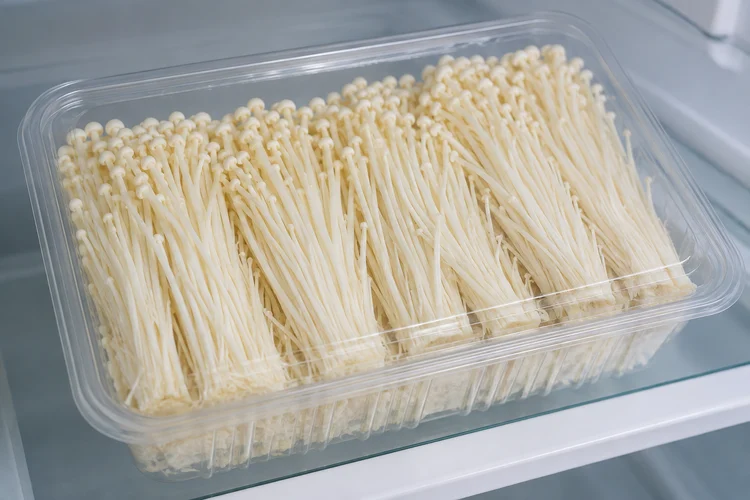
For household planning, buy fresh enoki for use within the next few days rather than relying on a long storage allowance. That is a planning approach, not a guaranteed safe-life claim. After opening, use it sooner and follow any specific instructions. Discard spoiled mushrooms, and do not use a recalled product even if it looks normal.
Frozen enoki is a separate product with its own labelled shelf life and cooking directions. Freezing does not make questionable fresh mushrooms safe. This guide separates visible quality, food safety and commercial shelf-life evidence so you can decide what to store, cook, freeze or reject.
Start with the label and the condition at purchase
Read the pack before deciding how long to keep enoki. Look for the storage temperature, date information, preparation instructions and any directions after opening. The meaning of date wording can vary by market, so follow the label and applicable local guidance rather than treating every printed date as the same kind of claim.
A date assumes the stated storage conditions have been maintained. A pack kept warm during transport or damaged before purchase does not gain protection from a future date. Similarly, a pack near the end of its stated period may offer little useful storage time after it reaches the kitchen. Purchase timing should reflect the intended cooking date.
Choose enoki in sound packaging with mushrooms that match the expected appearance. Commercial white enoki normally has fine pale stems and small caps. Obvious slime, mould, an abnormal odour or substantial deterioration is a reason to reject the product. A photograph of healthy enoki can help explain normal appearance, but it cannot establish safety.
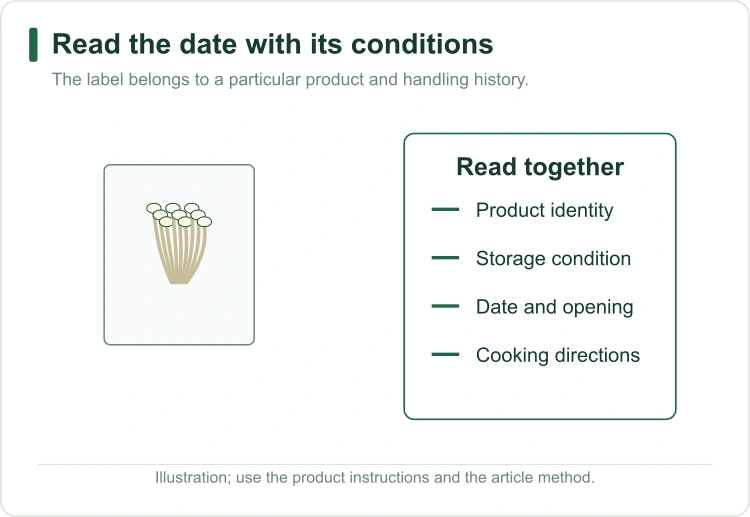
Read the date with the product identity, storage conditions and preparation directions. A future date cannot compensate for damaged packaging or an unreliable temperature history.
Check for product recalls through the relevant seller or food authority when there is a specific concern. A recall applies to the identified product regardless of whether a particular pack looks or smells acceptable. Do not assume cooking is an approved response unless the recall instructions explicitly say so; follow the stated return or disposal advice.
For a household, a useful habit is to buy enoki for a planned dish rather than as an indefinite refrigerator ingredient. If the recipe moves to a later date, reassess the pack and instructions promptly. Waiting until visible deterioration appears before deciding on freezing is poor stock management.
For a foodservice buyer, ask how much remaining labelled life will be available on delivery and what temperature controls apply. A large discount may be less useful if the kitchen cannot use the product within its acceptable period. Remaining life, portion demand and delivery frequency should be considered together.
At GreenLand-food, discussions of frozen mushroom supply focus on the actual supplied format and its documentation. A fresh enoki storage estimate cannot establish the shelf life of a processed frozen product, and a frozen catalogue description cannot establish the condition of a fresh pack.
Keep fresh enoki cold and manage opened packs
Place fresh enoki in the refrigerator promptly and follow the package temperature instruction. A household refrigerator at 4°C or below is a practical general target for perishable foods unless the product requires a stricter condition. Use a refrigerator thermometer rather than relying only on the setting dial.
Keep the unopened product in its intended packaging where the instructions call for that. Packaging design affects moisture and gas exchange, so an improvised storage method is not automatically an improvement. Do not copy a method for one type of mushroom or pack onto every enoki product without checking the instructions.
Once opened, protect the remaining mushrooms from contamination and use them promptly. Follow any stated opened-pack period. Avoid leaving the bag open beside raw meat or placing trimmed mushrooms into an unclean container. Opening introduces handling and changes the package environment, so the unopened date should not be treated as a fresh guarantee.
Wash and trim near cooking time rather than preparing a large wet batch for extended storage. Moisture trapped around cut stems can worsen quality during holding. Clean preparation is necessary, but extra water in a storage container is not helpful. Keep the prepared amount matched to the next cooking batch.
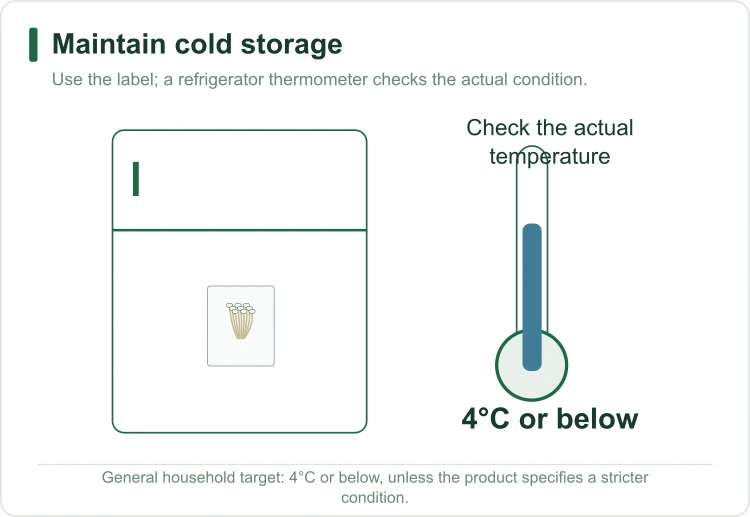
A thermometer checks the actual refrigerator condition. Use the product's stated temperature and opening instructions, with a general household target of four degrees Celsius or below.
The Centre for Food Safety's fresh mushroom handling guidance advises refrigeration and preparing mushrooms close to cooking. It also identifies deterioration signs such as slime and abnormal odour. Those observations support rejection decisions, while temperature and handling remain necessary even when appearance is normal.
For a shared kitchen, label opened containers with the opening time or date according to the operation's system. Do not combine the last portion of an older pack with a new pack and give the mixture the newer date. Keeping batches identifiable makes it easier to use them in order and respond to a product concern.
Check the storage location as well as the refrigerator setting. A crowded shelf, a door left open during preparation or repeated removal to room temperature can affect the product's actual conditions. The aim is consistent cold storage and prompt use, not merely putting the pack somewhere inside a refrigerator.
Distinguish visible spoilage from invisible contamination
Spoilage and foodborne contamination are related to handling but are not the same thing. Spoilage may produce visible mould, slime, objectionable odours or a clearly deteriorated texture. These are reasons to discard the product. Harmful microorganisms can also be present without creating a noticeable change that a consumer can detect.
Enoki deserves particular care because Listeria contamination has been associated with outbreaks and recalls. The FDA's enoki outbreak investigation page explains the concern and advises thorough cooking, along with cleaning surfaces that contact raw enoki. The cited outbreak is historical; it is not a claim that every current pack is affected.
Cold storage slows many forms of deterioration, but it does not sterilise the food. Food Standards Australia New Zealand's enoki risk statement notes that Listeria can grow on enoki under refrigeration. That is one reason a long refrigerator life should not be inferred simply because the mushrooms still look pale and firm.
| Observation or condition | What it tells you | What it does not tell you |
|---|---|---|
| Slime, mould or abnormal odour | The product should be rejected | That cooking will rescue it |
| Normal appearance | No obvious spoilage was noticed | That harmful bacteria are absent |
| A future printed date | The labelled period has not ended | That temperature abuse did not occur |
| Continuous refrigeration | An important storage control was used | That the product is sterile |
| Product matches a recall | Follow the recall instructions | That smell can override the notice |
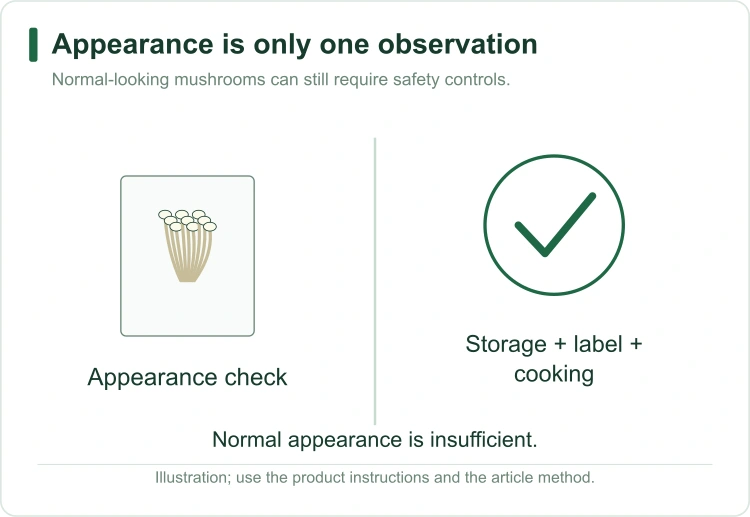
Normal appearance only indicates the absence of obvious visible deterioration. It does not prove that harmful microorganisms are absent or replace the required cooking step.
Do not taste a questionable mushroom to test it. A small taste cannot verify safety and creates an unnecessary exposure. If the pack has been handled poorly or its history is unreliable, use the relevant food safety guidance rather than inventing an extra number of cooking minutes as a correction.
People who are pregnant, aged 65 or older, or immunocompromised are among those particularly vulnerable to serious listeriosis. FDA advice specifically highlights avoiding raw enoki for these groups. For all consumers, thorough cooking is the appropriate preparation approach for enoki rather than raw garnishing.
In a commercial kitchen, distinguish a quality rejection from a food safety incident in the records. Both may lead to disposal, but the follow-up differs. A single crushed pack may require handling improvement; a recall or suspected contamination can require batch identification and a wider response through the supplier and established procedures.
Cook safely and handle leftovers promptly
Prepare only sound, correctly stored enoki. Trim the attached base as directed and separate the mushrooms into portions that can cook evenly. Follow the product instructions and the operation's cooking controls. A dense bundle needs adequate heat throughout, not just a brief contact with hot broth on the outside.
Keep raw enoki and its packaging away from ready-to-eat food. Clean boards, knives, containers and work surfaces after contact. Use clean utensils for the cooked mushrooms rather than returning them to the raw preparation bowl. These simple separations prevent the cooking step from being undermined by later handling.
If there are leftovers, refrigerate them promptly in suitable shallow containers. Do not leave a large pot of mushroom soup on the counter for an extended period while waiting for it to become completely cold. Divide large quantities according to safe cooling practice so that the food can cool efficiently under the appropriate controls.
The USDA's leftover storage advice gives three to four days for properly handled refrigerated leftovers. This is general leftover guidance, not a fresh enoki shelf-life claim. It assumes suitable cooking, cooling and refrigeration, and a stricter product or operation requirement should be followed where applicable.
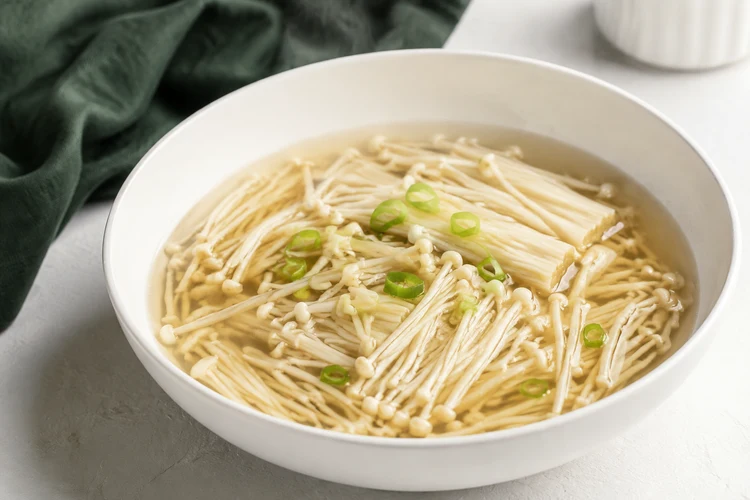
Cook sound enoki thoroughly and manage the whole dish afterwards. Leftover storage depends on proper cooking, cooling and refrigeration, not on the mushroom ingredient alone.
For preparation details, see Can You Freeze Cooked Mushrooms? Storage & Reheating.
USDA also advises that perishable food should not remain out of refrigeration for more than two hours, with a shorter limit in very hot conditions. Its guidance on putting hot food in the refrigerator explains that food can be refrigerated without an extended countertop cooling wait. Commercial operations should use their established cooling procedures.
Reheat only the amount needed and follow safe reheating instructions for the dish. Repeated warming and cooling create additional handling and can reduce eating quality. Reheating does not restart an unlimited storage period, and it should not be used to rescue leftovers with an uncertain history.
For a meal containing enoki, the whole recipe matters. Meat, rice, noodles, broth and sauce may have their own handling considerations. Label and manage the finished dish as a complete food. The fact that one ingredient is a mushroom does not determine the storage life of every other ingredient in the container.
Freeze sound enoki for a planned cooked use
Freezing can be considered while fresh enoki is still sound and within the product's acceptable handling period. It should be a planned preparation choice, not a last attempt to save mushrooms already showing spoilage or a recalled product. Freezing stops neither every hazard nor every quality change.
Follow a reliable preparation method appropriate to the product, including any required cooking before freezing. If the seller provides freezing directions, use them. Portion the product for the intended future dish, protect it from air exposure in suitable freezer packaging and label it with the product and preparation date.
Keep the freezer at the stated storage condition; -18°C is a common commercial frozen-food reference. A household freezer should maintain approximately 0°F, which is about -18°C. Actual temperature stability matters more than the dial number. Repeated warming can worsen texture and encourage ice changes within the package.
Expect a quality change. Fine enoki stems may become softer or release more liquid after freezing and cooking. A soup, sauce or filling can accommodate that more readily than a dish relying on the exact appearance of a fresh cluster. Test the intended cooked use before freezing a large quantity.
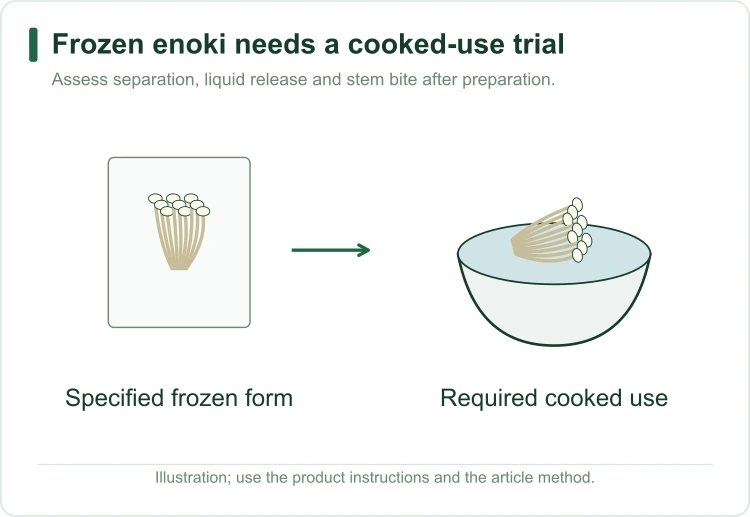
Freezing should be planned while the product is suitable. It does not rescue spoiled or recalled mushrooms, and the frozen portion still requires the appropriate preparation.
Do not assign a universal home-freezer life to every enoki preparation. Raw, cooked, sauced and commercially processed products differ, as do packaging and freezer conditions. Use product-specific guidance where available and plan reasonably prompt use for quality. Record the date so the product does not become an unidentified package at the back of the freezer.
When using the frozen portion, follow the appropriate cooking or reheating method. If thawing is required, use a controlled method such as refrigeration as directed, rather than leaving it on the counter. Freezing does not make enoki ready to eat raw, and a thawed appearance does not establish that it has received an adequate cooking step.
For buyers needing a regular frozen ingredient, a specified commercial product can be easier to assess than an improvised fresh-to-freezer process. Its preparation, packing and intended use should be documented. The resulting product still needs a representative cooking trial and verification of its particular shelf-life claim.
Read commercial frozen shelf life as a validated claim
A commercial frozen shelf life belongs to a defined product, package and storage condition. It should be supported by the supplier's relevant validation and quality system. A claim such as 18 or 24 months cannot be copied from another frozen vegetable or mushroom and applied to enoki without evidence.
Ask what the period starts from. Production, freezing and packing dates may not be identical in every process. The specification and label should make the basis clear enough for stock control. Remaining life at delivery is also important when shipping and distribution occupy part of the total period.
Packaging influences quality protection. The bag or carton system should protect the product under the intended frozen conditions and handling. Damaged seals, moisture ingress or excessive air exposure can affect quality even where the nominal storage temperature is correct. Shelf-life review therefore includes the package, not only the mushroom.
Temperature records provide useful evidence during storage and transport. A future expiry date cannot explain what happened during a thawing event or a prolonged deviation. If a shipment arrives outside the agreed condition, assess it through the operation's deviation procedure and supplier communication rather than relying on the calendar alone.

This enoki product photograph shows bundle shape and the fine-stemmed form. It cannot demonstrate a validated frozen shelf life: that claim needs the supplier's product-specific storage conditions, packaging specification and supporting shelf-life information for the actual item being purchased.
- Product identity and processing description: defines what was validated.
- Pack format and seal condition: connects the claim to the actual package.
- Stated frozen temperature: identifies the required storage condition.
- Start date and total labelled period: supports stock calculation.
- Minimum remaining life on delivery: supports distribution planning.
- Cooking instructions: defines intended preparation.
- Batch and traceability records: connects documents to the supplied lot.
Our frozen enoki handling article discusses performance considerations, but an article is not a shelf-life certificate. For an enquiry, the actual product specification and supporting information need review. We will confirm product-specific details rather than infer them from a general frozen mushroom category.
Where a customer repacks or reformulates the product, the original ingredient shelf life does not automatically become the finished product's shelf life. New packaging, added ingredients and a different process can change the relevant conditions. The finished food needs an appropriate assessment of its own.
Control shelf life through purchasing and stock rotation
Good shelf-life management starts with buying a quantity that fits demand. For fresh enoki, align delivery frequency with planned use and required remaining life. For frozen stock, consider storage capacity and the time needed for distribution. A large order is only useful if the product can remain within its specified conditions until use.
Use a rotation system that prioritises the earliest relevant expiry or use date. Keep batches identifiable and place newer stock so it does not hide older packs. For opened or prepared fresh product, include the opening or preparation date according to the kitchen's procedure. This makes the next action visible to the person using the ingredient.
Inspect deliveries for temperature, packaging condition, identity and date information. Record a discrepancy before the product is mixed into existing stock. A damaged pack or unexpected short remaining life is easier to resolve when the delivery details and batch are still clear.
For a frozen ingredient, assess whether the pack size suits the normal cooking batch. Repeatedly opening a large bag to remove small amounts can make handling more difficult. Smaller inner packs or an appropriately portionable format may improve control, provided those options are confirmed for the actual supply enquiry.
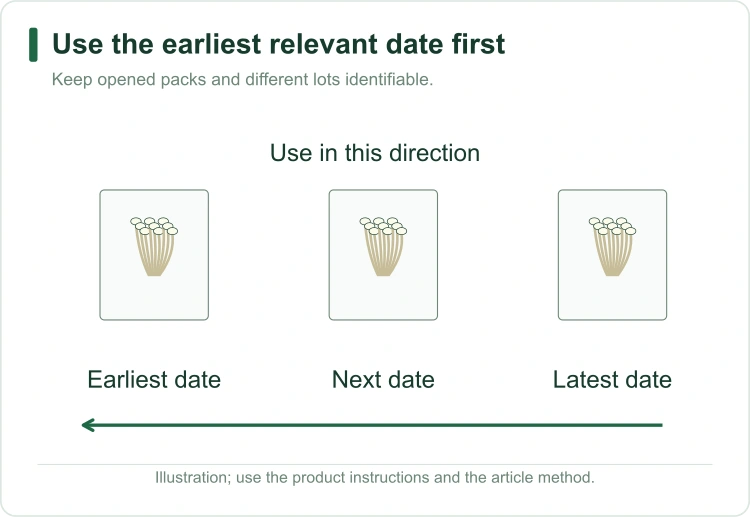
Keep batches identifiable and use the earliest relevant date first. Opening, preparing or combining packs should not silently replace an older product history with a newer date.
A useful specification combines safety and quality expectations. State the cooking requirement, storage temperature, pack format and shelf-life basis alongside the texture and appearance needed after preparation. This prevents a product from being approved solely because its remaining date is acceptable while its practical cooking performance is unsuitable.
For GreenLand-food enquiries, share the destination, requested mushroom or blend, pack size, expected volume, delivery schedule and intended application. Include any minimum remaining shelf-life requirement at arrival. We can then review the requested frozen option and the documentation needed for that particular order.
An importer can work backwards from the required sale or use date. In an illustrative schedule, transport, clearance, warehouse holding and customer distribution each consume part of the remaining labelled period. Add the customer's minimum remaining-life requirement at delivery, then compare the total with the supplier's offer. The calculation plans stock; it does not extend the validated shelf life.
Keep temperature and batch records with that schedule. If arrival is delayed, review the remaining period before allocating the stock to a customer with a different requirement. If a temperature deviation occurs, use the established assessment procedure independently of the date calculation. This gives the purchasing team two clear records: how much labelled time remains and whether the required storage conditions were maintained.
Confirm frozen storage and remaining shelf life
GreenLand-food is a professional frozen mushrooms supplier and manufacturer in China, providing factory-direct wholesale supply for importers, food manufacturers, foodservice distributors and private-label programmes.
Send the requested mushroom or blend, pack size, destination, order volume and delivery schedule. Include any minimum remaining shelf life at arrival and your cooking application. We will review the product-specific storage conditions, preparation instructions and supporting supply information for the enquiry.
Use the product range and downloadable catalogue to review the wider selection, then send the specification and order details that matter to your application.