


When to Harvest Spinach
Sep 08, 2026
Leave a message
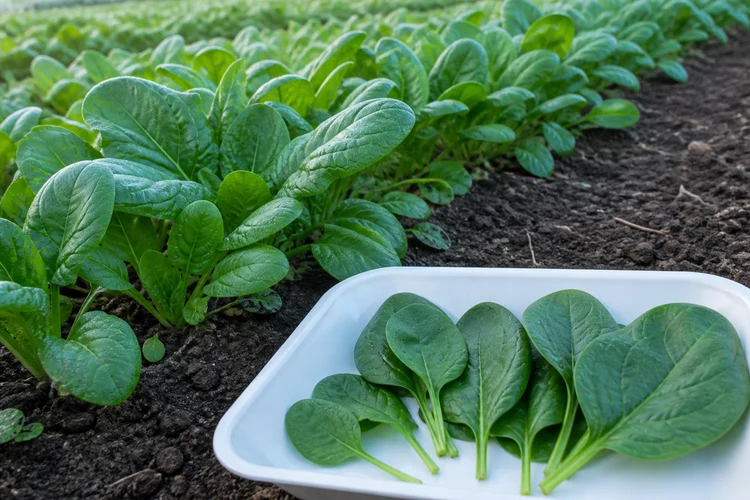
For a home garden, begin selective picking once the plant is established and has several true leaves, leaving the growing centre intact if you want another harvest. For a commercial crop, the harvest decision also needs the buyer's leaf size, stem proportion, cleanliness and processing requirements.
Spinach intended for freezing should reach the processor in suitable condition for washing, blanching and the agreed cut. A larger harvest is not automatically a better processing crop. Below, we connect the visible harvest stage with colour, tenderness, stem ratio and the quality of the finished frozen product.
Use leaf development rather than a fixed calendar date
Days to maturity is a planning estimate. It helps compare cultivars and organise sowing, but it does not guarantee that every planting will be ready on the same day. Temperature, season, growing conditions and the intended leaf size influence the actual harvest stage.
The University of Illinois spinach guidance describes selective harvesting once plants have developed a rosette of several leaves, with outer leaves around three inches as one useful garden reference. The point is to harvest an established plant with usable leaves, rather than removing the first small growth before the plant can support continued production.
Look at true leaves rather than counting the first seed leaves as a mature crop. True leaves show the developing spinach form and provide a better indication of the plant's established growth. For a selective harvest, the centre should still have healthy growth available to continue after outer leaves are removed.
A seed packet's maturity figure may refer to a particular market stage. One variety description may emphasise baby leaves, while another assumes a larger cooking leaf. Compare like with like before deciding that a planting is early or late. The number has meaning only with the stated cultivar and harvest objective.
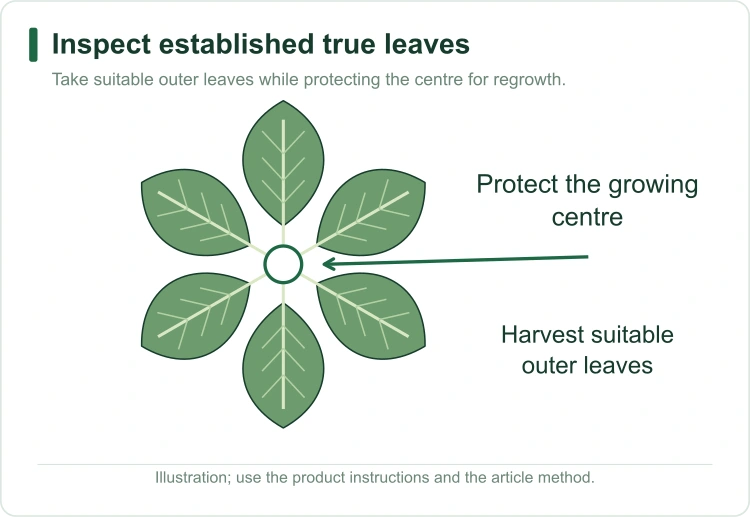
Selective picking removes suitable outer leaves while retaining healthy central growth. Use the plant's development and the intended leaf size rather than a calendar date alone.
| Field observation | What it suggests | Next decision |
|---|---|---|
| Small plant with limited true leaves | Crop is still establishing | Allow more growth before selective picking |
| Tender leaves at the required size | Potential harvest stage | Check cleanliness, condition and intended use |
| Rapid stem elongation | Bolting may be beginning | Inspect quality and harvest suitability promptly |
| Large leaves with heavy petioles | Greater stem contribution | Check the buyer's leaf-to-stem requirement |
| Damaged or deteriorating leaves | Quality problem | Sort or reject according to the specification |
For a home garden, inspect a few plants across the bed rather than judging only the largest plant at the edge. Growth can vary with shade, water and soil conditions. Harvesting selectively may allow the more developed leaves to be used while smaller plants continue growing.
For a commercial crop, use a representative field sample. Record leaf dimensions, stem proportion and visible defects against the intended product. A calendar date can trigger the inspection, but the inspection should support the decision. This becomes especially important when spinach will be processed into a consistent frozen specification.
Choose the harvest stage for baby leaves or cooking spinach
Baby spinach is a harvest stage, not necessarily a separate species or a unique variety. Leaves are taken while young and small for a tender product. The University of California's spinach guidance explains that baby leaves can be harvested from spinach varieties before they reach a larger stage.
Larger cooking leaves can still be good quality when harvested before deterioration or bolting. They may offer more usable leaf per plant, but the petiole and stem contribution can become more noticeable. The right stage depends on whether the product will be sold as whole leaves, chopped spinach, a purée ingredient or another processed form.
For a salad-style baby leaf, appearance, tenderness and a manageable stem length are central. For cooked spinach, some additional leaf size may be acceptable, but toughness and excessive stem material can still reduce eating quality. Larger should therefore be assessed as a physical characteristic, not automatically labelled better or worse.
The Royal Horticultural Society's spinach growing guide distinguishes young leaf picking from allowing leaves to reach a larger stage. It also discusses harvesting in ways that can support regrowth. Those garden methods need adaptation for commercial equipment, crop hygiene and the processor's requirements.

Baby leaves and larger cooking leaves represent different harvest objectives. Larger leaves still need acceptable tenderness, condition and stem proportions for their intended use.
For whole-leaf frozen spinach, a buyer may want recognisable leaf structure after blanching, freezing and cooking. Very delicate young leaves and larger mature leaves can behave differently during washing and handling. The best harvest stage is the one that survives the full process with the desired tenderness and appearance.
For chopped spinach, leaf size before cutting is less visible in the final product, but it still affects preparation and stem content. Chopping does not remove a high proportion of fibrous material; it merely makes the pieces smaller. A smooth filling can reveal a texture problem even when the raw leaf looked acceptable.
At GreenLand-food, we review frozen spinach requirements against the intended application. Whole leaves for a side dish, chopped spinach for a filling and a finely processed ingredient need different approval observations. The harvest stage should support that intended form.
For preparation details, see Can Spinach Be Frozen?.
Watch for bolting, heat stress and declining quality
Bolting is the transition towards flowering, often visible as the central stem elongates. Spinach commonly responds to the seasonal conditions associated with longer days and warmer weather, with cultivar differences in resistance. Once the crop begins this transition, the desirable leaf-harvest window can narrow.
The University of Wisconsin spinach article describes the crop's cool-season character and harvest considerations. For a gardener, watching the centre of the plant is more useful than waiting for flowers to open. The visible stem change can signal that the crop needs prompt assessment.
Leaf flavour and texture may become less desirable as the plant matures and bolts. The extent varies with cultivar and conditions. Do not use bitterness alone as a precise maturity test, and do not taste visibly damaged or questionable produce as a safety check. Inspect the crop's overall development and condition.
Heat or water stress can also affect the crop before an obvious flowering stem appears. Wilting, uneven growth and leaf damage may reduce the useful harvest. Some temporary field wilting differs from lasting deterioration, so assess the crop at an appropriate time and follow local horticultural guidance rather than making a decision from one midday glance.
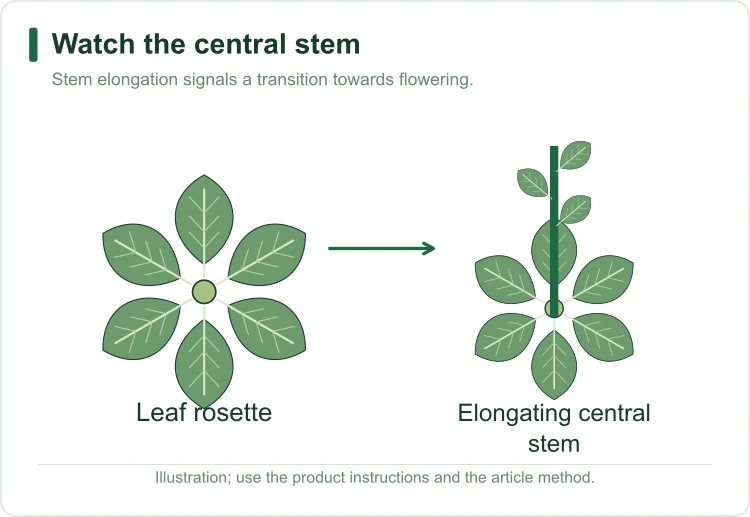
An elongating centre signals the transition towards flowering. Inspect the crop promptly because the useful leaf-harvest window can narrow as development progresses.
For a home garden, successive small sowings can help spread the harvest instead of relying on one ageing bed. The timing needs to suit the local season. A variety described as slow bolting may provide more flexibility, but it does not remove the need to inspect the crop as conditions change.
For a processing buyer, record defects that matter to the final use: yellowing, decay, insect damage, foreign material or excessive tough stems. These are more useful acceptance terms than a broad instruction to harvest young spinach. A crop can be young and still unsuitable if its condition or cleanliness fails the agreed requirements.
Freezing cannot reverse bolting or rebuild damaged leaf tissue. A processor can sort and trim within its process, but an unsuitable starting crop can reduce yield and quality. The harvest decision is therefore part of product quality control, rather than a field task disconnected from the frozen product.
Cut leaves with the next harvest and cleanliness in mind
For selective garden harvesting, remove suitable outer leaves while leaving the central growing point and enough healthy leaf area for continued growth. Use clean hands or a clean cutting tool and avoid tearing the crown. The aim is to take a usable portion without unnecessarily damaging the remaining plant.
For a larger cut, follow a method that leaves the crown intact if regrowth is intended. Cutting height depends on the plant and method; do not use one universal number for every crop stage. Inspect where the leaves emerge and avoid cutting into the growing point. A clean cut is easier to control than pulling the plant apart.
If the crop is being harvested once for processing, the method may differ from repeated garden picking. Mechanical cutting, field conditions and the processor's specification influence the harvest arrangement. The key requirements include suitable leaf and stem proportions, limited soil contact and protection from foreign material.
Keep harvested leaves off the ground and use clean, appropriate containers. Do not place good leaves into a container holding soil, decayed plant material or residues from another task. A careful cut loses value if the crop is contaminated or crushed immediately afterwards.

A selective cut can preserve the growing crown for another picking. The actual method should also limit soil contact, damage and contamination of the harvested leaves.
Handle the leaves gently and avoid compressing a large quantity into a deep, overloaded container. Spinach is easily damaged, and bruising or crushing can reduce its useful life and processing quality. Container depth, transport distance and unloading practice should fit the fragility of the crop.
For a yield check, separate usable leaves, acceptable petioles and rejected material according to the intended specification. Weigh those categories on a representative sample. If every stem is counted as waste in one trial and some stems are included in another, the resulting yield comparison is misleading.
A harvesting instruction should therefore state both the product objective and the handling method. For example, a trial may aim for intact cooking leaves with limited long petioles, collected into clean shallow containers and moved promptly for cooling. That is a practical process description, not a claim that one method suits every farm.
Remove field heat and protect the harvested leaves
Harvested spinach remains a perishable living plant material until it is processed. Heat and rough handling can accelerate quality loss. Moving the crop promptly into suitable cooling and handling conditions helps protect the colour and texture selected in the field.
The New England Vegetable Management Guide's spinach section discusses commercial harvest and rapid cooling, including cold storage near 32°F for fresh spinach under appropriate conditions. That fresh-produce cooling reference is different from freezing a processed product at around -18°C. The stages should not be confused.
Harvesting during a cooler part of the day can help reduce the initial heat load where practical. The wider decision still needs crop condition, weather, labour and hygiene considerations. A cool harvest does not eliminate the need for prompt transfer and temperature control afterwards.
Protect the leaves from unnecessary sun exposure while waiting for transport or processing. Keep containers clean and avoid leaving the crop in a warm vehicle. A short field-to-processing route can still produce poor results if the leaves spend much of it sitting in unsuitable conditions.
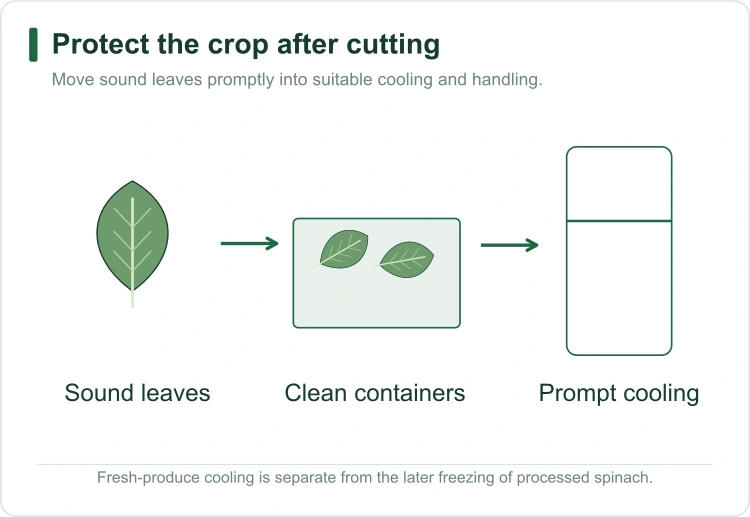
Protect the crop immediately after cutting. Clean containers, gentle handling and prompt suitable cooling help preserve the quality selected in the field.
Washing and cooling methods should be appropriate to the operation and its food safety controls. Water quality and prevention of cross-contamination matter. Repeated rinsing in an increasingly dirty container does not provide reliable cleaning. For a home garden, use clean running water for preparation and follow suitable storage guidance.
Surface water also needs control. Excess water left with the leaves can affect storage and later recipe performance. In processing, washing, draining and any blanching stage should be coordinated so the product enters freezing in the intended condition. Moisture management is part of the process, not simply an instruction to dry everything completely.
For a buyer reviewing a frozen sample, harvest handling may appear indirectly through colour, leaf integrity and texture. The sample alone cannot reveal every earlier temperature event. Where the supply programme requires it, review the relevant harvest, processing and traceability information alongside the physical product.
Connect leaf maturity with frozen spinach quality
Frozen spinach quality reflects both the harvested crop and the processing method. Leaf maturity influences tenderness and stem contribution, while washing, blanching, cutting, freezing and storage influence the final result. A buyer needs to assess the interaction rather than attributing every difference to harvest age.
Colour is one visible criterion. The starting leaves should meet the agreed condition, and the processed product should be assessed under consistent lighting. A bright photograph is not sufficient evidence if it has been heavily edited or shows a different preparation state. Compare representative samples with an agreed visual reference.
Stem ratio matters in fillings and finely textured foods. Long or fibrous petioles can remain noticeable after chopping and cooking. A higher stem contribution may be acceptable in one application and unsuitable in another. Define the requirement in relation to the dish rather than assuming that all stem material is either desirable or waste.
Whole-leaf products need a different review from chopped spinach. For whole leaves, look at recognisable leaf structure, breakage and the way portions separate after cooking. For chopped products, assess particle size, distribution of stem pieces and the consistency after the intended draining or mixing stage.

Leaf tissue and elongated stems remain visible in this frozen spinach sample. Harvest maturity affects the material entering the process, so evaluate the cooked sample for tenderness, colour and stem proportion rather than judging suitability from the green colour alone.
| Harvest or processing feature | What a buyer may notice | Useful trial |
|---|---|---|
| Leaf maturity | Tenderness and stem prominence | Taste after the intended cooking |
| Petiole proportion | Fibrous pieces in a filling | Inspect and assess the mixed recipe |
| Leaf damage | Breakage and loss of structure | Compare whole-leaf portions |
| Washing and draining | Grit or excess free water | Evaluate the prepared product |
| Blanching and freezing | Colour and softness | Use a consistent cooking method |
| Cut format | Distribution through a recipe | Test the final application |
Blanching is a controlled preparation stage, not a way to correct every defect in the raw crop. Excessive treatment can soften the leaves, while inadequate treatment can affect storage quality. The relevant process should be established for the product. A buyer can review its outcome through colour, texture and the supplied technical information.
Our article on freezing spinach leaves covers broader freezing considerations. The harvest question is narrower: choose leaves that can produce the required quality after that process. Freezing preserves a suitable crop for later cooked use; it does not make leaf maturity irrelevant.
Approve the harvest specification through a processing trial
A processing trial turns the harvest objective into observable product requirements. Select representative crop material at the proposed stage and record its leaf size, stem proportion and condition. Process it through the relevant method, then evaluate the frozen product in the customer's intended dish.
For a spinach filling, record the product input, cooking or thawing method where specified, draining procedure and finished filling weight. Water released from spinach can change the consistency of pastry, pasta or dumpling fillings. A sample that looks acceptable in a bowl may still create a wet finished product if the recipe is not tested.
For a closer explanation, see What to Do With Frozen Spinach.
For a whole-leaf side, assess portion appearance and tenderness after the labelled cooking method. Check whether the leaves remain recognisable and whether stems feel appropriate to the portion. The desired result may differ from a chopped ingredient used in a sauce, so use separate approval notes.
An illustrative yield record can distinguish incoming harvested material, rejected material, processed spinach and acceptable cooked output. The figures should come from the trial rather than a general industry percentage. Record the weighing stage and retained water so that a wetter sample is not automatically counted as a better yield.

A caliper check makes the physical cut of chopped frozen spinach visible. Agree the leaf and stem requirements before a processing trial, then compare tenderness, drained texture, fibre perception and usable yield after the same thawing and cooking method.
Review the result with both the crop and processing teams where available. If the cooked product is too fibrous, investigate stem proportion, maturity and cut before simply increasing cooking time. If whole leaves break excessively, review handling and process intensity as well as the starting crop. The cause may involve more than one stage.
For an enquiry to GreenLand-food, share the destination market, whole-leaf or chopped format, pack size, expected volume and application. Include any specific requirements for stem content, colour, particle size or cooked yield. We can review the requested product against a sample and the relevant supply information.
For a representative field sample, separate leaf blades, petioles and rejected material using the same definitions each time. Weigh the categories before processing, then record the result after the agreed washing, blanching and freezing method. The proportions are trial results for that crop and method; they should not be copied into a purchase specification as universal spinach values.
A filling developer can compare two otherwise acceptable harvest stages through the same recipe. Keep the spinach input and draining method consistent, then assess fibre, colour, moisture and the finished portion. A whole-leaf buyer should instead give more attention to recognisable leaves and handling breakage. These separate trials explain which stage serves each use, allowing the approved harvest requirement to rest on the food the customer actually makes.
Set the spinach format for your finished food
GreenLand-food is a professional frozen spinach supplier and manufacturer in China, providing factory-direct wholesale supply for importers, food manufacturers, foodservice distributors and private-label programmes.
Share the whole-leaf or chopped format, pack size, volume and destination. Include the application and any requirements for stems, particle size, colour or cooked yield. We will review the requested frozen spinach specification and the sample preparation needed to assess it in your recipe.
For a closer explanation, see Can You Eat Spinach Stems?.
Use the product range and downloadable catalogue to review the wider selection, then send the specification and order details that matter to your application.