


How Long Do Frozen Mushrooms Last?
Aug 28, 2026
Leave a message
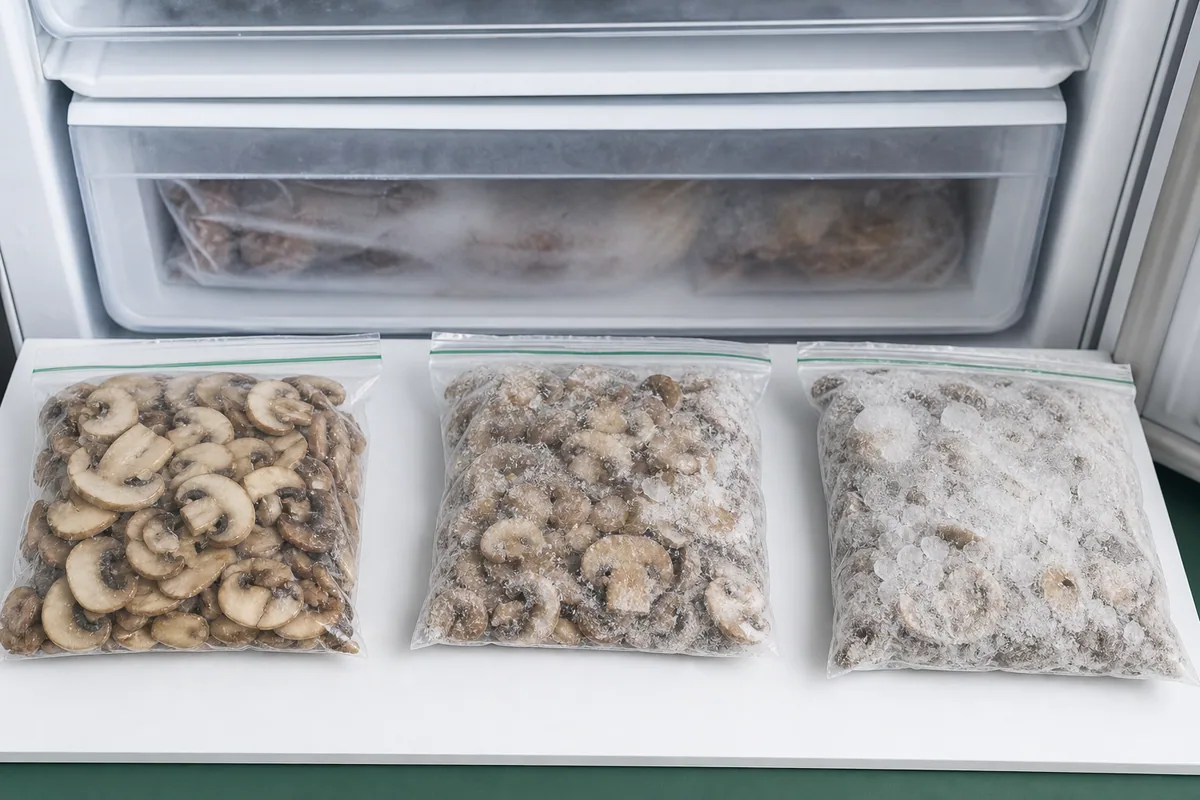
There is no single honest number for every frozen mushroom
Use 9–12 months as a general home-freezer best-quality target. For a purchased commercial product, follow the date and storage instruction on its actual label. Unopened commercial cases may have a longer declared shelf life, but this depends on process, packaging and evidence. Once a bag is opened, air exposure and handling accelerate dehydration and odor pickup. Heavy frost, large ice crystals, hard clumps or wet cartons require investigation of packaging and temperature history.
Quality ranges assume sound mushrooms and proper cold storage. A label, destination-market rule, site procedure or documented temperature event can require a shorter decision.
Key takeaways
- Nine to twelve months is a planning range for home best quality, not a universal expiration date.
- Continuous 0°F / -18°C storage protects safety, but quality can decline through dehydration, oxidation and texture damage.
- A commercial 24-month claim must belong to a defined product, package and specification; it cannot be borrowed for a home bag.
- Opened bags need tighter air control, FEFO rotation and an internal use window based on the operation.
Quick comparison
| Storage context | Useful planning range | What controls the answer | Decision rule |
|---|---|---|---|
| Home-prepared mushrooms | About 9–12 months for best quality | Preparation, air removal, freezer stability and fat or seasoning | Date the pack and use earlier if quality matters |
| Unopened commercial IQF pack | Often 12, 18 or 24 months when declared | Validated process, package, label, specification and stable cold chain | Follow the actual label and supplier document |
| Opened commercial bag | No universal published number | Air exposure, resealing, handling frequency and site QA rules | Reseal, keep frozen and apply FEFO plus an approved internal limit |
| Continuously frozen beyond quality date | May remain safe but quality can be poor | Continuous 0°F / -18°C storage and package integrity | Assess label rules and quality; do not sell outside declared shelf life |
Best quality, food safety and declared shelf life are different ideas
A best-quality range describes when flavor, color, texture and appearance are expected to remain most acceptable. FoodSafety.gov states that freezer times are for quality and food held continuously at 0°F / -18°C or below can be kept indefinitely from a safety standpoint. That does not mean an old, dried or badly packaged product is commercially acceptable, and it does not excuse temperature abuse before or after freezing.
Declared shelf life is a product commitment tied to a specific process, package, storage condition and evidence file. It determines label dating, stock rotation and saleability. A food business cannot simply extend a date because general frozen-food guidance says continuously frozen food may remain safe. Regulatory rules, customer contracts, sensory quality, package integrity and the manufacturer's validation still govern release.

Why 9–12 months is a practical home baseline
Many consumer references place properly prepared frozen mushrooms near a 9–12 month best-quality window. This range assumes sound mushrooms, appropriate pre-treatment, prompt cooling, low-air packaging and a freezer holding 0°F / -18°C or below. Raw mushrooms, loose weak bags, warm loading and a frequently thawing freezer can shorten acceptable quality. Sautéed mushrooms with added fat may develop stale flavors earlier.
Treat the range as an upper planning horizon, not a target to hit. A dated portion used after two or three months normally gives a more predictable result than one forgotten for a year. Rotate older packs first and freeze in recipe portions. If a home bag has no date, unknown preparation or evidence of partial thawing, you have less information and should be more conservative.
Commercial products may declare 12, 18 or 24 months
Commercial IQF mushroom shelf life varies with species, raw-material condition, fresh or blanched route, freezing rate, oxygen and moisture barrier, pack size, seal, storage temperature and validation. Suppliers may declare 12, 18 or 24 months. The buyer should see that value on the product specification and label, with production date, best-before format and storage instruction aligned across documents.
GreenLand's frozen mushroom category currently uses a typical 24-month shelf life under stable storage at or below -18°C for confirmed products. That statement is not a promise for every mushroom, facility, pack or destination. We confirm the final shelf life in the order specification. A retail bag, foodservice pouch and bulk inner liner do not necessarily have the same exposure after opening, even when the frozen ingredient came from one batch.
What the USDA 24-month example actually proves
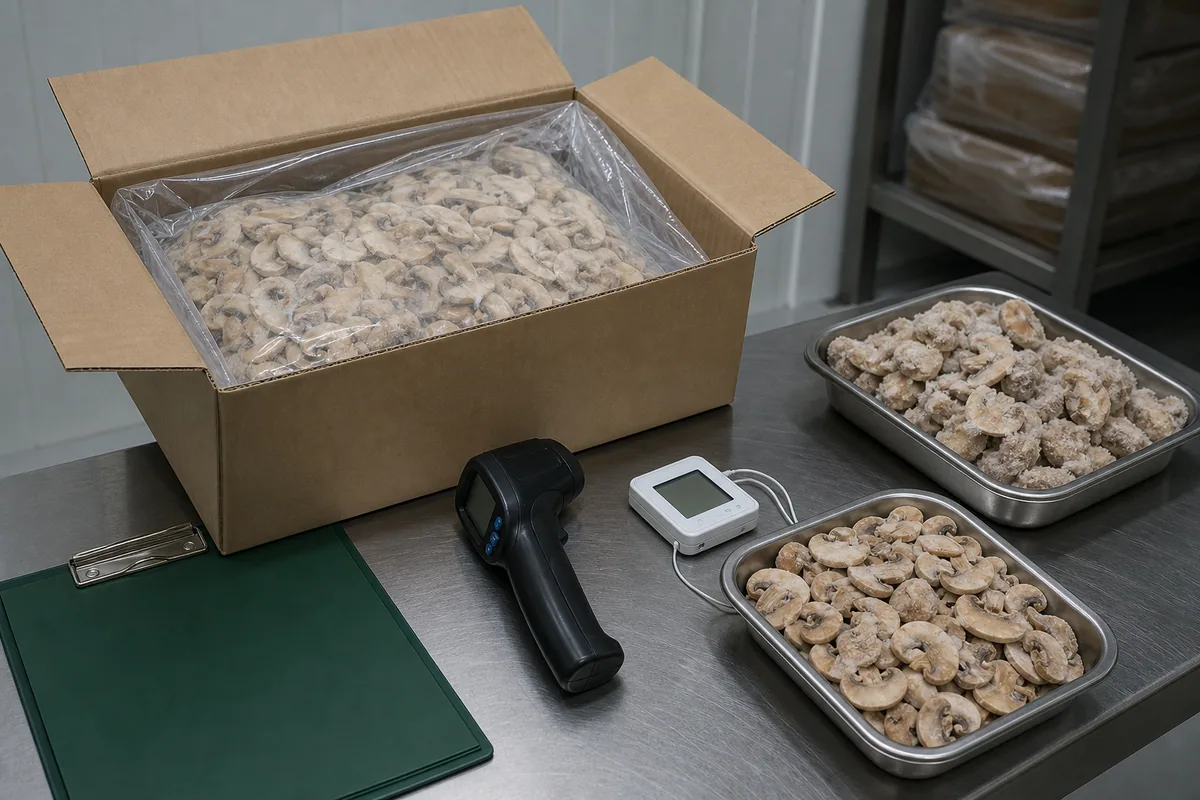
A USDA Agricultural Marketing Service commercial item description for IQF minimally processed mushrooms states that product may be kept up to 24 months at -18°C / 0°F or lower in its original unopened case, and requires at least one year of remaining shelf life. It also specifies ideal frozen storage and transport temperature ranges. This is valuable evidence that a defined public procurement specification can support a 24-month condition.
It is not a universal consumer rule. The statement belongs to that description, its product requirements and an original unopened case. It should not be applied to a home freezer bag, an opened pouch or another supplier's product without corresponding validation. Use the document as a worked example of how shelf life is conditioned, not as permission to overwrite a manufacturer's date.
Opened bags lose protection even when they remain frozen
Opening exposes mushrooms to drier circulating air, freezer odors and repeated warm-air contact. A bulk foodservice bag opened several times per shift may develop dehydration and frost faster than a sealed retail pack. Pieces can also spill into the seal, preventing full closure. Use a clean scoop, remove only the required amount, press out excess air, reseal or transfer to an approved container and return the product to frozen storage promptly.
Operations should set an internal opened-bag limit based on packaging, access frequency, freezer performance and application. Record the original batch and date when transferring product; never create an untraceable secondary container. FEFO-first expiry, first out-usually makes more sense than relying only on the date received. For a blend, manage the finished pack by its own declared date rather than the longest-lived ingredient.

Frost, ice and clumps are evidence, not automatic verdicts
A light dusting of frost can occur without making the product unusable. Heavy frost, large clear ice crystals, a solid block, deformed packaging or wet cartons deserve investigation. They may indicate a weak seal, long storage, air exchange or partial thawing and refreezing. Do not decide from one piece. Check whether the condition is isolated to an opened bag, one carton layer or the entire lot.
Record product temperature, carton and bag condition, batch, location, photographs and any logger data. Compare with the agreed IQF free-flow and clump limit. Freezer burn is mainly a quality defect-dry, pale or leathery areas caused by moisture loss-but severe dehydration can make the product fail its specification. Temperature abuse raises a different food-safety question and requires the site's hold-and-assess procedure.
Thawing and refreezing need a controlled decision
Frozen mushrooms are often best cooked directly from frozen. If thawing is required for a yield test or recipe, use refrigeration in a covered container and capture the liquid. Food thawed safely in a refrigerator may sometimes be refrozen, but quality declines with another cycle. A commercial operation should not treat this general principle as an automatic release rule; time, temperature, intended use and site procedure must be reviewed.
If product arrived soft, wet or above the agreed receiving limit, isolate it and document the condition before use. Do not refreeze merely to make the carton look normal. Review the transporter record, product temperature, duration, package integrity and food-safety plan. A temperature recorder supports that investigation but does not replace representative physical inspection.
How to test whether an older frozen batch still performs
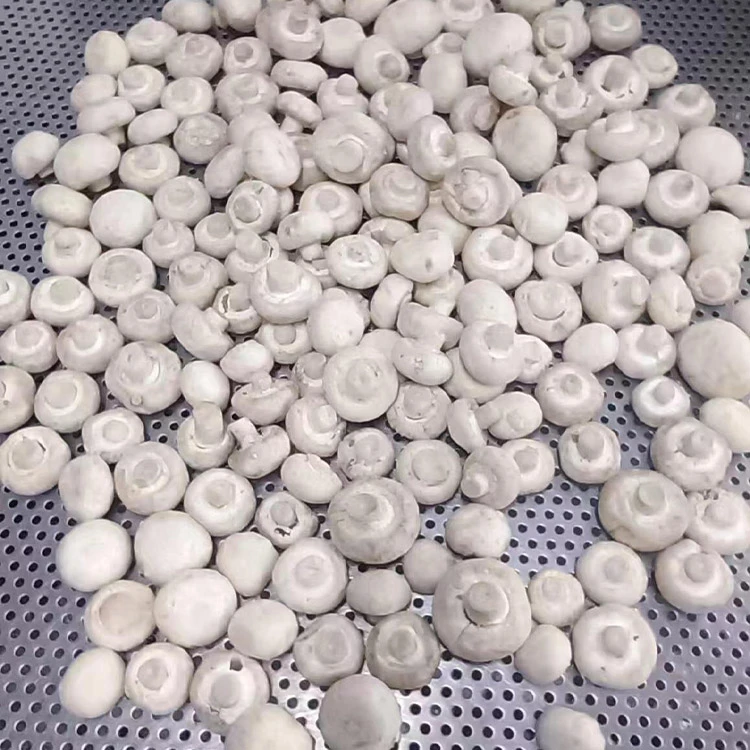
Examine the sealed and opened condition, then sample from more than one point. Record frost, dehydration, clumps, color and odor while frozen. Cook a measured quantity with the standard recipe and equipment. Measure released liquid, cooked yield, time to separate, bite and identity after normal holding. Compare with an approved reference or a recent lot.
A batch can remain safe under continuous freezing yet fail the restaurant or factory quality standard. Excess water may thin sauce, dry pieces may not rehydrate evenly, and old surface oxidation may dull flavor. Conversely, a small amount of harmless frost may have no meaningful effect in soup. The decision should connect observed condition to specification and application, not to fear generated by one ice crystal.
Documents a buyer should reconcile before release
Check product specification, production date, best-before date, storage instruction, batch code, COA, carton mark, inner-bag label and shipping documents. The declared shelf life and date format should match. Review packaging description, net weight, product identity, cut, pre-treatment and any customer-specific label. For imports, confirm that the destination market accepts the dating and storage presentation.
At GreenLand-food, we confirm the frozen mushroom shelf life, pack, cold-chain plan and document package against the actual order. Buyers can also review our separate B2B storage and shelf-life guide for warehouse, loading and claim-evidence detail. This article stays focused on the search question-how long the product lasts-while the linked guide handles broader cold-chain management.
- Identify home-prepared, opened commercial or unopened commercial context.
- Verify continuous storage at 0°F / -18°C or the contracted limit.
- Check label, production date, best-before date and package integrity.
- Inspect frost, clumps, dehydration and evidence of partial thawing.
- Run a measured cooking and yield test when commercial quality matters.
- Release, use soon, downgrade or hold according to specification and site procedure.
Plan inventory so the date never becomes the main problem
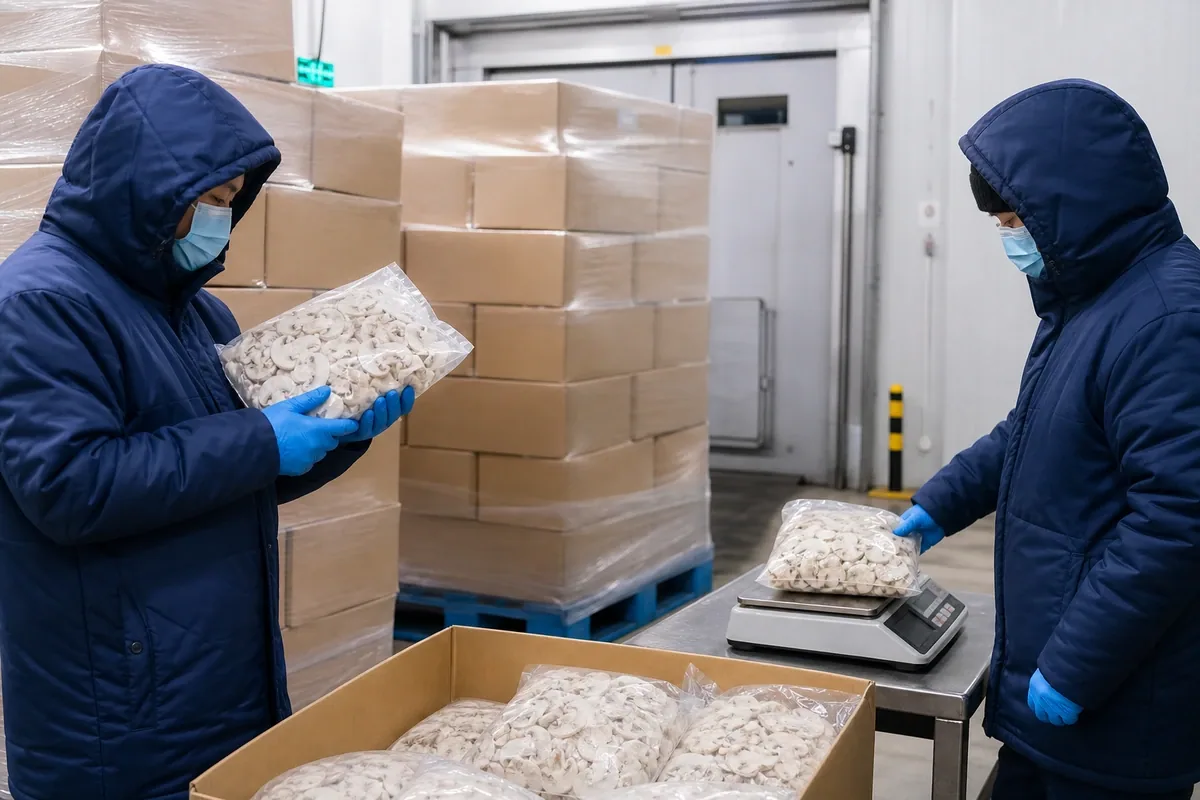
Order volume should reflect sales velocity, seasonal coverage, lead time and freezer capacity. A 24-month declared life does not make 23 months of stock efficient. Long storage ties up cash and increases exposure to packaging damage, temperature events and recipe changes. Build a reorder point that leaves practical remaining life for the downstream distributor, restaurant or retail customer.
For each RFQ, state the minimum remaining shelf life required at shipment or arrival, not only the total declared life from production. Confirm whether mixed loads, private-label printing or special packs add lead time. We can review quantity, pack, destination and shipment plan, then confirm available frozen mushroom products and the applicable shelf-life terms. Final supply follows the approved specification and contract.
Worked decisions that a short answer cannot cover
Calculate remaining life, not only total life
A product with 24 months total life does not give the importer 24 months after arrival. Subtract time before shipment, sea transit, customs clearance, inland delivery and customer distribution. If production was four months before shipment and the route takes two months, six months have already passed. A buyer who needs twelve months for downstream sale should write a minimum remaining life at arrival into the contract.
Date format also matters. Day-month-year and month-day-year can be confused, and some labels use production plus a stated period while others print a best-before date. Align the specification, carton and retail label before production. For private label, approve artwork and coding position, legibility and permanence. A correct shelf-life number can still fail if the date cannot be interpreted or traced.
Worked stock-rotation example
Lot A arrives with 16 months remaining and Lot B arrives later with 20 months remaining. FIFO would ship Lot A first because it arrived first; FEFO also ships Lot A first because it expires first. Now imagine a relabeled customer pack or a supplier correction gives Lot B only 12 months remaining. FEFO correctly changes the dispatch order while FIFO does not. Frozen warehouses should keep the original batch relationship when repacking or transferring inner bags.
Set alerts before the final date. A 90- or 120-day review can identify slow-moving stock while there is still time for an approved promotion, customer reallocation or application change. Do not wait until the declared date and then ask whether general continuous-freezing safety guidance permits sale. Commercial release follows the product date, customer agreement and law.
A temperature claim needs a documented investigation
If a carton arrives wet or pieces are soft, place the lot on hold. Record surface and core or between-pack temperature using the approved method, photograph cartons and seals, preserve the logger, note container and seal numbers and map which pallets are affected. Compare the event with transport set point, loading temperature and unloading time. Do not destroy evidence by immediately returning a thawed carton to the freezer.
The disposition may differ across unaffected, slightly temperature-stressed and fully thawed portions, but that decision belongs to qualified QA under the site food-safety plan. Sensory appearance alone cannot establish microbial safety. Likewise, a brief air-temperature spike on a logger does not prove the product core thawed. Combine records with physical temperature, package and lot evidence.
Shelf life should be connected to the cooking claim
A supplier can validate appearance and sensory quality over time, but a buyer should verify the attribute important to the product: slice identity on pizza, viscosity in sauce, bite in ready meals or free-flow dosing on a line. Test an early-life and later-life sample with the same method. If performance fails before the printed date, investigate packaging, storage and specification rather than assuming the entire concept of shelf life is false.
At GreenLand-food, the declared date is one line in a larger control file. Product identity, processing route, pack, storage, production code, COA, loading condition and intended application need to agree. We can discuss a target remaining life and shipment plan during quotation. Final shelf life is confirmed for the actual product and order, not inferred from the longest number found online.
What to confirm before approving volume
A useful inquiry describes the mushroom and the job it must do. Send the product identity, form or cut, target application, packing, quantity, destination and the quality points your team will measure. We will review current availability and match an appropriate product and facility route where possible. Final size, process, ingredients, defect limits, microbiology, documents, shelf life, lead time and commercial terms remain subject to the approved specification and order confirmation.
- Separate home best-quality guidance from commercial declared shelf life.
- Confirm production date, best-before date and minimum remaining life at arrival.
- Keep product and storage at or below the contracted frozen temperature.
- Inspect inner-bag seal, carton, frost, clumps, dehydration and product temperature.
- Use FEFO and preserve batch traceability after opening or transfer.
- Run an application trial before accepting an aged or disputed lot.
Frequently asked questions
How long do home-frozen mushrooms last?
About 9–12 months is a common best-quality planning range for mushrooms prepared and packed well at 0°F / -18°C. Earlier use gives more predictable flavor and texture.
For storage and handling details, see How Long Do Mushrooms Last in the Fridge?.
How long do commercial frozen mushrooms last?
Common declared shelf lives include 12, 18 or 24 months. Follow the actual product label and specification because process, packaging, facility and market requirements differ.
Are frozen mushrooms safe after one year?
Food held continuously at 0°F / -18°C can remain safe indefinitely, according to FoodSafety.gov, but quality still declines. A commercial product must also remain within its declared shelf life and applicable sale rules.
Can frozen mushrooms go bad?
They can lose acceptable quality through freezer burn, oxidation, odor absorption, clumping and temperature fluctuation. They may also become unsafe if they were mishandled before freezing or spent too long thawed.
What does freezer burn look like on mushrooms?
Look for dry pale or gray patches, leathery surfaces and heavy loose frost caused by moisture loss and air exposure. It is mainly a quality problem, but severe damage can make the product unusable.
Are large ice crystals a sign of refreezing?
They can indicate temperature fluctuation, air exchange or partial thawing, but one crystal does not prove the full history. Check bag seals, clumps, product temperature, cartons and logger records together.
How long do frozen mushrooms last after opening?
There is no universal number. Reseal the bag, keep it frozen, preserve the batch code and use an internal handling limit based on the pack, access frequency, freezer and application.
Can thawed mushrooms be refrozen?
Food thawed safely in the refrigerator may sometimes be refrozen, but another cycle reduces quality. A food business should follow its approved time-temperature and disposition procedure.
Why do some commercial mushrooms have a 24-month shelf life?
A validated process, protective packaging and stable frozen cold chain can support a longer declared life. The value belongs to the specific product and specification; it is not a universal home-freezer rule.
What remaining shelf life should an importer request?
Set a minimum remaining life at shipment or arrival that covers clearance, distribution and customer inventory. State the number in the RFQ and contract rather than assuming total shelf life is enough.
Reference points
- FoodSafety.gov cold storage chart
- USDA AMS IQF mushroom description
- GreenLand frozen mushroom shelf-life guide
These sources support the measured methods and quality-versus-safety boundaries. The applicable product label, specification, food-safety plan and destination-market rules still control a real batch.
Confirm the mushroom format against your real cooking process
We supply frozen mushroom ingredients for importers, distributors, food manufacturers, foodservice operators and private-label programs. Send us the species, cut, application, packing, quantity, destination and trial method. We will review an available specification and next step.